Q1. Una moneta di massa è lasciata cadere verticalmente dalla cima di un edificio molto alto. Mentre la moneta si avvicina alla velocità terminale, cosa è vero della forza netta su di essa? (A) verso l’alto; (B) nulla; (C) verso il basso, modulo ; (D) verso il basso, modulo ; (E) verso il basso, modulo .
Q14. Un uomo a latitudine spara un proiettile verso nord a velocità . Il raggio della Terra è . Qual è la deviazione laterale del proiettile dopo aver percorso ? (A) ovest; (B) ovest; (C) ; (D) est; (E) est. (effetto Coriolis)
Q17. (Q17-18: un lanciatore spara oggetti orizzontalmente su una pista di ghiaccio; due assi di massa trascurabile collegati da una cerniera con molla che esercita coppia costante su ciascuna asse; si trascuri l’attrito.) Un disco rigido è spinto nel lanciatore tra le assi finché esse lo toccano a distanza dalla cerniera e sono aperte di un angolo . Qual è la forza minima necessaria per tenere il disco in questa posizione? (A) ; (B) ; (C) ; (D) ; (E) .
Q23. Una lastra rettangolare è su una superficie priva di attrito. Una sfera sta sulla lastra; c’è attrito sufficiente tra sfera e lastra tale che la sfera rotola senza strisciare. Una forza è applicata a destra della lastra, con lastra e sfera inizialmente in quiete. La sfera (A) ruota in senso orario mentre il suo CM accelera a destra; (B) ruota in senso antiorario, CM a sinistra; (C) ruota in senso orario, CM a sinistra; (D) ruota in senso antiorario, CM a destra; (E) non ruota, CM accelera a destra.
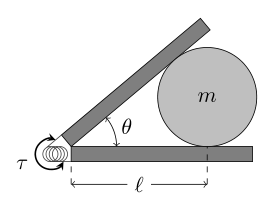 lanciatore a cerniera con disco m
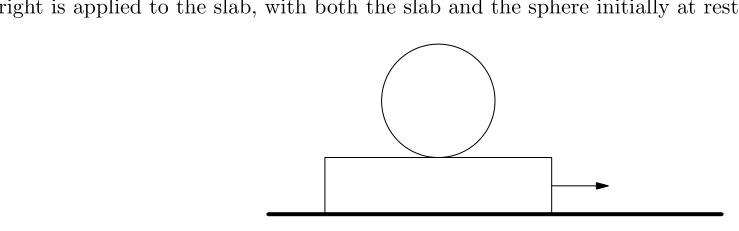 sfera su lastra rettangolare con forza
Topic: Newtonian Mechanics, Rotational Dynamics, Rigid Body Statics Metodi: Free-Body Diagram, Torque & Angular Momentum Analysis, Vector Decomposition Competenze: Diagrammatic Reasoning, Physical Reasoning, Mathematical Modeling Objects: Projectile, Disk, Sphere Fonte: Testo (PDF) — p.2
Q1. A coin of mass is released vertically from the top of a very tall building. As the coin approaches terminal velocity, what is true about the net force acting on it? (A) upward; (B) zero; (C) downward, magnitude ; (D) downward, magnitude ; (E) downward, magnitude .
Q14. An man at latitude fires a projectile northward with speed . The radius of the Earth is . What is the lateral deviation of the projectile after traveling distance ? (A) west; (B) west; (C) ; (D) east; (E) east. (Coriolis effect)
Q17. (Questions Q17–18: A launcher shoots objects horizontally onto an ice track; two rods of negligible mass connected by a hinge with a spring that exerts constant torque on each rod; friction is neglected.) A rigid disk is pushed into the launcher between the rods until they touch it at a distance from the hinge and are separated by an angle . What is the minimum force required to hold the disk in this position? (A) ; (B) ; (C) ; (D) ; (E) .
Q23. A rectangular slab is on a frictionless surface. A sphere rests on the slab; there is sufficient friction between the sphere and the slab so that the sphere rolls without slipping. A force is applied to the right of the slab, with both the slab and the sphere initially at rest. The sphere (A) rotates clockwise while its center of mass accelerates to the right; (B) rotates counterclockwise, center of mass to the left; (C) rotates clockwise, center of mass to the left; (D) rotates counterclockwise, center of mass to the right; (E) does not rotate, center of mass accelerates to the right.
latch with disk m
sphere on rectangular slab with force
Q2. Una massa a velocità urta una massa che si muove direttamente verso di essa, anch’essa a velocità . Se l’urto è perfettamente elastico l’energia cinetica totale dopo l’urto è ; se le masse si attaccano è . Qual è il rapporto ? (A) ; (B) ; (C) ; (D) ; (E) .
Q3. Un blocco di massa è lanciato orizzontalmente a velocità su un cuneo curvo di massa . Qual è l’altezza massima raggiunta dal blocco dopo che lascia il tratto verticale del cuneo? Tutte le superfici sono prive di attrito, blocco e cuneo liberi di muoversi. (A) ; (B) ; (C) ; (D) ; (E) .
Q6. Una pallina è rilasciata da ferma sopra un piano inclinato e rimbalza elasticamente lungo il piano. Mentre la pallina procede lungo il piano, il tempo e la distanza tra ciascuna collisione (A) restano uguali, e aumenta; (B) aumentano, e resta uguale; (C) diminuiscono, e aumenta; (D) diminuiscono, e resta uguale; (E) restano entrambi uguali.
Q12. Una sfera d’acciaio rimbalza verticalmente su una piastra d’acciaio. Se la velocità appena prima di un rimbalzo è , subito dopo è con . Quale grafico mostra meglio il tempo tra rimbalzi successivi in funzione del tempo? (scelte A-E: grafici; la risposta è una curva decrescente convessa che tende a zero)
Q13. Un giocoliere giocola palline identiche, prendendone e lanciandone una alla volta. Assumendo un tempo minimo tra i lanci, la potenza minima necessaria per continuare a giocolare è proporzionale a: (A) ; (B) ; (C) ; (D) ; (E) .
Q18. (seguito di Q17, vedi B1) Il disco è rimosso e sostituito con un cuneo a forma di spicchio della stessa massa , con la cerniera ancora tenuta aperta all’angolo . Quando il cuneo è rilasciato improvvisamente, qual è la sua velocità finale all’uscita dal lanciatore? (A) ; (B) ; (C) ; (D) ; (E) .
Q24. Una particella si muove nel piano con energia potenziale . La particella può eseguire diversi tipi di moto periodico. Il rapporto tra il periodo massimo e quello minimo è (A) ; (B) ; (C) ; (D) ; (E) .
blocco m su cuneo curvo M
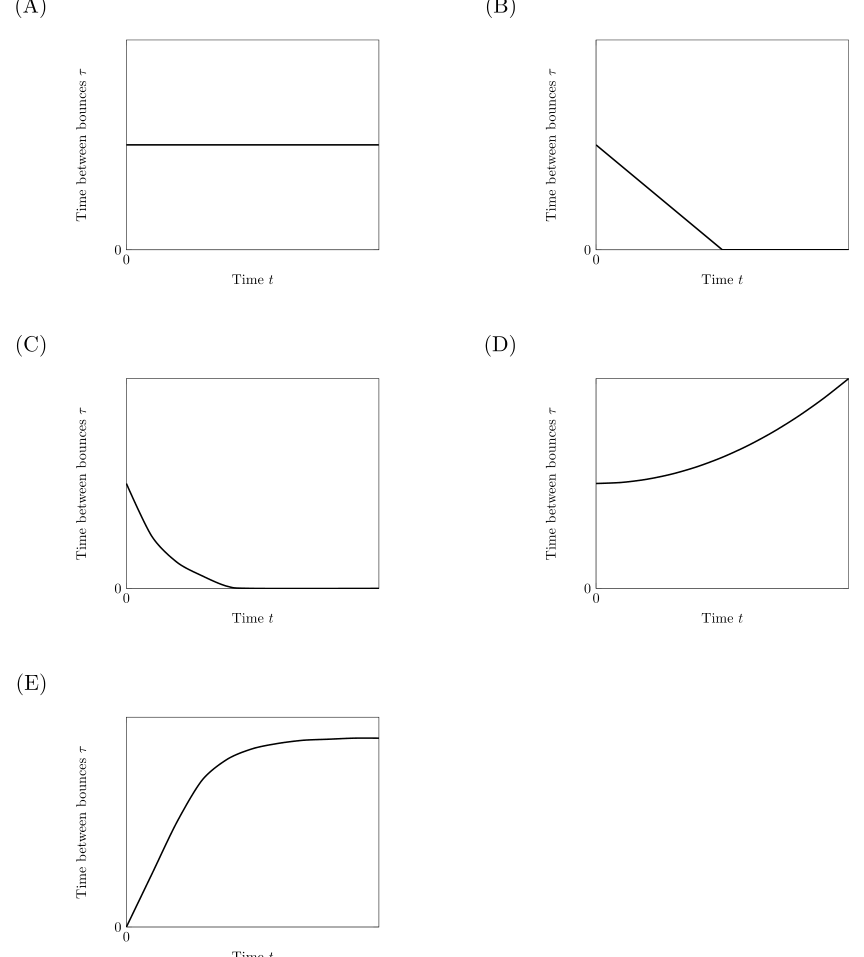 5 grafici tau vs tempo rimbalzi sfera
lanciatore a cerniera con cuneo m
Topic: Conservation of Momentum, Conservation of Energy, Oscillations & Waves Metodi: Conservation of Momentum, Conservation of Energy, Energy Conservation Method Competenze: Mathematical Modeling, Physical Reasoning, Estimation & Approximation Objects: Block, Wedge, Ball, Sphere Fonte: Testo (PDF) — p.2
Q2. A mass moving at velocity collides head-on with a second mass moving directly toward it at velocity . If the collision is perfectly elastic, the total kinetic energy after the collision is ; if the masses stick together, it is . What is the ratio ? (A) ; (B) ; (C) ; (D) ; (E) .
Q3. A block of mass is launched horizontally with velocity onto a curved wedge of mass . What is the maximum height reached by the block after it leaves the vertical portion of the wedge? All surfaces are frictionless, and both block and wedge are free to move. (A) ; (B) ; (C) ; (D) ; (E) .
Q6. A ball is released from rest above an inclined plane and bounces elastically along the plane. As the ball moves along the plane, the time between each collision and the distance traveled between collisions (A) remain equal, and increase; (B) increase, and remain equal; (C) decrease, and increase; (D) decrease, and remain equal; (E) both remain equal.
Q12. A steel ball bounces vertically on a steel plate. If the speed just before a bounce is , immediately after it is with . Which graph best shows the time between successive bounces as a function of time? (choices A–E: graphs; the correct answer is a decreasing convex curve approaching zero)
Q13. A juggler juggles identical balls, picking up and throwing one at a time. Assuming a minimum time between throws, the minimum power required to continue juggling is proportional to: (A) ; (B) ; (C) ; (D) ; (E) .
Q18. (continuation of Q17, see B1) The disk is removed and replaced by a wedge-shaped piece of the same mass , with the hinge still held open at angle . When the wedge is suddenly released, what is its final velocity upon exiting the launcher? (A) ; (B) ; (C) ; (D) ; (E) .
Q24. A particle moves in the plane with potential energy . The particle can perform various types of periodic motion. The ratio between the maximum and minimum periods is (A) ; (B) ; (C) ; (D) ; (E) .
bloc m on curved wedge M
5 graphs of tau vs time for sphere bounces
hinge launcher with wedge m
Q5. Un cilindro ha raggio e peso . Si cerca di farlo rotolare oltre uno scalino di altezza . La forza minima necessaria è (A) ; (B) ; (C) ; (D) ; (E) .
Q7. Un oggetto di massa è attaccato all’estremità di un’asta rigida priva di massa di lunghezza . L’altro capo è incernierato a un perno senza attrito. L’oggetto è sollevato così che la sua altezza sia sopra il perno, poi rilasciato da fermo. Qual è la tensione nell’asta quando essa è orizzontale? (A) ; (B) ; (C) ; (D) ; (E) .
Q9. Una ruota di raggio rotola senza strisciare con velocità angolare . Per un punto sulla ruota a un angolo rispetto alla verticale, qual è il modulo della sua velocità rispetto al suolo? (A) ; (B) ; (C) ; (D) ; (E) .
Q10. Un disco piatto uniforme di raggio ha un foro di raggio tolto dal centro. L’anello risultante è poi tagliato a metà lungo un diametro. La forma rimanente ha massa . Qual è il momento d’inerzia di questa forma, rispetto all’asse di simmetria rotazionale del disco originale? (A) ; (B) ; (C) ; (D) ; (E) .
Q15. Un’asta verticale di lunghezza è lanciata in aria con velocità verticale . Le viene dato momento angolare sufficiente a farle compiere una rotazione di prima di atterrare. Trovare la velocità orizzontale iniziale del fondo dell’asta. (A) ; (B) ; (C) ; (D) ; (E) .
Q22. Un palo verticale ha due funi prive di massa, entrambe di lunghezza , attaccate a distanza l’una dall’altra. Le altre estremità sono attaccate a una massa . La massa ruota attorno al palo con velocità angolare . Quale grafico dà meglio il rapporto tra la tensione della fune inferiore e quella della superiore in funzione di ? (scelte A-E: grafici; il rapporto è sotto un valore di soglia, poi cresce verso )
cilindro raggio R su gradino h
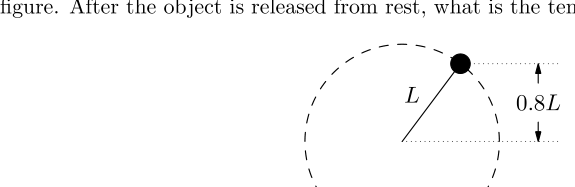 pendolo su asta incernierata, h=0.8L
ruota che rotola, punto A angolo theta
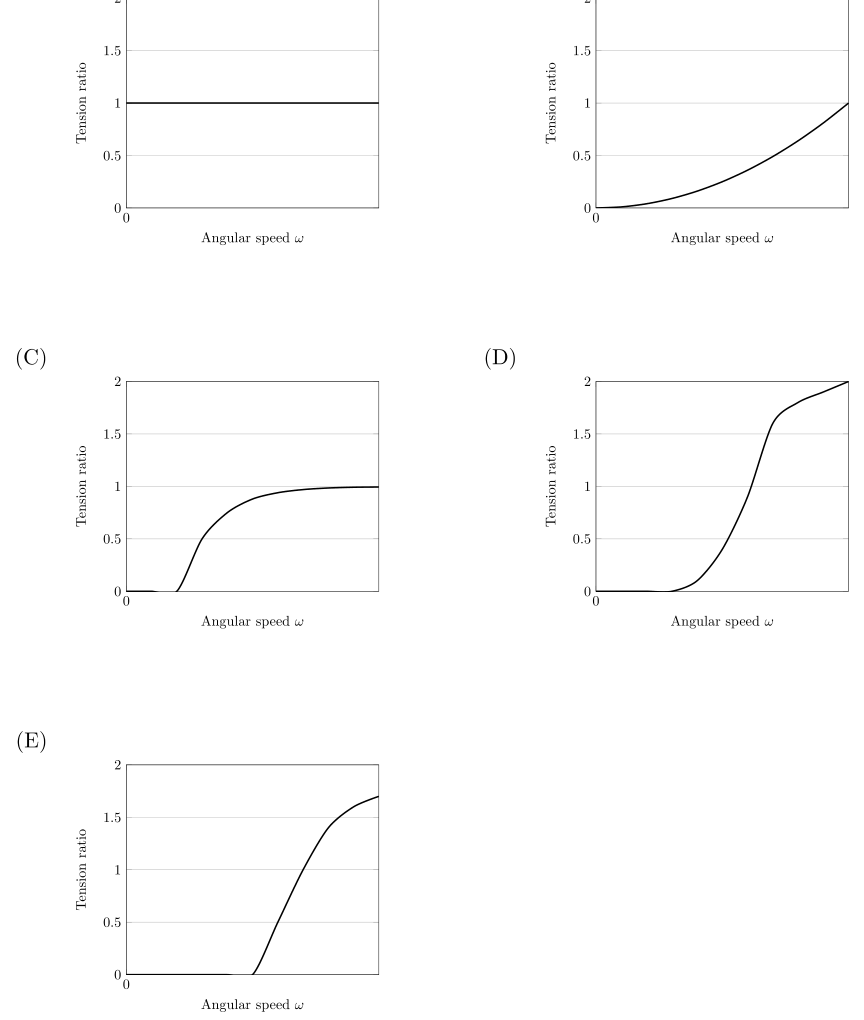 5 grafici rapporto tensioni vs omega
Topic: Rotational Dynamics, Newtonian Mechanics Metodi: Torque & Angular Momentum Analysis, Energy Conservation Method, Free-Body Diagram Competenze: Diagrammatic Reasoning, Mathematical Modeling, Physical Reasoning Objects: Cylinder, Rod, Wheel, Disk Fonte: Testo (PDF) — p.2
Q5. A cylinder has radius and weight . It is desired to roll it over a step of height . The minimum required force is (A) ; (B) ; (C) ; (D) ; (E) .
Q7. An object of mass is attached to the end of a rigid, massless rod of length . The other end is hinged to a frictionless pivot. The object is raised so that its height above the pivot is , then released from rest. What is the tension in the rod when it is horizontal? (A) ; (B) ; (C) ; (D) ; (E) .
Q9. A wheel of radius rolls without slipping with angular velocity . For a point on the wheel at an angle relative to the vertical, what is the magnitude of its velocity with respect to the ground? (A) ; (B) ; (C) ; (D) ; (E) .
Q10. A uniform flat disk of radius has a hole of radius removed from its center. The resulting annular ring is then cut in half along a diameter. The remaining shape has mass . What is the moment of inertia of this shape, about the rotational symmetry axis of the original disk? (A) ; (B) ; (C) ; (D) ; (E) .
Q15. A vertical rod of length is thrown into the air with an initial vertical velocity . It is given sufficient angular momentum to complete a rotation of before landing. Find the initial horizontal velocity of the bottom end of the rod. (A) ; (B) ; (C) ; (D) ; (E) .
Q22. A vertical pole has two massless ropes, each of length , attached to it at a distance apart. The other ends of the ropes are attached to a mass . The mass rotates around the pole with angular velocity . Which graph best represents the ratio of the tension in the lower rope to that in the upper rope as a function of ? (choices A–E: graphs; the ratio is below a threshold value, then increases toward )
cylinder of radius R on step of height h
pendulum on a hinged rod, h = 0.8L
wheel rolling, point A at angle theta
five graphs of tension ratio vs omega
Q8. La massa e il raggio della Terra sono e . Un oggetto che parte a distanza dalla superficie terrestre si muove a velocità tangenzialmente. Qual è la sua traiettoria? (A) parabola o iperbole; (B) cerchio attorno alla Terra; (C) ellisse la cui distanza minima dalla superficie è ; (D) ellisse la cui distanza massima dalla superficie è ; (E) retta lungo la direzione della velocità iniziale.
Q21. Una nube sferica di polvere ha densità di massa uniforme e raggio . Il satellite di massa trascurabile orbita sul bordo della nube; il satellite orbita in un’orbita circolare di raggio all’interno della nube ( è la velocità del satellite e il suo periodo, per ). Quale delle seguenti è vera (trascurando l’attrito della polvere)? (A) e ; (B) e ; (C) e ; (D) e ; (E) e .
Topic: Gravitation, Newtonian Mechanics Metodi: Newton’s Law of Gravitation, Energy Conservation Method, Kepler’s Laws Competenze: Mathematical Modeling, Physical Reasoning Objects: Planet, Satellite Fonte: Testo (PDF) — p.4
Q8. The mass and radius of the Earth are and . An object starting at a distance from the Earth’s surface moves with tangential velocity . What is its trajectory? (A) parabola or hyperbola; (B) circular orbit around the Earth; (C) ellipse whose minimum distance from the surface is ; (D) ellipse whose maximum distance from the surface is ; (E) straight line along the direction of initial velocity.
Q21. A spherical cloud of dust has uniform mass density and radius . Satellite , of negligible mass, orbits at the edge of the cloud; satellite orbits in a circular orbit of radius inside the cloud ( is the velocity of satellite and its period, for ). Which of the following is true (neglecting dust friction)? (A) and ; (B) and ; (C) and ; (D) and ; (E) and .
Q4. Una molla priva di massa pende dal soffitto e una massa è appesa al fondo. La massa è sostenuta così che inizialmente la tensione nella molla è nulla. La massa è poi rilasciata improvvisamente. Nel punto più basso della sua traiettoria, la massa è a dalla posizione originale. Trovare il suo periodo di oscillazione. (A) ; (B) ; (C) ; (D) ; (E) informazione insufficiente.
Q11. Per misurare la velocità di un’automobilina la si cronometra con un cronometro mentre percorre . Si registra un tempo di , con incertezza . Qual è l’incertezza sulla stima della velocità? (assumere velocità costante e distanza nota con precisione). (A) ; (B) ; (C) ; (D) ; (E) .
Q16. La profondità di un pozzo si misura lasciando cadere una pietra e misurando il tempo finché si sente lo splash sul fondo. Qual è il valore più piccolo di per cui trascurare il tempo di propagazione del suono dà meno del di errore sulla misura della profondità? Velocità del suono . (A) ; (B) ; (C) ; (D) ; (E) .
Q19. Una pietra è legata a una corda priva di massa di lunghezza . La densità della pietra è il doppio di quella dell’acqua, e l’altra estremità della corda è fissata a un perno. Trascurando le forze di attrito dell’acqua, la pietra oscilla come un pendolo con frequenza angolare di quale dei seguenti? (A) ; (B) ; (C) ; (D) ; (E) .
Q20. Un’asta uniforme di massa e lunghezza è incernierata a una superficie orizzontale al fondo. La sua estremità superiore è collegata a due molle, ciascuna di costante elastica . Quale relazione tra , e devono soddisfare affinché la posizione mostrata in figura sia un equilibrio stabile? (A) ; (B) ; (C) ; (D) ; (E) .
Q25. Un’automobile percorre una pista circolare di raggio a velocità costante . Un bicchiere cilindrico è posto verticalmente all’interno dell’auto. Il bicchiere ha un piccolo foro sul lato destro. Se il punto più alto dell’acqua nel bicchiere è ad altezza sopra il foro, qual è la velocità istantanea con cui l’acqua sfugge dal foro, dal punto di vista di un passeggero? (A) ; (B) ; (C) ; (D) ; (E) .
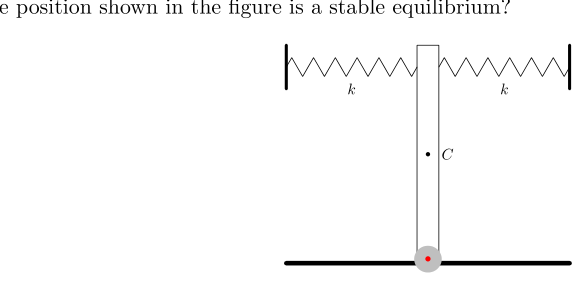 asta verticale incernierata con due molle k
Topic: Oscillations & Waves, Newtonian Mechanics, Fluid Mechanics Metodi: Simple Harmonic Motion Analysis, Energy Conservation Method, Bernoulli’s Equation Competenze: Error Propagation, Physical Reasoning, Mathematical Modeling Objects: Spring, Rod, Pendulum Fonte: Testo (PDF) — p.3
Q4. A massless spring hangs from the ceiling, with a mass attached to its lower end. The mass is initially held so that the spring’s tension is zero. The mass is then suddenly released. At the lowest point of its trajectory, the mass is at a distance from its original position. Find its oscillation period. (A) ; (B) ; (C) ; (D) ; (E) insufficient information.
Q11. To measure the speed of a toy car, it is timed with a stopwatch over a distance . The recorded time is , with uncertainty . What is the uncertainty in the estimated speed? (Assume constant velocity and distance known precisely.) (A) ; (B) ; (C) ; (D) ; (E) .
Q16. The depth of a well is measured by dropping a stone and measuring the time until the splash is heard at the bottom. What is the smallest value of for which neglecting the sound propagation time introduces less than error in the depth measurement? Speed of sound . (A) ; (B) ; (C) ; (D) ; (E) .
Q19. A stone is attached to a massless string of length . The density of the stone is twice that of water, and the other end of the string is fixed to a pivot. Neglecting water drag forces, what is the angular frequency of oscillation of the stone as a pendulum? (A) ; (B) ; (C) ; (D) ; (E) .
Q20. A uniform rod of mass and length is hinged to a horizontal surface at its lower end. Its upper end is connected to two springs, each with spring constant . What relation must , , and satisfy for the position shown in the figure to be a stable equilibrium? (A) ; (B) ; (C) ; (D) ; (E) .
Q25. An automobile travels along a circular track of radius at constant speed . A cylindrical glass is placed vertically inside the car. The glass has a small hole on its right side. If the highest point of the water in the glass is at height above the hole, what is the instantaneous speed with which water escapes from the hole, as seen by a passenger? (A) ; (B) ; (C) ; (D) ; (E) .
vertical hinged rod with two springs k