Q1. Un blocco uniforme di massa è rilasciato da fermo dalla cima di un piano inclinato lungo e inclinato di . I coefficienti di attrito statico e dinamico sono e . La fine del piano è collegata a una superficie orizzontale priva di attrito. Dopo molto tempo, quanta energia è dissipata per attrito? (A) ; (B) ; (C) ; (D) ; (E) .
Q7. Una vasca riempita a metà d’acqua è sospesa da due fili come mostrato. La tensione è inizialmente la stessa in ciascun filo. Una barchetta è posta nella vasca direttamente sotto il filo sinistro. Galleggia senza toccare i lati o far traboccare l’acqua. Come cambia la tensione nei fili? (A) non cambia in nessuno; (B) aumenta ugualmente in entrambi; (C) aumenta nel sinistro e diminuisce nel destro; (D) aumenta nel sinistro e resta uguale nel destro; (E) aumenta nel sinistro e aumenta di una quantità minore nel destro.
Q8. Una bilancia è calibrata per dare la lettura corretta posata a terra. Una persona la tiene e la preme su entrambi i lati con le mani, spingendo verso l’alto sul fondo con la mano sinistra e verso il basso sulla cima con la destra. La bilancia ha massa e la mano sinistra esercita una forza di . La lettura della bilancia è (A) ; (B) ; (C) ; (D) ; (E) .
Q9. Una tavola leggera di lunghezza è incernierata a una parete verticale. Una sfera piena di peso e raggio è tenuta tra la parete e la tavola da una forza applicata perpendicolarmente all’estremità della tavola. Parete e tavola sono prive di attrito. L’angolo tra tavola e parete è . Qual è il modulo di ? (A) ; (B) ; (C) ; (D) ; (E) .
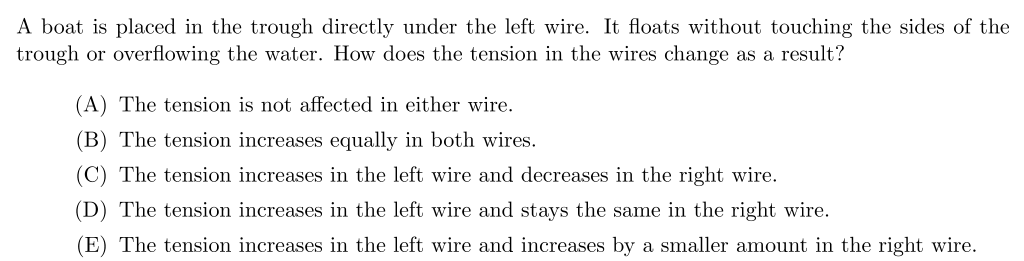 Vasca d’acqua sospesa da due fili
 Sfera tra asta incernierata e parete verticale
Topic: Newtonian Mechanics, Rigid Body Statics, Fluid Mechanics Metodi: Free-Body Diagram, Conservation of Energy, Torque & Angular Momentum Analysis Competenze: Diagrammatic Reasoning, Physical Reasoning, Mathematical Modeling Objects: Block, Inclined Plane, Container, Sphere Fonte: Testo (PDF) — p.2
Q1. A uniform block of mass is released from rest at the top of an inclined plane of length and inclined at angle . The coefficients of static and kinetic friction are and , respectively. The end of the incline is connected to a horizontal surface with no friction. After a long time, how much energy is dissipated by friction? (A) ; (B) ; (C) ; (D) ; (E) .
Q7. A tank half-filled with water is suspended by two wires as shown. The tension is initially equal in each wire. A small boat is placed into the tank directly under the left wire. It floats without touching the sides or causing any water to overflow. How does the tension in the wires change? (A) remains unchanged in both; (B) increases equally in both; (C) increases in the left and decreases in the right; (D) increases in the left and remains unchanged in the right; (E) increases in the left and increases by a smaller amount in the right.
Q8. A scale is calibrated to give the correct reading when placed on the ground. A person holds it and presses down on both sides with their hands, pushing upward on the bottom with the left hand and downward on the top with the right hand. The scale has mass , and the left hand exerts a force of . The scale reading is (A) ; (B) ; (C) ; (D) ; (E) .
Q9. A light board of length is hinged to a vertical wall. A solid sphere of weight and radius is held between the wall and the board by a force applied perpendicularly to the end of the board. The wall and the board are frictionless. The angle between the board and the wall is . What is the magnitude of ? (A) ; (B) ; (C) ; (D) ; (E) .
Water tank suspended by two wires
Sphere between a hinged rod and a vertical wall
Q3. Due molle di costanti e sono collegate in serie e tese. Qual è il rapporto delle loro energie potenziali ? (A) ; (B) ; (C) ; (D) ; (E) .
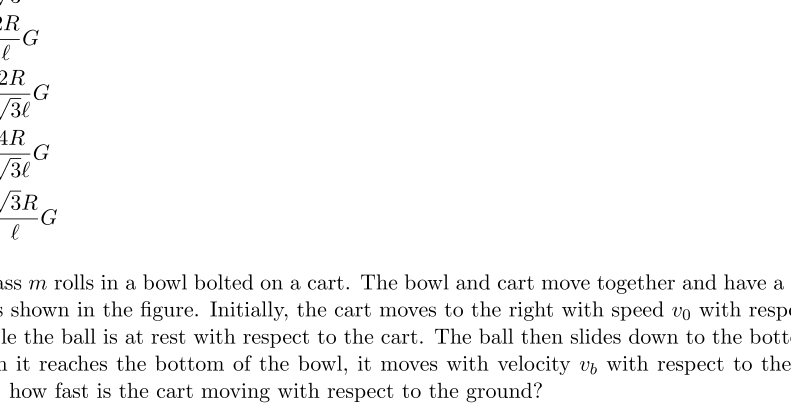
Q10. Una pallina di massa rotola in una ciotola fissata a un carrello. Ciotola e carrello (massa combinata ) si muovono insieme inizialmente verso destra a velocità rispetto al suolo, mentre la pallina è ferma rispetto al carrello. La pallina scivola fino al fondo della ciotola, dove si muove con velocità rispetto al carrello. A questo istante quanto si muove il carrello rispetto al suolo? (A) ; (B) ; (C) ; (D) ; (E) dipende dal coefficiente d’attrito tra pallina e ciotola.
Q13. Una manichetta è a livello del suolo contro la base di un grande muro. Puntando la manichetta a un certo angolo e spruzzando acqua a velocità si bagna una regione del muro. Se la velocità dell’acqua è raddoppiata, qual è la nuova regione che può essere bagnata? (Trascurare gli schizzi oltre il punto di contatto.) (scelte A-E: figure; la risposta corretta è “quadrupla altezza, doppia larghezza”)
Q14. Una palla è lanciata a velocità con angolo sull’orizzontale verso un muro verticale a distanza . Rimbalza elasticamente sul muro e ricade nel punto di lancio. Qual era la sua velocità iniziale? (A) ; (B) ; (C) ; (D) ; (E) .
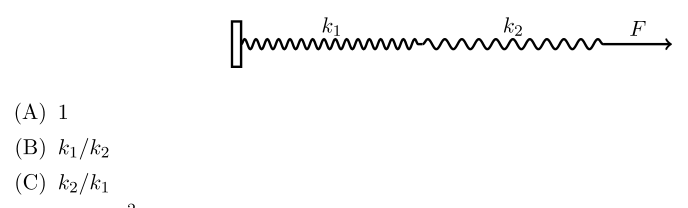 Due molle in serie tra due pareti
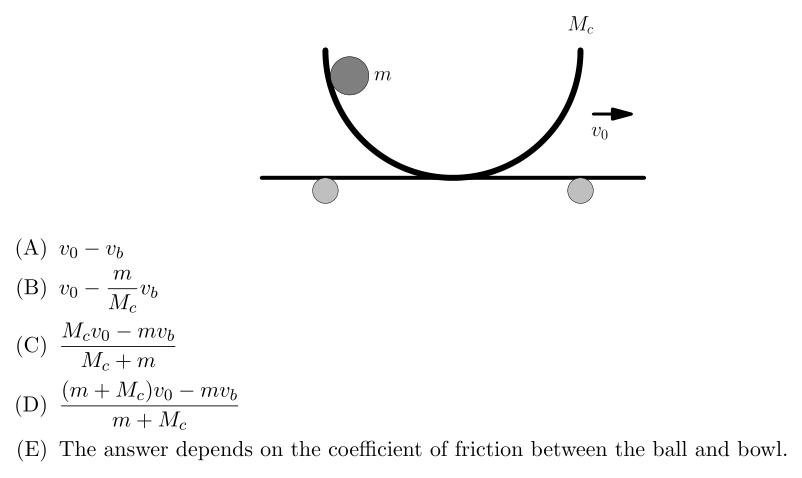 Pallina che rotola in ciotola su carrello
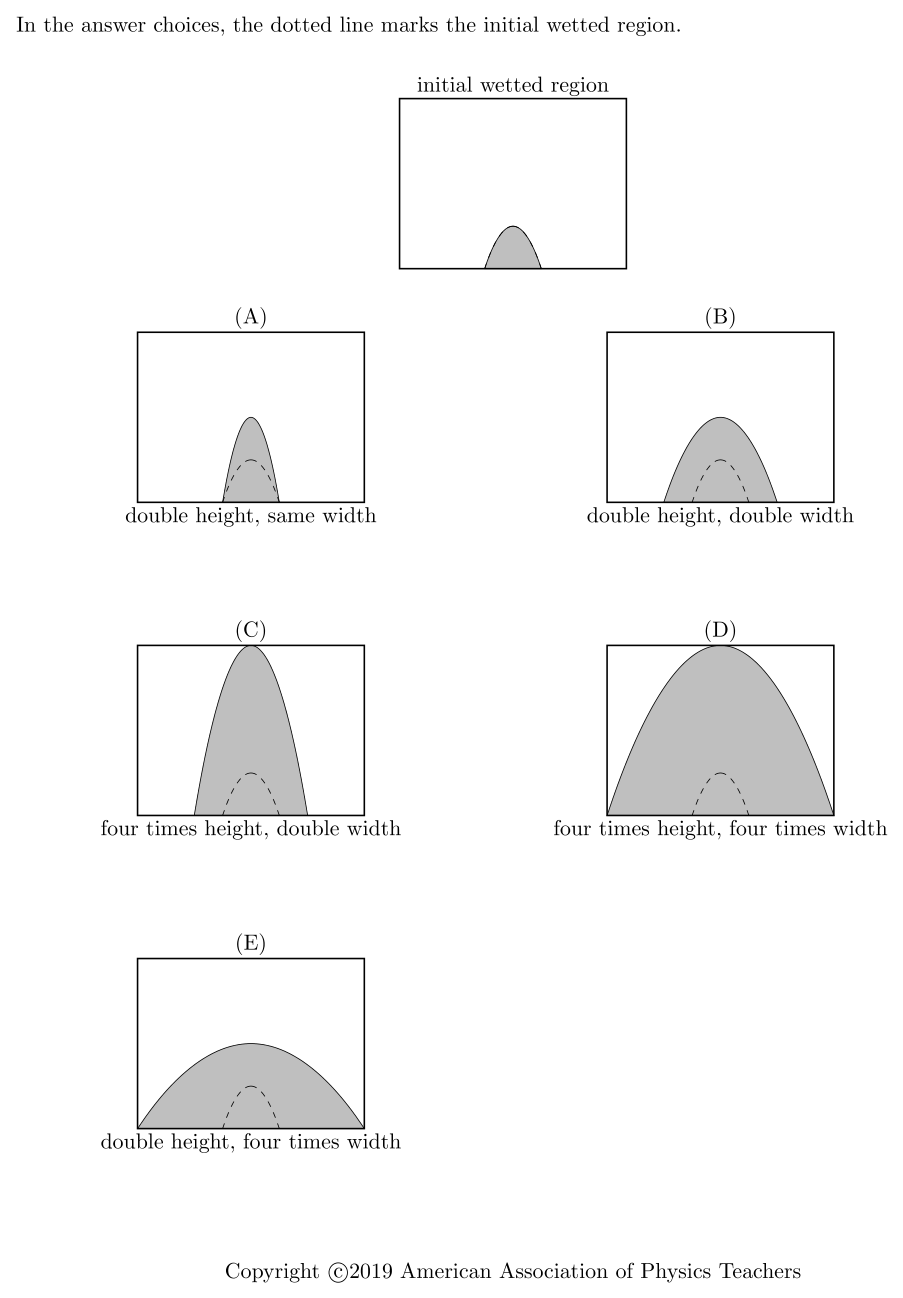 Regione bagnata da manichetta su parete (A-E)
Topic: Conservation of Momentum, Conservation of Energy, Newtonian Mechanics Metodi: Conservation Laws, Kinematic Equations, Energy Conservation Method Competenze: Mathematical Modeling, Physical Reasoning Objects: Spring, Ball, Cart Fonte: Testo (PDF) — p.2
Q3. Two springs with spring constants and are connected in series and stretched. What is the ratio of their potential energies ? (A) ; (B) ; (C) ; (D) ; (E) .
Q10. A small ball of mass rolls inside a bowl fixed to a cart. The bowl and the cart (combined mass ) initially move together to the right at velocity relative to the ground, while the ball is stationary relative to the cart. The ball slides down to the bottom of the bowl, where it moves at velocity relative to the cart. At this instant, how fast does the cart move relative to the ground? (A) ; (B) ; (C) ; (D) ; (E) depends on the coefficient of friction between ball and bowl.
Q13. A hose is positioned at ground level against the base of a large wall. By aiming the hose at a certain angle and spraying water at velocity , a region of the wall is wetted. If the water speed is doubled, what is the new region that can be wetted? (Neglect splashes beyond the point of contact.) (Choices A–E: figures; correct answer is “quadrupled height, doubled width”)
Q14. A ball is thrown with speed at an angle above the horizontal toward a vertical wall located distance away. It bounces elastically off the wall and lands back at the launch point. What was its initial speed? (A) ; (B) ; (C) ; (D) ; (E) .
Two springs in series between two walls
Ball rolling inside a bowl on a cart
Wet region on wall from a fire hose (A-E)
Q11. Si consideri un quadrato piatto uniforme di massa e lato . Si ritaglia dal quadrato un cerchio con diametro uguale al lato del quadrato, con lo stesso centro. Determinare il momento d’inerzia della forma rimanente rispetto a un asse passante per il centro e perpendicolare al piano del quadrato. (A) ; (B) ; (C) ; (D) ; (E) .
Q16. (Q16-17: un cerchio di raggio è lanciato a destra con velocità iniziale a livello del suolo; ruota anche in senso antiorario con velocità angolare ; coefficiente di attrito dinamico col suolo .) Quanto tempo impiega il cerchio a tornare alla posizione di partenza? (A) ; (B) ; (C) ; (D) ; (E) .
Q17. (seguito di Q16) La risposta alla domanda precedente, cioè il tempo per tornare alla posizione di partenza, sarebbe la stessa per un anello uniforme con lo stesso coefficiente di attrito dinamico lanciato con la stessa velocità iniziale? (A) Sì; (B) No, perché la coppia per attrito è maggiore per l’anello; (C) No, perché il disco torna prima alla posizione iniziale; (D) No, perché il disco smette di scivolare troppo presto; (E) informazione insufficiente.
Q19. Un pendolo fisico consiste di una massa all’estremità di un’asta rigida priva di massa che può ruotare attorno all’estremo opposto. Assumendo che le oscillazioni abbiano ampiezza di , quale grafico mostra l’accelerazione totale della massa in funzione della posizione angolare , misurata tra il pendolo e la verticale? (scelte A-E: grafici dell’accelerazione totale; il modulo è massimo a piccoli e decresce)
Q24. Una fune uniforme di lunghezza e massa passa su una carrucola priva di attrito e pende con entrambi i capi inizialmente uguali. Se un capo è tirato giù di una distanza e la fune è rilasciata, l’accelerazione della fune in quell’istante sarà (A) ; (B) ; (C) ; (D) ; (E) .
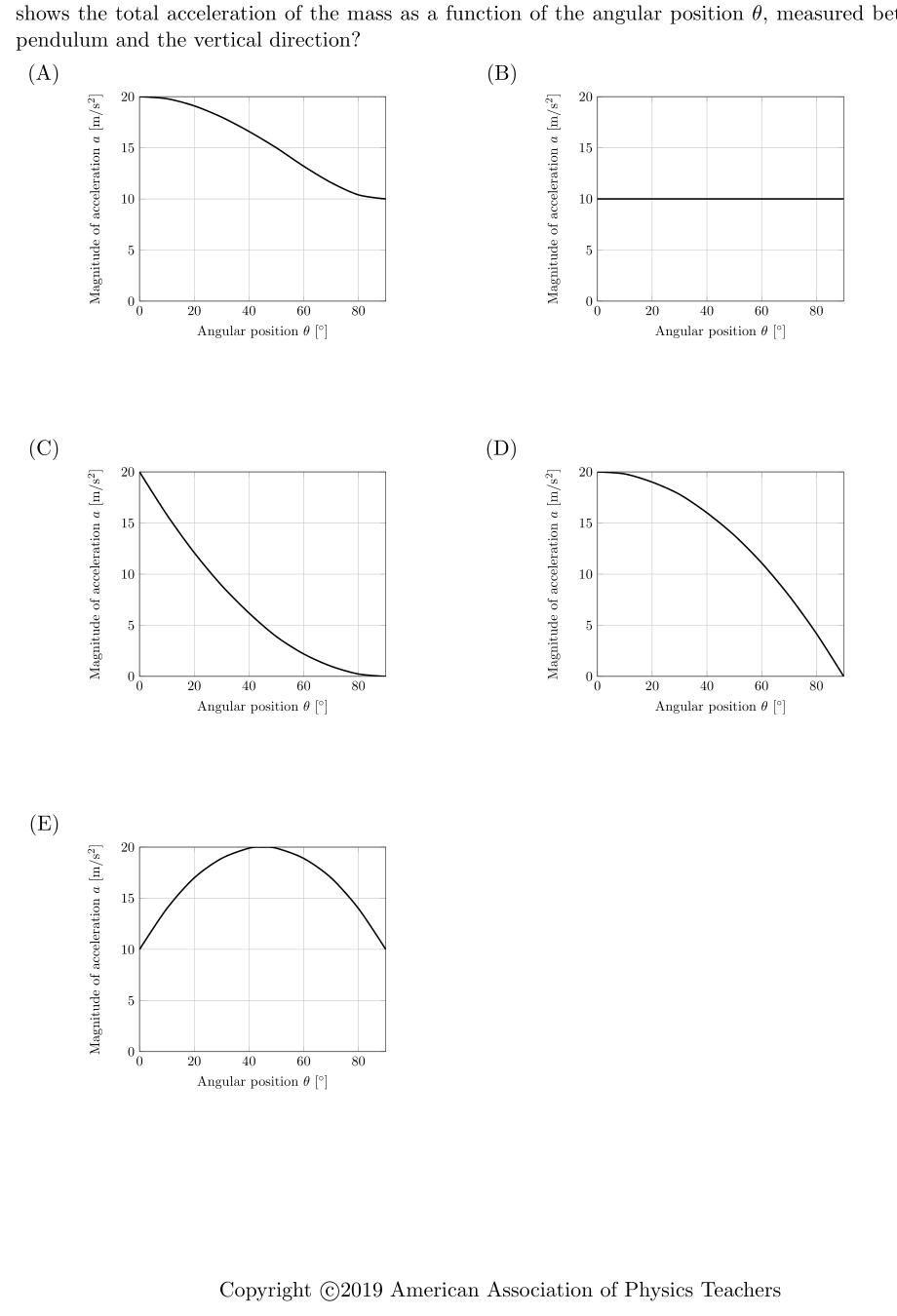 Cinque grafici accelerazione totale vs angolo pendolo
Topic: Rotational Dynamics, Newtonian Mechanics, Oscillations & Waves Metodi: Torque & Angular Momentum Analysis, Calculus-Integration, Free-Body Diagram Competenze: Mathematical Modeling, Diagrammatic Reasoning, Physical Reasoning Objects: Disk, Pendulum, String, Pulley Fonte: Testo (PDF) — p.6
Q11. Consider a flat, uniform square of mass and side length . A circle is cut out from the square, with diameter equal to the side of the square and centered at the same point. Determine the moment of inertia of the remaining shape about an axis passing through the center and perpendicular to the plane of the square. (A) ; (B) ; (C) ; (D) ; (E) .
Q16. (Questions Q16–17: A circle of radius is launched to the right with initial velocity at ground level; it also rotates counterclockwise with angular velocity ; coefficient of dynamic friction with the ground is .) How much time does it take for the circle to return to its starting position? (A) ; (B) ; (C) ; (D) ; (E) .
Q17. (Continuation of Q16) Would the answer to the previous question—the time required to return to the starting position—be the same for a uniform ring with the same coefficient of dynamic friction, launched with the same initial velocity? (A) Yes; (B) No, because the frictional torque is greater for the ring; (C) No, because the disk returns to the initial position earlier; (D) No, because the disk stops sliding too early; (E) Insufficient information.
Q19. A physical pendulum consists of a mass attached to the end of a rigid, massless rod that can rotate about the opposite end. Assuming oscillations have amplitude , which graph shows the total acceleration of the mass as a function of angular position , measured between the pendulum and the vertical? (Choices A–E: graphs of total acceleration; magnitude is maximum at small and decreases)
Q24. A uniform rope of length and mass passes over a frictionless pulley and initially hangs with equal lengths on both sides. If one end is pulled down a distance and the rope is released, the acceleration of the rope at that instant will be (A) ; (B) ; (C) ; (D) ; (E) .
Five graphs of total acceleration vs pendulum angle
Q2. Tre blocchi cubici dello stesso volume sono fatti di legno, polistirolo e plastica. Quando il blocco di plastica è messo in acqua, metà del suo volume è sommerso. Se il blocco di legno è messo in acqua con quello di plastica sopra, il blocco di legno è appena completamente sommerso. Analogamente, se il blocco di polistirolo è messo in olio con quello di plastica sopra, il polistirolo è appena completamente sommerso. La densità dell’olio è volte quella dell’acqua. Qual è il rapporto ? (A) ; (B) ; (C) ; (D) ; (E) .
Q4. Due masse identiche interagiscono solo per attrazione gravitazionale reciproca. Se una è fissa e l’altra rilasciata da ferma, le due masse collidono in tempo . Se entrambe sono rilasciate da ferme, collidono in tempo (A) ; (B) ; (C) ; (D) ; (E) .
Q5. La densità della Terra cresce gradualmente da circa alla crosta a circa al nucleo. Quale di questi grafici potrebbe mostrare l’accelerazione gravitazionale locale in funzione della distanza dal centro della Terra? (scelte A-E: grafici di ; la risposta è la curva che cresce dal centro fino a un massimo e poi ridiscende)
Q6. Un lunghissimo cilindro di polvere ruota attorno al suo asse con velocità angolare allo stato stazionario. Sia la distanza dall’asse. Se la polvere è tenuta insieme solo dalla gravità, la densità della polvere è proporzionale a (A) ; (B) ; (C) non dipende da ; (D) ; (E) .
Q12. Due pianeti e hanno masse . Orbitano una stella in orbite circolari di raggio . Siano e l’energia cinetica e il modulo del momento angolare del pianeta . Quale è vera? (A) e ; (B) e ; (C) e ; (D) e ; (E) e .
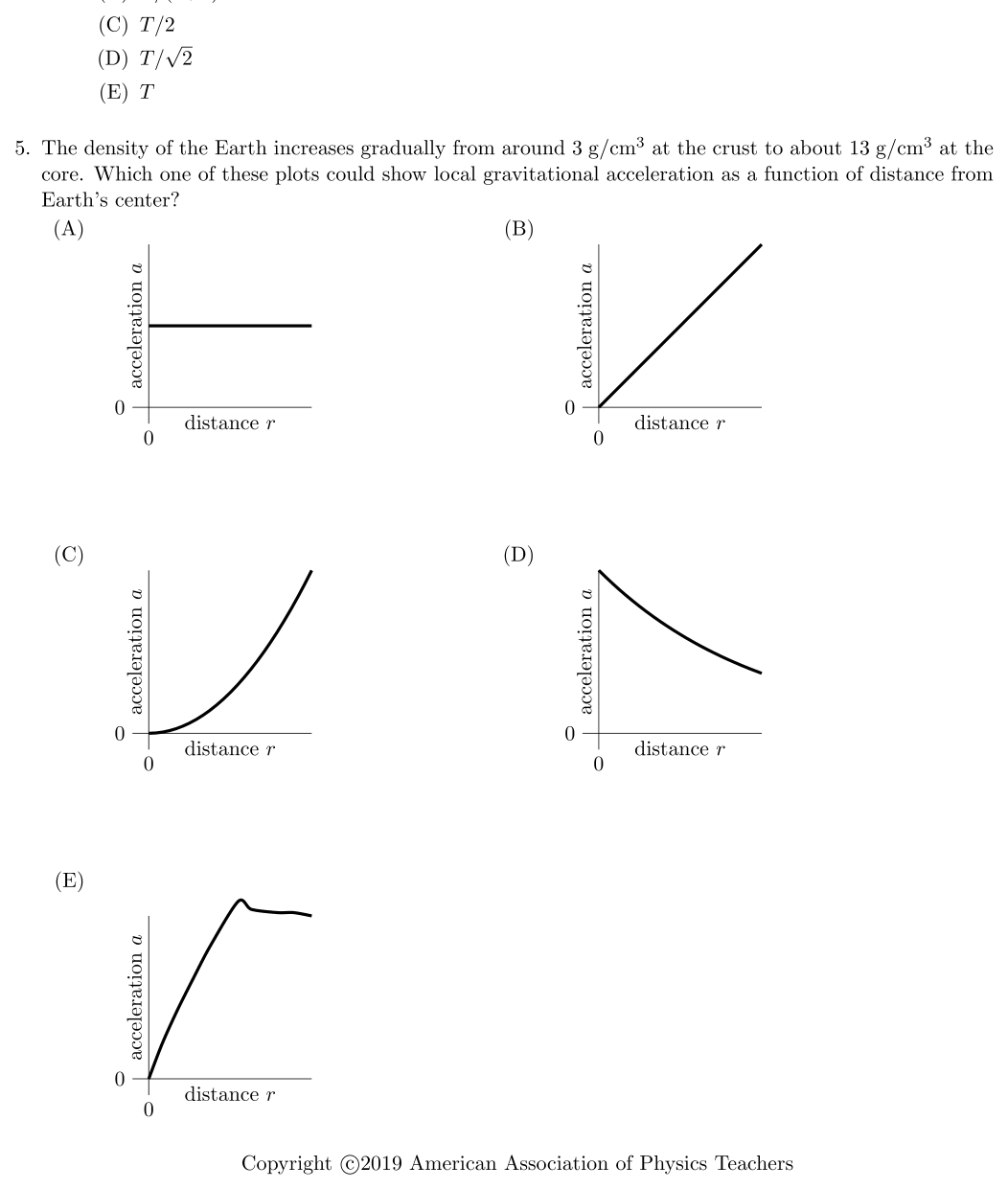 Cinque grafici a(r) vs distanza dal centro Terra
Topic: Gravitation, Fluid Mechanics Metodi: Newton’s Law of Gravitation, Hydrostatic Equilibrium, Symmetry Argument Competenze: Mathematical Modeling, Physical Reasoning Objects: Block, Planet, Star, Cylinder Fonte: Testo (PDF) — p.2
Q2. Three cubic blocks of the same volume are made of wood, polystyrene, and plastic. When the plastic block is placed in water, half of its volume is submerged. If the wooden block is placed in water with the plastic block on top, the wooden block is just completely submerged. Similarly, if the polystyrene block is placed in oil with the plastic block on top, the polystyrene block is just completely submerged. The density of oil is times that of water. What is the ratio ? (A) ; (B) ; (C) ; (D) ; (E) .
Q4. Two identical masses interact only via mutual gravitational attraction. If one is fixed and the other is released from rest, they collide in time . If both are released from rest, they collide in time (A) ; (B) ; (C) ; (D) ; (E) .
Q5. The density of the Earth increases gradually from about at the crust to about at the core. Which of these graphs could show local gravitational acceleration as a function of distance from the center of the Earth? (choices A–E: graphs of ; answer is the curve that rises from the center to a maximum and then decreases)
Q6. A very long cylinder of dust rotates about its axis with angular velocity in a steady state. Let be the distance from the axis. If the dust is held together only by gravity, the density of the dust is proportional to (A) ; (B) ; (C) independent of ; (D) ; (E) .
Q12. Two planets and have masses . They orbit a star in circular orbits of radius . Let and be the kinetic energy and magnitude of angular momentum of planet , respectively. Which statement is true? (A) and ; (B) and ; (C) and ; (D) and ; (E) and .
Five graphs of a(r) versus distance from Earth’s center
Q15. Una massa è attaccata all’estremità di una corda di lunghezza . Una persona fa ruotare la massa sopra la testa in modo che la mano percorra un cerchio di raggio a velocità angolare , in anticipo sulla massa di un angolo . Stimare la forza di resistenza dell’aria sull’oggetto. (A) ; (B) ; (C) ; (D) ; (E) .
Q18. Uno studente stima l’accelerazione di gravità lasciando cadere una pietra da altezza nota , misurando il tempo di caduta. Trascurando la resistenza dell’aria, prende dalla relazione . Quale incertezza è maggiore nella sua stima di , se la misura di ha incertezza del e del ? (A) l’incertezza su è sufficiente per gare brevi e quella su per gare lunghe (sic — vedi PDF); (B) …; (C) l’incertezza su ; (D) l’incertezza su ; (E) contribuiscono ugualmente. (item su propagazione dell’errore — vedi PDF per il testo esatto delle alternative)
Q20. Un blocco su una rampa è lanciato con velocità iniziale verso l’alto lungo la rampa. Scivola in salita per un tempo , viaggia per qualche distanza, poi scivola in discesa per un tempo finché torna alla posizione iniziale. Quanto vale in funzione di ? L’altezza della rampa è volte la sua lunghezza e il coefficiente di attrito dinamico tra blocco e rampa è . (A) ; (B) ; (C) ; (D) ; (E) .
Q21. Un vagone merci vuoto su una rotaia orizzontale ha massa . Una tramoggia sopra il vagone si apre e il grano cade nel vagone a tasso per secondo. Il grano cade per una distanza verticale prima di colpire il fondo del vagone senza rimbalzare. Quanta forza orizzontale è necessaria per spostare il vagone senza rimbalzo? Assumere che il grano parte da fermo. (A) ; (B) ; (C) ; (D) ; (E) .
Q22. La soglia di danno per un frutto è la massima altezza da cui può essere lasciato cadere senza ammaccarsi. Il muffin di una mela ha modulo e cade da una mela su un terreno duro che richiede secondi dopo l’impatto. Per la mela di massa , una superficie con di superficie di contatto durante l’impatto, qual è la pressione media necessaria per ammaccare la mela? (A) ; (B) ; (C) ; (D) ; (E) .
Q23. Un treno viaggia a su una pista quasi rettilinea. La pista è leggermente sinusoidale, con ampiezza verticale e lunghezza orizzontale . Se l’accelerazione verticale tollerabile dal treno è , qual è la dimensione massima consentita di ? (A) ; (B) ; (C) ; (D) ; (E) .
Q25. Uno studente stima lasciando cadere una pietra da altezza nota , misurando il tempo . Trascurando la resistenza dell’aria, prende . Quale incertezza è maggiore nella stima di se ha incertezza del e del ? (A) nessuna incertezza su , ha ; (B) nessuna su , ha ; (C) e hanno ; (D) (A) e (B) danno lo stesso valore, minore di (C); (E) (A), (B) e (C) danno la stessa incertezza. (item su propagazione dell’errore — vedi PDF per il testo esatto)
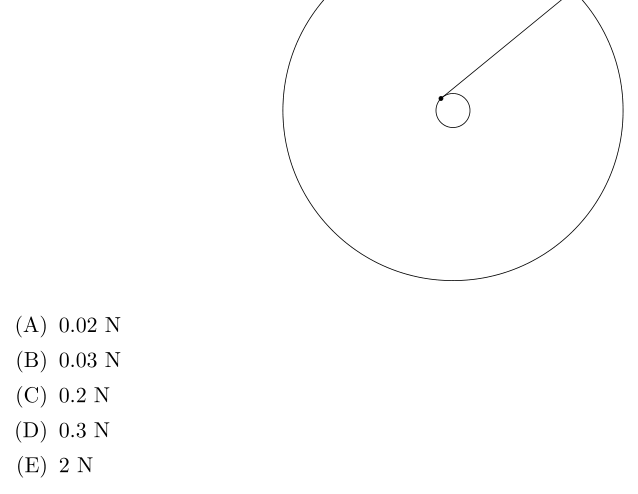 Massa in rotazione su corda, traiettoria circolare
 Blocco su piano inclinato con attrito
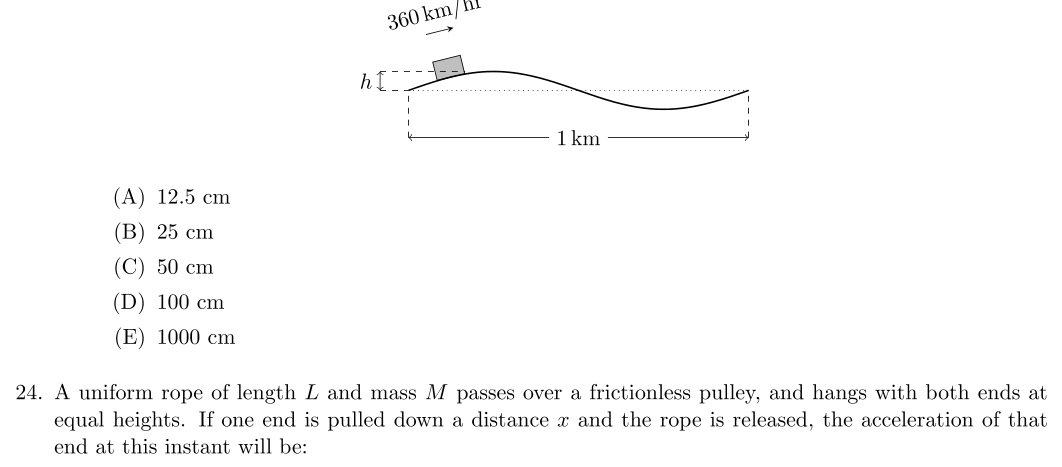 Binario sinusoidale per treno ad alta velocità
Topic: Newtonian Mechanics, Order-of-Magnitude Estimation Metodi: Order-of-Magnitude Estimation, Impulse-Momentum Theorem, Kinematic Equations Competenze: Error Propagation, Estimation & Approximation, Mathematical Modeling Objects: Block, String, Cart Fonte: Testo (PDF) — p.8
Q15. A mass is attached to the end of a string of length . A person rotates the mass above their head such that the hand traces a circle of radius at angular velocity , ahead of the mass by an angle . Estimate the air resistance force acting on the object. (A) ; (B) ; (C) ; (D) ; (E) .
Q18. A student estimates the acceleration due to gravity by dropping a stone from a known height , measuring the fall time . Neglecting air resistance, they compute from the relation . Which uncertainty is larger in their estimate of , if the measurement of has an uncertainty of and that of has an uncertainty of ? (A) the uncertainty in is sufficient for short races and that in for long races (yes — see PDF); (B) …; (C) the uncertainty in ; (D) the uncertainty in ; (E) they contribute equally. (item on error propagation — see PDF for the exact wording of alternatives)
Q20. A block on an inclined plane is launched upward along the ramp with initial velocity . It slides up for a time , travels some distance, then slides back down for a time until it returns to its initial position. What is the value of in terms of ? The height of the ramp is times its length, and the coefficient of dynamic friction between block and ramp is . (A) ; (B) ; (C) ; (D) ; (E) .
Q21. An empty freight car of mass on a horizontal track has grain falling into it from a hopper above at a rate of per second. The grain falls a vertical distance before hitting the bottom of the car without bouncing. What horizontal force is required to move the car smoothly (without bouncing)? Assume that the grain starts from rest. (A) ; (B) ; (C) ; (D) ; (E) .
Q22. The threshold for damage to a fruit is the maximum height from which it can be dropped without bruising. The muffin of an apple has a modulus of and falls from a tree onto a hard ground, requiring seconds after impact. For an apple of mass , with a contact surface area of during impact, what is the average pressure required to bruise the apple? (A) ; (B) ; (C) ; (D) ; (E) .
Q23. A train travels at along a track that is nearly straight. The track has a slight sinusoidal profile, with vertical amplitude and horizontal wavelength . If the maximum tolerable vertical acceleration for the train is , what is the largest allowable value of ? (A) ; (B) ; (C) ; (D) ; (E) .
Q25. A student estimates by dropping a stone from a known height , measuring the time . Neglecting air resistance, he takes . Which uncertainty is greater in the estimation of if has an uncertainty of and has an uncertainty of ? (A) No uncertainty on , has ; (B) No uncertainty on , has ; (C) and have ; (D) (A) and (B) give the same value, smaller than (C); (E) (A), (B), and (C) give the same uncertainty. (Item on error propagation — see PDF for exact text)
Rotating mass on a string, circular trajectory
Block on an inclined plane with friction
Sinusoidal track for high-speed train