Due blocchi e della stessa massa sono su un piano inclinato fisso che forma un angolo di con l’orizzontale. Al tempo , si trova a distanza lungo il piano sopra , ed entrambi i blocchi sono in quiete. I coefficienti di attrito statico e dinamico tra i blocchi e il piano sono e i blocchi collidono in modo perfettamente elastico. Siano e le velocità dei blocchi lungo il piano. Usare , assumere che entrambi i blocchi restino sul piano per tutto il tempo e trascurare le dimensioni dei blocchi.
- a. Graficare le funzioni e per da a secondo (linea continua e tratteggiata rispettivamente), indicando gli istanti in cui avvengono le collisioni.
- b. Ricavare un’espressione per la distanza totale percorsa dal blocco dalla sua posizione iniziale subito dopo la sua -esima collisione, in funzione di e .
Si supponga ora che il coefficiente del blocco sia invece , mentre resta invariato.
- c. Graficare di nuovo e per da a secondo (linea continua e tratteggiata), indicando gli istanti delle collisioni.
- d. Al tempo , di quanto si è spostato il blocco dalla sua posizione iniziale?
Topic: Newtonian Mechanics, Conservation of Energy, Conservation of Momentum Metodi: Free-Body Diagram, Kinematic Equations, Conservation Laws Competenze: Diagrammatic Reasoning, Mathematical Modeling, Physical Reasoning Objects: Block, Inclined Plane Fonte: Testo (PDF) — p.4
Two blocks and of equal mass are on a fixed inclined plane forming an angle with the horizontal. At time , block is located a distance along the plane above block , and both blocks are at rest. The coefficients of static and kinetic friction between the blocks and the plane are , and the blocks collide elastically. Let and be the velocities of the blocks along the plane. Use , assume both blocks remain on the plane at all times, and neglect the size of the blocks.
- a. Plot the functions and for from to , respectively (solid and dashed lines), indicating the instants when collisions occur.
- b. Derive an expression for the total distance traveled by block from its initial position immediately after its -th collision, as a function of and .
Now suppose that the coefficient for block is instead , while remains unchanged.
- c. Again plot and for from to , respectively (solid and dashed lines), indicating the instants of collisions.
- d. At time , by how much has block shifted from its initial position?
In questo problema si studia un semplice modello termodinamico per la conversione dell’energia solare in vento. Si consideri un pianeta di raggio che si suppone ruoti in modo che il lato sempre rivolto al Sole abbia temperatura uniforme costante , mentre il lato in ombra abbia temperatura uniforme costante . Il raggio orbitale del pianeta è , il Sole ha temperatura e raggio . Si assuma che lo spazio esterno abbia temperatura nulla e si trattino tutti gli oggetti come corpi neri ideali.
- a. Trovare la potenza solare ricevuta dal lato illuminato del pianeta. (Suggerimento: la legge di Stefan-Boltzmann afferma che la potenza emessa da un corpo nero di area è .)
Per mantenere e costanti, il calore deve essere continuamente trasferito dal lato illuminato a quello in ombra. Immaginando i due emisferi come i due serbatoi di una macchina termica reversibile, il lavoro estratto da questa differenza di temperatura, che compare sotto forma di potenza eolica, si suppone interamente catturato e immagazzinato da turbine eoliche.
- b. La temperatura di equilibrio dipende dal tasso di trasferimento di calore tra gli emisferi. Trovare i valori minimo e massimo di . In tal caso, qual è la potenza eolica prodotta ?
- c. Trovare la potenza eolica in funzione di e della temperatura .
- d. Stimare il valore massimo possibile di come frazione di , a una cifra significativa. Spiegare brevemente come si è ottenuta la stima.
Topic: Thermodynamics, Astrophysics Metodi: Thermodynamic Cycle Analysis, Energy Conservation Method, Order-of-Magnitude Estimation Competenze: Mathematical Modeling, Estimation & Approximation Objects: Planet, Star, Heat Engine Fonte: Testo (PDF) — p.5
In this problem, a simple thermodynamic model for converting solar energy into wind is studied. Consider a planet of radius , assumed to rotate such that the side permanently facing the Sun has a uniform constant temperature , while the dark side has a uniform constant temperature . The planet’s orbital radius is , the Sun has temperature and radius . Assume outer space has zero temperature, and treat all objects as ideal black bodies.
- a. Find the solar power received by the illuminated side of the planet. (Hint: The Stefan-Boltzmann law states that the power emitted by an ideal black body of area is .)
To keep and constant, heat must be continuously transferred from the illuminated side to the dark side. Imagining the two hemispheres as the two reservoirs of a reversible heat engine, the work extracted from this temperature difference—appearing in the form of wind power—is assumed to be entirely captured and stored by wind turbines.
- b. The equilibrium temperature depends on the heat transfer rate between the hemispheres. Find the minimum and maximum values of . In this case, what is the wind power produced ?
- c. Find the wind power as a function of and the temperature .
- d. Estimate the maximum possible value of as a fraction of , to one significant figure. Briefly explain how the estimate was obtained.
Due grandi armature parallele di area sono poste a e in un mezzo semiconduttore. L’armatura a è collegata a terra e quella a è a potenziale fisso , con . Particelle di carica positiva fluiscono tra queste armature. Si trascurino effetti dielettrici del mezzo.
- a. Per grandi, la velocità delle cariche positive è determinata da una forte forza di trascinamento (drag), così che , dove è il campo elettrico locale e la mobilità delle cariche.
- i. Allo stato stazionario c’è una densità di carica non nulla ma indipendente dal tempo tra le armature. Sia la densità di carica in una posizione pari a . Usando la conservazione della carica, ricavare una relazione tra , e la corrente .
- ii. Sia il potenziale elettrico a . Ricavare un’espressione che collega , e le sue derivate. (Suggerimento: usare la legge di Gauss per trovare la densità di carica in funzione del campo .)
- iii. Supporre che allo stato stazionario le condizioni siano tali che sia proporzionale a ; trovare ed esprimere la corrente in funzione di e degli altri parametri dati.
- b. Per piccoli, le cariche positive si muovono per diffusione. La corrente per diffusione è data dalla legge di Fick, , dove è il coefficiente di diffusione, che si può scrivere tramite la relazione di Einstein ( è la temperatura del sistema).
- i. Assumere che allo stato stazionario le condizioni siano tali che soddisfi , con valore diverso dal punto precedente. Trovare ed esprimere la corrente in funzione di e degli altri parametri.
- ii. A quale tensione il sistema passa da questo regime al regime di alta tensione del punto precedente?
Topic: Electrostatics, Circuits Metodi: Differential Equations, Gauss’s Law, Calculus-Integration Competenze: Mathematical Modeling, Physical Reasoning Objects: Capacitor, Point Charge Fonte: Testo (PDF) — p.6
Two large parallel plates of area are placed at and in a semiconducting medium. The plate at is grounded, and the one at is held at a fixed potential , with . Positive charge carriers of magnitude flow between these plates. Dielectric effects in the medium are neglected.
- a. For large, the velocity of positive charges is determined by a strong drag force, so that , where is the local electric field and is the charge mobility.
- i. At steady state, there exists a non-zero but time-independent charge density between the plates. Let the charge density at position be equal to . Using charge conservation, derive a relation between , and the current .
- ii. Let be the electric potential at . Derive an expression relating , and its derivatives. (Hint: Use Gauss’s law to find the charge density as a function of the field .)
- iii. Assume that at steady state conditions are such that is proportional to ; find and express the current in terms of and the other given parameters.
- b. For small, positive charges move by diffusion. The diffusive current is given by Fick’s law, , where is the diffusion coefficient, which can be expressed via the Einstein relation ( is the system temperature).
- i. Assume that in the steady state the conditions are such that satisfies , with taking a value different from the previous point. Find and express the current as a function of and the other parameters.
- ii. At what voltage does the system transition from this regime to the high-voltage regime of the previous point?
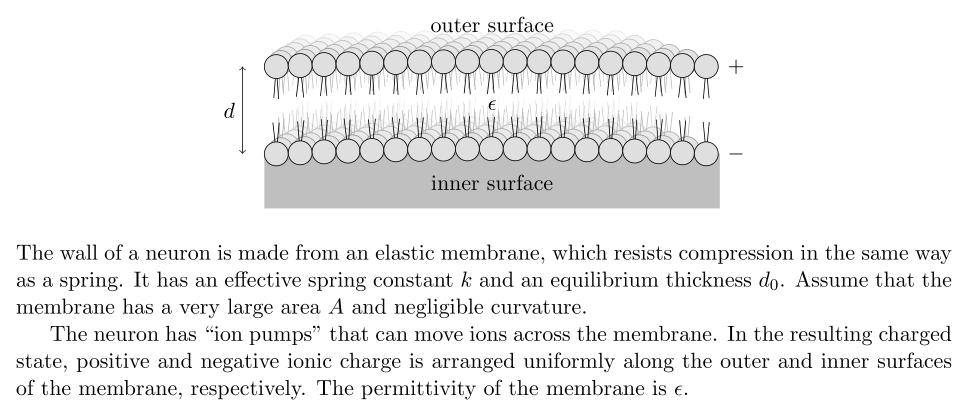
La parete di un neurone è fatta di una membrana elastica che resiste alla compressione come una molla. Ha una costante elastica effettiva e uno spessore di equilibrio . Si assuma che la membrana abbia area molto grande e curvatura trascurabile. Il neurone ha pompe ioniche che possono spostare ioni attraverso la membrana. La carica risultante, in stato stazionario, fa sì che cariche ioniche positive e negative siano disposte uniformemente lungo le superfici esterna e interna della membrana, rispettivamente. La permittività della membrana è .
- a. Supponendo che, dopo che le pompe ioniche hanno compiuto del lavoro, le cariche sulle superfici esterna e interna siano e rispettivamente, qual è lo spessore della membrana?
- b. Ricavare un’espressione per la differenza di potenziale tra le superfici esterna e interna della membrana in funzione dei parametri dati.
- c. Supporre che gli ioni siano dapprima attivati sulla membrana scarica e che la membrana sia caricata molto lentamente (quasi-staticamente). Le pompe accenderanno solo quando la differenza di potenziale tra le membrane diventi maggiore di un valore . Quanto deve essere grande affinché la costante elastica sia tale che la membrana non collassi?
- d. Quanto lavoro compiono le pompe ioniche in ciascuna delle seguenti situazioni? Esprimere le risposte in funzione di e .
- i. è infinitesimamente più grande del valore ricavato al punto (c).
- ii. è infinitesimamente più piccolo del valore ricavato al punto (c).
Si assuma in ogni caso che lo spessore della membrana non possa diventare negativo.
 Membrana neuronale bilayer con cariche
Topic: Electrostatics, Elasticity & Materials Metodi: Energy Conservation Method, Gauss’s Law, Hooke’s Law Competenze: Mathematical Modeling, Physical Reasoning Objects: Membrane, Spring Fonte: Testo (PDF) — p.8
The wall of a neuron consists of an elastic membrane that resists compression like a spring. It has an effective spring constant and an equilibrium thickness . It is assumed that the membrane has a very large area and negligible curvature. The neuron contains ion pumps that can transport ions across the membrane. In steady state, the resulting charge causes positively and negatively charged ions to be uniformly distributed on the external and internal surfaces of the membrane, respectively. The permittivity of the membrane is .
- a. Assuming that, after the ion pumps have done work, the charges on the external and internal surfaces of the membrane are and respectively, what is the thickness of the membrane?
- b. Derive an expression for the potential difference between the external and internal surfaces of the membrane as a function of the given parameters.
- c. Suppose that ions are initially activated on the uncharged membrane and that the membrane is charged very slowly (quasi-statically). The pumps will only activate when the potential difference across the membrane becomes greater than a value . How large must be so that the spring constant is such that the membrane does not collapse?
- d. How much work do the ion pumps perform in each of the following situations? Express your answers in terms of and .
- i. is infinitesimally larger than the value obtained in part (c).
- ii. is infinitesimally smaller than the value obtained in part (c).
In each case, assume that the membrane thickness cannot become negative.
Neuronal bilayer membrane with charges
Gli scienziati hanno recentemente rilevato una nuova stella, MAR-Kappa. La stella è quasi un corpo nero perfetto e il suo spettro misurato di intensità è mostrato in figura. L’intensità luminosa totale misurata da MAR-Kappa è . La massa di MAR-Kappa è stimata in . Si può usare la legge di Stefan-Boltzmann, che lega l’area alla potenza emessa da un corpo nero con .
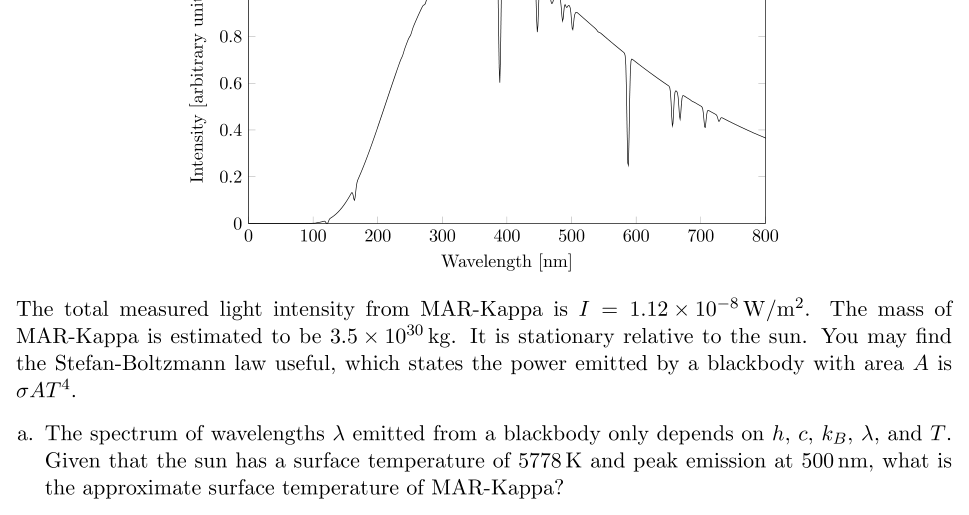 Spettro intensità vs lunghezza d’onda MAR-Kappa
- a. Lo spettro di lunghezze d’onda emesso da un corpo nero dipende solo da , , , e . Dato che il Sole ha temperatura di superficie e picco di emissione a , qual è la temperatura di superficie approssimata di MAR-Kappa?
- b. Le “righe” nello spettro provengono da atomi nella stella che assorbono lunghezze d’onda specifiche della luce emessa. Un contributo all’ampiezza delle righe assorbite è l’allargamento Doppler associato al moto degli atomi nella stella. L’ampiezza spettrale a è di questa riga. Quanta massa di elio è in moto in orbita circolare con raggio ? La massa di un atomo di elio è .
- c. Nel corso di un anno, MAR-Kappa appare oscillare tra due posizioni nel cielo, separate da una separazione angolare di a parte. Quanto dista MAR-Kappa, se si trova nello stesso piano dell’orbita terrestre, di raggio ?
- d. Cos’è il raggio di MAR-Kappa?
- e. Nel corso di un anno si osserva che l’intensità diminuisce di e poi risale a in un tempo . Una possibile spiegazione di tale osservazione è che un esopianeta orbiti la stella bloccando per un certo tempo la luce delle stelle.
- e. Stimare il raggio dell’esopianeta, dato che è molto più piccolo della stella.
- f. Assumendo che un corpo nero in moto con temperatura uniforme in orbita circolare attorno alla stella e che il pianeta abbia temperatura tra e una temperatura massima di (se ci fosse tempo, e il pianeta avesse un’atmosfera adeguata, la temperatura potrebbe restare abbastanza bassa da sostenere la vita).
Topic: Astrophysics, Thermodynamics, Modern-Quantum Physics Metodi: Order-of-Magnitude Estimation, Physical Modeling, Approximation & Series Expansion Competenze: Estimation & Approximation, Mathematical Modeling, Physical Reasoning Objects: Star, Atom, Planet Fonte: Testo (PDF) — p.9
Scientists have recently detected a new star, MAR-Kappa. The star is nearly a perfect black body and its measured intensity spectrum is shown in the figure. The total luminous intensity measured from MAR-Kappa is . The mass of MAR-Kappa is estimated to be . The Stefan-Boltzmann law may be used, which relates the area to the power emitted by a black body with .
Intensity spectrum vs wavelength for MAR-Kappa
-
a. The black body’s wavelength spectrum depends only on , , , and . Given that the Sun has a surface temperature of and its emission peak occurs at , what is the approximate surface temperature of MAR-Kappa?
-
b. The “lines” in the spectrum arise from atoms in the star that absorb specific wavelengths of emitted light. One contribution to the width of these absorption lines is Doppler broadening associated with atomic motion in the star. The spectral width at is for this line. What mass of helium is in circular orbit with radius ? The mass of a helium atom is .
-
c. Over the course of one year, MAR-Kappa appears to oscillate between two positions in the sky, separated by an angular distance of . How far is MAR-Kappa located, assuming it lies in the same plane as Earth’s orbit of radius ?
-
d. What is the radius of MAR-Kappa?
-
e. During one year, it is observed that the brightness decreases by and then rises back to within a time interval . A possible explanation for this observation is that an exoplanet orbits the star, temporarily blocking part of the star’s light.
-
e. Estimate the radius of the exoplanet, given that it is much smaller than the star.
-
f. Assuming a black body in circular orbit around the star with uniform temperature, and that the planet’s temperature ranges between and a maximum of (if sufficient time were available, and if the planet had an appropriate atmosphere, the temperature could remain low enough to sustain life).
Una pallina di massa è posta su una guida orizzontale, lungo la quale può scivolare senza attrito. È attaccata all’estremità di un’asta rigida priva di massa di lunghezza . All’altro capo dell’asta è attaccata una pallina di massa . La pallina di massa è inizialmente in quiete, con l’asta direttamente sopra la pallina di massa . Al sistema viene dato un impulso infinitesimo parallelo alla guida.
Perla su guida con asta e palla (stato iniziale)
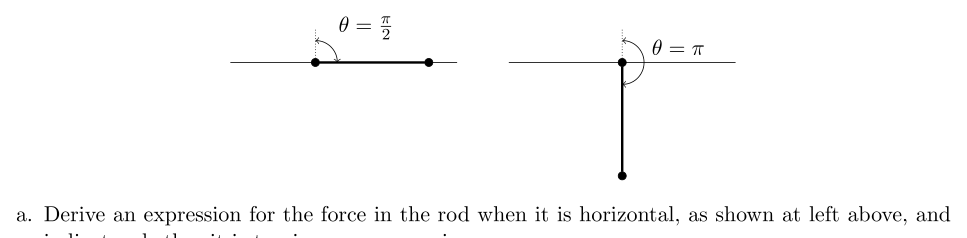 Due stati successivi theta=pi/2 e theta=pi
Si assuma che l’asta e la pallina siano progettate in modo che possano attraversare la guida senza urtarla. In altre parole, la guida vincola solo il moto della pallina (di massa minore). Due stati successivi del sistema sono mostrati: (asta orizzontale, a sinistra) e (asta verticale con la pallina direttamente sotto, a destra).
- a. Ricavare un’espressione per la forza nell’asta quando essa è orizzontale (caso a sinistra), indicando se è di trazione o compressione.
- b. Ricavare un’espressione per la forza nell’asta quando la pallina è direttamente sotto (caso a destra), indicando se è di trazione o compressione.
- c. Sia l’angolo che l’asta forma con la verticale, con l’asta che comincia a . Trovare la velocità angolare in funzione di .
Topic: Newtonian Mechanics, Rotational Dynamics, Conservation of Energy Metodi: Free-Body Diagram, Energy Conservation Method, Torque & Angular Momentum Analysis Competenze: Diagrammatic Reasoning, Mathematical Modeling, Physical Reasoning Objects: Rod, Ball Fonte: Testo (PDF) — p.10
A ball of mass is placed on a horizontal track along which it can slide without friction. It is attached to one end of a massless rigid rod of length . At the other end of the rod, a ball of mass is attached. The ball of mass is initially at rest, with the rod directly above the ball of mass . The system is given an infinitesimal impulse parallel to the track.
Ball on guide with rod and ball (initial state)
Two subsequent states: theta=pi/2 and theta=pi
It is assumed that the rod and ball are designed such that they can pass through the track without colliding with it. In other words, the track constrains only the motion of the ball (the lighter mass). Two subsequent states of the system are shown: (rod horizontal, on the left) and (rod vertical with ball directly below, on the right).
- a. Derive an expression for the force in the rod when it is horizontal (left case), indicating whether it is tensile or compressive.
- b. Derive an expression for the force in the rod when the ball is directly below (right case), indicating whether it is tensile or compressive.
- c. Let be the angle that the rod makes with the vertical, starting from . Find the angular velocity as a function of .