A golf ball is struck and begins to move at an initial velocity of at an angle above the horizontal. Determine at time after the strike
(i) the velocity of the ball, and
(ii) the position of the ball relative to the origin.
[4]
Topic: Newtonian Mechanics Metodi: Kinematic Equations, Vector Decomposition Competenze: Mathematical Modeling, Physical Reasoning Objects: Ball, Projectile Fonte: Testo (PDF) — p.3
Una palla da golf viene colpita e inizia a muoversi a una velocità iniziale di in un angolo sopra l’orizzontale. Determinazione al tempo dopo lo sciopero
(i) la velocità della palla; e
- la posizione della palla rispetto all’origine.
[4]
Topic: Newtonian Mechanics Metodi: Kinematic Equations, Vector Decomposition Competenze: Mathematical Modeling, Physical Reasoning Objects: Ball, Projectile Fonte: Testo (PDF) — p.3
A drone flies horizontally. The displacement of the drone is given by , where and are unit vectors to the East and North respectively. Determine at :
(i) the speed of the drone,
(ii) its bearing in degrees,
(iii) its acceleration.
Note: all bearings are measured clockwise from North.
[3]
Topic: Newtonian Mechanics Metodi: Kinematic Equations, Vector Decomposition Competenze: Mathematical Modeling, Physical Reasoning Objects: — Fonte: Testo (PDF) — p.3
Un drone vola orizzontalmente. Il spostamento del drone è indicato da , dove e sono rispettivamente vettori unitari verso est e nord. Determinazione a :
-
la velocità del drone,
-
il suo peso in gradi,
-
la sua accelerazione.
Nota: tutti i cuscinetti sono misurati in senso orario da nord.
[3]
Topic: Newtonian Mechanics Metodi: Kinematic Equations, Vector Decomposition Competenze: Mathematical Modeling, Physical Reasoning Objects: — Fonte: Testo (PDF) — p.3
Estimate the mass of a piece of paper the size of a pinhead (the blunt end of a sewing pin). Show your calculation.
[2]
Topic: Order-of-Magnitude Estimation Metodi: Order-of-Magnitude Estimation, Dimensional Analysis Competenze: Estimation & Approximation, Physical Reasoning Objects: — Fonte: Testo (PDF) — p.3
Calcolare la massa di un pezzo di carta della dimensione di una testa di pin (la punta impatta di un pin di cucito). Mostrami il tuo calcolo.
[2]
Topic: Order-of-Magnitude Estimation Metodi: Order-of-Magnitude Estimation, Dimensional Analysis Competenze: Estimation & Approximation, Physical Reasoning Objects: — Fonte: Testo (PDF) — p.3
The speed of surface waves of wavelength on a liquid of density is given by
where and are constants. Determine the units of and .
[2]
Topic: Oscillations & Waves Metodi: Dimensional Analysis Competenze: Physical Reasoning, Mathematical Modeling Objects: — Fonte: Testo (PDF) — p.3
La velocità delle onde superficiali di lunghezza d’onda su un liquido di densità è data da:
dove e sono costanti. Determinare le unità di e .
[2]
Topic: Oscillations & Waves Metodi: Dimensional Analysis Competenze: Physical Reasoning, Mathematical Modeling Objects: — Fonte: Testo (PDF) — p.3
Figure 1 shows the cross section of a high voltage overhead electrical transmission cable. The central strand is of steel and the six outer strands are of aluminium. The resistivity of steel is , and that of aluminium . The cross-sectional area of each strand is . The steel is present to give mechanical strength to the cable and only reduces the resistance of a length of cable by when it is included. Calculate the length of the cable.
[5]
 Cross section of 7-strand overhead cable
Topic: Circuits, Electromagnetism Metodi: Equivalent Circuit Reduction, Physical Modeling Competenze: Physical Reasoning, Mathematical Modeling Objects: Wire Fonte: Testo (PDF) — p.3
La figura 1 mostra la sezione trasversale di un cavo di trasmissione elettrica a alta tensione. Il filo centrale è di acciaio e i sei fili esterni sono di alluminio. La resistenza dell’acciaio è e quella dell’alluminio . La superficie trasversale di ciascun filo è . L’acciaio è presente per dare una resistenza meccanica al cavo e riduce solo la resistenza di una lunghezza del cavo di quando è incluso. Calcola la lunghezza del cavo.
[5]
Sezione trasversale del cavo a 7 fili
Topic: Circuits, Electromagnetism Metodi: Equivalent Circuit Reduction, Physical Modeling Competenze: Physical Reasoning, Mathematical Modeling Objects: Wire Fonte: Testo (PDF) — p.3
Platinum (symbol Pt) and potassium (symbol K) have densities of and respectively. How many cubic centimetres (cm) of platinum could be attached to of potassium before the combination sinks in mercury of density ? Ignore any chemical reactions.
[4]
Topic: Fluid Mechanics Metodi: Hydrostatic Equilibrium, Physical Modeling Competenze: Physical Reasoning, Mathematical Modeling Objects: — Fonte: Testo (PDF) — p.4
Il platino (simbolo Pt) e il potassio (simbolo K) hanno rispettivamente densità e . Quanti centimetri cubi (cm) di platino possono essere attaccati a di potassio prima che la combinazione si scomponi in mercurio di densità ? Ignora le reazioni chimiche.
[4]
Topic: Fluid Mechanics Metodi: Hydrostatic Equilibrium, Physical Modeling Competenze: Physical Reasoning, Mathematical Modeling Objects: — Fonte: Testo (PDF) — p.4
One kilogram of ice at is placed in a thermally insulated bucket of volume 5 litres. Water at is added until the bucket is completely filled. Calculate the temperature of the water when half of the ice has melted.
Latent heat of fusion of ice,
Specific thermal capacity of water,
Densities: and
[5]
Topic: Thermodynamics Metodi: First Law of Thermodynamics, Conservation of Energy Competenze: Physical Reasoning, Mathematical Modeling Objects: Calorimeter, Container Fonte: Testo (PDF) — p.4
Un chilogrammo di ghiaccio viene messo in un secchio termicamente isolato di 5 litri. Aggiunge acqua a fino a quando il secchio non è completamente riempito. Calcolare la temperatura dell’acqua quando la metà del ghiaccio si è sciolta.
Calore latente di fusione del ghiaccio,
Capacità termica specifica dell’acqua,
Densità: e
[5]
Topic: Thermodynamics Metodi: First Law of Thermodynamics, Conservation of Energy Competenze: Physical Reasoning, Mathematical Modeling Objects: Calorimeter, Container Fonte: Testo (PDF) — p.4
This question concerns three vessels at sea: a ferry (F), a container ship (C), and a pilot boat (P). The ferry is sailing on a bearing of at . Relative to the ferry, the container ship is sailing on a bearing of . The pilot boat is sailing on a bearing of at , and the pilot boat observes the container ship moving on a bearing of .
Determine the speed and direction of the container ship relative to the water.
Note: all bearings are measured clockwise from North.
[7]
Topic: Newtonian Mechanics Metodi: Vector Decomposition, Kinematic Equations Competenze: Mathematical Modeling, Physical Reasoning Objects: — Fonte: Testo (PDF) — p.4
La questione riguarda tre navi in mare: un traghetto (F), un container (C) e una barca pilota (P). Il traghetto naviga su un cuscinetto a . Relativamente al traghetto, la nave container naviga su un cuscinetto . Il peschereccio pilota naviga su un cuscinetto a e il peschereccio pilota osserva il container che si muove su un cuscinetto .
Determinare la velocità e la direzione della nave contenitore rispetto all’acqua.
Nota: tutti i cuscinetti sono misurati in senso orario da nord.
[7]
Topic: Newtonian Mechanics Metodi: Vector Decomposition, Kinematic Equations Competenze: Mathematical Modeling, Physical Reasoning Objects: — Fonte: Testo (PDF) — p.4
A car accelerates from a standing start. If the mass of the car is , and the car is driven at constant driving power , find an expression for the velocity of the car as a function of distance travelled from a standing start, . Ignore resistive effects and inefficiencies in power transmission.
[4]
Topic: Newtonian Mechanics, Conservation of Energy Metodi: Energy Conservation Method, Calculus-Integration Competenze: Mathematical Modeling, Physical Reasoning Objects: — Fonte: Testo (PDF) — p.4
Una macchina accelera da un punto di partenza fermo. Se la massa dell’auto è e l’auto è guidata a potenza di guida costante , trovare un’espressione per la velocità dell’auto come funzione della distanza percorsa da un partenza fermata, . Ignorare gli effetti di resistenza e le inefficienze nella trasmissione di energia.
[4]
Topic: Newtonian Mechanics, Conservation of Energy Metodi: Energy Conservation Method, Calculus-Integration Competenze: Mathematical Modeling, Physical Reasoning Objects: — Fonte: Testo (PDF) — p.4
An experiment is proposed which involves submerging a ball of mass and radius to a depth of in a swimming pool. The ball is then released, and emerges from the water and rises to a height above the surface. The quantities and are measured from the centre of the ball to the water surface.
An initial model is proposed, which ignores any resistive effects and the inertia of the water. Determine the prediction this initial model makes for the ratio in terms of , and the density of water, .
[5]
Topic: Fluid Mechanics, Newtonian Mechanics, Conservation of Energy Metodi: Energy Conservation Method, Hydrostatic Equilibrium, Physical Modeling Competenze: Physical Reasoning, Mathematical Modeling Objects: Ball Fonte: Testo (PDF) — p.4
Si propone un esperimento che prevede l’immersione in una piscina di una palla di massa e di raggio a una profondità . La palla viene quindi rilasciata, e emerge dall’acqua e sale ad un’altezza sopra la superficie. Le quantità e sono misurate dal centro della palla alla superficie dell’acqua.
Si propone un modello iniziale che ignora gli effetti di resistenza e l’inerzia dell’acqua. Determinare la previsione che questo modello iniziale fa per il rapporto in termini di , e densità dell’acqua, .
[5]
Topic: Fluid Mechanics, Newtonian Mechanics, Conservation of Energy Metodi: Energy Conservation Method, Hydrostatic Equilibrium, Physical Modeling Competenze: Physical Reasoning, Mathematical Modeling Objects: Ball Fonte: Testo (PDF) — p.4
A sand timer is a sealed glass vessel with a narrow section acting as a constraint, so that sand can flow through at a steady rate. A fifteen minute sand timer is shown in Figure 2 below. Unlike a liquid, the rate of flow of sand grains through the constrained section is independent of the height of the sand above.
Thus the rate of flow of sand through the timer can be expressed as a product of powers of the remaining relevant variables:
where is a dimensionless constant, is the density of the sand, is the cross sectional area at the narrowest point, and is the gravitational field strength, and , , are numbers.
(i) By considering the units of the variables on each side of the equation, find the values of , and .
(ii) On the Moon, the gravitational field strength is . How long would the sand timer last on the Moon if it runs for 15 minutes on Earth?
[4]
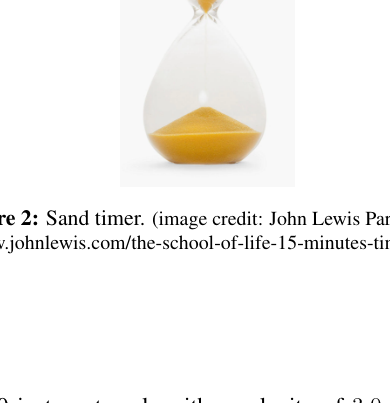 Fifteen-minute sand timer, narrow waist
Topic: Newtonian Mechanics, Order-of-Magnitude Estimation Metodi: Dimensional Analysis, Physical Modeling Competenze: Physical Reasoning, Mathematical Modeling Objects: Container Fonte: Testo (PDF) — p.5
Un timer di sabbia è un recipiente di vetro sigillato con una sezione stretta che funge da vincolo, in modo che la sabbia possa fluire a un ritmo costante. Il timer di sabbia di quindici minuti è mostrato nella figura 2 qui sotto. A differenza di un liquido, il flusso di granelli di sabbia attraverso la sezione ristretta è indipendente dall’altezza della sabbia sopra.
Il tasso di flusso di sabbia attraverso il timer può quindi essere espresso come prodotto delle potenze delle restanti variabili rilevanti:
se è una costante senza dimensioni, è la densità della sabbia, è l’area trasversale del punto più stretto e è la forza del campo gravitazionale e , , sono numeri.
(i) Considerando le unità delle variabili su ciascun lato dell’equazione, trovare i valori di , e .
(ii) sulla Luna, la forza del campo gravitazionale è . Quanto durerebbe il timer di sabbia sulla Luna se funzionasse per 15 minuti sulla Terra?
[4]
15 minuti di tempo di sabbia, vita stretta
Topic: Newtonian Mechanics, Order-of-Magnitude Estimation Metodi: Dimensional Analysis, Physical Modeling Competenze: Physical Reasoning, Mathematical Modeling Objects: Container Fonte: Testo (PDF) — p.5
An excited neon-20 isotope travels with a velocity of into a detector and disintegrates into an alpha particle and oxygen-16. The event produces an additional of kinetic energy. The oxygen nucleus leaves the event at right angles to the path of the original neon nucleus.
Determine the velocity of the alpha particle. Relativistic effects may be neglected.
[5]
Topic: Nuclear & Particle Physics, Conservation of Momentum, Conservation of Energy Metodi: Conservation of Momentum, Conservation of Energy, Physical Modeling Competenze: Mathematical Modeling, Physical Reasoning Objects: Nucleus Fonte: Testo (PDF) — p.5
Un isotopo di neone-20 eccitato viaggia con una velocità di in un rilevatore e si disintegra in una particella alfa e ossigeno-16. L’evento produce un’ulteriore di energia cinetica. Il nucleo di ossigeno lascia l’evento ad angolo retto verso il percorso del nucleo di neon originale.
Determina la velocità della particella alfa. Gli effetti relativistici possono essere trascurati.
[5]
Topic: Nuclear & Particle Physics, Conservation of Momentum, Conservation of Energy Metodi: Conservation of Momentum, Conservation of Energy, Physical Modeling Competenze: Mathematical Modeling, Physical Reasoning Objects: Nucleus Fonte: Testo (PDF) — p.5
An aeroplane flies due East along the equator at a constant low altitude and constant speed relative to the ground. On the aeroplane, a one kilogram mass is suspended on a spring balance and records a weight . The aeroplane then flies due West along the equator, at the same altitude and speed, and measures a balance reading of .
If the speed of the plane relative to the ground is , calculate the difference in apparent weights.
[5]
Topic: Newtonian Mechanics, Gravitation Metodi: Free-Body Diagram, Kinematic Equations, Physical Modeling Competenze: Physical Reasoning, Mathematical Modeling Objects: Spring Fonte: Testo (PDF) — p.6
Un aereo vola verso est lungo l’equatore a una costante bassa quota e velocità costante rispetto al suolo. L’aeroplano ha una massa di un chilogrammo sospesa su una bilancia di molla e registra un peso . L’aeroplano vola quindi verso ovest lungo l’equatore, alla stessa quota e velocità, e misura una lettura di equilibrio di .
Se la velocità del piano rispetto al terreno è , calcolare la differenza di pesi apparenti.
[5]
Topic: Newtonian Mechanics, Gravitation Metodi: Free-Body Diagram, Kinematic Equations, Physical Modeling Competenze: Physical Reasoning, Mathematical Modeling Objects: Spring Fonte: Testo (PDF) — p.6
Two glass bulbs are connected by a thin tube. One glass bulb has a volume of , the other , and gas can move freely between them. Initially the system contains nitrogen at and . The smaller bulb is then warmed to , whilst the larger bulb is maintained at .
Calculate the new pressure in the system. Assume the thermal expansion of the bulbs and the volume of the connecting tube are negligible.
[5]
Topic: Thermodynamics, Kinetic Theory Metodi: Ideal Gas Law, Physical Modeling Competenze: Physical Reasoning, Mathematical Modeling Objects: Gas, Container, Tube Fonte: Testo (PDF) — p.6
Due lampadine di vetro sono collegate da un tubo sottile. Una lampadina di vetro ha un volume di , l’altra e il gas può muoversi liberamente tra di loro. Inizialmente il sistema contiene azoto a e . La lampadina più piccola viene quindi riscaldata a , mentre la lampadina più grande viene mantenuta a .
Calcola la nuova pressione nel sistema. Supponiamo che l’espansione termica delle lampadine e il volume del tubo di connessione siano trascurabili.
[5]
Topic: Thermodynamics, Kinetic Theory Metodi: Ideal Gas Law, Physical Modeling Competenze: Physical Reasoning, Mathematical Modeling Objects: Gas, Container, Tube Fonte: Testo (PDF) — p.6
Determine the current in the resistor shown in Figure 3. The cells have no internal resistance.
(Figure 3: circuit with and resistors on the left branch, a resistor in the middle, a cell and a cell.)
[5]
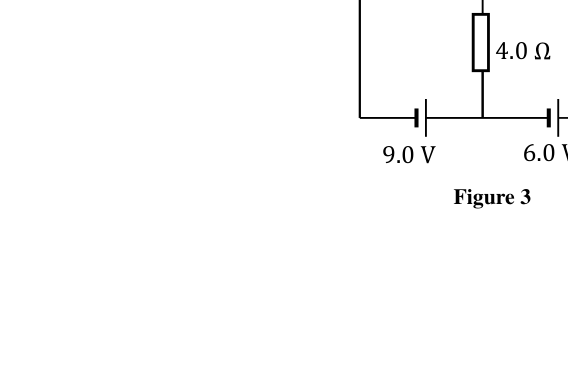 Three-branch circuit with two cells
Topic: Circuits Metodi: Kirchhoff’s Laws, Equivalent Circuit Reduction Competenze: Physical Reasoning, Mathematical Modeling Objects: Resistor, Battery Fonte: Testo (PDF) — p.6
Determina la corrente nella resistenza mostrata alla figura 3. Le cellule non hanno resistenza interna.
(Figura 3: circuito con resistori e sul ramo sinistro, resistore al centro, cellula e cellula .)
[5]
Circuito a tre rami con due celle
Topic: Circuits Metodi: Kirchhoff’s Laws, Equivalent Circuit Reduction Competenze: Physical Reasoning, Mathematical Modeling Objects: Resistor, Battery Fonte: Testo (PDF) — p.6
An electrically isolated copper sphere of radius is illuminated by light of wavelength . Determine
(i) the maximum electric potential that the copper sphere can reach
(ii) the number of electrons lost reaching the maximum potential
(Work function of copper )
[4]
Topic: Modern-Quantum Physics, Electrostatics Metodi: Photon Energy Relation, Electric Potential Method, Physical Modeling Competenze: Physical Reasoning, Mathematical Modeling Objects: Conducting Sphere, Photon, Electron Fonte: Testo (PDF) — p.6
Una sfera di rame elettricamente isolata di raggio è illuminata da luce di lunghezza d’onda . Determinazione
-
il potenziale elettrico massimo raggiungibile dalla sfera di rame
-
il numero di elettroni persi che raggiunge il potenziale massimo
(Funzione di lavoro del rame )
[4]
Topic: Modern-Quantum Physics, Electrostatics Metodi: Photon Energy Relation, Electric Potential Method, Physical Modeling Competenze: Physical Reasoning, Mathematical Modeling Objects: Conducting Sphere, Photon, Electron Fonte: Testo (PDF) — p.6
Three conducting spheres of radii , and are mounted on insulating rods, and are well separated from each other. The and spheres are each charged to a potential , whilst the sphere is uncharged. Then a thin copper wire is used to briefly connect all three spheres. What fraction of the original charge on the two spheres is now on the sphere?
[5]
Topic: Electrostatics Metodi: Electric Potential Method, Physical Modeling, Superposition Principle Competenze: Physical Reasoning, Mathematical Modeling Objects: Conducting Sphere, Wire Fonte: Testo (PDF) — p.7
Tre sfere conduttrici di raggio , e sono montate su bastone isolanti e ben separate tra loro. Le sfere e sono ciascuna carica a un potenziale , mentre la sfera è scarica. Poi viene utilizzato un sottile filo di rame per collegare brevemente tutte e tre le sfere. Qual è la frazione della carica originale sulle due sfere che si trova ora sulla sfera ?
[5]
Topic: Electrostatics Metodi: Electric Potential Method, Physical Modeling, Superposition Principle Competenze: Physical Reasoning, Mathematical Modeling Objects: Conducting Sphere, Wire Fonte: Testo (PDF) — p.7
The thermal power flowing by conduction through a surface is proportional to the temperature difference across the surface, , the area of the surface, , and inversely proportional to the thickness . The constant of proportionality is known as the thermal conductivity.
A composite rod, of constant cross section, is made of lengths of steel, copper and aluminium joined together. The rod is well insulated. The tip of the steel end of the rod is maintained at and the tip of the aluminium end at . What are the temperatures at each of the two junctions of dissimilar metals?
Thermal conductivities are as follows: steel ; copper ; aluminium .
[5]
Topic: Thermodynamics Metodi: Physical Modeling, Conservation of Energy, Differential Equations Competenze: Physical Reasoning, Mathematical Modeling Objects: Rod Fonte: Testo (PDF) — p.7
La potenza termica che fluisce con conduzione attraverso una superficie è proporzionale alla differenza di temperatura della superficie, , alla superficie, , e inverso proporzionale allo spessore . La costante di proporzionalità è conosciuta come la conducibilità termica.
Una canna composta , di sezione incrociata costante, è costituita da lunghezze di acciaio, rame e alluminio uniti. La canna è ben isolata. La punta dell’estremità in acciaio della canna è mantenuta a e la punta dell’estremità in alluminio a . Quali sono le temperature di ciascuna delle due unioni di metalli diversi?
Le conduttività termiche sono le seguenti: acciaio ; rame ; alluminio .
[5]
Topic: Thermodynamics Metodi: Physical Modeling, Conservation of Energy, Differential Equations Competenze: Physical Reasoning, Mathematical Modeling Objects: Rod Fonte: Testo (PDF) — p.7
A bicycle pump of cross-sectional area has one end sawn off and a cork is fitted into the end. The piston is pushed slowly inwards and the cork is fired out with a popping sound which has a frequency of . The initial distance between the cork and the piston is , with atmospheric pressure equal to and the speed of sound in air being .
Calculate the force required to eject the cork.
[4]
Topic: Thermodynamics, Oscillations & Waves Metodi: Ideal Gas Law, Wave Equation, Physical Modeling Competenze: Physical Reasoning, Mathematical Modeling Objects: Piston, Tube Fonte: Testo (PDF) — p.7
Una pompa per biciclette con superficie di sezione trasversale ha una estremità tagliata e un corteccio è montato nella estremità. Il pistone viene spinto lentamente verso l’interno e il cortico viene spinto con un suono di scattamento che ha una frequenza . La distanza iniziale tra il galleggiatore e il pistone è , con pressione atmosferica pari a e velocità del suono nell’aria .
Calcolare la forza necessaria per espellere il corteccio.
[4]
Topic: Thermodynamics, Oscillations & Waves Metodi: Ideal Gas Law, Wave Equation, Physical Modeling Competenze: Physical Reasoning, Mathematical Modeling Objects: Piston, Tube Fonte: Testo (PDF) — p.7
A cup of tea cools from to in 1 minute, in an ambient temperature of . Assuming the tea cools at a rate directly proportional to the temperature difference between the tea and the surroundings, calculate how long it will take for the tea to cool from to .
[5]
Topic: Thermodynamics Metodi: Differential Equations, Physical Modeling, Approximation & Series Expansion Competenze: Mathematical Modeling, Physical Reasoning Objects: — Fonte: Testo (PDF) — p.7
Una tazza di tè si raffredda da a in 1 minuto, a una temperatura ambiente di . Supponendo che il tè si raffreddi a un ritmo direttamente proporzionale alla differenza di temperatura tra il tè e l’ambiente circostante, calcolare il tempo necessario per raffreddare il tè da a .
[5]
Topic: Thermodynamics Metodi: Differential Equations, Physical Modeling, Approximation & Series Expansion Competenze: Mathematical Modeling, Physical Reasoning Objects: — Fonte: Testo (PDF) — p.7