- A ball is launched straight toward the ground from height . When it bounces off the ground, it loses half of its kinetic energy. It reaches a maximum height of before falling back to the ground again. What was the initial speed of the ball?
- A.
- B.
- C.
- D.
- E.
Topic: Conservation of Energy, Newtonian Mechanics Metodi: Energy Conservation Method, Kinematic Equations Competenze: Mathematical Modeling, Physical Reasoning Objects: Ball Fonte: Testo (PDF) — p.2
- Una palla viene lanciata direttamente verso il suolo da un’altezza . Quando rimbalza dal terreno, perde la metà della sua energia cinetica. raggiunge un’altezza massima di prima di cadere a terra
- Ancora una volta. Qual era la velocità iniziale della palla?
- A.
- B.
- C.
- D.
- E.
Topic: Conservation of Energy, Newtonian Mechanics Metodi: Energy Conservation Method, Kinematic Equations Competenze: Mathematical Modeling, Physical Reasoning Objects: Ball Fonte: Testo (PDF) — p.2
- A rigid ball of radius is rolling without slipping along the rib of a right-angle chute, as shown at left. A cross section of the ball, taken perpendicular to the ball’s direction of travel, is shown at right. Which of the marked point(s) of the ball have the highest speed?
- A. All the marked points have the same speed.
- B. The contact points and .
- C. The center .
- D. The point .
- E. The point .
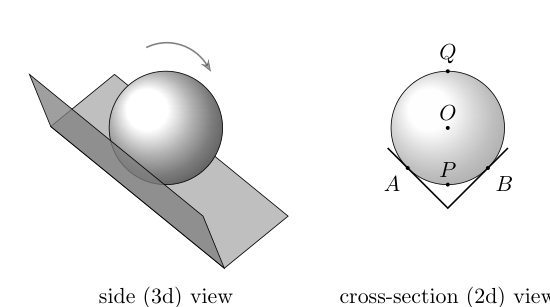 sfera su spigolo scanalatura ad angolo retto
Topic: Rotational Dynamics, Newtonian Mechanics Metodi: Physical Modeling, Vector Decomposition Competenze: Diagrammatic Reasoning, Physical Reasoning Objects: Ball Fonte: Testo (PDF) — p.2
- Una palla rigida di raggio ruota senza scivolare lungo la costola di un paracadute a angolo retto, come mostrato al punto
- A sinistra. Una sezione trasversale della palla, presa perpendicolare alla direzione di spostamento della palla, è mostrata a destra. Quale dei punti segnati della palla ha la velocità più alta?
- A. Tutti i punti segnalati hanno la stessa velocità.
- B. I punti di contatto e .
- C. Il centro .
- D. Il punto .
- E. Il punto .
sfera su spigolo scanalatura ad angolo retto
Topic: Rotational Dynamics, Newtonian Mechanics Metodi: Physical Modeling, Vector Decomposition Competenze: Diagrammatic Reasoning, Physical Reasoning Objects: Ball Fonte: Testo (PDF) — p.2
- When an axe is swung with kinetic energy directly at a piece of wood, the edge of the axe is buried a depth into the wood. If the axe is swung with kinetic energy , how deep will it be buried into the wood? Assume that the axe is wedge-shaped with a constant angle and that the force per unit contact area between the axe and the wood during the impact is proportional to the depth.
- A.
- B.
- C.
- D.
- E.
Topic: Conservation of Energy, Newtonian Mechanics Metodi: Energy Conservation Method, Calculus-Integration Competenze: Mathematical Modeling, Physical Reasoning Objects: Wedge Fonte: Testo (PDF) — p.2
- Quando un’ascia è oscillata con energia cinetica direttamente su un pezzo di legno, il bordo dell’ascia è seppellito a una profondità nel legno. Se l’ascia viene oscillata con energia cinetica , quanto profondità avrà
- Seppellito nel bosco? Supponiamo che l’ascia sia a forma di cucina con un angolo costante e che la la forza per unità di superficie di contatto tra l’ascia e il legno durante l’impatto è proporzionale alla profondità.
- A.
- B.
- C.
- D.
- E.
Topic: Conservation of Energy, Newtonian Mechanics Metodi: Energy Conservation Method, Calculus-Integration Competenze: Mathematical Modeling, Physical Reasoning Objects: Wedge Fonte: Testo (PDF) — p.2
- Four identical rods, each of mass and length , are joined together to form a square. The square is then spun around its center, as shown in the figure, at an angular frequency of . What is the magnitude of the force that the joints between the rods (at the corners of the square) must bear?
- A.
- B.
- C.
- D.
- E.
Topic: Rotational Dynamics, Newtonian Mechanics Metodi: Free-Body Diagram, Torque & Angular Momentum Analysis, Vector Decomposition Competenze: Diagrammatic Reasoning, Mathematical Modeling Objects: Rod Fonte: Testo (PDF) — p.2
- Quattro barre identiche, ciascuna di massa e lunghezza , sono unite per formare un quadrato. La piazza si gira quindi intorno al suo centro, come mostrato nella figura, ad una frequenza angolare di . Che cos’è la forza che le articolazioni tra le barre (all’angolo del quadrato) devono sostenere?
- A.
- B.
- C.
- D.
- E.
Topic: Rotational Dynamics, Newtonian Mechanics Metodi: Free-Body Diagram, Torque & Angular Momentum Analysis, Vector Decomposition Competenze: Diagrammatic Reasoning, Mathematical Modeling Objects: Rod Fonte: Testo (PDF) — p.2
- A pendulum of length oscillates inside a box. A person picks up the box and gently shakes it horizontally with frequency and a fixed amplitude for a fixed time. The final amplitude can be maximized if satisfies
- A.
- B.
- C.
- D. There will be no effect on the amplitude for any value of .
- E. None of the above
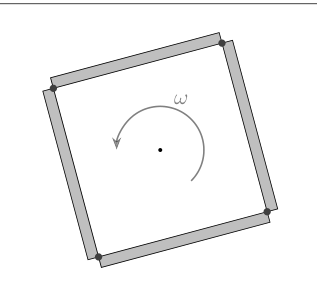 pendolo oscillante dentro una scatola
Topic: Oscillations & Waves Metodi: Simple Harmonic Motion Analysis, Superposition Principle Competenze: Physical Reasoning, Mathematical Modeling Objects: Pendulum Fonte: Testo (PDF) — p.3
- Un pendolo di lunghezza oscilla all’interno di una scatola. Una persona prende la scatola e la scuote delicatamente orizzontale con frequenza e amplitudine fissa per un tempo determinato. L’ampiezza finale può essere massimizzazione se soddisfa
- A.
- B.
- C.
- D. Non vi sarà alcun effetto sull’ampiezza per alcun valore di .
- E. Nessuna delle seguenti:
pendolo oscillante all’interno di una scatola
Topic: Oscillations & Waves Metodi: Simple Harmonic Motion Analysis, Superposition Principle Competenze: Physical Reasoning, Mathematical Modeling Objects: Pendulum Fonte: Testo (PDF) — p.3
- A planet is orbiting a star in a circular orbit of radius . Over a very long period of time, much greater than the period of the orbit, the star slowly and steadily loses 1% of its mass. Throughout the process, the planet’s orbit remains approximately circular. The final orbit radius is closest to
- A.
- B.
- C.
- D.
- E.
Topic: Gravitation, Astrophysics Metodi: Newton’s Law of Gravitation, Kepler’s Laws, Conservation Laws Competenze: Mathematical Modeling, Estimation & Approximation Objects: Planet, Star Fonte: Testo (PDF) — p.3
- Un pianeta orbita intorno a una stella in un’orbita circolare di raggio . Nel corso di un lungo periodo di tempo, molti maggiore del periodo di orbita, la stella perde lentamente e costantemente l’1% della sua massa. In tutto Il processo, l’orbita del pianeta rimane circolare. Il raggio di orbita finale è il più vicino a
- A.
- B.
- C.
- D.
- E.
Topic: Gravitation, Astrophysics Metodi: Newton’s Law of Gravitation, Kepler’s Laws, Conservation Laws Competenze: Mathematical Modeling, Estimation & Approximation Objects: Planet, Star Fonte: Testo (PDF) — p.3
- An astronaut standing on the exterior of the international space station wants to dispose of three pieces of trash. They face the station’s direction of travel with the Earth to their left. From the astronaut’s perspective, the three pieces are thrown (I) left, (II) right, and (III) up. To the astronaut’s frustration, some of the pieces of trash return to the space station after several hours. They are
- A. II only
- B. III only
- C. I and II
- D. II and III
- E. I, II, and III
Topic: Gravitation, Astrophysics Metodi: Newton’s Law of Gravitation, Physical Modeling Competenze: Physical Reasoning, Estimation & Approximation Objects: Satellite Fonte: Testo (PDF) — p.3
- Un astronauta che sta all’esterno della stazione spaziale internazionale vuole smaltire tre pezzi di spazzatura. Si affacciano sulla direzione di viaggio della stazione con la Terra a sinistra. Da dalla prospettiva dell’astronauta, i tre pezzi vengono gettati (I) a sinistra, (II) a destra e (III) in alto. - Al Frustrazione degli astronauti, alcuni pezzi di spazzatura tornano alla stazione spaziale dopo diverse ore. Sono
- solo A. II
- solo B. III
- C. I e II
- D. II e III
- E. I, II e III
Topic: Gravitation, Astrophysics Metodi: Newton’s Law of Gravitation, Physical Modeling Competenze: Physical Reasoning, Estimation & Approximation Objects: Satellite Fonte: Testo (PDF) — p.3
- The velocity versus position plot of a particle is shown below. Which following choices is the correct acceleration vs. position plot of the particle? The following information is relevant to problems 9 and 10.
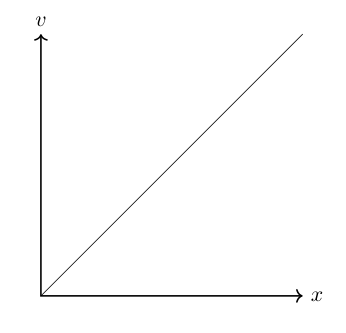 grafico velocita vs posizione dato
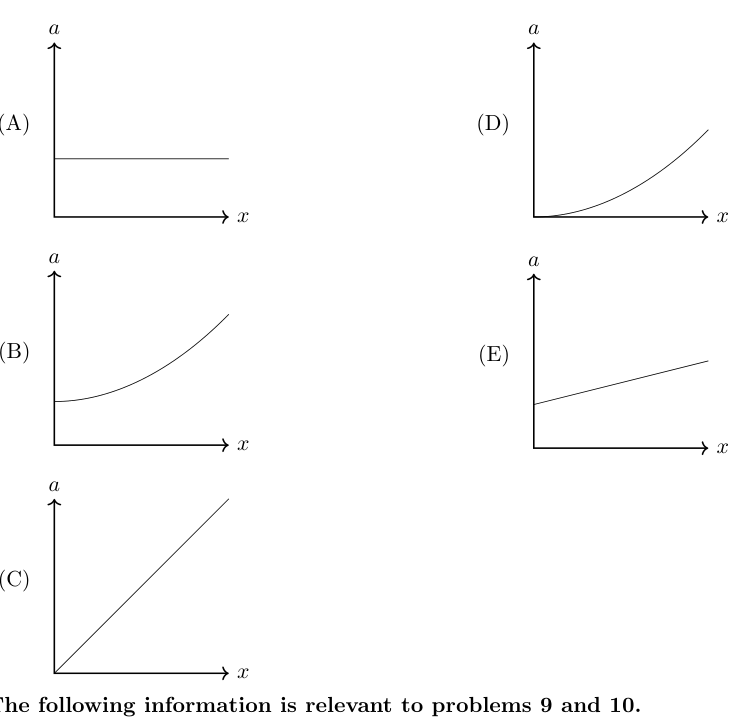 grafici accelerazione vs posizione scelte A-E
Topic: Newtonian Mechanics Metodi: Kinematic Equations, Physical Modeling Competenze: Graph Linearization, Physical Reasoning Objects: — Fonte: Testo (PDF) — p.4
- La grafica velocità contro posizione di una particella è mostrata di seguito. Che le scelte seguenti sono le giuste accelerazione vs. la posizione della particella? Le seguenti informazioni sono pertinenti per i problemi 9 e 10.
grafico velocita vs posizione dato
*grafici accelerazione vs posizione scelte A-E *
Topic: Newtonian Mechanics Metodi: Kinematic Equations, Physical Modeling Competenze: Graph Linearization, Physical Reasoning Objects: — Fonte: Testo (PDF) — p.4
- A block of mass is attached to a massless string. The string is passed over a massless pulley and the end of the string is fixed in place. The horizontal part of the string has length . Now a small mass is hung from the horizontal part of the string, and the system comes to equilibrium. (Diagram not necessarily to scale.) Neglecting friction everywhere, the tension at the end of the string is
- A.
- B.
- C.
- D.
- E.
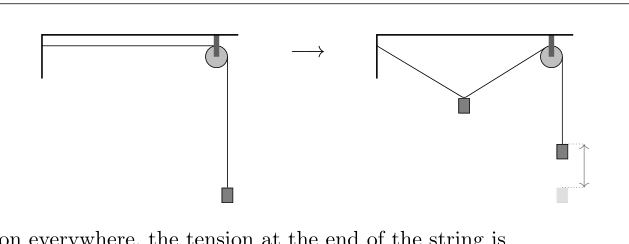 sistema blocco corda puleggia fissa
Topic: Newtonian Mechanics, Rigid Body Statics Metodi: Free-Body Diagram, Vector Decomposition Competenze: Diagrammatic Reasoning, Mathematical Modeling Objects: Block, String, Pulley Fonte: Testo (PDF) — p.4
- Un blocco di massa è attaccato a una stringa senza massa. La corda è passata su una pollice senza massa e la fine della corda è fissata. La parte orizzontale della corda ha una lunghezza . Ora un la piccola massa viene appesa alla parte orizzontale della corda e il sistema si equilibra. (Grafico non necessariamente a scala.) Nonostante la friczione ovunque, la tensione alla fine della corda è
- A.
- B.
- C.
- D.
- E.
*sistema blocco corda puleggia fissa *
Topic: Newtonian Mechanics, Rigid Body Statics Metodi: Free-Body Diagram, Vector Decomposition Competenze: Diagrammatic Reasoning, Mathematical Modeling Objects: Block, String, Pulley Fonte: Testo (PDF) — p.4
- During this process, the block has been raised by approximately a height
- A.
- B.
- C.
- D.
- E.
Topic: Newtonian Mechanics Metodi: Free-Body Diagram, Approximation & Series Expansion, Physical Modeling Competenze: Mathematical Modeling, Estimation & Approximation Objects: Block Fonte: Testo (PDF) — p.5
- Durante questo processo, il blocco è stato sollevato di circa un’altezza
- A.
- B.
- C.
- D.
- E.
Topic: Newtonian Mechanics Metodi: Free-Body Diagram, Approximation & Series Expansion, Physical Modeling Competenze: Mathematical Modeling, Estimation & Approximation Objects: Block Fonte: Testo (PDF) — p.5
- The maximal tension per area a material can sustain without failure is called its tensile strength. Plain steel has a tensile strength of 415 MPa. What is the maximal mass one can hang on a vertical steel rod of negligible mass and a diameter of ?
- A. 1300 kg
- B. 5200 kg
- C. 13 000 kg
- D. 52 000 kg
- E. The answer depends on the length of the steel rod.
Topic: Elasticity & Materials, Newtonian Mechanics Metodi: Stress-Strain Analysis, Physical Modeling Competenze: Physical Reasoning, Unit Conversion Objects: Rod Fonte: Testo (PDF) — p.5
- La tensione massima per area che un materiale può sostenere senza guasto si chiama resistenza alla trazione. L’acciaio semplice ha una resistenza alla trazione di 415 MPa. Qual è la massa massima che si può appendere su una verticale una canna di acciaio di massa trascurabile e di diametro ?
- A. 1300 kg
- B. 5200 kg
- C. 13 000 kg
- D. 52 000 kg
- E. La risposta dipende dalla lunghezza della canna d’acciaio.
Topic: Elasticity & Materials, Newtonian Mechanics Metodi: Stress-Strain Analysis, Physical Modeling Competenze: Physical Reasoning, Unit Conversion Objects: Rod Fonte: Testo (PDF) — p.5
- A point mass is glued inside a massless hollow rod of length at an unknown location. When the rod is pivoted at one end, the period of small oscillations is . When the rod is pivoted at the other end, the period of small oscillations is . How far is the mass from the center?
- A.
- B.
- C.
- D.
- E.
Topic: Oscillations & Waves, Newtonian Mechanics Metodi: Simple Harmonic Motion Analysis, Free-Body Diagram Competenze: Mathematical Modeling, Physical Reasoning Objects: Rod, Pendulum Fonte: Testo (PDF) — p.5
- Una massa puntaria è incollata all’interno di una barra vuota senza massa di lunghezza in un luogo sconosciuto. Quando la canna è rotata ad una estremità, il periodo di piccole oscillazioni è . Quando la canna è girata al all’altra estremità, il periodo di piccole oscillazioni è . Quanto è lontano la massa dal centro?
- A.
- B.
- C.
- D.
- E.
Topic: Oscillations & Waves, Newtonian Mechanics Metodi: Simple Harmonic Motion Analysis, Free-Body Diagram Competenze: Mathematical Modeling, Physical Reasoning Objects: Rod, Pendulum Fonte: Testo (PDF) — p.5
- A ballerina with moment of inertia is quickly twirling with angular velocity . In her hand she has a pen of mass at a radius from her axis of rotation. The ballerina releases the pen. Afterward, what happens to the vertical component of the angular momentum of the system consisting of the ballerina and the pen? You may ignore all friction, but not gravity or normal forces.
- A. It decreases until the pen hits the floor.
- B. It increases until the pen hits the floor.
- C. It always stays the same.
- D. It initially stays the same, but decreases when the pen hits the floor.
- E. It initially stays the same, but increases when the pen hits the floor.
Topic: Rotational Dynamics, Conservation of Momentum Metodi: Torque & Angular Momentum Analysis, Conservation Laws, Free-Body Diagram Competenze: Physical Reasoning, Diagrammatic Reasoning Objects: Ball Fonte: Testo (PDF) — p.5
- Una ballerina con un momento di inerzia ruota rapidamente con una velocità angolare . Nella sua mano ha una penna di massa a un raggio dal suo asse di rotazione. La ballerina rilascia la penna. Dopo, che cosa succede alla componente verticale del momento angolare del sistema composto dalla Ballerina e penna? Potresti ignorare tutti gli attriti, ma non la gravità o le forze normali.
- A. Si riduce fino a quando la penna non colpisce il pavimento.
- B. Si aumenta fino a quando la penna non colpisce il pavimento.
- C. rimane sempre lo stesso.
- D. Inizialmente rimane lo stesso, ma diminuisce quando la penna colpisce il pavimento.
- E. Inizialmente rimane lo stesso, ma aumenta quando la penna colpisce il pavimento.
Topic: Rotational Dynamics, Conservation of Momentum Metodi: Torque & Angular Momentum Analysis, Conservation Laws, Free-Body Diagram Competenze: Physical Reasoning, Diagrammatic Reasoning Objects: Ball Fonte: Testo (PDF) — p.5
- Two blocks of mass are placed on top of each other, and the bottom block is placed on the ground. The ground is frictionless. The static and kinetic coefficients of friction between the two blocks are and , with . The blocks are at rest initially. When a constant horizontal force is then applied to the bottom block, which of the following graphs could show its acceleration as a function of ?
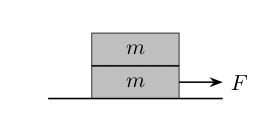 due blocchi sovrapposti con forza F
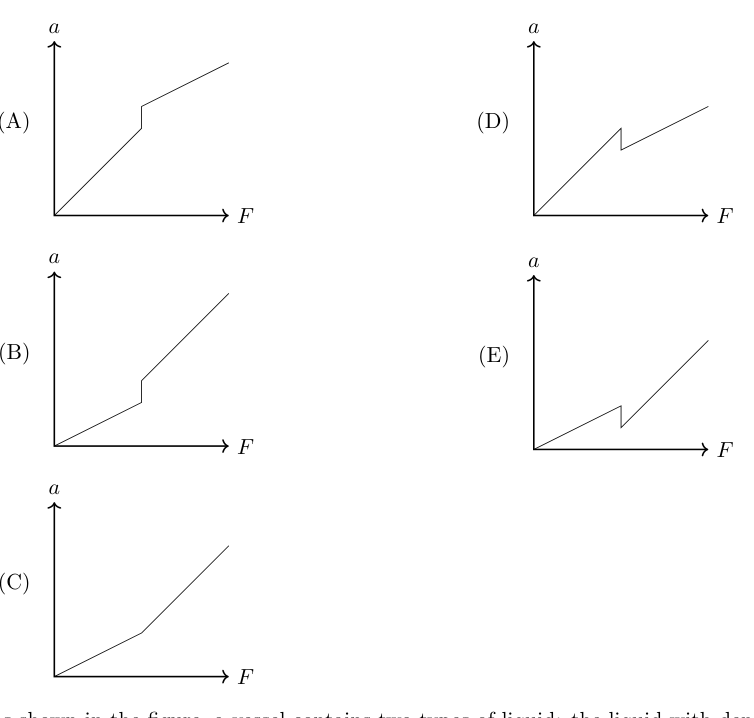 grafici accelerazione vs forza scelte A-E
Topic: Newtonian Mechanics Metodi: Free-Body Diagram, Physical Modeling, Vector Decomposition Competenze: Diagrammatic Reasoning, Physical Reasoning, Mathematical Modeling Objects: Block Fonte: Testo (PDF) — p.6
- Due blocchi di massa sono collocati uno sopra l’altro e il blocco inferiore è posto sul terreno. Il terreno è senza attriti. I coefficienti statici e cinetici di attrito tra i due blocchi sono: e , con . I blocchi sono a riposo inizialmente. Quando una forza orizzontale costante è Applicato al blocco inferiore, quale dei grafici seguenti potrebbe mostrare la sua accelerazione come un funzione di ?
I due blocchi di sovrapposti con forza F
*grafici accelerazione vs forza scelte A-E *
Topic: Newtonian Mechanics Metodi: Free-Body Diagram, Physical Modeling, Vector Decomposition Competenze: Diagrammatic Reasoning, Physical Reasoning, Mathematical Modeling Objects: Block Fonte: Testo (PDF) — p.6
- As shown in the figure, a vessel contains two types of liquid: the liquid with density on top and on the bottom. The depth of the top liquid is , and the interface area between the top and the bottom liquid is . The bottom liquid has a depth of . The area of the bottom of the vessel is . What is the gauge pressure (i.e. pressure in excess of atmospheric pressure) at the bottom of the vessel?
- A.
- B.
- C.
- D.
- E.
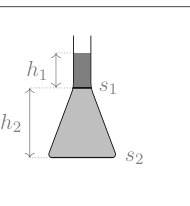 vaso con due liquidi stratificati
Topic: Fluid Mechanics Metodi: Hydrostatic Equilibrium, Physical Modeling Competenze: Physical Reasoning, Mathematical Modeling Objects: Container Fonte: Testo (PDF) — p.6
- Come mostrato nella figura, un recipiente contiene due tipi di liquidi: il liquido con densità in cima e il liquido con densità in cima. in basso. La profondità del liquido superiore è e l’area di interfaccia tra la parte superiore e la parte superiore il liquido inferiore è . Il liquido inferiore ha una profondità di . L’area del fondo della nave is . Qual è la pressione del calibratore (cioè pressione superiore alla pressione atmosferica) al fondo del
- La nave?
- A.
- B.
- C.
- D.
- E.
- stratificazioni di vasi liquidi *
Topic: Fluid Mechanics Metodi: Hydrostatic Equilibrium, Physical Modeling Competenze: Physical Reasoning, Mathematical Modeling Objects: Container Fonte: Testo (PDF) — p.6
- Liquid droplets store a given amount of potential energy per unit surface area, due to their surface tension. When two identical, nearly spherical liquid droplets coalesce on a certain type of surface, part of this energy can be converted into upward kinetic energy, causing the coalesced droplet to jump. Assuming the conversion is 100% efficient, how does the maximum height depend on the radius of the initial droplets?
- A.
- B.
- C.
- D.
- E.
Topic: Fluid Mechanics, Conservation of Energy Metodi: Energy Conservation Method, Dimensional Analysis Competenze: Mathematical Modeling, Physical Reasoning Objects: Droplet Fonte: Testo (PDF) — p.7
- Le gocce liquide conservano una determinata quantità di energia potenziale per unità di superficie, a causa della loro superficie
- Tensione. Quando due gocce liquide identiche, quasi sferiche, si uniscono su un certo tipo di superficie, Una parte di questa energia può essere convertita in energia cinetica ascendente, causando la goccia di fusione a Salta. Se la conversione è efficace al 100%, come dipende dall’altezza massima il raggio delle gocce iniziali?
- A.
- B.
- C.
- D.
- E.
Topic: Fluid Mechanics, Conservation of Energy Metodi: Energy Conservation Method, Dimensional Analysis Competenze: Mathematical Modeling, Physical Reasoning Objects: Droplet Fonte: Testo (PDF) — p.7
- Paul the Giant stands outside on a force-meter calibrated in Newtons, which reads 5000 N. Paul is wearing a large cowboy hat, which has horizontal cross-sectional area and completely covers both him and the scale when seen from directly above. At time , rain begins to fall vertically downward on Paul, and any rain that hits his hat is collected in the hat’s brim. The raindrops have a constant downward speed of 1 m/s, and the rain accumulates on the ground at a rate of 1 mm/s. What is the reading (in N) on the scale as a function of the time (in s)? The density of water is .
- A.
- B.
- C.
- D.
- E.
Topic: Newtonian Mechanics, Fluid Mechanics Metodi: Free-Body Diagram, Conservation of Momentum, Impulse-Momentum Theorem Competenze: Mathematical Modeling, Physical Reasoning Objects: Droplet Fonte: Testo (PDF) — p.7
- Paul il Gigante è fuori su un force-meter calibrato a Newton, che dice 5000 N. Paolo indossa un cappello da cowboy di grandi dimensioni, che ha una superficie trasversale orizzontale e che è completamente copre sia lui che la scala quando si vede direttamente dall’alto. Al tempo , la pioggia inizia a cadere Verticalmente verso il basso su Paul, e ogni pioggia che colpisce il cappello viene raccolta nel bordo del cappello. Il Le gocce di pioggia hanno una velocità di discesa costante di 1 m/s e la pioggia si accumula sul terreno a un velocità di 1 mm/s. Qual è la lettura (in N) della scala in funzione del tempo (in s)? Il la densità dell’acqua è .
- A.
- B.
- C.
- D.
- E.
Topic: Newtonian Mechanics, Fluid Mechanics Metodi: Free-Body Diagram, Conservation of Momentum, Impulse-Momentum Theorem Competenze: Mathematical Modeling, Physical Reasoning Objects: Droplet Fonte: Testo (PDF) — p.7
- A massless rigid rod is pivoted at one end, and a mass is at the other end. Originally, the rod rotates frictionlessly about the pivot with a uniform angular velocity such that the mass has speed . The rotating rod collides with another mass at its midpoint, which then sticks to the rod. After the collision, what is the kinetic energy of the system?
- A.
- B.
- C.
- D.
- E.
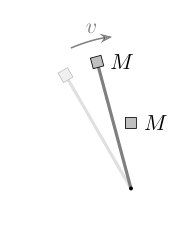 asta pivotante con massa M in rotazione
Topic: Rotational Dynamics, Conservation of Momentum, Conservation of Energy Metodi: Torque & Angular Momentum Analysis, Conservation Laws, Energy Conservation Method Competenze: Mathematical Modeling, Physical Reasoning Objects: Rod Fonte: Testo (PDF) — p.7
- Una barra rigida senza massa è rotata ad una estremità e un’altra è rotata con una massa . Originariamente, la canna ruota senza attrito intorno al pivot con una velocità angolare uniforme tale che la massa abbia velocità . La canna rotante si schianta con un’altra massa al suo punto medio, che si attacca poi alla
- La canna. Dopo la collisione, qual è l’energia cinetica del sistema?
- A.
- B.
- C.
- D.
- E.
*asta pivotante con massa M in rotazione *
Topic: Rotational Dynamics, Conservation of Momentum, Conservation of Energy Metodi: Torque & Angular Momentum Analysis, Conservation Laws, Energy Conservation Method Competenze: Mathematical Modeling, Physical Reasoning Objects: Rod Fonte: Testo (PDF) — p.7
- A system of cylinders and plates is set up as shown. The cylinders all have radius , and roll without slipping to the right with angular velocity . What is the speed of the top plate?
- A.
- B.
- C.
- D.
- E.
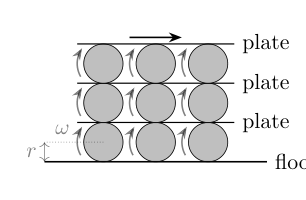 sistema cilindri e piastre a rotolamento
Topic: Rotational Dynamics, Newtonian Mechanics Metodi: Physical Modeling, Vector Decomposition Competenze: Diagrammatic Reasoning, Physical Reasoning Objects: Cylinder Fonte: Testo (PDF) — p.8
- Si dispone di un sistema di cilindri e piastre come illustrato. Tutti i cilindri hanno un raggio e rulla senza scivolare a destra con velocità angolare . Qual è la velocità della piastra superiore?
- A.
- B.
- C.
- D.
- E.
sistema cilindrico e piastre a rotolamento
Topic: Rotational Dynamics, Newtonian Mechanics Metodi: Physical Modeling, Vector Decomposition Competenze: Diagrammatic Reasoning, Physical Reasoning Objects: Cylinder Fonte: Testo (PDF) — p.8
- A car is driving against the wind at a constant speed relative to the ground. The wind direction is always opposite to the car’s velocity, but its speed fluctuates about an average speed of relative to the ground. The air drag force is , where is a constant and is the relative speed between the car and the wind. What is the average rate of energy dissipation due to the air resistance?
- A.
- B.
- C.
- D. Both (B) and (C) are possible depending on how fluctuates.
- E. Both (A) and (C) are possible depending on how fluctuates.
Topic: Newtonian Mechanics, Conservation of Energy Metodi: Energy Conservation Method, Statistical Averaging, Physical Modeling Competenze: Mathematical Modeling, Physical Reasoning Objects: — Fonte: Testo (PDF) — p.8
- Un’auto si muove contro il vento a una velocità costante rispetto al suolo. La direzione del vento è sempre opposto alla velocità della vettura, ma la sua velocità oscilla intorno a una velocità media relativa di
- A terra. La forza di resistenza aerea è , dove è una costante e è la velocità relativa tra l’auto e il vento. Qual è il tasso medio di dissipazione dell’energia dovuta all’aria resistenza?
- A.
- B.
- C.
- D. Entrambe le (B) e (C) sono possibili a seconda di come oscilla.
- E. Entrambe le (A) e (C) sono possibili a seconda di come oscilla.
Topic: Newtonian Mechanics, Conservation of Energy Metodi: Energy Conservation Method, Statistical Averaging, Physical Modeling Competenze: Mathematical Modeling, Physical Reasoning Objects: — Fonte: Testo (PDF) — p.8
- A circular table has radius and equally spaced legs of length attached to its perimeter. Suppose the table has a uniform mass density with total mass , and neglect the mass of the legs. Assuming the table does not slip, the minimum horizontal force needed to tip over the table is
- A.
- B.
- C.
- D.
- E.
Topic: Rigid Body Statics, Newtonian Mechanics Metodi: Torque & Angular Momentum Analysis, Free-Body Diagram, Vector Decomposition Competenze: Mathematical Modeling, Diagrammatic Reasoning Objects: — Fonte: Testo (PDF) — p.8
- Una tabella circolare ha un raggio e di gambe spaziate uguali di lunghezza attaccate al suo perimetro. Supponiamo che la tabella abbia una densità di massa uniforme con massa totale , e trascurate la massa delle gambe. Supponendo che la tavola non scivoli, la forza orizzontale minima necessaria per inclinare la tavola è
- A.
- B.
- C.
- D.
- E.
Topic: Rigid Body Statics, Newtonian Mechanics Metodi: Torque & Angular Momentum Analysis, Free-Body Diagram, Vector Decomposition Competenze: Mathematical Modeling, Diagrammatic Reasoning Objects: — Fonte: Testo (PDF) — p.8
- A collision occurs between two masses. In each inertial reference frame, one can compute the change in total momentum and the change in total kinetic energy due to the collision. Which of the following is true?
- A. and do not depend on the frame.
- B. and do not depend on the frame for perfectly elastic collisions, but may depend on the frame for inelastic collisions. (C) and do not depend on the frame for perfectly elastic collisions, but may depend on the frame for inelastic collisions. (D) and do not depend on the frame for perfectly elastic collisions, but both may depend on the frame for inelastic collisions. (E) and may both depend on the frame, for both perfectly elastic and inelastic collisions.
Topic: Conservation of Momentum, Conservation of Energy, Newtonian Mechanics Metodi: Conservation Laws, Physical Modeling Competenze: Physical Reasoning, Mathematical Modeling Objects: — Fonte: Testo (PDF) — p.9
- Si verifica una collisione tra due masse. In ogni quadro di riferimento inerziale, si può calcolare il cambiamento in moto totale e nella variazione dell’energia cinetica totale dovuta alla collisione. Qual è il numero di è vero il seguente?
- A. e non dipendono dal telaio.
- B. e non dipendono dal telaio per le collisioni perfettamente elastiche, ma possono dipendere sulla cornice per collisioni inelastiche. (C) e non dipendono dal telaio per le collisioni perfettamente elastiche, ma possono dipendere sulla cornice per collisioni inelastiche. (D) e non dipendono dal telaio per collisioni perfettamente elastiche, ma entrambe possono dipendere sulla cornice per collisioni inelastiche. (E) e possono entrambi dipendere dal telaio, sia per collisioni perfettamente elastiche che inelastiche.
Topic: Conservation of Momentum, Conservation of Energy, Newtonian Mechanics Metodi: Conservation Laws, Physical Modeling Competenze: Physical Reasoning, Mathematical Modeling Objects: — Fonte: Testo (PDF) — p.9
- Steve determines the spring constant of a spring by applying a force to it and measuring the change in length . The tools he uses to measure and both have a constant absolute uncertainty, leading to an uncertainty in of . If Tiffany measures the same spring constant with the same tools but by using a force that is five times larger, what will her uncertainty in be in terms of ?
- A.
- B.
- C.
- D.
- E.
Topic: Newtonian Mechanics, Elasticity & Materials Metodi: Error Propagation, Hooke’s Law Competenze: Error Propagation, Mathematical Modeling Objects: Spring Fonte: Testo (PDF) — p.9
- Steve determina la costante di molla di una molla applicandone una forza e misurando la variazione di lunghezza . Gli strumenti che usa per misurare e hanno entrambi un assoluto costante incertezza che porta ad un’incertezza in di . Se Tiffany misura la stessa costante di primavera con gli stessi strumenti, ma usando una forza cinque volte maggiore, qual sarà la sua incertezza in in termini di ?
- A.
- B.
- C.
- D.
- E.
Topic: Newtonian Mechanics, Elasticity & Materials Metodi: Error Propagation, Hooke’s Law Competenze: Error Propagation, Mathematical Modeling Objects: Spring Fonte: Testo (PDF) — p.9
- A mass is connected to one end of a zero-length spring with spring constant . The other end of the spring is connected to a frictionless bearing mounted around a horizontal pole so that the mass can swing in a vertical circle of radius around the pole. The setup is shown in the figure below. What is the vertical distance between the center of the circular orbit and the axis of the pole? Assume that both the diameter of the pole and the rest length of the spring are negligible compared to .
- A.
- B.
- C.
- D.
- E.
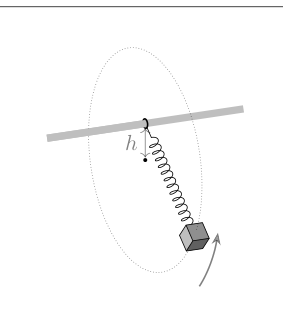 molla su asta inclinata rotante con massa
Topic: Newtonian Mechanics, Oscillations & Waves Metodi: Free-Body Diagram, Hooke’s Law, Vector Decomposition Competenze: Mathematical Modeling, Diagrammatic Reasoning Objects: Spring, Ball Fonte: Testo (PDF) — p.9
- Una massa è collegata ad una estremità di una molla di lunghezza zero con costante molla . L’altra estremità di molla è collegato a un cuscinetto senza attrito montato attorno a un polo orizzontale in modo che il la massa può oscillare in un cerchio verticale di raggio intorno al polo. La configurazione è mostrata nella figura
- Qui sotto. Qual è la distanza verticale tra il centro dell’orbita circolare e l’asse della
- La pole? Supponiamo che sia il diametro del polo che la lunghezza del resto della sorgente siano trascurabili rispetto a .
- A.
- B.
- C.
- D.
- E.
- molla su asta inclinata rotante con massa *
Topic: Newtonian Mechanics, Oscillations & Waves Metodi: Free-Body Diagram, Hooke’s Law, Vector Decomposition Competenze: Mathematical Modeling, Diagrammatic Reasoning Objects: Spring, Ball Fonte: Testo (PDF) — p.9
- A ball of negligible radius and mass is connected to two ideal springs. Each spring has rest length . The springs are connected to the ball inside a box of height , and the ball is allowed to come to equilibrium, as shown. Under what condition is this equilibrium point stable with respect to small horizontal displacements?
- A.
- B.
- C.
- D.
- E.
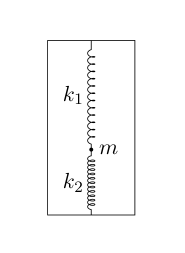 due molle verticali con massa in scatola
Topic: Oscillations & Waves, Newtonian Mechanics Metodi: Hooke’s Law, Physical Modeling, Approximation & Series Expansion Competenze: Mathematical Modeling, Physical Reasoning Objects: Spring, Ball Fonte: Testo (PDF) — p.10
- Una palla di raggio e massa trascurabili è collegata a due sorgenti ideali. Ogni primavera ha una lunghezza di riposo . Le molle sono collegate alla palla all’interno di una scatola di altezza , e la palla è ammessa a venire l’equilibrio, come mostrato. In che condizione questo punto di equilibrio è stabile rispetto a piccole spostamenti orizzontali?
- A.
- B.
- C.
- D.
- E.
- due molle verticali con massa in scatola *
Topic: Oscillations & Waves, Newtonian Mechanics Metodi: Hooke’s Law, Physical Modeling, Approximation & Series Expansion Competenze: Mathematical Modeling, Physical Reasoning Objects: Spring, Ball Fonte: Testo (PDF) — p.10