- A ball is bouncing vertically between a floor and ceiling, which are both horizontal and separated by 4 m. All collisions are perfectly elastic, and when the ball hits the floor, it has a speed of 12 m/s. How long does a complete up-down cycle take?
- A. 0.3 s
- B. 0.4 s
- C. 0.6 s
- D. 0.8 s
- E. 2.4 s
Topic: Newtonian Mechanics Metodi: Kinematic Equations, Conservation of Energy Competenze: Physical Reasoning, Mathematical Modeling Objects: Ball Fonte: Testo (PDF) — p.2
- Una palla rimbalza verticalmente tra un pavimento e un soffitto, che sono sia orizzontali che separati by 4 m. Tutte le collisioni sono perfettamente elastiche e quando la palla colpisce il pavimento, ha una velocità di 12 m/s. Quanto tempo ci vuole per un ciclo completo di ripresa?
- A. 0.3 s
- B. 0.4 s
- C. 0.6 s
- D. 0.8 s
- E. 2.4 s
Topic: Newtonian Mechanics Metodi: Kinematic Equations, Conservation of Energy Competenze: Physical Reasoning, Mathematical Modeling Objects: Ball Fonte: Testo (PDF) — p.2
- A uniform rod of mass and length has moment of inertia about an axis that is perpendicular to the rod and passes through its center. What is the moment of inertia of a uniform square plate with mass and side length about the axis along its diagonal?
- A.
- B.
- C.
- D.
- E.
Topic: Rotational Dynamics Metodi: Calculus-Integration, Physical Modeling Competenze: Mathematical Modeling, Physical Reasoning Objects: Rod Fonte: Testo (PDF) — p.2
- Una canna uniforme di massa e lunghezza ha un momento di inerzia attorno ad un asse perpendicolare alla canna e che passa attraverso il suo centro. Qual è il momento di inerzia di un uniforme piastra quadrata con massa e lunghezza laterale intorno all’asse lungo la sua diagonale?
- A.
- B.
- C.
- D.
- E.
Topic: Rotational Dynamics Metodi: Calculus-Integration, Physical Modeling Competenze: Mathematical Modeling, Physical Reasoning Objects: Rod Fonte: Testo (PDF) — p.2
- A conical pendulum of length swings in a horizontal circle of radius , as shown. If is the angular frequency of this motion, what is ?
- A.
- B.
- C.
- D.
- E.
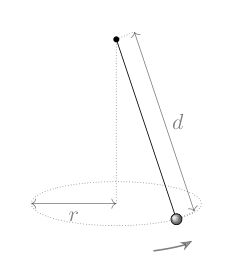 pendolo conico con raggio r e lunghezza d
Topic: Newtonian Mechanics Metodi: Free-Body Diagram, Vector Decomposition Competenze: Diagrammatic Reasoning, Mathematical Modeling Objects: Pendulum Fonte: Testo (PDF) — p.2
- Un pendolo conico di lunghezza oscilla in un cerchio orizzontale di raggio , come mostrato. Se è il la frequenza angolare di questo movimento, qual è ?
- A.
- B.
- C.
- D.
- E.
PENDOLO CON RIGIO e lunghezza d
Topic: Newtonian Mechanics Metodi: Free-Body Diagram, Vector Decomposition Competenze: Diagrammatic Reasoning, Mathematical Modeling Objects: Pendulum Fonte: Testo (PDF) — p.2
- In “zero-g” airplane rides, passengers can float around the cabin, as if they were weightless. A flight trajectory for such a ride is shown below, with a few points during the journey labelled. Which of the following statements is correct? Take to be the acceleration of the plane during the “zero-g” part of the flight.
- A. The “zero-g” flight begins at a and ends at c, during which and points up.
- B. The “zero-g” flight begins at a and ends at e, during which .
- C. The “zero-g” flight begins at b and ends at d, during which and points down.
- D. The “zero-g” flight begins at c and ends at e, during which and points down.
- E. The “zero-g” flight begins at d and ends at e, during which .
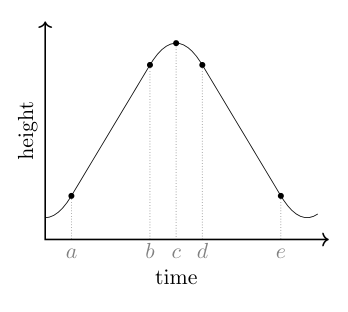 grafico altitudine vs tempo aereo zero-g
Topic: Newtonian Mechanics Metodi: Physical Modeling, Free-Body Diagram Competenze: Physical Reasoning Objects: — Fonte: Testo (PDF) — p.3
- Nei viaggi aerei a zero g, i passeggeri possono galleggiare intorno alla cabina, come se fossero senza peso. Un volo la traiettoria di tale viaggio è riportata di seguito, con alcuni punti durante il viaggio etichettati. Qual è il numero di le seguenti affermazioni sono corrette? Prendere per essere l’accelerazione del piano durante il zero-g parte del volo.
- A. Il volo zero-g inizia a e termina a c, durante il quale e puntano in alto.
- B. Il volo zero-g inizia a e termina a e, durante il quale .
- C. Il volo zero-g inizia a b e termina a d, durante il quale e puntano verso il basso.
- D. Il volo zero-g inizia a c e termina a e, durante il quale e puntano verso il basso.
- E. Il volo zero-g inizia a d e termina a e, durante il quale .
*grafico altitudine vs tempo aereo zero-g *
Topic: Newtonian Mechanics Metodi: Physical Modeling, Free-Body Diagram Competenze: Physical Reasoning Objects: — Fonte: Testo (PDF) — p.3
- A mote of dust is initially located at distance from the sun, which has mass . At this point, the mote has a small tangential velocity . Which of the following is a good approximation for the distance of closest subsequent approach between the mote and the sun?
- A.
- B.
- C.
- D.
- E.
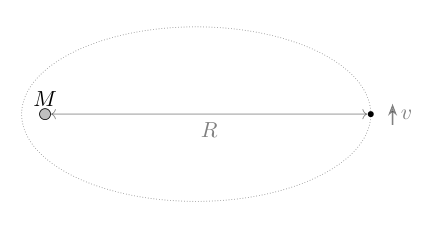 schema sole-granello con M, v, R
Topic: Gravitation Metodi: Conservation Laws, Approximation & Series Expansion, Newton’s Law of Gravitation Competenze: Mathematical Modeling, Physical Reasoning Objects: Star Fonte: Testo (PDF) — p.3
- Una mola di polvere è inizialmente situata a distanza dal sole, la cui massa . A questo punto, la mote ha una piccola velocità tangenziale . Qual è una buona approssimazione per il la distanza di avvicinamento successivo più vicino tra la mote e il sole?
- A.
- B.
- C.
- D.
- E.
Schema di granello unico con M, v, R
Topic: Gravitation Metodi: Conservation Laws, Approximation & Series Expansion, Newton’s Law of Gravitation Competenze: Mathematical Modeling, Physical Reasoning Objects: Star Fonte: Testo (PDF) — p.3
- A three-legged table is shaped like a uniform equilateral triangle, and has identical legs at each corner. When the mass of an object placed on the center of the table exceeds , the table’s legs will all simultaneously break. Which of the following shaded regions shows the area within which an object of can be placed without breaking any legs of the table? (A) (B) (C) (D) (E)
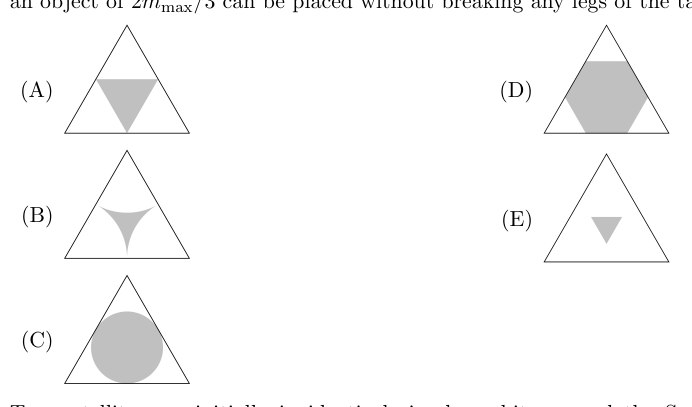 opzioni triangolo equilatero con punto massa
Topic: Rigid Body Statics Metodi: Torque & Angular Momentum Analysis, Free-Body Diagram Competenze: Physical Reasoning, Diagrammatic Reasoning Objects: — Fonte: Testo (PDF) — p.4
- Un tavolo a tre zampe è formato come un triangolo equilaterale uniforme, e ha le gambe identiche a ciascuna
- In un angolo. Quando la massa di un oggetto posto al centro della tavola supera , le gambe della tavola
- Si rompono tutte contemporaneamente. Qual è la regione ombrata che indica la superficie all’interno della quale si trova il un oggetto di può essere posizionato senza rompere le gambe del tavolo? (A) (B) (C) (D) (E)
opzioni triangolo equilatero con punto massa
Topic: Rigid Body Statics Metodi: Torque & Angular Momentum Analysis, Free-Body Diagram Competenze: Physical Reasoning, Diagrammatic Reasoning Objects: — Fonte: Testo (PDF) — p.4
- Two satellites are initially in identical circular orbits around the Sun, with orbital speed m/s. The first satellite fires its thrusters toward the Sun, and quickly obtains a radial velocity of m/s. The second satellite instead fires its thrusters behind it, and quickly increases its tangential velocity by . If the two satellites subsequently perform orbits with the same period, approximately what was ?
- A. 0.000 05 m/s
- B. 0.005 m/s
- C. 0.5 m/s
- D. 1 m/s
- E. 50 m/s
Topic: Gravitation Metodi: Kepler’s Laws, Approximation & Series Expansion, Energy Conservation Method Competenze: Mathematical Modeling, Estimation & Approximation Objects: Satellite, Star Fonte: Testo (PDF) — p.4
- Due satelliti sono inizialmente in identiche orbite circolari intorno al Sole, con velocità orbitale m/s. Il primo satellite spara i suoi propulsori verso il Sole e ottiene rapidamente un radial velocità di m/s. Il secondo satellite invece spara i suoi propulsori dietro di sé, e rapidamente aumenta la sua velocità tangenziale di . Se i due satelliti effettuano successivamente orbite con il lo stesso periodo, circa quanto è stato ?
- A. 0.000 05 m/s
- B. 0.005 m/s
- C. 0.5 m/s
- D. 1 m/s
- E. 50 m/s
Topic: Gravitation Metodi: Kepler’s Laws, Approximation & Series Expansion, Energy Conservation Method Competenze: Mathematical Modeling, Estimation & Approximation Objects: Satellite, Star Fonte: Testo (PDF) — p.4
- A conveyor belt is moving with velocity to the east. A block with velocity to the south slides from the ground onto the conveyor belt. The coefficient of friction between the block and the belt is . The block stops slipping after a time
- A.
- B.
- C.
- D.
- E. The block never stops slipping.
Topic: Newtonian Mechanics Metodi: Free-Body Diagram, Vector Decomposition, Kinematic Equations Competenze: Diagrammatic Reasoning, Mathematical Modeling Objects: Block Fonte: Testo (PDF) — p.4
- Una cintura trasportatrice si sta muovendo con velocità verso est. Blocco con velocità verso sud dal terreno alla cintura trasportatrice. Coefficiente di attrito tra il blocco e la cintura is . Il blocco smette di scivolare dopo un po ’
- A.
- B.
- C.
- D.
- E. Il blocco non smette mai di scivolare.
Topic: Newtonian Mechanics Metodi: Free-Body Diagram, Vector Decomposition, Kinematic Equations Competenze: Diagrammatic Reasoning, Mathematical Modeling Objects: Block Fonte: Testo (PDF) — p.4
- Two equal masses are connected by an elastic string that acts like an ideal spring with spring constant and unstretched length . The two masses are hung over a frictionless pulley. What is the total length of the string at equilibrium? (Diagram not necessarily to scale.)
- A.
- B.
- C.
- D.
- E. There is not enough information to decide.
Topic: Newtonian Mechanics Metodi: Free-Body Diagram, Hooke’s Law Competenze: Physical Reasoning, Mathematical Modeling Objects: Spring, String, Pulley Fonte: Testo (PDF) — p.5
- Due masse uguali sono collegate da una corda elastica che agisce come una molla ideale con una molla costante e lunghezza non allungata . Le due masse sono appese su una pollice senza attrito. Che cos’è ? la lunghezza totale della corda in equilibrio? (Grafico non necessariamente a scala.)
- A.
- B.
- C.
- D.
- E. Non ci sono informazioni sufficienti per decidere.
Topic: Newtonian Mechanics Metodi: Free-Body Diagram, Hooke’s Law Competenze: Physical Reasoning, Mathematical Modeling Objects: Spring, String, Pulley Fonte: Testo (PDF) — p.5
- The two masses are both displaced downward by a small vertical distance and simultaneously released from rest. What is the period of oscillation?
- A.
- B.
- C.
- D.
- E. There is not enough information to decide.
Topic: Oscillations & Waves Metodi: Simple Harmonic Motion Analysis, Hooke’s Law Competenze: Mathematical Modeling, Physical Reasoning Objects: Spring, Block Fonte: Testo (PDF) — p.5
- Le due masse sono entrambi spostati verso il basso da una piccola distanza verticale e contemporaneamente liberato dal riposo. Qual è il periodo di oscillazione?
- A.
- B.
- C.
- D.
- E. Non ci sono informazioni sufficienti per decidere.
Topic: Oscillations & Waves Metodi: Simple Harmonic Motion Analysis, Hooke’s Law Competenze: Mathematical Modeling, Physical Reasoning Objects: Spring, Block Fonte: Testo (PDF) — p.5
- An escalator can carry passengers up a vertical distance of 10 m in 30 s. A mischievous person of mass 50 kg walks down the up-escalator so that they stay in place with respect to the building. If the child does this for 30 s, the total work the child performs on the escalator, in the frame of the building, is
- A. J
- B. J
- C. 0 J
- D. J
- E. J
Topic: Conservation of Energy Metodi: Energy Conservation Method, Physical Modeling Competenze: Physical Reasoning, Mathematical Modeling Objects: — Fonte: Testo (PDF) — p.5
- Una scala mobile può trasportare passeggeri su una distanza verticale di 10 m in 30 secondi. Una persona cattiva di 50 kg scendono l’escalatore in modo che rimangano in posizione rispetto all’edificio. If il bambino lo fa per 30 secondi, il lavoro totale che il bambino svolge sulla scala mobile, nel quadro della costruzione, è
- A. J
- B. J
- C. 0 J
- D. J
- E. J
Topic: Conservation of Energy Metodi: Energy Conservation Method, Physical Modeling Competenze: Physical Reasoning, Mathematical Modeling Objects: — Fonte: Testo (PDF) — p.5
- A platform juts out horizontally from the edge of a building. If the platform is modeled as a uniform metal rod, which one of the following statements about the tensile and compressive stress is correct?
- A. There is a horizontal compression throughout the rod.
- B. There is a horizontal tension throughout the rod.
- C. There is horizontal tension in the top of the rod and a compression in the bottom.
- D. There is a horizontal tension near the middle of the rod and a compression near the end.
- E. There is a horizontal compression near the middle of the rod and a tension near the end.
Topic: Elasticity & Materials, Rigid Body Statics Metodi: Free-Body Diagram, Stress-Strain Analysis Competenze: Physical Reasoning, Diagrammatic Reasoning Objects: Rod Fonte: Testo (PDF) — p.5
- Una piattaforma si estende orizzontalmente dal bordo di un edificio. Se la piattaforma è modellata come uniforme quale delle seguenti affermazioni sulla tensione tracciabile e compressiva è corretta?
- A. C’è una compressione orizzontale in tutta la canna.
- B. C’è una tensione orizzontale in tutta la canna.
- C. C’è una tensione orizzontale nella parte superiore della canna e una compressione nella parte inferiore.
- D. C’è una tensione orizzontale vicino al centro della canna e una compressione vicino alla fine.
- E. C’è una compressione orizzontale vicino al centro della canna e una tensione vicino alla fine.
Topic: Elasticity & Materials, Rigid Body Statics Metodi: Free-Body Diagram, Stress-Strain Analysis Competenze: Physical Reasoning, Diagrammatic Reasoning Objects: Rod Fonte: Testo (PDF) — p.5
- A uniform disk of mass and radius is attached at its edge to a flexible pivot on the ceiling. It is given a small displacement perpendicular to the plane of the disk, so that it begins to oscillate perpendicular to the plane of the disk. What is the period of oscillation? The moment of inertia of a disk about the axis going through its center and perpendicular to the plane it’s in is
- A.
- B.
- C.
- D.
- E.
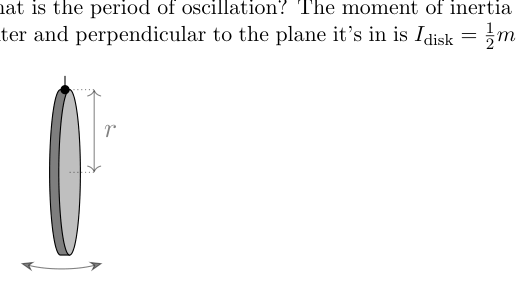 disco appeso al pivot sul soffitto
Topic: Oscillations & Waves, Rotational Dynamics Metodi: Simple Harmonic Motion Analysis, Torque & Angular Momentum Analysis Competenze: Mathematical Modeling, Physical Reasoning Objects: Disk Fonte: Testo (PDF) — p.6
- Un disco uniforme di massa e di raggio è fissato al bordo di un pivot flessibile sul soffitto. It viene dato un piccolo spostamento perpendicolare al piano del disco, in modo che comincia ad oscillare perpendicolare al piano del disco. Qual è il periodo di oscillazione? Il momento di inerzia di un disco intorno all’asse che attraversa il suo centro e perpendicolare al piano in cui si trova è
- A.
- B.
- C.
- D.
- E.
*disco appeso al pivot sul soffitto *
Topic: Oscillations & Waves, Rotational Dynamics Metodi: Simple Harmonic Motion Analysis, Torque & Angular Momentum Analysis Competenze: Mathematical Modeling, Physical Reasoning Objects: Disk Fonte: Testo (PDF) — p.6
- A large block of mass 5 kg is moving to the right at a velocity of 10 m/s. Spaced out every meter are smaller, initially stationary blocks of mass 1 kg. All collisions are perfectly inelastic. Neglecting friction, how far will the large block travel before its velocity has decreased to below 3 m/s?
- A. 5 m
- B. 8 m
- C. 12 m
- D. 17 m
- E. 50 m
Topic: Conservation of Momentum, Newtonian Mechanics Metodi: Conservation of Momentum, Impulse-Momentum Theorem Competenze: Mathematical Modeling, Physical Reasoning Objects: Block Fonte: Testo (PDF) — p.6
- Un grande blocco di massa di 5 kg si sta muovendo a destra a una velocità di 10 m/s. Distanti ogni metro sono blocchi più piccoli, inizialmente fermi, di massa 1 kg. Tutte le collisioni sono perfettamente inelasche. Negliendolo La velocità di frattura, quanto lontano si sposta il grande blocco prima che la sua velocità sia diminuita a meno di 3 m/s?
- A. 5 m
- B. 8 m
- C. 12 m
- D. 17 m
- E. 50 m
Topic: Conservation of Momentum, Newtonian Mechanics Metodi: Conservation of Momentum, Impulse-Momentum Theorem Competenze: Mathematical Modeling, Physical Reasoning Objects: Block Fonte: Testo (PDF) — p.6
- In the device shown, blocks of various masses are placed on pistons so that the device is in equilibrium. (The fluid in the drawing is to scale.) There are valves that are both initially open at locations A and B. One of the valves is closed, and the system is allowed to come to equilibrium. How will this affect the height of the mass ?
- A. Closing either valve will have no effect on the height of .
- B. Closing either valve causes to rise.
- C. Closing either valve causes to fall.
- D. Closing valve A causes to rise, and closing valve B causes to fall.
- E. Closing valve A causes to fall, and closing valve B causes to rise.
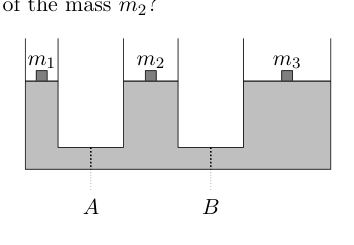 dispositivo a pistoni con valvole A e B
Topic: Fluid Mechanics Metodi: Hydrostatic Equilibrium, Physical Modeling Competenze: Physical Reasoning, Diagrammatic Reasoning Objects: Piston, Block Fonte: Testo (PDF) — p.6
- Nel dispositivo mostrato, blocchi di varie masse sono collocati sui pistoni in modo che il dispositivo sia in equilibrio. (Il fluido nel disegno è di scala.) Ci sono valvole che sono entrambi inizialmente aperti a le posizioni A e B. Una delle valvole è chiusa e il sistema viene permesso di tornare in equilibrio. In che modo ciò influenzerà l’altezza della massa ?
- A. Chiudere una delle valvole non influenzerà l’ altezza di .
- B. Chiusura di una delle valvole provoca un aumento di .
- C. Chiusura di una delle valvole provoca la caduta di .
- D. La valvola di chiusura A provoca l’ aumento di e la valvola di chiusura B provoca la caduta di .
- E. La valvola di chiusura A provoca la caduta di e la valvola di chiusura B provoca l’ aumento di .
Dispositivo a pistoni con valvole A e B
Topic: Fluid Mechanics Metodi: Hydrostatic Equilibrium, Physical Modeling Competenze: Physical Reasoning, Diagrammatic Reasoning Objects: Piston, Block Fonte: Testo (PDF) — p.6
- A mass sits on top of a vertical spring of spring constant , in equilibrium. A mass is held a height above it. The mass is then pushed downward by a distance , and both masses are released from rest simultaneously. For what value of will the two masses first collide when first returns to its equilibrium position?
- A.
- B.
- C.
- D.
- E.
Topic: Oscillations & Waves, Newtonian Mechanics Metodi: Simple Harmonic Motion Analysis, Kinematic Equations Competenze: Mathematical Modeling, Physical Reasoning Objects: Spring, Block Fonte: Testo (PDF) — p.7
- Una massa si trova in equilibrio sopra una molla verticale della costante molla . Una massa è tenuta a altezza sopra di esso. La massa viene poi spinta verso il basso da una distanza , e entrambe le masse sono rilasciato dal riposo contemporaneamente. Per quale valore di le due masse si colpiranno per la prima volta quando prima ritorna alla sua posizione di equilibrio?
- A.
- B.
- C.
- D.
- E.
Topic: Oscillations & Waves, Newtonian Mechanics Metodi: Simple Harmonic Motion Analysis, Kinematic Equations Competenze: Mathematical Modeling, Physical Reasoning Objects: Spring, Block Fonte: Testo (PDF) — p.7
- Assume that takes the value found in the previous question, and that the collision between the two masses is perfectly elastic. For what value of will rebound to a maximum height that is exactly equal to its original height?
- A.
- B.
- C.
- D.
- E.
Topic: Conservation of Momentum, Conservation of Energy Metodi: Conservation of Momentum, Conservation of Energy, Simple Harmonic Motion Analysis Competenze: Mathematical Modeling, Physical Reasoning Objects: Spring, Block Fonte: Testo (PDF) — p.7
- Supponiamo che abbia il valore trovato nella domanda precedente e che la collisione tra le due masse è perfettamente elastica. Per quale valore di rimbalzerà ad un’altezza massima che è esattamente uguale alla sua altezza originale?
- A.
- B.
- C.
- D.
- E.
Topic: Conservation of Momentum, Conservation of Energy Metodi: Conservation of Momentum, Conservation of Energy, Simple Harmonic Motion Analysis Competenze: Mathematical Modeling, Physical Reasoning Objects: Spring, Block Fonte: Testo (PDF) — p.7
- An extendable arm is made from rigid beams free to pivot around the dots shown. Spring 1, with equilibrium length , is attached between points A and C while spring 2, with equilibrium length is attached between B and D. The system is allowed to come to equilibrium. In equilibrium, what is the ratio of the tension in spring 1 to the tension in spring 2?
- A.
- B.
- C.
- D.
- E. There is not enough information to determine the ratio.
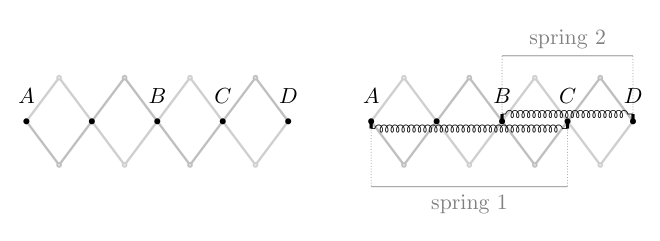 braccio estensibile con molle 1 e 2
Topic: Rigid Body Statics Metodi: Free-Body Diagram, Hooke’s Law, Torque & Angular Momentum Analysis Competenze: Physical Reasoning, Mathematical Modeling Objects: Beam, Spring Fonte: Testo (PDF) — p.7
- Un braccio estensibile è realizzato con travi rigide libere per ruotare intorno ai punti mostrati. Primavera 1, con lunghezza di equilibrio , è fissata tra i punti A e C mentre la primavera 2, con lunghezza di equilibrio è collegato tra B e D. Il sistema è permesso di arrivare all’equilibrio. In equilibrio, Qual è il rapporto tra la tensione di primavera 1 e la tensione di primavera 2?
- A.
- B.
- C.
- D.
- E. Non ci sono informazioni sufficienti per determinare il rapporto.
- braccio estensibile con molle 1 e 2 *
Topic: Rigid Body Statics Metodi: Free-Body Diagram, Hooke’s Law, Torque & Angular Momentum Analysis Competenze: Physical Reasoning, Mathematical Modeling Objects: Beam, Spring Fonte: Testo (PDF) — p.7
- Consider an axially symmetric object that experiences no external forces and initially rotates about its symmetry axis. The object then changes its shape while remaining axially symmetric. Afterward, it is found that its moment of inertia about the symmetry axis has increased. How have its kinetic energy and angular velocity changed?
- A. has decreased, and has decreased.
- B. has decreased, and stays the same.
- C. stays the same, and has decreased.
- D. has increased, and has increased.
- E. has increased, and stays the same.
Topic: Rotational Dynamics, Conservation of Energy Metodi: Torque & Angular Momentum Analysis, Conservation Laws Competenze: Physical Reasoning, Mathematical Modeling Objects: — Fonte: Testo (PDF) — p.8
- Considera un oggetto assimetrico che non sperimenta forze esterne e inizia a ruotare intorno a il suo asse di simmetria. L’oggetto cambia quindi la sua forma rimanendo assimetrico. Dopo, si scopre che il suo momento di inerzia intorno all’asse di simmetria è aumentato. Come hanno la sua cinetica energy and angular velocity changed?
- A. è diminuita e è diminuita.
- B. è diminuito e rimane lo stesso.
- C. rimane lo stesso e è diminuito.
- D. è aumentato e è aumentato.
- E. è aumentato e rimane lo stesso.
Topic: Rotational Dynamics, Conservation of Energy Metodi: Torque & Angular Momentum Analysis, Conservation Laws Competenze: Physical Reasoning, Mathematical Modeling Objects: — Fonte: Testo (PDF) — p.8
- A well-calibrated scale reads zero when nothing is placed on it. When a deflated balloon is placed on the scale, it reads . When a non-airtight box is placed on the scale, it reads , where . The balloon is inflated with helium, so that it floats upward in air. The balloon is placed in the box, and the box is placed on the scale. If the scale reads , which of the following is true?
- A.
- B.
- C.
- D.
- E. None of the above are necessarily true.
Topic: Fluid Mechanics, Newtonian Mechanics Metodi: Hydrostatic Equilibrium, Free-Body Diagram Competenze: Physical Reasoning Objects: Bubble, Container Fonte: Testo (PDF) — p.8
- Una scala ben calibrata è zero quando non viene posto nulla su di essa. Quando viene posto un pallone deflato sulla scala, si legge . Quando una scatola non a prova di aria viene posta sulla scala, viene indicato , dove . Il pallone è gonfiato di elio, in modo che galleggia verso l’alto nell’aria. Il palloncino è posto nella scatola, e la scatola viene posta sulla scala. Se la scala è , quale delle seguenti è vero?
- A.
- B.
- C.
- D.
- E. Nessuna delle previsioni di cui sopra è necessariamente vera.
Topic: Fluid Mechanics, Newtonian Mechanics Metodi: Hydrostatic Equilibrium, Free-Body Diagram Competenze: Physical Reasoning Objects: Bubble, Container Fonte: Testo (PDF) — p.8
- A person stands on the seat of a swing and squats down, so that the distance between their center of mass (CM) and the swing’s pivot is . As the swing gets to the lowest point, the speed of their CM is . At this moment, they quickly stand up, and thus decrease the distance from their CM to the swing’s pivot to . Immediately after they finish standing up, their CM speed is . Which of the following statements is correct? You may neglect friction, the change in moment of inertia of the person about their CM, and the time taken to stand up.
- A.
- B.
- C.
- D.
- E. Multiple statements are correct.
Topic: Rotational Dynamics Metodi: Torque & Angular Momentum Analysis, Conservation Laws Competenze: Physical Reasoning, Mathematical Modeling Objects: Pendulum Fonte: Testo (PDF) — p.8
- Una persona si trova sul sedile di uno swing e si accovaccia, in modo che la distanza tra il loro centro di massa (CM) e il pivot dello swing è . Quando l’oscillazione arriva al punto più basso, la velocità della loro CM is . In questo momento, si alzano rapidamente, riducendo così la distanza dal loro CM a il pivot dello swing è . Subito dopo aver finito di stare in piedi, la velocità del CM è . Qual è il numero di le seguenti affermazioni sono corrette? Potresti trascurare l’attrito, il cambiamento di momento di inerzia di la persona che ha il CM e il tempo necessario per alzarsi.
- A.
- B.
- C.
- D.
- E. Molte affermazioni sono corrette.
Topic: Rotational Dynamics Metodi: Torque & Angular Momentum Analysis, Conservation Laws Competenze: Physical Reasoning, Mathematical Modeling Objects: Pendulum Fonte: Testo (PDF) — p.8
- A point mass sits on a long block, also of mass , which rests on the floor. The coefficient of static and kinetic friction between the mass and the block is , and the coefficient of static and kinetic friction between the block and the floor is . An impulse gives a horizontal momentum to the point mass. After a long time, how far has the point mass moved relative to the block? Assume the mass does not fall off the block.
- A.
- B.
- C.
- D.
- E.
Topic: Newtonian Mechanics, Conservation of Momentum Metodi: Impulse-Momentum Theorem, Free-Body Diagram, Kinematic Equations Competenze: Mathematical Modeling, Physical Reasoning Objects: Block Fonte: Testo (PDF) — p.8
- Una massa puntaria si trova su un blocco lungo, anche di massa , che riposa sul pavimento. Il coefficiente di la frizione statica e cinetica tra la massa e il blocco è , e il coefficiente di la frizione cinetica tra il blocco e il pavimento è . Un impulso dà un impulso orizzontale alla massa del punto. Dopo un lungo tempo, quanto si è spostata la massa del punto rispetto al blocco? Supponiamo che la massa non cadga dal blocco.
- A.
- B.
- C.
- D.
- E.
Topic: Newtonian Mechanics, Conservation of Momentum Metodi: Impulse-Momentum Theorem, Free-Body Diagram, Kinematic Equations Competenze: Mathematical Modeling, Physical Reasoning Objects: Block Fonte: Testo (PDF) — p.8
- Assume that the drag force for a fish in water depends only on the typical length scale of the fish , its velocity , and the density of water . A pufferfish is about 10 cm in length and swims at about 5 m/s. How fast does a clown fish, about 1 cm in length, need to swim such that it experiences the same drag force as the pufferfish?
- A. 5 m/s
- B. 16 m/s
- C. 50 m/s
- D. 500 m/s
- E. 2500 m/s
Topic: Fluid Mechanics Metodi: Dimensional Analysis Competenze: Estimation & Approximation, Physical Reasoning Objects: — Fonte: Testo (PDF) — p.9
- Supponiamo che la forza di resistenza di un pesce in acqua dipenda solo dalla scala di lunghezza tipica del pesce , la sua velocità e la densità dell’acqua . Un pesce puffer ha circa 10 cm di lunghezza e nuota a circa 5 m/s. Quanto veloce deve nuotare un pesce clown, lungo circa 1 cm, in modo da sperimentare la la stessa forza di trazione del pesce puffer?
- A. 5 m/s
- B. 16 m/s
- C. 50 m/s
- D. 500 m/s
- E. 2500 m/s
Topic: Fluid Mechanics Metodi: Dimensional Analysis Competenze: Estimation & Approximation, Physical Reasoning Objects: — Fonte: Testo (PDF) — p.9
- Three boxes A, B and C lie along a straight line on a horizontal frictionless surface, as shown. Box A is initially moving to the right with speed while the other two boxes are initially at rest. If all collisions are elastic, and the masses of the boxes can be chosen freely, which of the following is closest to the maximum possible final speed of box C?
- A.
- B.
- C.
- D.
- E.
Topic: Conservation of Momentum, Conservation of Energy Metodi: Conservation of Momentum, Conservation of Energy Competenze: Mathematical Modeling, Physical Reasoning Objects: Block Fonte: Testo (PDF) — p.9
- Tre scatole A, B e C si trovano lungo una linea retta su una superficie orizzontale senza attrito, come mostrato. Cassa A si muove inizialmente a destra con velocità mentre le altre due caselle sono inizialmente a riposo. If tutte le collisioni sono elastiche e le masse delle scatole possono essere scelte liberamente, quale delle seguenti è la velocità finale massima possibile della casella C?
- A.
- B.
- C.
- D.
- E.
Topic: Conservation of Momentum, Conservation of Energy Metodi: Conservation of Momentum, Conservation of Energy Competenze: Mathematical Modeling, Physical Reasoning Objects: Block Fonte: Testo (PDF) — p.9
- If a certain radioactive decay process happens times per hour on average, then in any given hour, one expects to observe decays with an uncertainty of . Each hour can be assumed independent of the previous one, and can be assumed constant over time. How many hours do you need to conduct the observation so that you can determine within an uncertainty of 1%?
- A.
- B.
- C.
- D.
- E.
Topic: Nuclear & Particle Physics Metodi: Radioactive Decay Law, Statistical Averaging Competenze: Mathematical Modeling, Error Propagation Objects: Nucleus Fonte: Testo (PDF) — p.9
- Se un determinato processo di decomposizione radioattiva si verifica volte all’ora in media, allora in qualsiasi ora data, si prevede di osservare decadimenti con un’incertezza di . Ogni ora può essere considerata indipendente di quella precedente, e può essere presunta costante nel tempo. Quante ore hai bisogno di effettuare l’osservazione in modo da poter determinare con un’incertezza dell’1%?
- A.
- B.
- C.
- D.
- E.
Topic: Nuclear & Particle Physics Metodi: Radioactive Decay Law, Statistical Averaging Competenze: Mathematical Modeling, Error Propagation Objects: Nucleus Fonte: Testo (PDF) — p.9