- The electromagnetic induction and motion of a coil (Score: 20 points) As the figure shows, a rectangular coil of length ,
D width , mass , is put in a uniform magnetic field , X m
B and the magnetic field is perpendicular to the surface of
the coil. At time , the bottom side of the coil is
t = 0
situated at the edge of the uniform magnetic field. Let
denote the relative position between the top side of (t) y
the coil and the edge of the magnetic field. The above initial condition is then . Let the
(0) y = D
positive direction of current be counter-clockwise, and upward is the positive y-direction. Part A The coil is released at , and suppose that is big enough that the coil reaches terminal
t = 0
D
velocity before exiting the field. The inductance of the coil is negligible, and its resistance is vt
. Answer the following questions with parameters and acceleration due to R
, D, B , , R, t X
m
gravity . g
(i) Find the magnitude of . vt (ii) Find the relation between the speed of the coil and time before the coil exits the field. (iii) Find the relation between the power used by the coil and time before the coil exits the
field. (iv) Find the total energy the coil uses from till the coil exits the field. t = 0
Part B Let the coil be a superconductor, but its inductance is no longer negligible. Suppose is
L
D big enough that the coil never falls out. Answer the following questions with parameters
and gravitational acceleration . , D, B , , L, t X
m
g (v) Prove the coil performs SHM. (vi) Find . (t) y
(vii) Find the maximum kinetic energy of the coil. (viii) Find the maximum energy stored in the magnetic field of the coil, and when it happens.
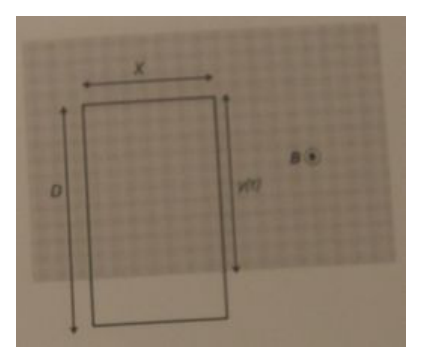 bobina rettangolare in campo magnetico uniforme
Topic: Electromagnetic Induction, Newtonian Mechanics, Oscillations & Waves Metodi: Faraday’s Law of Induction, Free-Body Diagram, Simple Harmonic Motion Analysis, Differential Equations Competenze: Mathematical Modeling, Physical Reasoning, Diagrammatic Reasoning Objects: Coil Fonte: Testo (PDF) — p.2
- L’induzione elettromagnetica e il movimento di una bobina (Punto: 20 punti) Come mostra la figura, una bobina rettangolare di lunghezza ,
D larghezza , massa , viene inserito in un campo magnetico uniforme , X m
B e il campo magnetico è perpendicolare alla superficie di
la bobina. A tempo debito , la parte inferiore della bobina è
t = 0
situato al bordo del campo magnetico uniforme. Lascia che
indicare la posizione relativa tra il lato superiore di (t) y
la bobina e il bordo del campo magnetico. La condizione iniziale di cui sopra è quindi . Lascia che il
(0) y = D
la direzione positiva della corrente è contraria alla direzione oraria e verso l’alto è la direzione positiva di y. Parte A La bobina viene rilasciata al , e supponiamo che è abbastanza grande da far raggiungere il terminale
t = 0
D
velocità prima di uscire dal campo. L’induttanza della bobina è trascurabile e la sua resistenza è vt
. Rispondi alle seguenti domande con parametri e l’accelerazione dovuta a R
, D, B , , R, t X
m
gravità . g
(i) Trova la magnitudine di . vt ii) Trovare il rapporto tra la velocità della bobina e il tempo prima che la bobina esci dal campo.
- Trova il rapporto tra la potenza utilizzata dalla bobina e il tempo prima che la bobina esci dalla
campo. (iv) Indicare l’energia totale utilizzata dalla bobina finché la bobina non esce dal campo. t = 0
Parte B La bobina deve essere un superconduttore, ma la sua induttanza non è più trascurabile. Supponiamo is
L
D abbastanza grande da non far cadere mai la bobina. Rispondi alle seguenti domande con parametri
e accelerazione gravitazionale . , D, B , , L, t X
m
g (v) Provare che la bobina esegue SHM. (vi) Trova . (t) y
(vii) Trova l’energia cinetica massima della bobina. (viii) Trova l’energia massima immagazzinata nel campo magnetico della bobina e quando accade.
*bobina rettangolare in campo magnetico uniforme *
Topic: Electromagnetic Induction, Newtonian Mechanics, Oscillations & Waves Metodi: Faraday’s Law of Induction, Free-Body Diagram, Simple Harmonic Motion Analysis, Differential Equations Competenze: Mathematical Modeling, Physical Reasoning, Diagrammatic Reasoning Objects: Coil Fonte: Testo (PDF) — p.2
- A slowly shortened pendulum (Score: 20 points)
A pendulum is hung below the ceiling, with a point mass on the other end, the string holding
m
them is massless, and gravitational acceleration is . now we shorten the string extremely
g
slowly, so is much greater than the period of the pendulum. L ̇ L
(A)When the string’s length is L, and the amplitude is What is the average tension of
.
the string? (B) When the string’s length is L, and the amplitude is , the length is shortened by
, the amplitude changed by What is the change of the mechanical energy L 0 <
. 0
of the pendulum? (C) Using the above results, find the amplitude when the length of the string is one half of
the original length.
Topic: Oscillations & Waves, Newtonian Mechanics, Conservation of Energy Metodi: Simple Harmonic Motion Analysis, Energy Conservation Method, Calculus-Integration Competenze: Mathematical Modeling, Physical Reasoning Objects: Pendulum Fonte: Testo (PDF) — p.3
- Un pendolo lentamente accorciato (punto: 20 punti)
Un pendolo è appeso sotto il soffitto, con una massa puntata all’altra estremità, la tenuta delle corde
m
Le loro masse sono senza massa, e l’accelerazione gravitazionale è . Ora accorciamo la corda estremamente
g
lentamente, quindi è molto più grande del periodo del pendolo. L ̇ L
(A) Quando la lunghezza della stringa è L e l’ampiezza è Qual è la tensione media di
.
La corda? (B) Quando la lunghezza della stringa è L e l’ampiezza è , la lunghezza è accorciata da
, l’ampiezza modificata da Qual è il cambiamento dell’energia meccanica L 0 <
. 0
del pendolo? (C) Usando i risultati di cui sopra, trovare l’amplitudine quando la lunghezza della stringa è una metà di
la lunghezza originale.
Topic: Oscillations & Waves, Newtonian Mechanics, Conservation of Energy Metodi: Simple Harmonic Motion Analysis, Energy Conservation Method, Calculus-Integration Competenze: Mathematical Modeling, Physical Reasoning Objects: Pendulum Fonte: Testo (PDF) — p.3
- The charge distribution of a rotating metal disk in a static magnetic field and the
mechanism of the earth’s magnetic field. (Score: 20 points)
Part A
As the figure shows, in an external magnetic
field along z-axis in the region , a B
r
neutral metal disk of radius is spinning along
a
an metallic axle with angular speed , the
radius of the axle can be ignored, and the
conductivity of the metal is , when the current
$\sigma$
and charge distribution is in a stable state, we
find the potential difference between the edge of
the plate and the axle is , answer the
V
following questions. The permittivity of vacuum
is . (i) When the current and charge distribution is in a stable state, let the electric field of is
r, z) (
, and the magnetic field is , deduce the relation between the electric field and the magnetic E
B
field, and then find V.
(ii) Ignore boundary effects, and view the disk as a long cylinder, consider the electric field flux
between radius and . Find the charge distribution in the stable state. r r r + d
(iii) Consider the current crossing radius and , estimate at , where is the
r
r r + d
dt r, z) (
charge density. Estimate how long it takes for the current and charge distribution to reach
equilibrium, from the moment it starts spinning.
Part B
As the figure shows, with certain configuration, we can , without an
external field, feed the current produced by the spinning disk to the
coil to create a magnetic field, finally getting a static magnetic
field. This is also a simple model of the Earth’s magnetic field. The
self inductance of the circuit is L (mostly from ) and the resistance
is R. For the coil, there are turns per unit length, the length of the
n
coil is and its radius is . The moment of inertia of the disk and the l
a
axle is , and the rotation damping coefficient is (the resisting
I
torque is ). Answer the following questions.
(i) Suppose the distance between the coil and the disk is negligible, and the field produced by
the coil is uniform, equal to the field produced at the center, find the self inductance of the coil
, and the mutual inductance between the coil and the disk. when the angular speed of L
spinning is , and current in the circuit is , find the relation of and . i , M, R, L
i
(ii) When the current of the coil is , find the torque on the disk. (take the upward torque as
i
positive)
(iii) From (i) and (ii) we can find the equation between and , suppose a constant torque
i
0 is acting on the axle to make it rotate, and , . If , what is
0 > 2 R M (0)
0 > M (0) i = 0
the equilibrium angular speed and the current ? If , what is in that
ie (0) .01 i = 0
, i e
case?
(iv) With the condition , plot graph with different initial conditions of
0 > 2 R M
(0), ). i
Note: Consider is at time . (0), ) i
i(t), )
t = 0
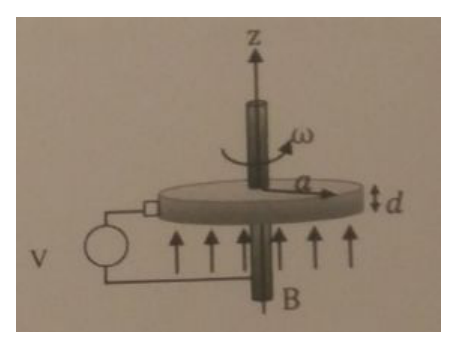 disco metallico rotante in campo magnetico esterno
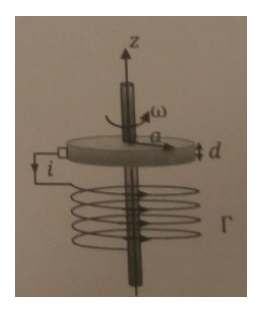 disco e bobina per campo magnetico autoalimentato
Topic: Electromagnetism, Electromagnetic Induction, Circuits Metodi: Lorentz Force Analysis, Gauss’s Law, Ampère’s Law, Differential Equations Competenze: Mathematical Modeling, Physical Reasoning, Diagrammatic Reasoning Objects: Disk, Coil Fonte: Testo (PDF) — p.3
- La distribuzione di cariche di un disco metallo in rotazione in un campo magnetico statico e la
Meccanismo del campo magnetico terrestre (punto: 20 punti)
Parte A
Come mostra la figura, in un magnetico esterno
campo lungo l’asse z nella regione , a B
r
disco metallico neutro di raggio si sta girando
a
un asse metallico con velocità angolare , il
Il raggio di raggi dell’asse può essere ignorato e il
la conducibilità del metallo è , quando la corrente
$\sigma$
e la distribuzione della carica è in uno stato stabile, noi
trovare la differenza potenziale tra il bordo di
il piatto e l’asse è , rispondere al
V
- le domande seguenti. La permissività del vuoto
is .
-
quando la distribuzione di corrente e carica è in stato stabile, is
r, z) (
, e il campo magnetico è , dedurre la relazione tra il campo elettrico e il campo magnetico E
B
campo, e poi trovare V.
(ii) Ignorare gli effetti di confine e considerare il disco come un lungo cilindro, considerare il flusso di campo elettrico
tra il raggio e . Trova la distribuzione della carica nello stato stabile. r r r + d
(iii) Considerare il raggio di attraversamento corrente e , stima at , dove è il
r
r r + d
dt r, z) (
densità di carica. Calcolare quanto tempo ci vuole per raggiungere la distribuzione della corrente e della carica
equilibrio, dal momento in cui inizia a girare.
Parte B
Come mostra la figura, con una certa configurazione, possiamo , senza un
campo esterno, alimentare la corrente prodotta dal disco di rotazione al
coniuga per creare un campo magnetico, finalmente ottenere un magnetico statico
campo. Questo è anche un modello semplice del campo magnetico terrestre. Il
L’auto-induzione del circuito è L (principalmente da ) e la resistenza
is R. Per la bobina, ci sono rotazioni per unità di lunghezza, la lunghezza della
n
la bobina è e il suo raggio è . Il momento di inerzia del disco e il l
a
L’asse è , e il coefficiente di amortizzazione della rotazione è (la resistenza
I
la coppia è ). Rispondete alle seguenti domande.
(i) Supponiamo che la distanza tra la bobina e il disco sia trascurabile e che il campo prodotto da
la bobina è uniforme, uguale al campo prodotto al centro, trovare l’auto-induzione della bobina
, e l’inductanza reciproca tra la bobina e il disco. quando la velocità angolare di L
spinning è , e corrente nel circuito è , trovare la relazione di E … i , M, R, L
i
(ii) Quando la corrente della bobina è
-
Trova la coppia sul disco. (considere la coppia verso l’alto come
i
positivo)
(iii) Da i) e (ii) si può trovare l’equazione tra e , supponiamo una coppia costante
i
0 agisce sull’asse per farla girare, e , . If , cosa è
0 > 2 R M (0)
0 > M (0) i = 0
velocità angolare di equilibrio e il corrente ? If , cosa è in quel
ie (0) .01 i = 0
, i e
- Il caso?
(iv) Con la condizione , complotto grafico con condizioni iniziali diverse di
0 > 2 R M
(0), ). i
Nota: Considerate is a tempo . (0), ) i
i(t), )
t = 0
*disco metallico rotante in campo magnetico esterno *
*disco e bobina per campo magnetico autoalimentato *
Topic: Electromagnetism, Electromagnetic Induction, Circuits Metodi: Lorentz Force Analysis, Gauss’s Law, Ampère’s Law, Differential Equations Competenze: Mathematical Modeling, Physical Reasoning, Diagrammatic Reasoning Objects: Disk, Coil Fonte: Testo (PDF) — p.3
- Conical Pendulum (Score: 20 points) Consider a pendulum system with a point mass , and a string with length , as the figure
m
d
shows. Gravitational acceleration is , ignore the mass of the string and the spinning of the
g
Earth. The initial condition of the system is , , and the velocity of the mass is
$\theta$ = $\theta0 \theta ̇$ = dt
= 0
(when the pendulum is on the x-z plane). y ˆ
(A)Find the angular momentum of the system relative to the pivot Lz . O
(B) Find the total energy of the system , and express your answer in the terms of
E0
. , , \theta \theta ̇ ̇
(C) If the minimum value of in the motion is , find v0.
(D) Prove that the form of is given by the differential equation
= A sin )sin + mv (sin ) 0 2 2 1 2 0 2 2 0
and thus compute . A
(E) If , and , find , the angle rotated about z-axis for the mass to go
< < 1 = 2
from to .
(F) If is no longer a small quantity, but , find the value of . < 1 = <
A useful integral:
,
1 2 1 dy )(y ) 2 2 4 1 = 0 dz = 2
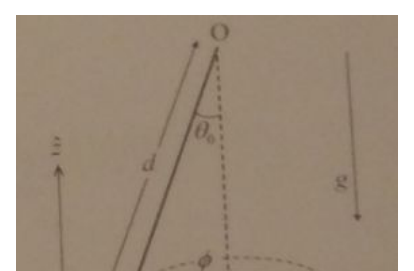 pendolo conico 3D con assi x y z
Topic: Rotational Dynamics, Newtonian Mechanics, Conservation of Energy Metodi: Torque & Angular Momentum Analysis, Conservation Laws, Calculus-Integration Competenze: Mathematical Modeling, Physical Reasoning, Diagrammatic Reasoning Objects: Pendulum Fonte: Testo (PDF) — p.4
- Pendolo conico (punto: 20 punti) Considera un sistema di pendolo con massa puntalistica e una corda di lunghezza , come figura
m
d
-
Le spettacoli. L’accelerazione gravitazionale è , ignorare la massa della corda e il giro della
g
La Terra. La condizione iniziale del sistema è: , , e la velocità della massa è
$\theta$ = $\theta0 \theta ̇$ = dt
= 0
(quando il pendolo è sul piano x-z). y ˆ
(A) Trova la dinamica angolare del sistema relativa al pivot Lz . O
(B) Trova l’energia totale del sistema , e esprime la tua risposta nei termini di
E0
. , , \theta \theta ̇ ̇
C) Se il valore minimo di La mozione è , trovare v0.
D) dimostrare che la forma di è dato dall’equazione differenziale
= A Sin )sin + mv (sin ) 0 2 2 1 2 0 2 2 0
e quindi calcolare . A
(E) If , e , trovare , l’angolo ruotato intorno all’asse z per la massa per andare
< < 1 = 2
di to .
(F) If non è più una piccola quantità, ma , trovare il valore di . < 1 = <
Un’integrale utile:
,
1 2 1 dy )(y ) 2 2 4 1 = 0 dz = 2
*pendolo conico 3D con assi x y z *
Topic: Rotational Dynamics, Newtonian Mechanics, Conservation of Energy Metodi: Torque & Angular Momentum Analysis, Conservation Laws, Calculus-Integration Competenze: Mathematical Modeling, Physical Reasoning, Diagrammatic Reasoning Objects: Pendulum Fonte: Testo (PDF) — p.4
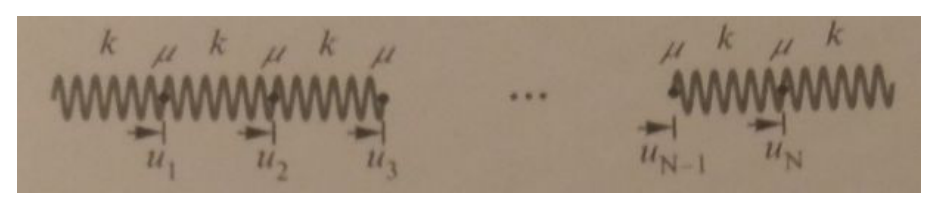
- The effect of mass on a spring (Score: 20%)
As the figure shows, view the spring as point mass of mass , connected by springs of
N
spring constant , natural length . Denote the position of the particles by ,
k
l0
, u , .., u u1 2 . n ignore any sideway motion. (A)The spring above is hung to the ceiling, and let the surface of the ceiling be ,
u1
z = 0 with downward being the positive direction. Hang a point mass of mass below ,
M uN and denote the position of the mass with , list the equation of motion obeyed by
uN+1
the particles. N + 1
(B) When the spring reaches equilibrium under the influence of gravity,
, find . j j(j ) uj = = a1 + a2
- 1 , a a1 2
(C) From (B), consider the continuity limit, , under this
, , j , N l0
circumstance, the natural length of the spring, , mass , and spring
l L0 = N 0
m = N
constant will approach a constant. Let be a continuous parameter, K = k N
l s = j 0
, and , find 0 < s < L0 (s) s s = b1 + b2 2 , b . b1 2
(D)From (C) , find the change in length of the spring , and the position of the center of
L
mass , . Express your answer in terms of X0 , M, g, K, L . m
0
(E) From (A), consider the continuity limit, , under this
, , j , N l0
circumstance, let the density be , Young’s modulus be , find a
= m L0
L Y = K 0
differential equation of . (s, ) u t
(F) Put the system on a smooth surface, and let be the center of rotation with
s = 0
angular speed , find a differential equation of and its boundary condition. (s, ) u t
(G) From (E), when the system is in a stable equilibrium, , find
(s, ) ) A sin(B s) u t
= 0 0
. , B A0 0 Mock APhO test - Time: 5 hours 150 marks total
 catena di N masse collegate da molle
Topic: Elasticity & Materials, Oscillations & Waves, Newtonian Mechanics Metodi: Differential Equations, Wave Equation, Free-Body Diagram, Calculus-Integration Competenze: Mathematical Modeling, Physical Reasoning Objects: Spring, Block Fonte: Testo (PDF) — p.5
- Effetto della massa su una molla (punto: 20%)
Come mostra la figura, la primavera è considerata come massa puntaria di massa , collegato da sorgenti di
N
costante di primavera , lunghezza naturale . Indicare la posizione delle particelle ,
k
l0
, u , .., u u1 2 . n ignorare qualsiasi movimento laterale. (A) La primavera sopra è appeso al soffitto, e la superficie del soffitto sia ,
u1
z = 0 con la direzione positiva verso il basso. Appendici di massa di seguito ,
M uN e indicare la posizione della massa con , elenca l’equazione di movimento obbedita da
uN+1
il
- Particelle. N + 1
(B) Quando il primavera raggiunge equilibrio sotto il influenza of gravità,
, trovare . j j(j ) uj = = a1 + a2
- 1 , a a1 2
(C) A partire da (B), si considera il limite di continuità, , sotto questo
, , j , N l0
la circostanza, la lunghezza naturale della primavera, , massa , e la primavera
l L0 = N 0
m = N
costante si avvicinerà a una costante. Lascia che essere un parametro continuo, K = k N
l s = j 0
, e , trovare 0 < s < L0 (s) s s = b1 + b2 2 , b . b1 2
(D) Da (C) trovi la variazione della lunghezza della primavera , e la posizione del centro di
L
massa , . Esprimi la tua risposta in termini di X0 , M, g, K, L . m
0
(E) A partire da (A), si considera il limite di continuità, , sotto questo
, , j , N l0
la densità è , modulo di Young , trovare un
= m L0
L Y = K 0
equazione differenziale di . (s, ) u t
F) Mettete il sistema su una superficie liscia e lasciate che essere il centro di rotazione con
s = 0
velocità angolare , trovare un’equazione differenziale di e la sua condizione di confine. (s, ) u t
(G) Da (E), quando il sistema è in equilibrio stabile, , trovare
(s, ) ) Un peccato u t
= 0 0
. , B A0 0 Test simulato APhO - Tempo: 5 ore 150 marks totali
- catena di N massa collegate da molle *
Topic: Elasticity & Materials, Oscillations & Waves, Newtonian Mechanics Metodi: Differential Equations, Wave Equation, Free-Body Diagram, Calculus-Integration Competenze: Mathematical Modeling, Physical Reasoning Objects: Spring, Block Fonte: Testo (PDF) — p.5
- Deflection of Light Under Gravitational Lenses (50%) According the the principle of equivalence in General Relativity, the laws of physics in
a uniform gravitational field is exactly the same as the laws in a lab with the same
g
acceleration. In a non-uniform gravitational field, the statement can be generalized as follows: in a
freely falling lab, the observed laws of physics are the same as the laws in special
relativity, with no gravity. Free falling means the only external force during the motion
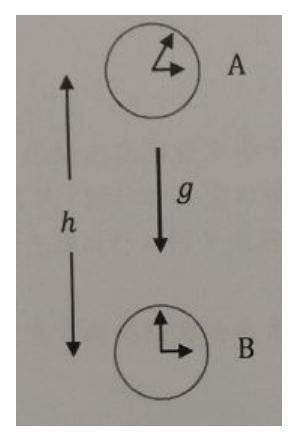
is gravity. (i) Consider the case of an uniform gravitational field , the two clocks have a height
g
difference of , as shown in the figure. h
It is known that the speed of light in vacuum is , and A and B use the same clock
c
(atomic clock). The clock is not affected by acceleration. Now, a light signal of
frequency is emitted from B, if we want to find , the frequency A recieved, we can f B
f A
consider a free falling reference frame S. In S, both clocks are accelerating in the
direction from B to A (opposite to the field). Suppose B was at rest relative to S when
it emitted the signal (at time ). t = 0
According to the principle of equivalence, in S, special relativity is applicable. It is
known that in a gravitational field, when is small enough, the shifting-ratio of the
h
light wave can be denoted as: fB f B A = c2 gh find . (ii) Suppose the same atoms, radiating the same frequency of light, are used to do the
timing, then the frequency shifting in (i) can be viewed as the same clocks, but runs
differently because of the different gravitational fields. If is positive in (i), we can see
$\alpha$
it as the clock period at B, , is longer than the period at A, ( , time
t B
t A t t B > A
dilates at B), so the frequency of photons from B, received at A, its frequency is
f A
smaller; otherwise, we can see it as the clock period at B, , is shorter than the
t B
period at A, ( , time contracts at B). Because special relativity is
t A t t B < A
applicable to S in (i) therefore, time dilation must come with the same factor of length
contraction. If the wavelength we found at A, B is , respectively, then
l , A B
/ ) / ) . ( A B ( A B = 1 let , and the speed of light at A, B is respectively, what is t / B A = , c cA B / c ? cA B (iii) Suppose a planet can be viewed as a uniform sphere of mass , radius , and the
M R
canter of the sphere is the origin of polar coordinates. denotes the gravitational
G
constant, suppose . From the result of (i), if atoms on the surface of the
M < G < Rc2
planet radiates a photon of frequency , then at the point of infinity (point A), the
f R
frequency received, is equal to f
1 )f f ( + k R R find constant . k (iv) From (ii) and (iii), it is known that the speed of light in zero gravity is equal to the
speed of light in vacuum, , then, from the results of (ii) and (iii), what is the speed of
c
light where the distance to the center of the planet is , ? what is the refractive
r (r)
c
index at in that case? (r) n r
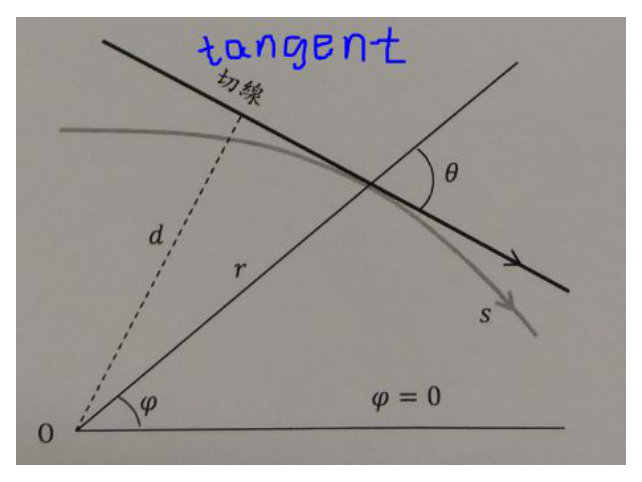
(v) From (iv), let the angle between the direction of light and radial be , denotes
r, ) (
polar coordinates in a plane, the path length along the trajectory of light is s, as the
following figure shows. According to Bouguer’s formula, when the refractive index of a medium has a spherical
symmetry, Snell’s law should be restated as: (r)d onst. r = n = c
when the light shoots with impact parameter from infinity on the left, because of
b > R
gravitational lensing effect (i.e. the deflection of light), when the light moves across the
planet ( ) and go toward infinity on the right, its direction will deflect for an angle r
.
find the equation of the trajectory of light (i.e. find the equation satisfies), and use it
dr
to solve for .
Note that the following mathematical formula may be of use: sin d dx x a = 1 2 2 ( is in the first or the fourth quadrant.) in s x a
 orologio A e B in campo gravitazionale, altezza h
 traiettoria luce deflessa da lente gravitazionale
Topic: Gravitation, Special Relativity, Geometric Optics Metodi: Newton’s Law of Gravitation, Snell’s Law, Approximation & Series Expansion Competenze: Mathematical Modeling, Physical Reasoning, Diagrammatic Reasoning Objects: Planet, Photon Fonte: Testo (PDF) — p.7
- Deflezione della luce sotto lenti gravitazionali (50%) Secondo il principio di equivalenza nella Relatività Generale, le leggi della fisica in
un campo gravitazionale uniforme E’ esattamente la stessa legge di un laboratorio con la stessa
g
Accelerazione. In un campo gravitazionale non uniforme, la dichiarazione può essere generalizzata come segue:
La legge della fisica è la stessa di quella della fisica in particolare.
La relatività, senza gravità. Caduta libera significa l’unica forza esterna durante il movimento
è la gravità.
-
Considerare il caso di un campo gravitazionale uniforme , i due orologi hanno un’altezza
g
differenze di , come mostrato nella figura. h
È noto che la velocità della luce nel vuoto è , e A e B usano lo stesso orologio
c
(orologio atomico). L’orologio non è influenzato dall’accelerazione. Ora, un segnale di luce di
frequenza è emesso da B, se vogliamo trovare , la frequenza A ricevuta, possiamo f B
f A
Considerare un quadro di riferimento S a caduta libera. In S, entrambi gli orologi sono in accelerazione nel
direzione da B a A (opposto al campo). Supponiamo che B sia in riposo rispetto a S quando
ha emesso il segnale (in tempo ). t = 0
Secondo il principio di equivalenza, in S si applica la relatività speciale. It is
si sa che in un campo gravitazionale, quando Il rapporto di spostamento del
h
l’onda di luce può essere indicata come: fB f B A = c2 gh trovare . (ii) Supponiamo che gli stessi atomi, che irradiano la stessa frequenza di luce, siano utilizzati per fare il
tempo, quindi la variazione di frequenza in (i) può essere vista come gli stessi orologi, ma corse
In modo diverso a causa dei diversi campi gravitazionali. If è positivo in (i), possiamo vedere
$\alpha$
il periodo di orologio a B, , è più lungo del periodo di A, ( , tempo
t B
t A t t B > A
dilata a B), quindi la frequenza dei fotoni da B, ricevuta a A, la sua frequenza is
f A
più piccole; altrimenti, Possiamo vederlo come il periodo dell’orologio a B, , è inferiore alla
t B
periodo A, ( , contratti temporali a B). Perché la relatività speciale è
t A t t B < A
applicabile a S nella lettera i), pertanto, la dilatazione temporale deve avere lo stesso fattore di lunghezza
- La contrazione. Se la lunghezza d’onda che abbiamo trovato a A, B è , rispettivamente,
l , A B
/ ) / ) . ( A B ( A B = 1 lasciate , e la velocità della luce a A, B è rispettivamente, che cosa è t / B A = , c cA B / c ? cA B (iii) Supponiamo che un pianeta possa essere visto come una sfera uniforme di massa , raggio , e il
M R
Il canter della sfera è l’origine delle coordinate polari. indica la gravità
G
costante, supponiamo . Dal risultato di i, se gli atomi sulla superficie della
M < G < Rc2
Il pianeta irradia un fotone di frequenza , quindi al punto di infinito (punto A), il
f R
frequenza ricevuta, è uguale a f
1 )f f ( + k R R trovare costante . k (iv) Dalle lettere ii) e iii) è noto che la velocità della luce in gravità zero è uguale alla velocità di
La velocità della luce nel vuoto, quindi, dai risultati di (ii) e (iii), qual è la velocità di
c
luce dove la distanza al centro del pianeta è , ? Qual è la rifrazione
r (r)
c
indice
- In quel caso? (r) n r
(v) A partire da (iv), l’angolo tra la direzione della luce e la radial deve essere , indicazioni
r, ) (
Le coordinate polari in un piano, la lunghezza del percorso lungo la traiettoria della luce è s, come il
- la figura mostra. Secondo la formula di Bouguer, quando l’indice di rifrazione di un mezzo ha un’onda
La simmetria, la legge di Snell, deve essere riformulata come: (r)d
- Sì, è vero. r = n = c
quando la luce spara con parametro di impatto dall’infinito a sinistra, a causa di
b > R
effetto di lente gravitazionale (ad esempio: la deflezione della luce), quando la luce si muove attraverso il
pianeta ( ) e andare verso l’infinito a destra , la sua direzione si devia per un angolo r
.
trovare l’equazione della traiettoria della luce (cioè trovare l’equazione (cfr.
dr
per risolvere .
Si noti che può essere utile la seguente formula matematica: il peccato d dx x a = 1 2 2 ( è nel primo o quarto quadrante.) in s x a
*orologio A e B in campo gravitazionale, altezza h *
traiettoria luce deflessa da lente gravitazionale
Topic: Gravitation, Special Relativity, Geometric Optics Metodi: Newton’s Law of Gravitation, Snell’s Law, Approximation & Series Expansion Competenze: Mathematical Modeling, Physical Reasoning, Diagrammatic Reasoning Objects: Planet, Photon Fonte: Testo (PDF) — p.7
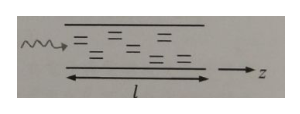
- Interaction between electron and light in free electron lasers (50%) Light can interact with electrons when it’s transmitting
in a media, this will cause the intensity to change. In a
microscopic view, there are two important processes,
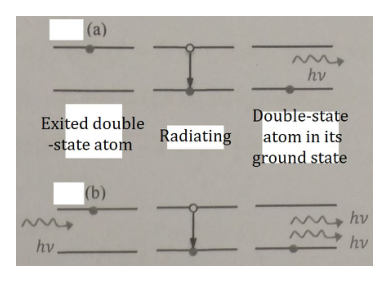
one is spontaneous emission, when electrons can emit
photons spontaneously and return to ground state. Like
how an excited double-state atom (with energy level
< , the energy of the photon is ) E1 E2
h = E2 can emit a photon spontaneously as in Fig(a); the other
is stimulated emission, when electrons in an excited
state is influenced by photon of the same energy already existed in space and emit a photon, the
probability of emission is proportional to not only the probability of electron transitioning, but
also the intensity of light. Its reverse process is called stimulated absorption, and also satisfies
the same relation. Answer the following questions. (A) Planck’s law can also be described as the energy density per unit frequency in an adiabatic
cavity , when the temperature is , where is the planck’s
, T) u
T , T) u
= c3 1 e T B h
constant and is the Boltzmann constant. Now consider there’s also N double-state atoms as
kB
in Fig (a) in the cavity, suppose the probability of spontaneous emission is , stimulated
A
emission is , stimulated absorption is , when the system is in equilibrium at
B21
B12
temperature , deduce and from Planck’s law. T /B A 21 /B A 12
(B) From (A), light of frequency and intensity shoots into a
I0
media containing double-state atom, suppose atoms at the lower
energy state is , atoms at the higher energy state is , the
N 1

N 2
distribution is uniform. The cross section of the media is , the
a
length is , find the intensity out of the media, and find the condition at which the intensity can l
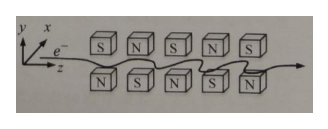
grow exponentially with .l Apart from the aforementioned method, we can also use an
external electric field and magnetic field to accelerate the
electron, to let it interact with light waves and amplify it, the
classical example is free electron laser, as the figure shows.
Free electron laser uses alternating magnetic field(undulator) to form (
0, sin(k z), ) B ( B u 0 , where is the period of the magnetic field in space), the field can accelerate ku = 2 u
incoming electrons to radiate light, then interact with electromagnetic wave to amplify it by
stimulated emission. the initial position of the electron is , initial velocity is in the
0, 0, 0)
(
v0
z-direction, its mass is , charge is , , because the speed of the electron is
m
$-e$
 livelli energetici atomo a due stati, emissione
 mezzo con atomi, luce di intensità I
 undulatore FEL con magneti alternati S-N
Topic: Modern-Quantum Physics, Oscillations & Waves, Electromagnetism Metodi: Photon Energy Relation, Statistical Averaging, Differential Equations Competenze: Mathematical Modeling, Physical Reasoning Objects: Electron, Photon, Atom Fonte: Testo (PDF) — p.10
- Interazione tra elettrone e luce nei laser ad elettroni liberi (50%) La luce può interagire con gli elettroni quando trasmette
in un mezzo, questo farà cambiare l’intensità. In a
La vista microscopica, ci sono due importanti processi,
una è l’emissione spontanea, quando gli elettroni possono emettere
i fotoni spontaneamente e ritornano allo stato di base. Come …
come un atomo a doppio stato eccitato (con livello di energia)
< , l’ energia del fotone è ) E1 E2
h = E2 può emettere spontaneamente un fotone come in figura a); l’altro
è stimolata l’emissione, quando gli elettroni in un’emissione eccitata
Il suo stato è influenzato da fotoni della stessa energia già esistente nello spazio e emette un fotone, il
la probabilità di emissione è proporzionale non solo alla probabilità di transizione degli elettroni, ma
anche l’intensità della luce. Il suo processo inverso si chiama assorbimento stimolo, e soddisfa anche
lo stesso rapporto. Rispondete alle seguenti domande. (A) La legge di Planck può essere descritta anche come la densità di energia per unità di frequenza in un adiabatico
cavità , quando la temperatura è , dove è il piano
, T) u
T , T) u
= c3 1 e T B h
costante e è la costante di Boltzmann. Ora consideriamo che ci sono anche N atomi a doppio stato come
kB
nella figura a) nella cavità, supponiamo che la probabilità di emissioni spontanee sia , stimolato
A
l’emissione è , l’ assorbimento stimato è , quando il sistema è in equilibrio a
B21
B12
temperatura , dedurre e
- dalla legge di Planck. T /B A 21 /B A 12
(B) Da (A), luce di frequenza e intensità spara in un
I0
media contenenti atomi a doppio stato, supponiamo atomi alla base
stato energetico è , gli atomi allo stato di energia superiore sono , il
N 1

N 2
la distribuzione è uniforme. La sezione trasversale dei media è , il
a
lunghezza è , trovare l’intensità fuori dal mezzo, e trovare la condizione in cui l’intensità può l
crescere esponenzialmente con .l Oltre al metodo di cui sopra, possiamo anche utilizzare un metodo di
campo elettrico esterno e campo magnetico per accelerare la
L’elettrone, per permettergli di interagire con le onde di luce e amplificarlo,
L’esempio classico è il laser ad elettroni liberi, come mostra la figura.
Il laser ad elettroni liberi utilizza un campo magnetico alternato (undulatore) per formare (
0, (sink) B ( B u 0 , dove è il periodo del campo magnetico nello spazio), il campo può accelerare ku = 2 u
L’energia elettrica è stata generata da un’onda elettromagnetica.
emissione stimolata. la posizione iniziale dell’elettrone è , velocità iniziale è nel
0, 0, 0)
(
v0
Z-direzione, la sua massa è , l’ accusa è , , perché la velocità dell’elettrone è
m
$-e$
- livelli energetici atomici a due stati, emissioni *
*mezzo con atomi, luce di intensità I *
- indulatore FEL con magneti alternati S-N *
Topic: Modern-Quantum Physics, Oscillations & Waves, Electromagnetism Metodi: Photon Energy Relation, Statistical Averaging, Differential Equations Competenze: Mathematical Modeling, Physical Reasoning Objects: Electron, Photon, Atom Fonte: Testo (PDF) — p.10
) ) γ0 = ( −( c v0 2 −2 1 very close to the
1 ) ) = ( c v0 2 1
very close to the speed of light , , we need to account for relativistic
c
Topic: Special Relativity, Electromagnetism Metodi: Relativistic Energy-Momentum, Lorentz Force Analysis, Approximation & Series Expansion Competenze: Mathematical Modeling, Physical Reasoning Objects: Electron Fonte: Testo (PDF) — p.10
**)) γ0 = ( −( c v0 2 −2 1 molto vicino alla **
1 ) ) = ( c v0 2 1
molto vicino alla velocità della luce , , dobbiamo spiegare la relativistica
c
Topic: Special Relativity, Electromagnetism Metodi: Relativistic Energy-Momentum, Lorentz Force Analysis, Approximation & Series Expansion Competenze: Mathematical Modeling, Physical Reasoning Objects: Electron Fonte: Testo (PDF) — p.10
1 ) )
= ( c v 2 1 > 1
effects. Answer the following: (C) Find the ratio between transverse velocity and , , as a function of z, c and y and thus find the average of , . precise to , express it with , where
) O 0
, K
B/mck . K = e u
Some helpful notes: (1) The relation between the motion of the electron and
time comes from the z coordinate of the electron. (2) x x = 1 1 + 8 3 2 +
(D) From (C), because the effect of the alternating
magnetic field, its x-coordinate varies periodically, at the
same time, the electron radiates light because it’s accelerating (this is spontaneous emission),
this is similar to forced oscillation. The electromagnetic wave electron beam radiates because
the undulator will be in resonance. It is known that for particles with speed close to , the
c
radiation is focused in a very small cone, therefore we can say the direction of radiation is
constant. Consider the wave radiated by different electrons at different places, as the figure
shows. The direction is . Suppose can be approximated to be , and ignoring random
initial phase of the wave, find the resonant wavelength , precise to ,when .
) O 0 = 0 Express it with . , K
(E) Now, the electrons are also influenced by the electric field it radiates. Suppose the electric
field of the electromagnetic wave is , where . When the
E cos(kz t ), 0, 0) ( 0 +
k =
incident point is , the interaction between the electron and the electromagnetic
,
z = 0 = 0
wave is as follows: (i) The time varying rate of energy is proportional to . It’s known that when the z
dt d(mc ) 2
dt
coordinate of the electron is , , find . z ) os( )] dt = A
- + c ˉ + , , A ˉ
(ii) the average of the time varying rate of electron (proportional to ) with respect to
dt
coordinate is an indicator of energy exchange between the electron and the electromagnetic z
wave. Suppose can be approximated to be , and in ’s expression can be
,
approximated to the case where there’s no electromagnetic wave (i.e. ), precise to
, find the wavelength of the electromagnetic wave that can make the average of ) O 0
dt with respect to coordinate be maximum. z
(F) For the beam of electron, phase of each electron’s radiation is not necessarily equal,
therefore if we want the maximum radiated electromagnetic field, we will have to synchronize
each electron’s radiation, the outputted light can then be at laser level. It’s known that
electrons within a wavelength is synchronized, and bunching occurs when energy is exchanged
between the electron and electromagnetic wave, which make the electron density periodical in
space with period . (i) Suppose the incident beam satisfies , find when the
,
z = 0 = 0 dt
z-coordinate is relative to the canter. (ii) From that, deduce of the radiated
z0
electromagnetic field when resonant condition is achieved, and explain how the bunching effect
can synchronize radiated electromagnetic waves. 3. Shielding Potential of Charges in Metal and Conditions of Electron Bound State (50%) Consider a proton of charge formed in a piece of metal, and its contribution to electrons’
e
potential . It’s known that the potential of electron due to proton in vacuum is
(r) U
, and the number density of electron in metal is , mass of an electron is . (r) e /r U c = 2
n0

m
First consider a metal without external charge, when the potential . Because of Pauli’s
(r) U = 0
exclusion principle, each electron has to be in a different state. Electrons have two spin state,
therefore each wave number vector can contain two electrons: k , , ) k ( x ky kz
(A)If the metal’s measure in one direction (like x) is , then the electron’s wave function
L
is the same at and , find the quantization condition of x = 0 x = L kx (B) If the maximum magnitude of electrons’ wave number is , and ,
k| | max = kF n0 kF satisfies the relation , find . Hence express with , the corresponding
k n0 = a b F , b a
n0 EF
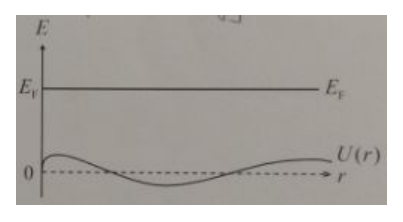
energy of . kF When there’s external charges, is no longer
(r) U
zero, but stays constant, as the figure shows.
EF
When this happens, charge density will change with
space. For the following parts, use in place of in
kF
n0
your answers. (C) From the relation between , , introduce
n0 EF
and write the relation between and (r) U (r) n . EF
(D) Suppose and the change in space of is sufficiently slow, so we can write
(r) EF > U
(r) U
, then , find (r) n(r) n = n0 + n(r) ) =
(E) Find the integration expression relating and (r) U n(r).
(F) Replace with and find the integration expression of n(r) (r) U (r). U
(G) Multiply your result from (F) by , and differentiate twice with respect to to get
r
r
, find U dr2 d U 2
- r 2 dr dU = .
(H) As a trial solution, substitute to the solution in (G) and find .
(r) (r)U (r) U = f c
(r) f
is the potential of an electron due to a proton in vacuum. (r) e /r U c = 2 (I) Consider if can bound an election: if is the radius of the electron’s orbit in bound
(r) U
r0
state, find the condition for the bounding energy to be negative.
(J) Suppose we can change (or ) continuously, so that this quantum system only has one
n0
bound state. From how Bohr considers the hydrogen atom, find the expression of under this
condition. Theoretical test 2 - Time: 4 hours, Total marks: 100
 livello di Fermi EF e potenziale U(r) nel metallo
Topic: Special Relativity, Electromagnetism, Oscillations & Waves Metodi: Relativistic Energy-Momentum, Lorentz Force Analysis, Approximation & Series Expansion Competenze: Mathematical Modeling, Physical Reasoning Objects: Electron, Particle Beam Fonte: Testo (PDF) — p.10
1 ) )
= ( c v 2 1 > 1
effetti. Rispondi alle seguenti domande: (C) Trovare il rapporto tra velocità trasversale e , , come funzione di z, c e y e quindi trovare la media di , . precisione , lo esprime con , dove
) O 0
, K
- B / mck . K = e u
Alcune note utili: (1) La relazione tra il movimento dell’elettrone e il
Il tempo proviene dalla coordinata z dell’elettrone. (2) x x = 1 1 + 8 3 2 +
(D) Da (C), perché l’effetto dell’alternativa
Il campo magnetico, la sua coordinata x varia periodicamente, al
allo stesso tempo, l’elettrone irradia luce perché si sta accelerando (questo è un’emissione spontanea),
Questo è simile all’oscillazione forzata. Il raggio di elettroni delle onde elettromagnetiche si irradia perché
l’ondulatore sarà in risonanza. È noto che per le particelle con velocità vicine a , il
c
La radiazione è concentrata in un cono molto piccolo, quindi possiamo dire che la direzione della radiazione è
costante. Considerate l’onda irradiata da diversi elettroni in diversi luoghi, come la figura
-
Le spettacoli. La direzione è . Supponiamo può essere approssimato a , e ignorare il casuale
fase iniziale dell’onda, trovare la lunghezza d’onda risonante , precise per Quando .
) O 0 = 0 Esprimete . , K
(E) Ora, gli elettroni sono influenzati anche dal campo elettrico che irradia. Supponiamo che l’ elettrico
campo dell’onda elettromagnetica è , dove . Quando il
E cos(kz t ), 0, 0) ( 0 +
k =
punto di incidente è , l’interazione tra l’elettrone e l’elettromagnetico
,
z = 0 = 0
l’onda è la seguente:
- Il tasso di variazione temporale dell’energia è proporzionale a . È noto che quando la z
dt d(mc ) 2
dt
La coordinata dell’ elettrone è , , trovare . z ) os( )] dt = A
- + c ˉ + , , A ˉ
-
la media della velocità di variazione temporale degli elettroni (proporzionale alla velocità di variazione temporale degli elettroni) ) per quanto riguarda
dt
coordinate è un indicatore dello scambio di energia tra l’elettrone e l’elettromagnetico z
-
La sua onda. Supponiamo può essere approssimato a , e in s espressione può essere
,
Approximato al caso in cui non vi sia onda elettromagnetica (cioè ), precise per
, trovare la lunghezza d’onda dell’ onda elettromagnetica che può rendere la media di ) O 0
dt per quanto riguarda la coordinata, essere massimale. z
(F) Per il fascio di elettrone, la fase di radiazione di ogni elettrone non è necessariamente uguale,
Quindi se vogliamo il campo elettromagnetico massimo irradiato, dovremo sincronizzare
per ogni radiazione di elettroni, la luce prodotta può essere a livello laser. È noto che
Gli elettroni all’interno di una lunghezza d’onda sono sincronizzati e il gruppo si verifica quando l’energia viene scambiata
La densità di un elettrone è periodicamente variabile in
spazio con periodo . (i) Supponiamo che il fascio incidentale soddisfi , trovare quando il
,
z = 0 = 0 dt
coordinate z is Relativa to il
-
Non è così. (ii) Da che, deduzione of il radiati
z0
campo elettromagnetico quando si raggiunge la condizione di risonanza, e spiegare come l’effetto di cluster
può sincronizzare le onde elettromagnetiche irradiate. 3. Potenziali di protezione delle cariche nel metallo e nelle condizioni dello stato di connessione elettronica (50%) Considerate un protone di carica costituita in un pezzo di metallo e il suo contributo agli elettroni
e
potenziale . È noto che il potenziale di un elettrone dovuto al protone nel vuoto è
(r) U
, e la densità numerica di elettroni nel metallo è , massa di un elettrone è . (r) e /r U c = 2
n0

m
In primo luogo, si consideri un metallo senza carica esterna, quando il potenziale di . A causa di Pauli.
(r) U = 0
In base al principio di esclusione, ogni elettrone deve essere in uno stato diverso. Gli elettroni hanno due stati di spin,
quindi ogni vettore di numero d’onda può contenere due elettroni: k , , ) k ( x ky kz
(A) Se la misura del metallo in una direzione (come x) è , quindi la funzione d’ onda degli elettroni
L
è lo stesso a e , trovare la condizione di quantizzazione di x = 0 x = L kx (B) Se la magnitudo massima di elettroni numero di onde è , e ,
k| | max = kF n0 kF soddisfa la relazione , trovare . Quindi esprimere con , il corrispondente
k n0 = a b F , b a
n0 EF
energia di . kF Quando ci sono cariche esterne, non è più
(r) U
zero, ma rimane costante, come mostra la figura.
EF
Quando questo accade, la densità della carica cambierà con
lo spazio. Per le seguenti parti, utilizzare al posto di in
kF
n0
le vostre risposte. C) Dal rapporto tra , , introdurre
n0 EF
e scrivere la relazione tra e (r) U (r) n . EF
(D) Supponiamo e il cambiamento nello spazio di è abbastanza lento, così possiamo scrivere
(r) EF > U
(r) U
, allora , trovare (r) n(r) n = n0 + n(r) ) =
(E) Trova l’espressione di integrazione relativa e (r) U n(r).
F) Rimpiazzare con e trovare l’espressione di integrazione di n(r) (r) U (r). U
(G) Moltiplicare il risultato da (F) per , e differenziare due volte rispetto a per ottenere
r
r
, trovare U dr2 d U 2
- r 2 dr dU = .
H) Come soluzione di prova, sostituire alla soluzione di (G) e trovare .
(r) (r)U (r) U = f c
(r) f
è il potenziale di un elettrone dovuto a un protone nel vuoto. (r) e /r U c = 2 (I) Considerare se può vincolare un’elezione: se è il raggio di orbita dell’elettrone in linea di linea
(r) U
r0
stato, trovare la condizione per l’energia di confine di essere negativa.
(J) Supponiamo di poter cambiare (or ) continuamente, in modo che questo sistema quantistico abbia solo una
n0
stato di confluenza. Dalla concezione di Bohr dell’atomo di idrogeno, trovi l’espressione di in questo
condizione. Test teorico 2 - Tempo: 4 ore, punteggi totali: 100
L’efficienza di ferro e il potenziale di U) nel metallo
Topic: Special Relativity, Electromagnetism, Oscillations & Waves Metodi: Relativistic Energy-Momentum, Lorentz Force Analysis, Approximation & Series Expansion Competenze: Mathematical Modeling, Physical Reasoning Objects: Electron, Particle Beam Fonte: Testo (PDF) — p.10
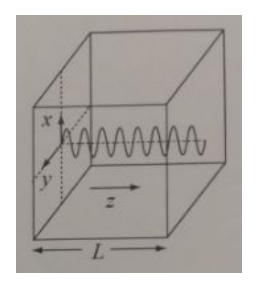
- Quantum Optics (Score: 20%) Light has wave-particle duality, so light waves can be described by one dimensional oscillator in classical mechanics. Quantum optics utilizes the quantization of Electromagnetic field to describe the quantum state of photons by quantum state of one dimensional oscillator. Part A Consider electromagnetic wave transmitting in a cubic cavity of side length , and volume , as the figure shows. The electric field is L V
(z, ) ) Ex t = E0
- where is the magnitude of the oscillation, is the wave E0 k = 2
vector, is the angular frequency of the oscillation. Consider the
case of in parts (i) ~ (iii).
= 0
(i) the magnetic field in the cavity can be expressed as . Find and the (z, ) f(z, ) By t = B0 t /B E0 0
function (z, ) f t (ii) Find the total energy of the electromagnetic field in the cavity (t) E
(iii) Now introduce two functions and satisfies , . then (t) q p(t)
(t) ) q (t) ) p
can be rewritten as . Find , express them with (t) E (p q ) E = 2 1 2 + 2 (t), q(t) p
, E , V 0
P.S. Here, , . The energy equation above can be viewed as the (t) q/dt p = d p/dt q(t) d =
energy of an oscillator. Part B In quantum mechanics, energy of an one-dimensional simple harmonic oscillator can be written as n ) En = ( + 2 1 ˉh
Here, can be interpreted as the number of photons, , is the Planck’s constant. n ˉh = h h q and satisfies Heisenberg’s uncertainty principle, meaning that p
/2
is true. Now, rewrite the electric field as (iv) and , . (z, ) E sin(kz){cos\phi X (t) X (t) } Ex t V 0 4 ˉh 0 1
- s 2 (t) q(t) X1 = (t) p(t) X2 =
Find the parameters . , In quantum optics we often use phasor diagram (i.e. graph) to describe the quadrature X1
of the electric field. The quantum state of photons can be expressed as in the X = X1 + i 2
phasor diagram as shown on the next page. (v) Find , express it in terms of | , E , . V 0
(vi) Consider the average energy of the electromagnetic wave, when , we can get . Find the constant . Strictly
n > 1 n = | a a
speaking, we have to consider the average number of photons in the cavity, meaning is expressed by . n nˉ
(vii) From the quantum energy equation above, the system has energy even when there’s no photon inside the cavity, this ˉh
energy is called zero-point energy. We can say that the existence of zero-point energy is caused by vacuum fluctuation. If that’s the case, find the electric field fluctuation in vacuum Evac.
(viii) In the phasor diagram, the quantum state of the photon satisfies . Find X 1 2
(ix) The uncertainty of phasors can also be written as . Find
This inequality means that photons have an uncertainty on particle number and phase n .
 cavità cubica con onda elettromagnetica
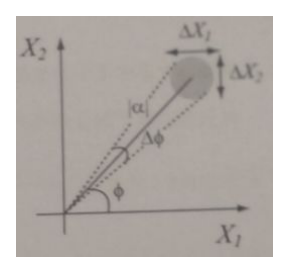 diagramma fasore X1-X2 con incertezze
Topic: Modern-Quantum Physics, Oscillations & Waves, Electromagnetism Metodi: Simple Harmonic Motion Analysis, Wave Equation, Bohr Model & Quantization Competenze: Mathematical Modeling, Physical Reasoning Objects: Photon Fonte: Testo (PDF) — p.14
- L’ottica quantistica (punto: 20%) La luce ha la dualità ondulazione-particellazione, quindi le onde luminose possono essere descritte da un oscillatore di una dimensione in meccanica classica. L’ottica quantistica utilizza la quantizzazione del campo elettromagnetico per descrivere lo stato quantistico dei fotoni per stato quantistico di un oscillatore a una dimensione. Parte A Considera l’ onda elettromagnetica che trasmette in una cavità cubica laterale lunghezza , e volume , come mostra la figura. Il campo elettrico è L V
(z, ) ) Ex t = E0
- dove è la magnitudo dell’oscillazione, E ’ l’ onda E0 k = 2
Vettore, è la frequenza angolare dell’oscillazione. Considerate le
caso di nelle parti i) ~ iii).
= 0
- il campo magnetico nella cavità può essere espresso come . Trova e il (z, ) f(z, ) By t = B0 t /B E0 0
funzione (z, ) f t (ii) Trova l’energia totale del campo elettromagnetico nella cavità (t) E
- Ora introdurre due funzioni e soddisfa , . Allora (t) q p(t)
(t) ) q (t) ) p
può essere riscritta come . Trova , esprimere con (t) E (p q ) E = 2 1 2 + 2 (t), q(t) p
, E , V 0
P.S. Ecco, , . L’equazione energetica di cui sopra può essere considerata come (t) q/dt p = d p/dt q(t) d =
energia di un oscillatore. Parte B Nella meccanica quantistica, l’energia di un oscillatore armonico semplice unidimensionale può essere scritta as n ) En = ( + 2 1 ˉh
Ecco, può essere interpretata come il numero di fotoni, , è la costante di Planck. n ˉh = h h q e Il principio di incertezza di Heisenberg è soddisfatto, in p
/2
- E’ vero. Ora, riscrivi il campo elettrico come (iv) e , . (z, ) E sin(kz){cos\phi X (t) X (t) } Ex t V 0 4 ˉh 0 1
- s 2 (t) q(t) X1 = (t) p(t) X2 =
Trova i parametri . , Nella ottica quantistica spesso usiamo il diagramma di fase (cioè grafico) per descrivere la quadratura X1
di un campo elettrico. Lo stato quantistico dei fotoni può essere espressa come nel X = X1 + i 2
diagramma di fase come mostrato nella pagina successiva. (v) Trova , che si esprime in termini di | , E , . V 0
Vi) Considerare l’energia media dell’onda elettromagnetica, quando
- Possiamo andare . . Trova la costante . Stritamente
n > 1 n = | a a
Parlando, dobbiamo considerare il numero medio di fotoni in la cavità, cioè è espresso da . n nˉ
(vii) Dall’equazione di energia quantistica di cui sopra, il sistema ha energia Anche quando non c’è nessun fotone all’interno della cavità, questo ˉh
l’energia è chiamata energia a punto zero. Possiamo dire che l’esistenza di energia a punto zero è causata da fluttuazioni del vuoto. Se questo è il caso, trovare la fluttuazione del campo elettrico in vacuo evac.
(viii) Nel diagramma di fase, lo stato quantistico del fotone soddisfa . Trova X 1 2
(ix) L’incertezza dei phase può essere scritta anche come . Trova
Questa disuguaglianza significa che i fotoni hanno un’incertezza sul numero di particelle e fase n .
- cavità cubiche con onda elettromagnetica *
diagramma di fasore X1-X2 con incertezze
Topic: Modern-Quantum Physics, Oscillations & Waves, Electromagnetism Metodi: Simple Harmonic Motion Analysis, Wave Equation, Bohr Model & Quantization Competenze: Mathematical Modeling, Physical Reasoning Objects: Photon Fonte: Testo (PDF) — p.14
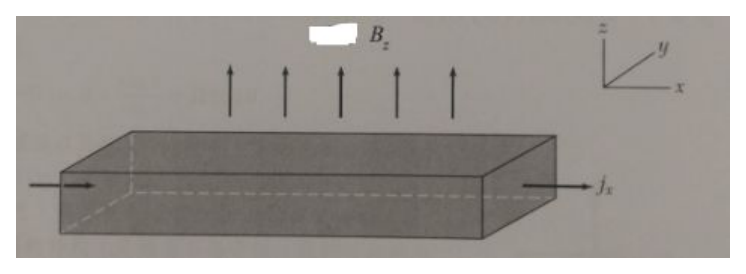
- Hall Resistance (Score: 20%) (A) Consider a metal plate in an uniform magnetic field in the z-direction as the first B
figure shows. It is known that the equation of motion of charged particles in metal is , where is a constant denoting the average collision time of the p/dt (t) d = p
- f
particle, denotes the average momentum of the particle, and is the external force. p (t) f
Current density is defined as , where is the velocity of the particle, is the ev j n v n
number density of particles. If is in a steady state, and , so we can j , , ) j ( x jy jz E j
write as: j
E E E jx = x + y + z E E E jy = x + y + z E E E jz = x + y + z Find all the terms where . and express your answer with , , , , i j = x y z e = n 2
and B/m = e (B) Rewrite it as . Find all the terms where j E , , , . i j = x y z (C) in Hall measurements, define the Hall resistance as , where is the /I Rxy = V y x V y
potential difference in the y-direction, is the current passing. The second figure Ix
shows the data from a few Hall measurements. If the lattice constant of the metal is , find the number of charged particles per lattice. .3926 nm 0
 piastra metallica in campo magnetico Bz, Hall
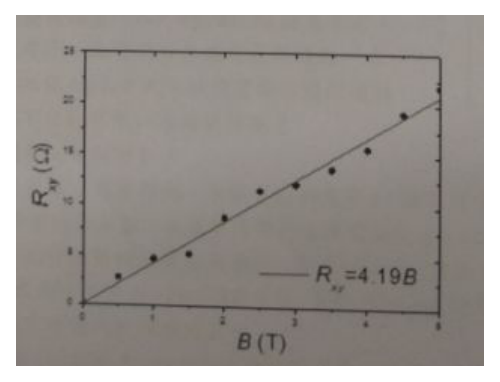 grafico resistenza Hall Rxy in funzione di B
Topic: Magnetism, Electrostatics, Circuits Metodi: Lorentz Force Analysis, Free-Body Diagram, Experimental Data Analysis Competenze: Mathematical Modeling, Physical Reasoning, Experimental Data Analysis Objects: Electron Fonte: Testo (PDF) — p.16
- Resistenza al gallo (punto: 20%) (A) Considerate una piastra metallica in un campo magnetico uniforme in direzione z come primo B
- Le figure mostrano. È noto che l’equazione di movimento delle particelle cariche nel metallo è , dove è una costante che indica il tempo medio di collisione del p/dt (t) d = p
- f
particelle, indica il momento medio della particella e è la forza esterna. p (t) f
La densità di corrente è definita come , dove è la velocità della particella, è il ev j n v n
densità di particelle. If è in stato di stabilità, e , così possiamo j , , ) j ( x jy jz E j
scrivere come: j
E E E jx = x + y + z E E E jy = x + y + z E E E jz = x + y + z Trova tutte le termini in cui . e esprime la tua risposta con , , , , i j = x y z e = n 2
e B/m = e (B) Riscritta come . Trova tutte le termini in cui j E , , , . i j = x y z (C) nelle misurazioni di Hall, definire la resistenza di Hall come , dove è il /I Rxy = V y x V y
differenze potenziali nella direzione y, è il passaggio corrente. La seconda figura Ix
mostra i dati di alcune misurazioni di Hall. Se la costante della rete del metallo è , trovare il numero di particelle cariche per rete. .3926 nm 0
Piastra metallica in campo magnetico Bz, Hall
Rxy in funzione di B
Topic: Magnetism, Electrostatics, Circuits Metodi: Lorentz Force Analysis, Free-Body Diagram, Experimental Data Analysis Competenze: Mathematical Modeling, Physical Reasoning, Experimental Data Analysis Objects: Electron Fonte: Testo (PDF) — p.16
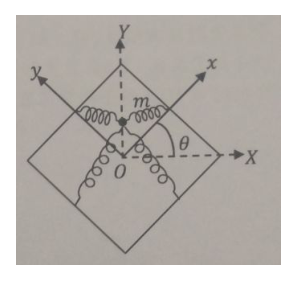
- The Resolution Power of Vibrational Gyroscope
Gyroscope is an object used to detect and maintain the orientation of an system on Earth, it usually uses the law of conservation of angular momentum to maintain the orientation. Nowadays, vibrational gyroscopes are often used in electronics. The figure on the right is a simplified model of a vibrational gyroscope. A point mass is put m
on a smooth, square platform of side length , the point a 2
mass is constrained by four springs of spring constant to points , the /2 m 0 2 a, ), , ), (0, ), ) ( 0 a 0 a a
vibration of the point mass can be used to detect the rotation of the platform, which can be further used to know the orientation (It takes 3 gyroscopes to fully know the orientation). Suppose the springs have negligible initial length, please answer the following: (A) When the platform is not rotating, and in the coordinate system shown in y x
the figure, the position of point mass is , write down the equation of x, ) ( y
motion of the point mass. (B) When the platform is spinning with angular speed , let the coordinate Y X
system be an inertial frame. at time , and coincide , therefore t = 0 Y X y x
. if the position of the point mass in coordinate system is , and t = y x x, ) ( y
in the frame, then , . find X, ) ( Y Y X cos sin x = X
- Y sin cos y = X
- Y
the equation of motion in the rotating frame, and explain how the motion in the platform frame can be viewed as a point mass under the influence of a potential (Let ) and an uniform magnetic field pointing straight out (x, ) V y (0, ) V 0 = 0 B
of paper(Let the equivalent charge of the point mass be 1). Find . (x, ), B V y
(C) When the gyroscope is spinning with angular speed , the motion of the point mass can be
described with or , like the figure on the x, ) ( y r, ) (
right shows(the springs aren’t shown for simplicity). The angular momentum isn’t conserved because of the equivalent magnetic field. We can generalize angular momentum is a certain way to make it become a conserved quantity, find the conserved quantity, express you answer with . for a certain angular speed the mass can perform stable circular , , m, r
motion, find the angular speed, express your answer with . When , , , r m
0
the point mass performs circular motion, under what circumstances can the motion be in one direction? Is it directed clockwise or counterclockwise? (D) To make the gyroscope able to detect rotation, charge the point mass with charge , and make the platform a capacitor, putting two charged metal plate q
on , to produce an uniform oscillating field , if we detect the x = a E0
motion of the mass on the y-axis, we can know if the platform is rotating or not. Suppose , and when the mass is moving relative to the platform, a > damping force is exerted on the mass( ),the damping coefficient f 2 > 0
is small enough that the point mass can still perform oscillating motion. (i) What is the trajectory of the stable motion? (ii) If we wish to detect rotation, then the bigger the amplitude of the y-axis motion of the mass , the better it is. This can be done by changing the frequency of the electric field to resonance frequency. Ignore the contribution of , and
find the resonance frequency of the system, and explain how this can be
used to detect rotation. (iii) Whether we can detect the angular speed of the rotation depend on the quality factor of the resonance , if the width of the peak is , then Q
. Estimate the quality factor of each resonant frequency. For Q =
, find when it is possible to get the rotating angular speed from the
1 Q >
resonant frequency.
 giroscopio vibrante, piattaforma quadrata con molle
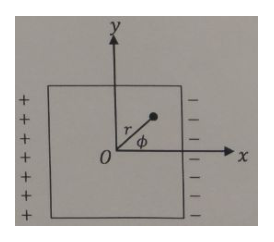 massa su piattaforma con piastre condensatore, angolo phi
Topic: Rotational Dynamics, Oscillations & Waves, Newtonian Mechanics Metodi: Torque & Angular Momentum Analysis, Simple Harmonic Motion Analysis, Free-Body Diagram Competenze: Mathematical Modeling, Physical Reasoning, Diagrammatic Reasoning Objects: Spring, Capacitor Fonte: Testo (PDF) — p.17
- La potenza di risoluzione del giroscopio vibrazionale
Il giroscopo è un oggetto utilizzato per rilevare e mantenere l’orientamento di un sistema sulla Terra, di solito utilizza la legge di conservazione del momento angolare per mantenere il
- l’orientamento. Oggi, i giroscopi vibrazionali sono spesso utilizzati nell’elettronica. La figura a destra è una semplificazione modello di giroscopio vibrazionale. Una massa di punto è messo m
su una piattaforma liscia e quadrata di lunghezza laterale , il punto a 2
la massa è limitata da quattro sorgenti di costante di primavera a punti , il /2 m 0 2 a, ), , ), (0, ), ) ( 0 a 0 a a
La vibrazione della massa puntalistica può essere utilizzata per rilevare la rotazione della piattaforma, che può Per conoscere l’orientamento (si richiede 3 giroscopi per conoscere pienamente il (cfr. punto 1.6.1) Supponiamo che le sorgenti abbiano una lunghezza iniziale trascurabile, si prega di rispondere alla domanda di seguito: (A) Quando la piattaforma non ruota, e sistema di coordinate mostrato in y x
la figura, la posizione della massa puntaria è , scrivere l’ equazione di x, ) ( y
movimento della massa del punto. (B) Quando la piattaforma ruota a velocità angolare
- Lascia che il coordinate Y X
Il sistema è un quadro inerziale. a tempo , e coincidono , quindi t = 0 Y X y x
. se la posizione della massa puntaria in sistema di coordinate è , e t = y x x, ) ( y
nel
- il quadro, quindi , . trovare X, ) ( Y Y X cos sin x = X
- Y sin cos y = X
- Y
l’equazione del movimento nel quadro rotativo, e spiegare come il movimento nel il quadro della piattaforma può essere visto come una massa puntaria sotto l’influenza di un potenziale (Lasciate che ) e un campo magnetico uniforme che indica direttamente (x, ) V y (0, ) V 0 = 0 B
di carta(La carica equivalente della massa di punto è 1). Trova . (x, ), B V y
(C) Quando il giroscopio gira con angolare velocità , il movimento della massa del punto può essere
descritto con or , come la figura sul x, ) ( y r, ) (
Le sorgenti non sono mostrate per
- la semplicità). Il momento angolare non è conservato a causa del campo magnetico equivalente. Possiamo generalizare l’andamento angolare è un certo modo di
- che la rendano una quantità conservata,
- la quantità conservata, esprimere la risposta con . per una certa velocità angolare la massa può eseguire una circolare stabile , , m, r
movimento, trovare la velocità angolare, esprimere la risposta con . Quando , , , r m
0
la massa puntaria svolge un movimento circolare, in quali circostanze la Il movimento deve essere in una direzione? È diretto in senso orario o in senso contrario? (D) Per rendere il giroscopio in grado di rilevare la rotazione, caricare la massa puntologica con carico , e rendere la piattaforma un condensatore, mettendo due piastre di metallo cariche q
on , per produrre un campo oscillante uniforme , se rilevamo il x = a E0
il movimento della massa sull’asse y, possiamo sapere se la piattaforma sta girando o no. Supponiamo , e quando la massa si muove rispetto alla piattaforma, una > forza di attenuazione viene esercitato sulla massa( ),il coefficiente di ammortizzazione f 2 > 0
è abbastanza piccolo da permettere alla massa puntaria di eseguire un movimento oscillante. (i) Qual è la traiettoria del movimento stabile? (ii) Se vogliamo rilevare la rotazione, allora maggiore è l’ampiezza dell’asse y Il movimento della massa, meglio è. Questo può essere fatto cambiando la frequenza di campo elettrico alla frequenza di risonanza. Ignorare il contributo di , e
trovare la frequenza di risonanza di questo sistema, e spiegare come questo può essere
utilizzato per rilevare la rotazione. (iii) Se possiamo rilevare la velocità angolare della rotazione dipende dalla fattore di qualità della risonanza , se la larghezza del picco è , allora Q
. Estimare il fattore di qualità di ciascuna frequenza di risonanza. Per Q =
, trovare quando è possibile ottenere la velocità angolare rotante dal
1 Q >
frequenza di risonanza.
Girocopia vibrante, piattaforma quadrata con molle
Mass su piattaforma con piastre condensatore, angolo phi
Topic: Rotational Dynamics, Oscillations & Waves, Newtonian Mechanics Metodi: Torque & Angular Momentum Analysis, Simple Harmonic Motion Analysis, Free-Body Diagram Competenze: Mathematical Modeling, Physical Reasoning, Diagrammatic Reasoning Objects: Spring, Capacitor Fonte: Testo (PDF) — p.17
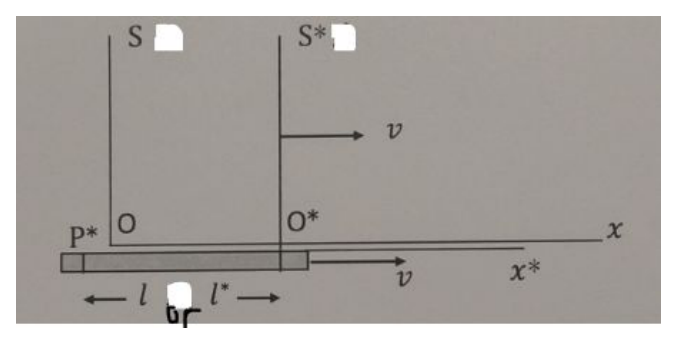
- Transformation between length and time As the figure below shows, the origin of the inertial reference frame is . A rigid ruler has S O
two marks on and , the origin of the inertial reference frame is fixed at , there are P * O* S* O*
two observers, one is at , one is at . the x-axis of both coordinate systems are collinear, O O*
and the relative motion between the two frames is along the x-axis, the speed is a constant , v when and coincide, the time at the origin of the two frames are zero. The speed of light O O*
in vacuum is , and let . c 1 /c ) = ( 2 Part A Fix the ruler in . move in the positive x direction with speed v, while remains S* S* S
stationary. is the time when and coincide, measured in frame t P * O S Let and denote the length of measured in and respectively. l l* O P * * S S* (i) find the ratio between and l l* (ii) Let be defined as above, and is the time when and coincide, measured in frame t t* P * O
, find the find the ratio between and S* t t* (iii) Let be defined as above, what is , which is what the clock on reads at time t t* O*
O* t seen by the observer at ? O Part B In this part, different to Part A, we let be the stationary frame, and is moving to the S* S
negative x direction with speed . When and coincide, the time at the origin of the two v O O*
frames are still zero We know that in the situation described, the length of measured by is , O P * * S* L* = l* answer the following: (iv) In the situation described above, when the time on is , what is the time at O, S* tˉ* = t* O*
tˉ
the origin of ? is what we got in (iii), and is defined as above. S t* O*
(v) what is the time when reaches , measured by the observer at ? How about the T * O P
S*
time when reaches , measured by the observer at ? When the time of is , what T O P
S S T
is the time at the origin of ? If the measured length of is , what is ? tˉO* * S* O P * * L /L L*
(vi) when the time at is , the observer at sends a signal to tell the observer at that S T O O*
has reached . The signal travels with speed with respect to . If we want the signal O P * S*
to reach before the time of is , what is the minimum value of ? S* T *
 sistemi di riferimento S e S con righello*
Topic: Special Relativity Metodi: Lorentz Transformation Competenze: Mathematical Modeling, Physical Reasoning Objects: — Fonte: Testo (PDF) — p.18
- Trasformazione tra lunghezza e tempo Come mostra la figura seguente, l’origine del quadro di riferimento inerziale is . Un regolare rigido ha S O
due marchi su e , l’origine del quadro di riferimento inerziale è fissato a , ci sono P * O* S* O*
Due osservatori, uno è al , uno è a . l’asse x di entrambi i sistemi di coordinate sono collineari, O O*
e il movimento relativo tra i due quadri è lungo l’asse x, la velocità è una costante , v quando e coincide, il tempo all’origine dei due quadri è zero. La velocità della luce O O*
in vuoto è , e lasciare . c 1 /c ) = ( 2 Parte A
-
Inserire la regola . si muove nella direzione x positiva con velocità v, mentre Resti S* S* S
-
Stazionario. E ’ il momento in cui e coincidono, misurati in cornice t P * O S Lascia che e indicare la lunghezza di misura in e rispettivamente. l l* O P *
S S*
- trovare il rapporto tra e l l*
- deve essere definito come sopra, e E ’ il momento in cui e coincidono, misurati in cornice t t* P * O
, trovare il rapporto tra e S* t t*
- La definizione di cui sopra indica che cosa è , che è quello che l’ orologio su Legge in tempo t t* O*
O* t visto dall’osservatore a ? O Parte B In questa parte, diversa dalla parte A, lasciamo essere il telaio stazionario e si sta spostando verso il S* S
direzione x negativa con velocità . Quando e La data di origine delle due v O O*
Le cornice sono ancora zero Sappiamo che nella situazione descritta, la durata di misurata con is , O P * * S* L* = l* rispondere:
- nel caso sopra descritto, quando il termine di is , che ora è a O, S* tˉ* = t* O*
tˉ
l’origine di ? è quello che abbiamo in (iii), e è definito come sopra. S t* O*
(v) quale è l’ora quando raggiunge , misurato dall’osservatore al ? Che ne dici della T * O P
S*
tempo quando raggiunge , misurato dall’osservatore al ? Quando il tempo di is
- Cosa ? T O P
S S T
E ’ il momento all’origine di ? Se la lunghezza misurata di is , cosa è ? TO* * S* O P * * L /L L*
(vi) quando il tempo di is , l’osservatore al invia un segnale per dire all’osservatore che che S T O O*
ha raggiunto . Il segnale viaggia con velocità in relazione al . Se vogliamo il segnale O P * S*
per raggiungere prima del momento di is , qual è il valore minimo di ? S* T *
*>sistemi di riferimento S e S * con diritto *
Topic: Special Relativity Metodi: Lorentz Transformation Competenze: Mathematical Modeling, Physical Reasoning Objects: — Fonte: Testo (PDF) — p.18
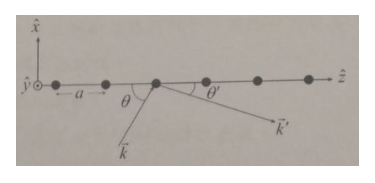
- Diffraction pattern of chiral material Using diffraction pattern of tell left-handed and right handed molecules apart: We first consider the diffraction pattern of one-dimensional lattice: (A) The figure shows the incident wave (with wave number ), the incident angle is , the diffracted k
wave has wave vector , find the k, , ) (
condition on for constructive interference to
happen (B) If the amplitude of the diffracted wave emitted from each lattice point is proportional to that of the incident wave, and the emitted wave is spherical, then the diffracted wave is when (R ){e /|r |} (R ){e /|r|} m | m m | m
is satisfied. Let , , find the total diffracted wave r| | (r) e i a z Rm m ˆ
from lattice point.
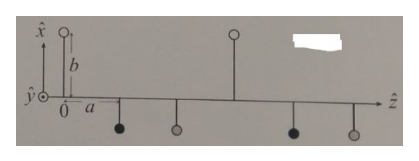
N (C) Find the condition of constructive interference from . Consider the diffraction from one-dimensional left/right-handed symmetric lattice: The figure on the right shows an one dimensional lattice with right handed symmetry, the small balls represent the atoms, it’s the place that can produce diffracted waves. We ignore the diffracting effect of the connecting rods for the atoms, the thin rods have length , and the neighboring rods are b
separated by distance . also, as the z-coordinate a
increases, the thin rods rotate relative to each other with angle . , = 0 = 1 . The figure shows the case when (corresponding to clockwise rotation), = 2 = 1
different beta represents different chirality. (D) the position of the atom is , find , is not yet determined. a z Rm m ˆ
(E) Use , where , is the same as in (A), , find . Find M m = 3
- j j = 0 1 k k, , ) (
the condition of constructive interference from . (F) Consider the special case of , and the condition for constructive /2, a
= = b =
interference is fixed at first order, find the relation between the intensity of wave ( I ) and I = | 2 = * . (G) Substitute into , and prove that is an even function. /2 = + ) I ) I
(H)Discuss the feature of at (or ) for
I
/2 . = 1
 reticolo 1D, vettori d’onda incidente e diffratto
 reticolo chirale destrorso con bastoncini rotanti
Topic: Wave Optics, Oscillations & Waves Metodi: Interference & Diffraction Analysis, Superposition Principle, Calculus-Integration Competenze: Mathematical Modeling, Physical Reasoning Objects: Diffraction Grating, Atom Fonte: Testo (PDF) — p.19
- Modello di diffrazione del materiale chiral Utilizzando un modello di diffrazione per separare le molecole a sinistra e a destra: Prendiamo in considerazione il modello di diffrazione della rete unidimensional: (A) La figura mostra l’onda incidente (con onda) Numero ), l’angolo di incidenza è , il diffractato k
L’onda ha vettore d’onda
- Trova il k, , ) (
condizione per interferenze costruttive
che accadono B) Se l’ampiezza dell’onda diffratta emessa da ogni punto della rete è proporzionale a quello dell’onda incidente e l’onda emessa è sferica, quindi l’onda diffratta è quando (R ){e /|r |} (R ){e /|r|} m | m m | m
- E’ soddisfatto. Let , , trovare l’ onda diffratta totale r| | (r) e i a z Rm m ˆ
di punto della rete.
N C) Indicare la condizione di interferenza costruttiva da . Si consideri la diffrazione da una rete simmetrica a sinistra/destra unidimensional: La figura a destra mostra un’unica dimensione Rettura con simmetria a destra, le piccole palle Rappresentano gli atomi, è il luogo che può produrre onde diffratte. Ignoriamo l’effetto di diffrazione di le barre di connessione per gli atomi, le barre sottili hanno lunghezza , e le barre vicine sono b
separati per distanza . anche, come coordinata z a
aumenta, le sottili barre ruotano l’una rispetto all’altra con angolo . , = 0 = 1 . La figura mostra il caso in cui (corrispondente alla rotazione in senso orario), = 2 = 1
- Un’altra beta rappresenta una chirallità diversa. D) la posizione dell’atomo è , trovare , non è ancora determinato. a z Rm m ˆ
(E) Uso , dove , è uguale a quello di (A), , trovare . Trova M m = 3
- j j = 0 1 k k, , ) (
la condizione di interferenza costruttiva da . F) Considerare il caso speciale di , e la condizione per la costruzione /2, a
= = b =
Se l’interferenza è fissata al primo grado, si trova la relazione tra l’intensità dell’onda ( I ) e I = | 2 = * . G) Substituzione in , e dimostrare che è una funzione pari. /2 = + ) I ) I
(H) Discussi della caratteristica di (or ) per
I
/2 . = 1
*reticolo 1D, vettori d’onda incidente e diffratto *
reticolo chiral destrorso con bastoncini rotanti
Topic: Wave Optics, Oscillations & Waves Metodi: Interference & Diffraction Analysis, Superposition Principle, Calculus-Integration Competenze: Mathematical Modeling, Physical Reasoning Objects: Diffraction Grating, Atom Fonte: Testo (PDF) — p.19