Question A1 — Braking up
An infinitely long wire with linear charge density lies along the -axis. An infinitely long insulating cylindrical shell of radius is concentric with the wire and can rotate freely about the -axis. The shell has moment of inertia per unit length . Charge is uniformly distributed on the shell, with surface charge density .
The system is immersed in an external magnetic field , and is initially at rest. Starting at , the external magnetic field is slowly reduced to zero over a time , where is the speed of light.
a. Find an expression of the final angular velocity of the cylinder in terms of the symbols given and other constants.
b. You may be surprised that the expression you find above is not zero! However, the electric and magnetic fields can have angular momentum. Analogous to the “regular” angular momentum definition, the EM field angular momentum per unit volume at a displacement from the axis of rotation is: is a vector analogous to momentum, given by where is some proportionality constant. Find an expression for in terms of given variables and fundamental constants.
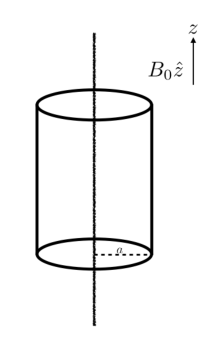 Cylindrical shell and wire geometry
Topic: Electromagnetism, Electromagnetic Induction, Electrostatics Metodi: Faraday’s Law of Induction, Gauss’s Law, Conservation Laws Competenze: Physical Reasoning, Mathematical Modeling Objects: Wire, Cylinder Fonte: Testo (PDF) — p.2
**Domanda A1 Interruzione **
Un filo infinitamente lungo con densità di carica lineare si trova lungo l’asse . Un’isolazione cilindrica infinitamente lunga di raggio è concentrica con il filo e può ruotare liberamente intorno all’asse . Il guscio ha un momento di inerzia per unità di lunghezza . La carica è distribuita uniformemente sullo strato, con densità di carica superficiale .
Il sistema è immerso in un campo magnetico esterno e inizia a riposo. A partire da , il campo magnetico esterno viene lentamente ridotto a zero nel corso di un tempo , dove è la velocità della luce.
a. Trovare un’espressione della velocità angolare finale del cilindro in termini di simboli dati e di altre costanti.
b. Potresti essere sorpreso che l’espressione che trovi sopra non sia zero! Tuttavia, i campi elettrici e magnetici possono avere un impulso angolare. Analogamente alla definizione di impulso angolare “regular”, il impulso angolare del campo EM per unità di volume a uno spostamento dall’asse di rotazione è: è un vettore analogo al momento, dato da dove è una costante di proporzionalità. Trova un’espressione per in termini di variabili e costanti fondamentali.
Gioometria della conchiglia e dei fili cilindrici
Topic: Electromagnetism, Electromagnetic Induction, Electrostatics Metodi: Faraday’s Law of Induction, Gauss’s Law, Conservation Laws Competenze: Physical Reasoning, Mathematical Modeling Objects: Wire, Cylinder Fonte: Testo (PDF) — p.2
Question A2 — Swoosh!
In 1851, Léon Foucault built a pendulum 67 metres tall with a 28-kg weight. He connected it to the top of the Panthéon in Paris with a bearing that enabled it to freely change its plane of oscillation. Because of the Earth’s rotation, the plane of oscillation slowly moved over time: if we imagine a large horizontal clock under the pendulum, if initially the oscillations went from “12” to “6”, later on they would move to the “3-9” plane, for example, as shown in the figure below. Perhaps surprisingly, the time it took the oscillations to go back to their original plane is longer than 12 hours. In this problem we will investigate why this is the case, and what the shape the pendulum traces out.
First, consider the case of a Foucault pendulum installed precisely at the North Pole, with length . We denote . The angular velocity of the Earth is .
John is an observer looking at the pendulum from a fixed point in space. At , he sees the pendulum at position and with velocity in the - (horizontal) plane.
a. For John, what are the approximate equations describing the motion of the pendulum in the - plane? You may assume that the amplitude of the oscillations is small. We define the coordinates of the pendulum at rest as .
b. What will the coordinates , in John’s frame be at a later time ?
c. Ella, an observer resides at the North Pole, is also looking at the pendulum. What are the coordinates, and , as observed by Ella? Assume that at time , the coordinate systems of John’s and Ella’s overlap.
d. What is the speed of the pendulum bob observed by Ella at ?
e. Find the initial conditions for , , such that as measured in Ella’s frame: i. the pendulum passes precisely through its resting position. ii. it has a “spike” at the points of maximal amplitude (see figure below) instead of a “rounded” trajectory.
In a rotating frame, a fictitious force known as the Coriolis force acts on the particles. For Foucault’s pendulum, the Coriolis force acts primarily in the horizontal plane, in a direction perpendicular to the velocity of the mass in the Earth’s frame with magnitude: where and are the pendulum’s mass and its velocity, and the latitude ( for the North Pole). Note that when the velocity changes sign, so does the Coriolis force.
f. How long would it take for the plane of oscillation of Foucault’s pendulum to return to its initial value in Paris, which has a latitude of about .
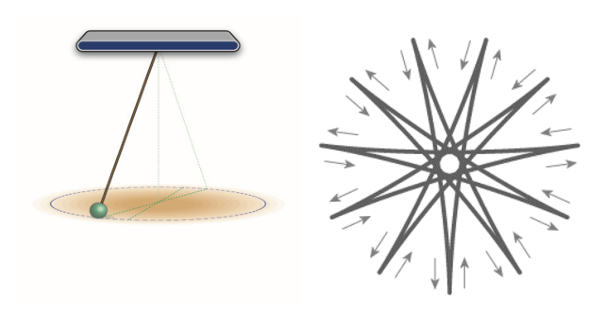 Foucault pendulum schematic and projected motion
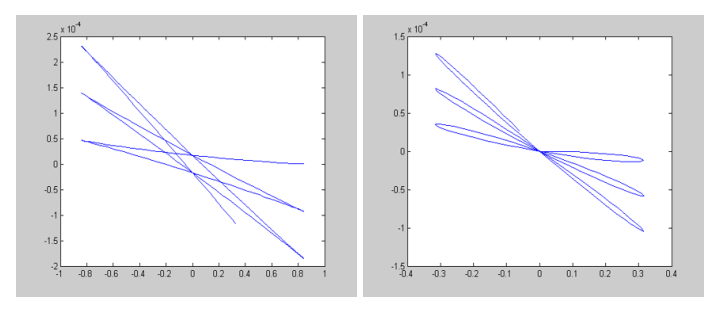 Spike vs rounded trajectory in rotating frame
Topic: Oscillations & Waves, Rotational Dynamics, Newtonian Mechanics Metodi: Simple Harmonic Motion Analysis, Free-Body Diagram, Kinematic Equations Competenze: Physical Reasoning, Mathematical Modeling Objects: Pendulum Fonte: Testo (PDF) — p.3
La domanda A2 Swoosh!
Nel 1851, Léon Foucault costruì un pendolo alto 67 metri e di peso di 28 kg. Lo collegò alla cima del Panthéon di Parigi con un cuscinetto che gli permise di cambiare liberamente il suo piano di oscillazione. A causa della rotazione della Terra, il piano di oscillazione si muove lentamente nel tempo: se immaginiamo un grande orologio orizzontale sotto il pendolo, se inizialmente le oscillazioni andavano da “12” a “6”, più tardi si muoveranno al piano “3-9”, ad esempio, come mostrato nella figura di seguito. Forse sorprendentemente, il tempo necessario per far tornare le oscillazioni al loro piano originale è più di 12 ore. In questo problema esamineremo perché questo è il caso e quale forma ha il pendolo.
Primo, consideriamo il caso di un pendolo Foucault installato precisamente al Polo Nord, con lunghezza . Indichiamo . La velocità angolare della Terra è .
John è un osservatore che guarda il pendolo da un punto fisso nello spazio. A , vede il pendolo in posizione e con velocità nel piano - (orizzontale).
a. Per John, quali sono le equazioni approssimative che descrivono il movimento del pendolo nel piano -? Potreste presumere che l’ampiezza delle oscillazioni sia piccola. Definire le coordinate del pendolo in riposo come .
b. Quali saranno le coordinate , nel quadro di John in un secondo momento ?
c. Ella, un osservatore che vive al Polo Nord, sta anche guardando il pendolo. Quali sono le coordinate, e , come osservato da Ella? Supponiamo che al tempo , i sistemi di coordinate di John e Ella si sovrappongono.
d. Qual è la velocità del bobino del pendolo osservata da Ella a ?
e. Trova le condizioni iniziali per , , tali da misurare nel quadro di Ella: i. il pendolo passa precisamente attraverso la sua posizione di riposo. ii. ha un “spike” nei punti di amplitudine massima (vedi figura seguente) invece di una traiettoria “arrotondata”.
In un quadro rotante, una forza fittizia nota come la forza di Coriolis agisce sulle particelle. Per il pendolo di Foucault, la forza di Coriolis agisce principalmente nel piano orizzontale, in una direzione perpendicolare alla velocità della massa nel quadro terrestre con grandezza: dove e sono la massa e la velocità del pendolo e la latitudine ( per il polo nord). Si noti che quando la velocità cambia segnale, così fa la forza di Coriolis.
f. Quanto tempo ci vorrebbe per il piano di oscillazione del pendolo di Foucault per tornare al suo valore iniziale a Parigi, che ha una latitudine di circa .
Schema e movimento proiettato del pendolo di Foucault
Spike vs rotondata trajectory in quadro rotativo
Topic: Oscillations & Waves, Rotational Dynamics, Newtonian Mechanics Metodi: Simple Harmonic Motion Analysis, Free-Body Diagram, Kinematic Equations Competenze: Physical Reasoning, Mathematical Modeling Objects: Pendulum Fonte: Testo (PDF) — p.3
Question A3 — Spin Cycle
Cosmonaut Carla is preparing for the Intergalactic 5000 race. She practices for her race on her handy race track of radius , carrying a stopwatch with her. Her racecar maintains a constant speed during her practices. For this problem, you can assume that , where is the speed of light.
a. How much time elapses on Carla’s stopwatch with each revolution?
Carla decides to do a fun experiment during her training. She places two stationary clocks down: Clock A at the center of the race track, i.e. the origin; and Clock B at a point on the race track denoted as . She then begins her training.
For parts (b) through (d), we define Carla’s inertial reference frame (CIRF) as an inertial reference frame in which Carla is momentarily at rest, and which has the same origin of coordinates as the lab frame. Thus, CIRF is a new inertial frame each moment. The times on the clocks and stopwatch are all calibrated such that they all read 0 in CIRF when she passes by Clock B for the first time.
b. In the lab frame (the reference frame of the clocks, which are at rest), what is the offset between Clock A and Clock B?
c. If Carla’s stopwatch measures an elapsed time , what does Clock A measure in CIRF?
d. If Carla’s stopwatch measures an elapsed time , what does Clock B measure in CIRF?
Topic: Special Relativity, Newtonian Mechanics Metodi: Lorentz Transformation, Kinematic Equations, Relativistic Energy-Momentum Competenze: Physical Reasoning, Mathematical Modeling Objects: — Fonte: Testo (PDF) — p.5
Domanda A3 Ciclo di rotazione
La cosmonauta Carla si prepara per la corsa Intergalattica 5000. Si esercita per la sua gara sul suo pratico circuito di raggio , portando con sé un cronometro. La sua auto da corsa mantiene una velocità costante durante le sue prove. Per questo problema, si può supporre che , dove è la velocità della luce.
a. Quanto tempo passa sul cronometro di Carla con ogni rivoluzione?
Carla decide di fare un esperimento divertente durante il suo allenamento. Lei mette due orologi fermi: Orologio A al centro della pista, cioè l’origine; e l’orologio B in un punto della pista di gara indicato come . Poi inizia il suo allenamento.
Per le parti da b) a d), definiamo il quadro di riferimento inerziale di Carla (CIRF) come un quadro di riferimento inerziale in cui Carla è momentaneamente a riposo e che ha la stessa origine di coordinate del quadro di laboratorio. Quindi, il CIRF è un nuovo quadro inerziale ogni momento. I tempi degli orologi e degli orologi fermarsi sono tutti calibrati in modo che tutti leggono 0 in CIRF quando passa per la prima volta da Orologio B.
b. Nel quadro di laboratorio (il quadro di riferimento degli orologi, che sono in riposo), qual è il contrasto tra Orologio A e Orologio B?
c. Se l’orologio di Carla misura un tempo trascorso , cosa misura l’orologio A in CIRF?
d. Se l’orologio di Carla misura un tempo passato , cosa misura l’ Orologio B in CIRF?
Topic: Special Relativity, Newtonian Mechanics Metodi: Lorentz Transformation, Kinematic Equations, Relativistic Energy-Momentum Competenze: Physical Reasoning, Mathematical Modeling Objects: — Fonte: Testo (PDF) — p.5
Question B1 — String Cheese
a. When a faucet is turned on, a stream of water flows down with initial speed at the spout. For this problem, we define to be the vertical coordinate with its positive direction pointing up.
Assuming the water speed is only affected by gravity as the water falls, find the speed of water at height . Define the zero of such that the equation for has only one term and find , the height of the spout.
b. Assume that the stream of water falling from the faucet is cylindrically symmetric about a vertical axis through the center of the stream. Also assume that the volume of water per unit time exiting the spout is constant, and that the shape of the stream of water is constant over time.
In this case, the radius of the stream of water is a function of vertical position . Let the radius at the faucet be . Using your result from part (a), find .
If is not constant, it implies that the water has some radial velocity during its fall, in contradiction to our assumptions in part (a) that the motion is purely vertical. You may assume throughout the problem that any such radial velocity is negligibly small.
c. The water-air interface has some surface tension, . The effect of surface tension is to change the pressure in the stream according to the Young-Laplace equation, where is the difference in pressure between the stream and the atmosphere and is the radius of curvature of the vertical profile of the stream. ( for the stream of water; the radius of curvature would be positive only if the stream profile curved inwards.)
For this part of the problem, we assume that , so that the curvature of the vertical profile of the stream can be ignored. Also assume that water is incompressible.
Accounting for the pressure in the stream, find a new equation relating in terms of , , , and , the density of water. You do not need to solve the equation for .
d. After falling for some distance, the water stream usually breaks into smaller droplets. This occurs because small random perturbations to the shape of the stream grow over time, eventually breaking the stream apart.
For the rest of this problem we ignore the change in the radius of the stream due to changing speed of the water. Instead, we examine small random variations in the radius of the stream.
Random variations can be broken down into a sum of sinusoidal variations in stream radius, each with a different wavenumber . We can analyze these different sinusoidal variations independently.
Consider a stream of water whose radius obeys where is the perturbation amplitude. To analyze such a stream, it is sufficient to consider only the thickest and thinnest parts of the stream.
Accounting for both sources of curvature, find a condition on and such that the size of perturbations increases with time.
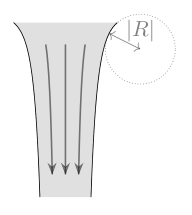 Water stream cross-section with radius |R|
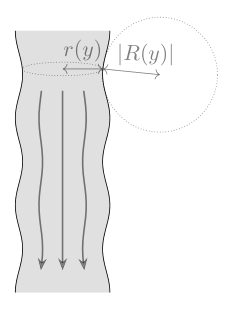 Stream profile r(y) and curvature |R(y)|
Topic: Fluid Mechanics, Oscillations & Waves Metodi: Bernoulli’s Equation, Continuity Equation, Differential Equations Competenze: Physical Reasoning, Mathematical Modeling Objects: Droplet Fonte: Testo (PDF) — p.6
Domanda B1 Formaggio a corda
a. Quando si accende un rubinetto, un flusso d’acqua scorre con velocità iniziale al spout. Per questo problema, definiamo come la coordinata verticale con la sua direzione positiva che punta verso l’alto.
Supponendo che la velocità dell’acqua sia influenzata solo dalla gravità quando l’acqua cade, si trova la velocità dell’acqua all’altezza . Definire lo zero di in modo che l’equazione di abbia solo un termine e trovare , l’altezza della spina.
b. Supponiamo che il flusso di acqua che cade dal rubinetto sia cilindricamente simmetrico su un asse verticale attraverso il centro del flusso. Supponiamo inoltre che il volume di acqua per unità di tempo che esce dalla scarica sia costante e che la forma del flusso d’acqua sia costante nel tempo.
In questo caso, il raggio del flusso d’acqua è una funzione della posizione verticale . Il raggio del rubinetto deve essere . Usando il risultato della parte (a), trova .
Se non è costante, implica che l’acqua ha una certa velocità radial durante la sua caduta, in contraddizione con le nostre ipotesi nella parte (a) che il movimento è puramente verticale. Durante tutto il problema potete presumere che qualsiasi velocità radial sia trascurabilmente piccola.
c. L’interfaccia acqua-aria ha una certa tensione superficiale, . L’effetto della tensione superficiale è di cambiare la pressione nel flusso secondo l’equazione Young-Laplace, dove è la differenza di pressione tra il flusso e l’atmosfera e è il raggio di curvatura del profilo verticale del flusso. ( per il flusso d’acqua; il raggio di curvatura sarebbe positivo solo se il profilo del flusso fosse curvo verso l’interno.)
Per questa parte del problema, supponiamo che , in modo che la curvatura del profilo verticale del flusso possa essere ignorata. Supponiamo anche che l’acqua sia incompressibile.
Tenendo conto della pressione nel flusso, trovare una nuova equazione relativa in termini di , , e , la densità dell’acqua. Non è necessario risolvere l’equazione per .
d. Dopo aver caduto per qualche distanza, il flusso di acqua di solito si rompe in piccole goccioline. Questo avviene perché le piccole perturbazioni casuali della forma del flusso crescono nel tempo, infine rompendo il flusso.
Per il resto di questo problema ignoriamo il cambiamento del raggio del flusso a causa della variazione della velocità dell’acqua. Invece, esaminiamo piccole variazioni casuali nel raggio del flusso.
Le variazioni casuali possono essere suddivise in una somma di variazioni sinusoidali del raggio del flusso, ognuna con un numero d’onda diverso . Possiamo analizzare queste diverse variazioni sinusoidali in modo indipendente.
Considerate un torrente d’acqua il cui raggio obbedisce dove è l’ampiezza di perturbazione. Per analizzare tale corrente, basta considerare solo le parti più spesse e sottili del flusso.
Tenendo conto di entrambe le fonti di curvatura, trovare una condizione su e tale che la dimensione delle perturbazioni aumenta con il tempo.
*Radio di attraversamento del flusso d’acqua con raggio di raggi *
*Profil di flusso r(y) e curvatura ↓R(y)
Topic: Fluid Mechanics, Oscillations & Waves Metodi: Bernoulli’s Equation, Continuity Equation, Differential Equations Competenze: Physical Reasoning, Mathematical Modeling Objects: Droplet Fonte: Testo (PDF) — p.6
Question B2 — Mirror Mirror on the Wall
Consider a square room with side length . The bottom wall of the room is a perfect mirror.* A perfect monochromatic point source with wavelength is placed a distance above the center of the mirror, where .
(Remember that the phase of light reflected by a mirror changes by .)
a. On the right wall, an interference pattern emerges. What is the distance between the bottom corner and the closest bright fringe above it? Hint: you may assume as well.
b. You plan on running an experiment to determine in a room with m, and you know that is between 550 and 750 nm. You will measure and (the distance of the tenth fringe from the corner) with the same ruler (with markings of 1 mm). At what should you place the point source to minimize your error in your measurement? Roughly what is that minimum error?
c. Now suppose we place a transparent hemispherical shell of thickness and index of refraction over the source such that all light from the source that directly strikes the right wall passes through the shell, and all light from the source that strikes the mirror first does not pass through the shell.
At what is the fringe closest to the bottom-most corner now? (You may find it convenient to use , the largest integer below .) What is the spacing between the fringes now? Ignore any reflections or diffraction from the hemispherical shell.
d. Now, suppose the hemispherical shell is removed, and we instead observe the interference pattern on the top wall. To the nearest integer, what is the total number of fringes that appear on the top wall? You may assume that .
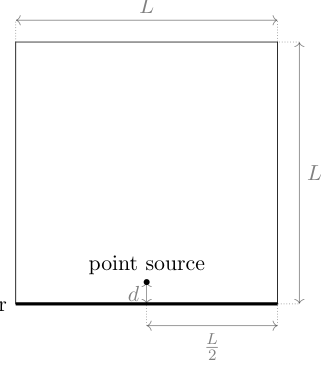 Square room with mirror and point source
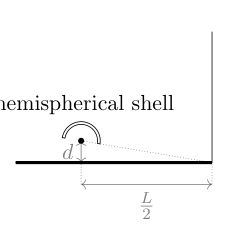 Hemispherical shell over point source
Topic: Wave Optics, Geometric Optics Metodi: Interference & Diffraction Analysis, Superposition Principle, Error Propagation Competenze: Physical Reasoning, Mathematical Modeling Objects: Mirror Fonte: Testo (PDF) — p.8
Domanda B2 Specchio specchio sul muro
Considera una stanza quadrata con lunghezza laterale . La parete inferiore della stanza è uno specchio perfetto.* Una fonte di punti monocromatica perfetta con lunghezza d’onda è posta a una distanza sopra il centro dello specchio, dove .
*(Ricorda che la fase di luce riflessa da uno specchio cambia di .) *
a. Sul muro destro emerge un modello di interferenza. Qual è la distanza tra l’angolo inferiore e il bordo luminoso più vicino sopra di esso? Signore: è possibile assumere anche .
b. Si prevede di eseguire un esperimento per determinare in una stanza con m, e si sa che è tra 550 e 750 nm. Misurare e (la distanza della decima periferia dall’angolo) con la stessa regola (con marcature di 1 mm). A quale punto si deve posizionare la fonte di punto per ridurre al minimo l’errore nella misura ? In pratica, qual è l’errore minimo?
c. Ora supponiamo di mettere una conchiglia emisferica trasparente di spessore e indice di rifrazione sopra la fonte in modo che tutta la luce dalla fonte che colpisce direttamente la parete destra passa attraverso la conchiglia, e tutta la luce dalla fonte che colpisce lo specchio prima non passa attraverso la conchiglia.
At what is the fringe closest to the bottom-most corner now? (Potresti trovare conveniente usare , il più grande numero intero sotto .) Qual è l’intervallo tra i margini ora? Ignorare qualsiasi riflessione o diffrazione dalla conchiglia emisferica.
d. Supponiamo che il guscio emisfero sia rimosso, e invece osserviamo il modello di interferenza sulla parete superiore. Per il numero intero più vicino, qual è il numero totale di margini che appaiono sulla parete superiore? Si può supporre che .
Camera quadrata con specchio e fonte di punto
Coscia emisferica sopra la fonte del punto
Topic: Wave Optics, Geometric Optics Metodi: Interference & Diffraction Analysis, Superposition Principle, Error Propagation Competenze: Physical Reasoning, Mathematical Modeling Objects: Mirror Fonte: Testo (PDF) — p.8
Question B3 — Real Expansion
Consider a “real” monatomic gas consisting of atoms of negligible volume and mass in equilibrium inside a closed cubical container of volume . In this “real” gas, the attractive forces between atoms is small but not negligible. Because these atoms have negligible volume, you can assume that the atoms do not collide with each other for the entirety of the problem.
a. Consider an atom in the interior of this container of volume . Suppose the potential energy of the interaction is given by where is the minimum allowed distance between two atoms. Assume the gas is uniformly distributed within the container, what is the average potential energy of this atom? Write your answer in terms of , , and .
b. What is the average potential energy of an atom near the boundary of the box? Assume that there is no interaction between atoms near the boundary and the box itself.
c. Using Bernoulli’s law , with pressure , potential energy density , mass density and fluid velocity , what is the pressure at the boundary of the box? Assume the interior pressure is given by the ideal gas law.
d. Assuming most atoms are in the interior of the box, what is the total energy of the atoms in the box?
Now consider an insulated partitioned container with two sections, each of volume . We fill one side of the container with atoms of this “real” gas at temperature , with the other side being a vacuum. We then quickly remove the partition and let the gas expand to fill the entirety of the partitioned container. During this expansion, the energy of the gas remains unchanged.
e. What is the final temperature of the gas after the expansion?
f. What is the increase in the entropy of the universe as a result of the free expansion? Give your answer to first order in .
Topic: Thermodynamics, Kinetic Theory Metodi: Ideal Gas Law, First Law of Thermodynamics, Thermodynamic Cycle Analysis Competenze: Physical Reasoning, Mathematical Modeling Objects: Gas, Container Fonte: Testo (PDF) — p.10
Domanda B3 Espansione reale
Considera un gas monatomo “reale” costituito da atomi di volume trascurabile e massa in equilibrio all’interno di un contenitore cubico chiuso di volume . In questo gas “reale”, le forze di attrazione tra gli atomi sono piccole ma non trascurabili. Poiché questi atomi hanno un volume trascurabile, si può presumere che gli atomi non si colliscano tra loro per l’intero problema.
a. Considera un atomo all’interno di questo contenitore di volume . Supponiamo che l’energia potenziale dell’interazione sia data da dove è la distanza minima consentita tra due atomi. Supponendo che il gas sia distribuito uniformemente all’interno del contenitore, qual è la media di energia potenziale di questo atomo? Scrivi la tua risposta in termini di , e .
b. Qual è l’energia potenziale media di un atomo vicino al confine della scatola? Supponiamo che non ci sia alcuna interazione tra gli atomi vicino al confine e la scatola stessa.
c. Usando la legge di Bernoulli , con pressione , densità di energia potenziale , densità di massa e velocità di fluido , qual è la pressione al confine della scatola? Supponiamo che la pressione interna sia data dalla legge del gas ideale.
d. Supponendo che la maggior parte degli atomi siano all’interno della scatola, qual è l’energia totale degli atomi nella scatola?
Ora consideriamo un contenitore isolato divisi con due sezioni, ciascuna di volume . Riempiamo un lato del contenitore con atomi di questo gas “reale” a temperatura , con l’altro lato come vuoto. Quindi rimuoviamo rapidamente la partizione e lasciamo che il gas si espandisca per riempire l’intero contenitore. Durante questa espansione, l’energia del gas rimane invariata.
e. Qual è la temperatura finale del gas dopo l’espansione?
f. Qual è l’aumento dell’entropia dell’universo a seguito della libera espansione? Rispondi al primo ordine in .
Topic: Thermodynamics, Kinetic Theory Metodi: Ideal Gas Law, First Law of Thermodynamics, Thermodynamic Cycle Analysis Competenze: Physical Reasoning, Mathematical Modeling Objects: Gas, Container Fonte: Testo (PDF) — p.10