Estimate from what height, under free-fall conditions, a heavy stone would need to be dropped if it were to reach the surface of the Earth at the speed of sound of 330 m s.
Topic: Newtonian Mechanics, Order-of-Magnitude Estimation Metodi: Kinematic Equations, Energy Conservation Method Competenze: Estimation & Approximation, Physical Reasoning Objects: Projectile Fonte: Testo (PDF) — p.3
Calcolare da quale altezza, in condizioni di caduta libera, sarebbe necessario abbattere una pietra pesante per raggiungere la superficie terrestre a una velocità sonora di 330 m s.
Topic: Newtonian Mechanics, Order-of-Magnitude Estimation Metodi: Kinematic Equations, Energy Conservation Method Competenze: Estimation & Approximation, Physical Reasoning Objects: Projectile Fonte: Testo (PDF) — p.3
A motorcycle rider is propelled up the left side of a symmetric ramp shown in Figure 1.
The rider reaches the apex of the ramp at speed of , and falls to a point P on the descending ramp. In terms of , and , obtain expressions for,
(i) The time for which the rider is airborne.
(ii) The distance OP () along the descending ramp.
(Figure 1: symmetric ramp with angle on each side, rider leaves apex O, lands at P on descending side.)
 Symmetric ramp, rider leaves apex O lands P
Topic: Newtonian Mechanics Metodi: Kinematic Equations, Vector Decomposition, Free-Body Diagram Competenze: Mathematical Modeling, Physical Reasoning Objects: Inclined Plane, Projectile Fonte: Testo (PDF) — p.3
Un motociclista è spinto verso il lato sinistro di una rampa simmetrica mostrata nella figura 1.
Il pilota raggiunge l’apice della rampa a velocità e cade al punto P della rampa discendente. In termini di , e , ottenere espressioni per:
(i) Il tempo per il quale il pilota è in volo.
(ii) La distanza OP () lungo la rampa discendente.
(Figura 1: rampa simmetrica con angolo su ciascun lato, il pilota lascia l’apice O, atterra a P sul lato discendente.)
Rampina simmetrica, il pilota lascia l’apice O terra P
Topic: Newtonian Mechanics Metodi: Kinematic Equations, Vector Decomposition, Free-Body Diagram Competenze: Mathematical Modeling, Physical Reasoning Objects: Inclined Plane, Projectile Fonte: Testo (PDF) — p.3
Two buckets hang from a rope over a frictionless pulley as in Figure 2. The bucket on the right has a mass , which is greater than the mass of the bucket on the left (). Bucket 2 starts at height above the ground. If the buckets are released from rest, determine:
(i) the speed with which bucket 2 hits the ground in terms of , , , and the acceleration due to gravity , and
(ii) the further increase in height of bucket 1 after bucket 2 hits the ground and stops.
Ignore resistive effects and assume the rope is long compared to the height above the ground.
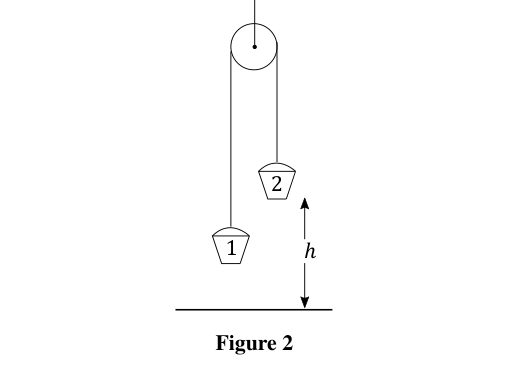 Atwood machine: bucket 1 left, bucket 2 right at height h
Topic: Newtonian Mechanics, Conservation of Energy Metodi: Conservation of Energy, Free-Body Diagram, Kinematic Equations Competenze: Physical Reasoning, Mathematical Modeling Objects: Pulley, String Fonte: Testo (PDF) — p.3
Due secchi appesi a una corda sopra una polla senza attrito come in Figura 2. Il secchio a destra ha una massa , che è maggiore della massa del secchio a sinistra (). Il secchio 2 inizia ad un’altezza sopra il terreno. Se i secchi vengono rilasciati dal riposo, determinare:
i) la velocità con cui il secchio 2 colpisce il terreno in termini di , , e l’accelerazione dovuta alla gravità , e
- l’ulteriore aumento dell’altezza del secchio 1 dopo che il secchio 2 colpisce il terreno e si ferma.
Ignorate gli effetti di resistenza e supponete che la corda sia lunga rispetto all’altezza al di sopra del terreno.
Machina di Atwood: secchio 1 a sinistra, secchio 2 a destra ad altezza h
Topic: Newtonian Mechanics, Conservation of Energy Metodi: Conservation of Energy, Free-Body Diagram, Kinematic Equations Competenze: Physical Reasoning, Mathematical Modeling Objects: Pulley, String Fonte: Testo (PDF) — p.3
A rugby pitch lies in a north-south direction. In this question represents a unit vector due east, and represents a unit vector due north. Rugby player Y collects the ball and runs with a velocity m s. Player X, starting 20 m due east of player Y, immediately gives chase at a speed of 8 m s. She is an expert player and runs in a straight line to intercept player Y. Calculate
(i) the velocity of player Y,
(ii) the time taken for the players to meet, and
(iii) the displacement of Y from her original position at their point of contact.
Topic: Newtonian Mechanics Metodi: Kinematic Equations, Vector Decomposition Competenze: Mathematical Modeling, Physical Reasoning Objects: — Fonte: Testo (PDF) — p.4
Un campo di rugby si trova in direzione nord-sud. In questa domanda rappresenta un vettore unitario verso est e rappresenta un vettore unitario verso nord. Il giocatore di rugby Y raccoglie la palla e corre con una velocità m s. Il giocatore X, partendo a 20 m a est del giocatore Y, dà immediatamente la caccia a una velocità di 8 m s. E’ un giocatore esperto e corre in linea retta per intercettare il giocatore Y. Calcolo
(i) la velocità del giocatore Y,
-
il tempo necessario per il incontro dei giocatori;
-
il spostamento di Y dalla sua posizione originaria al punto di contatto.
Topic: Newtonian Mechanics Metodi: Kinematic Equations, Vector Decomposition Competenze: Mathematical Modeling, Physical Reasoning Objects: — Fonte: Testo (PDF) — p.4
A long wire of uniform diameter 1.40 mm has a resistance of 0.478 . It is wrapped into a ball in order to find its weight, which is 4.60 N. When weighed in water it is 4.08 N. Calculate the resistivity of the wire.
Density of water = 1000 kg m
Topic: Circuits, Fluid Mechanics Metodi: Hydrostatic Equilibrium, Physical Modeling Competenze: Mathematical Modeling, Physical Reasoning Objects: Wire Fonte: Testo (PDF) — p.4
Un filo lungo di diametro uniforme di 1,40 mm ha una resistenza di 0,478 . È avvolto in una palla per trovare il suo peso, che è di 4,60 N. Quando pesato in acqua è di 4,08 N. Calcolare la resistività del filo.
Densità dell’acqua = 1000 kg m
Topic: Circuits, Fluid Mechanics Metodi: Hydrostatic Equilibrium, Physical Modeling Competenze: Mathematical Modeling, Physical Reasoning Objects: Wire Fonte: Testo (PDF) — p.4
A train travels at a constant speed for one hour but is then delayed on the line for half an hour. When it restarts, its speed is reduced to 75% of its previous speed. It arrives at its destination hours later than if it had travelled at its initial speed throughout. If the delay had occurred 45 km further on, then the train would only have been 1 hour late.
Determine,
(i) the distance travelled, and
(ii) the initial speed of the train.
Topic: Newtonian Mechanics Metodi: Kinematic Equations, Physical Modeling Competenze: Mathematical Modeling, Physical Reasoning Objects: — Fonte: Testo (PDF) — p.4
Un treno viaggia a velocità costante per un’ora, ma viene poi ritardato per mezz’ora. Quando viene riavviato, la sua velocità viene ridotta al 75% della sua velocità precedente. L’aeromobile arriva alla destinazione ore dopo di quanto non avesse fatto a velocità iniziale durante tutto il viaggio. Se il ritardo fosse avvenuto 45 km più avanti, il treno sarebbe arrivato solo un’ora in ritardo.
Determinare,
-
la distanza percorsa;
-
la velocità iniziale del treno.
Topic: Newtonian Mechanics Metodi: Kinematic Equations, Physical Modeling Competenze: Mathematical Modeling, Physical Reasoning Objects: — Fonte: Testo (PDF) — p.4
Emmy walks into a lift with a set of (bathroom) scales. She stands on the scales, presses the button for the 30th floor, and starts a timer as the lift begins to move. She notices that the reading on the scales varies with time, according to the equation below:
(i) Write down an expression for the acceleration of the lift as a function of time.
(ii) How fast is the lift moving after 10 seconds?
(iii) After the initial 10 seconds, the lift decelerates at a constant rate until it arrives at the 30th floor. Given that the 30th floor is 100 m above the ground, calculate the minimum value of the mass reading (in kg) shown on the scales during this deceleration.
Topic: Newtonian Mechanics Metodi: Kinematic Equations, Free-Body Diagram, Calculus-Integration Competenze: Mathematical Modeling, Physical Reasoning Objects: — Fonte: Testo (PDF) — p.4
Emmy entra in un ascensore con un set di scale. Si alza sulle scale, premere il pulsante per il 30° piano e accende un timer quando l’ascensore inizia a muoversi. Si nota che la lettura delle scale varia con il tempo, secondo l’equazione seguente:
(i) Scrivere un’espressione per l’accelerazione dell’ascensore in funzione del tempo.
(ii) Quanto veloce è l’ascensore dopo 10 secondi?
(iii) Dopo i primi 10 secondi, l’ascensore si rallenta a velocità costante fino a raggiungere il 30° piano. Poiché il 30° piano si trova a 100 m di altitudine, calcolare il valore minimo della lettura di massa (in kg) mostrata sulle scale durante questa decelerazione.
Topic: Newtonian Mechanics Metodi: Kinematic Equations, Free-Body Diagram, Calculus-Integration Competenze: Mathematical Modeling, Physical Reasoning Objects: — Fonte: Testo (PDF) — p.4
Two transparent miscible liquids of refractive indices and can be mixed together to produce a liquid of refractive index by mixing volumes and of the liquids. The refractive index of the mixture varies linearly with the volumes of the two liquids. The refractive index of powdered glass, , poured into the mixture can be found by adjusting the liquid mixture until the powdered glass cannot be observed in the liquid.
(i) Obtain an expression for in terms of , , and .
(ii) If the powdered glass is poured into 100 ml of liquid A and is seen to disappear when 64 ml of liquid B is added, what is the refractive index of the glass?
Topic: Geometric Optics Metodi: Snell’s Law, Physical Modeling Competenze: Mathematical Modeling, Physical Reasoning Objects: — Fonte: Testo (PDF) — p.5
Due liquidi miscibili trasparenti di indici di rifrazione e possono essere mescolati insieme per produrre un liquido di indice di rifrazione mischiando i volumi e dei liquidi. L’indice di rifrazione della miscela varia linearmente con i volumi dei due liquidi. L’indice di rifrazione del vetro in polvere, , versato nella miscela può essere riscontrato regolaendo la miscela liquida fino a quando il vetro in polvere non può essere osservato nel liquido.
(i) Ottenere un’espressione per in termini di , , e .
(ii) Se il vetro in polvere viene versato in 100 ml di liquido A e si vede che scompare quando si aggiungono 64 ml di liquido B, qual è l’indice di rifrazione del vetro?
Topic: Geometric Optics Metodi: Snell’s Law, Physical Modeling Competenze: Mathematical Modeling, Physical Reasoning Objects: — Fonte: Testo (PDF) — p.5
(i) Five resistors, are connected in a circuit between points A and B, as in Figure 3. Resistors and can be changed in value to be connecting wires with , finite values, or open circuit with . Write down the values of and so that the network between A and B is equivalent to
i. three resistors in series,
ii. three resistors in parallel, and
iii. two identical resistors in parallel.
(ii) Figure 4 shows a simple circuit with two cells and three resistors. If the current in the ammeter shown in the figure is 2.0 A determine the unknown e.m.f. , of the battery, assuming the batteries and ammeter have no internal resistance. (Resistors: 4 , 5 , 3 ; one cell 12 V.)
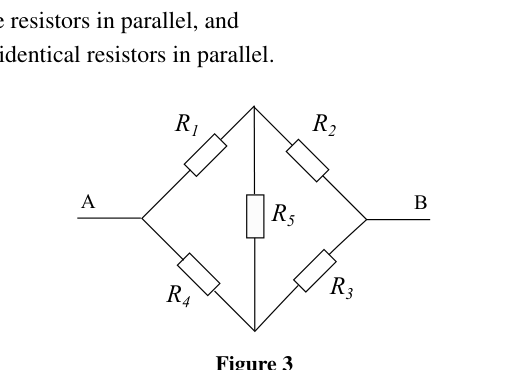 Five-resistor network between A and B
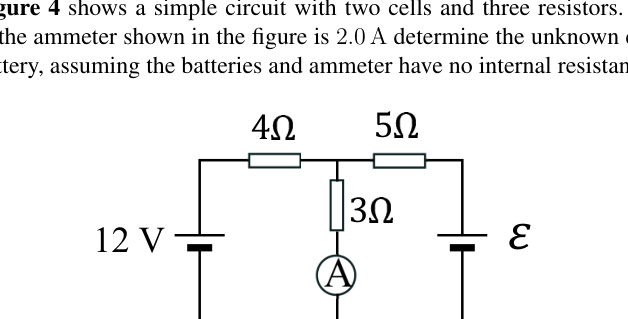 Circuit: two cells, three resistors, ammeter 2 A
Topic: Circuits Metodi: Equivalent Circuit Reduction, Kirchhoff’s Laws Competenze: Physical Reasoning, Mathematical Modeling Objects: Resistor, Battery, Wire Fonte: Testo (PDF) — p.5
(i) Cinque resistori sono collegati in un circuito tra i punti A e B, come nella figura 3. Le resistenze e possono essere modificate in valore per essere fili di connessione con , valori finiti o circuiti aperti con . Scrivere i valori di e in modo che la rete tra A e B sia equivalente a
i. tre resistori in serie,
ii. tre resistenti in parallelo e
iii. due resistori identici in parallelo.
(ii) La figura 4 mostra un circuito semplice con due celle e tre resistori. Se la corrente nell’ampilometro mostrata nella figura è di 2,0 A, determinare l’e.m.f. sconosciuta. della batteria, purché le batterie e l’ampiecatore non abbiano resistenza interna. (Resistori: 4 , 5 , 3 ; una cella 12 V.)
Rete di cinque resistori tra A e B
*Circuito: due celle, tre resistori, ammetro 2 A *
Topic: Circuits Metodi: Equivalent Circuit Reduction, Kirchhoff’s Laws Competenze: Physical Reasoning, Mathematical Modeling Objects: Resistor, Battery, Wire Fonte: Testo (PDF) — p.5
(i) In Figure 5a, resistors , and are connected between A and B. Derive an expression for in terms of and , if the equivalent resistance, is equal to .
(ii) A different arrangement is shown in Figure 5b for resistors , and . Again the equivalent resistance, , and the ratio . Determine the value of the ratio of .
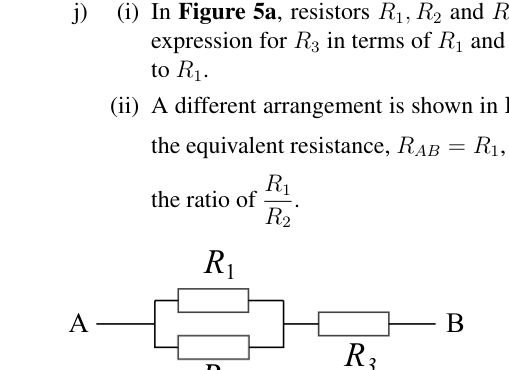 Figure 5a: R1 in series with parallel R2-R3
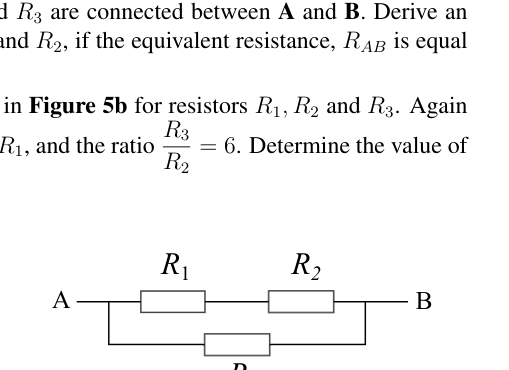 Figure 5b: R1 parallel with series R2-R3
Topic: Circuits Metodi: Equivalent Circuit Reduction, Kirchhoff’s Laws Competenze: Mathematical Modeling, Physical Reasoning Objects: Resistor Fonte: Testo (PDF) — p.6
(i) Nella figura 5a, le resistori , e sono collegate tra A e B. Derivare un’espressione per in termini di e , se la resistenza equivalente, è uguale a .
(ii) La figura 5b mostra un’arrangimento diverso per le resistenze , e . Ancora una volta la resistenza equivalente, , e il rapporto . Determinare il valore del rapporto .
Figura 5a: R1 in serie con R2-R3 parallelo
Figura 5b: R1 parallelo alla serie R2-R3
Topic: Circuits Metodi: Equivalent Circuit Reduction, Kirchhoff’s Laws Competenze: Mathematical Modeling, Physical Reasoning Objects: Resistor Fonte: Testo (PDF) — p.6
The stiffness, , of a beam of rectangular cross-section, with width , and thickness , is directly proportional to its width and the cube of its thickness, (); that is, stiffness, . Determine the cross-sectional dimensions of the stiffest rectangular cross-section wooden beam that can be cut from a log of diameter 20 cm.
Topic: Elasticity & Materials, Newtonian Mechanics Metodi: Calculus-Integration, Dimensional Analysis, Physical Modeling Competenze: Mathematical Modeling, Physical Reasoning Objects: Beam Fonte: Testo (PDF) — p.6
La rigidità, , di un fascio di sezione rettagonale, con larghezza e spessore , è direttamente proporzionale alla sua larghezza e al cubo di spessore (); cioè la rigidità, . Determinare le dimensioni trasversali del fascio di legno di sezione trasversale rettangolare più rigido che possa essere tagliato da un tronco di 20 cm di diametro.
Topic: Elasticity & Materials, Newtonian Mechanics Metodi: Calculus-Integration, Dimensional Analysis, Physical Modeling Competenze: Mathematical Modeling, Physical Reasoning Objects: Beam Fonte: Testo (PDF) — p.6
A narrow beam of monochromatic light is passed normally through a diffraction grating of lines per metre. Three spots of light are observed on a screen placed 80 cm away from the grating, and the outer spots are 30 cm away from the central spot. Determine the wavelength of the light used.
Topic: Wave Optics Metodi: Interference & Diffraction Analysis Competenze: Mathematical Modeling, Physical Reasoning Objects: Diffraction Grating, Screen Fonte: Testo (PDF) — p.6
Un raggio stretto di luce monocromatica passa normalmente attraverso una griglia di diffrazione di linee per metro. Su uno schermo posizionato a 80 cm dalla griglia si osservano tre punti di luce e i punti esterni a 30 cm dal punto centrale. Determina la lunghezza d’onda della luce utilizzata.
Topic: Wave Optics Metodi: Interference & Diffraction Analysis Competenze: Mathematical Modeling, Physical Reasoning Objects: Diffraction Grating, Screen Fonte: Testo (PDF) — p.6
Large craters can be produced on the Earth by meteorites. The size of a crater with diameter is dependent on the kinetic energy of the meteorite , the density of the rock removed from the crater , and the field strength , since the rock must be lifted out of the crater. We can express this as
where is a numeric constant and .
(i) By considering the dimensions (or units) of the quantities above, obtain an expression relating the diameter of the crater to , and .
(ii) The Barringer Crater in Arizona was made by a meteorite that landed there 30 000 years ago. It has a diameter of 1200 m and is in rock of typical density 3000 kg m. If the impact speed was 15 km s, estimate the mass of the meteorite.
(iii) If the spherical meteorite was made of iron of density 8000 kg m what was its diameter?
Topic: Newtonian Mechanics, Order-of-Magnitude Estimation Metodi: Dimensional Analysis, Order-of-Magnitude Estimation, Physical Modeling Competenze: Estimation & Approximation, Mathematical Modeling Objects: — Fonte: Testo (PDF) — p.6
I grandi crateri possono essere prodotti sulla Terra dai meteoriti. La dimensione di un cratere di diametro dipende dall’energia cinetica del meteorite , dalla densità della roccia rimossa dal cratere e dalla forza del campo , poiché la roccia deve essere sollevata dal cratere. Possiamo esprimere questo come
dove è una costante numerica e .
(i) Considerando le dimensioni (o le unità) delle quantità di cui sopra, si ottiene un’espressione che relaziona il diametro del cratere a , e .
- Il cratere Barringer in Arizona è stato creato da un meteorite che è atterrato lì 30.000 anni fa. Ha un diametro di 1200 m ed è in roccia di densità tipica di 3000 kg m. Se la velocità di impatto è stata di 15 km s, calcolare la massa del meteorite.
(iii) Se il meteorite sferico era fatto di ferro di densità 8000 kg m, qual era il suo diametro?
Topic: Newtonian Mechanics, Order-of-Magnitude Estimation Metodi: Dimensional Analysis, Order-of-Magnitude Estimation, Physical Modeling Competenze: Estimation & Approximation, Mathematical Modeling Objects: — Fonte: Testo (PDF) — p.6
The petrol engine of a car consumes 5.3 litres of petrol for every 100 km travelled at a speed of 100 km h with the outside temperature being 16°C. The heat of combustion of the petrol is 30 MJ per litre, and 23% of this energy finds its way to the water cooling system. Calculate the mass rate of flow of cooling water such that the temperature rise of the cooling water is limited to 40°C.
Specific thermal capacity of water = 4180 J kg °C.
Topic: Thermodynamics Metodi: First Law of Thermodynamics, Physical Modeling Competenze: Mathematical Modeling, Unit Conversion Objects: Heat Engine Fonte: Testo (PDF) — p.7
Il motore a benzina di un’auto consuma 5,3 litri di benzina per ogni 100 km percorsi a una velocità di 100 km/h con una temperatura esterna di 16°C. Il calore di combustione della benzina è di 30 MJ per litro, e il 23% di questa energia si trasmette al sistema di raffreddamento idrico. Calcolare la velocità di flusso di massa dell’acqua di raffreddamento in modo tale che l’aumento della temperatura dell’acqua di raffreddamento sia limitato a 40°C.
Capacità termica specifica dell’acqua = 4180 J kg °C .
Topic: Thermodynamics Metodi: First Law of Thermodynamics, Physical Modeling Competenze: Mathematical Modeling, Unit Conversion Objects: Heat Engine Fonte: Testo (PDF) — p.7
Stefan’s Law states that for a given perfectly radiating surface at an absolute temperature , the radiated power is directly proportional to . The radiated energy is distributed over a range of wavelengths of electromagnetic radiation, with the peak in emission occurring at , as shown in Figure 6. The value of is determined by Wien’s Law which states is inversely proportional to absolute temperature.
Determine:
(i) The ratio of the radiative powers of the surface at 500°C and 1000°C, i.e. evaluate ,
(ii) the wavelength of maximum emission at 1000°C if the wavelength of maximum emission at 500°C is 3750 nm.
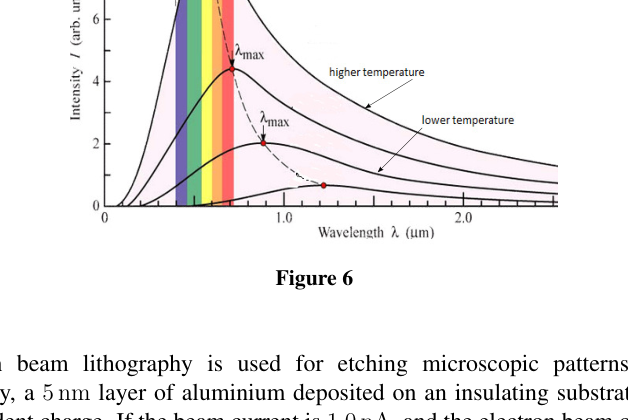 Spectral emission curve showing peak at lambda_max
Topic: Thermodynamics, Electromagnetism Metodi: Physical Modeling, Dimensional Analysis Competenze: Mathematical Modeling, Physical Reasoning Objects: — Fonte: Testo (PDF) — p.7
La legge di Stefan afferma che per una superficie perfettamente irradiante a temperatura assoluta , la potenza irradiata è direttamente proporzionale a . L’energia irradiata è distribuita su una gamma di lunghezze d’onda di radiazioni elettromagnetiche, con il picco di emissione che si verifica a , come mostrato alla figura 6. Il valore di è determinato dalla legge di Wien che afferma che è inversamente proporzionale alla temperatura assoluta.
Determinazione:
(i) Il rapporto tra le potenze radiative della superficie a 500°C e 1000°C, ovvero valutare ,
- la lunghezza d’onda della massima emissione a 1000°C se la lunghezza d’onda della massima emissione a 500°C è di 3750 nm.
Curva di emissione spettrale con picco a lambda_max
Topic: Thermodynamics, Electromagnetism Metodi: Physical Modeling, Dimensional Analysis Competenze: Mathematical Modeling, Physical Reasoning Objects: — Fonte: Testo (PDF) — p.7
Electron beam lithography is used for etching microscopic patterns on surfaces. Typically, a 5 nm layer of aluminium deposited on an insulating substrate will remove the incident charge. If the beam current is 1.0 nA, and the electron beam of width 15 nm is incident centrally on a circular aluminium covered surface of diameter 5.0 cm, calculate the electrical resistance and potential difference between the edge of the spot and the edge of the surface.
Resistivity of aluminium = m.
Topic: Circuits, Electrostatics Metodi: Calculus-Integration, Physical Modeling, Kirchhoff’s Laws Competenze: Mathematical Modeling, Physical Reasoning Objects: Particle Beam, Electron Fonte: Testo (PDF) — p.7
La litografia a fascio elettronico è usata per incidere modelli microscopici sulle superfici. In genere, un strato di alluminio di 5 nm depositato su un substrato isolante rimuove la carica incidente. Se il flusso del fascio è di 1,0 nA e il fascio di elettroni di larghezza 15 nm incide centralmente su una superficie circolare di alluminio di diametro 5,0 cm, calcolare la resistenza elettrica e la differenza potenziale tra il bordo del punto e il bordo della superficie.
Resistenza dell’alluminio = m.
Topic: Circuits, Electrostatics Metodi: Calculus-Integration, Physical Modeling, Kirchhoff’s Laws Competenze: Mathematical Modeling, Physical Reasoning Objects: Particle Beam, Electron Fonte: Testo (PDF) — p.7
A leaky capacitor is one which does not have a perfectly insulating dielectric layer between the plates upon which the charge is stored. Such a capacitor contains a dielectric material filling the space between the plates, and with an effective resistivity of m. The area of the plates is m, and the dielectric film thickness m. The capacitor is charged from a 24 V supply connected in series with a 4.7 M resistor.
(i) Calculate the maximum charge that can be accumulated on one of the capacitor plates. [For a parallel plate capacitor, ]
(ii) If the capacitor is disconnected from the circuit, calculate the time taken for the capacitor to lose half its maximum charge.
Topic: Circuits, Electrostatics Metodi: Kirchhoff’s Laws, Differential Equations, Physical Modeling Competenze: Mathematical Modeling, Physical Reasoning Objects: Capacitor, Resistor, Battery Fonte: Testo (PDF) — p.8
Un condensatore a perdita è uno che non ha uno strato dielettrico perfettamente isolante tra le piastre su cui è immagazzinato il carico. Tale condensatore contiene un materiale dielettrico che riempie lo spazio tra le piastre e con una resistenza efficace di m. La superficie delle lastre è m e lo spessore del film dielettrico m. Il condensatore è caricato da una alimentazione a 24 V collegata in serie con una resistenza di 4,7 M.
(i) Calcolare la carica massima che può essere accumulata su una delle piastre condensatori. [Per un condensatore di piastre parallele, ]
(ii) Se il condensatore è disconnesso dal circuito, calcolare il tempo necessario per la perdita della metà della carica massima del condensatore.
Topic: Circuits, Electrostatics Metodi: Kirchhoff’s Laws, Differential Equations, Physical Modeling Competenze: Mathematical Modeling, Physical Reasoning Objects: Capacitor, Resistor, Battery Fonte: Testo (PDF) — p.8
A fixed mass of gas expands isothermally and the relationship between the pressure , and the volume of the gas , is Pa m. The volume increases at a rate of 0.005 m s when the volume is 0.17 m. At what rate does the pressure decrease at this point?
Topic: Thermodynamics Metodi: Ideal Gas Law, Calculus-Integration Competenze: Mathematical Modeling, Physical Reasoning Objects: Gas Fonte: Testo (PDF) — p.8
Una massa fissa del gas si espande isotermicamente e il rapporto tra la pressione e il volume del gas è Pa m. Il volume aumenta a un ritmo di 0,005 m s quando il volume è di 0,17 m. A che velocità la pressione diminuisce a questo punto?
Topic: Thermodynamics Metodi: Ideal Gas Law, Calculus-Integration Competenze: Mathematical Modeling, Physical Reasoning Objects: Gas Fonte: Testo (PDF) — p.8
A hot air balloon uses a gas flame to heat the air it contains to a temperature required to enable it to hover at a small distance above ground level. The mass of the balloon, ropes, basket and riders is 240 kg and the volume of the balloon is 1100 m. The temperature of the surrounding air is 15°C and its density is 1.23 kg m.
To what temperature does the air in the balloon need to be heated?
Topic: Thermodynamics, Fluid Mechanics Metodi: Ideal Gas Law, Hydrostatic Equilibrium, Physical Modeling Competenze: Physical Reasoning, Mathematical Modeling Objects: Gas Fonte: Testo (PDF) — p.8
Un pallone a aria calda utilizza una fiamma a gas per riscaldare l’aria contenuta a una temperatura necessaria per permettergli di galleggiare a una piccola distanza dal livello del suolo. La massa del palloncino, delle corde, del cestino e dei piloti è di 240 kg e il volume del palloncino è di 1100 m. La temperatura dell’aria circostante è 15°C e la densità è di 1,23 kg m.
A che temperatura deve essere riscaldata l’aria del palloncino?
Topic: Thermodynamics, Fluid Mechanics Metodi: Ideal Gas Law, Hydrostatic Equilibrium, Physical Modeling Competenze: Physical Reasoning, Mathematical Modeling Objects: Gas Fonte: Testo (PDF) — p.8