- Here are some definitions of weight given by students:
- I. The gravitational force exerted on an object.
- II. The normal-contact force exerted by a supporting surface on an object.
- III. The normal-contact force exerted by an object on a supporting surface.
Which of the following is/are the correct definition? Select one:
- A. I only
- B. II and III
- C. III only
- D. I and III
- E. I, II and III
Topic: Newtonian Mechanics Metodi: Free-Body Diagram, Physical Modeling Competenze: Physical Reasoning Objects: - Fonte: Testo (PDF) - p.4
- Ecco alcune definizioni di peso da parte degli studenti:
- I. La forza gravitazionale esercitata su un oggetto.
- II. La forza di contatto normale esercitata da una superficie di supporto su un oggetto.
- III. La forza di contatto normale esercitata da un oggetto su una superficie di supporto.
Qual è/sono la definizione corretta? Scegli una:
- A. Io solo
- B. II e III
- C. Solo III
- D. I e III
- E. I, II e III
Topic: Newtonian Mechanics Metodi: Free-Body Diagram, Physical Modeling Competenze: Physical Reasoning Objects: - Fonte: Testo (PDF) - p.4
- Consider the following situations:
- I. You are standing in a lift and accelerating upwards
- II. You are standing in a lift and moving upwards at constant speed
- III. You are standing in a lift which has experienced a cable failure, and is freely falling downwards
In which of these situations is your weight substantially different to when you are standing at rest on the surface of the Earth? Select one:
- A. None of the above
- B. I only
- C. I and III
- D. III only
- E. All of the above
Topic: Newtonian Mechanics Metodi: Free-Body Diagram, Physical Modeling Competenze: Physical Reasoning Objects: - Fonte: Testo (PDF) - p.4
- Considerate le seguenti situazioni:
- I. Stai in ascensore e stai accelerando verso l’alto
- II. Stai in ascensore e ti muovi verso l’alto a velocità costante
- III. Sei in piedi in un ascensore che ha subito un guasto del cavo, e sta cadendo liberamente in basso
In quale di queste situazioni il tuo peso è sostanzialmente diverso da quando sei in riposo sulla superficie della Terra? Scegli una:
- A. Nessuna delle seguenti
- B. Io solo
- C. I e III
- D. Solo III
- E. Tutti i precedenti
Topic: Newtonian Mechanics Metodi: Free-Body Diagram, Physical Modeling Competenze: Physical Reasoning Objects: - Fonte: Testo (PDF) - p.4
- A block of mass 5 kg sits at rest on a horizontal surface. A downwards force of 20 N is applied to the block, as shown.
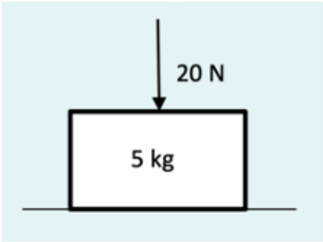
What is the weight of the block? Select one:
- A. 5 kg
- B. 25 kg
- C. 25 N
- D. 50 N
- E. 70 N
Topic: Newtonian Mechanics Metodi: Free-Body Diagram Competenze: Physical Reasoning Objects: Block Fonte: Testo (PDF) - p.4
- Un blocco di massa di 5 kg si trova a riposo su una superficie orizzontale. Si applica al blocco una forza verso il basso di 20 N, come mostrato.
Qual è il peso del blocco? Scegli una:
- A. 5 kg
- B. 25 kg
- C. 25 N
- D. 50 N
- E. 70 N
Topic: Newtonian Mechanics Metodi: Free-Body Diagram Competenze: Physical Reasoning Objects: Block Fonte: Testo (PDF) - p.4
- A block of mass 5 kg sits at rest on a horizontal surface. A second, smaller block, of mass 2 kg, is placed on top as shown.
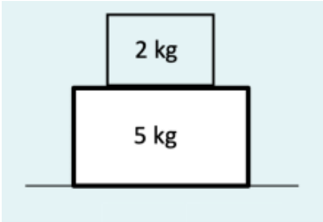
What is the weight of the block on the bottom? Select one:
- A. 5 kg
- B. 7 kg
- C. 7 N
- D. 50 N
- E. 70 N
Topic: Newtonian Mechanics Metodi: Free-Body Diagram Competenze: Physical Reasoning Objects: Block Fonte: Testo (PDF) - p.5
- Un blocco di massa di 5 kg si trova a riposo su una superficie orizzontale. Un secondo blocco più piccolo, di massa 2 kg, viene posto in cima, come mostrato.
Qual è il peso del blocco sul fondo? Scegli una:
- A. 5 kg
- B. 7 kg
- C. 7 N
- D. 50 N
- E. 70 N
Topic: Newtonian Mechanics Metodi: Free-Body Diagram Competenze: Physical Reasoning Objects: Block Fonte: Testo (PDF) - p.5
- What is the (approximate) mass of a water in a full teaspoon of water? Select one:
- A. kg
- B. kg
- C. kg
- D. kg
- E. kg
Topic: Order-of-Magnitude Estimation Metodi: Order-of-Magnitude Estimation Competenze: Estimation & Approximation Objects: - Fonte: Testo (PDF) - p.5
- Qual è la massa (approssimativa) di un acqua in un cucchiaino di acqua pieno? Scegli una:
- A. kg
- B. kg
- C. kg
- D. kg
- E. kg
Topic: Order-of-Magnitude Estimation Metodi: Order-of-Magnitude Estimation Competenze: Estimation & Approximation Objects: - Fonte: Testo (PDF) - p.5
- The equation for a straight-line graph is , so that a plot of vs is a line with gradient , and is the intercept of the line with the axis. Consider the equation:
What is the slope of a plot of vs ? Assume that all other quantities in the equation are constant. Select one:
- A.
- B.
- C.
- D.
- E. The graph will not be a straight line
Topic: Mathematics Metodi: Graph Linearization Competenze: Graph Linearization, Mathematical Modeling Objects: - Fonte: Testo (PDF) - p.6
- L’equazione per un grafico a linea retta è , in modo che un plot di vs sia una linea con gradiente , e sia l’intercettazione della linea con l’asse . Considerate l’equazione:
Qual è la pendenza di un plot di vs ? Supponiamo che tutte le altre quantità nell’equazione siano costanti. Scegli una:
- A.
- B.
- C.
- D.
- E. Il grafico non sarà una linea retta
Topic: Mathematics Metodi: Graph Linearization Competenze: Graph Linearization, Mathematical Modeling Objects: - Fonte: Testo (PDF) - p.6
- A cockatoo and a sparrow are flying towards each other. Both birds have the same kinetic energy, but the cockatoo has four times the mass of the sparrow. Which one of the following statements is true? Select one:
- A. The magnitude of the cockatoo’s momentum is four times larger than the sparrow’s
- B. The magnitude of the cockatoo’s momentum is twice as large as the sparrow’s
- C. The magnitude of the cockatoo’s momentum is the same as the sparrow’s
- D. The magnitude of the cockatoo’s momentum is half that of the sparrow’s
- E. The magnitude of the cockatoo’s momentum is one quarter that of the sparrow’s
Topic: Conservation of Momentum Metodi: Conservation of Momentum, Physical Modeling Competenze: Physical Reasoning, Mathematical Modeling Objects: - Fonte: Testo (PDF) - p.7
- Un cacao e un passeri volano l’uno verso l’altro. Entrambi gli uccelli hanno la stessa energia cinetica, ma il coccodromo ha quattro volte la massa del passeri. Quale delle seguenti affermazioni è vera? Scegli una:
- A. La grandezza del momento del coccadù è quattro volte maggiore di quella del passero
- B. La grandezza del momento del coccadù è due volte maggiore di quella del passero
- C. La grandezza del momento del coccadù è la stessa del passero
- D. La grandezza del momento del coccodromo è la metà di quella del passero
- E. La grandezza del momento del coccadù è un quarto di quella del passero
Topic: Conservation of Momentum Metodi: Conservation of Momentum, Physical Modeling Competenze: Physical Reasoning, Mathematical Modeling Objects: - Fonte: Testo (PDF) - p.7
- The cockatoo and the sparrow collide head-on in mid-air. During the collision, the magnitude of the force exerted by the cockatoo on the sparrow is:
Select one:
- A. Four times the magnitude of the force exerted by the sparrow on the cockatoo
- B. Twice the magnitude of the force exerted by the sparrow on the cockatoo
- C. The same as the magnitude of the force exerted by the sparrow on the cockatoo
- D. Half the magnitude of the force exerted by the sparrow on the cockatoo
- E. One quarter the magnitude of the force exerted by the sparrow on the cockatoo
Topic: Newtonian Mechanics Metodi: Free-Body Diagram, Impulse-Momentum Theorem Competenze: Physical Reasoning Objects: - Fonte: Testo (PDF) - p.8
- Il coccodromo e il passeri si scontrano faccia a faccia in mezzo all’aria. Durante la collisione, la forza esercitata dal coccodromo sul passero è:
Scegli una:
- A. Quattro volte la forza esercitata dal passero sul coccodromo
- B. Il doppio della forza esercitata dal passero sul coccodromo
- C. La stessa grandezza della forza esercitata dal passero sul cacao
- D. La metà della forza esercitata dal passero sul coccodromo
- E. Un quarto della forza esercitata dal passero sul coccodromo
Topic: Newtonian Mechanics Metodi: Free-Body Diagram, Impulse-Momentum Theorem Competenze: Physical Reasoning Objects: - Fonte: Testo (PDF) - p.8
- The cockatoo and sparrow become tangled together during the collision into a single feathery object. What happens in the instant immediately after the collision?
Select one:
- A. The feathery object moves in the same direction as the cockatoo’s original motion.
- B. The feathery object moves in the same direction as the sparrow’s original motion.
- C. The feathery object stops dead in the air.
- D. As soon as they collide they move directly downward.
- E. More information is needed to answer this question.
Topic: Conservation of Momentum Metodi: Conservation of Momentum Competenze: Physical Reasoning Objects: - Fonte: Testo (PDF) - p.8
- Il coccodromo e il passero si intrecciano durante la collisione in un unico oggetto piumoso. Cosa succede all’istante immediatamente dopo la collisione?
Scegli una:
- A. L’oggetto piumoso si muove nella stessa direzione del movimento originale del coccodromo.
- B. L’oggetto piumoso si muove nella stessa direzione del movimento originale del passero.
- C. L’oggetto piumoso si ferma morto in aria.
- D. Non appena si scontrano si muovono direttamente verso il basso.
- E. Per rispondere a questa domanda occorrono ulteriori informazioni.
Topic: Conservation of Momentum Metodi: Conservation of Momentum Competenze: Physical Reasoning Objects: - Fonte: Testo (PDF) - p.8
- A kookaburra observes the collision, and laughs so hard it falls off the branch it is perched on, at an initial height . Ignoring air resistance, which graph below correctly shows the mechanical energy of the kookaburra-Earth system as a function of the kookaburra’s height above ground, ? Assume that the kookaburra is laughing so hard that it neglects to fly.
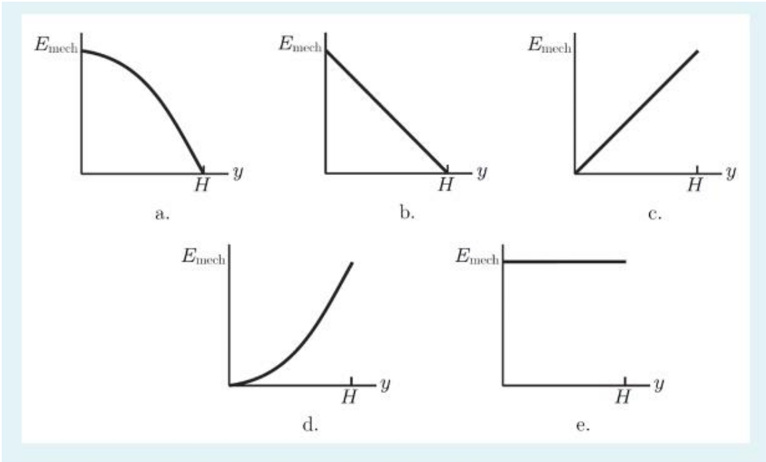
- A. a
- B. b
- C. c
- D. d
- E. e
Topic: Conservation of Energy Metodi: Conservation of Energy Competenze: Diagrammatic Reasoning, Physical Reasoning Objects: - Fonte: Testo (PDF) - p.9
- Un kookaburra osserva la collisione e ride così forte che cade dal ramo su cui è appeso, ad un’altezza iniziale . Ignorando la resistenza dell’aria, che grafico di seguito mostra correttamente l’energia meccanica del sistema kookaburra-Terra in funzione dell’altezza del kookaburra sopra il suolo, ? Supponiamo che il kookaburra stia ridendo così tanto che trascura di volare.
- A. a
- B. b
- C. c
- D. d
- E. e
Topic: Conservation of Energy Metodi: Conservation of Energy Competenze: Diagrammatic Reasoning, Physical Reasoning Objects: - Fonte: Testo (PDF) - p.9
Section B: Runners (Suggested time: 16 minutes)
Kara runs with her friend Anna around a track of length km. Anna completes two laps of the track in minutes. Kara completes two laps of the track in minutes.
a) Write an expression for Anna’s speed , and also find the numerical value of this speed.
b) In a certain time Kara gets to be one full lap ahead of Anna.
- i) Write a sentence in words to describe the relationship between this time and other known variables.
- ii) Write an equation representing the same relationship.
- iii) Hence or otherwise find the time it takes for Kara to get one full lap ahead of Anna.
c) How fast would Kara need to run to get one full lap ahead of Anna when Anna has run 2.7 laps?
Topic: Newtonian Mechanics Metodi: Kinematic Equations, Physical Modeling Competenze: Mathematical Modeling, Physical Reasoning Objects: - Fonte: Testo (PDF) - p.10
Sezione B: Corridori (Tempo suggerito: 16 minuti)
Kara corre con la sua amica Anna in una pista di lunghezza km. Anna completa due giri della pista in minuti. Kara completa due giri della pista in minuti.
a) Scrivere un’espressione per la velocità di Anna e trovare anche il valore numerico di questa velocità.
b) In a certain time Kara gets to be one full lap ahead of Anna.
- i) Scrivere una frase in parole per descrivere la relazione tra questo tempo e altre variabili conosciute.
- ii) Scrivere un’equazione che rappresenti la stessa relazione.
- iii) Quindi o altrimenti trovare il tempo necessario per Kara di ottenere un giro completo prima di Anna.
c) Quanto veloce avrebbe dovuto correre Kara per avere un giro completo davanti ad Anna quando Anna ha fatto 2,7 giri?
Topic: Newtonian Mechanics Metodi: Kinematic Equations, Physical Modeling Competenze: Mathematical Modeling, Physical Reasoning Objects: - Fonte: Testo (PDF) - p.10
Section C: Sugar gliders (Suggested time: 16 minutes)
A typical sugar glider has a mass of g and head to body length of cm. It glides by extending its arms and legs to tighten flaps of skin called the patagium which act as glider wings. A typical glide is at a speed of around m/s at an angle of around down from the horizontal.
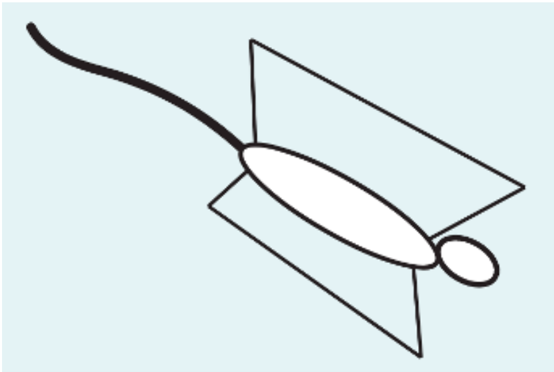
The gliding occurs because there is a lift force on the wings which must be to maintain a constant gliding angle . Here is the weight of the sugar glider. The lift force is proportional to the area of the wings and also proportional to the square of the speed of the glider.
Some landowners in outback Australia claim to have found a fossil of a giant sugar glider with a head to body length of around cm.
Throughout this question you may use the following variables:
- the mass of a typical sugar glider
- the mass of the fossil animal when it was alive
- the head to body length of a typical sugar glider
- the head to body length of the fossil animal
- the typical gliding speed of a typical sugar glider
- the typical gliding speed of the fossil animal
- the typical gliding angle of a typical sugar glider
- the typical gliding angle of the fossil animal
- the area of the patagium (glider wings) of a typical sugar glider
- the area of the patagium (glider wings) of the fossil animal
a)
- i) Write an expression relating , the mass of the fossil animal when it was alive, to the mass of a typical sugar glider.
- ii) Use your expression to estimate the mass of the fossil animal when alive.
b) Write an expression for the area of the patagium of the fossil glider compared to the area of the patagium of the typical sugar glider . You may include any other variables used in this question.
Animals are considered to fly if they can move their wings to generate thrust. They are considered to glide if they can travel through air at a constant angle which is less than to the horizontal. They are considered to parachute if they can slow their fall but it is always at an angle of more than to the horizontal.
c) Assuming that the typical gliding speed of the fossil animal , could the fossil animal glide, fly or parachute? To support your conclusion, include in your answer an equation relating the angle to other variables.
d) What is the minimum speed at which the fossilized glider would need to launch to be able to glide?
Topic: Newtonian Mechanics, Fluid Mechanics Metodi: Dimensional Analysis, Physical Modeling, Order-of-Magnitude Estimation Competenze: Mathematical Modeling, Physical Reasoning Objects: - Fonte: Testo (PDF) - p.12
Sezione C: gli aerei a vela a zucchero (Tempo suggerito: 16 minuti)
Un tipico lampadino a glissi di zucchero ha una massa di g e una lunghezza testa-corpo di cm. Scorre all’aria allungando le braccia e le gambe per stringere le tappe della pelle chiamate patagium che agiscono come ali di lampione. Un tipico glissi si svolge ad una velocità di circa m/s, ad un angolo di circa in basso dall’orizzontale.
Il gliding si verifica perché c’è una forza di sollevamento sulle ali che deve essere per mantenere un angolo di gliding costante . Qui è il peso del lampadino a zucchero. La forza di sollevamento è proporzionale all’area delle ali e anche proporzionale al quadrato della velocità del lampione.
Alcuni proprietari terrieri dell’Australia affermano di aver trovato un fossile di un gigantesco lampadino a ghiaccio con una lunghezza dal capo al corpo di circa cm.
In questa domanda potete utilizzare le seguenti variabili:
- la massa di un tipico lampadino a zucchero
- la massa dell’animale fossile quando era vivo
- lunghezza testa-corpo di un tipico lampadino a zucchero
- lunghezza da testa a corpo dell’animale fossile
- la velocità di glissi tipica di un glissiere tipico di zucchero
- velocità di movimento tipica dell’animale fossile
- angolo di glissi tipico di un tipico glissiere a zucchero
- l’angolo di scorrimento tipico dell’animale fossile
- la superficie del pataggio (ala di laminazione) di un laminazione tipico a zucchero
- la superficie del patagium (ala di galleggiatura) dell’animale fossile
a)
- i) Scrivere un’espressione che indichi la massa dell’animale fossile in vita alla massa di un tipico lampadino a zucchero.
- ii) Utilizzare la vostra espressione per stimare la massa dell’animale fossile quando è vivo.
b) Scrivere un’espressione per l’area del pataggio del lampione fossile rispetto all’area del pataggio del lampione tipico di zucchero . È possibile includere altre variabili utilizzate in questa domanda.
Gli animali sono considerati volanti se possono muovere le ali per generare spinta. Si considerano scivoli se possono viaggiare attraverso l’aria ad un angolo costante inferiore a verso l’orizzontale. Si considerano paracadutisti se possono rallentare la caduta ma si trova sempre ad un angolo superiore a orizzontale.
c) Supponendo che la velocità di glissi tipica dell’animale fossile , l’animale fossile possa glissiare, volare o paracadutare? Per sostenere la tua conclusione, includere nella tua risposta un’equazione che relaziona l’angolo ad altre variabili.
d) Qual è la velocità minima con cui il lampione fossilizzato dovrebbe lanciare per poterli lampiare?
Topic: Newtonian Mechanics, Fluid Mechanics Metodi: Dimensional Analysis, Physical Modeling, Order-of-Magnitude Estimation Competenze: Mathematical Modeling, Physical Reasoning Objects: - Fonte: Testo (PDF) - p.12
Section D: Pro-drugs (Suggested time: 26 minutes)
a) Once in the blood many drugs are metabolised by the liver to form substances which are easier for the body to excrete. The rate at which the liver metabolises the drug is proportional to the concentration of the drug in the blood.
One such drug is used to treat a common respiratory illness in children. When the initial blood concentration is 20 g/L and after four hours the blood concentration is 10 g/L.
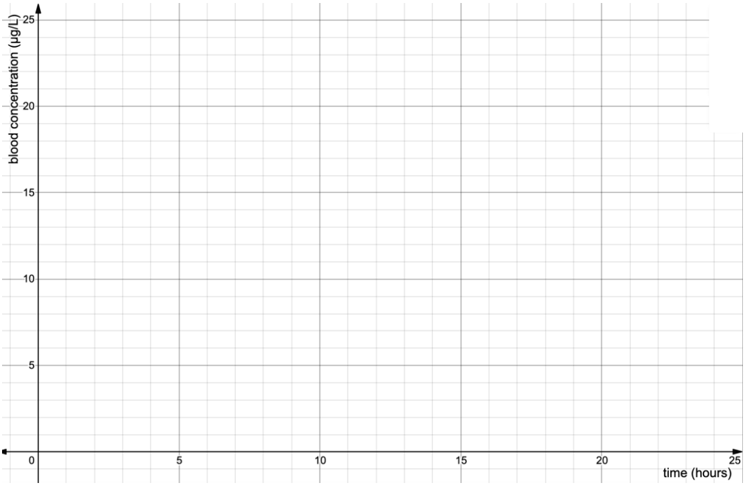
- i) Plot points to represent the information above on the axes below.
- ii) Sketch a prediction for concentration in the blood over 24 hours on the same axes.
Some medicines have more complex metabolic pathways, undergoing a range of chemical reactions in the body at different rates, to produce a range of substances called metabolites. Some of these substances may contribute to the action of the medicine, these are called active metabolites. Others are waste products which do not contribute to the action of the medicine and are called inactive metabolites.
Some medicines are called pro-drugs because they are not active but they produce active metabolites which are drugs. One example of a common pro-drug is used for pain relief in adults.
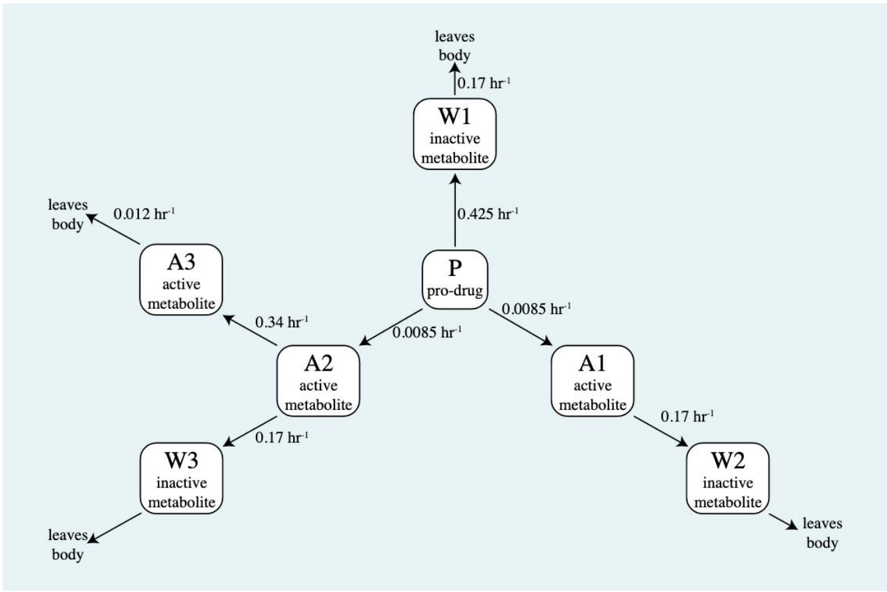
The diagram below shows the main metabolic pathways for this pro-drug, including the three main active metabolites. The values on the arrows show the probability of one molecule of the first substance reacting to form the second substance each hour. The total rates for each reaction are proportional to the amount of the starting substance in each case.
b) The graph below shows the concentration of the pro-drug, (solid black line), and its metabolite (dashed black line) versus time after an intravenous (directly into the blood) dose of .
- i) Describe how the concentration of would change if the rate of the reaction converting to were increased and the rate of leaving the body remained the same.
- ii) Describe how the concentration of would change if the rate of the reaction converting to remained around the same and the rate of leaving the body were increased.
- iii) Describe how the shape of the curve for at times long after the maximum would change if the rate of the reaction converting to were increased and the rate of leaving the body remained the same.
- iv) Describe how the shape of the curve for at times long after the maximum would change if the rate of the reaction converting to remained around the same and the rate of leaving the body were increased.
c) Sketch the concentration of active metabolite versus time on the axes below. Your sketch does not need to be exact, but should have approximately correct scale in both concentration and time. You need to add appropriate scales for both axes.
d) Give reasons for each of your answers in this part.
- i) Shortly after the dose of pro-drug was given will or have a higher concentration?
- ii) A long time after the dose of pro-drug was given will or have a higher concentration?
- iii) When is at its maximum concentration, how large will the ratio of concentration of to concentration of be?
- iv) When is at its maximum concentration, how large will the ratio of concentration of to concentration of be?
e)
- i) Sketch the concentration of active metabolite versus time on the axes above. Clearly mark which curve corresponds to .
- ii) Also sketch the concentration of active metabolite versus time on the same axes. Clearly mark which curve corresponds to . Your sketches do not need to be exact, but should have approximately correct scale in both concentration and time.
f) A measurement of the ratio of the blood concentration of to the blood concentration of can be used to estimate the time since a dose of in cases where this is unknown.
- i) Explain why it is necessary to measure the ratio of the blood concentrations rather than use a single concentration.
- ii) Describe how this ratio changes with time, and identify the times at which it will help make a reasonable estimate.
Topic: Mathematics, Biology Metodi: Differential Equations, Radioactive Decay Law, Curve Fitting Competenze: Mathematical Modeling, Diagrammatic Reasoning Objects: - Fonte: Testo (PDF) - p.14
Sezione D: Pro-drog (Tempo suggerito: 26 minuti)
a) Una volta nel sangue molti farmaci vengono metabolizzati dal fegato per formare sostanze che sono più facili da escrettare dall’organismo. La velocità con cui il fegato metabolizza il farmaco è proporzionale alla concentrazione del farmaco nel sangue.
Uno di questi farmaci è usato per curare una malattia respiratoria comune nei bambini. Quando la concentrazione sanguigna iniziale è di 20 g/L e dopo quattro ore la concentrazione sanguigna è di 10 g/L.
- i) Il plot indica le informazioni sopra riportate sugli assi di seguito.
- ii) Sine di una previsione della concentrazione nel sangue nel corso di 24 ore sugli stessi assi.
Alcuni farmaci hanno percorsi metabolici più complessi, che subiscono una serie di reazioni chimiche nell’organismo a velocità diverse, per produrre una serie di sostanze chiamate metaboliti. Alcune di queste sostanze possono contribuire all’azione del medicinale, queste sono chiamate metaboliti attivi. Altri sono prodotti di scarto che non contribuiscono all’azione del medicinale e sono chiamati metaboliti inattivi.
Alcuni farmaci sono chiamati pro-farmaci perché non sono attivi ma producono metaboliti attivi che sono farmaci. Un esempio di un comune farmaco pro-farmaco è usato per alleviare il dolore negli adulti.
Il diagramma di seguito mostra i principali percorsi metabolici di questo farmaco, compresi i tre principali metaboliti attivi. I valori delle frecce indicano la probabilità che una molecola della prima sostanza reagisca per formare la seconda sostanza ogni ora. I tassi totali per ciascuna reazione sono proporzionali alla quantità della sostanza di partenza in ciascun caso.
b) Il grafico seguente mostra la concentrazione del farmaco (linea nera solida) e del suo metabolito (linea nera scintillata) rispetto al tempo trascorso dopo una dose intravenosa (diretta nel sangue) di .
- i) Descrivere come la concentrazione di cambierebbe se il tasso di reazione che converte in fosse aumentato e il tasso di che lascia l’ organismo rimanga lo stesso.
- ii) Descrivere come la concentrazione di cambierebbe se il tasso di reazione che converte in rimaneva circa lo stesso e il tasso di che lascia l’ organismo fosse aumentato.
- iii) Descrivere come la forma della curva per a volte molto dopo il massimo cambierebbe se il tasso di reazione che converte in fosse aumentato e il tasso di che lascia il corpo rimanga lo stesso.
- iv) Descrivere come la forma della curva per in momenti lunghi dopo il massimo cambierebbe se il tasso di reazione che converte in rimaneva attorno allo stesso e il tasso di uscita del corpo di fosse aumentato.
c) Sine di concentrazione del metabolita attivo rispetto al tempo sugli assi di seguito. Il tuo disegno non deve essere esatto, ma deve avere una scala approssimativamente corretta sia in concentrazione che in tempo. Devi aggiungere le scale appropriate per entrambi gli assi.
d) In questa parte, spiegate le ragioni di ciascuna delle vostre risposte.
- i) Poco dopo la dose di pro-farmaci , o avranno una concentrazione più elevata?
- ii) Dopo un lungo periodo di tempo dalla somministrazione della dose di profarma , la concentrazione di o sarà maggiore?
- iii) Quando la concentrazione massima di è raggiunta, quanto sarà grande il rapporto tra la concentrazione di e la concentrazione di ?
- iv) Quando la concentrazione massima di è raggiunta, quanto sarà grande il rapporto tra la concentrazione di e la concentrazione di ?
e)
- i) Sine di concentrazione del metabolita attivo rispetto al tempo sugli assi sopra indicati. Indicare chiaramente quale curva corrisponde a .
- ii) Descrivere anche la concentrazione del metabolita attivo rispetto al tempo sugli stessi assi. Indicare chiaramente quale curva corrisponde a . I tuoi schizzi non devono essere esatti, ma devono avere una scala approssimativamente corretta sia in concentrazione che in tempo.
f) Per stimare il tempo trascorso dalla dose di , in casi in cui non è noto, può essere utilizzato un’ analisi del rapporto tra la concentrazione sanguigna di e la concentrazione sanguigna di .
- i) Spiegare perché è necessario misurare il rapporto delle concentrazioni nel sangue piuttosto che usare una singola concentrazione.
- ii) Descrivere come questo rapporto cambia nel tempo e identificare i tempi in cui contribuirà a fare una stima ragionevole.
Topic: Mathematics, Biology Metodi: Differential Equations, Radioactive Decay Law, Curve Fitting Competenze: Mathematical Modeling, Diagrammatic Reasoning Objects: - Fonte: Testo (PDF) - p.14
Section E: Surprising shadows (Suggested time: 24 minutes)
During the night, someone enters a room containing a sink to wash their hands, and turns on the single light bulb in the room. Their immediate view is this image:
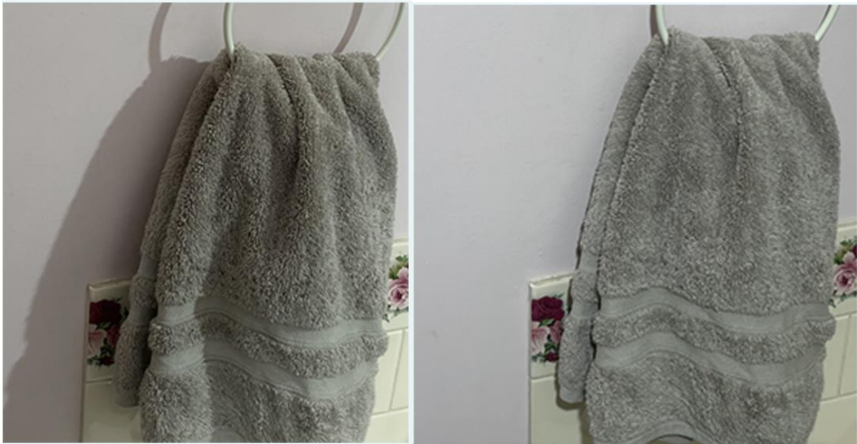
As the person stretches their arms, the person notices that the shadow seems to go dark and then disappear completely! These views are shown here:
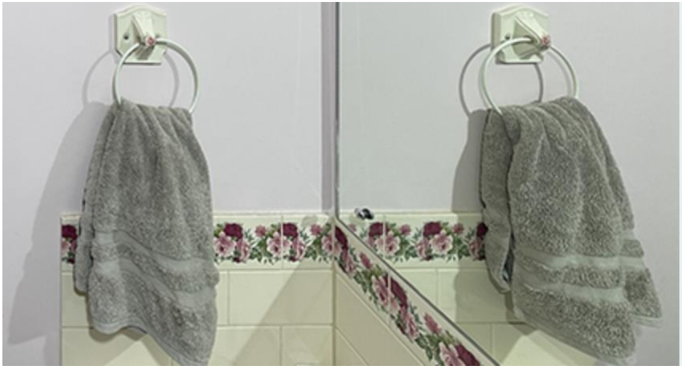
a) Explain using a drawing of light ray paths how these images might have been formed by the person and the light, including any other objects you think might have been present in the room and relevant.
b) What other object/s, if any, did you add to your drawing to help explain what is happening here?
c) A wider view of the room is shown in the image below. Unusually, the shadow appears not to have been reflected - it is in the same direction on both the towel and its image. The person thinks that this ‘non-reflecting shadow’ is strange indeed. Draw a picture including ray paths to explain why it looks this way and the location of the light bulb.
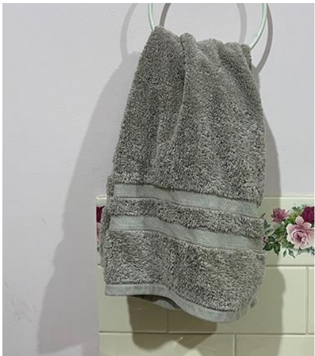
d) When looking at the towel from a different perspective, the image below is seen. Draw on the image to explain the difference in darkness of the two shadows, and how each is formed. You may also annotate your diagram with short phrases.
Topic: Geometric Optics Metodi: Ray Tracing, Physical Modeling Competenze: Diagrammatic Reasoning, Physical Reasoning Objects: Mirror Fonte: Testo (PDF) - p.18
Sezione E: ombre sorprendenti (Tempo suggerito: 24 minuti)
Durante la notte, qualcuno entra in una stanza che contiene un lavandino per lavarsi le mani e accende l’unica lampadina della stanza. La loro immediata visione è questa immagine:
Mentre la persona allunga le braccia, nota che l’ombra sembra scurire e poi scomparire completamente! Queste opinioni sono illustrate qui:
a) Spiegare, utilizzando un disegno di percorsi di raggi luminosi, come queste immagini potrebbero essere state formate dalla persona e dalla luce, compresi tutti gli altri oggetti che si ritiene possano essere presenti nella stanza e pertinenti.
b) Quale altro oggetto/oggetti, se del caso, ha aggiunto al suo disegno per aiutare a spiegare ciò che sta accadendo qui?
c) La foto di seguito mostra una panoramica più ampia della stanza. Insolitamente, l’ombra non sembra essere stata riflessa - è nella stessa direzione sia sul asciugamano che sulla sua immagine. La persona pensa che questa ‘ombra non riflessiva’ sia davvero strana. Disegna un’immagine che includa le vie dei raggi per spiegare perché appare così e la posizione della lampadina.
d) Quando si guarda il asciugamano da una prospettiva diversa, si vede l’immagine di seguito. Disegna l’immagine per spiegare la differenza tra le tenebre delle due ombre e come ciascuno di esse si forma. Potete anche annotare il diagramma con frasi brevi.
Topic: Geometric Optics Metodi: Ray Tracing, Physical Modeling Competenze: Diagrammatic Reasoning, Physical Reasoning Objects: Mirror Fonte: Testo (PDF) - p.18
Section F: Double glazing (Suggested time: 18 minutes)
Windows are a part of a building which is responsible for considerable heat loss in cold conditions. In cold areas, many buildings are designed with double glazing so that it is possible to keep the building warm without using as much energy to do so. Double glazing also significantly reduces the transmission of sound through windows and so is used in situations where a high level of sound insulation is required.
There are many different types of double glazing and one of the more effective types is vacuum double glazing. In vacuum double glazing two sheets of glass are separated by a space with substantially reduced air pressure. The two sheets of glass are held apart by supports, which must be made of a clear material and not be visible to the unaided eye.
There are four requirements for double glazing:
-
- It must meet the safety requirements around breakage, and must not break too easily.
-
- It should reduce the flow of heat considerably.
-
- It should transmit high amounts of visible light with little change of colour.
-
- It should reduce the transmission of sound significantly.
a)
- i) Identify two factors which will significantly change the level of transmission of sound through the double glazing.
- ii) Describe a method to compare the level of sound transmission through the double glazing as you change one of these factors.
b) A group of students modifies a fridge door so that a piece of glass or double glazing can be mounted in the door, acting as a window between the fridge and the surrounding room.
In order to test the rate of heat flow through a range of double-glazing types, the glass is mounted in the fridge door and the fridge is turned on until it is cold. At the same time, the room is heated to a chosen temperature. Once both are at temperature, both the room heating and fridge are turned off. The time taken for the temperature in the fridge to increase by C is measured.
- i) Do these measurements provide information which allows you to compare different types of double glazing?
- ii) What are the largest sources of error in these measurements, and are there any small modifications to the procedure, or additional steps which the students could take, which would significantly reduce the sources of error?
Topic: Thermodynamics, Oscillations & Waves Metodi: Experimental Data Analysis, Physical Modeling Competenze: Experimental Data Analysis, Physical Reasoning Objects: - Fonte: Testo (PDF) - p.20
Sezione F: doppio vetro (Tempo suggerito: 18 minuti)
Le finestre sono parte di un edificio che è responsabile di una notevole perdita di calore in condizioni fredde. In zone fredde, molti edifici sono progettati con doppio vetro in modo da poter mantenere il edificio caldo senza consumare tanta energia. Il doppio vetro riduce anche in modo significativo la trasmissione del suono attraverso le finestre e si usa in situazioni in cui è necessario un elevato livello di isolamento acustico.
Esistono molti tipi diversi di doppio vetro e uno dei tipi più efficaci è il doppio vetro a vuoto. In vetrate a doppio vuoto due lastre di vetro sono separate da uno spazio con una pressione dell’aria notevolmente ridotta. I due fogli di vetro sono tenuti separati da supporti, che devono essere realizzati in materiale trasparente e non visibili a occhio libero.
Esistono quattro requisiti per il doppio vetro:
-
- Deve soddisfare i requisiti di sicurezza in materia di rottura e non deve essere troppo facilmente rotta.
-
- Riduce notevolmente il flusso di calore.
-
- Deve trasmettere grandi quantità di luce visibile con pochi cambiamenti di colore.
-
- Riduce significativamente la trasmissione del suono.
a)
- i) Identificare due fattori che altereranno significativamente il livello di trasmissione del suono attraverso il doppio vetro.
- ii) Descrivere un metodo per confrontare il livello di trasmissione del suono attraverso il doppio vetro quando si modifica uno di questi fattori.
b) Un gruppo di studenti modifica una porta frigorifera in modo che possa essere montato un pezzo di vetro o doppio vetro nella porta, che funge da finestra tra il frigorifero e la stanza circostante.
Per verificare il flusso di calore attraverso una serie di tipi di doppio vetro, il vetro viene montato nella porta del frigorifero e il frigorifero viene acceso fino al freddo. Allo stesso tempo, la stanza viene riscaldata a una temperatura scelta. Una volta che entrambe sono a temperatura, il riscaldamento e il frigo vengono spenti. Si misura il tempo necessario per aumentare la temperatura del frigorifero di C.
- i) Queste misure forniscono informazioni che consentono di confrontare i diversi tipi di doppio vetro?
- ii) Quali sono le maggiori fonti di errore di queste misurazioni e ci sono piccole modifiche alla procedura o passi aggiuntivi che gli studenti potrebbero intraprendere, che ridurrebbero significativamente le fonti di errore?
Topic: Thermodynamics, Oscillations & Waves Metodi: Experimental Data Analysis, Physical Modeling Competenze: Experimental Data Analysis, Physical Reasoning Objects: - Fonte: Testo (PDF) - p.20