- The ball starts at point A, turns around at point B, and returns to point A. Which of the following shows the speed of the ball as a function of time? (A) (B) (C) (D) (E)
 Pallina su piano inclinato punti A e B
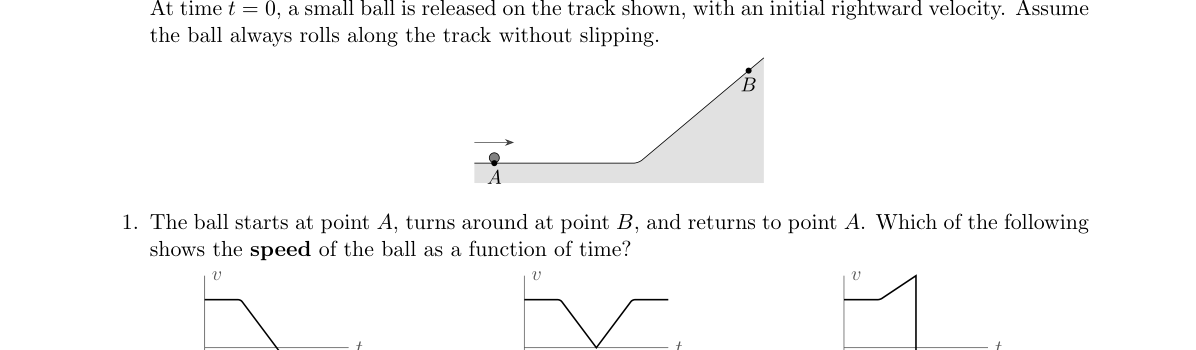 Cinque grafici velocità-tempo risposta
Topic: Newtonian Mechanics Metodi: Kinematic Equations, Physical Modeling Competenze: Physical Reasoning, Diagrammatic Reasoning Objects: Ball, Inclined Plane Fonte: Testo (PDF) — p.2
- La palla inizia al punto A, gira al punto B e ritorna al punto A. Qual è di seguito indicato: mostra la velocità della palla come funzione del tempo? (A) (B) (C) (D) (E)
Pallina su piano inclinato punti A e B
*Cinque grafici velocità-tempo risposta *
Topic: Newtonian Mechanics Metodi: Kinematic Equations, Physical Modeling Competenze: Physical Reasoning, Diagrammatic Reasoning Objects: Ball, Inclined Plane Fonte: Testo (PDF) — p.2
(A) (B) (C) (D) (E)
- Which of the following shows the horizontal velocity of the ball as a function of time? (A) (B) (C) (D) (E)
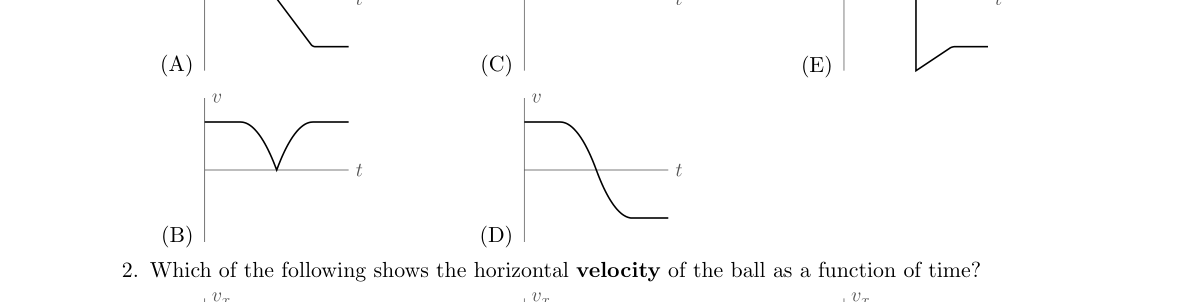 Cinque grafici velocità orizzontale-tempo
Topic: Newtonian Mechanics Metodi: Kinematic Equations, Physical Modeling Competenze: Physical Reasoning, Diagrammatic Reasoning Objects: Ball Fonte: Testo (PDF) — p.2
(A) (B) (C) (D) (E)
- Quale delle seguenti indica la velocità orizzontale della palla come funzione del tempo? (A) (B) (C) (D) (E)
Cinque grafici velocità orizzontale-tempo
Topic: Newtonian Mechanics Metodi: Kinematic Equations, Physical Modeling Competenze: Physical Reasoning, Diagrammatic Reasoning Objects: Ball Fonte: Testo (PDF) — p.2
- Two massless rods are attached to frictionless pivots, with their ends touching. The distances between the pivot points and the endpoints of the rods are shown below.
, , with distances , , , .
Neglecting friction between the rods, if a force is applied at the left end of the left rod, what force must be applied at the right end of the right rod to keep the system in equilibrium?
- A.
- B.
- C.
- D.
- E.
 Due aste con fulcri e distanze etichettate
Topic: Rigid Body Statics Metodi: Torque & Angular Momentum Analysis, Free-Body Diagram, Vector Decomposition Competenze: Diagrammatic Reasoning, Mathematical Modeling Objects: Rod Fonte: Testo (PDF) — p.2
- Due bastone senza massa sono attaccate a rotori senza attrito, le loro estremità si toccano. Le distanze tra i punti di rotazione e i punti di fine delle barre sono indicati di seguito.
, , con le distanze , , , .
Neglienzando l’attrito tra le barre, se viene applicata una forza all’estremità sinistra della canna sinistra, quale La forza deve essere applicata alla fine destra della canna destra per mantenere l’equilibrio del sistema?
- A.
- B.
- C.
- D.
- E.
*Due a questa composizione e etichettatura a distanza *
Topic: Rigid Body Statics Metodi: Torque & Angular Momentum Analysis, Free-Body Diagram, Vector Decomposition Competenze: Diagrammatic Reasoning, Mathematical Modeling Objects: Rod Fonte: Testo (PDF) — p.2
- Alice and Bethany stand side by side on the Earth’s equator. If Alice jumps directly upward, in her frame of reference, to a small height h much less than the radius of the Earth, she will land a distance D to the west of Bethany. If Alice had instead jumped to a height 2h, how far to the west of Bethany would she land? Neglect air resistance.
- A.
- B.
- C.
- D.
- E.
Topic: Newtonian Mechanics Metodi: Kinematic Equations, Physical Modeling Competenze: Physical Reasoning, Mathematical Modeling Objects: Planet Fonte: Testo (PDF) — p.3
- Alice e Bethany si trovano fianco a fianco sull’equatore terrestre. Se Alice salta direttamente in alto, in La sua cornice di riferimento, ad una piccola altezza h molto inferiore al raggio della Terra, atterrà un Distanza D a ovest di Bethany. Se Alice avesse saltato ad un’altezza di due ore, quanto lontano ad ovest di Bethany avrebbe sbarcato? - Non si tratta di resistenza all’aria.
- A.
- B.
- C.
- D.
- E.
Topic: Newtonian Mechanics Metodi: Kinematic Equations, Physical Modeling Competenze: Physical Reasoning, Mathematical Modeling Objects: Planet Fonte: Testo (PDF) — p.3
- A train starts from city A and stops in city B. The distance between the cities is s. The train’s maximal acceleration is and its maximal deceleration is (in absolute value). What is the shortest time in which the train can travel between A and B?
- A.
- B.
- C.
- D.
- E.
Topic: Newtonian Mechanics Metodi: Kinematic Equations, Calculus-Integration Competenze: Mathematical Modeling, Physical Reasoning Objects: — Fonte: Testo (PDF) — p.3
- Un treno parte dalla città A e si ferma nella città B. La distanza tra le città è di s. I treni l’accelerazione massima è e la sua decelerazione massima è (in valore assoluto). Che cos’è il periodo di tempo più breve in cui il treno può viaggiare tra A e B?
- A.
- B.
- C.
- D.
- E.
Topic: Newtonian Mechanics Metodi: Kinematic Equations, Calculus-Integration Competenze: Mathematical Modeling, Physical Reasoning Objects: — Fonte: Testo (PDF) — p.3
- A cylindrical bucket of negligible mass has radius R and height h, and is open at the top. It is submerged in water of density , with its top a distance H below the surface. How much work is needed to pull the bucket slowly up so that its bottom is just above the lake surface?
- A.
- B.
- C.
- D.
- E.
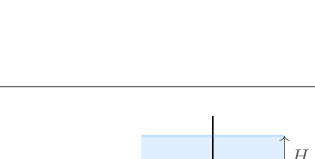 Secchio cilindrico sommerso con quote H h
Topic: Fluid Mechanics, Conservation of Energy Metodi: Energy Conservation Method, Hydrostatic Equilibrium, Calculus-Integration Competenze: Mathematical Modeling, Physical Reasoning Objects: Container Fonte: Testo (PDF) — p.3
- Un secchio cilindrico di massa trascurabile ha raggio R e altezza h, ed è aperto in cima. It is immersi in acqua di densità , con la parte superiore a una distanza H sotto la superficie. Quanto lavoro c’è doveva tirare lentamente il secchio in alto, in modo che il fondo fosse appena sopra la superficie del lago?
- A.
- B.
- C.
- D.
- E.
- Secchio cilindrico sommerso con citazione H h *
Topic: Fluid Mechanics, Conservation of Energy Metodi: Energy Conservation Method, Hydrostatic Equilibrium, Calculus-Integration Competenze: Mathematical Modeling, Physical Reasoning Objects: Container Fonte: Testo (PDF) — p.3
- A point mass slides with speed v on a frictionless horizontal surface between two fixed parallel walls, initially a distance L apart. It bounces between the walls perfectly elastically. You move one of the walls towards the other by a distance 0.01L, with speed 0.0001v. What is the final speed of the point mass?
- A. 1.001v
- B. 1.002v
- C. 1.005v
- D. 1.01v
- E. 1.02v
Topic: Newtonian Mechanics, Oscillations & Waves Metodi: Conservation Laws, Approximation & Series Expansion Competenze: Physical Reasoning, Mathematical Modeling Objects: — Fonte: Testo (PDF) — p.4
- Una massa puntaria scivola con velocità v su una superficie orizzontale senza attrito tra due pareti parallele fisse, all’inizio una distanza L. Riscolla tra le pareti con perfetta elasticità. Si muove uno dei le pareti verso l’altra a una distanza di 0,01L, con velocità di 0,0001v. Qual è la velocità finale della massa puntata?
- A. 1.001v
- B. 1.002v
- C. 1.005v
- D. 1.01v
- E. 1.02v
Topic: Newtonian Mechanics, Oscillations & Waves Metodi: Conservation Laws, Approximation & Series Expansion Competenze: Physical Reasoning, Mathematical Modeling Objects: — Fonte: Testo (PDF) — p.4
- A mint produces 100,000 coins. Upon weighing some of them with a precise scale, officials find that the coins vary slightly in weight, with an independent uncertainty of 1%. About how many coins must be randomly sampled and weighed in order to determine the total weight of the coins to within 0.1% uncertainty? Assume there are no sources of systematic uncertainty.
- A. Almost all of the coins must be weighed.
- B. 10,000
- C. 1,000
- D. 100
- E. 10
Topic: Order-of-Magnitude Estimation Metodi: Order-of-Magnitude Estimation, Statistical Averaging Competenze: Estimation & Approximation, Error Propagation Objects: — Fonte: Testo (PDF) — p.4
- Una menta produce 100.000 monete. Sulla base di una pesata precisa, alcuni funzionari trovano che che le monete variano leggermente di peso, con un’incertezza indipendente dell’1%. - Quanti? le monete devono essere campionate e pesate in modo casuale per determinare il peso totale delle monete
- all’interno dello 0,1% di incertezza? Supponiamo che non ci siano fonti di incertezza sistematica.
- A. Quasi tutte le monete devono essere pesate.
- B. 10,000
- C. 1,000
- D. 100
- E. 10
Topic: Order-of-Magnitude Estimation Metodi: Order-of-Magnitude Estimation, Statistical Averaging Competenze: Estimation & Approximation, Error Propagation Objects: — Fonte: Testo (PDF) — p.4
- NASA trains astronauts to experience weightlessness with an airplane which flies in a parabolic arc with constant acceleration g toward the ground. The plane can remain on this trajectory for at most 25 seconds, due to the large change in altitude required. If instead of simulating weightlessness, NASA wanted to fly a trajectory that would simulate the gravitational acceleration of Mars , for what length of time can the plane simulate Mars gravity? Assume that the maximum change in altitude is the same for both trajectories.
- A. 25 s
- B. 31 s
- C. 41 s
- D. 68 s
- E. 183 s
Topic: Newtonian Mechanics Metodi: Kinematic Equations, Physical Modeling Competenze: Mathematical Modeling, Physical Reasoning Objects: — Fonte: Testo (PDF) — p.4
- La NASA addestra gli astronauti a sperimentare l’assenza di peso con un aereo che vola in parabola arco con costante accelerazione g verso il suolo. L’ aereo può rimanere su questa traiettoria . per un massimo di 25 secondi, a causa del grande cambiamento di altitudine richiesto. Se invece di simulare l’assenza di peso, la NASA voleva volare una traiettoria che simulava l’accelerazione gravitazionale of Mars , for what length of time can the plane simulate Mars gravity? Supponiamo che il la variazione massima di altitudine è la stessa per entrambe le traiettorie.
- A. 25 s
- B. 31 s
- C. 41 s
- D. 68 s
- E. 183 s
Topic: Newtonian Mechanics Metodi: Kinematic Equations, Physical Modeling Competenze: Mathematical Modeling, Physical Reasoning Objects: — Fonte: Testo (PDF) — p.4
- A uniform solid circular disk of mass m is on a flat, frictionless horizontal table. The center of mass of the disk is at rest and the disk is spinning with angular frequency . A stone, modeled as a point object also of mass m, is placed on the edge of the disk, with zero initial velocity relative to the table. A rim built into the disk constrains the stone to slide, with friction, along the disk’s edge. After the stone stops sliding with respect to the disk, what is the angular frequency of rotation of the disk and stone together?
- A.
- B.
- C.
- D.
- E.
Topic: Rotational Dynamics Metodi: Torque & Angular Momentum Analysis, Conservation Laws Competenze: Mathematical Modeling, Physical Reasoning Objects: Disk Fonte: Testo (PDF) — p.5
- Un disco circolare solido uniforme di massa m è su una tavola orizzontale piatta e senza attrito. Il centro di massa di disco è in riposo e il disco ruota con frequenza angolare . Una pietra, modellata come un L’oggetto di punto, anche di massa m, è posizionato sul bordo del disco, con velocità iniziale zero rispetto a
- Il tavolo. Un bordo integrato nel disco limita la pietra a scivolare, con attrito, lungo il bordo del disco. Dopo che la pietra smette di scivolare rispetto al disco, qual è la frequenza angolare di rotazione di il disco e la pietra insieme?
- A.
- B.
- C.
- D.
- E.
Topic: Rotational Dynamics Metodi: Torque & Angular Momentum Analysis, Conservation Laws Competenze: Mathematical Modeling, Physical Reasoning Objects: Disk Fonte: Testo (PDF) — p.5
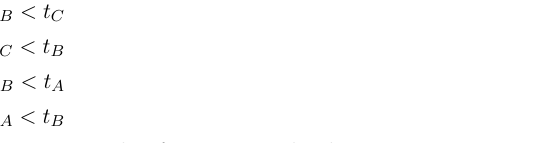
- Projectiles A, B, and C are simultaneously thrown off a cliff, and take the trajectories shown. Neglecting air resistance, rank the times , , and they take to hit the ground.
- A.
- B.
- C.
- D.
- E. There is not enough information to decide.
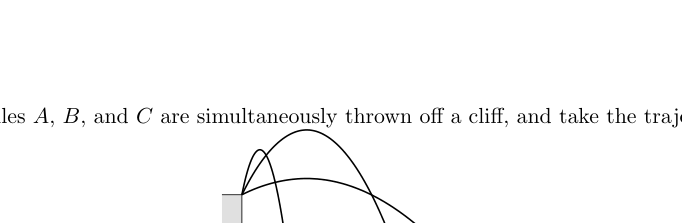 Tre traiettorie proiettili A B C
Topic: Newtonian Mechanics Metodi: Kinematic Equations, Physical Modeling Competenze: Physical Reasoning, Diagrammatic Reasoning Objects: Projectile Fonte: Testo (PDF) — p.5
- I proiettili A, B e C vengono gettati simultaneamente da una scogliera e prendono le traiettorie mostrate. Nonostante la resistenza dell’aria, classificare i tempi , e che richiedono per colpire il terreno.
- A.
- B.
- C.
- D.
- E. Non ci sono informazioni sufficienti per decidere.
Tre treettori proiettili A B C
Topic: Newtonian Mechanics Metodi: Kinematic Equations, Physical Modeling Competenze: Physical Reasoning, Diagrammatic Reasoning Objects: Projectile Fonte: Testo (PDF) — p.5
- An object of mass is attached to a platform of mass with a spring of spring constant . There is no friction between the object and the platform, and the coefficient of static friction between the platform and the ground is . The object is placed at its equilibrium position, and then given a horizontal velocity v.
For what v will the platform never slip on the ground?
- A. m/s
- B. m/s
- C. m/s
- D. m/s
- E. m/s
 Massa su molla su piattaforma M
Topic: Oscillations & Waves, Newtonian Mechanics Metodi: Simple Harmonic Motion Analysis, Free-Body Diagram, Energy Conservation Method Competenze: Mathematical Modeling, Physical Reasoning Objects: Spring, Block Fonte: Testo (PDF) — p.5
- Un oggetto di massa è fissato a una piattaforma di massa con una molla di molla costante . Non c’è attrito tra l’oggetto e la piattaforma, e il coefficiente di attrito statico tra piattaforma e terreno è . L’oggetto è posto alla sua la posizione di equilibrio, e poi una velocità orizzontale v.
Per quale v la piattaforma non scivolerà mai al suolo?
- A. m/s
- B. m/s
- C. m/s
- D. m/s
- E. m/s
Massa su molla su piattaforma M
Topic: Oscillations & Waves, Newtonian Mechanics Metodi: Simple Harmonic Motion Analysis, Free-Body Diagram, Energy Conservation Method Competenze: Mathematical Modeling, Physical Reasoning Objects: Spring, Block Fonte: Testo (PDF) — p.5
- A car is driving on a semicircular racetrack. Its velocity at several points along the track is shown below. Which of the following could depict its acceleration at the corresponding points? (A) (B) (C) (D) (E)
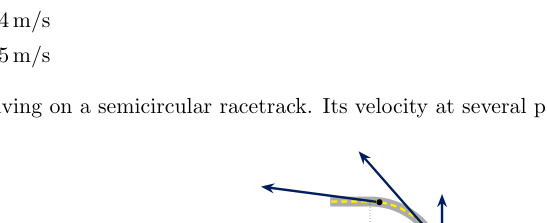 Pista semicircolare con vettori velocità
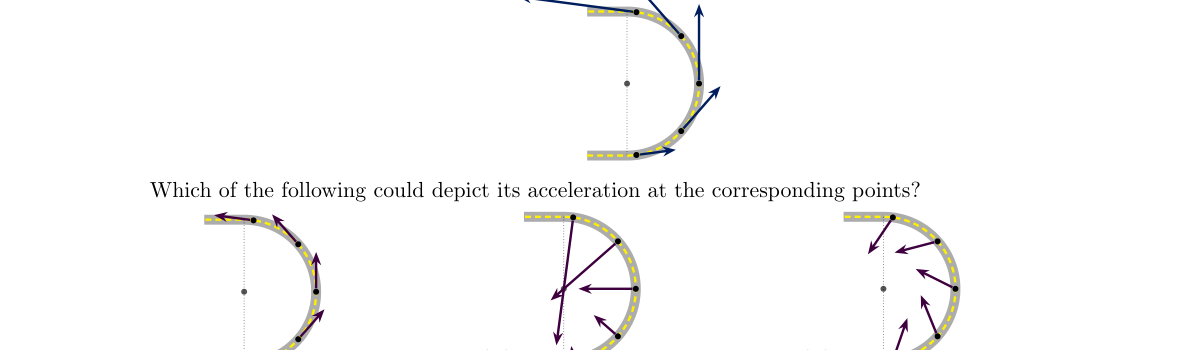 Cinque diagrammi accelerazione su semicerchio
Topic: Newtonian Mechanics Metodi: Physical Modeling, Vector Decomposition Competenze: Physical Reasoning, Diagrammatic Reasoning Objects: — Fonte: Testo (PDF) — p.6
- Una macchina guida su una pista di gare semicircolare. La sua velocità in diversi punti lungo la pista è mostrata
- Qui sotto. Quale delle seguenti potrebbe rappresentare la sua accelerazione nei punti corrispondenti? (A) (B) (C) (D) (E)