Question A1 — Toffee Pudding
A box of mass is at rest on a horizontal floor. The coefficients of static and kinetic friction between the box and the floor are and (less than ), respectively. One end of a spring with spring constant is attached to the right side of the box, and the spring is initially held at its relaxed length. The other end of the spring is pulled horizontally to the right with constant velocity . As a result, the box will move in fits and starts. Assume the box does not tip over.
a. Calculate the distance that the spring is stretched beyond its rest length when the box is just about to start moving.
b. Let the box start at , and let be the time the box first starts moving. Find the acceleration of the box in terms of , , , , and the other parameters, while the box is moving.
The position of the box as a function of time as defined in part (b) is where and . This expression applies as long as the box is still moving, and you can use it in the parts below. Express all your answers in terms of , , , and .
c. Find the time when the box stops for the first time.
d. For what values of will the spring always be at least as long as its rest length?
e. After the box stops, how long will it stay at rest before starting to move again?
Topic: Newtonian Mechanics, Oscillations & Waves Metodi: Free-Body Diagram, Simple Harmonic Motion Analysis, Kinematic Equations Competenze: Mathematical Modeling, Physical Reasoning Objects: Block, Spring Fonte: Testo (PDF) — p.2
Domanda A1 Pudding per il toffee
Una scatola di massa è in riposo su un pavimento orizzontale. I coefficienti di attrito statico e cinetico tra la scatola e il pavimento sono rispettivamente e (meno di ). Una estremità di una molla con costante molla è fissata sul lato destro della scatola e la molla è inizialmente tenuta nella sua lunghezza rilassata. L’altra estremità della molla viene tirata orizzontalmente a destra con velocità costante . Di conseguenza, la scatola si muoverà in attacchi e inizia. Supponiamo che la scatola non si inclinasse.
a. Calcolare la distanza che la molla si estende oltre la sua lunghezza di riposo quando la scatola sta per iniziare a muoversi.
b. Lasciate che la scatola inizi a , e lasciate che sia il momento in cui la scatola inizia a muoversi. Trova l’accelerazione della scatola in termini di , , , e degli altri parametri, mentre la scatola si muove.
La posizione della casella come funzione del tempo come definita nella parte b) è: dove e . Questa espressione si applica finché la scatola è ancora in movimento, e si può utilizzare nelle parti di seguito. Esprimere tutte le risposte in termini di , , e .
c. Trova l’ora quando la casella si ferma per la prima volta.
d. Per quali valori di la primavera sarà sempre almeno la stessa lunghezza di riposo?
e. Dopo che la scatola si ferma, per quanto tempo rimarrà in riposo prima di iniziare a muoversi di nuovo?
Topic: Newtonian Mechanics, Oscillations & Waves Metodi: Free-Body Diagram, Simple Harmonic Motion Analysis, Kinematic Equations Competenze: Mathematical Modeling, Physical Reasoning Objects: Block, Spring Fonte: Testo (PDF) — p.2
Question A2 — Flashlight
Alice the Mad Scientist, travelling in her flying car at height above the ground, shoots a beam of muons at the ground. Bob, observing from the ground at distance from Alice’s car, decides to check some facts about special relativity. Assume the muons travel extremely close to the speed of light in Alice’s frame.
a. Alice’s car flies at horizontal speed . Alice shoots her muon beam straight down, in her reference frame. Express your answers in terms of , , and fundamental constants.
i. What is the horizontal velocity of the muons in Bob’s reference frame?
ii. What is the vertical velocity of the muons in Bob’s reference frame?
iii. How long does it take the muons to reach the ground in Bob’s reference frame?
Alice’s velocity is directed an angle away from Bob. For the rest of the problem, you may additionally express your answers in terms of .
b. In Bob’s reference frame, how much time is there between when he sees Alice first fire the beam, and when he sees the beam first hit the ground? (Hint: remember to account for the travel time of light to Bob’s eyes.)
c. In this part, suppose that . Does there exist a value of so that the time it takes the muons to hit the ground in Alice’s frame is equal to the time taken according to Bob’s eyes, in Bob’s frame? If so, find the value of in degrees. If not, briefly explain why not.
d. Suppose Alice is carrying a radio transmitter set to frequency . To what frequency would Bob have to set his radio receiver in order to receive Alice’s transmission?
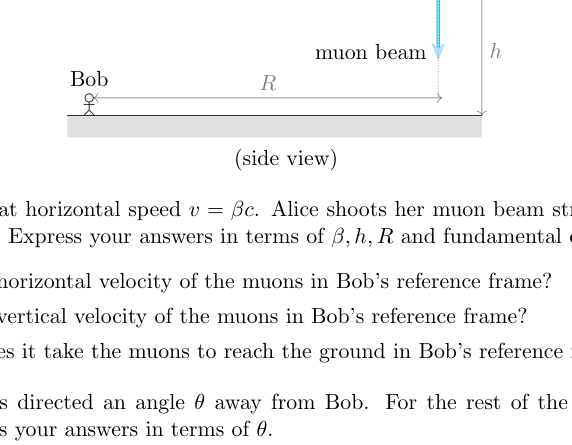 Alice and Bob side view with muon beam
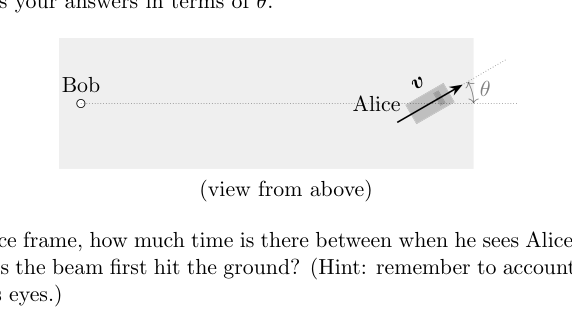 Alice velocity angle theta top view
Topic: Special Relativity, Newtonian Mechanics Metodi: Lorentz Transformation, Relativistic Energy-Momentum, Wave Equation Competenze: Mathematical Modeling, Physical Reasoning Objects: Particle Beam Fonte: Testo (PDF) — p.3
**Domanda A2 Lampada **
Alice la scienziata folle, viaggiando nella sua macchina volante ad un’altezza sopra il suolo, spara un raggio di muoni al suolo. Bob, osservando da terra a distanza dalla macchina di Alice, decide di verificare alcuni fatti sulla special relatività. Supponiamo che i muoni viaggiino molto vicino alla velocità della luce nel quadro di Alice.
a. Alice’s car flies at horizontal speed . Alice spara il suo raggio di muone dritto in basso, nella sua cornice di riferimento. Esprimere le risposte in termini di , , e costanti fondamentali.
i. Qual è la velocità orizzontale dei muoni nel quadro di riferimento di Bob?
ii. Qual è la velocità verticale dei muoni nel quadro di riferimento di Bob?
iii. Quanto tempo ci vuole per raggiungere il terreno nella cornice di riferimento di Bob?
La velocità di Alice è diretta da un angolo lontano da Bob. Per il resto del problema, è inoltre possibile esprimere le risposte in termini di .
b. Nel quadro di riferimento di Bob, quanto tempo c’è tra quando vede Alice sparare il fascio per la prima volta, e quando vede il fascio colpire il terreno per la prima volta? (Signore: ricordati di spiegare il tempo di viaggio della luce agli occhi di Bob.)
c. In questa parte, supponiamo che . Esiste un valore di in modo che il tempo necessario per colpire il terreno nel quadro di Alice sia uguale al tempo impiegato secondo gli occhi di Bob, nel quadro di Bob? In tal caso, trovare il valore di in gradi. Se no, spiegate brevemente perché no.
d. Supponiamo che Alice porti un trasmettitore radio impostato su frequenza . A che frequenza Bob avrebbe dovuto impostare il suo ricevitore radio per ricevere la trasmissione di Alice?
Vista laterale di Alice e Bob con fascio di muone
Angolo di velocità di Alice theta top view
Topic: Special Relativity, Newtonian Mechanics Metodi: Lorentz Transformation, Relativistic Energy-Momentum, Wave Equation Competenze: Mathematical Modeling, Physical Reasoning Objects: Particle Beam Fonte: Testo (PDF) — p.3
Question A3 — Electroneering
An electron is a particle with charge , mass , and magnetic moment . In this problem we will explore whether a classical model consistent with these properties can also explain the rest energy of the electron.
Let us describe the electron as a thin spherical shell with uniformly distributed charge and radius . Recall that the magnetic moment of a closed, planar loop of current is always equal to the product of the current and the area of the loop. For the electron, a magnetic moment can be created by making the sphere rotate around an axis passing through its center.
a. If no point on the sphere’s surface can travel faster than the speed of light (in the frame of the sphere’s center of mass), what is the maximum magnetic moment that the sphere can have? You may use the integral:
b. The electron’s magnetic moment is known to be , where is the reduced Planck constant. In this model, what is the minimum possible radius of the electron? Express your answer in terms of and fundamental constants.
c. Assuming the radius is the value you found in part (b), how much energy is stored in the electric field of the electron? Express your answer in terms of and the fine structure constant,
d. Roughly estimate the total energy stored in the magnetic field of the electron, in terms of and . (Hint: one way to do this is to suppose the magnetic field has roughly constant magnitude inside the sphere and is negligible outside of it, then estimate the field inside the sphere.)
e. How does your estimate for the total energy in the electric and magnetic fields compare to ?
In parts (a) and (b), you can also give your answers up to a dimensionless multiplicative constant for partial credit.
Topic: Electrostatics, Magnetism, Modern-Quantum Physics Metodi: Calculus-Integration, Electric Potential Method, Symmetry Argument Competenze: Mathematical Modeling, Physical Reasoning Objects: Electron, Sphere Fonte: Testo (PDF) — p.4
Domanda A3 Electroneering
Un elettrone è una particella con carica , massa e momento magnetico . In questo problema esploreremo se un modello classico coerente con queste proprietà può anche spiegare l’energia di riposo dell’elettrone.
Descriviamo l’elettrone come una sottile conchiglia sferica con carica e raggio uniformemente distribuiti . Ricordiamo che il momento magnetico di un circuito chiuso di corrente piano è sempre uguale al prodotto della corrente e all’area del circuito. Per l’elettrone, un momento magnetico può essere creato facendo ruotare la sfera attorno ad un asse che attraversa il suo centro.
a. Se nessun punto sulla superficie della sfera può viaggiare più velocemente della velocità della luce (nel quadro del centro di massa della sfera), qual è il momento magnetico massimo che la sfera può avere? Potete usare l’ integrale:
b. Il momento magnetico dell’elettrone è noto per essere , dove è la costante di Planck ridotta. In questo modello, qual è il raggio minimo possibile dell’elettrone? Esprimi la tua risposta in termini di e costanti fondamentali.
c. Supponendo che il raggio sia il valore che hai trovato nella parte (b), quanta energia è immagazzinata nel campo elettrico dell’elettrone? Esprimere la risposta in termini di e della costante struttura fine,
d. Calcolare approssimativamente l’energia totale immagazzinata nel campo magnetico dell’elettrone, in termini di e . (Signore: un modo per farlo è supporre che il campo magnetico abbia una grandezza costante all’interno della sfera e sia trascurabile al di fuori di essa, quindi stimare il campo all’interno della sfera.)
e. Come si confronta la stima dell’energia totale dei campi elettrici e magnetici con ?
Nella parte (a) e (b) è possibile fornire anche le risposte fino a una costante moltiplicativa senza dimensioni per il credito parziale.
Topic: Electrostatics, Magnetism, Modern-Quantum Physics Metodi: Calculus-Integration, Electric Potential Method, Symmetry Argument Competenze: Mathematical Modeling, Physical Reasoning Objects: Electron, Sphere Fonte: Testo (PDF) — p.4
Question B1 — Disk Jockey
A disk of uniform mass density, mass , and radius sits at rest on a frictionless floor. The disk is attached to the floor by a frictionless pivot at its center, which keeps the center of the disk in place, but allows the disk to rotate freely. An ant of mass is initially standing on the edge of the disk; you may give your answers to leading order in .
a. The ant walks an angular displacement along the edge of the disk. Then it walks radially inward by a distance , tangentially through an angular displacement , then back to its starting point on the disk. Assume the ant walks with constant speed .
Through what net angle does the disk rotate throughout this process, to leading order in ?
b. Now suppose the ant walks with speed along a circle of radius , tangent to its starting point.
Through what net angle does the disk rotate?
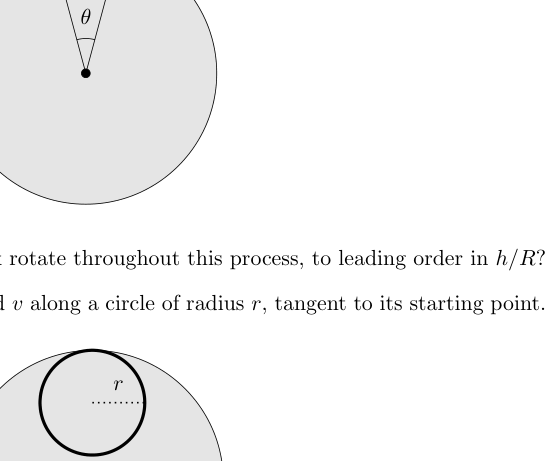 Ant path on rotating disk, part a
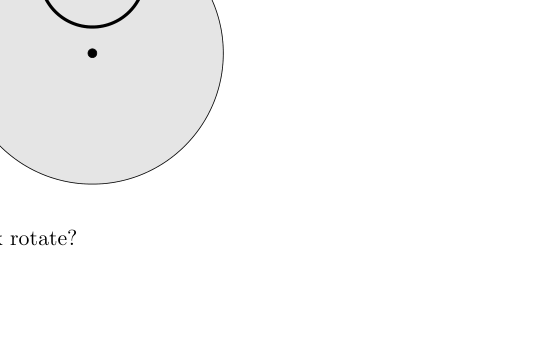 Ant circular path on disk, part b
Topic: Rotational Dynamics, Newtonian Mechanics Metodi: Torque & Angular Momentum Analysis, Conservation of Momentum, Approximation & Series Expansion Competenze: Mathematical Modeling, Physical Reasoning Objects: Disk Fonte: Testo (PDF) — p.5
La domanda B1 Disco Jockey
Un disco di densità di massa uniforme, massa e raggio si trova a riposo su un pavimento senza attrito. Il disco è attaccato al pavimento da un pivot senza attrito al suo centro, che mantiene il centro del disco in posizione, ma consente al disco di ruotare liberamente. Una formica di massa è inizialmente al bordo del disco; è possibile dare le risposte all’ordine di punta in .
a. La formica cammina con un spostamento angolare lungo il bordo del disco. Poi si muove radicalmente verso l’interno per una distanza , tangenzialmente attraverso un spostamento angolare , quindi di nuovo al suo punto di partenza sul disco. Supponiamo che la formica cammini a velocità costante .
Attraverso quale angolo netto il disco ruota durante tutto questo processo, fino all’ordine di guida in ?
b. Supponiamo che la formica cammini a velocità lungo un cerchio di raggio , tangente al suo punto di partenza.
Attraverso quale angolo della rete ruota il disco?
Coscolatore di formiche su disco rotante, parte a
Corrente circolare di formica sul disco, parte b
Topic: Rotational Dynamics, Newtonian Mechanics Metodi: Torque & Angular Momentum Analysis, Conservation of Momentum, Approximation & Series Expansion Competenze: Mathematical Modeling, Physical Reasoning Objects: Disk Fonte: Testo (PDF) — p.5
Question B2 — Hot Pocket
This question consists of two independent parts.
a. It’s winter and you want to keep warm. The temperature is outside and in your room. You have started a fire, which acts as a hot reservoir at temperature . You want to add a small amount of heat to your room. The simplest method would be to extract heat from the fire and directly transfer it to your room. However, it is possible to heat your room more efficiently. Suppose that you can exchange heat between any pair of reservoirs. You cannot use any external source of work, such as the electrical grid, but the work extracted from running heat engines can be stored and used without dissipation.
i. What is the minimum heat extraction required by the laws of thermodynamics to heat up the room by ?
ii. Let the “efficiency gain” be the ratio . Assuming is fixed at , make a graph whose axes are and , where varies from to , and varies from to . On the graph, sketch curves corresponding to gain , , and .
b. When the air at the bottom of a container is heated, it becomes less dense than the surrounding air and rises. Simultaneously, cooler air falls downward. This process of net upward heat transfer is known as convection.
Consider a closed, rectangular box of height filled with air initially of uniform temperature . Next, suppose the bottom of the box is heated so that the air there instantly reaches temperature . The hot parcel of air at the bottom rises upward until it hits the top of the box, where its temperature is instantly reduced to . You may neglect any heat transfer and friction between the parcel of air and the surrounding air, and assume that the temperature difference is not too large. In addition, you may assume the height is small enough so that the pressure and density of the surrounding air are very nearly constant throughout the container. More precisely, assume that . Express your answers in terms of , , , , and .
i. As a parcel of air moves upward, it accelerates. Find a rough estimate for the average speed during its upward motion.
ii. In the steady state, warm parcels of air are continuously moving upward from the bottom, and cold parcels of air are continuously moving downward from the top. Find a rough estimate for the net rate of upward energy transfer per area.
Topic: Thermodynamics, Fluid Mechanics Metodi: Thermodynamic Cycle Analysis, First Law of Thermodynamics, Ideal Gas Law Competenze: Physical Reasoning, Estimation & Approximation Objects: Heat Engine, Gas, Container Fonte: Testo (PDF) — p.6
Domanda B2 Taschetta calda
La questione è costituita da due parti indipendenti.
a. E’ inverno e vuoi stare caldo. La temperatura è all’esterno e nella stanza. Si è avviato un incendio che funge da serbatoio caldo a temperatura . You want to add a small amount of heat to your room. Il metodo più semplice sarebbe quello di estrarre il calore dal fuoco e trasferirlo direttamente nella tua stanza. Tuttavia, è possibile riscaldare la vostra stanza in modo più efficiente. Supponiamo che si possa scambiare calore tra qualsiasi coppia di serbatoi. Non è possibile utilizzare alcuna fonte esterna di lavoro, come la rete elettrica, ma il lavoro estratto dai motori di calore in funzione può essere conservato e utilizzato senza dissipazione.
i. Qual è la minima estrazione di calore richiesta dalle leggi della termodinamica per riscaldare la stanza da ?
ii. Il “guadagno di efficienza” deve essere il rapporto . Supponendo che sia fissato a , si deve fare un grafico i cui assi sono e , dove varia da a , e varia da a . Il grafico presenta le curve di bozza corrispondenti al guadagno , e .
b. Quando l’aria al fondo di un contenitore viene riscaldata, diventa meno densa dell’aria circostante e si alza. Allo stesso tempo, l’aria più fresca scende verso il basso. Questo processo di trasferimento netto di calore verso l’alto è conosciuto come convezione.
Si consideri una scatola chiusa rettangolare di altezza riempita di aria inizialmente di temperatura uniforme . Quindi, supponiamo che il fondo della scatola sia riscaldato in modo che l’aria che c’è raggiunga immediatamente la temperatura . Il pacchetto di aria calda in fondo sale verso l’alto fino a raggiungere la parte superiore della scatola, dove la sua temperatura viene immediatamente ridotta a . Si può trascurare qualsiasi trasferimento di calore e attrito tra il pacchetto d’aria e l’aria circostante, e presumere che la differenza di temperatura non sia troppo grande. Inoltre, si può presumere che l’altezza sia sufficientemente piccola da consentire che la pressione e la densità dell’aria circostante siano molto quasi costanti in tutto il contenitore. Più precisamente, supponiamo che . Esprimere le risposte in termini di , , , e .
i. Quando un pezzo di aria si muove verso l’alto, si accelera. Trova una stima approssimativa della velocità media durante il suo movimento in salita.
ii. In stato di stabilità, i pacchetti di aria calda si muovono continuamente verso l’alto dal basso, e i pacchetti di aria fredda si muovono continuamente verso il basso dall’alto. Trova una stima approssimativa del tasso netto di trasferimento di energia verso l’alto per area.
Topic: Thermodynamics, Fluid Mechanics Metodi: Thermodynamic Cycle Analysis, First Law of Thermodynamics, Ideal Gas Law Competenze: Physical Reasoning, Estimation & Approximation Objects: Heat Engine, Gas, Container Fonte: Testo (PDF) — p.6
Question B3 — The Mad Hatter
A frictionless hemisphere of radius is fixed on top of a flat cylinder. One end of a spring with zero relaxed length and spring constant (i.e. the force from the spring when stretched to length is ) is fixed to the top of the hemisphere. Its other end is attached to a point mass of mass .
a. The number and nature of the equilibrium points on the hemisphere depend on the value of the spring constant . Consider the semicircular arc shown above as a dashed line, which is parameterized by angle in the range . Make a table indicating the number of equilibrium points on the arc, and the number that are stable, for each range of values. A blank table for your reference is given below. (You may need more or fewer rows than shown.)
| Range of () | # of Equilibria | # of Stable Equilibria |
|---|---|---|
For the rest of the problem, suppose the value of is such that the mass begins at stable equilibrium on the surface of the hemisphere at angle . The mass can move on the two-dimensional surface of the hemisphere, but a radially-inward external force prevents it from jumping off the surface.
b. At , the mass is given a speed along a line of constant latitude .
i. Indicate which of the following trajectories the mass takes for a short time after and briefly explain your reasoning. (The differences between the paths are exaggerated: path A curves toward the pole, path B stays on the latitude line, path C curves away from the pole.)
ii. What is the total radial force (i.e., normal to the surface of the hemisphere) on the mass at ? Express your answer in terms of , , , , and .
c. A cylinder of radius is placed on top of the sphere. Suppose the mass is launched at an angle away from the direction of the spring’s displacement with kinetic energy . What is the maximum angle at which the mass can be launched such that it can still hit the cylinder? Express your answer in terms of , , , , , and . You may assume is large enough for the mass to reach the cylinder for .
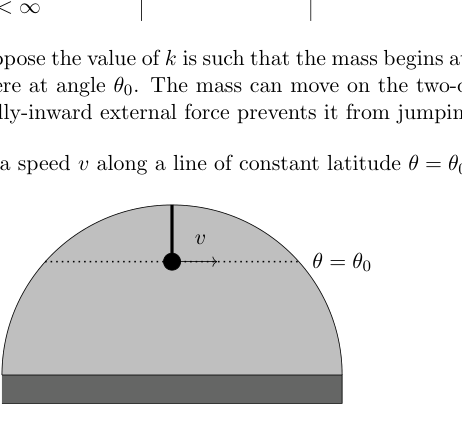 Hemisphere with spring and mass at angle theta
 Mass on latitude line with velocity v
 Top view of cylinder target and launch angle phi
Topic: Newtonian Mechanics, Oscillations & Waves, Rotational Dynamics Metodi: Free-Body Diagram, Simple Harmonic Motion Analysis, Energy Conservation Method Competenze: Mathematical Modeling, Diagrammatic Reasoning Objects: Spring, Cylinder Fonte: Testo (PDF) — p.7
Quesito B3 — Il Cappellaio Matto
Un emisfero privo di attrito di raggio è fissato sulla sommità di un cilindro piatto. Un’estremità di una molla con lunghezza a riposo nulla e costante elastica (cioè la forza esercitata dalla molla quando è allungata fino a una lunghezza è ) è fissata alla sommità dell’emisfero. L’altra estremità è attaccata a un punto materiale di massa .
a. Il numero e la natura dei punti di equilibrio sull’emisfero dipendono dal valore della costante elastica . Considera l’arco semicircolare mostrato sopra come linea tratteggiata, parametrizzato dall’angolo nell’intervallo . Compila una tabella indicando il numero di punti di equilibrio sull’arco, e quanti di essi sono stabili, per ciascun intervallo di valori di . Qui sotto è fornita una tabella vuota di riferimento. (Potrebbero servirti più o meno righe di quelle mostrate.)
| Intervallo di () | N. di equilibri | N. di equilibri stabili |
|---|---|---|
Per il resto del problema, supponi che il valore di sia tale che la massa parta da un equilibrio stabile sulla superficie dell’emisfero all’angolo . La massa può muoversi sulla superficie bidimensionale dell’emisfero, ma una forza esterna diretta radialmente verso l’interno le impedisce di staccarsi dalla superficie.
b. A , alla massa viene impressa una velocità lungo una linea di latitudine costante .
i. Indica quale delle seguenti traiettorie segue la massa per un breve intervallo dopo e spiega brevemente il tuo ragionamento. (Le differenze tra i percorsi sono esagerate: il percorso A curva verso il polo, il percorso B rimane sulla linea di latitudine, il percorso C curva allontanandosi dal polo.)
ii. Qual è la forza radiale totale (cioè normale alla superficie dell’emisfero) sulla massa a ? Esprimi la risposta in termini di , , , e .
c. Un cilindro di raggio è posto sulla sommità della sfera. Supponi che la massa venga lanciata con un angolo rispetto alla direzione dello spostamento della molla, con energia cinetica . Qual è il massimo angolo con cui la massa può essere lanciata in modo da poter comunque colpire il cilindro? Esprimi la risposta in termini di , , , , e . Puoi assumere che sia abbastanza grande da permettere alla massa di raggiungere il cilindro per .
Emisfero con molla e massa all’angolo theta
Massa sulla linea di latitudine con velocità v
Vista dall’alto del cilindro bersaglio e dell’angolo di lancio phi
Topic: Newtonian Mechanics, Oscillations & Waves, Rotational Dynamics Metodi: Free-Body Diagram, Simple Harmonic Motion Analysis, Energy Conservation Method Competenze: Mathematical Modeling, Diagrammatic Reasoning Objects: Spring, Cylinder Fonte: Testo (PDF) — p.7