A railway truck travelling along a level track at collides with a truck of twice the mass moving in the same direction at . The trucks couple together and continue moving. Calculate
(i) the final speed of the combined trucks, and
(ii) the percentage of the kinetic energy lost in the collision.
Topic: Conservation of Momentum, Conservation of Energy, Newtonian Mechanics Metodi: Conservation of Momentum, Conservation of Energy, Kinematic Equations Competenze: Physical Reasoning, Mathematical Modeling Objects: Cart Fonte: Testo (PDF) — p.3
Un camion ferroviario che percorre una pista a livello a si schianta con un camion di massa doppia che si muove nella stessa direzione a . I camion si accoppiano e continuano a muoversi. Calcolo
-
la velocità finale dei camion combinati;
-
la percentuale di energia cinetica persa in collisione.
Topic: Conservation of Momentum, Conservation of Energy, Newtonian Mechanics Metodi: Conservation of Momentum, Conservation of Energy, Kinematic Equations Competenze: Physical Reasoning, Mathematical Modeling Objects: Cart Fonte: Testo (PDF) — p.3
The fundamental frequency of a drum skin has been shown to be given by
where is the thickness of the skin, is the speed of sound in the skin, and is a constant of elasticity. Units are in SI units.
(i) What are the units of ?
(ii) Determine the units of quantity .
Topic: Oscillations & Waves, Newtonian Mechanics Metodi: Dimensional Analysis Competenze: Physical Reasoning, Unit Conversion Objects: Membrane Fonte: Testo (PDF) — p.3
La frequenza fondamentale di una pelle di tamburo è stata dimostrata da
dove è lo spessore della pelle, è la velocità del suono nella pelle e è una costante di elasticità. Le unità sono in unità SI.
(i) Quali sono le unità di ?
- Determinare le unità di quantità .
Topic: Oscillations & Waves, Newtonian Mechanics Metodi: Dimensional Analysis Competenze: Physical Reasoning, Unit Conversion Objects: Membrane Fonte: Testo (PDF) — p.3
A ball is thrown vertically upwards with a velocity of . After , a second ball is thrown upwards with a velocity of .
For this question, you may take .
(i) Sketch, on the same axes, velocity-time graphs for each ball. Take the direction upwards as positive.
(ii) After what time, and at what height do they meet?
(iii) What would be the required time separation between the two balls being thrown if they were to meet at the moment the first ball reached its maximum height?
Topic: Newtonian Mechanics Metodi: Kinematic Equations, Free-Body Diagram Competenze: Diagrammatic Reasoning, Mathematical Modeling Objects: Ball Fonte: Testo (PDF) — p.3
Una palla viene lanciata verticalmente verso l’alto con una velocità di . Dopo , una seconda palla viene lanciata verso l’alto con una velocità di .
Per questa domanda è possibile prendere .
(i) Sketch, sugli stessi assi, grafici velocità-tempo per ogni palla. Prendi la direzione verso l’alto come positiva.
(ii) Dopo che ora, e a che altezza si incontrano?
(iii) Qual sarebbe la distanza di tempo richiesta tra le due palle lanciate se si incontrassero nel momento in cui la prima palla raggiunge la sua altezza massima?
Topic: Newtonian Mechanics Metodi: Kinematic Equations, Free-Body Diagram Competenze: Diagrammatic Reasoning, Mathematical Modeling Objects: Ball Fonte: Testo (PDF) — p.3
A railway carriage for transporting liquids is carrying a viscous liquid and it is only half full. The carriage is attached to an engine which pulls away with a constant acceleration, so that the fluid in the carriage forms a steady sloping surface. If the acceleration of the train is , what is the angle of the liquid surface to the horizontal?
Topic: Fluid Mechanics, Newtonian Mechanics Metodi: Free-Body Diagram, Hydrostatic Equilibrium Competenze: Physical Reasoning, Mathematical Modeling Objects: Container Fonte: Testo (PDF) — p.3
Un vagone ferroviario per il trasporto di liquidi porta un liquido viscoso e è solo a metà pieno. Il carro è collegato a un motore che si allontana con una costante accelerazione, in modo che il fluido nel carro costituisca una superficie inclinata costante. Se l’accelerazione del treno è , quale è l’angolo della superficie liquida verso l’orizzontale?
Topic: Fluid Mechanics, Newtonian Mechanics Metodi: Free-Body Diagram, Hydrostatic Equilibrium Competenze: Physical Reasoning, Mathematical Modeling Objects: Container Fonte: Testo (PDF) — p.3
Two aeroplanes A and B travel with velocities and , where and are unit vectors to the east and north respectively, and the values are in units of .
(i) Find the relative velocity of plane A as seen from plane B.
(ii) When time , plane A has position and plane B has position . Find the time and distance of closest approach of the two aeroplanes.
Topic: Newtonian Mechanics Metodi: Vector Decomposition, Kinematic Equations Competenze: Mathematical Modeling, Physical Reasoning Objects: — Fonte: Testo (PDF) — p.3
Due aerei A e B viaggiano con velocità e , dove e sono rispettivamente vettori unitari verso est e nord, e i valori sono in unità di .
(i) Trova la velocità relativa del piano A visto dal piano B.
ii) Quando il tempo , il piano A ha la posizione e il piano B ha la posizione . Trova l’ora e la distanza del più vicino avvicinamento dei due aerei.
Topic: Newtonian Mechanics Metodi: Vector Decomposition, Kinematic Equations Competenze: Mathematical Modeling, Physical Reasoning Objects: — Fonte: Testo (PDF) — p.3
Water flows at a steady rate of through a pipe in which there is an electrical heater connected to a supply. The rise in temperature of the water after passing through the heater is . Calculate the resistance of the heater.
Assume no heat loss to the surroundings.
Density of water is .
Topic: Thermodynamics, Circuits Metodi: Energy Conservation Method, Kirchhoff’s Laws Competenze: Physical Reasoning, Mathematical Modeling Objects: Tube, Resistor Fonte: Testo (PDF) — p.4
L’acqua scorre a velocità costante di attraverso un tubo in cui è collegato un riscaldatore elettrico a un’alimentazione . L’aumento della temperatura dell’acqua dopo aver attraversato il riscaldatore è . Calcolare la resistenza del riscaldatore.
Non si deve perdere calore per l’ambiente circostante.
La densità dell’acqua è .
Topic: Thermodynamics, Circuits Metodi: Energy Conservation Method, Kirchhoff’s Laws Competenze: Physical Reasoning, Mathematical Modeling Objects: Tube, Resistor Fonte: Testo (PDF) — p.4
Dry steam at is passed into of water at contained in a calorimeter whose thermal capacity is equivalent to of water. When the temperature is it is found that of steam have condensed. Calculate the specific latent heat of steam.
Specific latent heat of ice .
Topic: Thermodynamics Metodi: First Law of Thermodynamics, Energy Conservation Method Competenze: Physical Reasoning, Mathematical Modeling Objects: Calorimeter Fonte: Testo (PDF) — p.4
Il vapore secco a viene trasmesso in di acqua a contenuta in un caloriometro la cui capacità termica è equivalente a di acqua. Quando la temperatura è si constata che di vapore si è condensata. Calcolare il calore specifico latente del vapore.
Calore latente specifico del ghiaccio .
Topic: Thermodynamics Metodi: First Law of Thermodynamics, Energy Conservation Method Competenze: Physical Reasoning, Mathematical Modeling Objects: Calorimeter Fonte: Testo (PDF) — p.4
The expansion of a metal rod varies linearly with temperature, in the form of
where and are the initial and final lengths respectively, is the temperature change, and is the coefficient of linear expansion.
An iron rod is at . What is the length of a copper rod at if the difference between its length and that of the iron rod is not to vary with temperature?
Coefficient of expansion of copper,
Coefficient of expansion of iron,
Topic: Thermodynamics, Elasticity & Materials Metodi: Physical Modeling, Approximation & Series Expansion Competenze: Physical Reasoning, Mathematical Modeling Objects: Rod Fonte: Testo (PDF) — p.4
L’espansione di una canna di metallo varia linearmente con la temperatura, sotto forma di
se e sono rispettivamente le lunghezze iniziali e finali, è il cambiamento di temperatura e è il coefficiente di espansione lineare.
Una canna di ferro è a . Qual è la lunghezza di una canna di rame a se la differenza tra la sua lunghezza e quella della canna di ferro non varia a seconda della temperatura?
Coefficiente di espansione del rame,
Coefficiente di espansione del ferro,
Topic: Thermodynamics, Elasticity & Materials Metodi: Physical Modeling, Approximation & Series Expansion Competenze: Physical Reasoning, Mathematical Modeling Objects: Rod Fonte: Testo (PDF) — p.4
An aeroplane flies over an observer at speed and at a fixed height of . After some time, the observer sees the plane at an angle of above the horizontal, which is decreasing at a rate of . Calculate
(i) the distance from the observer to the plane,
(ii) the speed of the plane,
(iii) the speed at which the plane is receding along the observer’s line of sight.
Topic: Newtonian Mechanics Metodi: Kinematic Equations, Vector Decomposition Competenze: Mathematical Modeling, Physical Reasoning Objects: — Fonte: Testo (PDF) — p.4
Un aereo vola sopra un osservatore a velocità e ad un’altezza fissa di . Dopo un certo tempo, l’osservatore vede il piano ad un angolo di sopra l’orizzontale, che sta diminuendo a un ritmo di . Calcolo
-
la distanza dall’osservatore al piano,
-
la velocità dell’aereo,
-
la velocità con cui l’aereo si ritira lungo la linea di vista dell’osservatore.
Topic: Newtonian Mechanics Metodi: Kinematic Equations, Vector Decomposition Competenze: Mathematical Modeling, Physical Reasoning Objects: — Fonte: Testo (PDF) — p.4
A smooth wedge of mass with the cross-section of an equilateral triangle is placed on a smooth horizontal table with its lower edge in contact with a smooth vertical wall. A smooth sphere of mass is placed between the wedge and the wall, so that the sphere falls without rotation.
(i) By geometry, find a relation between the height fallen by the sphere and the horizontal distance moved by the wedge.
(ii) Obtain an expression for in terms of , and .
Topic: Newtonian Mechanics, Rigid Body Statics Metodi: Free-Body Diagram, Conservation of Momentum, Vector Decomposition Competenze: Diagrammatic Reasoning, Mathematical Modeling Objects: Wedge, Sphere Fonte: Testo (PDF) — p.4
Un’anello liscia di massa con la sezione trasversale di un triangolo equilaterale è posizionato su una tavola orizzontale liscia con il suo bordo inferiore in contatto con una parete verticale liscia. Tra la cucina e la parete si colloca una sfera liscia di massa , in modo che la sfera cade senza rotazione.
- In geometria, si trova una relazione tra l’altezza caduta dalla sfera e la distanza orizzontale spostata dalla cuvia.
(ii) Ottenere un’espressione per in termini di , e .
Topic: Newtonian Mechanics, Rigid Body Statics Metodi: Free-Body Diagram, Conservation of Momentum, Vector Decomposition Competenze: Diagrammatic Reasoning, Mathematical Modeling Objects: Wedge, Sphere Fonte: Testo (PDF) — p.4
An oscillating pendulum bob has a maximum angle of swing of . In its lowest position, the tension in the string is times the weight of the bob. Obtain an expression for in terms of .
Topic: Newtonian Mechanics, Oscillations & Waves Metodi: Conservation of Energy, Free-Body Diagram, Simple Harmonic Motion Analysis Competenze: Physical Reasoning, Mathematical Modeling Objects: Pendulum Fonte: Testo (PDF) — p.5
Un bobino di pendolo oscillante ha un angolo massimo di oscillazione di . Nella posizione più bassa, la tensione della corda è volte il peso del bob. Ottenere un’espressione per in termini di .
Topic: Newtonian Mechanics, Oscillations & Waves Metodi: Conservation of Energy, Free-Body Diagram, Simple Harmonic Motion Analysis Competenze: Physical Reasoning, Mathematical Modeling Objects: Pendulum Fonte: Testo (PDF) — p.5
The standard railway gauge has tracks separated by . To travel around a curve the track is banked. Calculate the vertical displacement between the two tracks such that a train travelling at along a curve of radius will experience a normal reaction force on the wheels only.
Topic: Newtonian Mechanics Metodi: Free-Body Diagram, Kinematic Equations Competenze: Physical Reasoning, Mathematical Modeling Objects: — Fonte: Testo (PDF) — p.5
Il metro ferroviario standard ha binari separati da . Per girare una curva la pista è bancata. Calcolare il spostamento verticale tra le due binarie in modo tale che un treno che viaggia a lungo una curva di raggio subisca una forza di reazione normale solo sulle ruote.
Topic: Newtonian Mechanics Metodi: Free-Body Diagram, Kinematic Equations Competenze: Physical Reasoning, Mathematical Modeling Objects: — Fonte: Testo (PDF) — p.5
An isosceles glass prism is shown in Fig. 1. A ray of light in the plane of the paper is incident from air on the face AB.
(i) Calculate the critical angle for light in the prism.
(ii) Sketch the path of the ray incident on face AB such that the refracted ray strikes the face BC at the critical angle.
(iii) Calculate the angle of incidence on face AB for this same condition.
Refractive index of glass,
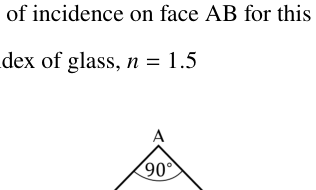 Isosceles glass prism apex angle 90 degrees
Topic: Geometric Optics Metodi: Snell’s Law, Ray Tracing Competenze: Diagrammatic Reasoning, Mathematical Modeling Objects: Prism Fonte: Testo (PDF) — p.5
Un prisma di vetro a uguali braccia è mostrato nella figura. 1. Un raggio di luce nel piano della carta incide dall’aria sulla faccia AB.
(i) Calcolare l’angolo critico della luce nel prisma.
ii) Segnare il percorso del raggi che incide sulla faccia AB in modo tale che il raggi refratto colpisca la faccia BC all’angolo critico.
(iii) Calcolare l’angolo di incidenza sul viso AB per questa stessa condizione.
Indice di refraczione del vetro,
Angolo di punta del prisma di vetro a isosceles 90 gradi
Topic: Geometric Optics Metodi: Snell’s Law, Ray Tracing Competenze: Diagrammatic Reasoning, Mathematical Modeling Objects: Prism Fonte: Testo (PDF) — p.5
An aluminium block is attached to a newton-meter that records a weight of . A beaker of water sits on a mass balance and records a mass of . The aluminium block is then lowered into the water and completely submerged without touching the sides of the beaker. What is
(i) the new reading on the newton-meter, and
(ii) the new reading on the mass balance?
Density of water is .
Topic: Fluid Mechanics, Newtonian Mechanics Metodi: Hydrostatic Equilibrium, Free-Body Diagram Competenze: Physical Reasoning, Mathematical Modeling Objects: Block, Container Fonte: Testo (PDF) — p.5
Un blocco di alluminio è attaccato a un newton-meter che registra un peso di . Un calice d’acqua si trova su un equilibrio di massa e registra una massa di . Il blocco di alluminio viene poi abbassato nell’acqua e completamente sommerso senza toccare i lati del bicchiere. Che cos’è ?
-
la nuova lettura del metrotone di Newton;
-
la nuova lettura del bilanciamento delle masse?
La densità dell’acqua è .
Topic: Fluid Mechanics, Newtonian Mechanics Metodi: Hydrostatic Equilibrium, Free-Body Diagram Competenze: Physical Reasoning, Mathematical Modeling Objects: Block, Container Fonte: Testo (PDF) — p.5
A solid square cross-section mild steel bar, of side is to be bent on the arc of a circle. What is the smallest radius to which it can be bent, if the breaking stress of the steel is , and Young’s Modulus is ? Assume that the radius of curvature is much larger than the thickness of the bar.
Topic: Elasticity & Materials Metodi: Stress-Strain Analysis, Physical Modeling Competenze: Physical Reasoning, Mathematical Modeling Objects: Rod Fonte: Testo (PDF) — p.5
Una barra di acciaio morbido a sezione quadrata solida di lato deve essere piegata sull’arco di un cerchio. Qual è il raggio più piccolo fino al quale può essere piegato, se la tensione di rottura dell’acciaio è , e il modulo di Young è ? Supponiamo che il raggio di curvatura sia molto più grande dello spessore della barra.
Topic: Elasticity & Materials Metodi: Stress-Strain Analysis, Physical Modeling Competenze: Physical Reasoning, Mathematical Modeling Objects: Rod Fonte: Testo (PDF) — p.5
In the photoelectric effect, an electrode is placed from a clean sodium surface, which has a work function of . Light of wavelength is shone on the surface and electrons are emitted.
(i) What is the shortest time it takes the most energetic photoelectrons to reach the electrode after illumination is started?
(ii) If a stopping potential of is applied between a plane electrode parallel to the photoemissive surface to produce a uniform electric field, what is now the shortest time it takes the most energetic photoelectrons to reach the electrode after illumination is started?
Topic: Modern-Quantum Physics, Electrostatics Metodi: Photon Energy Relation, Kinematic Equations, Electric Potential Method Competenze: Physical Reasoning, Mathematical Modeling Objects: Photon, Electron Fonte: Testo (PDF) — p.6
Nell’effetto fotoelettrico, un elettrodo viene posizionato da una superficie di sodio pulita, che ha una funzione di lavoro di . La luce di lunghezza d’onda viene illuminata sulla superficie e vengono emessi elettroni.
(i) Qual è il tempo più breve necessario per raggiungere l’elettrodo dopo l’alluminio dei fotonelettoni più energetici?
(ii) Se si applica un potenziale di arresto di tra un elettrodo piano parallelo alla superficie fotomessiale per produrre un campo elettrico uniforme, quale è ora il tempo più breve necessario per raggiungere l’elettrodo dopo l’alluminio?
Topic: Modern-Quantum Physics, Electrostatics Metodi: Photon Energy Relation, Kinematic Equations, Electric Potential Method Competenze: Physical Reasoning, Mathematical Modeling Objects: Photon, Electron Fonte: Testo (PDF) — p.6
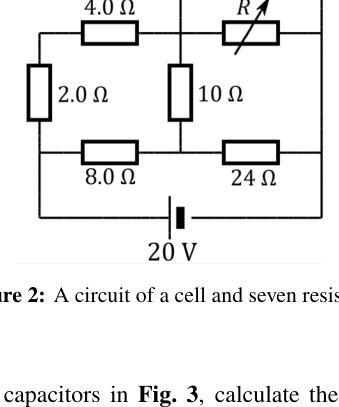
For the circuit shown in Fig. 2, what should be the value of the variable resistor in order to minimise the power converted in the resistor?
 Circuit with a cell and seven resistors
Topic: Circuits Metodi: Kirchhoff’s Laws, Equivalent Circuit Reduction Competenze: Physical Reasoning, Mathematical Modeling Objects: Resistor Fonte: Testo (PDF) — p.6
Per il circuito mostrato alla figura. 2, quale deve essere il valore della resistenza variabile per ridurre al minimo la potenza convertita nella resistenza ?
Circuito con una cella e sette resistori
Topic: Circuits Metodi: Kirchhoff’s Laws, Equivalent Circuit Reduction Competenze: Physical Reasoning, Mathematical Modeling Objects: Resistor Fonte: Testo (PDF) — p.6
In the arrangement of capacitors in Fig. 3, calculate the charge stored on the capacitor.
 Capacitor circuit with a cell
Topic: Circuits, Electrostatics Metodi: Equivalent Circuit Reduction, Kirchhoff’s Laws Competenze: Physical Reasoning, Mathematical Modeling Objects: Capacitor Fonte: Testo (PDF) — p.6
Nella disposizione dei condensatori di Fig. 3, calcolare la carica immagazzinata sul condensatore .
Circuito di condensatore con cellula
Topic: Circuits, Electrostatics Metodi: Equivalent Circuit Reduction, Kirchhoff’s Laws Competenze: Physical Reasoning, Mathematical Modeling Objects: Capacitor Fonte: Testo (PDF) — p.6
A capacitor is made of two parallel conducting plates of area and initial separation . It is attached to a constant voltage supply, . The energy stored in the capacitor is . The separation of the plates is gradually reduced to . The supply is then disconnected and the separation of the plates is gradually restored to the value , where the energy stored is now .
Calculate the difference in the energy stored in the capacitor between the final () and initial () states.
Topic: Electrostatics, Circuits Metodi: Electric Potential Method, Energy Conservation Method Competenze: Physical Reasoning, Mathematical Modeling Objects: Capacitor Fonte: Testo (PDF) — p.7
Un condensatore è costituito da due piastre conduttrici parallele di superficie e di separazione iniziale . È collegato ad una alimentazione di tensione costante, . L’energia immagazzinata nel condensatore è . La separazione delle lastre è gradualmente ridotta a . Il sistema di alimentazione viene quindi disconnesso e la separazione delle piastre viene gradualmente ripristinata al valore , dove l’energia immagazzinata è ora .
Calcolare la differenza di energia immagazzinata nel condensatore tra gli stati finali () e iniziali ().
Topic: Electrostatics, Circuits Metodi: Electric Potential Method, Energy Conservation Method Competenze: Physical Reasoning, Mathematical Modeling Objects: Capacitor Fonte: Testo (PDF) — p.7
An isotope of polonium, decays by alpha particle emission with a half-life of . A mass of of this isotope is in the form of a thin film in a very thin-walled glass container such that the alpha particles can escape. By how much will the mass of the thin film of polonium be reduced after ?
Topic: Nuclear & Particle Physics Metodi: Radioactive Decay Law, Mass-Energy Equivalence Competenze: Mathematical Modeling, Physical Reasoning Objects: Nucleus Fonte: Testo (PDF) — p.7
Isotopo di polonio, si decompone per emissione di particelle alfa con una semivida di . Una massa di questo isotopo è sotto forma di pellicola sottile in un contenitore di vetro a pareti molto sottili in modo che le particelle alfa possano sfuggire. Quanto diminuirà la massa del sottile film di polonio dopo ?
Topic: Nuclear & Particle Physics Metodi: Radioactive Decay Law, Mass-Energy Equivalence Competenze: Mathematical Modeling, Physical Reasoning Objects: Nucleus Fonte: Testo (PDF) — p.7
Beats are variations in sound intensity, produced by interference between two sources of sound very close in frequency.
The beat frequency is simply the difference in the frequencies of the two sources.
Three tuning forks in the audible range produce beats: B and C produce beats at , A and C produce beats at . The frequency of B is higher than that of A. Find the frequencies of the three tuning forks.
Topic: Oscillations & Waves Metodi: Superposition Principle, Physical Modeling Competenze: Mathematical Modeling, Physical Reasoning Objects: Tuning Fork Fonte: Testo (PDF) — p.7
I battiti sono variazioni di intensità sonora, prodotte da interferenze tra due fonti sonore molto vicine di frequenza.
La frequenza del battito è semplicemente la differenza nelle frequenze delle due fonti.
Tre forchette di sintonia nella gamma sonora producono battiti: B e C producono battiti a , A e C producono battiti a . La frequenza di B è superiore a quella di A. Trova le frequenze delle tre forche di sintonia.
Topic: Oscillations & Waves Metodi: Superposition Principle, Physical Modeling Competenze: Mathematical Modeling, Physical Reasoning Objects: Tuning Fork Fonte: Testo (PDF) — p.7
Resistance of a filament light bulb is given by where and are constants, and is the power emitted by the bulb. When operating at the power emitted is . When switched on from cold, the filament has a resistance value of its operating resistance, and consequently for the same mains voltage, the power is instantaneously five times greater than when at its normal operating power.
(i) Determine the values of and (if you wish, you may leave the answers as products of integer values given).
(ii) What would be the steady emitted power of the bulb if connected to a supply?
Topic: Circuits Metodi: Kirchhoff’s Laws, Physical Modeling, Differential Equations Competenze: Mathematical Modeling, Physical Reasoning Objects: Resistor Fonte: Testo (PDF) — p.7
La resistenza di una lampadina a filamento è data da , dove e sono costanti, e è la potenza emessa dalla lampadina. Quando si opera a , la potenza emessa è . Quando viene acceso dal freddo, il filamento ha un valore di resistenza della sua resistenza di funzionamento e, di conseguenza, per la stessa tensione della rete, la potenza è istantaneamente cinque volte maggiore di quando è a potenza di funzionamento normale.
(i) Determina i valori di e (se lo desideri, puoi lasciare le risposte come prodotti dei valori di enti dati).
(ii) Qual è la potenza di emissione costante dell’ampolla se collegata ad un’alimentazione ?
Topic: Circuits Metodi: Kirchhoff’s Laws, Physical Modeling, Differential Equations Competenze: Mathematical Modeling, Physical Reasoning Objects: Resistor Fonte: Testo (PDF) — p.7