P1. Mira arriba. En la película “No mires arriba” (2021), la estudiante de doctorado Kate Dibiasky descubre cerca de la órbita de Júpiter un meteorito, al que se da el nombre de su descubridora, y que se dirige directamente hacia la Tierra, de 10 km de diámetro, tamaño similar al del meteorito que produjo la extinción de los dinosaurios. Para evitar el impacto del meteorito Dibiasky con la Tierra se programa el lanzamiento de un conjunto de naves que deben chocar contra él y desviar su trayectoria. Vamos a tratar de analizar la viabilidad de semejante misión. Considera (Figura 1) que un meteorito de masa m cae radialmente hacia el centro de la Tierra, partiendo con velocidad igual a cero a una gran distancia de la misma (por simplicidad, despreciamos la interacción gravitatoria del meteorito con el resto de cuerpos del Sistema Solar). A una distancia r de la Tierra un satélite de intercepción de cometas, de masa m’, describe una órbita circular. El satélite y el meteorito tienen una colisión completamente inelástica, saliendo juntos después de la misma, moviéndose el objeto conjunto C en una órbita que es rasante a la Tierra y que, por tanto, evita el choque con la misma (Figura 2). a) ¿Cuál es la velocidad del meteorito y del satélite inmediatamente antes de la colisión? b) ¿Cuál es el vector velocidad del objeto C inmediatamente después de la colisión? Utiliza un vector unitario radial y un vector unitario tangencial a la trayectoria circular del satélite c) Halla la velocidad de C en el perigeo. d) A partir de la conservación de la energía de C, calcula la masa m’ del satélite interceptor necesaria para que el meteorito no impacte con la tierra, en función del radio r de la órbita circular inicial del satélite. Considera que el meteorito Dibiasky tiene una forma aproximadamente esférica y una densidad 3 2,5 g/cm = . La intercepción se produce a una distancia 6 4 10 km r
e) Calcula la masa m del meteorito. f) Determina numéricamente la masa m’ que debe tener el satélite. ¿Consideras viable poner en órbita dicha masa? Dato: Radio de la Tierra: 3 6,37 10 km T R = m’ m RT r m+m’ RT r Fig. 1 Fig. 2 C 33 OLIMPIADA ESPAÑOLA DE FÍSICA FASE DE ARAGÓN P1. Solución a) Para el asteroide 2 1 0 2 ast Mm G mv r +
2 ast M v G r
(1) donde M es la masa de la Tierra. Para el satélite, 2 2 sat v Mm G m r r
sat M v G r
(2) b) En una colisión se conserva el momento lineal. Considerando un vector unitario radial, ru , cuya dirección pasa por el centro de la Tierra y cuyo sentido va hacia el exterior de la misma, y un vector unitario tangencial, tu , tangente a la trayectoria circular del satélite de radio r y aplicando la conservación del momento lineal: 2 ( ) ( ) r t f objeto M M m G u m G u m m v r r +
2 ( ) ( ) ( ) f objeto r t m M m M v G u G u m m r m m r
+ + +
(3) c) El objeto se mueve bajo la acción de la fuerza de la gravedad, orientada hacia el centro de la Tierra. El momento de esta fuerza respecto del centro de la Tierra es cero permanentemente, luego se conserva el momento angular. Tras la colisión el momento angular es ( ) 2 ( ) ( ) ( ) r r t m M m M L m m ru G u G u m m r m m r GM m r k m GMrk r
+
+ +
=
(4) siendo k
un vector unitario perpendicular al plano de la figura 2 y dirigido hacia el lector. En el perigeo el vector velocidad será perpendicular a la dirección radial y el vector momento angular será ( ) p T p L R m m v k
(5) Por la conservación del momento angular, p L L
( ) T p m GMr R m m v
( ) p T m v GMr m m R
+ (6) d) A partir de la velocidad de C obtenida en la ecuación (3), la energía mecánica de C en el punto de impacto es 2 2 2 2 ( ) 1 2 ( ) 2 ( ) ( ) 4 2 mec M m m m GM m GM E G m m r r r m m m m Mm m m G r m m
+ = + + +
+ +
=
+
(7) 33 OLIMPIADA ESPAÑOLA DE FÍSICA FASE DE ARAGÓN En la nueva órbita, tras la colisión, se conserva la energía mecánica, de modo que de la conservación de energía entre el punto de impacto y el perigeo se tiene 2 4 ( ) 1 ( ) 2 2 ( ) T T Mm m m M m m m G G m m GMr r m m R m m R
+ +
= + +
+ +
(8) Arreglando y simplificando la expresión (8) obtenemos una ecuación de segundo grado para m’, ( ) ( ) 2 2 2 4 2 0 T T T T R r m mR R r m rR m +
(9) De donde ( ) 2 2 4 2 T T T T R R rR m m r R + = (10) Como r > RT, la solución con “-“ no tiene sentido físico pues daría un valor negativo de m’, así pues, ( ) 2 2 4 2 0,06 T T T T R R rR m m m r R + + =
(11) e) El radio del meteorito Dibiasky es 3 5km 5 10 m D R
= y su densidad es 3 3 3 2,5g/cm 2,5 10 kg / m =
. Su volumen vendrá dado por 3 4 3 D V R
(12) De modo que su masa será 3 4 3 D m V R
= 15 1,3 10 kg m = (13) f) Sustituyendo m en la expresión (11) obtenemos 13 7,8 10 kg = La tecnología actual no permite poner en órbita una masa tan grande. Una posible solución alternativa, que se sugiere en la película “No mires arriba”, sería enviar cargas nucleares que exploten en la superficie del meteorito, de forma que el material eyectado en la explosión produzca un impulso que lleve a una desviación suficiente. En todo caso, nos movemos en los límites de la ciencia ficción, aunque actualmente se ensayan técnicas de desviación, como es el caso del proyecto DART de la NASA. 33 OLIMPIADA ESPAÑOLA DE FÍSICA FASE DE ARAGÓN
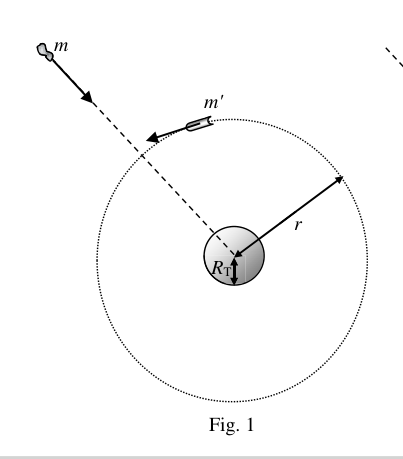 Meteorite in caduta verso la Terra
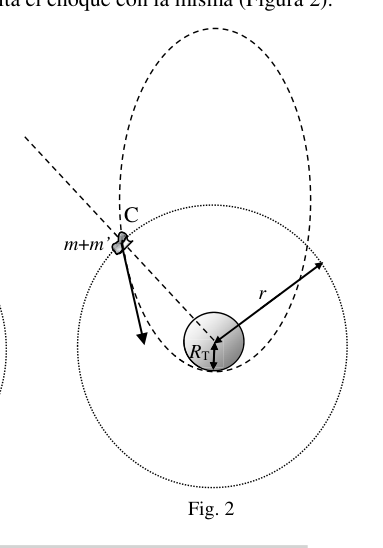 Satellite intercettore in orbita circolare
Topic: Gravitation, Conservation of Momentum, Conservation of Energy Metodi: Conservation of Momentum, Conservation Laws, Torque & Angular Momentum Analysis, Energy Conservation Method Competenze: Mathematical Modeling, Physical Reasoning, Diagrammatic Reasoning Objects: Planet, Satellite Fonte: Testo (PDF) — p.2
P1. Guarda in alto. Nel film “Non guardare sopra” (2021), la dottoressa Kate Dibiasky scopre che L’orbita di Giove è un meteorite, che prende il nome dal suo scopritore, e che si dirige direttamente verso la Terra. Terra, di 10 km di diametro, simile a quella del meteorito che ha prodotto l’estinzione dei dinosauri. Per per evitare l’impatto del meteorito Dibiasky con la Terra è programmata il lancio di un insieme di navi che Dovranno sbattersi contro di lui e deviare il loro percorso. Cercheremo di analizzare la fattibilità di una missione del genere. Considera (Figura 1) che un meteorito di massa m cade radialmente verso il centro della Terra, partendo con velocità pari a zero ad una grande distanza da essa (per semplicità, disprezziamo l’interazione gravità del meteorito con il resto dei corpi del Sistema Solare). A r distanza dalla Terra un satellite di intercepzione di comete, di massa m, descrive un’orbita circolare. Il satellite e il meteorito hanno una Colpissione completamente inelastica, uscendo insieme dopo di esso, spostando l’oggetto insieme C in un’orbita che è rasata verso la Terra e che quindi evita l’impatto con la Terra (Figura 2). a) Qual è la velocità del meteorito e del satellite immediatamente prima della collisione? b) Qual è la velocità vettoriale dell’oggetto C immediatamente dopo la collisione? Utilizza un vettore unitario radial e un vettore unitario tangenziale al percorso circolare del satellite c) Trova la velocità di C nel perigeo. d) Sulla base della conservazione dell’energia di C, si calcola la massa m del satellite interceptor necessario per che il meteorito non colpisca la terra, a seconda del raggio r dell’orbita circolare iniziale del satellite. Considera che il meteorito dibiasky ha una forma circa sferica e una densità 3 2,5 g/cm = . L’intercettazione avviene a distanza 6 4 10 km r
e) Calcola la massa m del meteorito. f) Determina numericamente la massa m che il satellite deve avere. Rite possibile mettere in orbita tale massa? Data: Radio Terra: 3 6,37 10 km T R = m’ m RT r m+m’ RT r Fig. 1 Fig. 2 C 33 Olimpiadi di Fisica in Spagna Fase di ARAGON P1. Soluzione a) Per l’asteroide 2 1 0 2 ast Mm G mv r +
2 ast M v G r
(1) dove M è la massa della Terra. Per il satellite, 2 2 sat v Mm G m r r
sat M v G r
(2) b) In una collisione il momento lineare viene conservato. Considerando un vettore unitario radial, ru , la cui direzione passa attraverso il centro della Terra e il cui senso E’ un vettore unitario tangenziale. Tu , tangente alla traiettoria circolare del radio r satellite e applicando la conservazione del tempo lineare: 2 ( ) ( ) r t f oggetto M M m G u m G u m m v r r +
2 ( ) ( ) ( ) f oggetto r t m M m M v G u G u m m r m m r
+ + +
(3) c) L’oggetto si muove sotto l’azione della forza della gravità, orientata verso il centro della Terra. El Il momento di questa forza rispetto al centro della Terra è zero per sempre, quindi si conserva il momento angolare. Dopo la collisione il momento angolare è ( ) 2 ( ) ( ) ( ) r r t m M m M L m m ru G u G u m m r m m r GM m r k m GMrk r
+
+ +
=
(4) essendo k
un vettore unitario perpendicolare al piano della figura 2 e rivolto verso il lettore. Nel perigeo il vettore di velocità sarà perpendicolare alla direzione radial e il vettore angolare del momento sarà ( ) p T p L R m m v k
(5) Per la conservazione del momento angolare, p L L
( ) T p m GMr R m m v
( ) p T m v GMr m m R
+ (6) d) A partire dalla velocità di C ottenuta nell’equazione (3), l’energia meccanica di C al punto di impatto es 2 2 2 2 ( ) 1 2 ( ) 2 ( ) ( ) 4 2 mec M m m m GM m GM E G m m r r r m m m m Mm m m G r m m
+ = + + +
+ +
=
+
(7) 33 Olimpiadi di Fisica in Spagna Fase di ARAGON La nuova orbita, dopo la collisione, conserva l’energia meccanica, in modo che la conservazione di l’energia tra il punto di impatto e il perigeo si ha 2 4 ( ) 1 ( ) 2 2 ( ) T T Mm m m M m m m G G m m GMr r m m R m m R
+ +
= + +
+ +
(8) Arrangendo e semplificando l’espressione (8) otteniamo un’equazione di secondo grado per m, ( ) ( ) 2 2 2 4 2 0 T T T T R r m mR R r m rR m +
(9) Da dove ( ) 2 2 4 2 T T T T R R rR m m r R + = (10) Come r > RT, la soluzione con - non ha senso fisico perché darebbe un valore negativo di m, quindi, ( ) 2 2 4 2 0,06 T T T T R R rR m m m r R + + =
(11) e) Il radio del meteorito Dibiasky è 3 5km 5 10 m D R
= e la densità è 3 3 3 2,5g/cm 2,5 10 kg / m =
. Il volume verrà dato da 3 4 3 D V R
(12) Quindi la sua massa sarà 3 4 3 D m V R
= 15 1,3 10 kg m = (13) f) Substituendo m nell’espressione (11) otteniamo 13 7,8 10 kg = La tecnologia attuale non permette di mettere in orbita una massa così grande. Una possibile soluzione alternativa, che Il film suggerisce che non guardate sopra, sarebbe inviare cariche nucleari che esplodono sulla superficie del pianeta. La meteorite, così che il materiale ejectato nell’esplosione produce un impulso che porta a una
- Basta deviare. In ogni caso, ci stiamo muovendo nei limiti della fantascienza, anche se attualmente si provano tecniche di deviazione, come il progetto DART della NASA. 33 Olimpiadi di Fisica in Spagna Fase di ARAGON
Meteorite in caduta verso la Terra
Satellite intercettore in orbita circolare
Topic: Gravitation, Conservation of Momentum, Conservation of Energy Metodi: Conservation of Momentum, Conservation Laws, Torque & Angular Momentum Analysis, Energy Conservation Method Competenze: Mathematical Modeling, Physical Reasoning, Diagrammatic Reasoning Objects: Planet, Satellite Fonte: Testo (PDF) — p.2
P1. Look up there. In the film Don’t Look Up (2021), PhD student Kate Dibiasky discovers near the The orbit of Jupiter is a meteorite, named after its discoverer, and heading directly towards the Earth, 10 km in diameter, similar in size to the meteorite that caused the extinction of the dinosaurs. Stop To avoid the impact of the Dibiasky meteorite on Earth, the launch of a set of spacecraft is scheduled. They must collide with him and divert his course. We’re going to try to analyze the feasibility of such a mission. Consider (Figure 1) that a meteorite of m mass falls radially towards the center of the Earth, starting with zero speed at a great distance from it (for simplicity, we despise interaction gravitational pull of the meteorite with the rest of the solar system. At a distance r from Earth a satellite The mean mass of the comet is defined as the mass of the comet. The satellite and the meteorite have a The total collision is completely inelastic, coming together after the same, moving the joint object C in a orbit that is flattened to Earth and therefore avoids collision with Earth (Figure 2). a) What is the speed of the meteorite and satellite immediately before the collision? b) What is the velocity vector of object C immediately after the collision? It uses a unit vector radial and a tangent unit vector to the circular path of the satellite c) Find the velocity of C at the perigee. d) From the conservation of C energy, calculate the m mass of the interceptor satellite needed to that the meteorite does not impact the earth, depending on the radius r of the satellite’s initial circular orbit. He considers the Dibiasky meteorite to have an approximately spherical shape and density 3 2,5 g/cm = . Interception is at a distance 6 4 10 km r
e) Calculate the mass m of the meteorite. f) Determine numerically the mass m the satellite must have. Do you consider it feasible to put it into orbit? What’s the matter? Date: Radio from the Earth: 3 6,37 10 km T R = m’ m RT r m+m’ RT r Fig. 1 Fig. 2 C 33 Spanish Olympics in Physics The following is the list of the categories of products: P1. Solution a) For the asteroid 2 1 0 2 the following: Mm G mv r +
2 the following: M v G r
(1) where M is the mass of the Earth. For the satellite, 2 2 Sat v Mm G m r r
Sat M v G r
(2) (b) In a collision, the linear momentum is preserved. Considering a radial unit vector, ru , whose direction passes through the center of the Earth and whose direction It goes out of the same, and a tangential unit vector, You , tangent to the circular path of the R-r-r-satellite and applying linear momentum conservation: 2 ( ) ( ) r t f object M M m G u m G u m m v r r +
2 ( ) ( ) ( ) f object r t m M m M v G u G u m m r m m r
+ + +
(3) c) The object moves under the action of gravity, oriented toward the center of the Earth. El The moment of this force relative to the center of the Earth is permanently zero, then the angular momentum. After the collision the angular momentum is ( ) 2 ( ) ( ) ( ) r r t m M m M L m m ru G u G u m m r m m r GM m r k m The following is the list of the countries of the European Union: r
+
+ +
=
(4) being k
a unit vector perpendicular to the plane of Figure 2 and directed towards the reader. In perigee the velocity vector will be perpendicular to the radial direction and the angular momentum vector will be ( ) p T p L R m m v k
(5) For the preservation of angular momentum, p L L
( ) T p m GMr R m m v
( ) p T m v GMr m m R
+ (6) d) From the velocity of C obtained in the equation (3), the mechanical energy of C at the point of impact es 2 2 2 2 ( ) 1 2 ( ) 2 ( ) ( ) 4 2
- I’m not. M m m m GM m GM E G m m r r r m m m m Mm m m G r m m
+ = + + +
+ +
=
+
(7) 33 Spanish Olympics in Physics The following is the list of the categories of products: The new orbit, after the collision, retains mechanical energy, so that the conservation of energy between the impact point and the perigee is 2 4 ( ) 1 ( ) 2 2 ( ) T T Mm m m M m m m G G m m GMr r m m R m m R
+ +
= + +
+ +
(8) By arranging and simplifying the expression (8) we get a second-degree equation for m, ( ) ( ) 2 2 2 4 2 0 T T T T R r m mR R r m rR m +
(9) Where did you come from? ( ) 2 2 4 2 T T T T R R rR m m r R + = (10) As r > RT, the solution with - has no physical meaning because it would give a negative value of m, so, ( ) 2 2 4 2 0,06 T T T T R R rR m m m r R + + =
(11) e) The radius of the Dibiasky meteorite is 3 5km 5 10 m D R
= And its density is 3 3 3 2,5g/cm 2,5 10 kg / m =
. Its volume will be given by 3 4 3 D V R
(12) So its mass will be 3 4 3 D m V R
= 15 1,3 10 kg m = (13) f) Substituting m in the expression (11) we get 13 7,8 10 kg = The current technology does not allow such a large mass to be put into orbit. A possible alternative solution, which is It’s suggested in the movie Don’t look up, it would be sending nuclear charges that explode on the surface of the Earth. The meteorite, so that the material ejected in the explosion produces a pulse that leads to a enough deviation. In any case, we’re moving within the boundaries of science fiction, although currently They try diversion techniques, like the NASA DART project. 33 Spanish Olympics in Physics The following is the list of the categories of products:
Meteorite in fall towards the Earth
The following information shall be provided:
Topic: Gravitation, Conservation of Momentum, Conservation of Energy Metodi: Conservation of Momentum, Conservation Laws, Torque & Angular Momentum Analysis, Energy Conservation Method Competenze: Mathematical Modeling, Physical Reasoning, Diagrammatic Reasoning Objects: Planet, Satellite Fonte: Testo (PDF) — p.2
P2. Carga oscilante. Considera dos pequeñas esferas sujetas en los extremos de una varilla no conductora de longitud 2d (Figura 1). Una tercera esfera C tiene masa m y puede deslizar sin rozamiento en la varilla. Las tres esferas son no conductoras y cada una tiene una carga eléctrica q distribuida sobre su superficie. Se separa la esfera C una distancia x de la posición de equilibrio O. Fig. 1 a) Halla la expresión de la fuerza que actúa sobre la esfera C cuando se encuentra a distancia x de la posición de equilibrio. b) ¿Cuál es la expresión de la fuerza sobre la esfera C si se considera que x << d ? Se desplaza la esfera C hasta un punto A, a una distancia x = d/20 hacia la derecha de O, como se observa en la figura, y se libera. c) Calcula la velocidad que llevará la esfera C cuando pase por la posición de equilibrio O. d) Calcula la frecuencia angular de oscilación de la esfera C alrededor de la posición de equilibrio. e) ¿Cuánto tiempo tardará la esfera C en ir desde A hasta O. f) Para 10 nC q = , 10 cm d = y 1g m = , calcula el valor del periodo T de una oscilación completa de la esfera C alrededor del punto O. Datos: * Constante de Coulomb, 9 2 -2 1 9 10 N m C 4 o
* 9 1nC 10 C
x q q q d d O C A 33 OLIMPIADA ESPAÑOLA DE FÍSICA FASE DE ARAGÓN P2. Solución a) La fuerza sobre la esfera cargada C será la suma de las fuerzas producidas sobre ella por cada una de las esferas cargadas de los extremos, 1 2 F F F
. Ambas fuerzas son repulsivas. La fuerza que ejerce cada una de las esferas sobre la esfera C es la misma que se ejercería entre dos cargas puntuales, 2 2 2 2 1 1 4 4 ( ) ( ) o o q q F d x d x
+ 2 2 2 1 4 4 ( ) ( ) o q d x F d x d x = + (1) b) Si x << d, podemos aproximar 2 2 ( ) x d d y 2 2 ( ) x d d + en la expresión (1) de modo que 2 3 1 4 4 o q x F d (2) c) La fuerza eléctrica sobre la carga q es conservativa, por lo tanto, se conserva la energía mecánica entre A y O. 2 2 2 2 1 1 1 1 2 4 4 4 2 20 20 o o o q q q mv d d d d d +
2 1 0,1 4 o q v md
(3) d) En la expresión (2) se observa que la fuerza F es proporcional a la distancia x de separación de la posición de equilibrio, y de sentido contrario, similar a una fuerza elástica F Kx = , a partir de lo que podemos determinar la “constante elástica” K del sistema, 2 3 1 4 4 o q x Kx d
2 3 1 4 4 o q K d
(4) La frecuencia angular de oscilación alrededor de la posición de equilibrio vendrá dada por K m = 2 3 1 4 4 o q md
(5) e) El tiempo que tardará la partícula C en ir de A hasta O será un cuarto del periodo T, tiempo que tarda en realizar una oscilación completa y volver a A. A partir de la expresión (5) se obtiene 3 2 (1/ 4 ) o md T q
= (6) De modo que el tiempo para ir de A hasta O será 4 T t = 3 4 (1/ 4 ) o md t q
(7) f) Expresando q, m y d en unidades del Sistema Internacional y sustituyendo en la expresión (6) obtenemos 3,31s T = 33 OLIMPIADA ESPAÑOLA DE FÍSICA FASE DE ARAGÓN
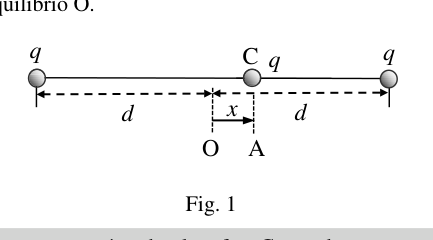 Tre sfere cariche su asta non conduttrice
Topic: Electrostatics, Oscillations & Waves Metodi: Coulomb’s Law, Small-Angle Approximation, Simple Harmonic Motion Analysis, Energy Conservation Method Competenze: Mathematical Modeling, Physical Reasoning Objects: Sphere, Rod, Point Charge Fonte: Testo (PDF) — p.5
P2. Carico oscilante. Considera due piccole sfere attaccate alle estremità di un bastone non conduttore di lunghezza 2d (Figura 1). Una terza sfera C ha massa m e può scivolare senza rottura sul bastone. Le tre sfere sono Le parti di questo sistema sono di tipo non conduttore e ognuna ha una carica elettrica distribuita sulla sua superficie. Separazione della sfera C una Distanza x dalla posizione di equilibrio O. Fig. 1 a) Trova l’espressione della forza che agisce sulla sfera C quando si trova a distanza x dalla posizione di equilibrio. b) Qual è l’espressione della forza sulla sfera C se si considera che x << d ? La sfera C viene spostata fino a un punto A, a una distanza x = d/20 verso la destra di O, come si osserva nella figura, e si libera. c) Calcola la velocità che la sfera C porterà quando passerà attraverso la posizione di equilibrio O. d) Calcola la frequenza angolare di oscillazione della sfera C attorno alla posizione di equilibrio. e) Quanto tempo ci vorrà per la sfera C di andare da A a O. f) Per 10 nC q = , 10 cm d = y 1g m = , calcola il valore del periodo T di un’oscillazione completa della sfera C intorno al punto O. Data: * Costante di Coulomb, 9 2 -2 1 9 10 N m C 4 o
* 9 1nC 10 C
x q q q d d O C A 33 Olimpiadi di Fisica in Spagna Fase di ARAGON P2. Soluzione a) La forza sulla sfera carica C sarà la somma delle forze prodotte su di essa da ciascuna delle sfere cariche dalle estremità, 1 2 F F F
. Entrambe le forze sono ripugnanti. La forza esercitata da ogni una sfera sopra la sfera C è la stessa che si eserciterebbe tra due carichi puntiali, 2 2 2 2 1 1 4 4 ( ) ( ) o o q q F d x d x
+ 2 2 2 1 4 4 ( ) ( ) o q d x F d x d x = + (1) b) Se x << d, possiamo avvicinare 2 2 ( ) x d d y 2 2 ( ) x d d + in espressione (1) in modo che 2 3 1 4 4 o q x F d (2) c) La forza elettrica sulla carica q è conservatrice, quindi l’energia meccanica viene conservata tra A e A. y O. 2 2 2 2 1 1 1 1 2 4 4 4 2 20 20 o o o q q q mv d d d d d +
2 1 0,1 4 o q v md
(3) d) Nella espressione (2) si osserva che la forza F è proporzionale alla distanza x di separazione della posizione di equilibrio, e di senso contrario, simile a una forza elastica F Kx = , da quanto possiamo determinare la costante elastica K del sistema, 2 3 1 4 4 o q x Kx d
2 3 1 4 4 o q K d
(4) Frequenza angolare di oscillazione intorno alla posizione di equilibrio verrà data da K m = 2 3 1 4 4 o q md
(5) e) Il tempo che ci vorrà per la particella C di andare da A a O sarà un quarto del periodo T, tempo che ci vorrà per fare un’oscillazione completa e tornare a A. L’espressione (5) è 3 2 (1/ 4 ) o md T q
= (6) Quindi il tempo per andare da A a O sarà 4 T t = 3 4 (1/ 4 ) o md t q
(7) f) Esprimendo q, m e d in unità del Sistema Internazionale e sostituendo in espressione (6) otteniamo 3,31s T = 33 Olimpiadi di Fisica in Spagna Fase di ARAGON
Tre sfere carica la sua asta non conduttrice
Topic: Electrostatics, Oscillations & Waves Metodi: Coulomb’s Law, Small-Angle Approximation, Simple Harmonic Motion Analysis, Energy Conservation Method Competenze: Mathematical Modeling, Physical Reasoning Objects: Sphere, Rod, Point Charge Fonte: Testo (PDF) — p.5
P2. It’s a swinging charge. Consider two small spheres attached at the ends of a non-conductive rod of length 2d The Commission has not yet adopted a proposal. A third C-sphere has mass m and can slide without a scratch on the rod. The three spheres are Each of these is non-conductive and each has an electrical charge distributed over its surface. The sphere C one is separated distance x from the equilibrium position O. Fig. 1 a) Find the expression of the force acting on the sphere C when it is at a distance x from the position The balance. b) What is the expression of the force on the sphere C if we consider that x < d? The sphere C is moved to a point A, at a distance x = d/20 to the right of O, as seen In the figure, and it’s released. c) Calculate the speed the sphere C will travel at when it passes through the equilibrium position O. d) Calculate the angular frequency of oscillation of the sphere C around the equilibrium position. e) How long will it take the C-sphere to go from A to O? f) Stop 10 nC q = , 10 cm d = y 1g m = , calculates the value of the period T of a complete oscillation of the Sphere C around the point O. The data set is the following: 9 2 -2 1 9 10 N m C 4 o
* 9 1nC 10 C
x q q q d d O C A 33 Spanish Olympics in Physics The following is the list of the categories of products: P2. Solution a) The force on the charged sphere C is the sum of the forces produced on it by each of the Charged spheres from the ends, 1 2 F F F
. Both forces are repulsive. The force exerted by each one of the spheres above the sphere C is the same as would be exercised between two point loads, 2 2 2 2 1 1 4 4 ( ) ( ) o o q q F d x d x
+ 2 2 2 1 4 4 ( ) ( ) o q d x F d x d x = + (1) (b) If x << d, we can approximate 2 2 ( ) x d d y 2 2 ( ) x d d + in expression (1) so that 2 3 1 4 4 o q x F d (2) c) The electrical force on the charge q is conservative, therefore the mechanical energy is conserved between A and A. y O. 2 2 2 2 1 1 1 1 2 4 4 4 2 20 20 o o o q q q mv d d d d d +
2 1 0,1 4 o q v md
(3) d) In expression (2) it is noted that the force F is proportional to the distance x from the position of a kind used for the manufacture of electrical equipment Kx = , from what we can determine the elastic constant K of the system, 2 3 1 4 4 o q x Kx d
2 3 1 4 4 o q K d
(4) Angular frequency of oscillation around the equilibrium position will be given by K m = 2 3 1 4 4 o q md
(5) e) The time it will take the particle C to go from A to O will be one quarter of the period T, the time it takes to Make a complete oscillation and go back to A. From the expression (5) is obtained 3 2 (1/ 4 ) o md T q
= (6) So the time to go from A to O will be 4 T t = 3 4 (1/ 4 ) o md t q
(7) f) Expressions q, m and d in units of the International System and substituting in the expression (6) are obtained 3,31s T = 33 Spanish Olympics in Physics The following is the list of the categories of products:
*Tre sphere charge its non-conductive axis *
Topic: Electrostatics, Oscillations & Waves Metodi: Coulomb’s Law, Small-Angle Approximation, Simple Harmonic Motion Analysis, Energy Conservation Method Competenze: Mathematical Modeling, Physical Reasoning Objects: Sphere, Rod, Point Charge Fonte: Testo (PDF) — p.5
P3. Una aproximación a las fibras ópticas0F1. Las fibras ópticas han revolucionado el mundo de las telecomunicaciones en las últimas décadas. Su funcionamiento está basado en las leyes de la reflexión y de la refracción (ley de Snell), en particular en el fenómeno de la reflexión total. Esquemáticamente (figura 1) una fibra óptica es un fino hilo de material transparente, llamado núcleo, por el que se propaga la luz sufriendo sucesivas reflexiones totales, pues está rodeado por otro material, llamado revestimiento, de menor índice de refracción. a) Si 465 ,1 nuc = n y 460 ,1 rev = n , determina el máximo ángulo respecto al eje, max , con que puede viajar la luz dentro del núcleo para que se produzcan reflexiones totales al alcanzar el revestimiento. ¿A qué ángulo de iluminación, max , desde el exterior ( 000 ,1 aire = n ) corresponde esta situación? Todos los rayos que inciden sobre la entrada del núcleo con max 0 se propagarán confinadamente por la fibra, pero siguiendo caminos diferentes, y por tanto tardando tiempos diferentes en alcanzar el extremo de salida. Dato: velocidad de la luz en el vacío, m/s 10 998 , 2 8
c . b) Calcula las longitudes, 0 L y max L recorridas por la luz en los casos extremos 0
y max = , y los tiempos de tránsito correspondientes, 0t y max t , para una longitud de fibra L =1000 m. La luz que viaja por la fibra es producida por un LED o un diodo láser que ilumina su entrada en un amplio margen de ángulos de incidencia. La señal a transmitir (por ejemplo, una conexión de internet o una conversación telefónica) se codifica digitalmente mediante una rápida sucesión de pulsos de luz, “bits” (figura 2), según un código binario preestablecido, de forma que un sistema detector al final de la fibra pueda reconocer estos pulsos luminosos y descifrar (decodificar) el mensaje que transportan. En el segundo apartado se ha visto que el tiempo de tránsito de la luz por la fibra depende del ángulo de propagación. Este fenómeno, llamado dispersión, es indeseable para los fines prácticos de comunicación digital, pues ensancha los pulsos transmitidos y tiende a superponer dos consecutivos, de forma que el detector puede llegar a no distinguirlos y la información se pierde. c) Supón que los pulsos luminosos que inciden sobre la fibra cubren todo el margen de ángulos de incidencia, entre 0
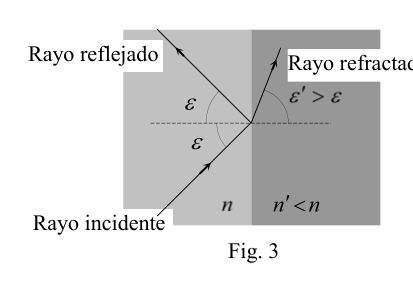
y max = . Si la duración inicial de los pulsos es ns 5 0 = T , tal como indica la figura 2, calcula la duración total de los pulsos de salida, T. d) Calcula la frecuencia máxima de transmisión de los pulsos, max f , para que puedan ser distinguidos por el detector a la salida de la fibra. Para aumentar la capacidad de transmisión del sistema, interesa que esta frecuencia sea lo más alta posible. ¿Cómo modificarías los datos de diseño de la fibra para conseguirlo? 1 Este problema fue propuesto en la 24 Olimpiada Española de Física celebrada en 2013 en la Universidad de Lleida. Fig. 1 Núcleo Revestimiento L Fig. 2 t 33 OLIMPIADA ESPAÑOLA DE FÍSICA FASE DE ARAGÓN P3. Solución Cuando la de luz incide desde un medio de índice n hacia otro de índice n’, la ley de Snell establece
sen sen n n (1) donde y son los ángulos de incidencia y refracción, respecto a la normal a ambas superficies. Si n n < , se tendrá que sen sen
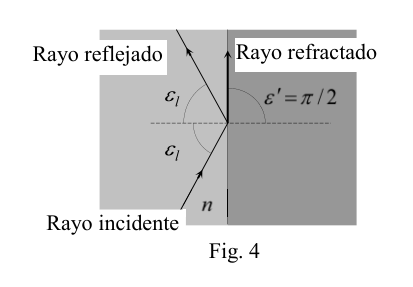
, y por tanto > (figura 3). El ángulo límite se define como aquél al que corresponde el máximo ángulo de refracción, 2 / = (figura 4), es decir n n l
sen ) / ( sen arc n n l
(2) Para incidencia con ángulo superior al límite, > , la ecuación (1) no tiene solución real para , pues sería necesario que 1 sen
. En estas circunstancias no existe rayo refractado; toda la energía luminosa se refleja en la superficie de separación entre los dos medios, con ángulo de reflexión igual al de incidencia, Este es el conocido fenómeno de “reflexión total”. a) En nuestro problema, la luz incide desde el núcleo hacia el revestimiento, con 460 ,1 465 ,1 rev nuc
=
=
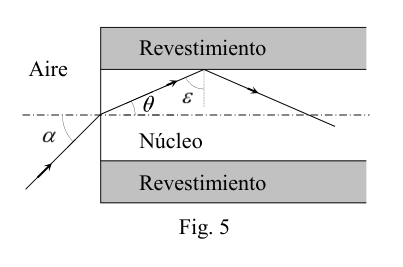
n n n n Por tanto, se producirá reflexión total cuando el ángulo de incidencia sea mayor que el límite, que puede calcularse teniendo en cuenta (2). Se obtiene o 265 , 85
El ángulo que se pide, , es el complementario de , (figura 5). Para que se produzcan reflexiones totales debe ser o 265 , 85
o 735 , 4 max = El ángulo de propagación respecto al eje, , es el ángulo de refracción respecto a la entrada de la luz en el núcleo de la fibra, procedente del aire. Como el índice del aire es la unidad, se cumplirá l n n cos sen sen nuc max nuc max
= o 946 , 6 max = Fig. 4 Rayo refractado Rayo reflejado Rayo incidente Rayo incidente Rayo reflejado Fig. 3 Rayo refractado Fig. 5 Revestimiento Revestimiento Aire Núcleo 33 OLIMPIADA ESPAÑOLA DE FÍSICA FASE DE ARAGÓN b) Los rayos que inciden desde el aire sobre el núcleo con 0
viajarán por la fibra con 0
, en paralelo al eje y sin sufrir reflexiones totales en el revestimiento. Por tanto, han de recorrer una distancia m 1000 0
= L L La velocidad de propagación de la luz dentro del núcleo es nuc /n c v = , donde m/s 10 00 ,3 8
c es la velocidad de la luz en el vacío. Por tanto, el tiempo que tardarán los rayos de luz en recorrer la fibra, para 0
, es c n L v L t nuc 0 0
= s 887 , 4 0
t Los rayos que inciden desde el aire sobre el núcleo con max = viajarán por la fibra con max = , de forma que la longitud realmente recorrida es L n n L L L l max max rev nuc sen cos
=
m 4 , 1003 max = L El tiempo de recorrido por la fibra para max = será, por tanto 0 rev nuc nuc max max max t n n c n L v L t
=
s 903 , 4 max
t c) Cada pulso de luz es transmitido por la fibra mediante rayos correspondientes a todo el margen de admisión a la entrada, max 0 , de forma que la luz que ha entrado en la fibra en un cierto instante t llega al final entre 0t t + y max t t + , durante un intervalo de tiempo ns 16 0 max
t t t Como los pulsos tienen una duración inicial ns 5 0 = T , a la salida de la fibra serán mucho más anchos, con una duración t T T +
0 ns 21 T Además, serán menos intensos, pues la energía inyectada se reparte en un mayor intervalo de tiempo. d) La separación temporal mínima entre dos pulsos consecutivos, para que no se solapen en el detector, es precisamente T . Esto corresponde a una frecuencia máxima de transmisión de pulsos T f 1 max = MHz 47 max f Para aumentar max f es necesario reducir T , o sea t . ( ) rev nuc rev nuc rev nuc 0 0 max 1 n n n c n L n n t t t t
Por tanto, para una L dada, un aumento de la frecuencia max f requiere: Reducir la diferencia de índices entre el núcleo y revestimiento, rev nuc n n . En nuestro problema, 005 , 0 rev nuc
n . Si, por ejemplo, la diferencia fuese 001 0 rev nuc , n n
, t se reduciría en un factor 5 y, max f aumentaría a unos 120 MHz. 33 OLIMPIADA ESPAÑOLA DE FÍSICA FASE DE ARAGÓN Nota: En las fibras reales la luz no puede viajar confinada para cualquier ángulo max < , sino sólo para algunos ángulos concretos, correspondientes a los llamados modos de propagación de la fibra. Para comprender cualitativamente este fenómeno basta plantearse el problema desde el punto de vista de un observador que viajase en paralelo al eje de la fibra y con la misma velocidad de avance de la luz a lo largo de dicho eje. Este observador vería luz viajando en una trayectoria rectilínea perpendicular al eje y sufriendo repetidas reflexiones en las fronteras núcleo-revestimiento (hacia arriba y hacia abajo en la figura 1). La interferencia de estas ondas sólo sería constructiva cuando se cumpliese una condición de tipo onda estacionaria para la luz en las dimensiones transversales del núcleo. Esta condición conduce a una cuantización de los posibles ángulos de propagación de la luz respecto al eje de la f
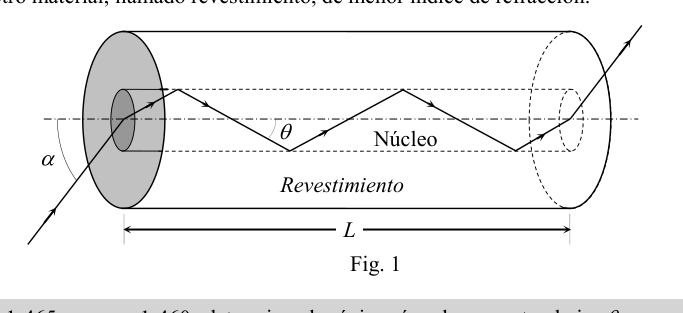 Sezione trasversale fibra ottica con angoli
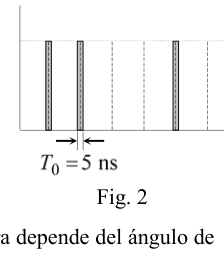 Diagramma temporale impulsi luminosi
 Rifrazione luce a interfaccia (n<n’)
 Riflessione totale a interfaccia (n>n’)
 Riflessione totale interna in fibra ottica
Topic: Geometric Optics, Oscillations & Waves Metodi: Snell’s Law, Ray Tracing, Small-Angle Approximation Competenze: Mathematical Modeling, Physical Reasoning, Diagrammatic Reasoning Objects: Tube Fonte: Testo (PDF) — p.7
P3. Un approccio alle fibre ottiche0F1. Le fibre ottiche hanno rivoluzionato il mondo delle telecomunicazioni negli ultimi decenni. Su La funzione è basata sulle leggi della riflessione e della refraczione (legge di Snell), in particolare in Il fenomeno della riflessione totale. Schematicamente (Figura 1) una fibra ottica è un filo di materiale sottile Il nucleo, chiamato nucleo, attraverso il quale la luce si diffonde subendo successive riflessioni totali, perché è circondato da un altro materiale, chiamato rivestimento, di minore indice di rifrazione. a) Si 465 ,1 nuc = n y 460 ,1 rev = n , determina l’angolo massimo rispetto all’asse, Max , con cui può viaggiare la luce all’interno del nucleo per produrre riflessi totali quando raggiunge il rivestimento. A cosa? angolo di illuminazione, Max , dall’esterno ( 000 ,1 aria = n ) corrisponde a questa situazione? Tutti i raggi che incidono sull’entrata del nucleo con Max 0 si diffonderanno in modo confinato La fibra, ma seguendo percorsi diversi, e quindi impiegando tempi diversi per raggiungere l’estremità di uscita. Data: velocità della luce nel vuoto, m/s 10 998 , 2 8
c . b) Calcola le lunghezze, 0 L y Max L viaggiati in luce in casi estremi 0
y Max = , e i i corrispondenti tempi di transito, 0t y Max t , per una lunghezza di fibra L = 1000 m. La luce che viaggia attraverso la fibra è prodotta da un LED o diodo laser che illumina la sua entrata in un ampio margine di angoli di incidenza. Il segnale a trasmettere (ad esempio, una connessione internet o una conversazione telefonica) codifica digitalmente attraverso una rapida successione di pulsi di luce, bits (figura 2), secondo un codice binario pre-impostato, in modo che un sistema di La fibra può riconoscere questi pulsi luminosi e decifrare il il messaggio che trasportano. Il secondo comma ha rilevato che il tempo di transito della luce attraverso la fibra dipende dall’angolo di diffusione. Questo fenomeno, chiamato dispersione, è indesiderabile per scopi pratici di comunicazione La misurazione del sistema di accelerazione è più elevata, in quanto aumenta i polsi trasmessi e tende a superponiere due successivi, in modo che il rilevatore si può non distinguere e l’informazione viene persa. c) Supponiamo che i pulsi luminosi che incidono sulla fibra coprono l’intero margine di angoli di incidenza, Entrate 0
y Max = . Se la durata iniziale dei polsi è ns 5 0 = T , come indicato in figura 2, Calcola la durata totale dei pulsi di uscita, T. d) Calcola la frequenza massima di trasmissione dei polsi, Max f , in modo che possano essere distinguiti dal il rilevatore all’uscita della fibra. Per aumentare la capacità di trasmissione del sistema, è interessante che questa Frequenza massima possibile. Come modificare i dati di design della fibra per ottenere questo? 1 Questo problema è stato proposto alla 24a Olimpiada spagnola di fisica celebrata nel 2013 presso l’Università di Lleida. Fig. 1 Cernello Cappello L Fig. 2 t 33 Olimpiadi di fisica in Spagna Fase di ARAGON P3. Soluzione Quando la luce incide da un mezzo di indice n verso un altro di indice n, la legge di Snell stabilisce che
sen sen n n (1) dove e sono gli angoli di incidenza e di refraczione rispetto al normale per entrambe le superfici. Si n n < , dovrà sen sen
, e quindi > (Figura 3). L’angolo limite è definito come tale il quale corrisponde all’angolo di rifrazione massimo, 2 / = (Figura 4), cioè: n n l
sen ) / ( sen arc n n l
(2) Per incidenti con angolo superiore al limite, > , l’equazione (1) non ha una soluzione reale per , poiché Sarebbe necessario che 1 sen
. In queste circostanze non esiste un raggio refrattato; tutta l’energia luminosa è riflette sulla superficie di separazione tra i due media, con angolo di riflessione pari a quello di incidenza, è il fenomeno noto di “riflessione totale”. a) Nel nostro problema, la luce incide dal nucleo verso il rivestimento, con 460 ,1 465 ,1 rev Nuovo
=
=
n n n n Si verifica quindi una riflessione totale quando l’angolo di l’incidenza è superiore al limite, che può essere calcolato considerando (2). Si ottiene o 265 , 85
L’angolo richiesto, , è il complementare di , (figura 5). Per avere riflessioni totali è necessario o 265 , 85
o 735 , 4 Max = L’angolo di diffusione rispetto all’asse, , è l’angolo di refrazione rispetto all’ingresso della luce in il nucleo della fibra, proveniente dall’aria. Poiché l’indice dell’aria è l’unità, si soddisferà l n n cos sen sen Nuovo Max Nuovo Max
= o 946 , 6 Max = Fig. 4 Raggiustato Raggi riflessi Raggi incidente Raggi incidente Raggi riflessi Fig. 3 Raggiustato Fig. 5 Cappello Cappello Air Cernello 33 Olimpiadi di Fisica in Spagna Fase di ARAGON b) I raggi che incitano dall’aria sul nucleo con 0
viaggiano attraverso la fibra con 0
, in parallelo L’acciaio e la rivestimento non sono completamente riflessi. Quindi, devono percorrere una distanza m 1000 0
= L L La velocità di diffusione della luce all’interno del nucleo è Nuovo /n c v = , dove m/s 10 00 ,3 8
c es la velocità della luce nel vuoto. Quindi, il tempo che i raggi di luce impiegano per attraversare la fibra, per 0
, es c n L v L t Nuovo 0 0
= s 887 , 4 0
t I raggi che incitano dall’aria sul nucleo con Max = viaggiano attraverso la fibra con Max = , de modo che la lunghezza realmente percorso è L n n L L L l Max Max rev Nuovo sen cos
=
m 4 , 1003 Max = L Il tempo di percorrenza della fibra per Max = sarà, quindi, 0 rev Nuovo Nuovo Max Max Max t n n c n L v L t
=
s 903 , 4 Max
t c) Ogni pulso di luce viene trasmesso dalla fibra attraverso raggi corrispondenti a tutto il margine di l’ingresso, Max 0 , in modo che la luce che è entrata nella fibra in un certo istante t arriva alla fine tra 0t t + y Max t t + , per un periodo di tempo ns 16 0 Max
t t t Come i polsi hanno una durata iniziale ns 5 0 = T , all’uscita della fibra saranno molto più larghi, con durata t T T +
0 ns 21 T Inoltre, saranno meno intense, poiché l’energia iniezionata viene distribuita in un intervallo di tempo più lungo. d) La minima separazione temporale tra due pulsi consecutivi, per non sovrapporsi nel rilevatore, è Proprio T. Questo corrisponde a una frequenza massima di trasmissione di polsi T f 1 Max = MHz 47 Max f Per aumentare Max f è necessario ridurre T , cioè t . ( ) rev Nuovo rev Nuovo rev Nuovo 0 0 Max 1 n n n c n L n n t t t t
Per un dato L, un aumento della frequenza Max f richiede: Riduzione del differenziale di indici tra il nucleo e il rivestimento, rev Nuovo n n . Nel nostro problema, 005 , 0 rev Nuovo
n . Se, per esempio, la differenza fosse 001 0 rev Nuovo , n n
, t si ridurrebbe di un fattore 5 e, Max f aumenterebbe a circa 120 MHz. 33 Olimpiadi di Fisica in Spagna Fase di ARAGON Nota: nelle fibre reali la luce non può viaggiare confinata ad ogni angolo Max < , ma solo per I campioni di produzione sono stati rilevati in base alle seguenti indicazioni: Per La nostra capacità di comprendere qualitativamente questo fenomeno è sufficiente a porre il problema dal punto di vista di un un osservatore che viaggiasse in parallelo all’asse della fibra e con la stessa velocità di avanzamento della luce al lungo tale asse. Questo osservatore vedrebbe la luce viaggiare in un percorso rettilineo perpendicolare all’asse e La riforma delle linee di controllo delle frontiere nucleare-rivestimento (upward and downward in the Figura 1). L’interferenza di queste onde sarebbe costruttiva solo se si soddisfa una condizione di tipo di onda stazionaria per la luce nelle dimensioni trasversali del nucleo. Questa condizione porta a una quantificazione dei possibili angoli di diffusione della luce rispetto all’asse della f
Sezione trasversale di fibra ottica con angoli
Tempo di grafico pulso luminoso
*Rifrazione luce a interfaccia (n<n’) *
*Riflessione totale a interfaccia (n>n’) *
Riflessione totale interna in fibra ottica
Topic: Geometric Optics, Oscillations & Waves Metodi: Snell’s Law, Ray Tracing, Small-Angle Approximation Competenze: Mathematical Modeling, Physical Reasoning, Diagrammatic Reasoning Objects: Tube Fonte: Testo (PDF) — p.7
P3. A close-up of the optical fibres0F1. Optical fibers have revolutionized the world of telecommunications in recent decades. Su The functioning of the system is based on the laws of reflection and refraction (Snell’s law), in particular the The phenomenon of total reflection. Sketchwise (Figure 1) an optical fiber is a fine material thread The translucent, so-called nucleus, through which light propagates under successive total reflections, because it is surrounded by another material, called coating, with a lower refractive index. a) Si 465 ,1 NUC = n y 460 ,1 The following is the list of the following: n , determines the maximum angle with respect to the axis, Max , which you can travel with The light inside the core to produce total reflections when it reaches the coating. What’s the point? angle of illumination, Max , from the outside ( 000 ,1 Air = n ) corresponds to this situation? All the lightning that hits the entrance of the core with Max 0 They will spread in confinement. The fiber is not the same as the fiber, but it takes different paths, and therefore takes different times to reach the end. The exit. Date: speed of light in vacuum, m/s 10 998 , 2 8
c . b) Calculate the lengths, 0 L y Max L light travel in extreme cases 0
y Max = , and the the corresponding transit times, 0t y Max t , for a length of fibre L = 1000 m. The light traveling through the fiber is produced by an LED or laser diode that illuminates its entry in a wide range of angle of incidence. Signal a transmit (e.g. an internet connection or telephone conversation) It encodes digitally by a rapid succession of light pulses, bits (figure 2), according to a pre-established binary code, so that a detector system at the end of the The fiber can recognize these luminous pulses and decode the message they carry. The second paragraph shows that the transit time of light through the fibre depends on the angle of The Commission will take the necessary measures to ensure that the information is available to the public. This phenomenon, called dispersion, is undesirable for practical communication purposes. The digital detector is designed to amplify the pulses transmitted and tend to overlay two consecutive ones, so that the detector can be used to detect the You can’t tell them apart and the information gets lost. c) Suppose the light pulses that strike the fiber cover the entire range of angle of incidence, I’m going in. 0
y Max = . If the initial duration of pulses is ns 5 0 = T , as shown in Figure 2, calculates the total duration of the output pulses, T. d) Calculates the maximum frequency of pulse transmission, Max f , so that they can be distinguished by the detector to the output of the fiber. In order to increase the transmission capacity of the system, it is important that the frequency as high as possible. How would you modify the design data of the fiber to achieve this? 1 This problem was proposed at the 24th Spanish Olympiad of Physics held in 2013 at the University of Lleida. Fig. 1 The core Coating L Fig. 2 t 33 Spanish Olympics in Physics The following is the list of the categories of products: P3. Solution When the light is moving from one n-index medium to another n-index medium, Snell’s law states
Other Other n n (1) where and are the angle of incidence and refraction, relative to the normal to both surfaces. Si n n < , you ‘ll have to Other Other
, and therefore > The Commission has not yet adopted a proposal. The limit angle is defined as that the maximum angle of refraction is equal to, 2 / = (Figure 4), that is to say n n l
Other ) / ( Other arc n n l
(2) For incidents with an angle above the limit, > , equation (1) has no real solution for , because It would be necessary that 1 Other
. In these circumstances there is no refracted beam; all light energy is reflects on the separation surface between the two media, with an angle of reflection equal to that of incidence, It’s the well-known phenomenon of “total reflection”. a) In our problem, light penetrates from the core to the coating, with 460 ,1 465 ,1 Re: Re: Re: Re: Re: Re: Re: Re: Re: Re: Re: Re: Re: Re: Re: Re: Re: Re: Re: Re: Re: Re: Re: Re: Re: Re: Re: Re: Re: Re: Re: Re: Re: Re: Re: Re: Re: Re: Re: Re: Re: Re: Re: Re: Re: Re: Re: Re: Re: Re: Re: Re: Re: Re: Re: Re: Re: Re: Re: Re: Re: Re: Re: Re: Re: Re: Re: Re: Re: Re: Re: Re: Re: Re: Re: Re: Re: Re: Re: Re: Re: Re: Re: Re: Re: Re: Re: Re: Re: Re: Re: Re: Re: Re: Re: Re: Re: Re: Re: Re: Re: Re: Re: Re: Re: Re: Re: Re: Re: Re: Re: Re: Re: Re: Re: Re: Re: Re: Re: Re: Re: Re: Re: Re: Re: Re: Re: Re: Re: Re: Re: Re: Re: Re: Re: Re: Re: Re: Re: Re: Re: Re: Re: Re: Re: Re: Re: Re: Re: Re: Re: Re: Re: Re: Re: Re: Re: Re: Re: Re: Re: Re: Re: Re: Re: Re: Re: Re: Re: Re: Re: Re: Re: Re: Re: Re: Re: Re: Re: Re: Re: Re: Re: Re: Re: Re: Re: re: Re: are are are are are are are are not included with the are not included in the are not included in the are not included in the first included in the first included in the first two or Other
=
=
n n n n Therefore, full reflection will occur when the angle of the incidence is greater than the limit, which can be calculated having regard to (2). You get it o 265 , 85
The angle required, , is the complement of , (figure 5). In order for total reflection to take place, it must be o 265 , 85
o 735 , 4 Max = The angle of propagation with respect to the axis, , is the angle of refraction with respect to the light input in the the core of the fiber, coming from the air. Since the air index is the unit, it will be met l n n body Other Other Other Max Other Max
= o 946 , 6 Max = Fig. 4 Refractory beam Reflected beam Incident lightning Incident lightning Reflected beam Fig. 3 Refractory beam Fig. 5 Coating Coating Air The core 33 Spanish Olympics in Physics The following is the list of the categories of products: b) The rays that strike from the air over the nucleus with 0
They’ll travel through the fiber with 0
, in parallel The product is not covered with any colour or colour. So they have to travel a distance m 1000 0
= L L The speed of light propagation within the nucleus is Other /n c v = , where m/s 10 00 ,3 8
c es la speed of light in the vacuum. Therefore, the time it will take light rays to travel through the fiber, to 0
, es c n L v L t Other 0 0
= s 887 , 4 0
t The rays that strike from the air over the nucleus with Max = They’ll travel through the fiber with Max = , de So the length actually travelled is L n n L L L l Max Max Re: Re: Re: Re: Re: Re: Re: Re: Re: Re: Re: Re: Re: Re: Re: Re: Re: Re: Re: Re: Re: Re: Re: Re: Re: Re: Re: Re: Re: Re: Re: Re: Re: Re: Re: Re: Re: Re: Re: Re: Re: Re: Re: Re: Re: Re: Re: Re: Re: Re: Re: Re: Re: Re: Re: Re: Re: Re: Re: Re: Re: Re: Re: Re: Re: Re: Re: Re: Re: Re: Re: Re: Re: Re: Re: Re: Re: Re: Re: Re: Re: Re: Re: Re: Re: Re: Re: Re: Re: Re: Re: Re: Re: Re: Re: Re: Re: Re: Re: Re: Re: Re: Re: Re: Re: Re: Re: Re: Re: Re: Re: Re: Re: Re: Re: Re: Re: Re: Re: Re: Re: Re: Re: Re: Re: Re: Re: Re: Re: Re: Re: Re: Re: Re: Re: Re: Re: Re: Re: Re: Re: Re: Re: Re: Re: Re: Re: Re: Re: Re: Re: Re: Re: Re: Re: Re: Re: Re: Re: Re: Re: Re: Re: Re: Re: Re: Re: Re: Re: Re: Re: Re: Re: Re: Re: Re: Re: Re: Re: Re: Re: Re: Re: Re: Re: Re: Re: Re: are are are are are are not included with the are not included in the are not included in the are not included in the are not included in the included in the included in the included in the first Other Other body
=
m 4 , 1003 Max = L The time taken to travel through the fibre for Max = It will, therefore, be 0 Re: Re: Re: Re: Re: Re: Re: Re: Re: Re: Re: Re: Re: Re: Re: Re: Re: Re: Re: Re: Re: Re: Re: Re: Re: Re: Re: Re: Re: Re: Re: Re: Re: Re: Re: Re: Re: Re: Re: Re: Re: Re: Re: Re: Re: Re: Re: Re: Re: Re: Re: Re: Re: Re: Re: Re: Re: Re: Re: Re: Re: Re: Re: Re: Re: Re: Re: Re: Re: Re: Re: Re: Re: Re: Re: Re: Re: Re: Re: Re: Re: Re: Re: Re: Re: Re: Re: Re: Re: Re: Re: Re: Re: Re: Re: Re: Re: Re: Re: Re: Re: Re: Re: Re: Re: Re: Re: Re: Re: Re: Re: Re: Re: Re: Re: Re: Re: Re: Re: Re: Re: Re: Re: Re: Re: Re: Re: Re: Re: Re: Re: Re: Re: Re: Re: Re: Re: Re: Re: Re: Re: Re: Re: Re: Re: Re: Re: Re: Re: Re: Re: Re: Re: Re: Re: Re: Re: Re: Re: Re: Re: Re: Re: Re: Re: Re: Re: Re: Re: Re: Re: Re: Re: Re: Re: Re: Re: Re: Re: Re: Re: Re: Re: Re: Re: Re: Re: Re: are are are are are are not included with the are not included in the are not included in the are not included in the are not included in the included in the included in the included in the first Other Other Max Max Max t n n c n L v L t
=
s 903 , 4 Max
t c) Each pulse of light is transmitted by the fibre by beams corresponding to the entire admission to the entrance, Max 0 , so that the light that has entered the fiber at a certain instant t It comes to an end between 0t t + y Max t t + , for a period of time ns 16 0 Max
t t t As the pulses have an initial duration ns 5 0 = T , the fiber output will be much wider, with a duration of t T T +
0 ns 21 T In addition, they will be less intense, as the injected energy is distributed over a longer time interval. d) The minimum time separation between two consecutive pulses, so that they do not overlap on the detector, is It ‘s T. This corresponds to a maximum pulse transmission frequency T f 1 Max = MHz 47 max f To increase Max f It is necessary to reduce T , i.e. t . ( ) Re: Re: Re: Re: Re: Re: Re: Re: Re: Re: Re: Re: Re: Re: Re: Re: Re: Re: Re: Re: Re: Re: Re: Re: Re: Re: Re: Re: Re: Re: Re: Re: Re: Re: Re: Re: Re: Re: Re: Re: Re: Re: Re: Re: Re: Re: Re: Re: Re: Re: Re: Re: Re: Re: Re: Re: Re: Re: Re: Re: Re: Re: Re: Re: Re: Re: Re: Re: Re: Re: Re: Re: Re: Re: Re: Re: Re: Re: Re: Re: Re: Re: Re: Re: Re: Re: Re: Re: Re: Re: Re: Re: Re: Re: Re: Re: Re: Re: Re: Re: Re: Re: Re: Re: Re: Re: Re: Re: Re: Re: Re: Re: Re: Re: Re: Re: Re: Re: Re: Re: Re: Re: Re: Re: Re: Re: Re: Re: Re: Re: Re: Re: Re: Re: Re: Re: Re: Re: Re: Re: Re: Re: Re: Re: Re: Re: Re: Re: Re: Re: Re: Re: Re: Re: Re: Re: Re: Re: Re: Re: Re: Re: Re: Re: Re: Re: Re: Re: Re: Re: Re: Re: Re: Re: Re: Re: Re: Re: Re: Re: Re: Re: Re: Re: Re: Re: Re: Re: are are are are are are not included with the are not included in the are not included in the are not included in the are not included in the included in the included in the included in the first Other Re: Re: Re: Re: Re: Re: Re: Re: Re: Re: Re: Re: Re: Re: Re: Re: Re: Re: Re: Re: Re: Re: Re: Re: Re: Re: Re: Re: Re: Re: Re: Re: Re: Re: Re: Re: Re: Re: Re: Re: Re: Re: Re: Re: Re: Re: Re: Re: Re: Re: Re: Re: Re: Re: Re: Re: Re: Re: Re: Re: Re: Re: Re: Re: Re: Re: Re: Re: Re: Re: Re: Re: Re: Re: Re: Re: Re: Re: Re: Re: Re: Re: Re: Re: Re: Re: Re: Re: Re: Re: Re: Re: Re: Re: Re: Re: Re: Re: Re: Re: Re: Re: Re: Re: Re: Re: Re: Re: Re: Re: Re: Re: Re: Re: Re: Re: Re: Re: Re: Re: Re: Re: Re: Re: Re: Re: Re: Re: Re: Re: Re: Re: Re: Re: Re: Re: Re: Re: Re: Re: Re: Re: Re: Re: Re: Re: Re: Re: Re: Re: Re: Re: Re: Re: Re: Re: Re: Re: Re: Re: Re: Re: Re: Re: Re: Re: Re: Re: Re: Re: Re: Re: Re: Re: Re: Re: Re: Re: Re: Re: Re: Re: Re: Re: Re: Re: Re: Re: are are are are are are not included with the are not included in the are not included in the are not included in the are not included in the included in the included in the included in the first Other Re: Re: Re: Re: Re: Re: Re: Re: Re: Re: Re: Re: Re: Re: Re: Re: Re: Re: Re: Re: Re: Re: Re: Re: Re: Re: Re: Re: Re: Re: Re: Re: Re: Re: Re: Re: Re: Re: Re: Re: Re: Re: Re: Re: Re: Re: Re: Re: Re: Re: Re: Re: Re: Re: Re: Re: Re: Re: Re: Re: Re: Re: Re: Re: Re: Re: Re: Re: Re: Re: Re: Re: Re: Re: Re: Re: Re: Re: Re: Re: Re: Re: Re: Re: Re: Re: Re: Re: Re: Re: Re: Re: Re: Re: Re: Re: Re: Re: Re: Re: Re: Re: Re: Re: Re: Re: Re: Re: Re: Re: Re: Re: Re: Re: Re: Re: Re: Re: Re: Re: Re: Re: Re: Re: Re: Re: Re: Re: Re: Re: Re: Re: Re: Re: Re: Re: Re: Re: Re: Re: Re: Re: Re: Re: Re: Re: Re: Re: Re: Re: Re: Re: Re: Re: Re: Re: Re: Re: Re: Re: Re: Re: Re: Re: Re: Re: Re: Re: Re: Re: Re: Re: Re: Re: Re: Re: Re: Re: Re: Re: Re: Re: Re: Re: Re: Re: Re: Re: are are are are are are not included with the are not included in the are not included in the are not included in the are not included in the included in the included in the included in the first Other 0 0 Max 1 n n n c n L n n t t t t
Therefore, for a given L, an increase in frequency Max f requires: Reducing the index difference between core and coating, Re: Re: Re: Re: Re: Re: Re: Re: Re: Re: Re: Re: Re: Re: Re: Re: Re: Re: Re: Re: Re: Re: Re: Re: Re: Re: Re: Re: Re: Re: Re: Re: Re: Re: Re: Re: Re: Re: Re: Re: Re: Re: Re: Re: Re: Re: Re: Re: Re: Re: Re: Re: Re: Re: Re: Re: Re: Re: Re: Re: Re: Re: Re: Re: Re: Re: Re: Re: Re: Re: Re: Re: Re: Re: Re: Re: Re: Re: Re: Re: Re: Re: Re: Re: Re: Re: Re: Re: Re: Re: Re: Re: Re: Re: Re: Re: Re: Re: Re: Re: Re: Re: Re: Re: Re: Re: Re: Re: Re: Re: Re: Re: Re: Re: Re: Re: Re: Re: Re: Re: Re: Re: Re: Re: Re: Re: Re: Re: Re: Re: Re: Re: Re: Re: Re: Re: Re: Re: Re: Re: Re: Re: Re: Re: Re: Re: Re: Re: Re: Re: Re: Re: Re: Re: Re: Re: Re: Re: Re: Re: Re: Re: Re: Re: Re: Re: Re: Re: Re: Re: Re: Re: Re: Re: Re: Re: Re: Re: Re: Re: Re: Re: Re: Re: Re: Re: Re: Re: are are are are are are not included with the are not included in the are not included in the are not included in the are not included in the included in the included in the included in the first Other n n . In our problem, 005 , 0 Re: Re: Re: Re: Re: Re: Re: Re: Re: Re: Re: Re: Re: Re: Re: Re: Re: Re: Re: Re: Re: Re: Re: Re: Re: Re: Re: Re: Re: Re: Re: Re: Re: Re: Re: Re: Re: Re: Re: Re: Re: Re: Re: Re: Re: Re: Re: Re: Re: Re: Re: Re: Re: Re: Re: Re: Re: Re: Re: Re: Re: Re: Re: Re: Re: Re: Re: Re: Re: Re: Re: Re: Re: Re: Re: Re: Re: Re: Re: Re: Re: Re: Re: Re: Re: Re: Re: Re: Re: Re: Re: Re: Re: Re: Re: Re: Re: Re: Re: Re: Re: Re: Re: Re: Re: Re: Re: Re: Re: Re: Re: Re: Re: Re: Re: Re: Re: Re: Re: Re: Re: Re: Re: Re: Re: Re: Re: Re: Re: Re: Re: Re: Re: Re: Re: Re: Re: Re: Re: Re: Re: Re: Re: Re: Re: Re: Re: Re: Re: Re: Re: Re: Re: Re: Re: Re: Re: Re: Re: Re: Re: Re: Re: Re: Re: Re: Re: Re: Re: Re: Re: Re: Re: Re: Re: Re: Re: Re: Re: Re: Re: Re: Re: Re: Re: Re: Re: Re: are are are are are are not included with the are not included in the are not included in the are not included in the are not included in the included in the included in the included in the first Other
n . If, for example, the difference was 001 0 Re: Re: Re: Re: Re: Re: Re: Re: Re: Re: Re: Re: Re: Re: Re: Re: Re: Re: Re: Re: Re: Re: Re: Re: Re: Re: Re: Re: Re: Re: Re: Re: Re: Re: Re: Re: Re: Re: Re: Re: Re: Re: Re: Re: Re: Re: Re: Re: Re: Re: Re: Re: Re: Re: Re: Re: Re: Re: Re: Re: Re: Re: Re: Re: Re: Re: Re: Re: Re: Re: Re: Re: Re: Re: Re: Re: Re: Re: Re: Re: Re: Re: Re: Re: Re: Re: Re: Re: Re: Re: Re: Re: Re: Re: Re: Re: Re: Re: Re: Re: Re: Re: Re: Re: Re: Re: Re: Re: Re: Re: Re: Re: Re: Re: Re: Re: Re: Re: Re: Re: Re: Re: Re: Re: Re: Re: Re: Re: Re: Re: Re: Re: Re: Re: Re: Re: Re: Re: Re: Re: Re: Re: Re: Re: Re: Re: Re: Re: Re: Re: Re: Re: Re: Re: Re: Re: Re: Re: Re: Re: Re: Re: Re: Re: Re: Re: Re: Re: Re: Re: Re: Re: Re: Re: Re: Re: Re: Re: Re: Re: Re: Re: Re: Re: Re: Re: Re: Re: are are are are are are not included with the are not included in the are not included in the are not included in the are not included in the included in the included in the included in the first Other , n n
, t would be reduced by a factor of 5 and, Max f It would increase to about 120 MHz. 33 Spanish Olympics in Physics The following is the list of the categories of products: Note: In real fibres light cannot travel confined to any angle Max < But only for Some specific angles corresponding to the so-called modes of propagation of the fibre. Stop The problem of the social dimension is not only a question of the social dimension but also of the social dimension. An observer traveling parallel to the fiber axis and at the same speed as the speed of light length of that axis. This observer would see light traveling in a straight path perpendicular to the axis and The main problem is that the number of people who are living in the same area is increasing. The following table shows the following: The interference of these waves would only be constructive if a condition of stationary wave type for light in the transverse dimensions of the nucleus. This condition leads to a quantification of the possible angles of propagation of the light with respect to the axis of the f-beam
*Fibre optical cross-section with angular *
Diagramma temporale impulsi luminosi
Rifrazione luce a interfaccia (n<n’)
Riflessione totale a interfaccia (n>n’)
Riflessione totale interna in fibra ottica
Topic: Geometric Optics, Oscillations & Waves Metodi: Snell’s Law, Ray Tracing, Small-Angle Approximation Competenze: Mathematical Modeling, Physical Reasoning, Diagrammatic Reasoning Objects: Tube Fonte: Testo (PDF) — p.7