A projectile is thrown upward with speed . By the time its speed has decreased to , it has risen a height . Neglecting air resistance, what is the maximum height reached by the projectile?
(A)
(B)
(C)
(D)
(E)
Topic: Newtonian Mechanics Metodi: Kinematic Equations, Energy Conservation Method Competenze: Mathematical Modeling, Physical Reasoning Objects: Projectile Fonte: Testo (PDF) — p.2
Un proiettile viene lanciato verso l’alto con velocità . Quando la sua velocità è diminuita a , è aumentata a . Nonostante la resistenza dell’aria, qual è l’altezza massima raggiunta dal proiettile?
(A)
(B)
(C)
(D)
(E)
Topic: Newtonian Mechanics Metodi: Kinematic Equations, Energy Conservation Method Competenze: Mathematical Modeling, Physical Reasoning Objects: Projectile Fonte: Testo (PDF) — p.2
A car is moving at 60 miles per hour (mph), when the driver notices an obstacle ahead. Hitting the brakes, the driver decelerates at a constant rate, and manages to come to a stop just barely before hitting the obstacle. If the car had instead been moving at 70 mph, and started decelerating at the same place and at the same rate, with what speed would it have hit the obstacle?
(A) 10 mph
(B) 14 mph
(C) 28 mph
(D) 36 mph
(E) There is not enough information to decide.
Topic: Newtonian Mechanics Metodi: Kinematic Equations, Energy Conservation Method Competenze: Physical Reasoning, Mathematical Modeling Objects: Cart Fonte: Testo (PDF) — p.2
Una macchina si muove a 60 miglia all’ora (mph), quando il conducente nota un ostacolo davanti. Colpendo i freni, il conducente rallenta a una velocità costante e riesce a fermarsi appena prima di colpire l’ostacolo. Se invece la macchina si fosse mossava a 70 mph, e avesse iniziato a rallentare nello stesso posto e allo stesso ritmo, con quale velocità avrebbe colpito l’ostacolo?
(A) 10 mph
(B) 14 mph
(C) 28 mph
(D) 36 mph
(E) Non ci sono informazioni sufficienti per decidere.
Topic: Newtonian Mechanics Metodi: Kinematic Equations, Energy Conservation Method Competenze: Physical Reasoning, Mathematical Modeling Objects: Cart Fonte: Testo (PDF) — p.2
Two blocks of mass have an inelastic one-dimensional collision. Initially, the first block is moving with speed 5 m/s, and the second is at rest. After the collision, the first block is moving with speed 2 m/s. What percentage of the system’s original kinetic energy was lost during the collision?
(A) 16%
(B) 42%
(C) 48%
(D) 52%
(E) 84%
Topic: Conservation of Momentum, Newtonian Mechanics Metodi: Conservation of Momentum, Conservation of Energy Competenze: Mathematical Modeling, Physical Reasoning Objects: Block Fonte: Testo (PDF) — p.2
Due blocchi di massa hanno una collisione inelastica unidimensional. Inizialmente, il primo blocco si muove a velocità di 5 m/s, mentre il secondo è in riposo. Dopo la collisione, il primo blocco si muove a velocità di 2 m/s. Quanti percentuali dell’energia cinetica originale del sistema sono state perse durante la collisione?
(A) 16%
(B) 42%
(C) 48%
(D) 52%
(E) 84%
Topic: Conservation of Momentum, Newtonian Mechanics Metodi: Conservation of Momentum, Conservation of Energy Competenze: Mathematical Modeling, Physical Reasoning Objects: Block Fonte: Testo (PDF) — p.2
A mass on an ideal pendulum is released from rest at point I. It swings over to point II, at which point the string suddenly breaks. Which of the following shows the trajectory of the mass?
(A) (B) (C) (D) (E) [see figure — multiple trajectory options shown]
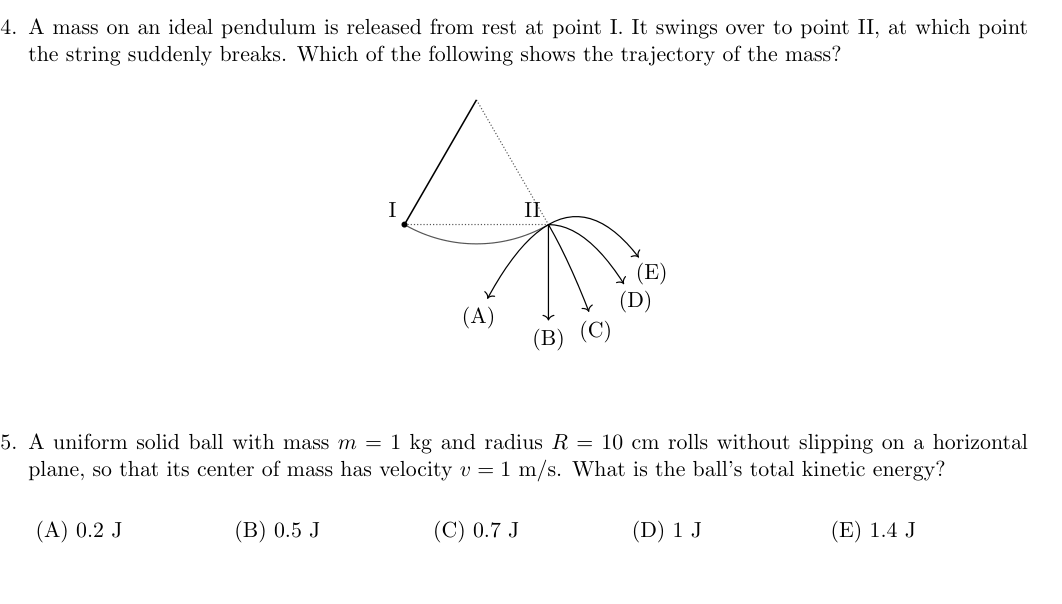 Pendulum at point II, five trajectory options
Topic: Newtonian Mechanics Metodi: Kinematic Equations, Free-Body Diagram Competenze: Diagrammatic Reasoning, Physical Reasoning Objects: Pendulum, String Fonte: Testo (PDF) — p.2
Una massa su un pendolo ideale viene rilasciata dal riposo al punto I. Si svinge verso il punto II, momento in cui la corda si rompe improvvisamente. Quale delle seguenti indica la traiettoria della massa?
(A) (B) (C) (D) (E) [vedi figura più opzioni di traiettoria mostrate]
Pendolo al punto II, cinque opzioni di traiettoria
Topic: Newtonian Mechanics Metodi: Kinematic Equations, Free-Body Diagram Competenze: Diagrammatic Reasoning, Physical Reasoning Objects: Pendulum, String Fonte: Testo (PDF) — p.2
A uniform solid ball with mass kg and radius cm rolls without slipping on a horizontal plane, so that its center of mass has velocity m/s. What is the ball’s total kinetic energy?
(A) 0.2 J
(B) 0.5 J
(C) 0.7 J
(D) 1 J
(E) 1.4 J
Topic: Rotational Dynamics, Newtonian Mechanics Metodi: Energy Conservation Method, Torque & Angular Momentum Analysis Competenze: Mathematical Modeling, Physical Reasoning Objects: Ball Fonte: Testo (PDF) — p.2
Una palla solida uniforme di massa kg e di raggio cm ruota senza scivolare su un piano orizzontale, in modo che il suo centro di massa abbia una velocità m/s. Qual è l’energia cinetica totale della palla?
(A) 0.2 J
(B) 0.5 J
(C) 0.7 J
(D) 1 J
(E) 1.4 J
Topic: Rotational Dynamics, Newtonian Mechanics Metodi: Energy Conservation Method, Torque & Angular Momentum Analysis Competenze: Mathematical Modeling, Physical Reasoning Objects: Ball Fonte: Testo (PDF) — p.2
A bob of mass hangs from a rigid, massless rod, forming an ideal pendulum. The rod is held horizontally and released from rest. What is its maximum tension during its swing?
(A)
(B)
(C)
(D)
(E)
Topic: Newtonian Mechanics, Oscillations & Waves Metodi: Energy Conservation Method, Free-Body Diagram Competenze: Physical Reasoning, Mathematical Modeling Objects: Pendulum, Rod Fonte: Testo (PDF) — p.3
Un bobino di massa è appeso a una barra rigida e senza massa, formando un pendolo ideale. La canna viene tenuta orizzontale e rilasciata dal riposo. Qual è la sua tensione massima durante il suo swing?
(A)
(B)
(C)
(D)
(E)
Topic: Newtonian Mechanics, Oscillations & Waves Metodi: Energy Conservation Method, Free-Body Diagram Competenze: Physical Reasoning, Mathematical Modeling Objects: Pendulum, Rod Fonte: Testo (PDF) — p.3
The following graph shows the results of measurements of two physical quantities, and . Which of the following best describes the functional dependence of on ? Below, and are positive constants.
[log-log graph: -axis linear 0–60, -axis logarithmic 1–100, showing a decreasing trend]
(A)
(B)
(C)
(D)
(E)
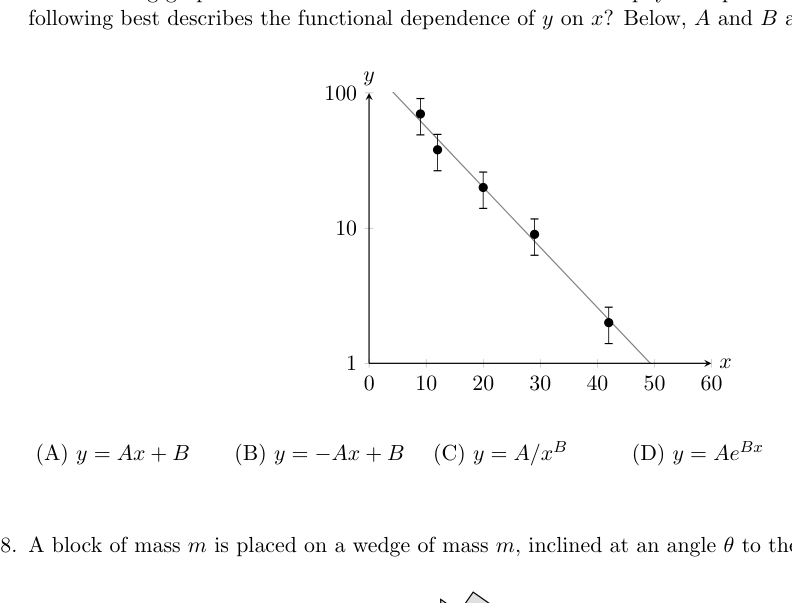 Log-linear graph of y vs x, decreasing
Topic: Order-of-Magnitude Estimation Metodi: Experimental Data Analysis, Graph Linearization Competenze: Graph Linearization, Diagrammatic Reasoning Objects: — Fonte: Testo (PDF) — p.3
Il grafico seguente mostra i risultati delle misurazioni di due quantità fisiche, e . Qual è la migliore descrizione della dipendenza funzionale di da ? Sotto e sono costanti positive.
[grafico log log: -asse lineare 060, -asse logaritmica 1100, mostrando una tendenza a diminuzione]
(A)
(B)
(C)
(D)
(E)
*grafico log-lineare di y vs x, diminuzione *
Topic: Order-of-Magnitude Estimation Metodi: Experimental Data Analysis, Graph Linearization Competenze: Graph Linearization, Diagrammatic Reasoning Objects: — Fonte: Testo (PDF) — p.3
A block of mass is placed on a wedge of mass , inclined at an angle to the horizontal.
[figure: block on wedge with angle ]
The coefficients of friction between the block and wedge, and the wedge and ground, are high enough for both the block and the wedge to remain static. What is the magnitude of the friction force of the ground on the wedge?
(A)
(B)
(C)
(D)
(E) 0
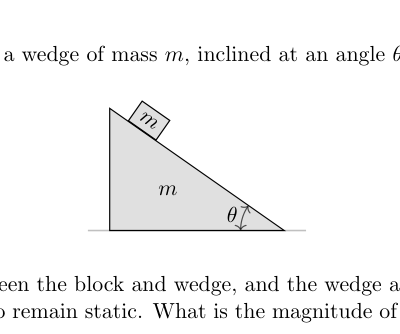 Block of mass m on wedge of mass m
Topic: Newtonian Mechanics, Rigid Body Statics Metodi: Free-Body Diagram, Vector Decomposition Competenze: Diagrammatic Reasoning, Physical Reasoning Objects: Block, Wedge Fonte: Testo (PDF) — p.3
Un blocco di massa è posizionato su un cuneo di massa inclinato in un angolo orizzontale.
[figura: blocco su un’angolazione ]
I coefficienti di attrito tra il blocco e la cucina, e la cucina e il terreno, sono sufficientemente alti per permettere al blocco e alla cucina di rimanere statici. Qual è la forza di attrito del terreno sulla ciglia?
(A)
(B)
(C)
(D)
(E) 0
Blocco di massa m su un’angolazione di massa m
Topic: Newtonian Mechanics, Rigid Body Statics Metodi: Free-Body Diagram, Vector Decomposition Competenze: Diagrammatic Reasoning, Physical Reasoning Objects: Block, Wedge Fonte: Testo (PDF) — p.3
A person is holding a massless rope, on which hangs a mass , as shown at left. To pull the end of the rope with constant upward velocity , the person must exert a force . To pull the end of the rope with constant upward acceleration , the person must exert a force . Now the rope is wrapped around a fixed, massless pulley, and the mass is doubled to , as shown at right.
[figure: left — person pulling rope with mass ; right — rope over pulley with mass ]
Compared to the original setup, how do the forces and needed to pull the end of the rope with a given upward velocity and acceleration change? In both cases, ignore friction and air resistance.
(A) stays the same, and decreases.
(B) Both and stay the same.
(C) stays the same, and increases.
(D) increases, and stays the same.
(E) Both and increase.
 Rope with mass m (left) and pulley with 2m (right)
Topic: Newtonian Mechanics Metodi: Free-Body Diagram, Physical Modeling Competenze: Physical Reasoning, Diagrammatic Reasoning Objects: String, Pulley, Block Fonte: Testo (PDF) — p.3
Una persona tiene una corda senza massa, sulla quale è appesa una massa , come mostrato a sinistra. Per tirare l’estremità della corda con una velocità costante verso l’alto , la persona deve esercitare una forza . Per tirare l’estremità della corda con costante accelerazione verso l’alto , la persona deve esercitare una forza . Ora la corda è avvolta intorno a una pollice fissa e senza massa, e la massa è raddoppiata a , come mostrato a destra.
[figura: sinistra persona che tira la corda con massa ; destra corda sopra la polla con massa ]
Rispetto all’impostazione originale, come cambiano le forze e necessarie per tirare l’estremità della corda con una data velocità in salita e accelerazione? In entrambi i casi, ignora l’attrito e la resistenza dell’aria.
(A) rimane lo stesso e diminuisce.
(B) Sia il che il restano uguali.
(C) rimane lo stesso e aumenta.
(D) aumenta e resta lo stesso.
(E) Both and increase.
*Riccia con massa m (sinistra) e pollice con massa 2 m (destra) *
Topic: Newtonian Mechanics Metodi: Free-Body Diagram, Physical Modeling Competenze: Physical Reasoning, Diagrammatic Reasoning Objects: String, Pulley, Block Fonte: Testo (PDF) — p.3
The two ends of a uniform rod of length are hung on massless strings of length .
[figure: rod of length suspended by two strings of length from ceiling]
If the strings are attached to the ceiling, and the rod is pulled a small distance horizontally and released as shown, what is the period of oscillation?
(A)
(B)
(C)
(D)
(E)
 Uniform rod 2L hung on two strings of length L
Topic: Oscillations & Waves, Newtonian Mechanics Metodi: Simple Harmonic Motion Analysis, Physical Modeling Competenze: Mathematical Modeling, Physical Reasoning Objects: Rod, String Fonte: Testo (PDF) — p.4
Le due estremità di una canna uniforme di lunghezza sono appese a stringhe senza massa di lunghezza .
[figura: bastone di lunghezza sospeso da due stringhe di lunghezza dal soffitto]
Se le corde sono attaccate al soffitto e la canna viene tirata a breve distanza orizzontalmente e rilasciata come mostrato, qual è il periodo di oscillazione?
(A)
(B)
(C)
(D)
(E)
*Rota uniforme 2L appesa su due corde di lunghezza L *
Topic: Oscillations & Waves, Newtonian Mechanics Metodi: Simple Harmonic Motion Analysis, Physical Modeling Competenze: Mathematical Modeling, Physical Reasoning Objects: Rod, String Fonte: Testo (PDF) — p.4
Two identical spherically symmetric planets, each of mass , are somehow held at rest with respect to each other. Each planet has radius , and the distance between the centers of the planets is . If a rocket is launched from the surface of one planet with speed , what is the minimum speed so that the rocket can reach the other planet?
(A)
(B)
(C)
(D)
(E)
Topic: Gravitation, Conservation of Energy Metodi: Newton’s Law of Gravitation, Energy Conservation Method Competenze: Mathematical Modeling, Physical Reasoning Objects: Planet, Projectile Fonte: Testo (PDF) — p.4
Due pianeti identici, sfericamente simmetrici, ognuno di massa , sono in qualche modo tenuti a riposo rispetto l’altro. Ogni pianeta ha un raggio , e la distanza tra i centri dei pianeti è . Se un razzo viene lanciato dalla superficie di un pianeta con velocità , qual è la velocità minima in modo che il razzo possa raggiungere l’altro pianeta?
(A)
(B)
(C)
(D)
(E)
Topic: Gravitation, Conservation of Energy Metodi: Newton’s Law of Gravitation, Energy Conservation Method Competenze: Mathematical Modeling, Physical Reasoning Objects: Planet, Projectile Fonte: Testo (PDF) — p.4
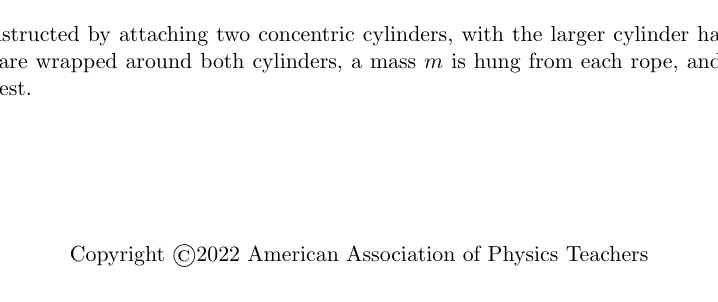
A pulley is constructed by attaching two concentric cylinders, with the larger cylinder having twice the radius. Ropes are wrapped around both cylinders, a mass is hung from each rope, and the system is released from rest.
[figure: double-cylinder compound pulley with mass on each rope]
Neglect the masses of the cylinders and ropes. Each mass experiences both a gravitational and a tension force. If the net force experienced by the left mass is , and the net force experienced by the right mass is , what is the ratio ?
(A)
(B)
(C) 1
(D) 2
(E) 4
 Compound pulley with two masses m
Topic: Rotational Dynamics, Newtonian Mechanics Metodi: Torque & Angular Momentum Analysis, Free-Body Diagram Competenze: Physical Reasoning, Mathematical Modeling Objects: Pulley, Cylinder, String Fonte: Testo (PDF) — p.4
Una pollice è costruita collegando due cilindri concentrici, con il cilindro più grande con il doppio di raggio. Le corde sono avvolte attorno a entrambi i cilindri, una massa viene appesa a ciascuna corda e il sistema viene rilasciato dal riposo.
[figura: pollice composta a doppio cilindro con massa su ciascuna corda]
Non si tratta di massa dei cilindri e delle corde. Ogni massa sperimenta una forza gravitazionale e una forza di tensione. Se la forza netta sperimentata dalla massa sinistra è e la forza netta sperimentata dalla massa destra è , qual è il rapporto ?
(A)
(B)
(C) 1
(D) 2
(E) 4
Pullee composte con due masse m
Topic: Rotational Dynamics, Newtonian Mechanics Metodi: Torque & Angular Momentum Analysis, Free-Body Diagram Competenze: Physical Reasoning, Mathematical Modeling Objects: Pulley, Cylinder, String Fonte: Testo (PDF) — p.4
Consider a laptop made of two identical uniform plates, each of mass , connected by a hinge. The hinge is locked when the screen makes an angle to the vertical, as shown, fixing the angle between the two pieces.
[figure: laptop with screen at angle to vertical]
Assuming the laptop does not slip, what is the minimum force that can be exerted on the top of the laptop, in the plane of the page, to cause the bottom of the laptop to lift off the ground?
(A)
(B)
(C)
(D)
(E)
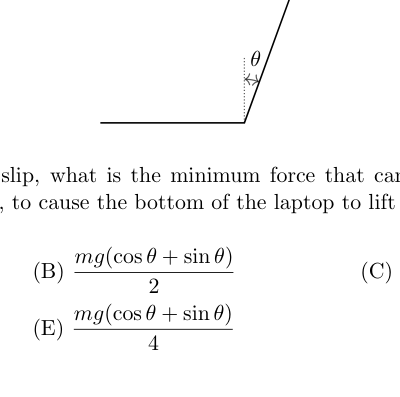 Laptop two-plate model, screen at angle theta
Topic: Rigid Body Statics, Newtonian Mechanics Metodi: Torque & Angular Momentum Analysis, Free-Body Diagram Competenze: Diagrammatic Reasoning, Mathematical Modeling Objects: — Fonte: Testo (PDF) — p.5
Considerate un portatile fatto di due piastre uniformi identiche, ciascuna di massa , collegate da una cerniera. La cerniera è bloccata quando lo schermo fa un angolo verso la verticale, come mostrato, fissando l’angolo tra i due pezzi.
[Figura: laptop con schermo all’angolo verso verticale]
Supponendo che il laptop non scivoli, qual è la forza minima che può essere esercitata sulla parte superiore del laptop, nel piano della pagina, per far sollevare il fondo del laptop dal terreno?
(A)
(B)
(C)
(D)
(E)
Modello a due piastre per portatile, schermo a angolo theta
Topic: Rigid Body Statics, Newtonian Mechanics Metodi: Torque & Angular Momentum Analysis, Free-Body Diagram Competenze: Diagrammatic Reasoning, Mathematical Modeling Objects: — Fonte: Testo (PDF) — p.5
A small block is released from rest on the rim of a fixed, frictionless hemispherical bowl. From the time the block is released, until it reaches the bottom of the bowl, which of the following is true?
I. The speed of the block never decreases.
II. The magnitude of the horizontal component of the velocity of the block never decreases.
III. The magnitude of the vertical component of the velocity of the block never decreases.
(A) Only I.
(B) Only III.
(C) I and II.
(D) I and III.
(E) I, II, and III.
Topic: Newtonian Mechanics, Conservation of Energy Metodi: Energy Conservation Method, Free-Body Diagram, Physical Modeling Competenze: Physical Reasoning, Diagrammatic Reasoning Objects: Block Fonte: Testo (PDF) — p.5
Un piccolo blocco viene rilasciato dal riposo sul bordo di una ciotola emisferica fissa e senza attrito. Dal momento in cui il blocco viene rilasciato fino a quando raggiunge il fondo della ciotola, quale di queste parole è vero?
I. La velocità del blocco non diminuisce mai.
II. La grandezza della componente orizzontale della velocità del blocco non diminuisce mai.
III. Il La grandezza della componente verticale della velocità del blocco non diminuisce mai.
(A) Solo io.
B) Solo III.
(C) I e II.
(D) I e III.
(E) I, II e III.
Topic: Newtonian Mechanics, Conservation of Energy Metodi: Energy Conservation Method, Free-Body Diagram, Physical Modeling Competenze: Physical Reasoning, Diagrammatic Reasoning Objects: Block Fonte: Testo (PDF) — p.5
An egg is launched with speed from the ground, a distance from a vertical wall.
[figure: egg launched at angle from ground, wall at horizontal distance , hitting at height ]
If is high enough for the egg to hit the wall, which of the following could describe the angle that maximizes the height at which the egg hits the wall?
(A)
(B)
(C)
(D)
(E)
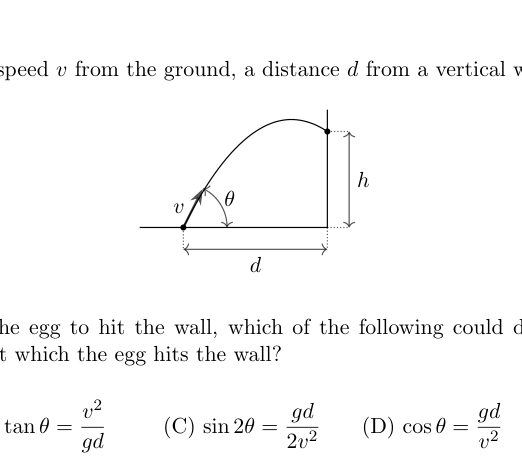 Projectile launched at angle toward vertical wall
Topic: Newtonian Mechanics Metodi: Kinematic Equations, Calculus-Integration Competenze: Mathematical Modeling, Physical Reasoning Objects: Projectile Fonte: Testo (PDF) — p.6
Un uovo viene lanciato con velocità dal terreno, a distanza da una parete verticale.
[Figura: uovo lanciato all’angolo dal terreno, parete a distanza orizzontale , colpendo ad altezza ]
Se è abbastanza alto da permettere all’uovo di colpire il muro, quale dei seguenti potrebbe descrivere l’angolo che massimizza l’altezza all’altezza a cui l’uovo colpisce il muro?
(A)
(B)
(C)
(D)
(E)
Proiettolo lanciato in angolo verso la parete verticale
Topic: Newtonian Mechanics Metodi: Kinematic Equations, Calculus-Integration Competenze: Mathematical Modeling, Physical Reasoning Objects: Projectile Fonte: Testo (PDF) — p.6
A hexagonal pencil of uniform density lies at rest on a horizontal table. It is pushed horizontally with a steadily increasing force halfway up its height, as shown.
[figure: hexagonal cross-section pencil, horizontal force applied at mid-height]
What is the minimum value of the coefficient of static friction between the floor and pencil, so that the pencil will eventually begin to roll?
(A) 0
(B)
(C)
(D)
(E)
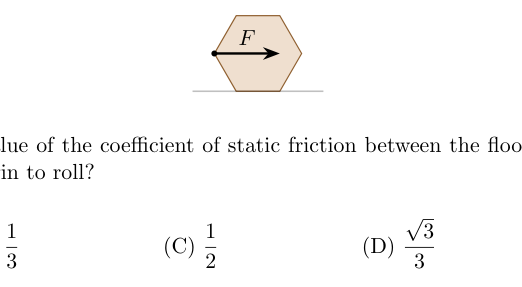 Hexagonal pencil with horizontal force at mid-height
Topic: Rigid Body Statics, Newtonian Mechanics Metodi: Torque & Angular Momentum Analysis, Free-Body Diagram Competenze: Physical Reasoning, Mathematical Modeling Objects: Rod Fonte: Testo (PDF) — p.6
Una matita esagonale di densità uniforme si trova a riposo su un tavolo orizzontale. Si spinge orizzontalmente con una forza costantemente crescente fino alla metà della sua altezza, come mostrato.
[figura: matita a sezione trasversale esagonale, forza orizzontale applicata a metà altezza]
Qual è il valore minimo del coefficiente di attrito statico tra il pavimento e la matita, in modo che la matita inizi a rotolare?
(A) 0
(B)
(C)
(D)
(E)
Pensile esagonale con forza orizzontale a metà altezza
Topic: Rigid Body Statics, Newtonian Mechanics Metodi: Torque & Angular Momentum Analysis, Free-Body Diagram Competenze: Physical Reasoning, Mathematical Modeling Objects: Rod Fonte: Testo (PDF) — p.6
A thin rod has a nonuniform density. It is mounted on an axle passing perpendicular to it, through its center of mass, as shown, and is then rotated about the axle.
[figure: nonuniform rod rotating about axle through CM, angular velocity ]
The axle divides the rod into two parts, one on each side of it. Which of the following must be true, no matter how the mass in the rod is distributed?
(A) The two parts have the same mass.
(B) The magnitudes of the momenta of the two parts are equal.
(C) The magnitudes of the angular momenta of the two parts, about the center of mass, are equal.
(D) The kinetic energies of the two parts are equal.
(E) At least two of the above are true.
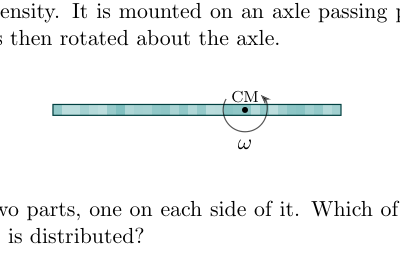 Nonuniform rod on axle through CM, rotating
Topic: Rotational Dynamics, Newtonian Mechanics Metodi: Torque & Angular Momentum Analysis, Physical Modeling Competenze: Physical Reasoning, Diagrammatic Reasoning Objects: Rod Fonte: Testo (PDF) — p.6
Una sottile canna ha una densità non uniforme. È montato su un asse che passa perpendicolare a esso, attraverso il suo centro di massa, come mostrato, e viene poi girato attorno all’asse.
[figura: canna non uniforme che ruota attorno all’asse attraverso CM, velocità angolare ]
L’asse divide la canna in due parti, una su ogni lato. Quale di queste cose deve essere vera, indipendentemente dalla distribuzione della massa della canna?
(A) Le due parti hanno la stessa massa.
(B) Le magnitudini del momento delle due parti sono uguali.
(C) Le magnitudini dei momenti angolari delle due parti, circa il centro di massa, sono uguali.
(D) Le energie cinetiche delle due parti sono uguali.
(E) Almeno due di questi elementi sono veri.
Stope non uniforme sull’asse attraverso CM, in rotazione
Topic: Rotational Dynamics, Newtonian Mechanics Metodi: Torque & Angular Momentum Analysis, Physical Modeling Competenze: Physical Reasoning, Diagrammatic Reasoning Objects: Rod Fonte: Testo (PDF) — p.6
A cylindrical piece of cork of density , height , and cross-sectional area is in a larger empty cylindrical container of cross-sectional area . Water of density is slowly poured into the empty container. What is the height of the water in the container when the cork starts to float?
(A)
(B)
(C)
(D)
(E)
Topic: Fluid Mechanics Metodi: Hydrostatic Equilibrium, Physical Modeling Competenze: Physical Reasoning, Mathematical Modeling Objects: Cylinder, Container Fonte: Testo (PDF) — p.7
Un pezzo cilindrico di corteccia di densità , altezza e superficie trasversale è presente in un contenitore cilindrico vuoto più grande di superficie trasversale . L’acqua di densità viene versata lentamente nel contenitore vuoto. Qual è l’altezza dell’acqua nel contenitore quando il sughero inizia a galleggiare?
(A)
(B)
(C)
(D)
(E)
Topic: Fluid Mechanics Metodi: Hydrostatic Equilibrium, Physical Modeling Competenze: Physical Reasoning, Mathematical Modeling Objects: Cylinder, Container Fonte: Testo (PDF) — p.7
A toy elephant is standing on the bottom of a fish tank. The fish tank is filled with water to a depth of 10 cm, completely covering the toy. The elephant’s legs are perfectly polished, so that there is no water between the bottom of the legs and the tank’s floor, and the total area of contact is . The water has density , the toy has uniform density , the atmospheric pressure is , and the toy has total mass 120 g. What is the total hydrostatic force that the water exerts on the toy?
[figure: toy elephant submerged in water of depth 10 cm]
(A) 1 N, down
(B) 0.6 N, down
(C) 0 N
(D) 0.6 N, up
(E) 1 N, up
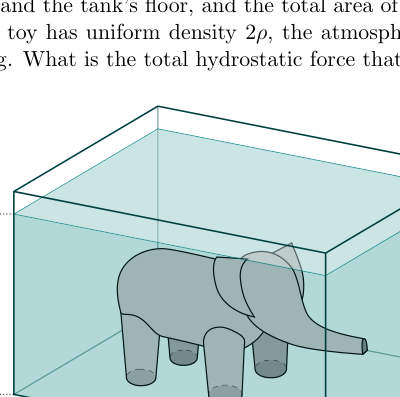 Toy elephant on tank floor submerged 10 cm
Topic: Fluid Mechanics, Newtonian Mechanics Metodi: Hydrostatic Equilibrium, Free-Body Diagram Competenze: Physical Reasoning, Mathematical Modeling Objects: Container Fonte: Testo (PDF) — p.7
Un elefante giocattolo sta in piedi sul fondo di un acquario. Il serbatoio è riempito di acqua fino a 10 cm di profondità, che copre completamente il giocattolo. Le gambe dell’elefante sono perfettamente lucidate, in modo che non ci sia acqua tra il fondo delle gambe e il pavimento del serbatoio, e la superficie totale di contatto è . L’acqua ha una densità , il giocattolo ha una densità uniforme , la pressione atmosferica è e il giocattolo ha una massa totale di 120 g. Qual è la forza idrostatica totale che l’acqua esercita sul giocattolo?
[Figura: elefante giocattolo sommerso in acqua di profondità di 10 cm]
(A) 1 N, verso il basso
B) 0,6 N, in basso
(C) 0 N
(D) 0.6 N, up
(E) 1 N, up
*Elefante giocattolo sul pavimento del serbatoio sommerso 10 cm *
Topic: Fluid Mechanics, Newtonian Mechanics Metodi: Hydrostatic Equilibrium, Free-Body Diagram Competenze: Physical Reasoning, Mathematical Modeling Objects: Container Fonte: Testo (PDF) — p.7
A bead is threaded on a frictionless wire and launched horizontally from height with speed , as shown. If the shape of the wire is steep, as in curve I, then the normal force from the wire on the bead will point inward. If it is shallow, as in curve II, then the normal force will point outward.
[figure: bead on wire, curve I (steep) and curve II (shallow), launched from height with speed , falling horizontal distance ]
There is exactly one possible shape of wire, shown as a dotted line, for which the normal force of the wire on the bead is always equal to zero. What is the horizontal displacement of the bead when it travels along this wire?
(A)
(B)
(C)
(D)
(E)
 Bead on wire, steep vs shallow shape, normal force zero
Topic: Newtonian Mechanics Metodi: Free-Body Diagram, Kinematic Equations, Physical Modeling Competenze: Physical Reasoning, Mathematical Modeling Objects: Wire Fonte: Testo (PDF) — p.7
Una manciata è infilata su un filo senza attrito e lanciata orizzontalmente dall’altezza con velocità , come mostrato. Se la forma del filo è ripida, come nella curva I, la forza normale del filo sul perlo punta verso l’interno. Se è superficiale, come nella curva II, la forza normale punta verso l’esterno.
[figura: perla su filo, curva I (spetta) e curva II (bassa), lanciata da un’altezza con velocità , a distanza orizzontale ]
C’è esattamente una forma possibile di filo, mostrata come una linea puntata, per la quale la forza normale del filo sul perlo è sempre uguale a zero. Qual è il spostamento orizzontale della perla quando si sposta lungo questo filo?
(A)
(B)
(C)
(D)
(E)
Perla su filo, forma ripida vs superficiale, forza normale zero
Topic: Newtonian Mechanics Metodi: Free-Body Diagram, Kinematic Equations, Physical Modeling Competenze: Physical Reasoning, Mathematical Modeling Objects: Wire Fonte: Testo (PDF) — p.7
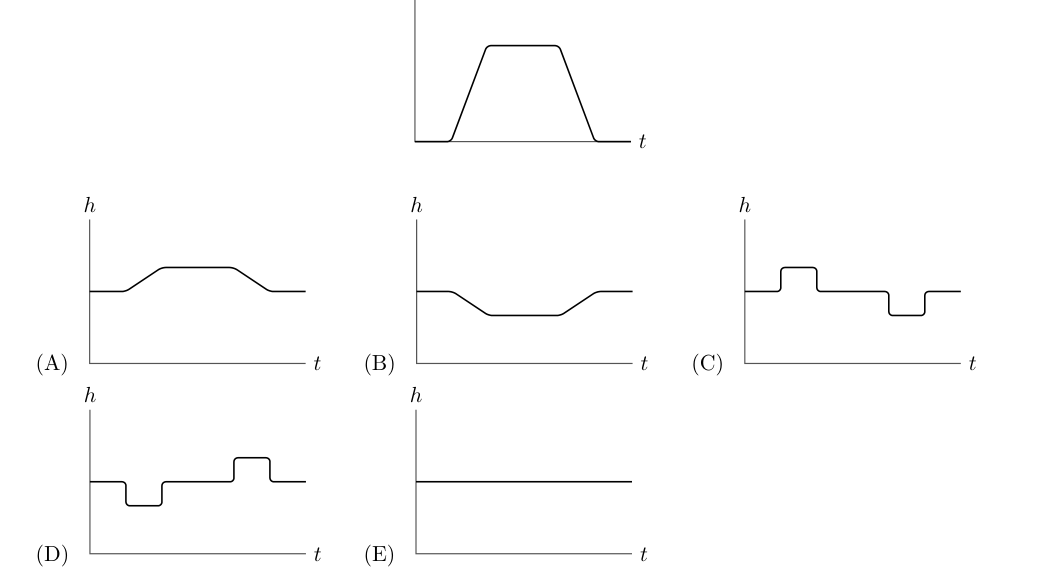
A cork floating in a cup filled with a viscous fluid is placed in an elevator. Below is a plot of the velocity of the elevator as a function of time . Which of the following plots best describes the height of the cork in the cup as a function of time? Assume that the fluid is viscous enough to dampen all oscillations, that the fluid does not slosh as the elevator accelerates, and that both the cork and fluid are incompressible.
[figure: velocity vs time graph for elevator — linear increase then constant; five options for cork height vs ]
(A) (B) (C) (D) (E) [see figure]
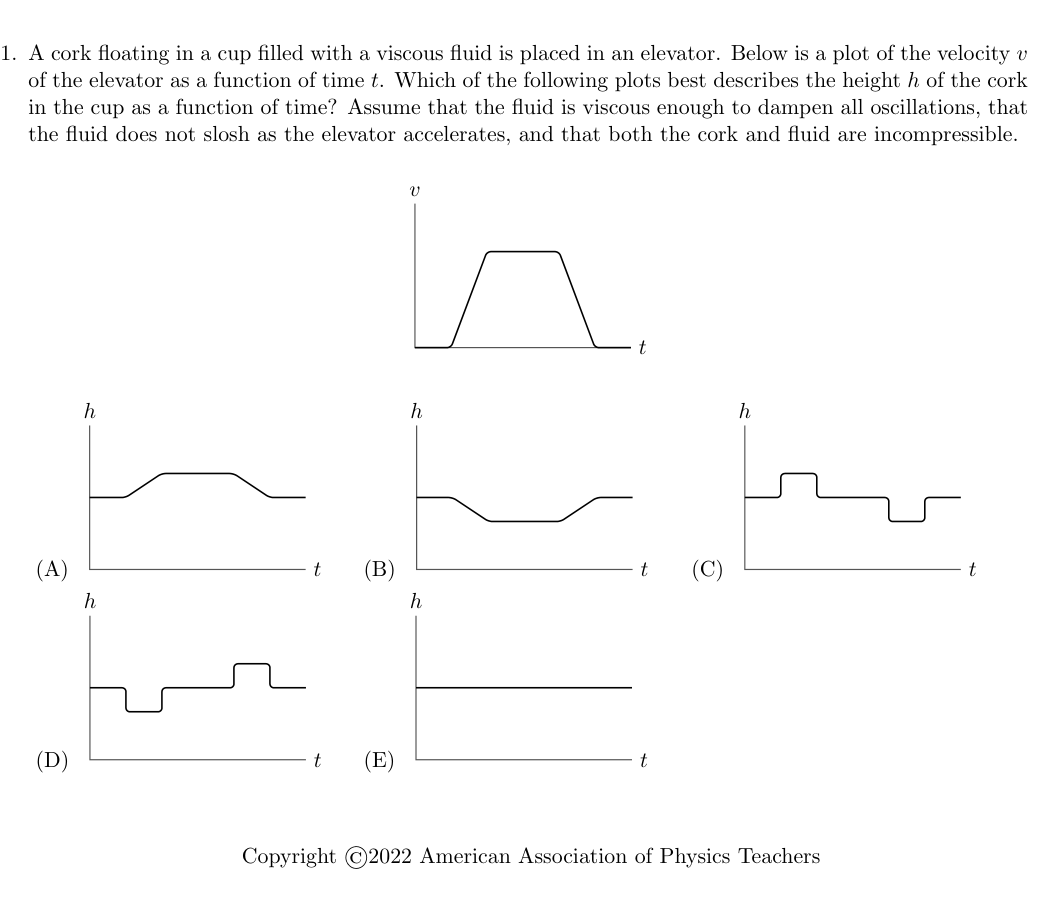 Elevator velocity vs time and five cork height options
Topic: Fluid Mechanics, Newtonian Mechanics Metodi: Free-Body Diagram, Physical Modeling, Hydrostatic Equilibrium Competenze: Physical Reasoning, Diagrammatic Reasoning Objects: Container Fonte: Testo (PDF) — p.8
Un corteccio che galleggia in una tazza piena di liquido viscoso viene messo in un ascensore. In seguito è riportato un diagramma della velocità dell’ascensore in funzione del tempo . Quale delle seguenti parti descrive meglio l’altezza del sughero nella tazza in funzione del tempo? Supponiamo che il fluido sia abbastanza viscoso da attenuare tutte le oscillazioni, che il fluido non si scorrga mentre l’ascensore accelera e che sia il sughero che il fluido siano incompressibili.
[figura: velocità vs grafico temporale per ascensore aumento lineare quindi costante; cinque opzioni per altezza di corteccia vs ]
(A) (B) (C) (D) (E) [vedi figura]
Velocità dell’ascensore contro tempo e cinque opzioni di altezza di corteccia
Topic: Fluid Mechanics, Newtonian Mechanics Metodi: Free-Body Diagram, Physical Modeling, Hydrostatic Equilibrium Competenze: Physical Reasoning, Diagrammatic Reasoning Objects: Container Fonte: Testo (PDF) — p.8
A block of mass is placed symmetrically on two identical wedges of mass , as shown.
[figure: block 2m resting symmetrically on two wedges of mass , each at angle to the vertical, on frictionless surface]
All surfaces are frictionless, and the wedges have angle to the vertical. If the system is released from rest, what is the downward acceleration of the block?
(A)
(B)
(C)
(D)
(E)
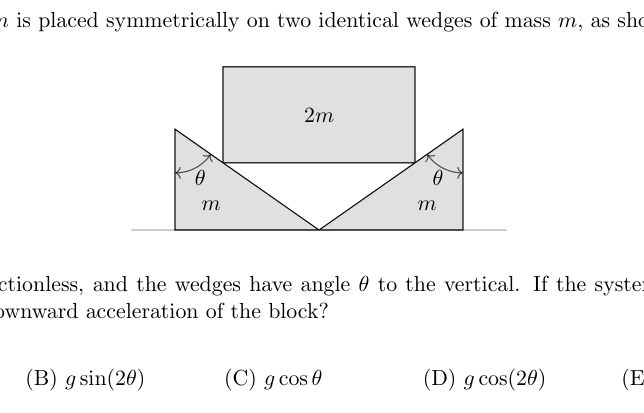 Block 2m on two symmetric frictionless wedges
Topic: Newtonian Mechanics Metodi: Free-Body Diagram, Vector Decomposition, Physical Modeling Competenze: Mathematical Modeling, Physical Reasoning Objects: Block, Wedge Fonte: Testo (PDF) — p.9
Un blocco di massa è posizionato simmetricamente su due cucine identiche di massa , come mostrato.
[figura: blocco di 2 m che si posa simmetricamente su due cucine di massa , ciascuna all’angolo verso la verticale, su superficie senza attrito]
Tutte le superfici sono senza attrito e le cucine hanno un angolo verso la verticale. Se il sistema viene rilasciato dal riposo, qual è l’accelerazione verso il basso del blocco?
(A)
(B)
(C)
(D)
(E)
Block 2m su due culi simmetrici senza attrito
Topic: Newtonian Mechanics Metodi: Free-Body Diagram, Vector Decomposition, Physical Modeling Competenze: Mathematical Modeling, Physical Reasoning Objects: Block, Wedge Fonte: Testo (PDF) — p.9
For objects moving through air, the force of air resistance can be modeled as proportional to the speed (“linear drag”) or proportional to the square of the speed (“quadratic drag”), depending on the circumstances. Two identical objects, A and B, are dropped from the same height simultaneously, but object A is given an initial horizontal velocity . The objects hit the ground at times and . Accounting for air resistance, which of the following is true?
(A) For both linear drag and quadratic drag, .
(B) For linear drag, , while for quadratic drag, .
(C) For linear drag, , while for quadratic drag, .
(D) For both linear drag and quadratic drag, .
(E) For both linear drag and quadratic drag, the answer depends on and .
Topic: Newtonian Mechanics Metodi: Free-Body Diagram, Physical Modeling, Differential Equations Competenze: Physical Reasoning, Mathematical Modeling Objects: — Fonte: Testo (PDF) — p.9
Per gli oggetti che si muovono attraverso l’aria, la forza della resistenza dell’aria può essere modellata come proporzionale alla velocità (“resistenza lineare”) o proporzionale al quadrato della velocità (“resistenza quadrata”), a seconda delle circostanze. Due oggetti identici, A e B, vengono abbassati dalla stessa altezza contemporaneamente, ma all’oggetto A viene data una velocità orizzontale iniziale . Gli oggetti colpiscono il terreno in e . Considerando la resistenza all’aria, quale di queste parole è vero?
(A) Per la resistenza lineare e la resistenza quadrata, .
(B) Per la resistenza lineare , mentre per la resistenza quadrata .
(C) Per la resistenza lineare , mentre per la resistenza quadrata .
(D) Per la resistenza lineare e la resistenza quadrata, .
(E) Per la resistenza sia lineare che quadrata, la risposta dipende da e .
Topic: Newtonian Mechanics Metodi: Free-Body Diagram, Physical Modeling, Differential Equations Competenze: Physical Reasoning, Mathematical Modeling Objects: — Fonte: Testo (PDF) — p.9
A satellite is in orbit around a planet of mass . Its maximum distance from the center of the planet is , and at this point, it is traveling at a speed of . What is the area of the satellite’s orbit?
(A)
(B)
(C)
(D)
(E)
Topic: Gravitation, Conservation of Energy Metodi: Kepler’s Laws, Newton’s Law of Gravitation, Conservation Laws Competenze: Mathematical Modeling, Physical Reasoning Objects: Satellite, Planet Fonte: Testo (PDF) — p.9
Un satellite è in orbita attorno a un pianeta di massa . La sua distanza massima dal centro del pianeta è , e a questo punto, viaggia a una velocità di . Qual è l’area dell’orbita del satellite?
(A)
(B)
(C)
(D)
(E)
Topic: Gravitation, Conservation of Energy Metodi: Kepler’s Laws, Newton’s Law of Gravitation, Conservation Laws Competenze: Mathematical Modeling, Physical Reasoning Objects: Satellite, Planet Fonte: Testo (PDF) — p.9
A cylinder is placed with its axis vertical, and a rubber band of mass and tension is wrapped horizontally around it. What is the minimum coefficient of static friction between the rubber band and the cylinder such that the band will not slide down the cylinder?
(A)
(B)
(C)
(D)
(E)
Topic: Newtonian Mechanics, Rigid Body Statics Metodi: Free-Body Diagram, Physical Modeling, Vector Decomposition Competenze: Physical Reasoning, Mathematical Modeling Objects: Cylinder, String Fonte: Testo (PDF) — p.9
Un cilindro è posizionato con il suo asse verticale e è avvolto orizzontalmente intorno a esso una fascia di gomma di massa e di tensione . Qual è il coefficiente minimo di attrito statico tra la fascia gommata e il cilindro in modo tale che la fascia non scivoli giù per il cilindro?
(A)
(B)
(C)
(D)
(E)
Topic: Newtonian Mechanics, Rigid Body Statics Metodi: Free-Body Diagram, Physical Modeling, Vector Decomposition Competenze: Physical Reasoning, Mathematical Modeling Objects: Cylinder, String Fonte: Testo (PDF) — p.9