- A ball is held a height above a slope, which is at an angle from the horizontal. The ball is dropped from rest. Assume the ball bounces off the slope perfectly elastically. What is the distance between its first and second impact points?
- A.
- B.
- C.
- D.
- E.
Topic: Newtonian Mechanics Metodi: Kinematic Equations, Vector Decomposition, Conservation of Energy Competenze: Physical Reasoning, Mathematical Modeling Objects: Ball, Inclined Plane Fonte: Testo (PDF) — p.2
- Una palla è tenuta ad un’altezza sopra una pendenza, che si trova ad un angolo dall’orizzontale. La palla è caduta dal riposo. Supponiamo che la palla rimbalzi dalla pendenza perfettamente elastica. Qual è la distanza tra i suoi punti di primo e secondo impatto?
- A.
- B.
- C.
- D.
- E.
Topic: Newtonian Mechanics Metodi: Kinematic Equations, Vector Decomposition, Conservation of Energy Competenze: Physical Reasoning, Mathematical Modeling Objects: Ball, Inclined Plane Fonte: Testo (PDF) — p.2
- A massless wheel of radius has four small masses placed evenly along its rim. Let the moment of inertia for rotations about the center of wheel, in the plane of the wheel, be . Now consider rotations about the two axes shown, with corresponding moments of inertia and . Which of the following is true?
- A.
- B.
- C.
- D.
- E.
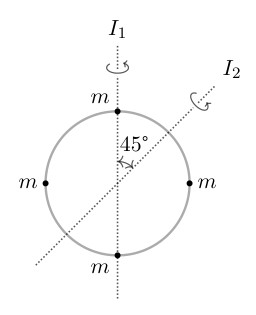 ruota con masse e assi di rotazione
Topic: Rotational Dynamics Metodi: Torque & Angular Momentum Analysis, Symmetry Argument, Physical Modeling Competenze: Physical Reasoning, Diagrammatic Reasoning Objects: Wheel Fonte: Testo (PDF) — p.2
- Una ruota senza massa di raggio ha quattro piccole masse disposte uniformemente lungo il suo bordo. Lascia che il momento di inerzia per le rotazioni intorno al centro della ruota, nel piano della ruota, è . Ora, considerate le rotazioni intorno ai due assi mostrati, con i corrispondenti momenti di inerzia e . Quale di queste parole è vero?
- A.
- B.
- C.
- D.
- E.
- rota con massa e assi di rotazione *
Topic: Rotational Dynamics Metodi: Torque & Angular Momentum Analysis, Symmetry Argument, Physical Modeling Competenze: Physical Reasoning, Diagrammatic Reasoning Objects: Wheel Fonte: Testo (PDF) — p.2
- Four evenly spaced points are marked on a massless seesaw, as shown. Two blocks, of masses and , are placed on the seesaw, so that it balances when the fulcrum is at point IV. (The diagram is not drawn to scale.) Now suppose the fulcrum is moved to point II. How much mass should be placed at point I so that the seesaw again balances?
- A.
- B.
- C.
- D.
- E. There is not enough information to decide.
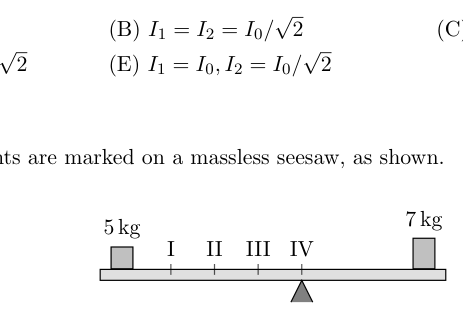 bilancia con masse 5 kg e 7 kg
Topic: Rigid Body Statics Metodi: Torque & Angular Momentum Analysis, Free-Body Diagram Competenze: Physical Reasoning, Mathematical Modeling Objects: Lever, Block Fonte: Testo (PDF) — p.2
- Quattro punti uniformemente spaziati sono segnati su una scorta senza massa, come mostrato. Due blocchi, di massa e , sono collocati sulla spina di presa, in modo che essa si bilanci quando il fulcro è a punto IV. (Il diagramma non è disegnato a scala.) Ora supponiamo che il fulcro sia spostato al punto II. Quanto ? La massa deve essere posta al punto I in modo che la scatola di scatto sia di nuovo in equilibrio?
- A.
- B.
- C.
- D.
- E. Non ci sono informazioni sufficienti per decidere.
*balancia con massa 5 kg e 7 kg *
Topic: Rigid Body Statics Metodi: Torque & Angular Momentum Analysis, Free-Body Diagram Competenze: Physical Reasoning, Mathematical Modeling Objects: Lever, Block Fonte: Testo (PDF) — p.2
- A firework explodes, sending shells in all directions in a vertical plane, as shown. Suppose the shells are all launched with the same speed, and ignore air resistance, but not gravity. A long time later, but before any of the shells hit the ground, what shape do the shells make? (A) (B) (C) (D) (E)
Topic: Newtonian Mechanics, Conservation of Energy Metodi: Kinematic Equations, Energy Conservation Method, Physical Modeling Competenze: Physical Reasoning, Mathematical Modeling Objects: Projectile Fonte: Testo (PDF) — p.3
- Un fuochi d’artificio esplode, inviando proiettili in tutte le direzioni in un piano verticale, come mostrato. Supponiamo che i proiettili siano lanciati con la stessa velocità e ignorino la resistenza dell’aria, ma non la gravità. A molto tempo dopo, ma prima che uno dei proiettili colpisca il terreno, quale forma fanno i proiettili? (A) (B) (C) (D) (E)
Topic: Newtonian Mechanics, Conservation of Energy Metodi: Kinematic Equations, Energy Conservation Method, Physical Modeling Competenze: Physical Reasoning, Mathematical Modeling Objects: Projectile Fonte: Testo (PDF) — p.3
- A swimmer swims at speed relative to still water. A river flows from a pier to a lake, with speed . If the swimmer swims downstream from the pier to the lake, then back upstream, what was their average speed during the trip?
- A.
- B.
- C.
- D.
- E.
Topic: Newtonian Mechanics Metodi: Kinematic Equations, Physical Modeling Competenze: Physical Reasoning, Mathematical Modeling Objects: — Fonte: Testo (PDF) — p.3
- Un nuotatore nuota a velocità rispetto all’acqua ferma. Un fiume scorre da un molo a un lago, con velocità . If il nuotatore nuota a valle dal molo al lago, poi torna a monte, che era la loro media velocità durante il viaggio?
- A.
- B.
- C.
- D.
- E.
Topic: Newtonian Mechanics Metodi: Kinematic Equations, Physical Modeling Competenze: Physical Reasoning, Mathematical Modeling Objects: — Fonte: Testo (PDF) — p.3
- A block of mass is at rest on a frictionless table. It is pushed horizontally by a constant force , and has total momentum when it reaches the end of the table. If a block of mass is pushed across the table in the same way, also starting from rest, what is its momentum when it reaches the end of the table?
- A.
- B.
- C.
- D.
- E.
Topic: Newtonian Mechanics, Conservation of Momentum Metodi: Free-Body Diagram, Kinematic Equations, Impulse-Momentum Theorem Competenze: Physical Reasoning, Mathematical Modeling Objects: Block Fonte: Testo (PDF) — p.3
- Un blocco di massa è a riposo su un tavolo senza attrito. è spinto orizzontalmente da una forza costante , e ha un impulso totale quando raggiunge la fine della tabella. Se un blocco di massa viene spinto attraverso il La Commissione ha deciso di adottare un’azione di riforma per la creazione di una nuova tabella.
- A.
- B.
- C.
- D.
- E.
Topic: Newtonian Mechanics, Conservation of Momentum Metodi: Free-Body Diagram, Kinematic Equations, Impulse-Momentum Theorem Competenze: Physical Reasoning, Mathematical Modeling Objects: Block Fonte: Testo (PDF) — p.3
- Two blocks of unequal mass and are hung from the ends of a massless, frictionless pulley, as shown. The blocks are held in place, and the entire pulley is mounted on a sensitive scale. After the blocks are released from rest, but before either has fallen off the pulley, what is the scale reading?
- A. It is less than .
- B. It is equal to .
- C. It is more than .
- D. It is initially less than , then approaches .
- E. It is initially more than , then approaches .
Topic: Newtonian Mechanics Metodi: Free-Body Diagram, Kinematic Equations, Conservation Laws Competenze: Physical Reasoning, Diagrammatic Reasoning Objects: Block, Pulley Fonte: Testo (PDF) — p.3
- Due blocchi di massa diseguale e sono appesi alle estremità di una pollice senza massa e senza attrito, come mostrato. I blocchi sono tenuti in posizione e l’intera polla è montata su una scala sensibile. Dopo che i blocchi sono rilasciati dal riposo, ma prima che uno di essi sia caduto dalla polla, qual è la lettura della scala?
- A. È inferiore a .
- B. È uguale a .
- C. È superiore a .
- D. Inizialmente è inferiore a , poi si avvicina a .
- E. Inizialmente è superiore a , poi si avvicina a .
Topic: Newtonian Mechanics Metodi: Free-Body Diagram, Kinematic Equations, Conservation Laws Competenze: Physical Reasoning, Diagrammatic Reasoning Objects: Block, Pulley Fonte: Testo (PDF) — p.3
- A ball is launched with speed at an angle to a fixed ramp, which itself makes a angle with the horizontal. Assume that when the ball hits the ramp, it bounces elastically and frictionlessly. For what value of will the ball bounce off the ramp two times, and then return to its original launch point?
- A.
- B.
- C.
- D.
- E.
Topic: Newtonian Mechanics Metodi: Kinematic Equations, Vector Decomposition, Conservation of Energy Competenze: Mathematical Modeling, Physical Reasoning Objects: Ball, Inclined Plane Fonte: Testo (PDF) — p.4
- Una palla viene lanciata con velocità ad un angolo verso una rampa fissa, che da sé produce un angolo con la
- L’orizzontale. Supponiamo che quando la palla colpisce la rampa, rimbalzi in modo elastico e senza attrito. Per quale valore di La palla rimbalzerà dalla rampa due volte, e poi ritornerà al suo punto di lancio originale?
- A.
- B.
- C.
- D.
- E.
Topic: Newtonian Mechanics Metodi: Kinematic Equations, Vector Decomposition, Conservation of Energy Competenze: Mathematical Modeling, Physical Reasoning Objects: Ball, Inclined Plane Fonte: Testo (PDF) — p.4
- Billy is leaning on a box of mass , exerting a force below the horizontal. If the coefficient of static friction of the box on the ground is , what is the minimum force needed for the box to slide?
- A.
- B.
- C.
- D.
- E.
Topic: Newtonian Mechanics Metodi: Free-Body Diagram, Vector Decomposition Competenze: Physical Reasoning, Mathematical Modeling, Diagrammatic Reasoning Objects: Block Fonte: Testo (PDF) — p.4
- Billy si appoggia su una scatola di massa , esercitando una forza sotto l’orizzontale. Se il coefficiente di la frizione statica della scatola sul terreno è , qual è la forza minima necessaria per far sì che la scatola si
- Slide?
- A.
- B.
- C.
- D.
- E.
Topic: Newtonian Mechanics Metodi: Free-Body Diagram, Vector Decomposition Competenze: Physical Reasoning, Mathematical Modeling, Diagrammatic Reasoning Objects: Block Fonte: Testo (PDF) — p.4
- Two springs with spring constants and are connected in parallel. They are both connected in series to a spring of constant , as shown. What force must be exerted at the end to extend the system by from its relaxed length?
- A.
- B.
- C.
- D.
- E.
Topic: Newtonian Mechanics, Oscillations & Waves Metodi: Hooke’s Law, Superposition Principle, Physical Modeling Competenze: Physical Reasoning, Mathematical Modeling Objects: Spring Fonte: Testo (PDF) — p.4
- Due sorgenti con costanti sorgenti e sono collegate in parallelo. Sono entrambe connesse . in serie a una molla di costante , come mostrato. Qual è la forza che deve essere esercitata alla fine per estendere il sistema di dalla sua lunghezza rilassata?
- A.
- B.
- C.
- D.
- E.
Topic: Newtonian Mechanics, Oscillations & Waves Metodi: Hooke’s Law, Superposition Principle, Physical Modeling Competenze: Physical Reasoning, Mathematical Modeling Objects: Spring Fonte: Testo (PDF) — p.4
- Water with total mass is poured into a cup of cross-sectional area . A block of mass , whose density is half that of water, is tied to a thin string. The string is attached to the bottom of the cup, and the block floats in the water as shown. The atmospheric pressure is . What is the total pressure force that the water exerts on the bottom of the cup?
- A.
- B.
- C.
- D.
- E.
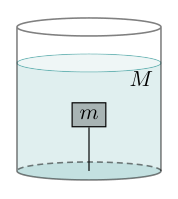 tazza con blocco immerso in acqua
Topic: Fluid Mechanics, Newtonian Mechanics Metodi: Hydrostatic Equilibrium, Free-Body Diagram, Physical Modeling Competenze: Physical Reasoning, Mathematical Modeling Objects: Block, String, Container Fonte: Testo (PDF) — p.4
- L’acqua di massa totale viene versata in una tazza di superficie trasversale . Un blocco di massa , la cui densità è inferiore o uguale a è metà dell’acqua, è legata a una sottile corda. La corda è attaccata al fondo della tazza, e la blocco galleggiante nell’acqua come mostrato. La pressione atmosferica è . Qual è la forza di pressione totale che l’acqua si esercita sul fondo della tazza?
- A.
- B.
- C.
- D.
- E.
tazza con blocco immersione in acqua
Topic: Fluid Mechanics, Newtonian Mechanics Metodi: Hydrostatic Equilibrium, Free-Body Diagram, Physical Modeling Competenze: Physical Reasoning, Mathematical Modeling Objects: Block, String, Container Fonte: Testo (PDF) — p.4
- Two identical bricks of mass are attached to two frictionless pulleys by a massless string, on a fixed slope of angle to the horizontal, as shown. Suppose that the coefficient of static friction between the lower block and the slope is , and all other surfaces are frictionless. What is the minimum value of so that the blocks can stay static?
- A.
- B.
- C.
- D.
- E.
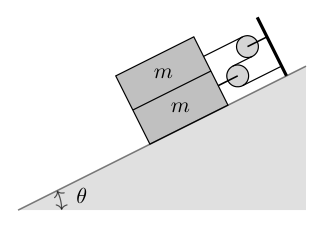 piano inclinato con carrucole e mattoni
Topic: Newtonian Mechanics, Rigid Body Statics Metodi: Free-Body Diagram, Vector Decomposition, Torque & Angular Momentum Analysis Competenze: Mathematical Modeling, Diagrammatic Reasoning Objects: Block, Pulley, Inclined Plane, String Fonte: Testo (PDF) — p.5
- Due mattoni identici di massa sono attaccati a due polli senza attrito con una corda senza massa, su una inclinamento dell’angolo verso l’orizzontale, come mostrato. Supponiamo che il coefficiente di attrito statico tra il blocco inferiore e la pendenza sia , e tutti gli altri Le superfici sono senza attrito. Qual è il valore minimo di in modo che i blocchi possano rimanere statici?
- A.
- B.
- C.
- D.
- E.
Piano inclinato con carrucole e mattoni
Topic: Newtonian Mechanics, Rigid Body Statics Metodi: Free-Body Diagram, Vector Decomposition, Torque & Angular Momentum Analysis Competenze: Mathematical Modeling, Diagrammatic Reasoning Objects: Block, Pulley, Inclined Plane, String Fonte: Testo (PDF) — p.5
- A ballistic pendulum is designed as shown below. A uniform ball of mass and radius is attached to a massless rigid rod, so that its center is a distance from the ceiling. The ball has a small tunnel hollowed out. A small block of mass and speed goes into the tunnel and collides at the center of the ball, perfectly inelastically. Subsequently, to what maximum height does the block rise?
- A.
- B.
- C.
- D.
- E.
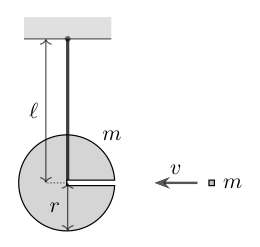 pendolo balistico con palla e proiettile
Topic: Rotational Dynamics, Conservation of Momentum Metodi: Conservation of Momentum, Torque & Angular Momentum Analysis, Energy Conservation Method Competenze: Mathematical Modeling, Physical Reasoning Objects: Pendulum, Ball, Rod, Block Fonte: Testo (PDF) — p.5
- Un pendolo balistico è progettato come mostrato di seguito. Una palla uniforme di massa e di raggio è attaccata a una canna rigida senza massa, in modo che il suo centro sia a una distanza dal soffitto. La palla ha un piccolo tunnel svuotato. Un piccolo blocco di massa e velocità entra in il tunnel e colpisce al centro della palla, perfettamente inelasticamente. Successivamente, fino a che punto
- L’altezza del blocco aumenta?
- A.
- B.
- C.
- D.
- E.
*pendolo balistico con palla e proiettile *
Topic: Rotational Dynamics, Conservation of Momentum Metodi: Conservation of Momentum, Torque & Angular Momentum Analysis, Energy Conservation Method Competenze: Mathematical Modeling, Physical Reasoning Objects: Pendulum, Ball, Rod, Block Fonte: Testo (PDF) — p.5
- A cylinder of water is suspended in a space station. Under the influence of surface tension, the cylinder splits into droplets. After a short time, viscosity causes the droplets to settle into static shapes. Neglect the effect of evaporation. Compared to the original cylinder, the final set of droplets will have
- A. Almost exactly the same volume and surface area
- B. More volume, but almost exactly the same surface area
- C. Less volume, but almost exactly the same surface area
- D. More surface area, but almost exactly the same volume
- E. Less surface area, but almost exactly the same volume
Topic: Fluid Mechanics Metodi: Physical Modeling, Symmetry Argument Competenze: Physical Reasoning, Mathematical Modeling Objects: Cylinder, Droplet Fonte: Testo (PDF) — p.6
- Un cilindro d’acqua è sospeso in una stazione spaziale. Sotto l’influenza della tensione superficiale, il cilindro si divide in goccioline. Dopo un breve periodo di tempo, la viscosità fa sì che le gocce si stabiliscano in forme statiche. L’abbandono l’effetto dell’evaporazione. Rispetto al cilindro originale, l’ultimo set di goccioline avrà
- A. Quasi esattamente lo stesso volume e superficie
- B. Più volume, ma quasi esattamente la stessa superficie
- C. Meno volume, ma quasi esattamente la stessa superficie
- D. Più superficie, ma quasi esattamente lo stesso volume
- E. Più superficie, ma quasi esattamente lo stesso volume
Topic: Fluid Mechanics Metodi: Physical Modeling, Symmetry Argument Competenze: Physical Reasoning, Mathematical Modeling Objects: Cylinder, Droplet Fonte: Testo (PDF) — p.6
- Five astronauts are orbiting Earth in a low circular orbit. They decided to go around the planet following the same orbit, but much faster, to set a new record for orbiting Earth. Four of them thought that they could quickly increase the velocity, then use a jet engine to maintain an orbit of the same shape; in the first four choices below, the red arrow denotes the direction that fuel will flow out of the jet nozzle. The fifth astronaut was skeptical about such a possibility. Who is right?
- A. Earth
- B. Earth
- C. Earth
- D. Earth
- E. It is impossible to follow the same orbit faster.
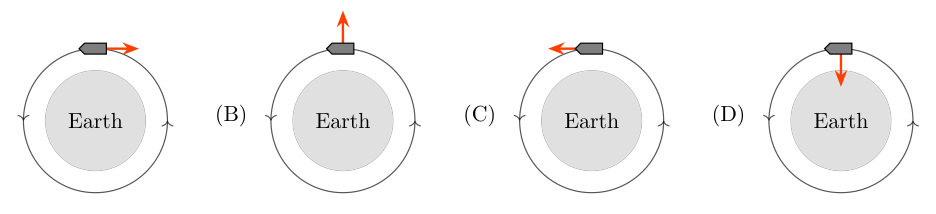 quattro opzioni orbita terrestre
Topic: Gravitation, Astrophysics Metodi: Newton’s Law of Gravitation, Kepler’s Laws, Energy Conservation Method Competenze: Physical Reasoning, Mathematical Modeling Objects: Satellite, Planet Fonte: Testo (PDF) — p.6
- Cinque astronauti orbitano intorno alla Terra in una bassa orbita circolare. Hanno deciso di girare il pianeta seguendo la stessa orbita, ma molto più veloce, per stabilire un nuovo record per l’orbita della Terra. Quattro di loro pensavano che La velocità di un’orbita di una forma simile è aumentata rapidamente, quindi si utilizza un motore a reazione per mantenere un’orbita della stessa forma; Le prime quattro scelte di seguito, la freccia rossa indica la direzione in cui il carburante scorrera’ dalla bozza del jet. Il Il quinto astronauta era scettico di una tale possibilità. Chi ha ragione?
- A. Terra
- B. Terra
- C. Terra
- D. Terra
- E. È impossibile seguire la stessa orbita più velocemente.
quattro opzioni orbita terrestre
Topic: Gravitation, Astrophysics Metodi: Newton’s Law of Gravitation, Kepler’s Laws, Energy Conservation Method Competenze: Physical Reasoning, Mathematical Modeling Objects: Satellite, Planet Fonte: Testo (PDF) — p.6
- A uniform rectangular block is in static equilibrium on an inclined plane, and experiences gravity, static friction, and the normal force from the plane. Though gravity acts on the entire volume of the block, for the purposes of torque balance, it is equivalent to a single resultant force acting at the block’s center of mass. Similarly, while the normal force acts on the entire bottom surface of the block, its torque is equivalent to a resultant force acting at a single point. Which of the following best shows this point?
- A. Point A, at the lowest point of the bottom side
- B. Point B, directly below the center of mass
- C. Point C, at the midpoint of the bottom side
- D. Point D, directly below the top corner
- E. Point E, at the highest point of the bottom side
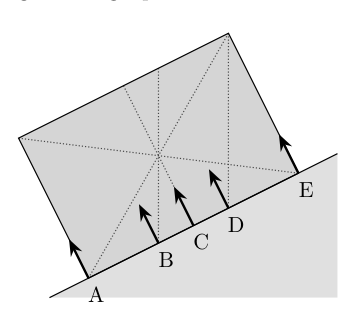 blocco rettangolare su piano inclinato
Topic: Rigid Body Statics, Newtonian Mechanics Metodi: Free-Body Diagram, Torque & Angular Momentum Analysis, Vector Decomposition Competenze: Diagrammatic Reasoning, Physical Reasoning Objects: Block, Inclined Plane Fonte: Testo (PDF) — p.6
- Un blocco rettangolare uniforme è in equilibrio statico su un piano inclinato, e sperimenta la gravità, statico
- E’ la forza normale dell’aereo. Anche se la gravità agisce sull’intero volume del blocco, per l’equilibrio della coppia, è equivalente a una singola forza risultante che agisce al centro del blocco di massa. Allo stesso modo, mentre la forza normale agisce su tutta la superficie inferiore del blocco, la sua coppia è equivalente a una forza risultante che agisce in un singolo punto. Quale delle seguenti indica meglio questo punto?
- A. Punto A, al punto più basso del lato inferiore
- B. Punto B, direttamente al di sotto del centro di massa
- C. Punto C, al centro del lato inferiore
- D. Punto D, direttamente sotto l’angolo superiore
- E. Punto E, al punto più alto del lato inferiore
*blocco rettangolare su pianoforte inclinato *
Topic: Rigid Body Statics, Newtonian Mechanics Metodi: Free-Body Diagram, Torque & Angular Momentum Analysis, Vector Decomposition Competenze: Diagrammatic Reasoning, Physical Reasoning Objects: Block, Inclined Plane Fonte: Testo (PDF) — p.6
- A box of mass is sliding to the right with velocity on a frictionless table. A small puck of mass slides frictionlessly inside the box. Initially, the puck is at the left wall of the box, with a rightward velocity of with respect to the table. After a time , the puck collides elastically with the right wall of the box. How much longer will it take until the puck hits the left wall of the box again?
- A.
- B.
- C.
- D.
- E.
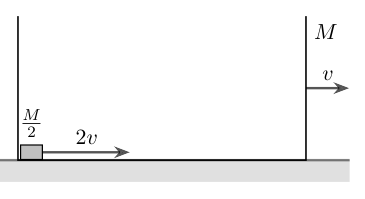 scatola con puck rimbalzante interno
Topic: Newtonian Mechanics, Conservation of Momentum Metodi: Conservation of Momentum, Kinematic Equations, Conservation Laws Competenze: Physical Reasoning, Mathematical Modeling Objects: Block Fonte: Testo (PDF) — p.7
- Una scatola di massa scivola a destra con velocità su una tavola senza attrito. Un piccolo disco di massa scivola senza attriti all’interno della scatola. Inizialmente, il puck è sulla parete sinistra della scatola, con un verso destra velocità di rispetto alla tabella. Dopo un tempo , la puck colpisce elasticamente la parete destra della scatola. Quanto tempo ci vorrà ancora prima che il puck colpisca di nuovo la parete sinistra della scatola?
- A.
- B.
- C.
- D.
- E.
- scatola con puck rimbalzante interno *
Topic: Newtonian Mechanics, Conservation of Momentum Metodi: Conservation of Momentum, Kinematic Equations, Conservation Laws Competenze: Physical Reasoning, Mathematical Modeling Objects: Block Fonte: Testo (PDF) — p.7
- The following information applies to problems 18 and 19. A uniform rod of length and mass is placed with its ends resting on two identical springs of spring constant , as shown. The rod is initially in equilibrium. If the rod is uniformly displaced downward and released from rest, what is the frequency of its oscillations?
- A.
- B.
- C.
- D.
- E.
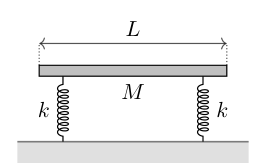 asta su due molle identiche
Topic: Oscillations & Waves, Newtonian Mechanics Metodi: Simple Harmonic Motion Analysis, Hooke’s Law, Superposition Principle Competenze: Mathematical Modeling, Physical Reasoning Objects: Rod, Spring Fonte: Testo (PDF) — p.7
- Le seguenti informazioni si applicano ai problemi 18 e 19. Si colloca una canna uniforme di lunghezza e di massa con le sue estremità appoggiate su due sorgenti identiche di primavera costante , come mostrato. La canna è inizialmente in equilibrio. Se la canna è spostata uniformemente verso il basso e rilasciata dal riposo, Qual è la frequenza delle sue oscillazioni?
- A.
- B.
- C.
- D.
- E.
*asta su due molle identiche *
Topic: Oscillations & Waves, Newtonian Mechanics Metodi: Simple Harmonic Motion Analysis, Hooke’s Law, Superposition Principle Competenze: Mathematical Modeling, Physical Reasoning Objects: Rod, Spring Fonte: Testo (PDF) — p.7
- Next, the rod is brought back to equilibrium. It is slightly rotated about its center of mass, then released from rest. What is the frequency of its oscillations?
- A.
- B.
- C.
- D.
- E.
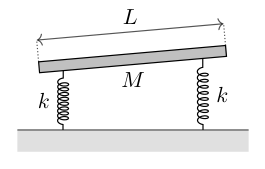 asta ruotata leggermente sull’equilibrio
Topic: Oscillations & Waves, Rotational Dynamics Metodi: Simple Harmonic Motion Analysis, Torque & Angular Momentum Analysis, Hooke’s Law Competenze: Mathematical Modeling, Physical Reasoning Objects: Rod, Spring Fonte: Testo (PDF) — p.7
- Successivamente, la canna viene riportata in equilibrio. Si ruota leggermente intorno al suo centro di massa, quindi viene rilasciato dal riposo. Qual è la frequenza delle sue oscillazioni?
- A.
- B.
- C.
- D.
- E.
asta ruotata leggermente sull’equilibrio
Topic: Oscillations & Waves, Rotational Dynamics Metodi: Simple Harmonic Motion Analysis, Torque & Angular Momentum Analysis, Hooke’s Law Competenze: Mathematical Modeling, Physical Reasoning Objects: Rod, Spring Fonte: Testo (PDF) — p.7
- A uniform, hollow sphere is initially at rest on a horizontal plane. The plane begins to accelerate horizontally to the right, with acceleration . If friction is high enough to prevent the sphere from slipping, what is its translational acceleration?
- A. to the left
- B. to the left
- C. zero
- D. to the right
- E. to the right
Topic: Rotational Dynamics, Newtonian Mechanics Metodi: Free-Body Diagram, Torque & Angular Momentum Analysis, Kinematic Equations Competenze: Physical Reasoning, Mathematical Modeling Objects: Sphere Fonte: Testo (PDF) — p.8
- Una sfera uniforme e vuota è inizialmente in riposo su un piano orizzontale. Il piano inizia ad accelerare orizzontalmente a destra, con accelerazione . Se la frizione è abbastanza alta da impedire che la sfera scivoli, Qual è la sua accelerazione traslazionale?
- A. a sinistra
- B. a sinistra
- C. zero
- D. a destra
- E. a destra
Topic: Rotational Dynamics, Newtonian Mechanics Metodi: Free-Body Diagram, Torque & Angular Momentum Analysis, Kinematic Equations Competenze: Physical Reasoning, Mathematical Modeling Objects: Sphere Fonte: Testo (PDF) — p.8
- Amora and Bronko are given a long, thin rectangle of sheet metal. (It has been machined very precisely, so they can assume it is perfectly rectangular.) Using calipers, Amora measures the width of the rectangle as with 1% uncertainty. Using a tape measure, Bronko independently measures its length as with 0.1% uncertainty. Which of the following are closest to the relative uncertainties they should report for the area and the perimeter of the rectangle, respectively?
- A. 0.1%; 0.2%
- B. 1%; 0.1%
- C. 1%; 0.2%
- D. 1%; 1%
- E. 1%; 2%
Topic: Order-of-Magnitude Estimation Metodi: Error Propagation, Dimensional Analysis Competenze: Error Propagation, Mathematical Modeling Objects: — Fonte: Testo (PDF) — p.8
- Amora e Bronko ricevono un lungo rettangolo sottile di lamiera. (È stato lavorato con una precisione molto elevata, Per questo, possono assumere che sia perfettamente rettangolare.) in con un’incertezza dell’ 1%. Utilizzando una nastro misurabile, Bronko misura autonomamente la sua lunghezza come con un’incertezza dello 0,1%. Quali dei seguenti sono i casi di incertezza relativa che dovrebbero segnalare per l’area e il perimetro del rettangolo, rispettivamente?
- A. 0.1%; 0.2%
- B. 1%; 0.1%
- C. 1%; 0.2%
- D. 1%; 1%
- E. 1%; 2%
Topic: Order-of-Magnitude Estimation Metodi: Error Propagation, Dimensional Analysis Competenze: Error Propagation, Mathematical Modeling Objects: — Fonte: Testo (PDF) — p.8
- A cannon just above the surface of a spherical planet with mass and radius launches a particle with speed , where . The initial velocity of the particle makes an angle with the vertical direction. Neglect drag. For what will the particle never collide with the planet?
- A. All possible launch angles,
- B.
- C.
- D. Only
- E. A collision will occur for any value of
Topic: Gravitation, Conservation of Energy Metodi: Newton’s Law of Gravitation, Energy Conservation Method, Conservation Laws Competenze: Mathematical Modeling, Physical Reasoning Objects: Planet, Projectile Fonte: Testo (PDF) — p.8
- Un cannone appena sopra la superficie di un pianeta sferico con massa e raggio lancia una particella con velocità , dove . La velocità iniziale della particella fa un angolo con la direzione verticale. - Non ti preoccupare. For what will the particle never collide with the planet?
- A. Tutti gli angoli di lancio possibili,
- B.
- C.
- D. Solo
- E. Si verificerà una collisione per qualsiasi valore di
Topic: Gravitation, Conservation of Energy Metodi: Newton’s Law of Gravitation, Energy Conservation Method, Conservation Laws Competenze: Mathematical Modeling, Physical Reasoning Objects: Planet, Projectile Fonte: Testo (PDF) — p.8
- A mass attached to a spring is performing simple harmonic motion, with velocity and acceleration . Which of the following could be a graph of the curve over a complete oscillation?
- A. ,
- B. ,
- C. ,
- D. ,
- E. ,
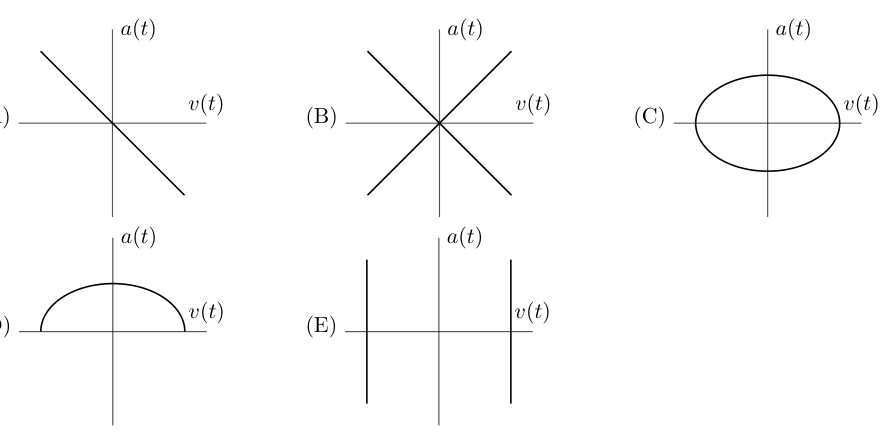 cinque grafici fase v(t)-a(t) per MAS
Topic: Oscillations & Waves Metodi: Simple Harmonic Motion Analysis, Physical Modeling Competenze: Mathematical Modeling, Physical Reasoning, Diagrammatic Reasoning Objects: Spring Fonte: Testo (PDF) — p.8
- Una massa attaccata a una molla esegue un semplice movimento armonico, con velocità e accelerazione . Quale delle seguenti potrebbe essere un grafico della curva su un’oscillazione completa?
- A. ,
- B. ,
- C. ,
- D. ,
- E. ,
*cinque grafici fase v) t) a) t) per MAS *
Topic: Oscillations & Waves Metodi: Simple Harmonic Motion Analysis, Physical Modeling Competenze: Mathematical Modeling, Physical Reasoning, Diagrammatic Reasoning Objects: Spring Fonte: Testo (PDF) — p.8
- A ramp with height is moving with fixed, uniform speed to the right. A small block of mass is placed at the top of the ramp, and is released at rest with respect to the ramp. The block slides smoothly to the bottom of the ramp and onto the floor. How much kinetic energy does it gain in this process? Neglect friction.
- A.
- B.
- C.
- D.
- E.
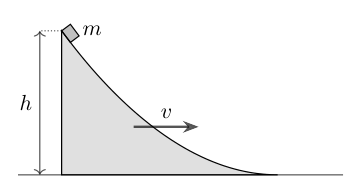 rampa in moto con blocco in cima
Topic: Newtonian Mechanics, Conservation of Energy Metodi: Energy Conservation Method, Kinematic Equations, Free-Body Diagram Competenze: Mathematical Modeling, Physical Reasoning Objects: Block, Inclined Plane Fonte: Testo (PDF) — p.9
- Una rampa con altezza si muove a destra con velocità fissa e uniforme . Un piccolo blocco di massa è collocato in cima alla rampa e rilasciato in riposo rispetto alla rampa. Il blocco scivola liscia verso il fondo della rampa e sul pavimento. Quanto energia cinetica che guadagna in questo processo? - Non si tratta di attrito.
- A.
- B.
- C.
- D.
- E.
rampa in moto con blocco in cima
Topic: Newtonian Mechanics, Conservation of Energy Metodi: Energy Conservation Method, Kinematic Equations, Free-Body Diagram Competenze: Mathematical Modeling, Physical Reasoning Objects: Block, Inclined Plane Fonte: Testo (PDF) — p.9
- Two masses are initially at rest, separated by a distance , and attract each other gravitationally. If their masses are and , then they will collide after a time . How long would they take to collide if they both had mass ?
- A.
- B.
- C.
- D.
- E.
Topic: Gravitation, Conservation of Energy Metodi: Newton’s Law of Gravitation, Energy Conservation Method, Calculus-Integration Competenze: Mathematical Modeling, Physical Reasoning Objects: — Fonte: Testo (PDF) — p.9
- Due masse sono inizialmente a riposo, separate da una distanza , e si attraggono gravitazionalmente. Se il loro le masse sono e , quindi si colpiranno dopo un tempo . Quanto tempo ci vorrebbe per collidere se entrambe le parti avevano massa ?
- A.
- B.
- C.
- D.
- E.
Topic: Gravitation, Conservation of Energy Metodi: Newton’s Law of Gravitation, Energy Conservation Method, Calculus-Integration Competenze: Mathematical Modeling, Physical Reasoning Objects: — Fonte: Testo (PDF) — p.9