- A simple scale consists of two platforms of negligible mass fitted together by springs. When the scale is put on the ground, your weight W is measured by the deformation of the springs. Suppose you now fit the same number of springs on the upper platform of twice the stiffness of the lower springs. You then put another platform of negligible mass on the upper springs and then stand on the scale again to have the scale observe a weight . What is the ratio of the new observed weight to the original, ?
- A. 1/3
- B. 3/2
- C. 2/3
- D. 3
- E. 2
Topic: Newtonian Mechanics, Oscillations & Waves Metodi: Hooke’s Law, Free-Body Diagram, Physical Modeling Competenze: Physical Reasoning, Mathematical Modeling Objects: Spring Fonte: Testo (PDF) — p.2
- Una scala semplice è costituita da due piattaforme di massa trascurabile montate insieme da sorgenti. Quando la scala Se il peso W viene misurato dalla deformazione delle molle. Supponiamo che tu sia ora si inseriscono nello stesso numero di sorgenti sulla piattaforma superiore, due volte più rigide delle sorgenti inferiori. Tu… Poi mettere un’altra piattaforma di massa trascurabile sulle sorgenti superiori e poi stare di nuovo sulla scala per far osservare alla scala un peso . Qual è il rapporto tra il nuovo peso osservato e l’originale, ?
- A. 1/3
- B. 3/2
- C. 2/3
- D. 3
- E. 2
Topic: Newtonian Mechanics, Oscillations & Waves Metodi: Hooke’s Law, Free-Body Diagram, Physical Modeling Competenze: Physical Reasoning, Mathematical Modeling Objects: Spring Fonte: Testo (PDF) — p.2
- A small mass is put on the end of an ideal string of length which is fastened to a vertex O on a small fixed cube of sidelength . The mass-string system is extended to its maximum length and put parallel to one side of the square. The mass is then given a velocity perpendicular to the string. In how much time will the mass hit the cube? O
- A.
- B.
- C.
- D.
- E.
Topic: Newtonian Mechanics, Oscillations & Waves Metodi: Kinematic Equations, Physical Modeling, Simple Harmonic Motion Analysis Competenze: Physical Reasoning, Mathematical Modeling Objects: String Fonte: Testo (PDF) — p.2
- Una piccola massa viene posta all’estremità di una stringa ideale di lunghezza che è fissata ad un vertice O su una piccolo cubo fisso di lunghezza laterale . Il sistema di stringhe di massa è esteso alla sua lunghezza massima e messo parallelo ad un lato della piazza. La massa viene quindi data una velocità perpendicolare alla corda. In Quanto tempo ci vorrà per raggiungere il cubo? O
- A.
- B.
- C.
- D.
- E.
Topic: Newtonian Mechanics, Oscillations & Waves Metodi: Kinematic Equations, Physical Modeling, Simple Harmonic Motion Analysis Competenze: Physical Reasoning, Mathematical Modeling Objects: String Fonte: Testo (PDF) — p.2
- A sprinkler can be modelled as a hemisphere with evenly divided holes, where water comes out at equal velocities. The maximum height that water reaches from the sprinkler is . What is the maximum possible height achieved by the water when all the holes on the sprinkler, except one, are covered? Assume the initial flow rate of water that enters the hemisphere never changes with time.
- A.
- B.
- C.
- D.
- E.
Topic: Fluid Mechanics, Newtonian Mechanics Metodi: Bernoulli’s Equation, Continuity Equation, Physical Modeling Competenze: Physical Reasoning, Mathematical Modeling Objects: — Fonte: Testo (PDF) — p.2
- Un sprinkler può essere modellato come un emisfero con buchi uniformemente divisi, dove l’acqua esce a velocità uguali. L’altezza massima che l’acqua raggiunge dal sprinkler è . Che cos’è l’altezza massima possibile raggiunta dall’acqua quando tutti i fori della sprinkler, tranne uno, sono
- Coperto? Supponiamo che il flusso iniziale di acqua che entra nell’emisfero non cambie mai con il tempo.
- A.
- B.
- C.
- D.
- E.
Topic: Fluid Mechanics, Newtonian Mechanics Metodi: Bernoulli’s Equation, Continuity Equation, Physical Modeling Competenze: Physical Reasoning, Mathematical Modeling Objects: — Fonte: Testo (PDF) — p.2
- Consider a setup consisting of a four-way small pipe connected to a tube from below. The structure rotates at an angular velocity anti-clockwise and water flows upwards into the pipe at a constant rate. What would the pattern of water that flows out of the pipes look like from a ground observer watching from top? (A) (C) (E) (B) (D)
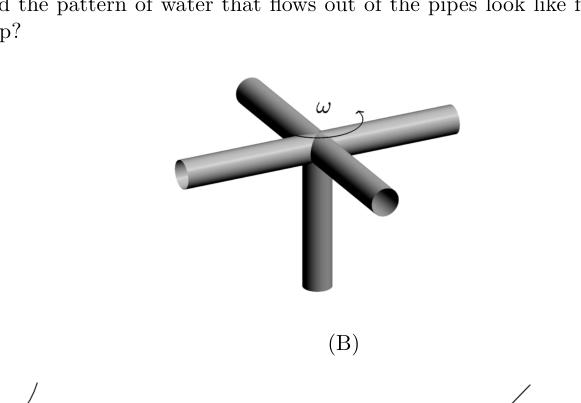 tubo a quattro vie rotante con omega
 schemi top-view pattern acqua (A-E)
Topic: Rotational Dynamics, Newtonian Mechanics Metodi: Torque & Angular Momentum Analysis, Vector Decomposition, Physical Modeling Competenze: Diagrammatic Reasoning, Physical Reasoning Objects: Tube Fonte: Testo (PDF) — p.3
- Considerate un’impostazione costituita da un piccolo tubo a quattro vie collegato da sotto a un tubo. La struttura rota a velocità angolare contro il senso dell’orologio e l’acqua scorre verso l’alto nel tubo a una costante velocità
- Le tasse. Come sarebbe il modello dell’acqua che scorre dalle tubi da un osservatore a terra Guardando da sopra? (A) (C) (E) (B) (D)
*tubo a quattro vie rotante con omega *
*schemi top-view pattern acqua (A-E) *
Topic: Rotational Dynamics, Newtonian Mechanics Metodi: Torque & Angular Momentum Analysis, Vector Decomposition, Physical Modeling Competenze: Diagrammatic Reasoning, Physical Reasoning Objects: Tube Fonte: Testo (PDF) — p.3
- A meteor hits the moon and creates a crater within the ground. The crater can be modelled as a cubic hole of length , created when the material originally within it is ejected out after the collision. Assume that energy is not lost during the collision. If a meteor of twice the mass of the initial meteor hits the moon at the same velocity, how much larger is the volume of the crater compared to the initial one? Assume everything on the moon are of the same density. initial crater
- A. 16
- B. 4
- C. 2
- D.
- E.
 cratere cubico sezione trasversale
Topic: Conservation of Energy, Conservation of Momentum, Newtonian Mechanics Metodi: Energy Conservation Method, Conservation Laws, Dimensional Analysis Competenze: Physical Reasoning, Mathematical Modeling Objects: Planet Fonte: Testo (PDF) — p.4
- Un meteorito colpisce la luna e crea un cratere all’interno della terra. Il cratere può essere modellato come un buco cubo di lunghezza , creato quando il materiale originariamente all’interno viene espulso dopo la collisione. Supponiamo che l’energia non venga persa durante la collisione. Se un meteorito di doppio massa del meteorito iniziale colpisce la luna alla stessa velocità, quanto è più grande il volume del cratere rispetto al
- L’inizio? Supponiamo che tutto sulla luna abbia la stessa densità. cratere iniziale
- A. 16
- B. 4
- C. 2
- D.
- E.
crate cubico sezione trasversale
Topic: Conservation of Energy, Conservation of Momentum, Newtonian Mechanics Metodi: Energy Conservation Method, Conservation Laws, Dimensional Analysis Competenze: Physical Reasoning, Mathematical Modeling Objects: Planet Fonte: Testo (PDF) — p.4
- A thin hollow cylinder of radius and thickness , is situated vertically on a plane with kinetic and static coefficient of friction 0.3. A force is applied normal to the plane, and the cylinder is made to rotate at a constant angular velocity . How much heat is dissipated due to friction after a time ?
- A.
- B.
- C.
- D.
- E.
 cilindro cavo verticale con forza F e omega
Topic: Rotational Dynamics, Newtonian Mechanics, Thermodynamics Metodi: Free-Body Diagram, Torque & Angular Momentum Analysis, Kinematic Equations Competenze: Mathematical Modeling, Physical Reasoning Objects: Cylinder Fonte: Testo (PDF) — p.4
- Un cilindro incrocio sottile di raggio e spessore , è situato verticalmente su un piano con coefficiente di attrito cinetico e statico 0,3. Si applica una forza normale sul piano, e la il cilindro è fatto per ruotare a velocità angolare costante . Quanto calore viene dissipato a causa di attrito dopo un tempo ?
- A.
- B.
- C.
- D.
- E.
- cilindro cavo verticale con forza F e omega *
Topic: Rotational Dynamics, Newtonian Mechanics, Thermodynamics Metodi: Free-Body Diagram, Torque & Angular Momentum Analysis, Kinematic Equations Competenze: Mathematical Modeling, Physical Reasoning Objects: Cylinder Fonte: Testo (PDF) — p.4
- A tower is glued together from three identical wooden blocks of edge lengths and as in the figure below. What is the largest ratio such that the tower would still be stable? The figure is not necessarily stable.
- A. 2
- B. 3
- C. 4
- D. 5
- E. 6
Topic: Rigid Body Statics, Newtonian Mechanics Metodi: Free-Body Diagram, Torque & Angular Momentum Analysis, Physical Modeling Competenze: Physical Reasoning, Mathematical Modeling Objects: Block Fonte: Testo (PDF) — p.5
- Una torre è incollata insieme da tre blocchi di legno identici di lunghezza di bordo e come nella figura
- Qui sotto. Qual è il rapporto più grande tale che la torre sia ancora stabile? La cifra non è necessariamente stabile.
- A. 2
- B. 3
- C. 4
- D. 5
- E. 6
Topic: Rigid Body Statics, Newtonian Mechanics Metodi: Free-Body Diagram, Torque & Angular Momentum Analysis, Physical Modeling Competenze: Physical Reasoning, Mathematical Modeling Objects: Block Fonte: Testo (PDF) — p.5
- In a vertical plane, where gravity acts downwards, a circle of radius is put at the origin, and a bead is placed at point . If the angle to the horizontal measured anti-clockwise is , at which of the following angle can a point Q on the circle be placed such that, if a rod through which the bead can freely slide without friction is put between points P and Q, the time of travel will be minimal? The speed of the bead is zero when released. P
- A.
- B.
- C.
- D.
- E.
Topic: Newtonian Mechanics, Gravitation Metodi: Kinematic Equations, Free-Body Diagram, Vector Decomposition Competenze: Mathematical Modeling, Physical Reasoning Objects: Rod Fonte: Testo (PDF) — p.5
- In un piano verticale, dove la gravità agisce verso il basso, si pone all’origine un cerchio di raggio e una perla è posto al punto . Se l’angolo di riferimento all’orizzontale misurato in senso antiorologio è , a quale punto di l’angolo seguente può posizionare un punto Q sul cerchio in modo tale che, se una barra attraverso la quale il perla se si può scivolare liberamente senza attrito, si mette tra i punti P e Q, il tempo di viaggio sarà minimo? La velocità della perla è zero quando viene rilasciata. P
- A.
- B.
- C.
- D.
- E.
Topic: Newtonian Mechanics, Gravitation Metodi: Kinematic Equations, Free-Body Diagram, Vector Decomposition Competenze: Mathematical Modeling, Physical Reasoning Objects: Rod Fonte: Testo (PDF) — p.5
- A small hole is made on the side of a vessel of flat base and unknown shape which is placed on a flat table. The hole is covered by a piece of tape which can withstand a maximum of 6 N of force before breaking apart. Water is added to the vessel very slowly. Find the magnitude of force exerted by fluid on the vessel just after the tape breaks.
- A. 3 N
- B. 6 N
- C. 9 N
- D. 12 N
- E. 18 N
Topic: Fluid Mechanics Metodi: Hydrostatic Equilibrium, Physical Modeling, Free-Body Diagram Competenze: Physical Reasoning, Mathematical Modeling Objects: Container Fonte: Testo (PDF) — p.6
- Un piccolo buco è fatto sul lato di un recipiente di base piatta e di forma sconosciuta che è posto su un piano
- Il tavolo. Il buco è coperto da un pezzo di nastro che può resistere a una forza massima di 6 N prima di
- Si sta rompendo. L’acqua viene aggiunta al recipiente molto lentamente. Trova la forza esercitata dal fluido sulla nave appena dopo che la nastro si è rotto.
- A. 3 N
- B. 6 N
- C. 9 N
- D. 12 N
- E. 18 N
Topic: Fluid Mechanics Metodi: Hydrostatic Equilibrium, Physical Modeling, Free-Body Diagram Competenze: Physical Reasoning, Mathematical Modeling Objects: Container Fonte: Testo (PDF) — p.6
- A thin disk of mass and radius is rotating about its central axis at an angular velocity . The disk has a very small hole made at a distance from its center. The hole is suddenly covered by a rod and the rod stays at rest afterwards. What angular velocity does the disk starts to rotate ? Assume disk is lying on a frictionless surface
- A.
- B.
- C.
- D.
- E.
Topic: Rotational Dynamics, Newtonian Mechanics Metodi: Torque & Angular Momentum Analysis, Conservation Laws, Physical Modeling Competenze: Mathematical Modeling, Physical Reasoning Objects: Disk, Rod Fonte: Testo (PDF) — p.6
- Un disco sottile di massa e di raggio ruota intorno al suo asse centrale a una velocità angolare . Il il disco ha un buco molto piccolo, fatto a una distanza dal suo centro. Il buco è improvvisamente coperto da una canna e la canna rimane a riposo dopo. A che velocità angolare inizia a girare il disco ? Supponiamo che il disco sia sdraiato su una superficie senza attrito
- A.
- B.
- C.
- D.
- E.
Topic: Rotational Dynamics, Newtonian Mechanics Metodi: Torque & Angular Momentum Analysis, Conservation Laws, Physical Modeling Competenze: Mathematical Modeling, Physical Reasoning Objects: Disk, Rod Fonte: Testo (PDF) — p.6
- A beam balance is used to measure the mass of a solid which has a very low density . This solid is placed in the left-hand pan and metal weights of very high density are placed on the right-hand side. What is the percent error of the mass of the solid if the measurement is carried in a dense gas which has a density of ?
- A. 1%
- B. 1.2%
- C. 1.5%
- D. 2%
- E. 2.3%
Topic: Fluid Mechanics, Newtonian Mechanics Metodi: Hydrostatic Equilibrium, Free-Body Diagram, Physical Modeling Competenze: Physical Reasoning, Mathematical Modeling, Estimation & Approximation Objects: — Fonte: Testo (PDF) — p.6
- Per misurare la massa di un solido di densità molto bassa si utilizza un bilanciatore di fascio. Questo il solido viene inserito nella vasca a sinistra e i pesi metallici di densità molto elevata sono collocati sulla destra
- Da parte. Qual è l’errore percentuale della massa del solido se la misura è effettuata in un gas denso che ha una densità di ?
- A. 1%
- B. 1.2%
- C. 1.5%
- D. 2%
- E. 2.3%
Topic: Fluid Mechanics, Newtonian Mechanics Metodi: Hydrostatic Equilibrium, Free-Body Diagram, Physical Modeling Competenze: Physical Reasoning, Mathematical Modeling, Estimation & Approximation Objects: — Fonte: Testo (PDF) — p.6
- A weightless ladder of length rests at an angle of to the horizontal between a wall and a ground, both of coefficient of friction . A construction worker gets on top of the ladder. What is the maximum possible height the construction worker can be on the ladder for it to not slip?
- A. 0.15 m
- B. 0.25 m
- C. 0.35 m
- D. 0.55 m
- E. 0.85 m
Topic: Rigid Body Statics, Newtonian Mechanics Metodi: Free-Body Diagram, Torque & Angular Momentum Analysis, Vector Decomposition Competenze: Mathematical Modeling, Physical Reasoning, Diagrammatic Reasoning Objects: Lever Fonte: Testo (PDF) — p.6
- Una scala senza peso di lunghezza si posa ad un angolo di all’orizzontale tra una parete e un terreno, entrambi con coefficiente di attrito . Un costruttore sale in cima alla scala. Qual è l’altezza massima possibile che il lavoratore di costruzione può avere sulla scala per non scivolare?
- A. 0.15 m
- B. 0.25 m
- C. 0.35 m
- D. 0.55 m
- E. 0.85 m
Topic: Rigid Body Statics, Newtonian Mechanics Metodi: Free-Body Diagram, Torque & Angular Momentum Analysis, Vector Decomposition Competenze: Mathematical Modeling, Physical Reasoning, Diagrammatic Reasoning Objects: Lever Fonte: Testo (PDF) — p.6
- A dam is a large wall that holds water. The dam is of width and water is at a depth near the dam. How much compressive force acts from the water on the dam? The density of water is .
- A.
- B.
- C.
- D.
- E.
Topic: Fluid Mechanics Metodi: Hydrostatic Equilibrium, Calculus-Integration, Physical Modeling Competenze: Physical Reasoning, Mathematical Modeling Objects: — Fonte: Testo (PDF) — p.6
- Una diga è un grande muro che tiene l’acqua. La diga è di larghezza e l’acqua è a una profondità vicino alla
- La diga. Quanta forza compressiva agisce dall’acqua sulla diga? La densità dell’acqua è .
- A.
- B.
- C.
- D.
- E.
Topic: Fluid Mechanics Metodi: Hydrostatic Equilibrium, Calculus-Integration, Physical Modeling Competenze: Physical Reasoning, Mathematical Modeling Objects: — Fonte: Testo (PDF) — p.6
- A box of mass contains a spring attached to its ceiling with an oscillating mass attached below it. It is released from a height in which the mass continues to oscillate in the frame of the box. When hitting the ground all the residual kinetic energy of the box is dissipated by heat. What is the minimum height the box must be released from to bounce back after the collision? The box is tall enough such that the inner mass does not hit its walls.
- A.
- B.
- C.
- D.
- E.
Topic: Conservation of Energy, Oscillations & Waves, Newtonian Mechanics Metodi: Energy Conservation Method, Conservation Laws, Simple Harmonic Motion Analysis Competenze: Physical Reasoning, Mathematical Modeling Objects: Spring, Block Fonte: Testo (PDF) — p.7
- Una scatola di massa contiene una molla attaccata al suo soffitto con una massa oscillante attaccata sotto it. È rilasciato da un’altezza in cui la massa continua ad oscillare nel quadro della scatola. Quando si colpisce il terreno, tutta l’energia cinetica residuo della scatola viene dissipata dal calore. Che cos’è Altezza minima dalla quale la scatola deve essere rilasciata per rimbalzare dopo la collisione? La scatola è alta. abbastanza che la massa interna non colpisca le pareti.
- A.
- B.
- C.
- D.
- E.
Topic: Conservation of Energy, Oscillations & Waves, Newtonian Mechanics Metodi: Energy Conservation Method, Conservation Laws, Simple Harmonic Motion Analysis Competenze: Physical Reasoning, Mathematical Modeling Objects: Spring, Block Fonte: Testo (PDF) — p.7
- A miniature carousel can be modelled as a disk of mass and radius which rotates at an angular velocity about a fixed axis through its center. Sand is then poured uniformly across the carousel such that the mass per unit area per unit time at which the sand hits the carousel is . Sand sticks to the surface of the carousel on contact. What is the angular acceleration in radians per second squared of the carousel immediately after the sand is poured?
- A.
- B.
- C.
- D.
- E.
Topic: Rotational Dynamics Metodi: Torque & Angular Momentum Analysis, Conservation Laws, Calculus-Integration Competenze: Mathematical Modeling, Physical Reasoning Objects: Disk Fonte: Testo (PDF) — p.7
- Un carosello in miniatura può essere modellato come un disco di massa e di raggio che ruota a un velocità angolare circa un asse fisso attraverso il suo centro. La sabbia viene poi versata uniformemente il carosello in modo tale che la massa per unità di area per unità di tempo alla quale la sabbia colpisce il carosello is . La sabbia si attacca alla superficie del carosello al contatto. Qual è l’angolare l’accelerazione nei radiani al secondo quadrato del carosello subito dopo che la sabbia è stata versata?
- A.
- B.
- C.
- D.
- E.
Topic: Rotational Dynamics Metodi: Torque & Angular Momentum Analysis, Conservation Laws, Calculus-Integration Competenze: Mathematical Modeling, Physical Reasoning Objects: Disk Fonte: Testo (PDF) — p.7
- In an isolated system, two point masses A and B of and respectively interact with each other. If at the moment in this picture, the velocity of A is and the velocity of B is , which of the following graphs would represent the trajectory of B? B A (A) B A (C) B A (E) B A (B) B A (D) B A
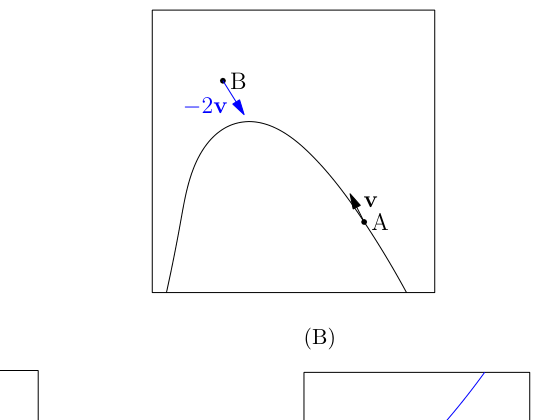 traiettorie masse A e B con velocita
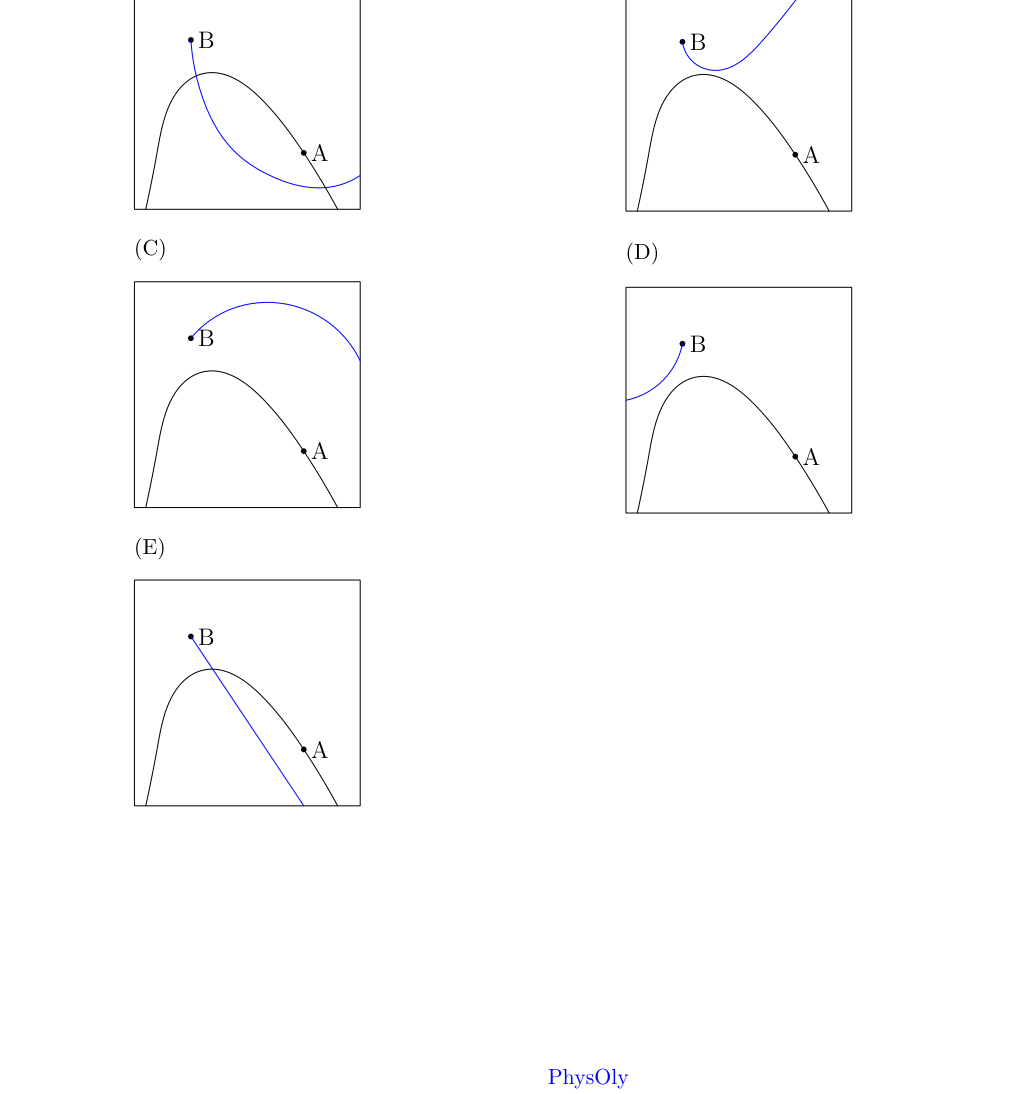 traiettorie possibili massa B (A-E)
Topic: Conservation of Momentum, Newtonian Mechanics Metodi: Conservation Laws, Conservation of Momentum, Free-Body Diagram Competenze: Physical Reasoning, Diagrammatic Reasoning Objects: — Fonte: Testo (PDF) — p.8
- In un sistema isolato, due masse puntologiche A e B di e interagiscono rispettivamente tra loro. Se al momento in questa immagine, la velocità di A è e la velocità di B è , quale di Le seguenti grafiche rappresenterebbero la traiettoria di B? B A (A) B A (C) B A (E) B A (B) B A (D) B A
- massa di trasformazione A e B con velocità *
*traiettorie possibili massa B (A-E) *
Topic: Conservation of Momentum, Newtonian Mechanics Metodi: Conservation Laws, Conservation of Momentum, Free-Body Diagram Competenze: Physical Reasoning, Diagrammatic Reasoning Objects: — Fonte: Testo (PDF) — p.8
- In a firework display, a firework rises in the air vertically and then explodes into fragments with equivalent velocity at all directions at a certain height. Which of the following graphs depicts the number of fragments hitting the ground with respect to time ? (A) (C) (E) (B) (D)
Topic: Newtonian Mechanics, Conservation of Momentum Metodi: Kinematic Equations, Conservation Laws, Physical Modeling Competenze: Physical Reasoning, Mathematical Modeling Objects: Projectile Fonte: Testo (PDF) — p.9
- In una mostra di fuochi d’artificio, un fuochi d’artificio si alza in aria verticalmente e poi esplode in frammenti con velocità equivalente in tutte le direzioni ad una certa altezza. Qual è il grafico seguente che mostra il numero di frammenti che colpiscono il terreno rispetto al tempo ? (A) (C) (E) (B) (D)
Topic: Newtonian Mechanics, Conservation of Momentum Metodi: Kinematic Equations, Conservation Laws, Physical Modeling Competenze: Physical Reasoning, Mathematical Modeling Objects: Projectile Fonte: Testo (PDF) — p.9
- A massless spring with constant which is attached to the ceiling of a 10 m room. A small block of mass is attached to the end of the spring. An identical spring is attached under the block. This pattern is repeated, adding blocks and springs until the contraption touches the floor. If the length of a relaxed spring is 50 cm, how many springs are needed?
- A. 6
- B. 9
- C. 10
- D. 11
- E. 20
Topic: Newtonian Mechanics, Oscillations & Waves Metodi: Hooke’s Law, Free-Body Diagram, Physical Modeling Competenze: Mathematical Modeling, Physical Reasoning Objects: Spring, Block Fonte: Testo (PDF) — p.10
- Una sorgente senza massa con costante che è fissata al soffitto di una stanza di 10 m. A un piccolo blocco di massa è attaccato alla fine della primavera. Un’immagine identica è fissata sotto Il quartiere. Questo modello viene ripetuto, aggiungendo blocchi e molla finché l’apparecchio non tocca il pavimento. Se la lunghezza di una sorgente rilassata è di 50 cm, quante sorgenti sono necessarie?
- A. 6
- B. 9
- C. 10
- D. 11
- E. 20
Topic: Newtonian Mechanics, Oscillations & Waves Metodi: Hooke’s Law, Free-Body Diagram, Physical Modeling Competenze: Mathematical Modeling, Physical Reasoning Objects: Spring, Block Fonte: Testo (PDF) — p.10
- A stretchy table consists of a square of mass and sidelength with fixed legs made of springs of constant . The table is gently pushed down at the middle of one of the edges - point A in the figure - and the resulting angular frequency is measured to be . What is the angular frequency of the table when it is put at rest and now pushed down at its corner, B? Assume the center of mass does not move at all before and after being compressed. side view A top view A B
- A.
- B.
- C.
- D.
- E.
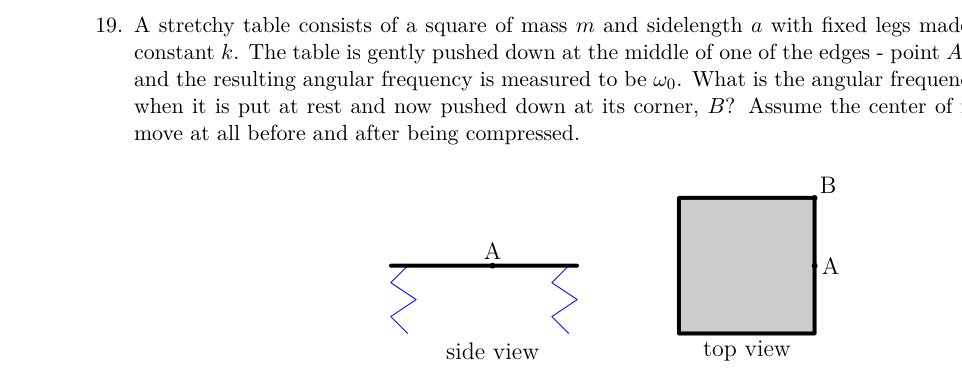 tavolo elastico vista laterale e dall’alto
Topic: Oscillations & Waves, Rigid Body Statics Metodi: Simple Harmonic Motion Analysis, Torque & Angular Momentum Analysis, Hooke’s Law Competenze: Mathematical Modeling, Physical Reasoning Objects: Spring Fonte: Testo (PDF) — p.10
- Un tavolo allungato è costituito da un quadrato di massa e lunghezza laterale con gambe fisse di molle di costante . Il tavolo è spinto verso il basso delicatamente al centro di uno dei bordi - punto A nella figura - e la frequenza angolare risultante è misurata a . Qual è la frequenza angolare della tabella Quando viene messa a riposo e spinta in un angolo, B? Supponiamo che il centro di massa non si muove prima e dopo la compressione. vista laterale A vista in alto A B
- A.
- B.
- C.
- D.
- E.
tavolo elastico vista laterale e dall’alto
Topic: Oscillations & Waves, Rigid Body Statics Metodi: Simple Harmonic Motion Analysis, Torque & Angular Momentum Analysis, Hooke’s Law Competenze: Mathematical Modeling, Physical Reasoning Objects: Spring Fonte: Testo (PDF) — p.10
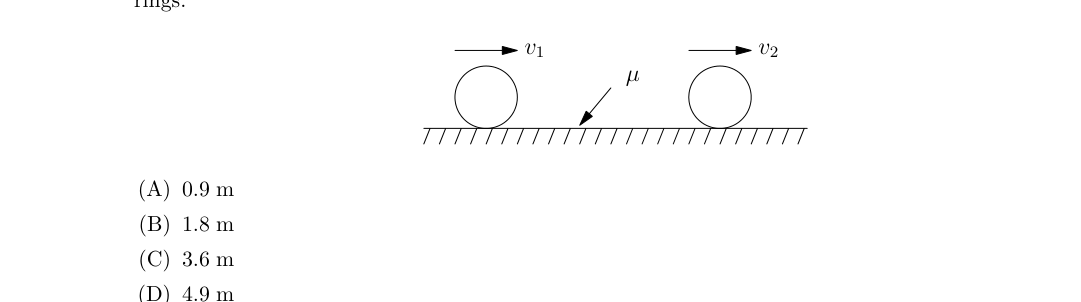
- Two small rings of the same mass are put on a horizontal rough surface () as shown in the figure. Ring A is rolling with velocity towards ring B and ring B is rolling with a velocity away from ring A. Find the final separation between the two rings after all possible collisions. Assume all collisions to be perfectly elastic and there is no friction interaction between the rings.
- A. 0.9 m
- B. 1.8 m
- C. 3.6 m
- D. 4.9 m
- E. 9.8 m
Topic: Newtonian Mechanics, Conservation of Momentum, Conservation of Energy Metodi: Conservation Laws, Conservation of Momentum, Kinematic Equations Competenze: Physical Reasoning, Mathematical Modeling Objects: Wheel Fonte: Testo (PDF) — p.10
- Due piccoli anelli della stessa massa vengono messi su una superficie orizzontale rugosa () come mostrato nella figura. L’anello A si sta rotoliando con velocità verso l’anello B e l’anello B si sta rotoliando con velocità lontano dall’anello A. Trova la separazione finale tra i due anelli dopo tutto il possibile
- Collizie. Supponiamo che tutte le collisioni siano perfettamente elastiche e che non ci sia alcuna interazione di attrito tra le due
- Gli anelli.
- A. 0.9 m
- B. 1.8 m
- C. 3.6 m
- D. 4.9 m
- E. 9.8 m
Topic: Newtonian Mechanics, Conservation of Momentum, Conservation of Energy Metodi: Conservation Laws, Conservation of Momentum, Kinematic Equations Competenze: Physical Reasoning, Mathematical Modeling Objects: Wheel Fonte: Testo (PDF) — p.10
The following information applies to problems 21-23. A spaceship of mass encounters cosmic dust of uniform density and definite edges. The dust has no initial kinetic energy and sticks uniformly to the spaceship and does not fall off after.
- In deep space, the spaceship passes through the dust cloud. After passing through, its mass has increased by 2%. If the time taken to pass through the same area with no dust is , then what is the time taken by the spaceship through the dust cloud?
- A.
- B.
- C.
- D.
- E.
 due anelli su superficie ruvida con asta
Topic: Newtonian Mechanics, Conservation of Momentum Metodi: Conservation Laws, Differential Equations, Physical Modeling Competenze: Physical Reasoning, Mathematical Modeling Objects: Satellite Fonte: Testo (PDF) — p.11
Le seguenti informazioni si applicano ai problemi 21-23. Una nave spaziale di massa incontra polvere cosmica di densità uniforme e bordi definiti. La polvere ha non ha energia cinetica iniziale e si attacca uniformemente alla nave spaziale e non cade dopo.
- Nel profondo dello spazio, la nave spaziale passa attraverso la nube di polvere. Dopo aver attraversato, la sua massa ha aumento del 2%. Se il tempo necessario per attraversare la stessa area senza polvere è , qual è il tempo trascorso dalla nave spaziale attraverso la nube di polvere?
- A.
- B.
- C.
- D.
- E.
- dovuta alla superficie di superficie di cui trattasi *
Topic: Newtonian Mechanics, Conservation of Momentum Metodi: Conservation Laws, Differential Equations, Physical Modeling Competenze: Physical Reasoning, Mathematical Modeling Objects: Satellite Fonte: Testo (PDF) — p.11
- The spaceship now flies at a constant speed away from the surface of the Earth, which has a radius and mass . The spaceship encounters cosmic dust immediately from take-off which sticks at a constant mass rate of no matter what velocity the spaceship travels at. When the spaceship is at a distance from the center of the Earth. Find the value of velocity that minimizes the amount of thrust exerted by the spaceship at this position. Note: The thrust of a spaceship is also known as the force needed to propel itself.
- A.
- B.
- C.
- D. 0
- E. Very Large (infinite)
Topic: Newtonian Mechanics, Gravitation Metodi: Newton’s Law of Gravitation, Differential Equations, Conservation Laws Competenze: Mathematical Modeling, Physical Reasoning Objects: Satellite, Planet Fonte: Testo (PDF) — p.11
- La nave spaziale ora vola a velocità costante lontano dalla superficie della Terra, che ha un raggio di e massa . La nave spaziale incontra polvere cosmica immediatamente dal decollo che si attacca a un velocità di massa costante di a qualsiasi velocità si muova la nave spaziale. Quando la nave spaziale è a un Distanza dal centro della Terra. Trova il valore della velocità che minimizza la quantità di spinta esercitata dalla nave spaziale in questa posizione. Nota: La spinta di una nave spaziale è anche conosciuta come la forza necessaria per spingere se stessa.
- A.
- B.
- C.
- D. 0
- E. Molto grande (infinito)
Topic: Newtonian Mechanics, Gravitation Metodi: Newton’s Law of Gravitation, Differential Equations, Conservation Laws Competenze: Mathematical Modeling, Physical Reasoning Objects: Satellite, Planet Fonte: Testo (PDF) — p.11
- In this part, suppose the spaceship takes the form of a sphere of uniform density . It remains stationary within a non-rotating dust cloud which has a density , rotating at an angular velocity . When dust particles hit the spaceship, they stick to it. The spaceship grows in mass in a way such that its density remains . How much time does it take for the spaceship to start rotating at an angular velocity where ?
- A.
- B.
- C.
- D.
- E.
Topic: Rotational Dynamics, Gravitation, Astrophysics Metodi: Torque & Angular Momentum Analysis, Newton’s Law of Gravitation, Differential Equations Competenze: Mathematical Modeling, Physical Reasoning Objects: Satellite, Sphere Fonte: Testo (PDF) — p.11
- In questa parte, supponiamo che la nave spaziale assume la forma di una sfera di densità uniforme . Rimane . stazionari all’interno di una nuvola di polvere non rotante di densità , rotanti a un angolo velocità . Quando le particelle di polvere colpiscono la nave spaziale, si attaccano a essa. La nave spaziale cresce in massa in una in modo tale che la densità rimanga . Quanto tempo ci vuole per iniziare a girare la nave spaziale a velocità angolare dove ?
- A.
- B.
- C.
- D.
- E.
Topic: Rotational Dynamics, Gravitation, Astrophysics Metodi: Torque & Angular Momentum Analysis, Newton’s Law of Gravitation, Differential Equations Competenze: Mathematical Modeling, Physical Reasoning Objects: Satellite, Sphere Fonte: Testo (PDF) — p.11
- A person is standing at the British Royal Observatory in Greenwich England, which is at a latitude of N. The velocity of the sun relative to person that is measured by him at 6AM is closet to which of the following? The radius of the earth is 6400 km and the Earth-Sun distance is . Ignore effects occurring when speeds are near the speed of light.
- A.
- B.
- C.
- D.
- E. 1.28 m/s
Topic: Newtonian Mechanics, Astrophysics Metodi: Kinematic Equations, Order-of-Magnitude Estimation, Physical Modeling Competenze: Estimation & Approximation, Mathematical Modeling, Physical Reasoning Objects: Planet, Star Fonte: Testo (PDF) — p.11
- Una persona sta al British Royal Observatory di Greenwich in Inghilterra, che si trova a una latitudine di N. La velocità del sole rispetto alla persona che viene misurata da lui alle 6 del mattino è vicino a quale di le seguenti? Il raggio di radio della Terra è di 6400 km e la distanza Terra-Sol è . Ignorare effetti che si verificano quando le velocità sono vicine alla velocità della luce.
- A.
- B.
- C.
- D.
- E. 1.28 m/s
Topic: Newtonian Mechanics, Astrophysics Metodi: Kinematic Equations, Order-of-Magnitude Estimation, Physical Modeling Competenze: Estimation & Approximation, Mathematical Modeling, Physical Reasoning Objects: Planet, Star Fonte: Testo (PDF) — p.11
- A square of sidelength and mass is cut across its diagonal which is situated in the z-axis. Two ideal light rods of negligible length are put in between the two corners that were cut. A tangential impulse (into the page) is applied to the outermost corner of the square. What is the tension developed in the rods? T T
- A.
- B.
- C.
- D.
- E.
Topic: Rotational Dynamics, Newtonian Mechanics Metodi: Torque & Angular Momentum Analysis, Impulse-Momentum Theorem, Conservation Laws Competenze: Mathematical Modeling, Physical Reasoning, Diagrammatic Reasoning Objects: Rod Fonte: Testo (PDF) — p.12
- Un quadrato di lunghezza laterale e massa è tagliato attraverso la sua diagonale che si trova nell’asse z. Due le barre di luce ideali di lunghezza trascurabile sono messe tra le due angoli che sono state tagliate. Un tangenziale L’impulso (in pagina) viene applicato all’angolo più esterno del quadrato. Qual è la tensione ? sviluppato nelle bacche? T T
- A.
- B.
- C.
- D.
- E.
Topic: Rotational Dynamics, Newtonian Mechanics Metodi: Torque & Angular Momentum Analysis, Impulse-Momentum Theorem, Conservation Laws Competenze: Mathematical Modeling, Physical Reasoning, Diagrammatic Reasoning Objects: Rod Fonte: Testo (PDF) — p.12