- Consider a partially polarized light beam, containing a mix of unpolarized and linearly polarized light. The intensity of the beam is analyzed using a linear polarizer. At a particular orientation of the polarizer, the outgoing beam has maximum intensity . Turning the polarizer by a angle reduces the outgoing beam’s intensity by 10%. Find the degree of polarization of the beam, where is the minimum intensity for any orientation of the polarizer.
Topic: Wave Optics, Oscillations & Waves Metodi: Superposition Principle, Physical Modeling, Small-Angle Approximation Competenze: Mathematical Modeling, Physical Reasoning Objects: — Fonte: Testo (PDF) — p.2
- Considerate un raggio di luce parzialmente polarizzato, contenente un mix di luce non polarizzata e lineare polarizzata. L’intensità del fascio viene analizzata con un polarizzatore lineare. In particolare, il Consiglio ha adottato una decisione il polarizzatore, il fascio uscente ha l’intensità massima . Rottura del polarizzatore con un angolo riduce l’intensità del fascio uscente del 10%. Trova il grado di polarizzazione del raggio, dove è l’intensità minima per qualsiasi orientamento del polarizzatore.
Topic: Wave Optics, Oscillations & Waves Metodi: Superposition Principle, Physical Modeling, Small-Angle Approximation Competenze: Mathematical Modeling, Physical Reasoning Objects: — Fonte: Testo (PDF) — p.2
- According to Newton’s law of cooling, a hot object transfers heat to the environment at a rate where is the temperature of the object, is the temperature of the environment, and is a constant. Consider a circuit element whose resistance depends on its temperature as shown below (not to scale), with heat capacity J/K in a lab of temperature K. Note that the curve is multivalued, which indicates hysteresis: the resistance takes the lower value when increasing from low temperatures, and the higher value when decreasing from high temperatures. When this component is placed in series with a voltage V, its temperature stabilizes at K. When it is instead placed in series with a voltage V, its temperature does not stabilize, and the current through it instead oscillates. Find the period of these oscillations.
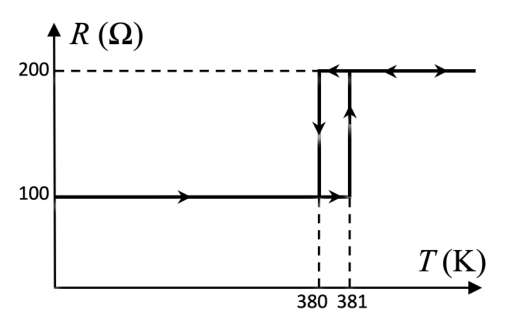 grafico R vs T con isteresi
Topic: Circuits, Thermodynamics, Oscillations & Waves Metodi: Differential Equations, Physical Modeling, First Law of Thermodynamics Competenze: Mathematical Modeling, Diagrammatic Reasoning, Physical Reasoning Objects: Resistor, Battery Fonte: Testo (PDF) — p.2
- Secondo la legge di Newton, un oggetto caldo trasmette calore all’ambiente a un ritmo se è la temperatura dell’oggetto, è la temperatura dell’ambiente e è una costante. Considerare un elemento di circuito la cui resistenza dipende dalla sua temperatura come mostrato di seguito (non per scala), con capacità termico J/K in laboratorio di temperatura K. Si noti che la curva è
- di valore multivaluato, che indica l’isteresi: la resistenza assume il valore inferiore quando aumenta da basso le temperature, e il valore più elevato quando diminuisce dalle temperature elevate. Quando questo componente viene messo in serie con una tensione V, la sua temperatura si stabilizza a K. Quando viene invece collocato in serie con una tensione V, la sua temperatura non è Stabilizzarsi, e la corrente che attraversa oscilla invece. Trova il periodo di queste oscillazioni.
grafico R vs T con isteresi
Topic: Circuits, Thermodynamics, Oscillations & Waves Metodi: Differential Equations, Physical Modeling, First Law of Thermodynamics Competenze: Mathematical Modeling, Diagrammatic Reasoning, Physical Reasoning Objects: Resistor, Battery Fonte: Testo (PDF) — p.2
- Two speakers are 3.00 m apart. They both emit perfect sinusoids, whose frequencies differ by 0.250 Hz. Spaceman Fred, who is standing 40.0 m away in the direction shown in the diagram, must run at 3.46 m/s to avoid hearing beats. The speed of sound in air is 343 m/s. Approximately what frequency are the speakers emitting?
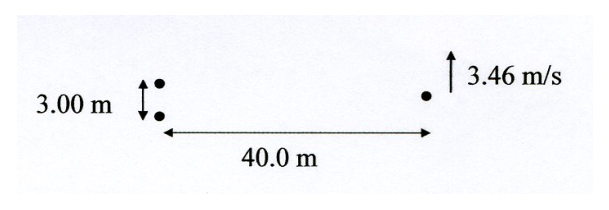 schema due altoparlanti e Fred
Topic: Oscillations & Waves Metodi: Wave Equation, Physical Modeling, Approximation & Series Expansion Competenze: Physical Reasoning, Mathematical Modeling Objects: — Fonte: Testo (PDF) — p.2
- Due altoparlanti sono a 3,00 metri di distanza. Entrambe emettono sinusoidi perfetti, le cui frequenze differiscono per 0.250 Hz. L’astronauta Fred, che si trova a 40,0 m di distanza nella direzione indicata nel diagramma, deve correre a 3,46 m/s per evitare battiti uditivi. La velocità del suono nell’aria è di 343 m/s. Circa che cosa la frequenza che i diffusori emettono?
- schema dovuto altoparlanti e Fred*
Topic: Oscillations & Waves Metodi: Wave Equation, Physical Modeling, Approximation & Series Expansion Competenze: Physical Reasoning, Mathematical Modeling Objects: — Fonte: Testo (PDF) — p.2
- The input voltage is the voltage difference between points I and II. What is the voltage difference between the points a and b in the circuit below as a function of time? You should assume , and simplify your answer as much as possible.
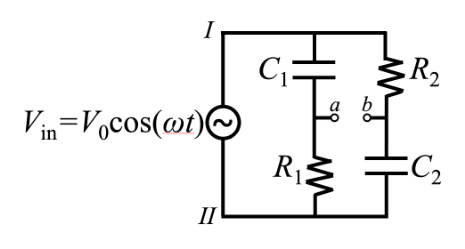 circuito RC con sorgente V_in
Topic: Circuits Metodi: Kirchhoff’s Laws, Differential Equations, Equivalent Circuit Reduction Competenze: Mathematical Modeling, Diagrammatic Reasoning Objects: Resistor, Capacitor Fonte: Testo (PDF) — p.3
- La tensione di ingresso è la differenza di tensione tra i punti I e II. Qual è la differenza di tensione tra i punti a e b del circuito di seguito come funzione del tempo? Dovreste assumere e semplificare la vostra risposta il più possibile.
circuito RC con sorgente V_in
Topic: Circuits Metodi: Kirchhoff’s Laws, Differential Equations, Equivalent Circuit Reduction Competenze: Mathematical Modeling, Diagrammatic Reasoning Objects: Resistor, Capacitor Fonte: Testo (PDF) — p.3
- An empty cylindrical glass of cross-sectional area is resting on a table. Water of density is slowly poured into the glass from a beaker, at a constant volume per unit time . The beaker nozzle is at height , and the water exits the beaker with negligible speed. Let at the moment the water first hits the bottom of the glass. Find the force of the water on the glass as a function of time, until the glass overflows. Assume the water does not splash and the atmospheric pressure is . Furthermore, assume the glass is wide, so that the rate at which the water level rises is negligible compared to the speed at which water enters the glass.
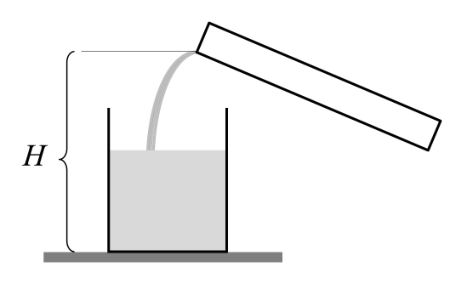 brocca versa acqua in bicchiere
Topic: Fluid Mechanics, Newtonian Mechanics Metodi: Impulse-Momentum Theorem, Continuity Equation, Conservation of Momentum Competenze: Physical Reasoning, Mathematical Modeling Objects: Container Fonte: Testo (PDF) — p.3
- Un vetro cilindrico vuoto di superficie trasversale si trova su un tavolo. Acqua di densità è lentamente versato nel vetro da una coppa, a un volume costante per unità di tempo . L’orticello del bicchiere è di altezza e l’acqua esce dal bicchiere con una velocità trascurabile. Lasciare Il momento in cui l’acqua colpisce per la prima volta il fondo del vetro. Trova la forza dell’ acqua sul vetro come Una funzione del tempo, fino a quando il vetro si esagera. Supponiamo che l’acqua non si scaglia e l’atmosfera la pressione è . Inoltre, supponiamo che il vetro sia largo, in modo che la velocità con cui il livello dell’acqua aumenta sia non è considerato importante rispetto alla velocità con cui l’acqua entra nel vetro.
brocca versus acqua in bicchiere
Topic: Fluid Mechanics, Newtonian Mechanics Metodi: Impulse-Momentum Theorem, Continuity Equation, Conservation of Momentum Competenze: Physical Reasoning, Mathematical Modeling Objects: Container Fonte: Testo (PDF) — p.3
- A frictionless circular cylinder of radius is placed with its axis horizontal, and a flexible, inextensible string of uniform linear mass density is wrapped around it. When the length of the string is slightly longer than , part of the string will sag below the cylinder. Now suppose the string is slowly shortened, until the entire string just touches the cylinder. At this moment, find the tension at the top of the string.
Topic: Newtonian Mechanics, Rigid Body Statics Metodi: Free-Body Diagram, Calculus-Integration, Vector Decomposition Competenze: Mathematical Modeling, Diagrammatic Reasoning, Physical Reasoning Objects: Cylinder, String Fonte: Testo (PDF) — p.4
- Un cilindro circolare senza attrito di raggio è posizionato con il suo asse orizzontale e un cilindro flessibile e inespandibile una corda di massa lineare uniforme è avvolta intorno a essa. Quando la lunghezza della corda è leggermente Se il filo è più lungo di , una parte della corda si abbassa sotto il cilindro. Ora supponiamo che la corda sia lenta ridotto, fino a quando l’intera corda tocca il cilindro. In questo momento, trova la tensione in cima della corda.
Topic: Newtonian Mechanics, Rigid Body Statics Metodi: Free-Body Diagram, Calculus-Integration, Vector Decomposition Competenze: Mathematical Modeling, Diagrammatic Reasoning, Physical Reasoning Objects: Cylinder, String Fonte: Testo (PDF) — p.4
- Model a grappling hook as a point mass attached to the end of a uniform chain of linear mass density . Initially, the chain is loosely coiled on the ground. Then the mass is launched directly upward from the ground, with an initial speed . The chain is flexible, so that when the mass is at a height , a length of the chain dangles directly beneath it, while the rest of the chain remains at rest on the ground. Find the maximum height reached by the mass, assuming this is less than the length of the chain. (Hint: if you directly compute the acceleration, you will find an intractable differential equation, but it can be solved with a clever change of variable.)
Topic: Newtonian Mechanics, Conservation of Energy Metodi: Differential Equations, Conservation Laws, Energy Conservation Method Competenze: Mathematical Modeling, Physical Reasoning Objects: String Fonte: Testo (PDF) — p.4
- Modellare un gancio da aggancio come massa puntaria attaccata alla fine di una catena uniforme di densità di massa lineare . Inizialmente, la catena è scivolamente avvolta sul terreno. Poi la massa viene lanciata direttamente verso l’alto da il terreno, con una velocità iniziale . La catena è flessibile, in modo che quando la massa è a un’altezza , un La lunghezza della catena pendolo direttamente sotto di essa, mentre il resto della catena rimane a riposo sulla
- A terra. Trova l’altezza massima raggiunta dalla massa, supponendo che sia inferiore alla lunghezza della
- La catena. (Signore: se calcoli direttamente l’accelerazione, troverai un’equazione differenziale intragiuntabile, ma può essere risolto con una cambiamento intelligente della variabile.)
Topic: Newtonian Mechanics, Conservation of Energy Metodi: Differential Equations, Conservation Laws, Energy Conservation Method Competenze: Mathematical Modeling, Physical Reasoning Objects: String Fonte: Testo (PDF) — p.4
- A uniform rod of length is placed inside a fixed, frictionless hemispherical bowl of radius . In equilibrium, the rod makes an angle with the horizontal. Assume that the rod and bowl are ideally rigid, but that the lip of the bowl and the end of the rod are both slightly rounded, so that there is a well-defined normal direction at the points they touch. Find an analytic expression for and evaluate it to three significant figures, in degrees.
Lego Movie Gravitational waves are predicted by general relativity, but can be modeled with Newtonian physics and a few small assumptions. Throughout this problem, assume classical Newtonian physics, and ignore special relativistic effects. The mass of the sun is kg, and the luminosity of the sun is W. In all parts of this problem, you may use the fundamental constants and in your answers.
Topic: Rigid Body Statics, Newtonian Mechanics Metodi: Free-Body Diagram, Torque & Angular Momentum Analysis, Vector Decomposition Competenze: Mathematical Modeling, Diagrammatic Reasoning, Physical Reasoning Objects: Rod Fonte: Testo (PDF) — p.4
- Una barra uniforme di lunghezza è collocata all’interno di una ciotola emisferica fissa e senza attrito di raggio . In equilibrio, la canna fa un angolo con l’orizzontale. Supponiamo che la canna e la ciotola siano ideali La parte superiore della tavola è rigida, ma la parte superiore della tavola e la parte superiore della canna sono entrambi leggermente arrotondati, in modo che ci sia un direzione normale ben definita nei punti che toccano. Trova un’espressione analitica per e valuta
- E’ in grado di tre cifre significative.
Lego Movie Le onde gravitazionali sono previste dalla relatività generale, ma possono essere modellate con la fisica newtonica e un
- Poche ipotesi. In tutto questo problema, assumete la fisica newtoniana classica, e ignorate le speciali effetti relativistici. La massa del sole è kg e la luminosità del sole è W. In tutte le parti di questo problema, è possibile utilizzare le costanti fondamentali e nelle risposte.
Topic: Rigid Body Statics, Newtonian Mechanics Metodi: Free-Body Diagram, Torque & Angular Momentum Analysis, Vector Decomposition Competenze: Mathematical Modeling, Diagrammatic Reasoning, Physical Reasoning Objects: Rod Fonte: Testo (PDF) — p.4
- Consider a spherically symmetric body with mass . Determine the Schwarzschild radius of such a body so that the escape velocity would be equal to the speed of light .
Topic: Gravitation, Special Relativity Metodi: Newton’s Law of Gravitation, Energy Conservation Method, Physical Modeling Competenze: Physical Reasoning, Mathematical Modeling Objects: — Fonte: Testo (PDF) — p.5
- Considerate un corpo sfericamente simmetrico con massa . Determinare il raggio di Schwarzschild di tali un corpo in modo tale che la velocità di fuga sia uguale alla velocità della luce .
Topic: Gravitation, Special Relativity Metodi: Newton’s Law of Gravitation, Energy Conservation Method, Physical Modeling Competenze: Physical Reasoning, Mathematical Modeling Objects: — Fonte: Testo (PDF) — p.5
- Two such bodies, with masses and , are in circular orbits about their common center of mass. The separation of the bodies is , and the total mass is .
- A. Find the frequency of the orbital motion in terms of and .
- B. Find the total energy of the system in terms of , , and .
- C. The minimum possible orbital separation is , where and are the Schwarzschild radii for masses 1 and 2. Find the maximum possible orbital frequency in terms of .
Topic: Gravitation, Conservation of Energy Metodi: Newton’s Law of Gravitation, Kepler’s Laws, Energy Conservation Method Competenze: Mathematical Modeling, Physical Reasoning Objects: Black Hole Fonte: Testo (PDF) — p.5
- Due di questi corpi, con masse e , sono in orbite circolari intorno al loro centro di massa comune. La separazione dei corpi è e la massa totale è .
- A. Trova la frequenza del movimento orbitale in termini di e .
- B. Trova l’energia totale del sistema in termini di , e .
- C. La separazione orbitale minima possibile è , dove e sono i Schwarzschild radii per le masse 1 e 2. Trova la frequenza orbitale massima possibile in termini di .
Topic: Gravitation, Conservation of Energy Metodi: Newton’s Law of Gravitation, Kepler’s Laws, Energy Conservation Method Competenze: Mathematical Modeling, Physical Reasoning Objects: Black Hole Fonte: Testo (PDF) — p.5
- We would like to estimate the rate at which the system loses energy due to the emission of gravitational waves. In classical electromagnetism, the simplest form of radiation is dipole radiation, which results from a second time derivative of the electric dipole moment. However, for gravity the analogue of the electric dipole moment is the center of mass, which always moves at constant velocity by momentum conservation. Thus, the leading source of gravitational radiation is quadrupole radiation, which depends on a time derivative of the moment of inertia. All subparts of this part are rough estimates, which means you may drop numeric prefactors such as . (a) The power radiated in gravitational waves by a system with moment of inertia takes the form where is a dimensionless constant. Determine , , and . (b) For two black holes circularly orbiting each other in the plane, with center of mass at the origin, find the moment of inertia about the -axis in terms of , , , and the angular frequency , defining the origin of time so that . (c) Roughly estimate the average power radiated over an orbital period. Your final answer should be a product of powers of , , , , and fundamental constants. (d) The maximum power radiated occurs when . Roughly estimate the maximum power in the case in terms of fundamental constants. What is the order of magnitude of its ratio to the luminosity of the Sun?
Topic: Gravitation, Astrophysics, Rotational Dynamics Metodi: Dimensional Analysis, Order-of-Magnitude Estimation, Torque & Angular Momentum Analysis Competenze: Estimation & Approximation, Mathematical Modeling, Physical Reasoning Objects: Black Hole Fonte: Testo (PDF) — p.5
- Vorremmo stimare il tasso di perdita di energia del sistema a causa dell’emissione di onde. Nell’elettromagnetismo classico, la forma più semplice di radiazione è la radiazione dipole, che si traduce in da una seconda derivata del momento di dipolo elettrico. Tuttavia, per la gravità l’analogio della Il momento di dipolo elettrico è il centro di massa, che si muove sempre a velocità costante per impulso
- La conservazione. La fonte principale di radiazioni gravitazionali è la radiazione quadrupola, che dipende su una derivata temporale del momento di inerzia. Tutte le parti di questa parte sono stime approssimative, che significa che è possibile eliminare i prefatori numerici come . (a) La potenza irradiata in onde gravitazionali da un sistema con momento di inerzia assume la forma di dove è una costante senza dimensioni. Determina , e . b) per due buchi neri che orbitano in maniera circolare l’uno intorno all’altro nel piano , con centro di massa all’origine, trovare il momento di inerzia sull’asse in termini di , , e della frequenza angolare , che definisce l’origine del tempo in modo che . (c) Estimare approssimativamente la potenza media irradiata in un periodo orbitale. La tua risposta finale dovrebbe essere: un prodotto delle potenze di , , , e delle costanti fondamentali. d) La potenza massima irradiata si verifica quando . Calcolare approssimativamente la potenza massima in il caso in termini di costanti fondamentali. Qual è l’ordine di grandezza del suo rapporto alla luminosità del Sole?
Topic: Gravitation, Astrophysics, Rotational Dynamics Metodi: Dimensional Analysis, Order-of-Magnitude Estimation, Torque & Angular Momentum Analysis Competenze: Estimation & Approximation, Mathematical Modeling, Physical Reasoning Objects: Black Hole Fonte: Testo (PDF) — p.5
- The energy loss due to gravitational wave emission causes orbiting black holes to spiral towards each other, changing the orbital frequency over time. Assume the orbit is always approximately circular. (a) Assuming the energy loss is slow, find the rate of change of the orbital frequency in terms of , and . You should find your answer is simply expressed in terms of the “chirp mass” , defined as Here you are expected to keep numeric prefactors. In particular, according to general relativity, the correct numeric prefactor to part 3(c) is 32/5.
- B. What is the frequency of the gravitational waves emitted when the orbital frequency is ?
- C. The Hanford, Washington and Livingston, Louisiana LIGO detectors observed a binary black hole merger event on September 14, 2015. Their data is shown in the graphs marked H1 and L1. Use the smoothed (shaded) H1 data to answer the questions below. No detailed data analysis is expected. Graph downloaded from LIGO Open Science Center, operated by California Institute of Technology and Massachussets Institute of Technology and supported by the U. S. National Science Foundation: losc.ligo.org i. Estimate the maximum gravitational wave frequency, and thereby estimate the total mass , giving your answer as a multiple of the solar mass . ii. Estimate the chirp mass , giving your answer as a multiple of the solar mass .
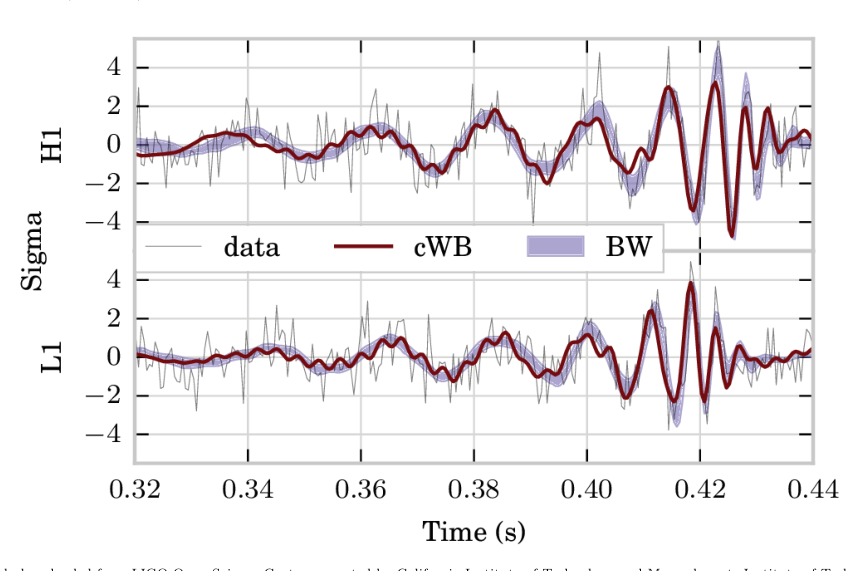 segnali LIGO H1 e L1 GW150914
Topic: Gravitation, Astrophysics, Oscillations & Waves Metodi: Differential Equations, Order-of-Magnitude Estimation, Experimental Data Analysis Competenze: Estimation & Approximation, Experimental Data Analysis, Mathematical Modeling Objects: Black Hole Fonte: Testo (PDF) — p.5
- La perdita di energia dovuta all’emissione di onde gravitazionali provoca che i buchi neri in orbita si spiralizzino verso ciascun Altri, che cambiano la frequenza orbitale nel tempo. Supponiamo che l’orbita sia sempre circolare. (a) Supponendo che la perdita di energia sia lenta, si trova il tasso di variazione della frequenza orbitale in termini di , e . Dovresti trovare che la tua risposta è semplicemente espressa in termini di massa di chirp , definito come Qui si prevede che si conservino i prefatori numerici. In particolare, secondo la relatività generale, il prefatore numerico corretto della parte 3 ((c) è 32/5.
- B. Qual è la frequenza delle onde gravitazionali emesse quando la frequenza orbitale è ? I rilevatori LIGO di Hanford, Washington e Livingston, Louisiana hanno osservato un buco nero binario. avvenimento di fusione il 14 settembre 2015. I loro dati sono riportati nei grafici con H1 e L1. Utilizzare dati H1 lisci (ombrelli) per rispondere alle domande di seguito. Non si prevede alcuna analisi dettagliata dei dati. Grafico scaricato dal LIGO Open Science Center, gestito dall’Istituto di Tecnologia della California e dal Massachusetts Institute of Technology E sostenuto dall’U. S. Fondazione Nazionale della Scienza: losc.ligo.org i. Calcolare la frequenza massima di onde gravitazionali e quindi calcolare la massa totale , la risposta è un multiple della massa solare . ii. Estima la massa chirp , dando la risposta come un multiple della massa solare .
segnali LIGO H1 e L1 GW150914
Topic: Gravitation, Astrophysics, Oscillations & Waves Metodi: Differential Equations, Order-of-Magnitude Estimation, Experimental Data Analysis Competenze: Estimation & Approximation, Experimental Data Analysis, Mathematical Modeling Objects: Black Hole Fonte: Testo (PDF) — p.5