A bullet hits a moving block of wood, which was thrown up in the air as a target. The bullet stays in it. Which has a bigger change of momentum?
- A. The bullet
- B. The wood
- C. They are both the same
- D. The answer depends on the angle of initial velocities
- E. The answer depends on the final velocity
Topic: Conservation of Momentum, Newtonian Mechanics Metodi: Conservation of Momentum, Impulse-Momentum Theorem Competenze: Physical Reasoning Objects: Projectile, Block Fonte: Testo (PDF) — p.2
Un proiettile colpisce un blocco in movimento di legno, che è stato gettato in aria come obiettivo. Il proiettile rimane dentro. Che ha un cambiamento di impulso maggiore?
- A. Il proiettile
- B. Il legno
- C. Entrambi sono uguali
- D. La risposta dipende dall’angolo delle velocità iniziali
- E. La risposta dipende dalla velocità finale
Topic: Conservation of Momentum, Newtonian Mechanics Metodi: Conservation of Momentum, Impulse-Momentum Theorem Competenze: Physical Reasoning Objects: Projectile, Block Fonte: Testo (PDF) — p.2
Tom is riding a hot air balloon by himself. There is a rope ladder hanging from the top of the balloon and reaching into the basket. At a moment when the balloon is stationary in the air, Tom begins climbing the ladder with speed relative to the ladder. Suppose Tom has mass , the balloon has mass . What is the speed of the balloon relative to the ground if air resistance can be neglected?
- A.
- B.
- C.
- D.
- E.
Topic: Conservation of Momentum, Newtonian Mechanics Metodi: Conservation of Momentum, Free-Body Diagram Competenze: Physical Reasoning, Mathematical Modeling Objects: String Fonte: Testo (PDF) — p.2
Tom sta guidando da solo un pallone ad aria calda. C’è una scala a corda appesa dalla parte superiore del palloncino e che si estende nel cestino. In un momento in cui il palloncino è fermo in aria, Tom inizia a salire la scala con velocità rispetto alla scala. Supponiamo che Tom abbia massa , il palloncino ha massa . Qual è la velocità del palloncino rispetto al suolo se la resistenza dell’aria può essere trascurata?
- A.
- B.
- C.
- D.
- E.
Topic: Conservation of Momentum, Newtonian Mechanics Metodi: Conservation of Momentum, Free-Body Diagram Competenze: Physical Reasoning, Mathematical Modeling Objects: String Fonte: Testo (PDF) — p.2
Ann and Betty are good at throwing and catching balls. They can always throw a ball for the other to catch it with only negligible motion. This time they want to have more fun and play the game on skateboards as shown. Initially they are both at rest. Ann first throws the ball to Betty at speed . After catching the ball, Betty throws the ball back to Ann at the same speed. After Ann catches the ball, Betty is moving faster than Ann by how much? Assuming:
-
mass of the ball
-
mass of Ann and the skateboard mass of Betty and the skateboard
-
A.
-
B.
-
C.
-
D.
-
E.
Topic: Conservation of Momentum, Newtonian Mechanics Metodi: Conservation of Momentum, Impulse-Momentum Theorem Competenze: Physical Reasoning, Mathematical Modeling Objects: Ball Fonte: Testo (PDF) — p.3
Ann e Betty sono buone a lanciare e catturare palle. Possono sempre lanciare una palla per l’altro per prenderla con solo un movimento trascurabile. Questa volta vogliono divertirsi di più e giocare sul skateboard come mostrato. Inizialmente sono entrambi a riposo. Ann lancia la palla prima a Betty a velocità . Dopo aver preso la palla, Betty lancia la palla di nuovo a Ann alla stessa velocità. Dopo che Ann ha preso la palla, Betty si muove più veloce di Ann? - Supponendo:
-
massa della palla
-
massa di Ann e della skateboard massa di Betty e della skateboard
-
A.
-
B.
-
C.
-
D.
-
E.
Topic: Conservation of Momentum, Newtonian Mechanics Metodi: Conservation of Momentum, Impulse-Momentum Theorem Competenze: Physical Reasoning, Mathematical Modeling Objects: Ball Fonte: Testo (PDF) — p.3
Two objects are lying at rest on a flat, smooth surface. Suppose the mass of object B is twice that of object A. If the same horizontal force is applied to the objects for the same length of time, what is the ratio of energy gain of object A to that of B?
- A.
- B.
- C.
- D.
- E.
Topic: Newtonian Mechanics, Conservation of Energy Metodi: Kinematic Equations, Energy Conservation Method Competenze: Physical Reasoning, Mathematical Modeling Objects: — Fonte: Testo (PDF) — p.3
Due oggetti si trovano a riposo su una superficie piatta e liscia. Supponiamo che la massa dell’oggetto B sia il doppio dell’oggetto A. Se la stessa forza orizzontale viene applicata agli oggetti per lo stesso periodo di tempo, qual è il rapporto tra il guadagno energetico dell’oggetto A e quello di B?
- A.
- B.
- C.
- D.
- E.
Topic: Newtonian Mechanics, Conservation of Energy Metodi: Kinematic Equations, Energy Conservation Method Competenze: Physical Reasoning, Mathematical Modeling Objects: — Fonte: Testo (PDF) — p.3
Air resistance affects a satellite orbiting the Earth in a nearly circular orbit. Which of the following does not occur?
- A. An increase in the time for the satellite to complete one revolution
- B. A decrease in the total mechanical energy
- C. An increase in the linear speed
- D. A decrease in the distance to the Earth
Topic: Gravitation, Newtonian Mechanics Metodi: Newton’s Law of Gravitation, Energy Conservation Method Competenze: Physical Reasoning Objects: Satellite, Planet Fonte: Testo (PDF) — p.3
La resistenza dell’aria colpisce un satellite che orbita la Terra in un’orbita quasi circolare. Quale di queste non si verifica?
- A. Un aumento del tempo per il satellite per completare una rivoluzione
- B. Una diminuzione dell’energia meccanica totale
- C. Un aumento della velocità lineare
- D. Una diminuzione della distanza dalla Terra
Topic: Gravitation, Newtonian Mechanics Metodi: Newton’s Law of Gravitation, Energy Conservation Method Competenze: Physical Reasoning Objects: Satellite, Planet Fonte: Testo (PDF) — p.3
A metal rod of length is inclined on the rails in a uniform magnetic field of flux density as shown in the graph. If the rod moves with constant velocity upward, what is the induced emf on the rod?
- A.
- B.
- C.
- D.
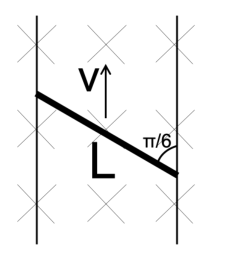 Rod on inclined rails in magnetic field
Topic: Electromagnetic Induction Metodi: Faraday’s Law of Induction, Vector Decomposition Competenze: Physical Reasoning, Mathematical Modeling Objects: Rod, Wire Fonte: Testo (PDF) — p.3
Una barra di metallo di lunghezza è inclinata sulle rotaie in un campo magnetico uniforme di densità di flusso come mostrato nel grafico. Se la canna si muove con velocità costante verso l’alto, qual è l’emf indotto sulla canna?
- A.
- B.
- C.
- D.
Rota su rotaie inclinate in campo magnetico
Topic: Electromagnetic Induction Metodi: Faraday’s Law of Induction, Vector Decomposition Competenze: Physical Reasoning, Mathematical Modeling Objects: Rod, Wire Fonte: Testo (PDF) — p.3
The graph below shows the wavefronts of a plane wave with frequency travelling at speed hitting a board at an angle . What is the phase difference between the waves at two points apart along the board?
- A.
- B.
- C.
- D.
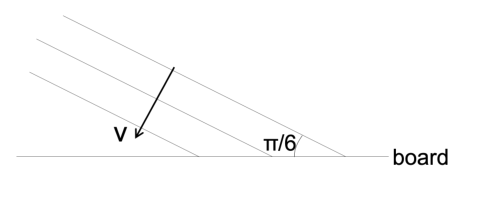 Plane wavefronts hitting board at angle π/6
Topic: Oscillations & Waves Metodi: Wave Equation, Superposition Principle Competenze: Physical Reasoning, Mathematical Modeling Objects: — Fonte: Testo (PDF) — p.3
Il grafico seguente mostra i fronti d’onda di un’onda a piana con frequenza che viaggia a velocità colpendo una lavagna ad un angolo . Qual è la differenza di fase tra le onde a due punti separati lungo la tavola?
- A.
- B.
- C.
- D.
Front d’onda aereo che colpisce il bordo ad angolo π/6
Topic: Oscillations & Waves Metodi: Wave Equation, Superposition Principle Competenze: Physical Reasoning, Mathematical Modeling Objects: — Fonte: Testo (PDF) — p.3
A uniform wire of cross-sectional area has resistance . A voltage difference of is applied across its two ends. Given that the number of conduction electrons per volume of the wire is , what is the average drift velocity of electrons along the wire?
- A.
- B.
- C.
- D.
- E.
Topic: Circuits, Electromagnetism Metodi: Kirchhoff’s Laws, Dimensional Analysis Competenze: Mathematical Modeling, Unit Conversion Objects: Wire, Electron Fonte: Testo (PDF) — p.3
Un filo uniforme di superficie trasversale ha una resistenza . Si applica una differenza di tensione di sulle sue due estremità. Dato che il numero di elettroni di conduttività per volume del filo è , qual è la velocità media di deriva degli elettroni lungo il filo?
- A.
- B.
- C.
- D.
- E.
Topic: Circuits, Electromagnetism Metodi: Kirchhoff’s Laws, Dimensional Analysis Competenze: Mathematical Modeling, Unit Conversion Objects: Wire, Electron Fonte: Testo (PDF) — p.3
Two metal balls of the same diameter but different mass are dropped simultaneously from a high cliff. Which of the statements below describes best what happens?
- A. The heavier one has the same acceleration from the start
- B. The lighter one has higher acceleration from the start
- C. They both have the same acceleration at the start but then the lighter one has higher acceleration.
- D. They both have the same acceleration at the start but then the heavier one has higher acceleration.
- E. They both have the same acceleration all the way to the bottom
Topic: Newtonian Mechanics, Fluid Mechanics Metodi: Free-Body Diagram, Physical Modeling Competenze: Physical Reasoning Objects: Ball Fonte: Testo (PDF) — p.4
Due palle di metallo dello stesso diametro ma di massa diversa vengono lanciate contemporaneamente da una alte scogliera. Quale delle seguenti affermazioni descrive meglio cosa succede?
- A. Il più pesante ha la stessa accelerazione dall’inizio
- B. Il più leggero ha una maggiore accelerazione dall’inizio
- C. Entrambi hanno la stessa accelerazione all’inizio ma poi il più leggero ha una maggiore accelerazione.
- D. Entrambi hanno la stessa accelerazione all’inizio ma poi il più pesante ha una maggiore accelerazione.
- E. Entrambi hanno la stessa accelerazione fino in fondo
Topic: Newtonian Mechanics, Fluid Mechanics Metodi: Free-Body Diagram, Physical Modeling Competenze: Physical Reasoning Objects: Ball Fonte: Testo (PDF) — p.4
A person biking down a slope without pedaling or braking noticed that her speed is constant at . Approximately what power does she need to bike up this hill at the same speed if her weight including the bike is ?
- A. Nobody can bike down the hill at constant speed without braking.
- B.
- C.
- D.
- E.
Topic: Newtonian Mechanics, Conservation of Energy Metodi: Energy Conservation Method, Free-Body Diagram Competenze: Physical Reasoning, Estimation & Approximation Objects: — Fonte: Testo (PDF) — p.4
Una persona che scende in bicicletta su una pendice senza pedalizzare o frenare ha notato che la sua velocità è costante a . Quanta potenza ha bisogno per salire in bici su questa collina alla stessa velocità se il suo peso, compreso la moto, è ?
Nessuno può scendere in bici sulla collina a velocità costante senza frenare.
- B.
- C.
- D.
- E.
Topic: Newtonian Mechanics, Conservation of Energy Metodi: Energy Conservation Method, Free-Body Diagram Competenze: Physical Reasoning, Estimation & Approximation Objects: — Fonte: Testo (PDF) — p.4
A level (a device for establishing a horizontal plane, which consists of a small sealed transparent tube containing liquid and an air bubble) was pushed on the table. When the level was accelerated, the bubble:
- A. did not move relative to the glass
- B. moved in the direction of acceleration
- C. moved in the direction opposite to the acceleration
- D. moved to the side of the tube
- E. was pushed deeper into the liquid
Topic: Fluid Mechanics, Newtonian Mechanics Metodi: Hydrostatic Equilibrium, Free-Body Diagram Competenze: Physical Reasoning, Diagrammatic Reasoning Objects: Bubble, Tube Fonte: Testo (PDF) — p.4
Un livello (un dispositivo per stabilire un piano orizzontale, costituito da un piccolo tubo trasparente sigillato contenente liquido e una bolla d’aria) è stato spinto sul tavolo. Quando il livello è stato accelerato, la bolla:
- A. non si è mossa rispetto al vetro
- B. spostato nella direzione di accelerazione
- C. spostato nella direzione opposta all’accelerazione
- D. spostato sul lato del tubo
- E. è stato spinto più a fondo nel liquido
Topic: Fluid Mechanics, Newtonian Mechanics Metodi: Hydrostatic Equilibrium, Free-Body Diagram Competenze: Physical Reasoning, Diagrammatic Reasoning Objects: Bubble, Tube Fonte: Testo (PDF) — p.4
People were watching a movie showing a car driving inside a big cylinder on a vertical wall. How would you explain this?
- A. Impossible – some kind of film trick
- B. The only way to do it would be to add some very strong magnets in the wheels and drive on an iron wall. The attraction force between the magnets and the iron wall results in the friction force to be bigger than the force of gravity pushing the car down.
- C. Most likely, there is a huge vacuum pump under the car, which sucks it to the wall and results in a friction force bigger than the force of gravity pushing the car down.
- D. The car is moving at high speed so a centripetal force forcing it to drive in a circle inside the cylinder results in the force pushing the car towards the wall. This force results in the friction force bigger than the force of gravity pushing the car down.
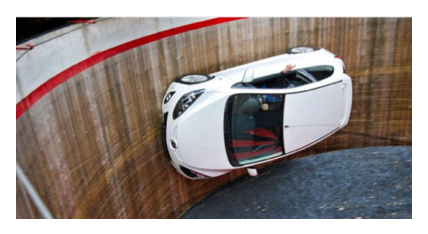 Car driving on inner wall of vertical cylinder
Topic: Newtonian Mechanics, Rotational Dynamics Metodi: Free-Body Diagram, Kinematic Equations Competenze: Physical Reasoning, Diagrammatic Reasoning Objects: Cylinder Fonte: Testo (PDF) — p.4
La gente stava guardando un film che mostrava una macchina che guidava dentro un grande cilindro su un muro verticale. Come spiegherai questo?
- A. Impossibile qualche trucco di film
- B. L’unico modo per farlo sarebbe aggiungere dei magneti molto forti alle ruote e guidare su una parete di ferro. La forza di attrazione tra i magneti e la parete di ferro rende la forza di attrito maggiore della forza di gravità che spinge l’auto giù.
- C. Molto probabilmente, c’è una enorme pompa a vuoto sotto l’auto, che la succhia alla parete e si traduce in una forza di attrito maggiore della forza di gravità che spinge l’auto verso il basso.
- D. L’auto si muove ad alta velocità, quindi una forza centripetal che la costringe a guidare in cerchio all’interno del cilindro comporta la forza che spinge l’auto verso la parete. Questa forza si traduce in una forza di attrito maggiore della forza di gravità che spinge l’auto giù.
Costruzione di auto su parete interne di cilindro verticale
Topic: Newtonian Mechanics, Rotational Dynamics Metodi: Free-Body Diagram, Kinematic Equations Competenze: Physical Reasoning, Diagrammatic Reasoning Objects: Cylinder Fonte: Testo (PDF) — p.4
A diver shines a beam of light from a laser at to the surface as shown below. How high above the water surface will the laser beam hit the vertical wall placed away from the point A (the place where the laser beam hits the surface of the water)?
- A. About
- B. About
- C. About
- D. About
- E. It will never go above the water
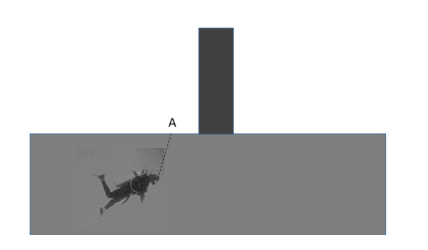 Diver laser beam hitting water surface at 80°
Topic: Geometric Optics Metodi: Snell’s Law, Ray Tracing Competenze: Physical Reasoning, Mathematical Modeling Objects: — Fonte: Testo (PDF) — p.4
Un subacqueo illumina un fascio di luce da un laser a sulla superficie come mostrato di seguito. Quanto in alto sopra la superficie dell’acqua il fascio laser colpirà la parete verticale posizionata lontano dal punto A (il luogo in cui il fascio laser colpisce la superficie dell’acqua)?
- A. Circa
- B. Circa
- C. Circa
- D. Circa
- E. Non supererà mai l’acqua
*Raggiunto della superficie dell’acqua da fascio laser immersivo a 80° *
Topic: Geometric Optics Metodi: Snell’s Law, Ray Tracing Competenze: Physical Reasoning, Mathematical Modeling Objects: — Fonte: Testo (PDF) — p.4
If he directs the beam (from the previous question) to be to the surface, how high above the water surface will the laser beam hit the vertical wall placed away from the point A (the place where the laser beam hits the surface of the water)?
- A. About
- B. About
- C. About
- D. About
- E. It will never go above the water
 Diver laser beam at 20° to water surface
Topic: Geometric Optics Metodi: Snell’s Law, Ray Tracing Competenze: Physical Reasoning, Mathematical Modeling Objects: — Fonte: Testo (PDF) — p.5
Se egli dirige il fascio (dalla domanda precedente) a verso la superficie, a che altezza sopra la superficie dell’acqua il fascio laser colpirà il muro verticale posizionato lontano dal punto A (il luogo in cui il fascio laser colpisce la superficie dell’acqua)?
- A. Circa
- B. Circa
- C. Circa
- D. Circa
- E. Non supererà mai l’acqua
Raggiunto laser di immersione a 20° alla superficie dell’acqua
Topic: Geometric Optics Metodi: Snell’s Law, Ray Tracing Competenze: Physical Reasoning, Mathematical Modeling Objects: — Fonte: Testo (PDF) — p.5
We are using X-rays (wavelength of the order of ) to measure the spacing between the atoms or molecules in crystals. If we use a beam of neutrons for the same purpose their energy should be of the order of:
- A.
- B.
- C.
- D.
- E.
Topic: Modern-Quantum Physics Metodi: de Broglie Relation, Order-of-Magnitude Estimation Competenze: Estimation & Approximation, Mathematical Modeling Objects: — Fonte: Testo (PDF) — p.5
Stiamo usando raggi X (lunghezza d’onda dell’ordine di ) per misurare l’intervallo tra gli atomi o le molecole nei cristalli. Se usiamo un fascio di neutroni allo stesso scopo la loro energia dovrebbe essere dell’ordine di:
- A.
- B.
- C.
- D.
- E.
Topic: Modern-Quantum Physics Metodi: de Broglie Relation, Order-of-Magnitude Estimation Competenze: Estimation & Approximation, Mathematical Modeling Objects: — Fonte: Testo (PDF) — p.5
What is the voltage across the resistor in the circuit below?
- A.
- B.
- C.
- D.
- E.
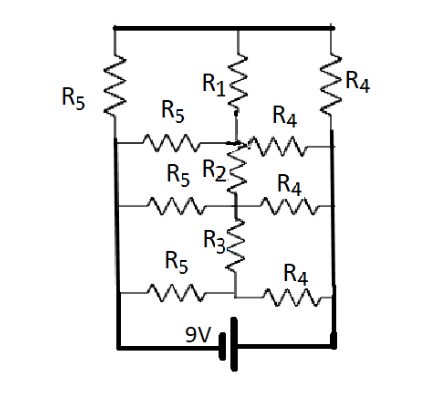 Circuit with resistors R1–R5
Topic: Circuits Metodi: Kirchhoff’s Laws, Equivalent Circuit Reduction Competenze: Diagrammatic Reasoning, Mathematical Modeling Objects: Resistor Fonte: Testo (PDF) — p.5
Qual è la tensione del resistore nel circuito di seguito?
- A.
- B.
- C.
- D.
- E.
Circuito con resistori R1R5
Topic: Circuits Metodi: Kirchhoff’s Laws, Equivalent Circuit Reduction Competenze: Diagrammatic Reasoning, Mathematical Modeling Objects: Resistor Fonte: Testo (PDF) — p.5
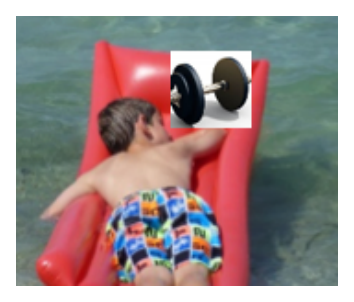
A child sitting on an inflatable mattress in a swimming pool had a steel weight with him. When he dropped it to the bottom of the pool the water level in the pool:
- A. Went down
- B. Went up
- C. Did not change
- D. Depends on the mass of the child and mattress
Topic: Fluid Mechanics Metodi: Hydrostatic Equilibrium, Physical Modeling Competenze: Physical Reasoning Objects: — Fonte: Testo (PDF) — p.6
Un bambino seduto su un materasso gonfiabile in una piscina aveva con sé un peso di acciaio . Quando l’ha gettato al fondo della piscina il livello dell’acqua nella piscina:
- A. Ha scesa
- B. È salito
- C. Non è stato modificato
- D. Dipende dalla massa del bambino e dal materasso
Topic: Fluid Mechanics Metodi: Hydrostatic Equilibrium, Physical Modeling Competenze: Physical Reasoning Objects: — Fonte: Testo (PDF) — p.6
A polarizer is a device that lets the component of light parallel to the polarizer’s direction to go through and absorbs the perpendicular direction. For example, a vertically oriented polarizer only allows the vertical component of the light to go through and the transmitted light is vertically polarized light. Now we have three polarizers as shown below. The first polarizer is vertically oriented and the last one is horizontally oriented. The middle one is oriented at an angle with respect to the vertical direction. When a randomly oriented light with intensity is passed into this series of polarizers, what is the intensity of the light after it passes through the third polarizer?
- A.
- B.
- C.
- D.
- E.
 Three polarizers at angles 0°, θ, 90°
Topic: Wave Optics, Electromagnetism Metodi: Superposition Principle, Physical Modeling Competenze: Mathematical Modeling, Physical Reasoning Objects: — Fonte: Testo (PDF) — p.6
Un polarizzatore è un dispositivo che permette alla componente di luce parallela alla direzione del polarizzatore di passare attraverso e assorbe la direzione perpendicolare. Ad esempio, un polarizzatore orientato verticalmente permette solo di attraversare la componente verticale della luce e la luce trasmessa è la luce polarizzata verticalmente. Ora abbiamo tre polarizzatori come mostrato qui sotto. Il primo polarizzatore è orientato verticalmente e l’ultimo orizzontale orizzontalmente. Il centro è orientato ad un angolo rispetto alla direzione verticale. Quando una luce orientata a caso con intensità viene trasmessa in questa serie di polarizzatori, qual è l’intensità della luce dopo aver attraversato il terzo polarizzatore?
- A.
- B.
- C.
- D.
- E.
*Tre polarizzatori ad angoli 0°, θ, 90° *
Topic: Wave Optics, Electromagnetism Metodi: Superposition Principle, Physical Modeling Competenze: Mathematical Modeling, Physical Reasoning Objects: — Fonte: Testo (PDF) — p.6
The figure below shows two rectangular spaceships, one at rest and the other one moving at speed . In the stationary frame, they are seen to have the same length and their two ends align at . If we know that the clock at the left end of the moving spaceship is showing that the time is at , what time would the clock at its right end show?
- A.
- B.
- C.
- D.
- E.
 Two spaceships — stationary and moving at √3c/2
Topic: Special Relativity Metodi: Lorentz Transformation, Physical Modeling Competenze: Mathematical Modeling, Physical Reasoning Objects: — Fonte: Testo (PDF) — p.6
La figura seguente mostra due navi spaziali rettangolari, una in riposo e l’altra in movimento a velocità . Nel quadro stazionario, si vede che hanno la stessa lunghezza e che le loro due estremità si allineano a . Se sappiamo che l’orologio all’estremità sinistra della nave spaziale in movimento mostra che l’ora è a , che ora mostrerebbe l’orologio all’estremità destra?
- A.
- B.
- C.
- D.
- E.
Due navi spaziali stazionarie e in movimento a √3c/2
Topic: Special Relativity Metodi: Lorentz Transformation, Physical Modeling Competenze: Mathematical Modeling, Physical Reasoning Objects: — Fonte: Testo (PDF) — p.6
A car has maximum acceleration of and maximum deceleration of . The shortest possible time for the car to begin at rest, then arrive at rest at a point a distance away is:
- A.
- B.
- C.
- D.
- E.
Topic: Newtonian Mechanics Metodi: Kinematic Equations, Calculus-Integration Competenze: Mathematical Modeling, Physical Reasoning Objects: — Fonte: Testo (PDF) — p.7
Un’auto ha un’accelerazione massima di e una decelerazione massima di . Il tempo più breve possibile per iniziare a riposo e poi arrivare a riposo in un punto a distanza è:
- A.
- B.
- C.
- D.
- E.
Topic: Newtonian Mechanics Metodi: Kinematic Equations, Calculus-Integration Competenze: Mathematical Modeling, Physical Reasoning Objects: — Fonte: Testo (PDF) — p.7
A uniform spring is fixed at one end. A mass is attached to the other end and the system oscillates with angular frequency . Now suppose the spring is fixed at both ends, then cut in half and the mass is attached between the two half-springs. The new angular frequency of oscillations is:
- A.
- B.
- C.
- D.
- E.
Topic: Oscillations & Waves Metodi: Simple Harmonic Motion Analysis, Hooke’s Law Competenze: Physical Reasoning, Mathematical Modeling Objects: Spring Fonte: Testo (PDF) — p.7
Una molla uniforme è fissata ad una estremità. Un’altra estremità è collegata a una massa e il sistema oscilla con frequenza angolare . Supponiamo che la molla sia fissata alle due estremità, poi tagliata a metà e la massa sia attaccata tra le due mezza molle. La nuova frequenza angolare delle oscillazioni è:
- A.
- B.
- C.
- D.
- E.
Topic: Oscillations & Waves Metodi: Simple Harmonic Motion Analysis, Hooke’s Law Competenze: Physical Reasoning, Mathematical Modeling Objects: Spring Fonte: Testo (PDF) — p.7
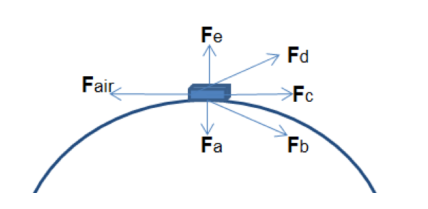
A car travels with constant speed on a circular road on level ground as shown below. is the force of air resistance on the car. Which of the other forces is the horizontal force of the road on the car’s tires?
- A.
- B.
- C.
- D.
- E.
Topic: Newtonian Mechanics, Rotational Dynamics Metodi: Free-Body Diagram, Vector Decomposition Competenze: Diagrammatic Reasoning, Physical Reasoning Objects: — Fonte: Testo (PDF) — p.7
Una macchina percorre una strada circolare su terreno piatto con velocità costante, come mostrato di seguito. è la forza di resistenza all’aria dell’auto. Quale delle altre forze è la forza orizzontale della strada sui pneumatici dell’auto?
- A.
- B.
- C.
- D.
- E.
Topic: Newtonian Mechanics, Rotational Dynamics Metodi: Free-Body Diagram, Vector Decomposition Competenze: Diagrammatic Reasoning, Physical Reasoning Objects: — Fonte: Testo (PDF) — p.7
What is the speed of a particle observed to have a momentum of and a total relativistic energy of ?
- A.
- B.
- C.
- D.
- E.
Topic: Special Relativity, Modern-Quantum Physics Metodi: Relativistic Energy-Momentum, Mass-Energy Equivalence Competenze: Mathematical Modeling, Physical Reasoning Objects: — Fonte: Testo (PDF) — p.7
Qual è la velocità di una particella osservata con un momento di e un’energia relativistica totale di ?
- A.
- B.
- C.
- D.
- E.
Topic: Special Relativity, Modern-Quantum Physics Metodi: Relativistic Energy-Momentum, Mass-Energy Equivalence Competenze: Mathematical Modeling, Physical Reasoning Objects: — Fonte: Testo (PDF) — p.7
Cherie is doing an experiment; she needs to heat a small sample to . There is only one oven available with a maximum temperature of . Could she heat the sample to by using a large lens to focus the radiation from the oven onto the sample?
- A. Yes, if the volume of the oven is at least the volume of the sample.
- B. Yes, if the area of the front of the oven is at least the area of the front of the sample.
- C. Yes, if the sample is placed at the focal point of the lens.
- D. No, because it would violate the conservation of energy.
- E. No, because it would violate the second law of thermodynamics.
Topic: Thermodynamics, Geometric Optics Metodi: Thermodynamic Cycle Analysis, Physical Modeling Competenze: Physical Reasoning, Mathematical Modeling Objects: Lens Fonte: Testo (PDF) — p.7
Cherie sta facendo un esperimento, deve riscaldare un piccolo campione a . È disponibile solo un forno con una temperatura massima di . Potrebbe riscaldare il campione a utilizzando una lente grande per concentrare la radiazione dal forno sul campione?
- A. Sì, se il volume del forno è almeno il volume del campione.
- B. Sì, se la superficie della parte anteriore del forno è almeno la superficie della parte anteriore del campione.
- C. Sì, se il campione è posto al punto focale della lente.
- D. No, perché violerebbe la conservazione dell’energia.
- No, perché violerebbe la seconda legge della termodinamica.
Topic: Thermodynamics, Geometric Optics Metodi: Thermodynamic Cycle Analysis, Physical Modeling Competenze: Physical Reasoning, Mathematical Modeling Objects: Lens Fonte: Testo (PDF) — p.7
A bead slides on a wire with the shape of a helix as shown above, whose symmetry axis is oriented vertically. Which graph on the right best represents the acceleration of the bead as a function of time?
- A. [graph a]
- B. [graph b]
- C. [graph c]
- D. [graph d]
- E. [graph e]
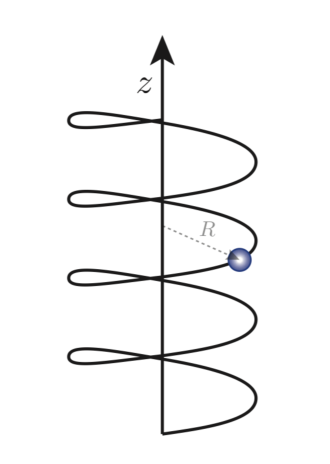 Bead on vertical helix wire
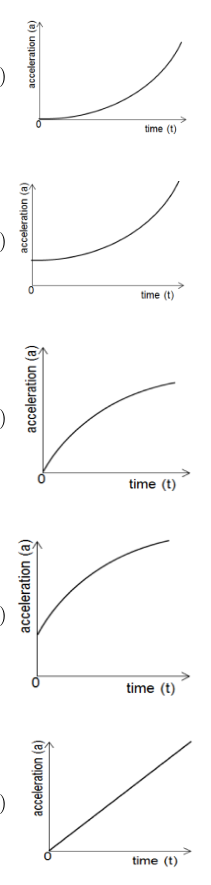 Five acceleration-vs-time graph options a–e
Topic: Newtonian Mechanics, Oscillations & Waves Metodi: Kinematic Equations, Physical Modeling Competenze: Diagrammatic Reasoning, Physical Reasoning Objects: Wire, Ball Fonte: Testo (PDF) — p.7
Una perla scivola su un filo con forma di elica come mostrato sopra, il cui asse di simmetria è orientato verticalmente. Quale grafico a destra rappresenta meglio l’accelerazione della perla in funzione del tempo?
- A. [grafico a]
- B. [grafico b]
- C. [grafico c]
- D. [grafico d]
- E. [grafico e]
Perla su filo di elice verticale
Cinque opzioni di grafico di accelerazione contro tempo ae
Topic: Newtonian Mechanics, Oscillations & Waves Metodi: Kinematic Equations, Physical Modeling Competenze: Diagrammatic Reasoning, Physical Reasoning Objects: Wire, Ball Fonte: Testo (PDF) — p.7
The velocity needed for the rocket or other projectile to orbit around the Earth is called the ‘first cosmic velocity’ (). The velocity required to escape the Earth is called the ‘second cosmic velocity’ (). The minimum velocity one has to attain to leave the solar system from the Earth is called the ‘third cosmic velocity’ (). In terms of the radius of the Earth , the speed of Earth orbiting around the Sun , and the gravitational acceleration near the Earth surface , find:
a) The ‘first cosmic velocity’ ()
b) The ‘second cosmic velocity’ ()
c) The ‘third cosmic velocity’ ()
Finally, estimate the values of , and using values from the formula page and the expressions obtained above.
Topic: Gravitation, Newtonian Mechanics Metodi: Newton’s Law of Gravitation, Energy Conservation Method, Kepler’s Laws Competenze: Mathematical Modeling, Physical Reasoning Objects: Projectile, Planet, Star Fonte: Testo (PDF) — p.8
La velocità necessaria per il razzo o altro proiettile per orbitare intorno alla Terra è chiamata la ‘prima velocità cosmica’ (). La velocità necessaria per sfuggire alla Terra è chiamata “seconda velocità cosmica” (). La velocità minima che si deve raggiungere per lasciare il sistema solare dalla Terra è chiamata la “terza velocità cosmica” (). In termini di raggio di terra , velocità della Terra in orbita attorno al Sole , e accelerazione gravitazionale vicino alla superficie terrestre , trovare:
a) La “prima velocità cosmica” ()
b) La “seconda velocità cosmica” ()
c) La “terza velocità cosmica” ()
Infine, calcolare i valori di , e utilizzando i valori della pagina della formula e le espressioni ottenute sopra.
Topic: Gravitation, Newtonian Mechanics Metodi: Newton’s Law of Gravitation, Energy Conservation Method, Kepler’s Laws Competenze: Mathematical Modeling, Physical Reasoning Objects: Projectile, Planet, Star Fonte: Testo (PDF) — p.8
A very narrow beam of sound from a directional loudspeaker was directed towards the water at the angle to the surface as shown by a dashed line on the picture. It was noticed that the fish avoids the dashed area, as they dislike the noise. Using the information from the picture calculate the speed of sound in water.
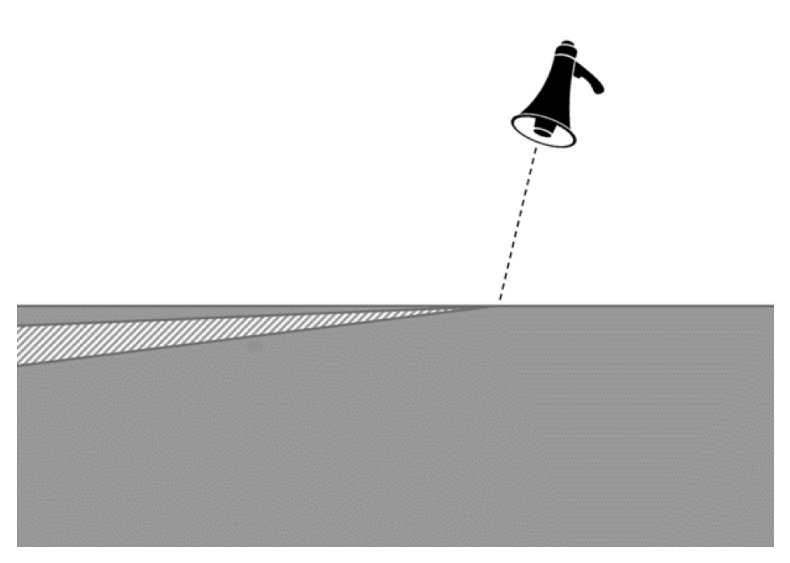 Sound beam from loudspeaker refracting into water with fish
Topic: Oscillations & Waves, Geometric Optics Metodi: Snell’s Law, Wave Equation Competenze: Physical Reasoning, Mathematical Modeling, Experimental Data Analysis Objects: — Fonte: Testo (PDF) — p.9
Un raggio molto stretto di suono proveniente da un altoparlante direzionale è stato diretto verso l’acqua all’angolo verso la superficie come mostrato da una linea disegnata sull’immagine. Si è notato che i pesci evitano le zone dismesse, poiché non amano il rumore. Usando le informazioni dell’immagine si calcola la velocità del suono in acqua.
Fonte sonore proveniente da altoparlanti che si frattura nell’acqua con pesce
Topic: Oscillations & Waves, Geometric Optics Metodi: Snell’s Law, Wave Equation Competenze: Physical Reasoning, Mathematical Modeling, Experimental Data Analysis Objects: — Fonte: Testo (PDF) — p.9
Deuterium is the heavy stable isotope of hydrogen, having a proton and neutron in its nucleus (protons and neutrons have approximately the same mass). Heavy water is a form of water that contains Deuterium and Oxygen. A heavy water nuclear reactor has heavy water between the nuclear fuel rods. Suppose that a neutron from the fuel rod has a head-on elastic collision with a Deuterium nucleus.
a) Find the ratio of the final speed of the deuteron to the initial speed of the neutron.
b) What percentage of the initial kinetic energy is transferred to the deuteron?
c) How many such collisions are needed to slow down the neutron from to ?
d) How would this estimate change if we consider collisions at other angles?
Topic: Nuclear & Particle Physics, Conservation of Momentum Metodi: Conservation of Momentum, Conservation of Energy, Kinematic Equations Competenze: Mathematical Modeling, Physical Reasoning Objects: Nucleus Fonte: Testo (PDF) — p.10
Il deuterio è l’isotopo stabile pesante dell’idrogeno, che ha un protone e un neutrone nel suo nucleo (protoni e neutroni hanno circa la stessa massa). L’acqua pesante è una forma di acqua che contiene deuterio e ossigeno. Un reattore nucleare ad acqua pesante ha acqua pesante tra le barre di combustibile nucleare. Supponiamo che un neutrone della canna di combustibile abbia una collisione elastica frontale con un nucleo di deuterio.
a) Trovare il rapporto tra la velocità finale del deuteron e la velocità iniziale del neutrone.
b) Quale percentuale dell’energia cinetica iniziale viene trasferita al Deuteron?
c) Quante collisioni sono necessarie per rallentare il neutrone da a ?
d) Come si potrebbe valutare la variazione se si considerino le collisioni da altri angoli?
Topic: Nuclear & Particle Physics, Conservation of Momentum Metodi: Conservation of Momentum, Conservation of Energy, Kinematic Equations Competenze: Mathematical Modeling, Physical Reasoning Objects: Nucleus Fonte: Testo (PDF) — p.10