A steel ball is thrown down with a speed of 3.0 m s on to a hard surface from a height of 2.0 m. It retains 70% of its energy on each bounce. Calculate
(i) the speed at which it hits the ground for the first time, and
(ii) the maximum height it reaches after the 4th bounce.
Topic: Newtonian Mechanics, Conservation of Energy Metodi: Kinematic Equations, Energy Conservation Method Competenze: Mathematical Modeling, Physical Reasoning Objects: Ball Fonte: Testo (PDF) — p.3
Una palla di acciaio viene gettata a una velocità di 3,0 m s su una superficie dura da un’altezza di 2,0 m. Ritenere il 70% della sua energia su ogni rimbalzo. Calcolo
-
la velocità con cui colpisce per la prima volta il suolo;
-
l’altezza massima raggiunta dopo il quarto rimbalzo.
Topic: Newtonian Mechanics, Conservation of Energy Metodi: Kinematic Equations, Energy Conservation Method Competenze: Mathematical Modeling, Physical Reasoning Objects: Ball Fonte: Testo (PDF) — p.3
A long-distance cyclist uses a cycle computer that is dual-powered: it has an internal battery and a solar panel. While the cyclist is riding in direct sunlight, the solar panel on the computer provides energy at a rate equal to of the power consumption. If a fully-charged cycle computer lasts 10 hours when riding at night, calculate how long a fully charged computer will run for in direct sunlight.
Topic: Newtonian Mechanics Metodi: Physical Modeling, Dimensional Analysis Competenze: Physical Reasoning, Mathematical Modeling Objects: Battery Fonte: Testo (PDF) — p.3
Un ciclista di lunga distanza utilizza un computer a ciclo a doppio propulsione: ha una batteria interna e un pannello solare. Mentre il ciclista guida sotto la luce diretta del sole, il pannello solare del computer fornisce energia a un tasso pari a del consumo di energia. Se un computer a ciclo completamente carico dura 10 ore durante la notte, calcola quanto tempo un computer completamente carico funzionerà sotto la luce diretta del sole.
Topic: Newtonian Mechanics Metodi: Physical Modeling, Dimensional Analysis Competenze: Physical Reasoning, Mathematical Modeling Objects: Battery Fonte: Testo (PDF) — p.3
Riding round a corner at 10 km h a cyclist leans over at an angle of 12° to the vertical. At what angle would they lean over if they went round the corner at 15 km h?
Topic: Newtonian Mechanics Metodi: Free-Body Diagram, Kinematic Equations Competenze: Physical Reasoning, Mathematical Modeling Objects: — Fonte: Testo (PDF) — p.3
In giro per un angolo a 10 km h un ciclista si inclina in un angolo di 12° verso la verticale. A che angolo si appoggiano se si girano dietro l’angolo a 15 km h?
Topic: Newtonian Mechanics Metodi: Free-Body Diagram, Kinematic Equations Competenze: Physical Reasoning, Mathematical Modeling Objects: — Fonte: Testo (PDF) — p.3
Io and Europa are both moons of Jupiter. Europa takes twice as long as Io to complete an orbit. What is the ratio of the centripetal acceleration of Io and Europa, ?
You may use the result that for this gravitational system, , where is the angular velocity and is the radius of the orbit.
Topic: Gravitation, Newtonian Mechanics Metodi: Kepler’s Laws, Newton’s Law of Gravitation Competenze: Mathematical Modeling, Physical Reasoning Objects: Satellite, Planet Fonte: Testo (PDF) — p.3
Io e Europa sono entrambe le lune di Giove. Europa richiede due volte più tempo di Io per completare un’orbita. Qual è il rapporto di accelerazione centripetale di Io e Europa, ?
Si può usare il risultato che per questo sistema gravitazionale, , dove è la velocità angolare e è il raggio dell’orbita.
Topic: Gravitation, Newtonian Mechanics Metodi: Kepler’s Laws, Newton’s Law of Gravitation Competenze: Mathematical Modeling, Physical Reasoning Objects: Satellite, Planet Fonte: Testo (PDF) — p.3
A particle of mass and initial speed makes an elastic collision with a stationary particle of mass . The particles move off at speeds and respectively, at equal angles either side of the initial incident direction of .
(i) What is the largest ratio of for which this equal angle condition can occur?
(ii) If , what is the largest angle of deflection, , of particle for this equal angle condition?
Topic: Conservation of Momentum, Newtonian Mechanics Metodi: Conservation of Momentum, Conservation of Energy Competenze: Mathematical Modeling, Physical Reasoning Objects: Particle Beam Fonte: Testo (PDF) — p.3
Una particella di massa e velocità iniziale produce una collisione elastica con una particella fermata di massa . Le particelle si spostano rispettivamente a velocità e , ad angoli uguali su entrambi i lati della direzione iniziale di incidenza di .
(i) Qual è il più grande rapporto di per il quale può verificarsi questa condizione di angolo uguale?
(ii) Se , qual è l’angolo di deviazione più grande, , della particella per questa condizione di angolo uguale?
Topic: Conservation of Momentum, Newtonian Mechanics Metodi: Conservation of Momentum, Conservation of Energy Competenze: Mathematical Modeling, Physical Reasoning Objects: Particle Beam Fonte: Testo (PDF) — p.3
A body is projected with velocity up a plane inclined at an angle to the horizontal. When it returns through its starting point it is moving with half the speed with which it was projected.
Determine the coefficient of friction , in terms of the angle of the plane.
Hint: The coefficient of friction is given by where is the normal contact force and is the frictional force on the body.
Topic: Newtonian Mechanics Metodi: Free-Body Diagram, Energy Conservation Method Competenze: Mathematical Modeling, Physical Reasoning Objects: Block, Inclined Plane Fonte: Testo (PDF) — p.3
Un corpo è proiettato con velocità su un piano inclinato in un angolo orizzontale. Quando ritorna attraverso il suo punto di partenza si muove con la metà della velocità con cui è stato proiettato.
Determinare il coefficiente di attrito , in termini di angolo del piano.
Insigno: il coefficiente di attrito è dato da dove è la forza di contatto normale e è la forza di attrito sul corpo.
Topic: Newtonian Mechanics Metodi: Free-Body Diagram, Energy Conservation Method Competenze: Mathematical Modeling, Physical Reasoning Objects: Block, Inclined Plane Fonte: Testo (PDF) — p.3
A cylindrical container is filled with equal volumes of different liquids which do not mix, so that they form horizontal layers each of height . The densities of the liquids are , with the lowest liquid of density . The curved surface area of the cylinder enclosing each liquid is .
(i) Give an expression for the force on the area surrounding the top liquid in terms of .
(ii) What is the force on the surface surrounding the second liquid down from the top, in terms of ?
(iii) Give an expression for the force on the area surrounding the th liquid at the bottom of the cylinder in terms of ?
Hint:
Topic: Fluid Mechanics Metodi: Hydrostatic Equilibrium, Physical Modeling Competenze: Mathematical Modeling, Physical Reasoning Objects: Cylinder, Container Fonte: Testo (PDF) — p.4
Un contenitore cilindrico è riempito di volumi uguali di liquidi diversi che non si mescolano, in modo che formino strati orizzontali di altezza . Le densità dei liquidi sono , con il liquido più basso di densità . L’area curva della superficie del cilindro che racchiude ogni liquido è .
(i) Indicare l’espressione della forza sull’area che circonda il liquido superiore in termini di .
(ii) Qual è la forza sulla superficie che circonda il secondo liquido in basso dall’alto, in termini di ?
(iii) Indicare l’espressione della forza sull’area che circonda il ° liquido nella parte inferiore del cilindro in termini di ?
*Signore: *
Topic: Fluid Mechanics Metodi: Hydrostatic Equilibrium, Physical Modeling Competenze: Mathematical Modeling, Physical Reasoning Objects: Cylinder, Container Fonte: Testo (PDF) — p.4
A rocket of mass kg contains a further mass kg of fuel. Once the fuel is ignited, 50 kg per second of hot gas is expelled downwards at a speed of 2000 m s.
(i) Calculate the thrust, , applied to the rocket.
(ii) Find an expression for the acceleration of the rocket, , in terms of its total mass , and .
(iii) Find an expression for the acceleration of the rocket as a function of time, , in terms of , , , and , the total time for which the thrust acts.
(iv) Calculate the time after launch at which the weight of an astronaut on board will have appeared to double.
Topic: Newtonian Mechanics, Conservation of Momentum Metodi: Impulse-Momentum Theorem, Free-Body Diagram Competenze: Mathematical Modeling, Physical Reasoning Objects: Projectile Fonte: Testo (PDF) — p.4
Un razzo di massa kg contiene un’ulteriore massa kg di carburante. Una volta acceso il combustibile, 50 kg di gas caldo al secondo vengono espulsi verso il basso a una velocità di 2000 m s.
(i) Calcolare la spinta, , applicata al razzo.
ii) Trovare un’espressione per l’accelerazione del razzo, , in termini di massa totale , e .
(iii) Trovare un’espressione per l’accelerazione del razzo in funzione del tempo, , in termini di , , , e , il tempo totale per il quale agisce la spinta.
(iv) Calcolare il tempo dopo il lancio in cui il peso di un astronauta a bordo avrà avuto l’impressione di raddoppiare.
Topic: Newtonian Mechanics, Conservation of Momentum Metodi: Impulse-Momentum Theorem, Free-Body Diagram Competenze: Mathematical Modeling, Physical Reasoning Objects: Projectile Fonte: Testo (PDF) — p.4
An open topped steel drum is completely filled with oil on a day when the temperature is 5.0 °C. On a warm day the temperature rises, and 2.4% of the oil spills out.
What is the temperature reached on that day?
The volume coefficient of expansion of oil is °C
The linear coefficient of expansion of steel is °C
Topic: Thermodynamics Metodi: Physical Modeling, Approximation & Series Expansion Competenze: Mathematical Modeling, Physical Reasoning Objects: Container Fonte: Testo (PDF) — p.4
Un tamburo di acciaio a capo aperto è completamente riempito di olio in un giorno in cui la temperatura è 5.0 °C. In una giornata calda la temperatura sale e il 2,4% dell’olio scorre.
Qual è la temperatura raggiunta quel giorno?
Il coefficiente di espansione del volume del petrolio è °C
Il coefficiente lineare di espansione dell’acciaio è °C
Topic: Thermodynamics Metodi: Physical Modeling, Approximation & Series Expansion Competenze: Mathematical Modeling, Physical Reasoning Objects: Container Fonte: Testo (PDF) — p.4
Observed from an air traffic control tower, an aeroplane has a bearing of 068° and a range of 43 km. Five minutes later the bearing of the aircraft is 040° with a range of 52 km.
Determine
(i) The speed of the aircraft in m s.
(ii) Its bearing and range 10 minutes after the second sighting.
Topic: Newtonian Mechanics Metodi: Kinematic Equations, Vector Decomposition Competenze: Mathematical Modeling, Physical Reasoning Objects: — Fonte: Testo (PDF) — p.4
Osservato da una torre di controllo del traffico aereo, un aereo ha un punteggio 068° e una autonomia di 43 km. Cinque minuti dopo il cuscinetto dell’aeromobile è 040° con un raggio di 52 km.
Determinazione
(i) La velocità dell’aeromobile in m s.
- Il suo orientamento e la sua portata sono raggiunti 10 minuti dopo il secondo avvistamento.
Topic: Newtonian Mechanics Metodi: Kinematic Equations, Vector Decomposition Competenze: Mathematical Modeling, Physical Reasoning Objects: — Fonte: Testo (PDF) — p.4
A gas is found to obey the equation relating , , , , :
where is the gas pressure, is its volume, is the molar gas constant, is the number of moles, and and are constants.
(i) Determine the SI base units (m, kg, s) in which and are expressed.
(ii) If and , show that this expression approximates to the ideal gas equation relating , , , , at a particular temperature . Determine in terms of , , and .
Hint: For :
Topic: Thermodynamics, Kinetic Theory Metodi: Ideal Gas Law, Approximation & Series Expansion, Dimensional Analysis Competenze: Mathematical Modeling, Physical Reasoning Objects: Gas Fonte: Testo (PDF) — p.5
Si ritiene che un gas obbedisca all’equazione relativa a , , , , :
se è la pressione del gas, è il suo volume, è la costante del gas molare, è il numero di moli e e sono costanti.
(i) Determinare le unità di base SI (m, kg, s) in cui sono espresse e .
(ii) Se e , dimostrano che questa espressione si avvicina all’equazione di gas ideale relativa a , , , , a una particolare temperatura . Determinare in termini di , , e .
Signore: per :
Topic: Thermodynamics, Kinetic Theory Metodi: Ideal Gas Law, Approximation & Series Expansion, Dimensional Analysis Competenze: Mathematical Modeling, Physical Reasoning Objects: Gas Fonte: Testo (PDF) — p.5
A thin rod is balanced in a smooth hemispherical bowl fixed to a table, touching both the interior and the rim as shown in Fig. 1. The rim of the bowl remains horizontal.
Expressed in the simplest form, determine the radius of the bowl in terms of the length of the rod , and the angle to the horizontal.
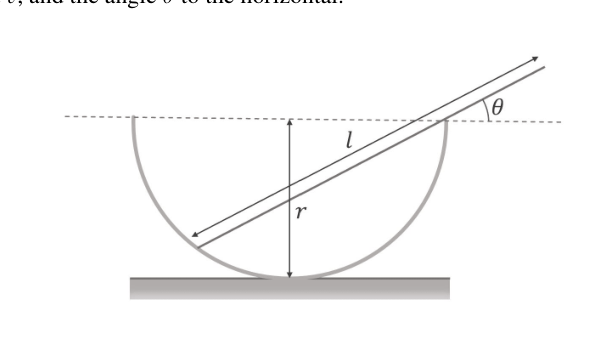 Rod balanced in smooth hemispherical bowl
Topic: Rigid Body Statics Metodi: Torque & Angular Momentum Analysis, Free-Body Diagram Competenze: Diagrammatic Reasoning, Mathematical Modeling Objects: Rod Fonte: Testo (PDF) — p.5
Una sottile canna è equilibrata in una ciotola liscia e emisfera fissata a un tavolo, toccando sia l’interno che il bordo, come mostrato nella figura. 1. Il bordo della ciotola rimane orizzontale.
Esprimendo la forma più semplice, determinare il raggio della ciotola in termini di lunghezza della canna e l’angolo verso l’orizzontale.
Rota bilanciata in una ciotola emisferica liscia
Topic: Rigid Body Statics Metodi: Torque & Angular Momentum Analysis, Free-Body Diagram Competenze: Diagrammatic Reasoning, Mathematical Modeling Objects: Rod Fonte: Testo (PDF) — p.5
In the circuit shown in Fig. 2, the three cells each supply an emf of 5.0 V and have an internal resistance of 5.0 Ω. The external resistors also each have a resistance of 5.0 Ω.
What arrangement of switches gives
(i) the maximum current,
(ii) the minimum non-zero current.
(iii) Determine the current in each case.
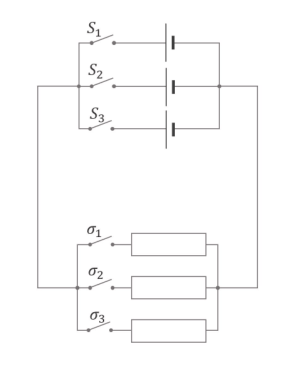 Three cells and switches in parallel circuit
Topic: Circuits Metodi: Kirchhoff’s Laws, Equivalent Circuit Reduction Competenze: Physical Reasoning, Mathematical Modeling Objects: Battery, Resistor, Switch Fonte: Testo (PDF) — p.5
Nel circuito mostrato alla figura. 2, le tre celle forniscono ciascuna una emf di 5,0 V e hanno una resistenza interna di 5,0 Ω. Le resistenze esterne hanno anche una resistenza di 5,0 Ω.
Che disposizione di interruttori dà
-
la corrente massima,
-
la corrente minima non zero.
-
Determinare la corrente in ogni caso.
Tre celle e interruttori in circuito parallelo
Topic: Circuits Metodi: Kirchhoff’s Laws, Equivalent Circuit Reduction Competenze: Physical Reasoning, Mathematical Modeling Objects: Battery, Resistor, Switch Fonte: Testo (PDF) — p.5
The circuit of Fig. 3 consists of four resistors and a switch S. When S is open, the current flowing through the 5 kΩ resistor is . When S is closed, the current flowing through the same resistor is . What is the ratio , giving your answer as the ratio of two integers.
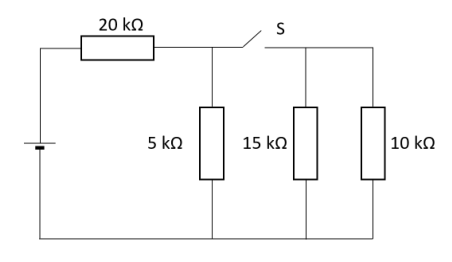 Four resistors and switch S circuit
Topic: Circuits Metodi: Kirchhoff’s Laws, Equivalent Circuit Reduction Competenze: Physical Reasoning, Mathematical Modeling Objects: Resistor, Switch Fonte: Testo (PDF) — p.6
Il circuito di Fig. 3 è costituito da quattro resistori e da uno switch S. Quando S è aperto, la corrente che scorre attraverso la resistenza 5 kΩ è . Quando S è chiuso, la corrente che scorre attraverso la stessa resistenza è . Qual è il rapporto , dando la risposta come il rapporto di due enti.
Quattro resistori e circuito S interruttore
Topic: Circuits Metodi: Kirchhoff’s Laws, Equivalent Circuit Reduction Competenze: Physical Reasoning, Mathematical Modeling Objects: Resistor, Switch Fonte: Testo (PDF) — p.6
The Stefan-Boltzmann law says that the emitted power of a spherical “black body”, , is related to the radius, , and absolute surface temperature, , as . Wien’s “displacement law” says that the wavelength corresponding to the peak value of the emitted power of this spectrum is inversely proportional to the absolute surface temperature. The Sun currently has its peak wavelength as 500 nm.
What will be the new peak wavelength when it becomes a red giant, given its radius will be 200 times larger and its power output 4000 times larger?
Topic: Astrophysics Metodi: Physical Modeling, Approximation & Series Expansion Competenze: Mathematical Modeling, Physical Reasoning Objects: Star Fonte: Testo (PDF) — p.6
La legge di Stefan-Boltzmann afferma che la potenza emessa da un “corpo nero” sferico, , è correlata al raggio, , e alla temperatura assoluta della superficie, , come . La “legge di spostamento” di Wien afferma che la lunghezza d’onda corrispondente al valore massimo della potenza emessa di questo spettro è inversamente proporzionale alla temperatura assoluta della superficie. Il Sole ha attualmente la sua lunghezza d’onda massima di 500 nm.
Qual sarà la nuova lunghezza d’onda di picco quando diventerà un gigante rosso, dato che il suo raggio sarà 200 volte più grande e la sua potenza di produzione 4000 volte maggiore?
Topic: Astrophysics Metodi: Physical Modeling, Approximation & Series Expansion Competenze: Mathematical Modeling, Physical Reasoning Objects: Star Fonte: Testo (PDF) — p.6
One spectral line in hydrogen is caused by photons with an energy of 2.55 eV. The same line is redshifted in the spectrum of a distant galaxy by 5.4 nm. Calculate
(i) the wavelength of the photon,
(ii) the speed of recession of the galaxy,
(iii) the distance to the galaxy.
How far away is the galaxy? Give your answer in megaparsecs (Mpc).
The Hubble constant, km s Mpc.
Topic: Astrophysics, Modern-Quantum Physics Metodi: Photon Energy Relation, Physical Modeling Competenze: Mathematical Modeling, Physical Reasoning Objects: Photon, Star Fonte: Testo (PDF) — p.6
Una linea spettrale nell’idrogeno è causata da fotoni con un’energia di 2,55 eV. La stessa linea è spostata in rosso nello spettro di una galassia lontana di 5,4 nm. Calcolo
-
la lunghezza d’onda del fotone,
-
la velocità di recessione della galassia,
-
la distanza dalla galassia.
Quanto è lontana la galassia? Rispondi in megaparseci (Mpc).
La costante di Hubble, km s Mpc.
Topic: Astrophysics, Modern-Quantum Physics Metodi: Photon Energy Relation, Physical Modeling Competenze: Mathematical Modeling, Physical Reasoning Objects: Photon, Star Fonte: Testo (PDF) — p.6
A car drives along a road that has small depressions regularly spaced about 8.0 m apart. When four 80 kg passengers enter the 800 kg car, it sinks down by 1.8 cm.
At approximately what speed might travelling in the vehicle become very uncomfortable?
Topic: Oscillations & Waves, Newtonian Mechanics Metodi: Simple Harmonic Motion Analysis, Hooke’s Law Competenze: Physical Reasoning, Estimation & Approximation Objects: Spring Fonte: Testo (PDF) — p.6
Una macchina guida lungo una strada che ha piccoli depressioni regolarmente distanti circa 8,0 metri. Quando quattro passeggeri da 80 kg entrano nell’auto da 800 kg, essa scende di 1,8 cm.
A che velocità circa può diventare molto scomodo viaggiare nel veicolo?
Topic: Oscillations & Waves, Newtonian Mechanics Metodi: Simple Harmonic Motion Analysis, Hooke’s Law Competenze: Physical Reasoning, Estimation & Approximation Objects: Spring Fonte: Testo (PDF) — p.6
A pendulum clock is controlled by the swing of a simple pendulum (a mass on the end of a light rod) and is intended to have a period of 1.00 seconds. However, the clock runs slow by ten minutes each day. What percentage change should be made in the length of the pendulum?
Topic: Oscillations & Waves Metodi: Simple Harmonic Motion Analysis, Approximation & Series Expansion Competenze: Mathematical Modeling, Physical Reasoning Objects: Pendulum, Rod Fonte: Testo (PDF) — p.7
Un orologio a pendolo è controllato dallo svingimento di un semplice pendolo (una massa all’estremità di una barra leggera) e ha un periodo di 1,00 secondi. Tuttavia, l’orologio corre lentamente di dieci minuti ogni giorno. Qual è la variazione percentuale della lunghezza del pendolo?
Topic: Oscillations & Waves Metodi: Simple Harmonic Motion Analysis, Approximation & Series Expansion Competenze: Mathematical Modeling, Physical Reasoning Objects: Pendulum, Rod Fonte: Testo (PDF) — p.7
A binary star system is 2140 light years away and consists of two stars like the Sun. The average separation between the stars is 0.00593 light years.
Determine the diameter of the telescope needed to resolve them if using a visible wavelength of 550 nm.
Topic: Astrophysics, Wave Optics Metodi: Interference & Diffraction Analysis, Small-Angle Approximation Competenze: Mathematical Modeling, Physical Reasoning Objects: Star, Lens Fonte: Testo (PDF) — p.7
Un sistema stellare binario si trova a 2140 anni luce e consiste di due stelle come il Sole. La distanza media tra le stelle è di 0,00593 anni luce.
Determinare il diametro del telescopio necessario per risolverli se si utilizza una lunghezza d’onda visibile di 550 nm.
Topic: Astrophysics, Wave Optics Metodi: Interference & Diffraction Analysis, Small-Angle Approximation Competenze: Mathematical Modeling, Physical Reasoning Objects: Star, Lens Fonte: Testo (PDF) — p.7
A glass prism of refracting angle 75.0° is shown in Fig. 4 and has a refractive index of .
(i) For what range of incident angles will light from air that is incident on face AB emerge from face AC?
(ii) Show your result on a diagram.
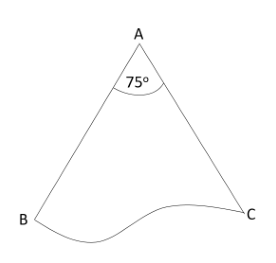 Glass prism with apex angle 75°
Topic: Geometric Optics Metodi: Snell’s Law, Ray Tracing Competenze: Diagrammatic Reasoning, Mathematical Modeling Objects: Prism Fonte: Testo (PDF) — p.7
Il quadro mostra un prisma di vetro con angolo di rifrazione 75.0°. 4 e ha un indice di rifrazione di .
(i) Per quale gamma di angoli di incidenza si illuminerà dall’aria che incide sul viso AB emergere dal viso AC?
(ii) Mostra il risultato su un diagramma.
*Prisma di vetro con angolo di punta 75° *
Topic: Geometric Optics Metodi: Snell’s Law, Ray Tracing Competenze: Diagrammatic Reasoning, Mathematical Modeling Objects: Prism Fonte: Testo (PDF) — p.7
A particle A, of mass carrying a charge of is suspended by an insulating thread of length . Another particle B, of negligible mass but of positive charge is brought towards A, which is repelled. When B arrives at the point previously occupied by A, the system is in (neutral) equilibrium.
Calculate the work done in terms of , , , , , and , where .
Topic: Electrostatics Metodi: Electric Potential Method, Energy Conservation Method Competenze: Mathematical Modeling, Physical Reasoning Objects: Point Charge, String Fonte: Testo (PDF) — p.7
Una particella A di massa con carico di è sospesa da un filo isolante di lunghezza . Un’altra particella B, di massa trascurabile ma di carica positiva , viene portata verso A, che viene respinta. Quando B arriva al punto precedentemente occupato da A, il sistema è in equilibrio (neutrale).
Calcolare il lavoro svolto in termini di , , , , e , dove .
Topic: Electrostatics Metodi: Electric Potential Method, Energy Conservation Method Competenze: Mathematical Modeling, Physical Reasoning Objects: Point Charge, String Fonte: Testo (PDF) — p.7
A capacitor of value 1.0 F discharges through a device whose resistance varies linearly with applied potential difference, , so that , where and are constants. The resistance of the device has a value of 10.0 Ω when V, and 4.0 Ω when V.
The capacitor is initially charged to a potential of 6.0 V.
Determine how long it takes for the capacitor to discharge to 1% of this initial value.
Topic: Circuits Metodi: Differential Equations, Calculus-Integration Competenze: Mathematical Modeling, Physical Reasoning Objects: Capacitor, Resistor Fonte: Testo (PDF) — p.7
Un condensatore di valore 1,0 F si scarica attraverso un dispositivo la cui resistenza varia linearmente con la differenza di potenziale applicata, , in modo che , dove e sono costanti. La resistenza del dispositivo ha un valore di 10,0 Ω quando V e di 4,0 Ω quando V.
Il condensatore è inizialmente carico a un potenziale di 6,0 V.
Determinare quanto tempo ci vuole per la scarica del condensatore all’1% di questo valore iniziale.
Topic: Circuits Metodi: Differential Equations, Calculus-Integration Competenze: Mathematical Modeling, Physical Reasoning Objects: Capacitor, Resistor Fonte: Testo (PDF) — p.7
The U decays according to
Determine the kinetic energy of the emitted -particle in MeV.
m s
Mass of the U nucleus is kg
Mass of the Th nucleus is kg
Mass of the -particle is kg
Topic: Nuclear & Particle Physics Metodi: Mass-Energy Equivalence, Conservation Laws Competenze: Mathematical Modeling, Physical Reasoning Objects: Nucleus Fonte: Testo (PDF) — p.8
Il U decade in base alle seguenti condizioni:
Determinare l’energia cinetica della particella emessa in MeV.
m s
Massa del nucleo U è kg
La massa del nucleo Th è kg
La massa della particella è kg
Topic: Nuclear & Particle Physics Metodi: Mass-Energy Equivalence, Conservation Laws Competenze: Mathematical Modeling, Physical Reasoning Objects: Nucleus Fonte: Testo (PDF) — p.8