Section A: Amusing Airport Adventures
Some students are wandering around an airport waiting for their flight. This question deals with kinematics only, so there is no need to consider resistive forces such as drag.
A group of students are walking at a speed of . They walk alongside a travellator which is moving at a speed of .
One of the students, Mali, decides to walk on the travellator which is moving in the same direction as the group of students. How fast must Mali walk to move at the same speed as the rest of the group? (1 mark)
Note: when we refer to Mali’s walking speed we mean with respect to the ground/travellator beneath them.
Topic: Newtonian Mechanics Metodi: Kinematic Equations, Vector Decomposition Competenze: Physical Reasoning Objects: — Fonte: Testo (PDF) — p.3
Sezione A: Avventure divertenti all’aeroporto
Alcuni studenti vagano in un aeroporto in attesa del loro volo. Questa domanda riguarda solo la cinematica, quindi non è necessario considerare le forze resistenti come il traguardo.
Un gruppo di studenti cammina a una velocità . Si muovono accanto a un vialettore che si muove a una velocità .
Uno degli studenti, Mali, decide di camminare sul vialettore che si muove nella stessa direzione del gruppo di studenti. Quanto veloce deve camminare Mali per muoversi alla stessa velocità del resto del gruppo? 1 punto
Nota: quando si parla di velocità di camminata del Mali si intende per il terreno/travellator sotto di esso.
Topic: Newtonian Mechanics Metodi: Kinematic Equations, Vector Decomposition Competenze: Physical Reasoning Objects: — Fonte: Testo (PDF) — p.3
The group stops to read a sign. Mali is still on the travellator. How fast must Mali walk now to stay with the group? (1 mark)
Topic: Newtonian Mechanics Metodi: Kinematic Equations, Vector Decomposition Competenze: Physical Reasoning Objects: — Fonte: Testo (PDF) — p.3
Il gruppo si ferma per leggere un cartello. Mali è ancora sul vialettore. Quanto veloce deve camminare Mali ora per rimanere con il gruppo? 1 punto
Topic: Newtonian Mechanics Metodi: Kinematic Equations, Vector Decomposition Competenze: Physical Reasoning Objects: — Fonte: Testo (PDF) — p.3
The group moves at towards the left. The travellator moves at towards the left. Mali walks at a constant speed relative to the ground/travellator beneath them. Mali wants to take path L and arrive at point A at the same time as the rest of the group. At what speed should Mali move? Ignore any distance travelled in the -direction for this problem. (4 marks)
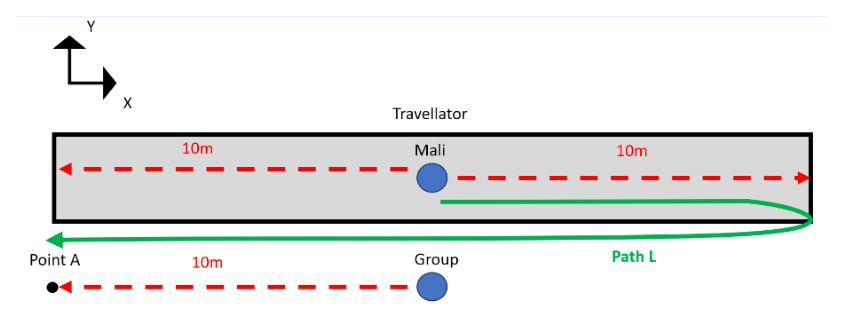 Travellator path L to point A diagram
Topic: Newtonian Mechanics Metodi: Kinematic Equations, Vector Decomposition Competenze: Physical Reasoning, Mathematical Modeling Objects: — Fonte: Testo (PDF) — p.3
Il gruppo si muove a verso sinistra. Il viaggiatore si muove a verso sinistra. Il Mali cammina a velocità costante rispetto al terreno/travellator sotto di essi. Mali vuole prendere il percorso L e arrivare al punto A allo stesso tempo del resto del gruppo. A che velocità dovrebbe muoversi Mali? Ignorare qualsiasi distanza percorsa nella direzione per questo problema. (4 punti)
Segna del percorso del viaggio L al punto A
Topic: Newtonian Mechanics Metodi: Kinematic Equations, Vector Decomposition Competenze: Physical Reasoning, Mathematical Modeling Objects: — Fonte: Testo (PDF) — p.3
You may ignore the -direction for this question; it exists simply for the clarity of the diagram. Imagine Mali and the group start in line with point A. They walk to the end of the travellator (point B) and then return. Mali completes the entire journey on the travellator. The group does the entire journey on the ground.
Assume the group walking speed is . You may not assume that . Assume that the travellator speed is . You may not assume that . Assume the travellator has length .
Mali walks at a constant speed (relative to the ground beneath them) for the entire journey. Determine speed such that Mali and the group return at the same time. Give your answer as an algebraic expression.
Explore the limiting behaviours of your equation. Explain what happens to when is very large compared to , and what happens when is very large compared to . What happens to when is increased? Does the behaviour of your equation make sense in these scenarios? Why? (7 marks)
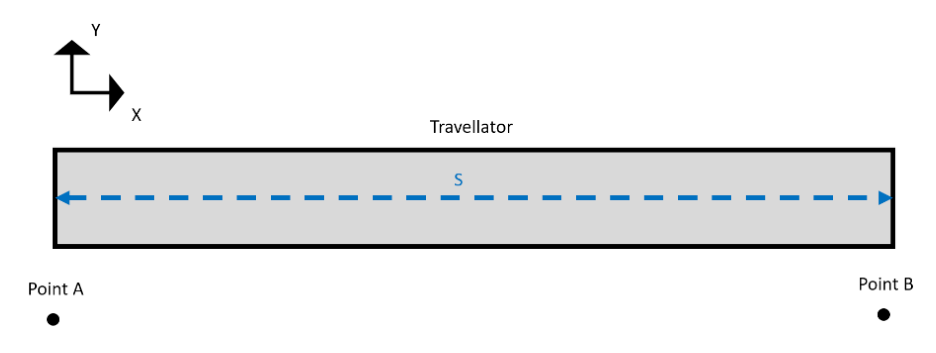 Travellator A-B return journey diagram
Topic: Newtonian Mechanics Metodi: Kinematic Equations, Approximation & Series Expansion Competenze: Mathematical Modeling, Physical Reasoning Objects: — Fonte: Testo (PDF) — p.4
Per questa domanda si può ignorare la direzione ; essa esiste semplicemente per la chiarezza del diagramma. Immaginate che Mali e il gruppo iniziino in linea con il punto A. Essi camminano fino alla fine del vialettore (punto B) e poi tornano. Mali completa l’intero viaggio sul vialettore. Il gruppo fa l’intero viaggio a terra.
Supponiamo che la velocità di camminata del gruppo sia . Non si può presumere che . Supponiamo che la velocità del viaggiatore sia . Non si può presumere che . Supponiamo che il viaggiatore abbia una lunghezza .
Il Mali cammina a velocità costante (relativamente al suolo sotto di essi) per tutto il viaggio. Determinare la velocità in modo tale che il Mali e il gruppo ritornino contemporaneamente. Di’ la tua risposta come espressione algebrica.
Esplora i comportamenti limitanti della tua equazione. Spiegate cosa succede a quando è molto grande rispetto a , e cosa succede quando è molto grande rispetto a . Cosa succede a quando è aumentato? Il comportamento della sua equazione ha senso in questi scenari? - Perché? - Perché? (7 punti)
Diagramma del viaggio di ritorno del viaggiatore A-B
Topic: Newtonian Mechanics Metodi: Kinematic Equations, Approximation & Series Expansion Competenze: Mathematical Modeling, Physical Reasoning Objects: — Fonte: Testo (PDF) — p.4
Section B: Rainy Day Radar
A weather radar is a device used to identify the location and intensity of rain in surrounding areas by sending out a pulse of electromagnetic radiation. This question looks at a simplified model of a weather radar which sends out pulses horizontally. It also neglects the effects of scattering and absorption by precipitation.
To determine the location of the rain, the radar uses time of flight. Because the pulse travels at the speed of light (), the time between when the pulse is emitted and received back by the radar can be used to determine the distance from the radar to the rain.
The time between when a pulse is emitted and returned is . How far away is the rain from the radar? (1 mark)
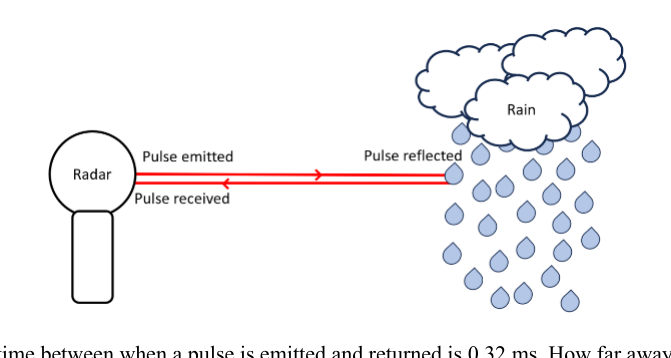 BOM weather radar in Newdegate
Topic: Oscillations & Waves, Electromagnetism Metodi: Kinematic Equations Competenze: Physical Reasoning, Unit Conversion Objects: — Fonte: Testo (PDF) — p.5
Sezione B: Radar per giorni di pioggia
Un radar meteorologico è un dispositivo utilizzato per identificare la posizione e l’intensità della pioggia nelle aree circostanti inviando un impulso di radiazioni elettromagnetiche. Questa domanda riguarda un modello semplificato di radar meteorologico che emette impulsi orizzontalmente. Essa trascura anche gli effetti della dispersione e dell’assorbimento da precipitazione.
Per determinare la posizione della pioggia, il radar utilizza il tempo di volo. Poiché il pulso viaggia alla velocità della luce (), il tempo tra il momento in cui il pulso viene emesso e ricevuto dal radar può essere utilizzato per determinare la distanza dal radar alla pioggia.
Il tempo tra l’emissione e il ritorno di un impulso è . Quanto è lontano la pioggia dal radar? 1 punto
BOM radar meteorologico a Newdegate
Topic: Oscillations & Waves, Electromagnetism Metodi: Kinematic Equations Competenze: Physical Reasoning, Unit Conversion Objects: — Fonte: Testo (PDF) — p.5
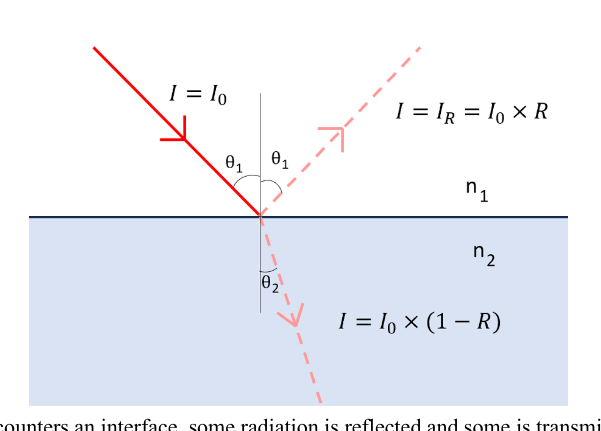
When the pulse encounters an interface, some radiation is reflected and some is transmitted. Every material has a refractive index , which is the ratio of the speed of light in a vacuum to the speed in the material. Assuming the light is incident normal to the surface, the proportion of light which is reflected can be calculated with:
Using the data below, calculate the percentage of normally incident light which is reflected for a water droplet. (1 mark)
Refractive index of air ; Refractive index of water ; Refractive index of ice
Topic: Wave Optics, Oscillations & Waves Metodi: Superposition Principle, Snell’s Law Competenze: Physical Reasoning, Mathematical Modeling Objects: Droplet Fonte: Testo (PDF) — p.6
Quando l’impulso incontra un’interfaccia, alcune radiazioni vengono riflesse e altre trasmesse. Ogni materiale ha un indice di rifrazione , che è il rapporto tra la velocità della luce in vuoto e la velocità del materiale. Supponendo che la luce incida normalmente sulla superficie, la proporzione di luce riflessa può essere calcolata con:
Con i dati di seguito, calcolare la percentuale di luce normalmente accidentale riflessa per una goccia d’acqua. 1 punto
Indice di refrattazione dell’aria ; Indice di refrattazione dell’acqua ; Indice di refrattazione del ghiaccio
Topic: Wave Optics, Oscillations & Waves Metodi: Superposition Principle, Snell’s Law Competenze: Physical Reasoning, Mathematical Modeling Objects: Droplet Fonte: Testo (PDF) — p.6
Using the data below, calculate the percentage of normally incident light which is reflected for a solid hailstone. (1 mark)
Refractive index of air ; Refractive index of water ; Refractive index of ice
Topic: Wave Optics, Oscillations & Waves Metodi: Superposition Principle, Snell’s Law Competenze: Physical Reasoning, Mathematical Modeling Objects: — Fonte: Testo (PDF) — p.6
Con i dati di seguito, calcolare la percentuale di luce normalmente accidentale riflessa per una pietra di granizo solida. 1 punto
Indice di refrattazione dell’aria ; Indice di refrattazione dell’acqua ; Indice di refrattazione del ghiaccio
Topic: Wave Optics, Oscillations & Waves Metodi: Superposition Principle, Snell’s Law Competenze: Physical Reasoning, Mathematical Modeling Objects: — Fonte: Testo (PDF) — p.6
Often hailstones form rapidly. This means pockets of air get trapped between thin layers of ice, and the hailstone appears cloudy.
Describe how this process changes the percentage of light that is reflected by a hailstone compared to what was previously calculated. (1 mark)
 Hailstone with trapped air pockets diagram
Topic: Wave Optics, Oscillations & Waves Metodi: Superposition Principle, Physical Modeling Competenze: Physical Reasoning Objects: — Fonte: Testo (PDF) — p.6
Spesso si formano pietre di granizo rapidamente. Ciò significa che le tasche di aria si intrappolano tra sottili strati di ghiaccio e la grossa pietra appare nuvolosa.
Descrivi come questo processo modifichi la percentuale di luce riflessa da una grossa pietra rispetto a quanto era stato calcolato in precedenza. 1 punto
Pietra di grossa pietra con diagramma di tasche d’aria intrappolate
Topic: Wave Optics, Oscillations & Waves Metodi: Superposition Principle, Physical Modeling Competenze: Physical Reasoning Objects: — Fonte: Testo (PDF) — p.6
If the pulse travels through 50 air pockets, what proportion of its intensity will be reflected? Ignore the wave nature of light for this question. (4 marks)
Topic: Oscillations & Waves, Wave Optics Metodi: Physical Modeling, Superposition Principle Competenze: Mathematical Modeling, Physical Reasoning Objects: — Fonte: Testo (PDF) — p.7
Se il polso passa attraverso 50 tasche d’aria, quale proporzione della sua intensità si rifletterà? Ignora la natura ondulata della luce per questa domanda. (4 punti)
Topic: Oscillations & Waves, Wave Optics Metodi: Physical Modeling, Superposition Principle Competenze: Mathematical Modeling, Physical Reasoning Objects: — Fonte: Testo (PDF) — p.7
How can the radar use the intensity of the reflected pulse to determine the type and intensity of precipitation? (2 marks)
Topic: Oscillations & Waves, Electromagnetism Metodi: Physical Modeling, Experimental Data Analysis Competenze: Physical Reasoning, Diagrammatic Reasoning Objects: — Fonte: Testo (PDF) — p.7
Come può il radar usare l’intensità dell’impulso riflesso per determinare il tipo e l’intensità delle precipitazioni? 2 punti)
Topic: Oscillations & Waves, Electromagnetism Metodi: Physical Modeling, Experimental Data Analysis Competenze: Physical Reasoning, Diagrammatic Reasoning Objects: — Fonte: Testo (PDF) — p.7
Sketch and justify the intensity vs time graphs for the pulse received by the radar for two identical small patches of rain which are located and from the radar. Take as the time when the pulse is emitted from the radar, and plot the intensities received by the radar for each case separately but on the same graph rather than a superposition of the pulses. (3 marks)
Topic: Oscillations & Waves, Electromagnetism Metodi: Physical Modeling, Experimental Data Analysis Competenze: Diagrammatic Reasoning, Physical Reasoning Objects: — Fonte: Testo (PDF) — p.7
Sine e giustificazione delle grafiche di intensità vs tempo per l’impulso ricevuto dal radar per due piccole zone identiche di pioggia che si trovano e dal radar. Prendi come tempo in cui l’impulso viene emesso dal radar e disegni le intensità ricevute dal radar per ogni caso separatamente, ma sullo stesso grafico piuttosto che su una sovrapposizione degli impulsi. (3 punti)
Topic: Oscillations & Waves, Electromagnetism Metodi: Physical Modeling, Experimental Data Analysis Competenze: Diagrammatic Reasoning, Physical Reasoning Objects: — Fonte: Testo (PDF) — p.7
Sketch and justify the intensity vs time graphs for the pulse received by the radar for two identical small patches of hail and rain each located from the radar. Take as the time when the pulse is emitted from the radar, and plot the intensities received by the radar for each case separately but on the same graph rather than a superposition of the pulses. (3 marks)
Topic: Oscillations & Waves, Electromagnetism Metodi: Physical Modeling, Experimental Data Analysis Competenze: Diagrammatic Reasoning, Physical Reasoning Objects: — Fonte: Testo (PDF) — p.7
Sine e giustificazione delle grafiche di intensità vs tempo per l’impulso ricevuto dal radar per due piccole zone identiche di grossace e pioggia, ciascuna situata dal radar. Prendi come tempo in cui l’impulso viene emesso dal radar e disegni le intensità ricevute dal radar per ogni caso separatamente, ma sullo stesso grafico piuttosto che su una sovrapposizione degli impulsi. (3 punti)
Topic: Oscillations & Waves, Electromagnetism Metodi: Physical Modeling, Experimental Data Analysis Competenze: Diagrammatic Reasoning, Physical Reasoning Objects: — Fonte: Testo (PDF) — p.7
Sketch and justify the intensity vs time graphs for the pulse received by the radar for a small heavy patch of rain and a small light patch of rain each located from the radar. Take as the time when the pulse is emitted from the radar, and plot the intensities received by the radar for each case separately but on the same graph rather than a superposition of the pulses. (3 marks)
Topic: Oscillations & Waves, Electromagnetism Metodi: Physical Modeling, Experimental Data Analysis Competenze: Diagrammatic Reasoning, Physical Reasoning Objects: — Fonte: Testo (PDF) — p.8
Sine e giustificazione delle grafiche di intensità vs tempo per l’impulso ricevuto dal radar per una piccola parte pesante di pioggia e una piccola parte leggera di pioggia, ciascuna situata dal radar. Prendi come tempo in cui l’impulso viene emesso dal radar e disegni le intensità ricevute dal radar per ogni caso separatamente, ma sullo stesso grafico piuttosto che su una sovrapposizione degli impulsi. (3 punti)
Topic: Oscillations & Waves, Electromagnetism Metodi: Physical Modeling, Experimental Data Analysis Competenze: Diagrammatic Reasoning, Physical Reasoning Objects: — Fonte: Testo (PDF) — p.8
Sketch and justify the intensity vs time graphs for the pulse received by the radar for a small, dense patch of rain and a larger, less dense band of rain with their centres each located from the radar. Take as the time when the pulse is emitted from the radar, and plot the intensities received by the radar for each case separately but on the same graph rather than a superposition of the pulses. (4 marks)
Topic: Oscillations & Waves, Electromagnetism Metodi: Physical Modeling, Experimental Data Analysis Competenze: Diagrammatic Reasoning, Physical Reasoning Objects: — Fonte: Testo (PDF) — p.8
Sine e giustificazione dei grafici di intensità vs tempo per l’impulso ricevuto dal radar per una piccola zona di pioggia densa e per una fascia di pioggia più grande e meno densa con i loro centri ciascuno situati dal radar. Prendi come tempo in cui l’impulso viene emesso dal radar e disegni le intensità ricevute dal radar per ogni caso separatamente, ma sullo stesso grafico piuttosto che su una sovrapposizione degli impulsi. (4 punti)
Topic: Oscillations & Waves, Electromagnetism Metodi: Physical Modeling, Experimental Data Analysis Competenze: Diagrammatic Reasoning, Physical Reasoning Objects: — Fonte: Testo (PDF) — p.8
The weather radar sometimes displays the signal of patches of light rain behind bands of heavy rain, even when this light rain is not present. Explain what causes this, including any relevant diagrams. (5 marks)
Topic: Oscillations & Waves, Electromagnetism Metodi: Physical Modeling, Superposition Principle Competenze: Diagrammatic Reasoning, Physical Reasoning Objects: — Fonte: Testo (PDF) — p.9
Il radar meteorologico mostra talvolta il segnale di piccole piogge dietro le bande di pioggia intensa, anche quando non è presente. Spiegate cosa ne è la causa, compresi i diagrammi pertinenti. 5 punti)
Topic: Oscillations & Waves, Electromagnetism Metodi: Physical Modeling, Superposition Principle Competenze: Diagrammatic Reasoning, Physical Reasoning Objects: — Fonte: Testo (PDF) — p.9
Some very sensitive weather radars are also able to detect changes in frequency between when the pulse is emitted and received. When the pulse is incident on moving precipitation, the precipitation moves slightly between receiving each wavefront and then moves again slightly between reflecting each wavefront. This means that the wavelength of radiation which it reflects is different to the wavelength emitted by the radar. Since the speed of light is constant in air and , a shorter wavelength leads to a higher frequency and a longer wavelength to a lower frequency.
In general, the observed frequency due to relative motion between the radar and cloud at speeds much lower than the speed of light can be calculated with: where is the original frequency, is the new frequency, is the speed of light, is the speed of the observer, and is the speed of the source.
Explain why the frequency received by the radar is: where is the velocity of the precipitation which is positive when it is moving towards the radar and negative when it is moving away. (2 marks)
Topic: Oscillations & Waves, Electromagnetism Metodi: Wave Equation, Physical Modeling Competenze: Physical Reasoning, Mathematical Modeling Objects: — Fonte: Testo (PDF) — p.10
Alcuni radar meteorologici molto sensibili sono anche in grado di rilevare i cambiamenti di frequenza tra il momento in cui viene emesso e il momento in cui viene ricevuto l’impulso. Quando il pulso incide sulla precipitazione in movimento, la precipitazione si muove leggermente tra il ricevimento di ogni fronte d’onda e poi si muove di nuovo leggermente tra il riflesso di ogni fronte d’onda. Ciò significa che la lunghezza d’onda della radiazione che riflette è diversa dalla lunghezza d’onda emessa dal radar. Poiché la velocità della luce è costante nell’aria e , una lunghezza d’onda più breve porta ad una frequenza più alta e una lunghezza d’onda più lunga ad una frequenza più bassa.
In generale, la frequenza osservata a causa del movimento relativo tra il radar e la nube a velocità molto inferiori a quelle della luce può essere calcolata con: se è la frequenza originale, è la nuova frequenza, è la velocità della luce, è la velocità dell’osservatore e è la velocità della fonte.
Spiega perché la frequenza ricevuta dal radar è: dove è la velocità della precipitazione che è positiva quando si sta muovendo verso il radar e negativa quando si sta allontanando. 2 punti)
Topic: Oscillations & Waves, Electromagnetism Metodi: Wave Equation, Physical Modeling Competenze: Physical Reasoning, Mathematical Modeling Objects: — Fonte: Testo (PDF) — p.10
Calculate the received frequency by the radar for precipitation moving at towards the radar. The radar emits a pulse of frequency . Give your answer to 10 significant figures and use . (1 mark)
Topic: Oscillations & Waves, Electromagnetism Metodi: Wave Equation Competenze: Physical Reasoning, Significant Figures Objects: — Fonte: Testo (PDF) — p.10
Calcolare la frequenza ricevuta dal radar per la precipitazione che si muove a verso il radar. Il radar emette un impulso di frequenza . Rispondi alle 10 cifre significative e usa . 1 punto
Topic: Oscillations & Waves, Electromagnetism Metodi: Wave Equation Competenze: Physical Reasoning, Significant Figures Objects: — Fonte: Testo (PDF) — p.10
Calculate the received frequency by the radar for precipitation moving at away from the radar. The radar emits a pulse of frequency . Give your answer to 10 significant figures and use . (1 mark)
Topic: Oscillations & Waves, Electromagnetism Metodi: Wave Equation Competenze: Physical Reasoning, Significant Figures Objects: — Fonte: Testo (PDF) — p.10
Calcolare la frequenza ricevuta dal radar per la precipitazione che si muove a lontano dal radar. Il radar emette un impulso di frequenza . Rispondi alle 10 cifre significative e usa . 1 punto
Topic: Oscillations & Waves, Electromagnetism Metodi: Wave Equation Competenze: Physical Reasoning, Significant Figures Objects: — Fonte: Testo (PDF) — p.10
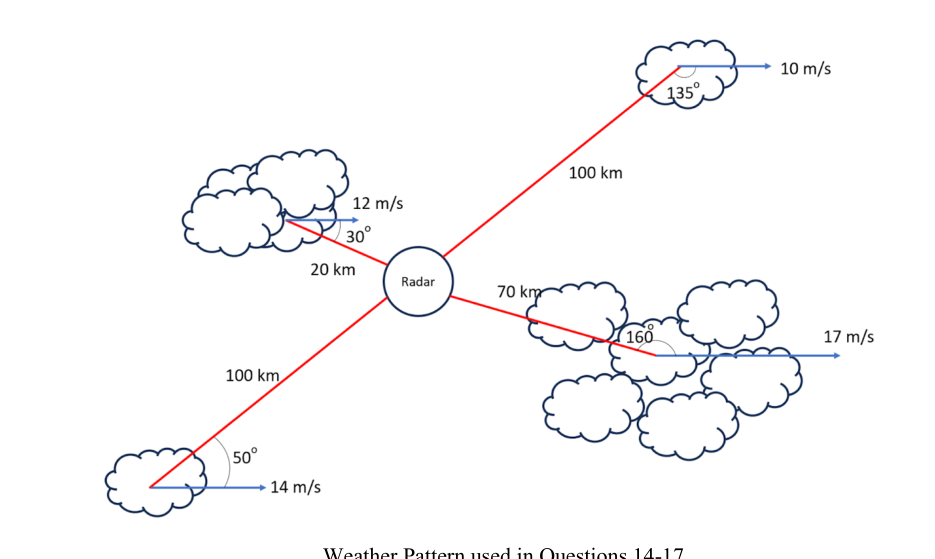
For the weather pattern shown above, explain why there are three peaks in its intensity-time graph. (1 mark)
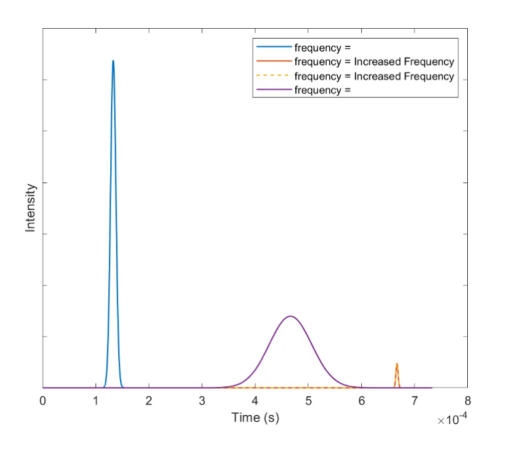 Weather pattern with rain/hail bands
 Intensity-time graph three peaks
Topic: Oscillations & Waves, Electromagnetism Metodi: Physical Modeling, Experimental Data Analysis Competenze: Physical Reasoning, Diagrammatic Reasoning Objects: — Fonte: Testo (PDF) — p.11
Per il modello meteorologico mostrato sopra, spiegate perché ci sono tre picchi nel suo grafico di intensità-tempo. 1 punto
Modello meteorologico con fasce di pioggia/grilla
Grafico di intensità-tempo tre picchi
Topic: Oscillations & Waves, Electromagnetism Metodi: Physical Modeling, Experimental Data Analysis Competenze: Physical Reasoning, Diagrammatic Reasoning Objects: — Fonte: Testo (PDF) — p.11
What is the received frequency from the pulse reflected by the precipitation from the radar? Give your answer to 10 significant figures. (2 marks)
Topic: Oscillations & Waves, Electromagnetism Metodi: Wave Equation Competenze: Physical Reasoning, Significant Figures Objects: — Fonte: Testo (PDF) — p.11
Qual è la frequenza ricevuta dal pulso riflessa dalla precipitazione dal radar? Di’ la tua risposta a 10 numeri significativi. 2 punti)
Topic: Oscillations & Waves, Electromagnetism Metodi: Wave Equation Competenze: Physical Reasoning, Significant Figures Objects: — Fonte: Testo (PDF) — p.11
What is the received frequency from the pulse reflected by the precipitation from the radar? Give your answer to 10 significant figures. (2 marks)
Topic: Oscillations & Waves, Electromagnetism Metodi: Wave Equation Competenze: Physical Reasoning, Significant Figures Objects: — Fonte: Testo (PDF) — p.11
Qual è la frequenza ricevuta dal pulso riflessa dalla precipitazione dal radar? Di’ la tua risposta a 10 numeri significativi. 2 punti)
Topic: Oscillations & Waves, Electromagnetism Metodi: Wave Equation Competenze: Physical Reasoning, Significant Figures Objects: — Fonte: Testo (PDF) — p.11
Which of the graphs below (labelled a, b, c and d) could correspond to data received by the radar from the above weather pattern? (1 mark)
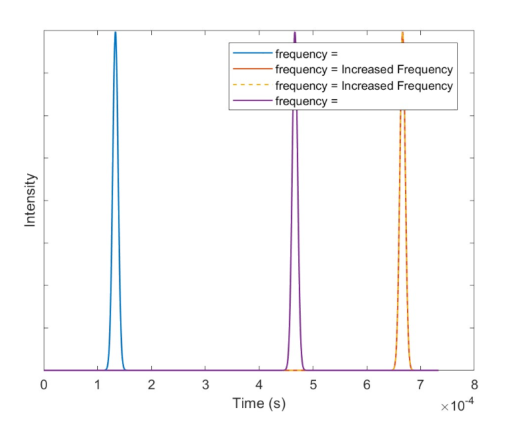 Graph a: frequency vs time
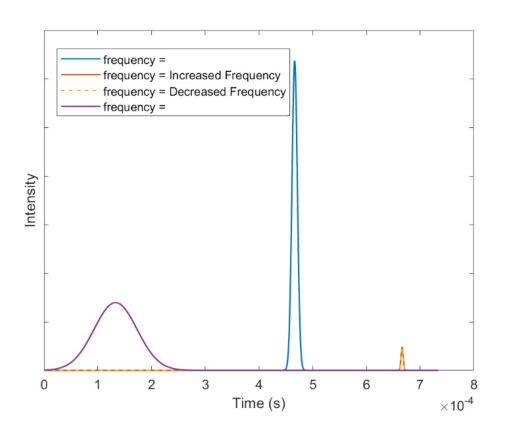 Graph b: frequency vs time
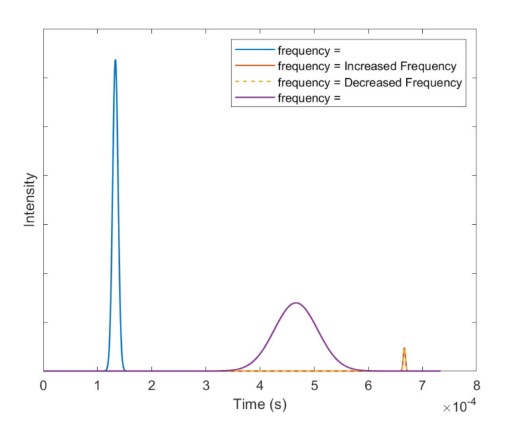 Graphs c and d: frequency vs time
Topic: Oscillations & Waves, Electromagnetism Metodi: Experimental Data Analysis, Physical Modeling Competenze: Diagrammatic Reasoning, Physical Reasoning Objects: — Fonte: Testo (PDF) — p.11
Quali dei grafici di seguito (indicati a, b, c e d) potrebbero corrispondere ai dati ricevuti dal radar dal modello meteorologico di cui sopra? 1 punto
Grafico a: frequenza vs tempo
Grafico b: frequenza vs tempo
Grafici c e d: frequenza vs tempo
Topic: Oscillations & Waves, Electromagnetism Metodi: Experimental Data Analysis, Physical Modeling Competenze: Diagrammatic Reasoning, Physical Reasoning Objects: — Fonte: Testo (PDF) — p.11
Section C: Bounce-back Beam Biopsy
Consider two solid, spherical masses, one with mass , and one with mass . Assuming that is initially at rest, and that is incident on with some energy , the particles will scatter with final energies and respectively.
Write an equation for conservation of energy for this process. Only include the following variables in your answer:
- – the mass of the incoming particle
- – the mass of the originally stationary target
- – the kinetic energy of before the collision
- – the kinetic energy of after the collision
- – the kinetic energy of after the collision (1 mark)
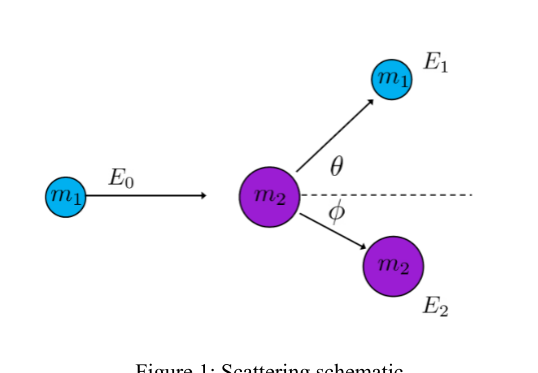 Scattering schematic Figure 1
Topic: Conservation of Energy, Conservation of Momentum, Newtonian Mechanics Metodi: Conservation of Energy, Free-Body Diagram Competenze: Mathematical Modeling, Physical Reasoning Objects: Sphere Fonte: Testo (PDF) — p.13
Sezione C: Biopsia a fascio di rimbalzo
Si consideriamo due masse solide sferiche, una con massa e una con massa . Supponendo che sia inizialmente a riposo e che incida su con qualche energia , le particelle si disperderanno con rispettivamente le energie finali e .
Scrivi un’equazione per la conservazione dell’energia per questo processo. In risposta, includere solo le seguenti variabili:
- la massa della particella in entrata
- la massa dell’obiettivo originariamente fermo
- l’energia cinetica di prima della collisione
- l’energia cinetica di dopo la collisione
- l’energia cinetica di dopo la collisione 1 punto
Scattering schematic Fig. 1
Topic: Conservation of Energy, Conservation of Momentum, Newtonian Mechanics Metodi: Conservation of Energy, Free-Body Diagram Competenze: Mathematical Modeling, Physical Reasoning Objects: Sphere Fonte: Testo (PDF) — p.13
Write two equations for conservation of momentum, accounting for the scattering angles and . (4 marks)
Topic: Conservation of Momentum, Newtonian Mechanics Metodi: Conservation of Momentum, Vector Decomposition Competenze: Mathematical Modeling, Physical Reasoning Objects: Sphere Fonte: Testo (PDF) — p.13
Scrivere due equazioni per la conservazione del momento, tenendo conto degli angoli di dispersione e . (4 punti)
Topic: Conservation of Momentum, Newtonian Mechanics Metodi: Conservation of Momentum, Vector Decomposition Competenze: Mathematical Modeling, Physical Reasoning Objects: Sphere Fonte: Testo (PDF) — p.13
Solve these equations to find an expression for the final energy of , (), as a function of initial energy, masses and scattering angle . Show that: (4 marks)
If you have not solved this in 10 minutes, it is recommended that you move on and just use this result for the later parts of the question.
Topic: Conservation of Energy, Conservation of Momentum, Newtonian Mechanics Metodi: Conservation of Energy, Conservation of Momentum, Differential Equations Competenze: Mathematical Modeling, Physical Reasoning Objects: — Fonte: Testo (PDF) — p.13
Risolvi queste equazioni per trovare un’espressione per l’energia finale di , (), come funzione dell’energia iniziale, delle masse e dell’angolo di dispersione . Mostralo . (4 punti)
Se non hai risolto questo problema in 10 minuti, ti consigliamo di passare avanti e di utilizzare questo risultato solo per le parti successive della domanda.
Topic: Conservation of Energy, Conservation of Momentum, Newtonian Mechanics Metodi: Conservation of Energy, Conservation of Momentum, Differential Equations Competenze: Mathematical Modeling, Physical Reasoning Objects: — Fonte: Testo (PDF) — p.13
The expression in question 3 contains a “plus-minus” sign (). This would seem to imply that we can get two different final energies! Explain under what circumstances we take the positive solution, and when we take the negative, and why. (4 marks)
Topic: Conservation of Energy, Conservation of Momentum, Newtonian Mechanics Metodi: Conservation of Energy, Conservation of Momentum, Physical Modeling Competenze: Physical Reasoning, Mathematical Modeling Objects: — Fonte: Testo (PDF) — p.13
L’espressione di cui alla domanda 3 contiene un segno “plus-minus” (). Questo sembra indicare che possiamo ottenere due energie finali diverse! Spiegate in quali circostanze prendiamo la soluzione positiva, quando prendiamo la soluzione negativa e perché. (4 punti)
Topic: Conservation of Energy, Conservation of Momentum, Newtonian Mechanics Metodi: Conservation of Energy, Conservation of Momentum, Physical Modeling Competenze: Physical Reasoning, Mathematical Modeling Objects: — Fonte: Testo (PDF) — p.13
Using the expression in question 3, take the limits where , and . What do you notice about scattering angles? Can you describe why you see this? (4 marks)
Hint: are any scattering angles forbidden?
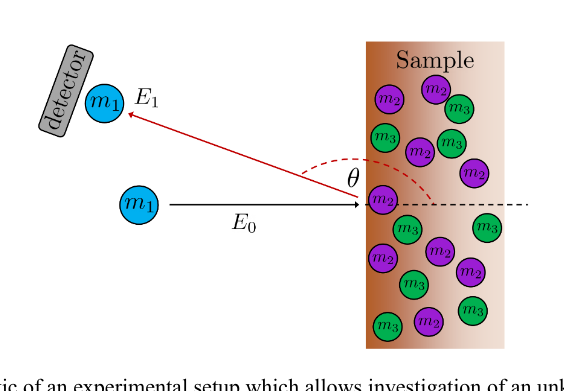 Scattering schematic Figure 2 with ,
Topic: Conservation of Energy, Conservation of Momentum, Newtonian Mechanics Metodi: Approximation & Series Expansion, Conservation of Momentum, Physical Modeling Competenze: Physical Reasoning, Mathematical Modeling Objects: — Fonte: Testo (PDF) — p.14
Usando l’espressione di cui alla domanda 3, prendere i limiti dove e . Cosa notate degli angoli di dispersione? Puoi descrivere perche’ vedi questo? (4 punti)
Insegna: sono proibiti gli angoli di dispersione?
Scattering schematic Figure 2 con ,
Topic: Conservation of Energy, Conservation of Momentum, Newtonian Mechanics Metodi: Approximation & Series Expansion, Conservation of Momentum, Physical Modeling Competenze: Physical Reasoning, Mathematical Modeling Objects: — Fonte: Testo (PDF) — p.14
If two particles are now electrically charged, they will experience a repulsive force throughout the process. Does conservation of momentum still hold in this case? Explain why/why not. (2 marks)
Topic: Conservation of Momentum, Electrostatics, Newtonian Mechanics Metodi: Conservation of Momentum, Physical Modeling Competenze: Physical Reasoning Objects: Point Charge Fonte: Testo (PDF) — p.14
Se due particelle sono ora cariche elettricamente, sperimenteranno una forza repulsiva durante tutto il processo. La conservazione dell’impulso è ancora valida in questo caso? Spiegate perché. 2 punti)
Topic: Conservation of Momentum, Electrostatics, Newtonian Mechanics Metodi: Conservation of Momentum, Physical Modeling Competenze: Physical Reasoning Objects: Point Charge Fonte: Testo (PDF) — p.14
Knowledge of an incoming particle’s energy and incoming angle, along with the final angle and energy, gives information about what particle scatters off. This technique underpins analysis of samples of solids with unknown chemical composition. Assume the unknown solid may contain:
- Diopside
- Calcite
- Dolomite
- Pyrite
- Forsterite
There is a beam of high-energy silicon ions incident on your sample. Under these conditions, which of the minerals produce an observable signal through backscattering that would allow them to be distinguished from the other minerals? Explain your answer. (5 marks)
Topic: Conservation of Energy, Conservation of Momentum, Modern-Quantum Physics Metodi: Conservation of Energy, Conservation of Momentum, Experimental Data Analysis Competenze: Physical Reasoning, Mathematical Modeling Objects: Particle Beam Fonte: Testo (PDF) — p.14
La conoscenza dell’energia e dell’angolo di entrata di una particella, insieme all’angolo finale e all’energia, dà informazioni su cosa la particella si disperde. Questa tecnica è alla base dell’analisi di campioni di solidi di composizione chimica sconosciuta. Supponiamo che il solido sconosciuto possa contenere:
- Diopside
- Calcite
- Dolomite
- Pirite
- Forsterite
C’e’ un raggio di ioni di silicio ad alta energia inciso sul tuo campione. In queste condizioni, quali dei minerali producono un segnale osservabile attraverso la retro-scatter che li permetterebbe di essere distinti dagli altri minerali? Spiega la tua risposta. 5 punti)
Topic: Conservation of Energy, Conservation of Momentum, Modern-Quantum Physics Metodi: Conservation of Energy, Conservation of Momentum, Experimental Data Analysis Competenze: Physical Reasoning, Mathematical Modeling Objects: Particle Beam Fonte: Testo (PDF) — p.14
Instead, consider now that you have an oxygen-16 beam. Is it possible to determine the relative amounts of calcite and dolomite in a sample where they are mixed? Assume that we know the sample only contains these two compounds. (2 marks)
Topic: Conservation of Energy, Conservation of Momentum, Modern-Quantum Physics Metodi: Conservation of Energy, Experimental Data Analysis Competenze: Physical Reasoning, Mathematical Modeling Objects: Particle Beam Fonte: Testo (PDF) — p.14
Invece, considera ora che hai un raggio di ossigeno-16. È possibile determinare le relative quantità di calcite e dolomite in un campione in cui sono mescolate? Supponiamo che sappiamo che il campione contiene solo questi due composti. 2 punti)
Topic: Conservation of Energy, Conservation of Momentum, Modern-Quantum Physics Metodi: Conservation of Energy, Experimental Data Analysis Competenze: Physical Reasoning, Mathematical Modeling Objects: Particle Beam Fonte: Testo (PDF) — p.14
Using the same experimental set-up, now assume that there is a probing source of (alpha) particles. -particles are simply helium-4 nuclei (i.e. no electrons, just the nucleus). These -particles are produced by an Americium-241 source, which then undergoes alpha decay. The alpha decay process produces alpha particles with an energy of .
Let’s say you have two pieces of elemental, grey metal. One is a thick piece, and the other is thin. You know one is composed of iron, and one is tin, but you’ve forgotten which is which! Luckily, you have made measurements of the scattered -particles using the experimental apparatus. The figure shows the energy spectra obtained from each sample. The -axis is the energy of the scattered -particle, measured at an angle . The -axis is proportional to the number of -particles measured with that energy.
Which graph corresponds to which element, and which is the thicker piece? Explain your reasoning with calculation and words. (4 marks)
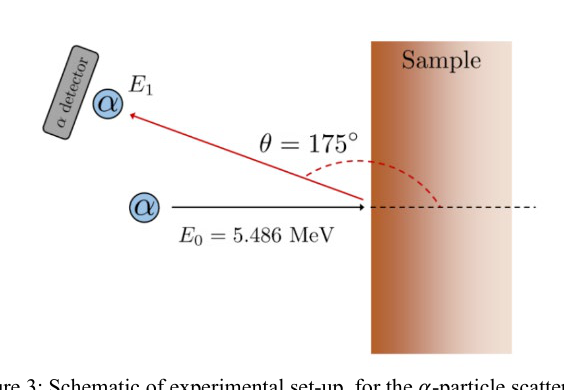 Figure 3: alpha particle scattering setup
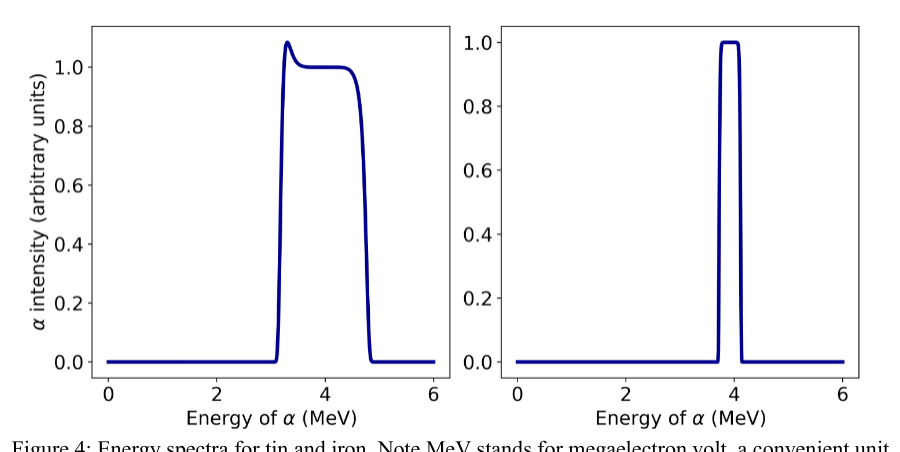 Figure 4: energy spectra for tin and iron
Topic: Nuclear & Particle Physics, Conservation of Energy, Conservation of Momentum Metodi: Conservation of Energy, Conservation of Momentum, Experimental Data Analysis Competenze: Physical Reasoning, Mathematical Modeling Objects: Nucleus Fonte: Testo (PDF) — p.15
Usando la stessa configurazione sperimentale, supponiamo ora che ci sia una fonte di sondaggio di particelle (alfa). Le particelle sono semplicemente nuclei di elio-4 (cioè Nessun elettrone, solo il nucleo). Queste -particelle sono prodotte da una fonte di Americium-241, che subisce quindi un decadimento alfa. Il processo di decadimento alfa produce particelle alfa con un’energia di .
Diciamo che hai due pezzi di metallo grey elementare. Uno è un pezzo speso, l’altro è sottile. Sai che uno è composto da ferro e l’altro da stagno, ma hai dimenticato quale è quale! Luckily, you have made measurements of the scattered -particles using the experimental apparatus. La figura mostra gli spettri energetici ottenuti da ciascun campione. L’asse è l’energia della particella scatenata , misurata ad un angolo . L’asse è proporzionale al numero di particelle misurate con tale energia.
Quale grafico corrisponde a quale elemento, e quale è il pezzo più speso? Spiegate il vostro ragionamento con calcolo e parole. (4 punti)
Figura 3: configurazione di dispersione delle particelle alfa
Figura 4: spettri energetici per stagno e ferro
Topic: Nuclear & Particle Physics, Conservation of Energy, Conservation of Momentum Metodi: Conservation of Energy, Conservation of Momentum, Experimental Data Analysis Competenze: Physical Reasoning, Mathematical Modeling Objects: Nucleus Fonte: Testo (PDF) — p.15
While we can find the energy of the scattered particle for a given angle, this gives no information about the probability of scattering into that angle. Because the -particles are charged (), and they scatter off nuclei which are also charged, this changes the probability of scattering into a particular angle. This probability is approximately given by: where and are the charges of the nuclei, and are the masses of the nuclei, and .
Assume that we have an unknown compound that has two elements, and , in a compound , where , are integers indicating the ratio of and . Elements and have masses , , and charges , respectively. If the same experimental set-up is used, write a ratio for the heights of the peaks from and , in terms of the above quantities, and . (4 marks)
 Scattering probability formula and setup
Topic: Nuclear & Particle Physics, Electrostatics, Conservation of Energy Metodi: Coulomb’s Law, Physical Modeling, Conservation of Energy Competenze: Mathematical Modeling, Physical Reasoning Objects: Nucleus Fonte: Testo (PDF) — p.16
Mentre possiamo trovare l’energia della particella dispersa per un determinato angolo, questo non dà alcuna informazione sulla probabilità di dispersione in quell’angolo. Poiché le particelle sono cariche (), e si disperdono dai nuclei che sono anche carichi, questo cambia la probabilità di dispersione in un particolare angolo. Questa probabilità è approssimativamente data da: se e sono le cariche dei nuclei, e sono le masse dei nuclei e .
Supponiamo che abbiamo un composto sconosciuto che ha due elementi, e , in un composto , dove , sono enti che indicano il rapporto di e . Gli elementi e hanno rispettivamente masse , e cariche e . Se si utilizza la stessa configurazione sperimentale, scrivere un rapporto per le altezze delle cime da e , in termini di quantità sopra indicate, e . (4 punti)
Formula di probabilità di dispersione e configurazione
Topic: Nuclear & Particle Physics, Electrostatics, Conservation of Energy Metodi: Coulomb’s Law, Physical Modeling, Conservation of Energy Competenze: Mathematical Modeling, Physical Reasoning Objects: Nucleus Fonte: Testo (PDF) — p.16
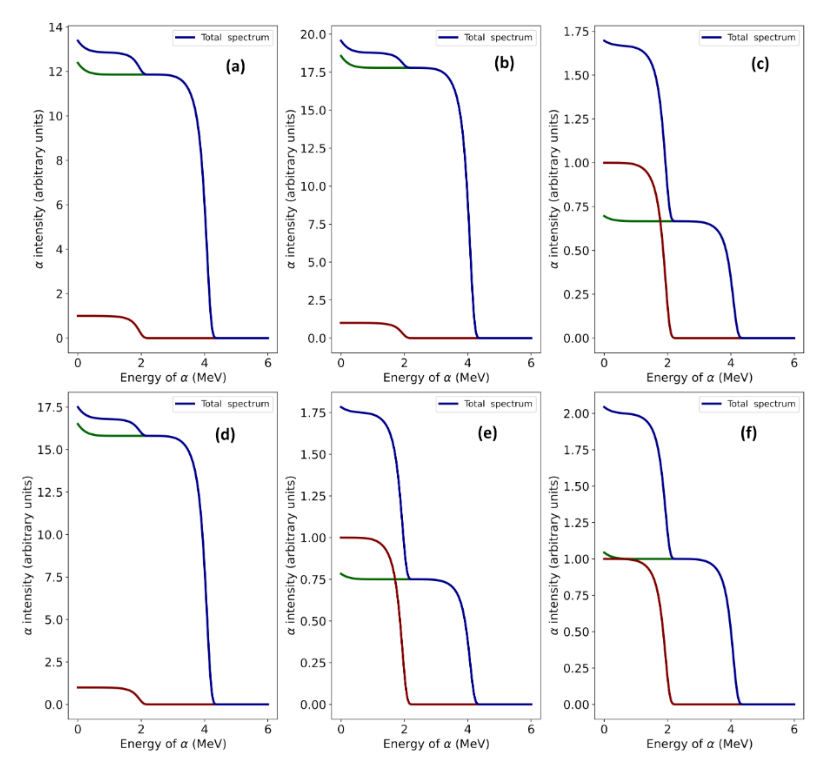
This measurement technique allows us to determine what elements are present in a material, and also in what ratio. Consider three common oxides of iron: wüstite (FeO), magnetite (), and hematite (). Determine which of the three spectra below correspond to each oxide of iron, explaining your reasoning with words and calculations. Note that in the graphs below, the red and green lines show the contribution of each element towards the total spectrum. For this problem let and . (6 marks)
 Three spectra for FeO, Fe3O4, Fe2O3
Topic: Nuclear & Particle Physics, Electrostatics, Conservation of Energy Metodi: Experimental Data Analysis, Physical Modeling, Coulomb’s Law Competenze: Physical Reasoning, Mathematical Modeling Objects: Nucleus Fonte: Testo (PDF) — p.16
Questa tecnica di misura ci permette di determinare quali elementi sono presenti in un materiale e in quale rapporto. Considerate tre ossidi comuni di ferro: la wüstite (FeO), la magnetite () e l’ematitite (). Determina quale dei tre spettri di seguito corrisponde a ciascun ossido di ferro, spiegando il tuo ragionamento con parole e calcoli. Si noti che nei grafici di seguito, le linee rosse e verdi mostrano il contributo di ciascun elemento allo spettro totale. Per questo problema, si possono definire e . (6 punti)
Tre spettri per FeO, Fe3O4, Fe2O3
Topic: Nuclear & Particle Physics, Electrostatics, Conservation of Energy Metodi: Experimental Data Analysis, Physical Modeling, Coulomb’s Law Competenze: Physical Reasoning, Mathematical Modeling Objects: Nucleus Fonte: Testo (PDF) — p.16
Section D: Seeing Secchis
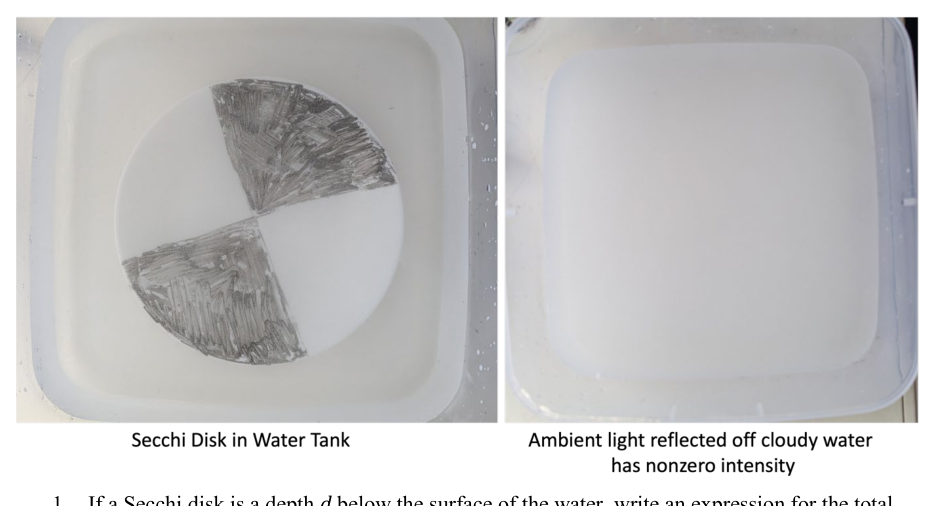
A Secchi disk is a tool used to measure the turbidity (cloudiness) of a body of water. It consists of a disk split into quarters alternatingly painted black and white. The disk is lowered into the water until the ‘secchi’ depth at which it can no longer be seen. Attenuation of light can be calculated using the Beer-Lambert Law: where is the attenuation coefficient of the fluid, is the Euler number , is the path length of the light through the fluid, is the intensity of the light observed, and is the initial intensity of the light source.
If there is an ambient light intensity , then:
If a Secchi disk is at a depth below the surface of the water, write an expression for the total path length for light that passes straight down from the surface to the disk and then reflects and comes back to the observer at the surface. (1 mark)
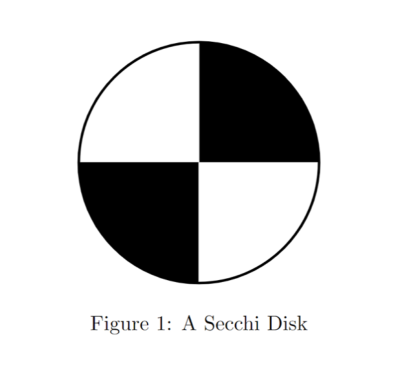 Secchi disk alternating black and white
Topic: Wave Optics, Geometric Optics Metodi: Physical Modeling, Kinematic Equations Competenze: Mathematical Modeling, Physical Reasoning Objects: Disk Fonte: Testo (PDF) — p.18
Sezione D: Visto Secchis
Un disco Secchi è uno strumento utilizzato per misurare la turbidezza (nuvolosità) di un corpo d’acqua. È costituito da un disco diviso in quarti alternatamente dipinto in bianco e nero. Il disco viene abbassato nell’acqua fino alla profondità di “secchi” a cui non può più essere visto. L’attenuazione della luce può essere calcolata usando la legge di Beer-Lambert: se è il coefficiente di attenuazione del fluido, è il numero di Euler , è la lunghezza del percorso della luce attraverso il fluido, è l’intensità della luce osservata e è l’intensità iniziale della sorgente luminosa.
Se c’è una intensità luminosa ambientale , allora:
Se un disco di Secchi si trova a una profondità sotto la superficie dell’acqua, scrivere un’espressione per la lunghezza totale del percorso per la luce che passa direttamente dalla superficie al disco e poi si riflette e ritorna all’osservatore sulla superficie. 1 punto
Secchi disc alternando bianco e nero
Topic: Wave Optics, Geometric Optics Metodi: Physical Modeling, Kinematic Equations Competenze: Mathematical Modeling, Physical Reasoning Objects: Disk Fonte: Testo (PDF) — p.18
Assuming that the initial light intensity is greater than the ambient light intensity, describe what happens to the intensity of light with depth. What happens to the light intensity with depth if the initial light intensity is equal to the ambient light intensity? (2 marks)
Topic: Wave Optics, Geometric Optics Metodi: Physical Modeling Competenze: Physical Reasoning Objects: — Fonte: Testo (PDF) — p.18
Supponendo che l’intensità iniziale della luce sia superiore all’intensità luminosa ambientale, descrivere cosa accade all’intensità luminosa con la profondità. Cosa succede all’intensità luminosa con la profondità se l’intensità luminosa iniziale è uguale all’intensità luminosa ambientale? 2 punti)
Topic: Wave Optics, Geometric Optics Metodi: Physical Modeling Competenze: Physical Reasoning Objects: — Fonte: Testo (PDF) — p.18
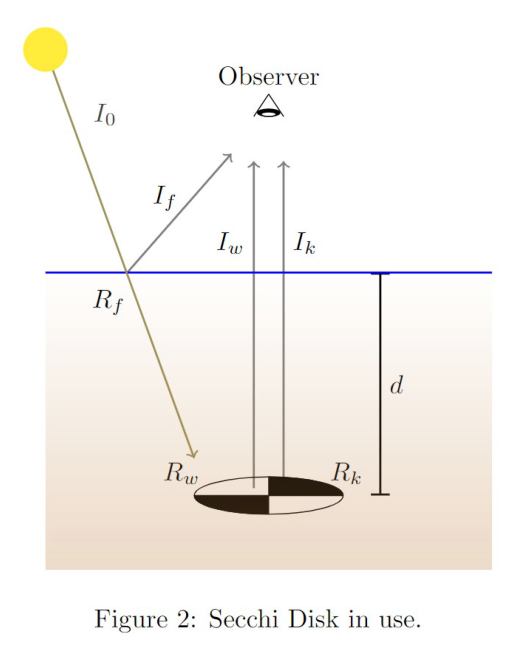
The surface of the water will also reflect some of the initial light, creating ambient light intensity . Hence the intensity formula becomes: where is the reflectivity of the water surface, is the reflectivity of the white part of the Secchi disk, and is the reflectivity of the black part.
Explain why the intensity of light reflected off the white part of the Secchi Disk that reaches the observer at the surface is given by: Ensure you explain where each of the terms come from. Does this formula account for ambient light reflected off the water? (3 marks)
 Secchi disk in water diagram Figure 2
 Observer and Secchi disk geometry
Topic: Wave Optics, Geometric Optics Metodi: Physical Modeling, Superposition Principle Competenze: Physical Reasoning, Mathematical Modeling Objects: Disk Fonte: Testo (PDF) — p.20
La superficie dell’acqua rifletterà anche parte della luce iniziale, creando un’intensità luminosa ambientale . La formula di intensità diventa quindi: dove è la riflettività della superficie dell’acqua, è la riflettività della parte bianca del disco Secchi e è la riflettività della parte nera.
Spiega perché l’intensità della luce riflessa sulla parte bianca del disco Secchi che raggiunge l’osservatore alla superficie è data da: Assicurati di spiegare da dove provengono i termini. Questa formula si riferisce alla luce che si riflette nell’acqua? (3 punti)
Disco di secchi nel diagramma dell’acqua Figura 2
Geometria del disco di osservatore e Secchi
Topic: Wave Optics, Geometric Optics Metodi: Physical Modeling, Superposition Principle Competenze: Physical Reasoning, Mathematical Modeling Objects: Disk Fonte: Testo (PDF) — p.20
Determine an expression for the intensity of light reflected off the black part of the Secchi disk that reaches the observer at the surface. Ensure your formula also includes a term for the ambient light. (1 mark)
Topic: Wave Optics, Geometric Optics Metodi: Physical Modeling, Superposition Principle Competenze: Physical Reasoning, Mathematical Modeling Objects: Disk Fonte: Testo (PDF) — p.20
Determinare un’espressione per l’intensità della luce riflessa dalla parte nera del disco Secchi che raggiunge l’osservatore alla superficie. Assicurarsi che la formula inclua anche un termine per la luce ambientale. 1 punto
Topic: Wave Optics, Geometric Optics Metodi: Physical Modeling, Superposition Principle Competenze: Physical Reasoning, Mathematical Modeling Objects: Disk Fonte: Testo (PDF) — p.20
The contrast is given by the following formula: .
Using your expressions above, write a simplified expression for the contrast in terms of , , , and . (2 marks)
Topic: Wave Optics, Geometric Optics Metodi: Physical Modeling, Superposition Principle Competenze: Mathematical Modeling, Physical Reasoning Objects: — Fonte: Testo (PDF) — p.20
Il contrasto è dato dalla seguente formula: .
Usando le espressioni sopra, scrivete un’espressione semplificata per il contrasto in termini di , , , e . 2 punti)
Topic: Wave Optics, Geometric Optics Metodi: Physical Modeling, Superposition Principle Competenze: Mathematical Modeling, Physical Reasoning Objects: — Fonte: Testo (PDF) — p.20
Solve your equation from the previous question to derive the following expression for . Show your working. (3 marks)
Topic: Wave Optics, Geometric Optics Metodi: Physical Modeling, Calculus-Integration Competenze: Mathematical Modeling, Physical Reasoning Objects: — Fonte: Testo (PDF) — p.21
Risolvi la tua equazione dalla domanda precedente per derivare la seguente espressione per . Mostrate il vostro lavoro. (3 punti)
Topic: Wave Optics, Geometric Optics Metodi: Physical Modeling, Calculus-Integration Competenze: Mathematical Modeling, Physical Reasoning Objects: — Fonte: Testo (PDF) — p.21
Assume that the fluid has a reflectance of and that the disk remains discernible while . Assume and . If the lake has a depth of , what is the minimum turbidity that can be measured? (1 mark)
Topic: Wave Optics, Geometric Optics Metodi: Physical Modeling, Experimental Data Analysis Competenze: Mathematical Modeling, Physical Reasoning Objects: Disk Fonte: Testo (PDF) — p.21
Supponiamo che il fluido abbia una riflessione di e che il disco rimanga visibile mentre . Supponiamo e . Se il lago ha una profondità di , qual è la turbidezità minima che può essere misurata? 1 punto
Topic: Wave Optics, Geometric Optics Metodi: Physical Modeling, Experimental Data Analysis Competenze: Mathematical Modeling, Physical Reasoning Objects: Disk Fonte: Testo (PDF) — p.21
Which of the following changes would allow the measurement of a smaller minimum turbidity in this lake? Explain your reasoning. (3 marks)
- A. Using a specialised detector with instead of your eye,
- B. Increasing ,
- C. Increasing ,
- D. Waiting until the sun is at the highest point in the sky to perform the measurement,
- E. Using a larger Secchi Disk.
Topic: Wave Optics, Geometric Optics Metodi: Physical Modeling, Experimental Data Analysis Competenze: Physical Reasoning, Diagrammatic Reasoning Objects: Disk Fonte: Testo (PDF) — p.21
Quale delle seguenti modifiche consentirebbe di misurare una minima turbidezità di questo lago? Spiegate il vostro ragionamento. (3 punti)
- A. Utilizzando un rilevatore specializzato con invece dell’ occhio,
- B. Aumento di ,
- C. Aumento di ,
- D. Attendere che il sole sia al punto più alto del cielo per eseguire la misura,
- E. Utilizzando un disco Secchi più grande.
Topic: Wave Optics, Geometric Optics Metodi: Physical Modeling, Experimental Data Analysis Competenze: Physical Reasoning, Diagrammatic Reasoning Objects: Disk Fonte: Testo (PDF) — p.21
The reflectance of the fluid is only known to . Will the upper () or lower () value lead to more uncertainty in the final calculated turbidity? (1 mark)
Topic: Wave Optics, Geometric Optics Metodi: Error Propagation, Physical Modeling Competenze: Error Propagation, Physical Reasoning Objects: — Fonte: Testo (PDF) — p.21
La riflessione del fluido è nota solo per . Il valore superiore () o inferiore () porterà a maggiore incertezza nella turbità calcolata finale? 1 punto
Topic: Wave Optics, Geometric Optics Metodi: Error Propagation, Physical Modeling Competenze: Error Propagation, Physical Reasoning Objects: — Fonte: Testo (PDF) — p.21
Find the extremal turbidity bound given your answer to the previous question, and thus calculate the uncertainty to which the turbidity is measured. (1 mark)
Topic: Wave Optics, Geometric Optics Metodi: Error Propagation, Physical Modeling Competenze: Error Propagation, Mathematical Modeling Objects: — Fonte: Testo (PDF) — p.21
Trova la limite di turbidezità estrema data la tua risposta alla domanda precedente e calcola così l’incertezza alla quale viene misurata la turbidezità. 1 punto
Topic: Wave Optics, Geometric Optics Metodi: Error Propagation, Physical Modeling Competenze: Error Propagation, Mathematical Modeling Objects: — Fonte: Testo (PDF) — p.21
Section E: Trailer-Towing Truck
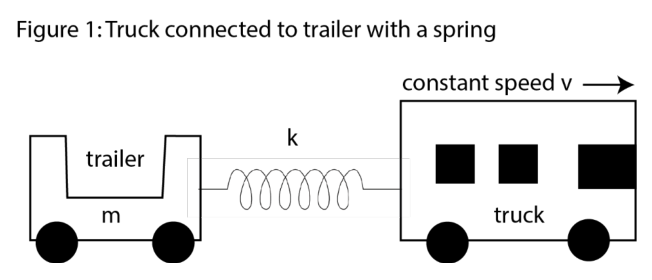
A truck is towing a trailer with an unusual towing device: a light spring with spring constant and natural length . The truck is travelling at a constant speed of relative to the ground. The road is on a hill such that the truck first travels on flat, horizontal ground, then up a incline relative to the horizontal, and then back to the horizontal ground. Assume that the truck and trailer smoothly transition between the different inclines, and each segment is sufficiently long that the system reaches equilibrium. The mass of the trailer is and the friction coefficient between the wheels and ground is . Assume the gravitational acceleration .
Draw a force diagram of the forces on the trailer while on horizontal ground. (1 mark)
 Truck and trailer with spring on flat
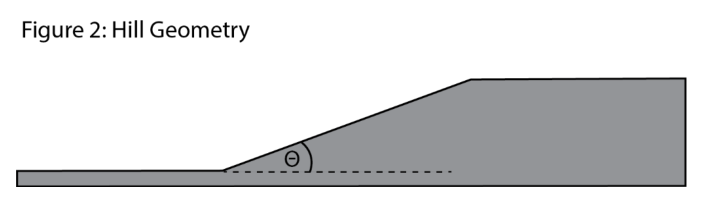 Truck on hill segments Figure 2
Topic: Newtonian Mechanics, Oscillations & Waves Metodi: Free-Body Diagram, Hooke’s Law Competenze: Diagrammatic Reasoning, Physical Reasoning Objects: Spring, Cart, Inclined Plane Fonte: Testo (PDF) — p.22
**Sezione E: camion a remorchio **
Un camion sta trainando un rimorchio con un dispositivo di trainaggio insolito: una molla leggera con costante molla e lunghezza naturale . Il camion si sta muovendo a una velocità costante di rispetto al suolo. La strada è su una collina tale che il camion percorra prima un terreno piatto e orizzontale, poi una penetrazione rispetto all’orizzontale e poi ritorna sul terreno orizzontale. Supponiamo che il camion e il rimorchio passino senza problemi tra le diverse inclinazioni e che ogni segmento sia abbastanza lungo da raggiungere l’equilibrio del sistema. La massa del rimorchio è e il coefficiente di attrito tra le ruote e il terreno è . Supponiamo l’accelerazione gravitazionale .
Disegnare un diagramma delle forze sul rimorchio mentre si trova in terra orizzontale. 1 punto
Trasporto e rimorchio con molla a piatto
Trasporto su segmenti collinari Figura 2
Topic: Newtonian Mechanics, Oscillations & Waves Metodi: Free-Body Diagram, Hooke’s Law Competenze: Diagrammatic Reasoning, Physical Reasoning Objects: Spring, Cart, Inclined Plane Fonte: Testo (PDF) — p.22
Draw a force diagram of the forces on the trailer while on an incline. (1 mark)
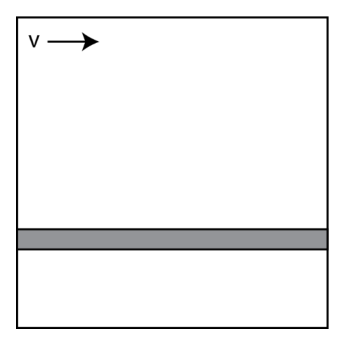 Truck and trailer spring mechanism Figure 1
Topic: Newtonian Mechanics, Oscillations & Waves Metodi: Free-Body Diagram, Hooke’s Law, Vector Decomposition Competenze: Diagrammatic Reasoning, Physical Reasoning Objects: Spring, Cart, Inclined Plane Fonte: Testo (PDF) — p.23
Disegnare un diagramma delle forze sul rimorchio mentre si trova in pensione. 1 punto
Meccanismo di molla per camion e rimorchi Figura 1
Topic: Newtonian Mechanics, Oscillations & Waves Metodi: Free-Body Diagram, Hooke’s Law, Vector Decomposition Competenze: Diagrammatic Reasoning, Physical Reasoning Objects: Spring, Cart, Inclined Plane Fonte: Testo (PDF) — p.23
Determine the length of the spring while the trailer is being towed on flat ground, once the system has reached equilibrium. (2 marks)
Topic: Newtonian Mechanics, Oscillations & Waves Metodi: Free-Body Diagram, Hooke’s Law Competenze: Mathematical Modeling, Physical Reasoning Objects: Spring, Cart Fonte: Testo (PDF) — p.23
Determinare la lunghezza della molla mentre il rimorchio viene rimorchiato su terreno piatto, una volta che il sistema è in equilibrio. 2 punti)
Topic: Newtonian Mechanics, Oscillations & Waves Metodi: Free-Body Diagram, Hooke’s Law Competenze: Mathematical Modeling, Physical Reasoning Objects: Spring, Cart Fonte: Testo (PDF) — p.23
Determine the length of the spring while the trailer is being towed on the inclined slope, once the system has reached equilibrium. (3 marks)
Topic: Newtonian Mechanics, Oscillations & Waves Metodi: Free-Body Diagram, Hooke’s Law, Vector Decomposition Competenze: Mathematical Modeling, Physical Reasoning Objects: Spring, Cart, Inclined Plane Fonte: Testo (PDF) — p.23
Determinare la lunghezza della molla mentre il rimorchio viene rimorchiato sulla pendenza inclinata, una volta che il sistema è in equilibrio. (3 punti)
Topic: Newtonian Mechanics, Oscillations & Waves Metodi: Free-Body Diagram, Hooke’s Law, Vector Decomposition Competenze: Mathematical Modeling, Physical Reasoning Objects: Spring, Cart, Inclined Plane Fonte: Testo (PDF) — p.23
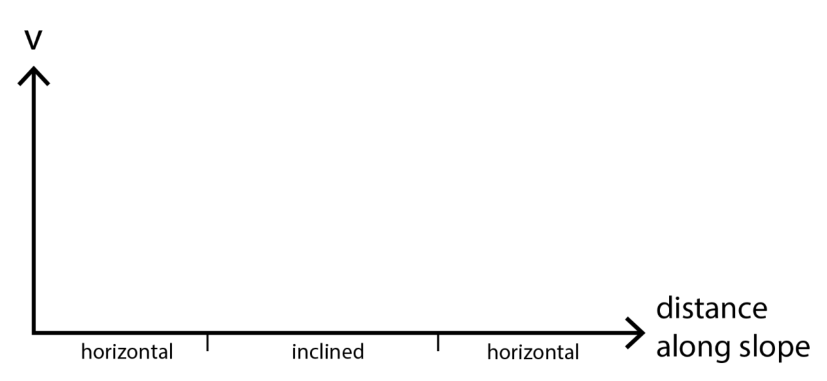
Sketch the velocity of the trailer relative to the ground, , as a function of position along the slope using the given axes. (2 marks)
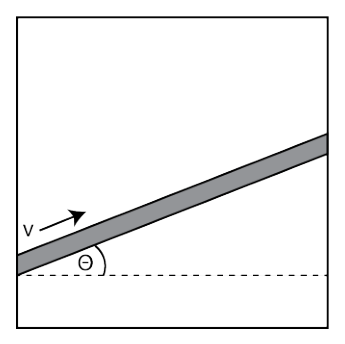 Velocity vs position axes for sketching
 Position vs slope diagram for trailer
Topic: Newtonian Mechanics, Oscillations & Waves Metodi: Kinematic Equations, Physical Modeling Competenze: Diagrammatic Reasoning, Physical Reasoning Objects: Cart, Inclined Plane Fonte: Testo (PDF) — p.23
Segnare la velocità del rimorchio rispetto al suolo, , in funzione della posizione lungo la pendenza utilizzando gli assi dati. 2 punti)
Velocità vs assi di posizione per lo schema
Diagramma posizione vs pendenza per rimorchio
Topic: Newtonian Mechanics, Oscillations & Waves Metodi: Kinematic Equations, Physical Modeling Competenze: Diagrammatic Reasoning, Physical Reasoning Objects: Cart, Inclined Plane Fonte: Testo (PDF) — p.23