In the sport of curling, participants take turns sliding near-cylindrical stones across an ice court towards a target, trying to get their stones as close to the target as possible after using a set of stones. A vertical cross section of a stone is depicted below, showing that the stone is in contact with the ice on a thin ring of radius . The full radius of the stone is , the mass of the stone is and the coefficient of friction with the ice is .
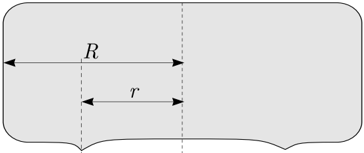
Consider the case when the stone is released at a speed with the aim of knocking out an opponent’s stone at a distance .
i) (1 point) Give an expression for the sliding speed as a function of the time since the stone was released until the stone hits the opponent’s stone.
ii) (1 point) What is the sliding speed just before the stone hits the opponent’s stone?
Now the stone is given a small rotation at the initial angular speed (this can be done to alter the deflection angle of the stone when it hits the opponent’s stone). Assume that the rotation speed remains small throughout the sliding motion: . Keep only the main non-vanishing terms in your calculations, i.e. among the terms with a factor , keep only the term with the smallest . Depending on your approach you may use the following approximations for : , , . You may also need the integral .
iii) (2 points) By how much does the friction force on the stone change due to its rotation? Express your answer in terms of the current angular speed and sliding speed .
iv) (2 points) Give an expression for the torque exerted on the stone.
v) (2 points) What is the angular speed of the stone just before it hits the opponent’s stone?
Topic: Newtonian Mechanics, Rotational Dynamics Metodi: Free-Body Diagram, Torque & Angular Momentum Analysis, Calculus-Integration Competenze: Mathematical Modeling, Physical Reasoning Objects: Disk Fonte: Testo (PDF)
Nel sport del curling, i partecipanti si alternano a scivolare pietre quasi cilindriche su un campo di ghiaccio verso un obiettivo, cercando di avvicinare le loro pietre al bersaglio il più possibile dopo aver utilizzato un insieme di pietre. Un’intersezione verticale di una pietra è raffigurata di seguito, mostrando che la pietra è in contatto con il ghiaccio su un anello sottile di raggio . Il raggio completo della pietra è , la massa della pietra è e il coefficiente di attrito con il ghiaccio è .
Considerare il caso in cui la pietra viene rilasciata a una velocità con l’obiettivo di eliminare la pietra di un avversario a una distanza .
i) (1 punto) Indicare l’espressione della velocità di scorrimento in funzione del tempo dal momento in cui la pietra è stata rilasciata fino a quando non colpisce la pietra dell’avversario.
ii) (1 punto) Qual è la velocità di scorrimento poco prima che la pietra colpisca la pietra dell’avversario?
Ora alla pietra viene data una piccola rotazione alla velocità angolare iniziale (questo può essere fatto per alterare l’angolo di deviazione della pietra quando colpisce la pietra dell’avversario). Supponiamo che la velocità di rotazione rimanga piccola durante il movimento scorrevole: . Tenete nel calcolo solo i termini principali non scomparsi, cioè tra i termini con fattore , conservare solo il termine con il minimo . A seconda del tuo approccio puoi utilizzare le seguenti approssimazioni per : , , . Potrebbe anche essere necessario l’integrale .
iii) (2 punti) Quanto cambia la forza di attrito sulla pietra a causa della sua rotazione? Esprimere la risposta in termini di velocità angolare corrente e velocità di scorrimento .
iv) (2 punti) Indicare l’espressione della coppia esercitata sulla pietra.
v) (2 punti) Qual è la velocità angolare della pietra poco prima di colpire la pietra dell’avversario?
Topic: Newtonian Mechanics, Rotational Dynamics Metodi: Free-Body Diagram, Torque & Angular Momentum Analysis, Calculus-Integration Competenze: Mathematical Modeling, Physical Reasoning Objects: Disk Fonte: Testo (PDF)
A half-sphere of radius m is filled with liquid nitrogen at the boiling point temperature of K (C). The other half is then firmly sealed onto the first, creating a sphere containing liquid nitrogen and nitrogen gas, each occupying one-half of the volume. The sphere is immediately thrown into C temperature water, where it floats exactly as shown in the figure below. After some time, it explodes.
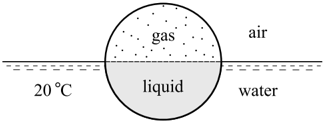
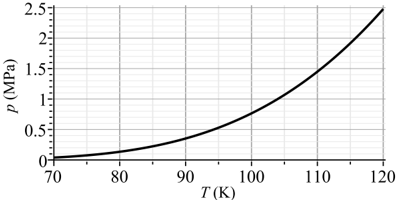
The sphere is made of PCTFE plastic of density , maximum tensile strength (above this stress, the plastic will break) and thermal conductivity . For liquid nitrogen, under the conditions considered here, the latent heat of vaporization is , specific heat and density . Molar mass . The ideal gas constant . Temperature dependence of saturated vapor pressure of nitrogen is shown below.
i) (1.5 points) What is the wall thickness of the sphere?
ii) (1.5 points) What is the pressure inside the sphere right before it explodes? The outside pressure is Pa.
iii) (1.5 points) What is the temperature of liquid nitrogen right before the explosion?
iv) (1.5 points) Calculate the mass of nitrogen that evaporates inside the sphere before the explosion.
v) (2 points) Estimate the time it will take for the sphere to explode. The heat capacity of the plastic and the heat flux through the upper half of the sphere can be neglected.
Topic: Thermodynamics, Elasticity & Materials Metodi: Ideal Gas Law, First Law of Thermodynamics, Stress-Strain Analysis Competenze: Mathematical Modeling, Estimation & Approximation Objects: Sphere, Gas Fonte: Testo (PDF)
Una semisfera di raggio m è riempita di azoto liquido alla temperatura di punto di ebollizione di K ( C). L’altra metà viene quindi saldamente sigillata sulla prima, creando una sfera contenente azoto liquido e gas azoto, ognuna occupando la metà del volume. La sfera viene immediatamente gettata in acqua a temperatura C, dove galleggia esattamente come mostrato nella figura seguente. Dopo un po’ esplode.
La sfera è costituita da plastica PCTFE di densità , resistenza massima alla trazione (sopra questo stress, la plastica si romperà) e conducibilità termica . Per l’azoto liquido, nelle condizioni considerate qui, il calore latente di vaporizzazione è , il calore specifico e la densità . Massa molare . La costante di gas ideale . La dipendenza di temperatura della pressione saturazione del vapore di azoto è indicata di seguito.
i) (1.5 points) What is the wall thickness of the sphere?
(ii) (1,5 punti) Qual è la pressione all’interno della sfera appena prima dell’esplosione? La pressione esterna è Pa.
iii) (1,5 punti) Qual è la temperatura dell’azoto liquido subito prima dell’esplosione?
iv) (1,5 punti) Calcolare la massa di azoto che evapora all’interno della sfera prima dell’esplosione.
v) (2 punti) Calcolare il tempo necessario per far esplodere la sfera. La capacità termico della plastica e il flusso di calore attraverso la metà superiore della sfera possono essere trascurati.
Topic: Thermodynamics, Elasticity & Materials Metodi: Ideal Gas Law, First Law of Thermodynamics, Stress-Strain Analysis Competenze: Mathematical Modeling, Estimation & Approximation Objects: Sphere, Gas Fonte: Testo (PDF)
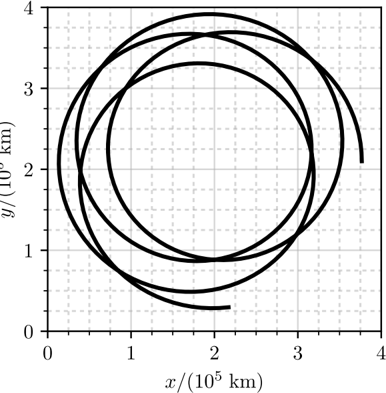
We investigate the so-called astrometric wobble method for detecting exoplanets. The method relies on the ability to measure the change in position in the sky that the host star experiences due to the gravitational influence of its orbiting planets. This method has become feasible in recent years due to the availability of more precise instruments.
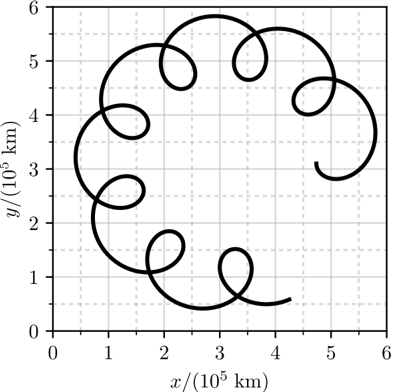
i) (2.5 points) Consider a system consisting of a host star, an inner planet , and an outer planet . Below is a measurement of the trajectory of the centre of the star in the plane perpendicular to the line of sight, measured over a period of yr. In all of the subsequent parts, you may assume that both planets orbit in circular orbits in the plane of the diagram. What are the orbital periods and of the two planets?
ii) (2.5 points) Based on direct imaging of planet in the infrared, the orbital radius of planet is measured to be km. What is the mass of the host star, and the mass of planet ? The gravitational constant is .
iii) (1 point) What is the mass of planet ?
iv) (2 points) Now consider a similar yr measurement of a different system, also consisting of a host star and two planets and (where is the inner planet). Similarly to before, find the mass of the host star, and the masses , of the planets in the new system. As before, direct imaging yields that the orbital radius of planet is km.
Topic: Gravitation, Astrophysics Metodi: Kepler’s Laws, Newton’s Law of Gravitation, Conservation of Momentum Competenze: Mathematical Modeling, Graph Linearization Objects: Star, Planet Fonte: Testo (PDF)
Stiamo studiando il cosiddetto metodo di oscillazione astrometrica per rilevare gli esopianeti. Il metodo si basa sulla capacità di misurare il cambiamento di posizione nel cielo che la stella ospitante sperimenta a causa dell’influenza gravitazionale dei suoi pianeti in orbita. Questo metodo è diventato fattibile negli ultimi anni grazie alla disponibilità di strumenti più precisi.
i) (2,5 punti) Considerate un sistema composto da una stella ospitante, un pianeta interno e un pianeta esterno . Qui di seguito è riportata la misura della traiettoria del centro della stella nel piano perpendicolare alla linea di vista, misurata in un periodo di anni. In tutte le parti successive, si può presumere che entrambi i pianeti orbitino in orbite circolari nel piano del diagramma. Quali sono i periodi orbitali e dei due pianeti?
ii) (2,5 punti) Sulla base di immagini dirette del pianeta nell’infrarosso, il raggio orbitale del pianeta è misurato a km. Qual è la massa della stella ospitante e la massa del pianeta ? La costante gravitazionale è .
iii) (1 punto) Qual è la massa del pianeta ?
iv) (2 punti) Ora consideriamo una misurazione simile di un sistema diverso, composta anche da una stella ospitante e da due pianeti e (dove è il pianeta interno). Come prima, trovi la massa della stella ospitante e le masse , dei pianeti nel nuovo sistema. Come prima, l’imaging diretto rende che il raggio orbitale del pianeta è km.
Topic: Gravitation, Astrophysics Metodi: Kepler’s Laws, Newton’s Law of Gravitation, Conservation of Momentum Competenze: Mathematical Modeling, Graph Linearization Objects: Star, Planet Fonte: Testo (PDF)
Tools: a black box with two output terminals, a multimeter, a stopwatch, wires.
The resistance of the multimeter is as follows: when used as microammeter ; when used as a milliammeter ; when used as a voltmeter - more than . When used as a voltmeter, the multimeter will automatically determine the optimum range, but this will slow it down; to make it faster, press the ‘Range’ button to fix it to the current range.
Which four components (apart from the wires; there can be more than one of the same type) are in the black box? What are the values of the quantities that characterise these components and how could they be connected? Document and tabulate all your measurements and plot them graphically where appropriate.
Topic: Circuits Metodi: Equivalent Circuit Reduction, Kirchhoff’s Laws, Experimental Data Analysis Competenze: Experimental Data Analysis, Measurement & Instrumentation Objects: Resistor, Capacitor, Battery Fonte: Testo (PDF)
**Istrumenti: ** una scatola nera con due terminali di uscita, un multimetro, un orologio fermo, fili.
La resistenza del multimetro è la seguente: quando viene utilizzato come microammetro ; quando viene utilizzato come millimetro ; quando viene utilizzato come voltmetro - più di . Quando viene utilizzato come voltmeter, il multimetro determina automaticamente la gamma ottimale, ma questo la rallenta; per renderla più veloce, premere il pulsante ‘Range’ per fissarla alla gamma corrente.
Quali sono i quattro componenti (oltre ai fili; possono esserci più di uno dello stesso tipo) presenti nella scatola nera? Quali sono i valori delle quantità che caratterizzano questi componenti e come possono essere collegati? Documenta e tabula tutte le misure e, se del caso, disegnale in modo grafico.
Topic: Circuits Metodi: Equivalent Circuit Reduction, Kirchhoff’s Laws, Experimental Data Analysis Competenze: Experimental Data Analysis, Measurement & Instrumentation Objects: Resistor, Capacitor, Battery Fonte: Testo (PDF)
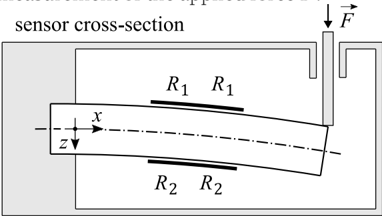
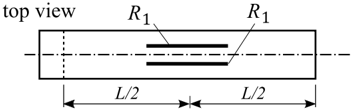
A force sensor is constructed from a flexible beam of working length and height to which four identical electrically resistive wires of length are attached, as shown in the figure below. If a force is applied to the end of the beam, it will bend the beam and stretch the upper wires and compress the lower ones, causing changes in the electrical resistance. Using the Wheatstone bridge method, these changes can be converted into a voltmeter reading, allowing for the measurement of the applied force .
In what follows, assume that the deflection of the beam is very small.
i) (2 points) The bending moment (i.e. the torque with which one fictitious half of the beam affects the other) is inversely proportional to the curvature radius of the center line of the beam: , where is Young’s modulus and is a constant depending on the geometry of the beam’s cross-section (both are known). Find the elongation of the upper wire when a force is applied to the sensor. Assume that the wires are placed in the middle of the beam.
ii) (1 point) Find the resistances and when from the previous section is known and the initial resistance of the wires is . Assume that the volume of the wire remains constant during the deformation.
iii) (2 points) The resistors are arranged in a Wheatstone bridge configuration shown in the figure below, where is the known battery voltage. Find the relationship between the measured voltage and the force .
Topic: Elasticity & Materials, Circuits Metodi: Stress-Strain Analysis, Equivalent Circuit Reduction Competenze: Mathematical Modeling, Diagrammatic Reasoning Objects: Beam, Resistor, Wire Fonte: Testo (PDF)
Un sensore di forza è costruito da un fascio flessibile di lunghezza di lavoro e di altezza al quale sono collegati quattro fili resistenti elettricamente identici di lunghezza , come mostrato nella figura seguente. Se viene applicata una forza alla fine del fascio, questo piegarà il fascio e allungerà i fili superiori e comprimerà quelli inferiori, causando cambiamenti nella resistenza elettrica. Utilizzando il metodo del ponte Wheatstone, questi cambiamenti possono essere convertiti in una lettura di voltometro, consentendo la misura della forza applicata .
In quanto segue, supponiamo che la deviazione del fascio sia molto piccola.
i) (2 punti) Il momento di piega (cioè la coppia con cui una metà fittizia del fascio colpisce l’altra) è inversamente proporzionale al raggio di curvatura della linea centrale del fascio: , dove è il modulo di Young e è una costante a seconda della geometria della sezione trasversale del fascio (si conoscono entrambe). Trova l’allungamento del filo superiore quando viene applicata una forza al sensore. Supponiamo che i fili siano posizionati nel mezzo del fascio.
ii) (1 punto) Trovare le resistenze e quando è nota la della sezione precedente e la resistenza iniziale dei fili è . Supponiamo che il volume del filo rimanga costante durante la deformazione.
iii) (2 punti) Le resistenze sono disposte in una configurazione di ponte Wheatstone mostrata nella figura seguente, dove è la tensione della batteria nota. Trova la relazione tra la tensione misurata e la forza .
Topic: Elasticity & Materials, Circuits Metodi: Stress-Strain Analysis, Equivalent Circuit Reduction Competenze: Mathematical Modeling, Diagrammatic Reasoning Objects: Beam, Resistor, Wire Fonte: Testo (PDF)
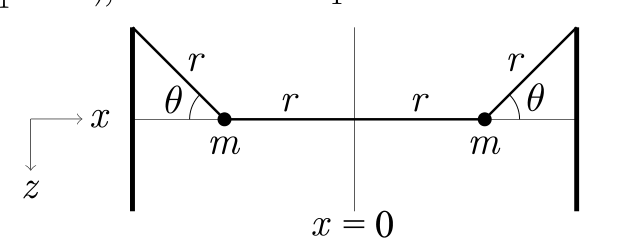
Two small masses are connected and hung between walls by weightless strings as pictured below. The acceleration due to gravity is . All oscillatory motion is assumed to have a small amplitude and the system is always in one of its normal modes (i.e. the oscillations are sinusoidal).
i) (2 points) Find , the angular frequency of in-phase oscillations (by which the oscillation phases of both masses are always equal), perpendicular to the plane of the figure.
ii) (3 points) Find , the angular frequency of anti-phase oscillations (by which the oscillation phases of both masses are always opposite), in terms of .
Topic: Oscillations & Waves Metodi: Simple Harmonic Motion Analysis, Small-Angle Approximation Competenze: Mathematical Modeling, Physical Reasoning Objects: String Fonte: Testo (PDF)
Due piccole masse sono collegate e appese tra le pareti con stringhe senza peso come illustrato di seguito. L’accelerazione dovuta alla gravità è . Si presume che tutti i movimenti oscillatori abbiano una piccola amplitudine e che il sistema sia sempre in una delle sue modalità normali (cioè le oscillazioni sono sinusoidi).
i) (2 punti) Trova , la frequenza angolare delle oscillazioni in fase (che rende sempre uguali le fasi di oscillazione di entrambe le masse), perpendicolare al piano della figura.
ii) (3 punti) Trova , la frequenza angolare delle oscillazioni antifase (che hanno le fasi di oscillazione di entrambe le masse sempre opposte), in termini di .
Topic: Oscillations & Waves Metodi: Simple Harmonic Motion Analysis, Small-Angle Approximation Competenze: Mathematical Modeling, Physical Reasoning Objects: String Fonte: Testo (PDF)
There is a pack of identical sheets of paper lying on an infinite horizontal table. The coefficient of friction between the surface of the table, and between two sheets of paper are both equal to . Each sheet has dimensions , with . Sandra is trying to fetch the bottom-most sheet by pulling from a shorter edge of it with a constant velocity (while all the sheets lie almost exactly on top of each other, she managed to get hold of an edge of the bottommost sheet).
i) (2 points) Sketch a qualitative graph of how the acceleration of the pack (excluding the bottom-most sheet) depends on time when (a) the speed is very small; (b) the speed is very big.
ii) (3 points) What is the minimal speed by which it is possible to pull the bottommost sheet out (i.e. separating it completely from the remaining pack)?
iii) (1 point) Assuming , what is the speed of the remaining pack at the moment when the bottom-most sheet gets out of the pack (i.e. there is no longer overlapping areas)?
iv) (2 points) Considering still , what is the minimal distance between the pack of papers and the edge of the table such that the pack would not slide over the edge of the table? ( is the maximal allowed travel distance of the pack.)
Topic: Newtonian Mechanics Metodi: Free-Body Diagram, Differential Equations Competenze: Mathematical Modeling, Diagrammatic Reasoning Objects: - Fonte: Testo (PDF)
There is a pack of identical sheets of paper lying on an infinite horizontal table. Il coefficiente di attrito tra la superficie del tavolo e tra due fogli di carta è entrambi uguale a . Ogni foglio ha dimensioni , con . Sandra sta cercando di prendere il foglio più basso tirando da un bordo più breve con una velocità costante (mentre tutti i fogli si trovano quasi esattamente l’uno sull’altro, è riuscita a prendere un bordo del foglio più basso).
i) (2 punti) Segnare un grafico qualitativo del modo in cui l’accelerazione del pacchetto (esclusa la foglia più bassa) dipende dal tempo in cui (a) la velocità è molto piccola; (b) la velocità è molto grande.
(iii) (3 punti) Qual è la velocità minima con cui è possibile tirare fuori il foglio più basso (cioè separandolo completamente dal resto del pacchetto)?
iii) (1 punto) Supponendo , qual è la velocità del resto del confezionamento al momento in cui il foglio più basso esce dal confezionamento (cioè non esistono più aree sovrapposte)?
iv) (2 punti) Considerando ancora , qual è la distanza minima tra il pacchetto di carta e il bordo del tavolo in modo che il pacchetto non scivoli sul bordo del tavolo? ( è la distanza massima consentita per il trasporto del pacchetto.)
Topic: Newtonian Mechanics Metodi: Free-Body Diagram, Differential Equations Competenze: Mathematical Modeling, Diagrammatic Reasoning Objects: - Fonte: Testo (PDF)
In the region , there is an electric field , where denotes the unit vector parallel to the -axis. Two small balls, each of mass and carrying charge () are connected with a weightless non-stretchable string of length . Initially, at the moment of time , the string is taut, the velocity of both balls is , one of the balls, the ball , is at while the other ball, the ball , is at . The electric field created by the balls can be neglected, and it can be assumed that is very small (much smaller than ).
i) (2 points) Consider the case when the string is parallel to the -axis, and . Sketch the dependence of the velocity of both balls as a function of time. Will the balls collide? If yes, then when?
ii) (2 points) Now, at , the string forms an angle of with the -axis, . By this string length, at the moment when the ball reaches , the string is parallel to the -axis. Find .
iii) (2 points) Under the assumptions of the previous task, what is the speed of the ball at the moment ?
iv) (2 points) Now, at , the string forms a very small angle with the -axis. Similarly to the previous two tasks, at the moment when the ball reaches , the string is parallel to the -axis. Find the string length assuming that . The answer to this point should contain only and numerical constants.
Topic: Electrostatics Metodi: Kinematic Equations, Vector Decomposition, Energy Conservation Method Competenze: Mathematical Modeling, Physical Reasoning Objects: Point Charge, String Fonte: Testo (PDF)
Nella regione , esiste un campo elettrico , dove indica il vettore unitario parallelo all’asse . Due piccole palle, ciascuna di massa e carica di carico () sono collegate con una corda senza peso non allungata di lunghezza . Inizialmente, al momento del tempo , la corda è stretta, la velocità di entrambe le palle è , una delle palle, la palla , è a mentre l’altra palla, la palla , è a . Il campo elettrico creato dalle palle può essere trascurato e si può supporre che sia molto piccolo (molto più piccolo di ).
i) (2 punti) Considerare il caso in cui la stringa è parallela all’asse e . Segna la dipendenza della velocità di entrambe le palle come funzione del tempo. Le palle si incrociano? Se sì, quando?
ii) (2 punti) Ora, a , la stringa forma un angolo di con l’asse , . Per questa lunghezza della stringa, nel momento in cui la palla raggiunge , la stringa è parallela all’asse . Trova .
iii) (2 punti) Secondo le ipotesi del compito precedente, qual è la velocità della palla al momento ?
iv) (2 punti) Ora, a , la stringa forma un angolo molto piccolo con l’asse . Simile alle due attività precedenti, nel momento in cui la palla raggiunge , la stringa è parallela all’asse . Trova la lunghezza della stringa supponendo che . La risposta a questo punto dovrebbe contenere solo e costanti numeriche.
Topic: Electrostatics Metodi: Kinematic Equations, Vector Decomposition, Energy Conservation Method Competenze: Mathematical Modeling, Physical Reasoning Objects: Point Charge, String Fonte: Testo (PDF)
Tools: a syringe, a small glass plate, a support for holding the glass plate horizontally at an adjustable height, a cup with water (coefficient of refraction of water ), a caliper, a sheet of graph paper. Your working room has ceiling lights at an approximate height of 3 m. The glass plate holder is a short piece of plastic pipe with a nut; put the glass plate on top of the nut and turn the nut to adjust the height. By turning the nut, one can change the holder height only by the thickness of the nut; there are also spare nuts that can be stacked to increase the total height of the pipe-nuts system, and a cap that fits into the pipe - use it if there is a need to make the distance between the glass plate and the surface beneath it smaller than the height of the pipe. NB! Hold the glass plate only from its matte part and do not touch the glossy (transparent) part as fingerprints will affect the value of the contact angle. If you accidentally do touch, ask organisers to clean the glass surface.
i) (3 points) Put a small drop of water onto the glass plate; this will form a plano-convex lens. Determine the focal length of this lens and measure its diameter.
ii) (2 points) Calculate the curvature radius of the water surface and the water-glass contact angle . The contact angle is defined as the angle under which the water surface (the air-water interface) meets the surface of the glass plate.
iii) (3 points) Now increase the amount of water on the glass plate so that it covers a big part of the glass plate so that its top surface becomes almost flat. Determine the thickness of the water layer.
iv) (2 points) Calculate the surface tension of water . Hint: a given amount of water takes a shape which minimises its total potential energy. Use reasonable approximations. Keep in mind that the glass-water interface makes also a certain contribution to the full surface energy, the magnitude of which is related to the contact angle: , where denotes the surface area of the glass-water interface.
Topic: Fluid Mechanics, Geometric Optics Metodi: Hydrostatic Equilibrium, Thin Lens & Mirror Equation, Experimental Data Analysis Competenze: Experimental Data Analysis, Measurement & Instrumentation Objects: Lens, Droplet Fonte: Testo (PDF)
**Utili: ** una siringa, una piccola piastra di vetro, un supporto per tenere la piastra di vetro orizzontale ad un’altezza regolabile, una tazza con acqua (coefficiente di rifrazione dell’acqua ), un calibro, un foglio di carta grafica. La vostra sala di lavoro ha luci al soffitto ad un’altezza approssimativa di 3 m. Il contenitore della piastra di vetro è un piccolo pezzo di tubo di plastica con un’aria; metti la piastra di vetro sopra la noce e gira la noce per regolare l’altezza. Girando la noce, si può cambiare l’altezza del tenitore solo per lo spessore della noce; ci sono anche noci di riserva che possono essere impilate per aumentare l’altezza totale del sistema di noce di tubo, e un tappo che si adatta alla pipa - utilizzarlo se c’è bisogno di rendere la distanza tra la piastra di vetro e la superficie sotto di esso inferiore all’altezza della pipa. NB! Tenere la piastra vetrata solo dalla sua parte matta e non toccare la parte lucida (trasparente) poiché le impronte digitali influiranno sul valore dell’angolo di contatto. Se per caso tocchi, chiedi agli organizzatori di pulire la superficie del vetro.
i) (3 punti) Mettete una piccola goccia di acqua sulla piastra di vetro, che costituirà una lente convexa a piano. Determina la distanza focale di questa lente e misura il suo diametro.
ii) (2 punti) Calcolare il raggio di curvatura della superficie dell’acqua e l’angolo di contatto acqua- vetro . L’angolo di contatto è definito come l’angolo sotto il quale la superficie dell’acqua (interfaccia aria-acqua) incontra la superficie della piastra di vetro.
iii) (3 punti) Ora aumentare la quantità di acqua sulla piastra in modo che copra una grande parte della piastra in modo che la sua superficie superiore diventi quasi piatta. Determina lo spessore dello strato idrico.
iv) (2 punti) Calcolare la tensione superficiale dell’acqua . Suggerimento: una determinata quantità di acqua assume una forma che riduce al minimo la sua energia potenziale totale. Utilizzare approssimazioni ragionevoli. Si deve tenere presente che l’interfaccia vetro-acqua contribuisce anche in modo determinato all’energia di superficie completa, la cui grandezza è correlata all’angolo di contatto: , dove indica l’area superficiale dell’interfaccia vetro-acqua.
Topic: Fluid Mechanics, Geometric Optics Metodi: Hydrostatic Equilibrium, Thin Lens & Mirror Equation, Experimental Data Analysis Competenze: Experimental Data Analysis, Measurement & Instrumentation Objects: Lens, Droplet Fonte: Testo (PDF)