An aluminum wire of varying thickness is pulled at each end with a force of 30 N. Which of the following statements is true? Note: tension is a force that tends to stretch something, and stress is the force per unit area.
- A. The tension is 60 N all along the wire, and stress is constant along the wire
- B. The tension is 60 N all along the wire, and stress varies along the wire
- C. The tension is 30 N all along the wire, and stress is constant along the wire
- D. The tension is 30 N all along the wire, and stress varies along the wire
Topic: Elasticity & Materials, Newtonian Mechanics Metodi: Free-Body Diagram, Stress-Strain Analysis Competenze: Physical Reasoning Objects: Wire Fonte: Testo (PDF) — p.2
Un filo di alluminio di spessore variabile viene tirato a ciascuna estremità con una forza di 30 N. Quale delle seguenti affermazioni è vera? Nota: la tensione è una forza che tende a allungare qualcosa, e lo stress è la forza per unità di area.
- A. La tensione è di 60 N lungo tutto il filo, e la tensione è costante lungo il filo
- B. La tensione è di 60 N lungo tutto il filo e la tensione varia lungo il filo
- C. La tensione è di 30 N lungo tutto il filo, e la tensione è costante lungo il filo
- D. La tensione è di 30 N lungo tutto il filo, e la tensione varia lungo il filo
Topic: Elasticity & Materials, Newtonian Mechanics Metodi: Free-Body Diagram, Stress-Strain Analysis Competenze: Physical Reasoning Objects: Wire Fonte: Testo (PDF) — p.2
A 1 kg object slides 3.6 m down a ramp with a slope. It has an initial speed of 2 m/s and a final speed of 1.06 m/s when it reaches the bottom. What was the work done by kinetic friction () when the object has slid to the bottom of the ramp?
- A. 10.6 Nm
- B. 21.7 Nm
- C. 0 Nm
- D. 19.6 Nm
Topic: Newtonian Mechanics, Conservation of Energy Metodi: Energy Conservation Method, Kinematic Equations, Free-Body Diagram Competenze: Physical Reasoning, Mathematical Modeling Objects: Block, Inclined Plane Fonte: Testo (PDF) — p.2
Un oggetto di 1 kg scorre 3,6 m in basso su una rampa con pendenza . Ha una velocità iniziale di 2 m/s e una velocità finale di 1,06 m/s quando raggiunge il fondo. Qual è stato il lavoro effettuato con attrito cinetico () quando l’oggetto è scivolato verso il fondo della rampa?
- A. 10.6 Nm
- B. 21.7 Nm
- C. 0 Nm
- D. 19.6 Nm
Topic: Newtonian Mechanics, Conservation of Energy Metodi: Energy Conservation Method, Kinematic Equations, Free-Body Diagram Competenze: Physical Reasoning, Mathematical Modeling Objects: Block, Inclined Plane Fonte: Testo (PDF) — p.2
After swinging on a vine in the jungle, monkey A releases the vine and simultaneously drops his banana. Monkey B is stationary on the ground below, watching intently. Immediately after the banana is dropped, what is the direction of the velocity of the banana from each monkey’s frame of reference?
- A. [figure: banana velocity from monkey A’s frame]
- B. [figure: banana velocity from monkey B’s frame]
- C. [figure: option c]
- D. [figure: option d]
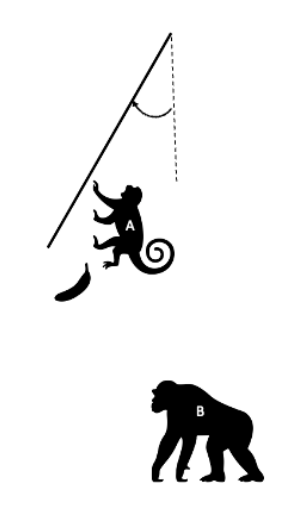 velocity directions from each frame
Topic: Newtonian Mechanics Metodi: Kinematic Equations, Vector Decomposition Competenze: Physical Reasoning, Diagrammatic Reasoning Objects: Projectile Fonte: Testo (PDF) — p.2
Dopo aver girato su una vite nella giungla, la scimmia A rilascia la vite e simultaneamente lascia cadere la sua banana. Sapi B è fermo sul terreno, sotto, guardando attentamente. Subito dopo che la banana è caduta, qual è la direzione della velocità della banana dal quadro di riferimento di ciascuna scimmia?
- A. [figura: velocità della banana dal telaio della scimmia A]
- B. [figura: velocità della banana dal telaio della scimmia B]
- C. [figura: opzione c]
- D. [figura: opzione d]
indicazioni di velocità da ogni telaio
Topic: Newtonian Mechanics Metodi: Kinematic Equations, Vector Decomposition Competenze: Physical Reasoning, Diagrammatic Reasoning Objects: Projectile Fonte: Testo (PDF) — p.2
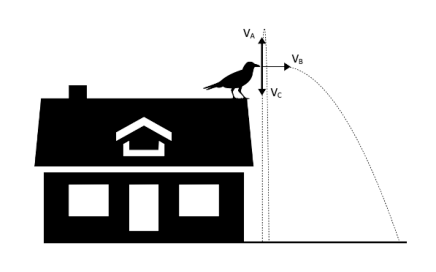
A very smart bird is sitting on a roof holding a shell in its beak. It wants to throw the shell so that it hits the ground with the highest speed possible. Assuming air resistance is negligible, and initial speed is constant in all scenarios (), how should the bird throw the shell so that its final speed before hitting the ground is greatest?
- A. Throw it upwards ()
- B. Throw it horizontally ()
- C. Throw it downwards ()
- D. A and C produce a faster final speed than B
- E. A, B, and C all produce the same final speed
Topic: Newtonian Mechanics, Conservation of Energy Metodi: Energy Conservation Method, Kinematic Equations Competenze: Physical Reasoning Objects: Projectile Fonte: Testo (PDF) — p.3
Un uccello molto intelligente sta seduto su un tetto con una conchiglia nel becco. Vuole lanciare il guscio in modo che colpisca il terreno con la massima velocità possibile. Supponendo che la resistenza all’aria sia trascurabile e che la velocità iniziale sia costante in tutti gli scenari (), come dovrebbe lanciare l’uccello in modo che la sua velocità finale prima di colpire il terreno sia la più grande?
- A. Getta verso l’alto ()
- B. Lanciarlo orizzontalmente ()
- C. Getta giù ()
- D. A e C producono una velocità finale più veloce di B
- E. A, B e C producono tutte la stessa velocità finale
Topic: Newtonian Mechanics, Conservation of Energy Metodi: Energy Conservation Method, Kinematic Equations Competenze: Physical Reasoning Objects: Projectile Fonte: Testo (PDF) — p.3
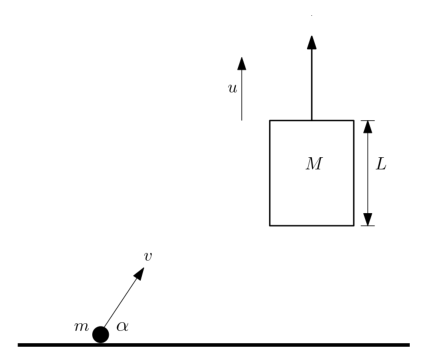
A very heavy box of mass is being lifted upward by a crane at a constant velocity . A ball of mass is thrown at the box with velocity at angle .
If the ball hits the box at some time , what are the and components of the velocity of the ball after the collision? Assume a perfectly elastic collision.
- A.
- B.
- C.
- D.
- E. Either A or B. (F) Either C or D.
 crane lifting heavy box, ball thrown at angle
Topic: Newtonian Mechanics, Conservation of Momentum Metodi: Conservation of Momentum, Vector Decomposition, Kinematic Equations Competenze: Physical Reasoning, Mathematical Modeling Objects: Ball, Block Fonte: Testo (PDF) — p.3
Una scatola molto pesante di massa viene sollevata verso l’alto da una gru a una velocità costante . Una palla di massa viene lanciata sulla scatola con velocità all’angolo .
Se la palla colpisce la scatola in un certo momento , quali sono i componenti e della velocità della palla dopo la collisione? Supponiamo una collisione perfettamente elastica.
- A.
- B.
- C.
- D.
- E. O A o B. (F) C o D.
*cancello pesante di sollevamento con gru, palla lanciata in angolo *
Topic: Newtonian Mechanics, Conservation of Momentum Metodi: Conservation of Momentum, Vector Decomposition, Kinematic Equations Competenze: Physical Reasoning, Mathematical Modeling Objects: Ball, Block Fonte: Testo (PDF) — p.3
A sphere of mass 0.2 kg is suspended from the ceiling by a light spring whose force constant is 3.2 N/m. It is projected vertically downwards with a speed of 0.5 m/s from its equilibrium position. What would be its maximum acceleration in subsequent motion?
- A. 2.0 m/s²
- B. 8.0 m/s²
- C. 10.0 m/s²
- D. 12.0 m/s²
 sphere on spring suspended from ceiling
Topic: Oscillations & Waves, Newtonian Mechanics Metodi: Simple Harmonic Motion Analysis, Hooke’s Law Competenze: Physical Reasoning, Mathematical Modeling Objects: Sphere, Spring Fonte: Testo (PDF) — p.3
Una sfera di massa di 0,2 kg è sospesa dal soffitto da una sorgente luminosa la cui costante di forza è di 3,2 N/m. È proiettata verticalmente verso il basso a una velocità di 0,5 m/s dalla sua posizione di equilibrio. Qual è la sua massima accelerazione nel successivo movimento?
- A. 2.0 m/s²
- B. 8.0 m/s²
- C. 10.0 m/s²
- D. 12.0 m/s²
sfera su molla sospesa dal soffitto
Topic: Oscillations & Waves, Newtonian Mechanics Metodi: Simple Harmonic Motion Analysis, Hooke’s Law Competenze: Physical Reasoning, Mathematical Modeling Objects: Sphere, Spring Fonte: Testo (PDF) — p.3
A block accelerates uniformly along a straight line from A to C as shown above. Its speed at point A is and that at point C is . What is its speed at point B, which is the mid-point between point A and C?
(A)
(B)
(C)
(D)
Topic: Newtonian Mechanics Metodi: Kinematic Equations Competenze: Physical Reasoning, Mathematical Modeling Objects: Block Fonte: Testo (PDF) — p.4
Un blocco accelera uniformemente lungo una linea retta da A a C come mostrato sopra. La sua velocità al punto A è e che al punto C è . Qual è la sua velocità al punto B, che è il punto medio tra il punto A e il punto C?
(A)
(B)
(C)
(D)
Topic: Newtonian Mechanics Metodi: Kinematic Equations Competenze: Physical Reasoning, Mathematical Modeling Objects: Block Fonte: Testo (PDF) — p.4
Two charged spheres X and Y are suspended from the ceiling by identical strings as shown below. When the system is in equilibrium, the angles between string OX and the vertical is and that between OY and the vertical is . If , which of the following statements must be correct?
- A. Both X and Y carry positive charges.
- B. The charges on X and Y are opposite.
- C. The magnitude of charges on Y is greater than that on X.
- D. The mass of Y is larger than that of X.
 two charged spheres on strings from ceiling
Topic: Electrostatics, Newtonian Mechanics Metodi: Free-Body Diagram, Coulomb’s Law Competenze: Physical Reasoning, Diagrammatic Reasoning Objects: Conducting Sphere, String Fonte: Testo (PDF) — p.4
Due sfere a carica X e Y sono sospesi dal soffitto con stringhe identiche come mostrato di seguito. Quando il sistema è in equilibrio, gli angoli tra string OX e la verticale sono e quelli tra OY e la verticale sono . Se , quale delle seguenti affermazioni deve essere corretta?
- A. Sia X che Y portano cariche positive.
- B. Le cariche su X e Y sono opposte.
- C. L’entità delle cariche su Y è maggiore di quella su X.
- D. La massa di Y è maggiore di quella di X.
due sfere cariche su stringhe dal soffitto
Topic: Electrostatics, Newtonian Mechanics Metodi: Free-Body Diagram, Coulomb’s Law Competenze: Physical Reasoning, Diagrammatic Reasoning Objects: Conducting Sphere, String Fonte: Testo (PDF) — p.4
When two ends of a circular uniform wire are joined to the terminals of a battery, what is the strength of the magnetic field at the center of the circle?
- A. Zero
- B. Infinite
- C. Depends on the amount of e.m.f. applied
- D. Depends on the radius of the circle
- E. Both C and D.
Topic: Magnetism, Circuits Metodi: Biot-Savart Law, Superposition Principle, Symmetry Argument Competenze: Physical Reasoning Objects: Wire, Battery Fonte: Testo (PDF) — p.4
Quando due estremità di un filo circolare uniforme sono collegate ai terminali di una batteria, qual è la forza del campo magnetico al centro del cerchio?
- A. Zero
- B. Infinito
- C. Dipende dall’importo di e.m.f. applicato
- D. Dipende dal raggio del cerchio
- E. Sia C che D.
Topic: Magnetism, Circuits Metodi: Biot-Savart Law, Superposition Principle, Symmetry Argument Competenze: Physical Reasoning Objects: Wire, Battery Fonte: Testo (PDF) — p.4
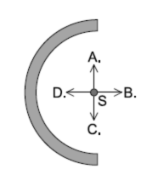
Negative charge is uniformly distributed on a semicircular plastic rod. What is the direction of the electric field strength at point S?
- A. A
- B. B
- C. C
- D. D
Topic: Electrostatics Metodi: Superposition Principle, Symmetry Argument, Coulomb’s Law Competenze: Physical Reasoning, Diagrammatic Reasoning Objects: Rod Fonte: Testo (PDF) — p.4
La carica negativa è distribuita uniformemente su una canna di plastica semicircolare. Qual è la direzione della forza del campo elettrico al punto S?
- A. A
- B. B
- C. C
- D. D
Topic: Electrostatics Metodi: Superposition Principle, Symmetry Argument, Coulomb’s Law Competenze: Physical Reasoning, Diagrammatic Reasoning Objects: Rod Fonte: Testo (PDF) — p.4
Suppose that a positron (charge , mass ) is fired at a non-relativistic velocity towards a proton (charge , mass ) at rest. What is the minimum separation between the two particles as they approach each other?
(A)
(B)
(C)
(D)
Topic: Electrostatics, Conservation of Energy Metodi: Conservation of Energy, Energy Conservation Method, Coulomb’s Law Competenze: Physical Reasoning, Mathematical Modeling Objects: Particle Beam Fonte: Testo (PDF) — p.4
Supponiamo che un positrone (carica , massa ) sia sparato a una velocità non relativistica verso un protone (carica , massa ) in riposo. Qual è la separazione minima tra le due particelle quando si avvicinano?
(A)
(B)
(C)
(D)
Topic: Electrostatics, Conservation of Energy Metodi: Conservation of Energy, Energy Conservation Method, Coulomb’s Law Competenze: Physical Reasoning, Mathematical Modeling Objects: Particle Beam Fonte: Testo (PDF) — p.4
An electron enters the space inside an infinite current-carrying solenoid. The velocity of the electron is parallel to the solenoid’s axis. The electron will:
- A. Deflect outwards
- B. Slow down
- C. Speed up
- D. Stay parallel to the axis of the solenoid
Topic: Magnetism, Electromagnetism Metodi: Lorentz Force Analysis, Ampère’s Law Competenze: Physical Reasoning Objects: Electron, Solenoid Fonte: Testo (PDF) — p.4
Un elettrone entra nello spazio all’interno di un solenoide che porta una corrente infinita. La velocità dell’elettrone è parallela all’asse del solenoide. L’ elettrone:
- A. Deflezione verso l’esterno
- B. Rallenta
- C. Accelerazione
- D. Rimani parallelo all’asse del solenoide
Topic: Magnetism, Electromagnetism Metodi: Lorentz Force Analysis, Ampère’s Law Competenze: Physical Reasoning Objects: Electron, Solenoid Fonte: Testo (PDF) — p.4
An ion follows a circular path in a uniform magnetic field. Which single change increases the radius of the path?
- A. Decrease the mass of the ion
- B. Decrease the charge of the ion
- C. Decrease the speed of the ion
- D. Increase the magnetic flux density of the field
Topic: Magnetism Metodi: Lorentz Force Analysis Competenze: Physical Reasoning Objects: Particle Beam Fonte: Testo (PDF) — p.4
Un ione segue un percorso circolare in un campo magnetico uniforme. Quale singolo cambiamento aumenta il raggio del percorso?
- A. Diminuire la massa dell’io
- B. Diminuire la carica dell’io
- C. Diminuire la velocità dell’io
- D. Aumentare la densità del flusso magnetico del campo
Topic: Magnetism Metodi: Lorentz Force Analysis Competenze: Physical Reasoning Objects: Particle Beam Fonte: Testo (PDF) — p.4
The number of field lines crossing a given area is given by the electric flux. For a closed surface (like a cube or sphere) the total electric flux is given by Gauss’s law:
where is the net charge inside the closed surface. A point charge is placed somewhere inside a cube. The electric flux through the bottom surface of the cube is measured to be . What is the approximate location of the charge?
- A. Slightly off center.
- B. Slightly off center, towards the top surface.
- C. Slightly off center, towards the bottom surface.
- D. Far from the center, closer to the bottom surface.
- E. At the center of the cube.
Topic: Electrostatics Metodi: Gauss’s Law, Symmetry Argument Competenze: Physical Reasoning, Mathematical Modeling Objects: Point Charge Fonte: Testo (PDF) — p.5
Il numero di linee di campo che attraversano una determinata area è dato dal flusso elettrico. Per una superficie chiusa (come un cubo o una sfera) il flusso elettrico totale è dato dalla legge di Gauss:
dove è la carica netta all’interno della superficie chiusa. Una carica puntologica è collocata da qualche parte all’interno di un cubo. Il flusso elettrico attraverso la superficie inferiore del cubo è misurato a . Qual è la posizione approssimativa della carica?
- A. Un po’ fuori dal centro.
- B. Un po’ fuori dal centro, verso la superficie superiore.
- C. Un po’ fuori dal centro, verso la superficie inferiore.
- D. Lungi dal centro, più vicino alla superficie inferiore.
- E. Al centro del cubo.
Topic: Electrostatics Metodi: Gauss’s Law, Symmetry Argument Competenze: Physical Reasoning, Mathematical Modeling Objects: Point Charge Fonte: Testo (PDF) — p.5
Consider an infinite grid made of identical wires of resistance 1 Ω. The equivalent resistance between two adjacent points A and B is . If the wire connecting A and B (marked with x) is cut, :
- A. will increase.
- B. will decrease.
- C. will not change.
- D. will become zero.
- E. will become infinity. (F) cannot be determined.
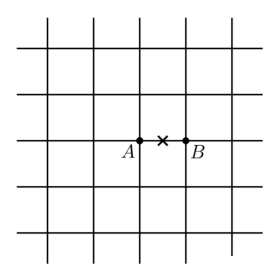 infinite resistor grid with points A and B
Topic: Circuits Metodi: Equivalent Circuit Reduction, Superposition Principle, Kirchhoff’s Laws Competenze: Physical Reasoning, Mathematical Modeling Objects: Wire, Resistor Fonte: Testo (PDF) — p.5
Considera una griglia infinita fatta di fili identici di resistenza 1 Ω. La resistenza equivalente tra due punti adiacenti A e B è . Se il filo che collega A e B (marcato con x) è tagliato, :
- A. aumenterà.
- B. diminuirà.
- C. non cambierà.
- D. diventerà zero.
- E. diventerà infinito. F) non può essere determinata.
*griglia di resistenza infinita con punti A e B *
Topic: Circuits Metodi: Equivalent Circuit Reduction, Superposition Principle, Kirchhoff’s Laws Competenze: Physical Reasoning, Mathematical Modeling Objects: Wire, Resistor Fonte: Testo (PDF) — p.5
A diode conducts current only when the potential of point A is higher than the potential of point B, otherwise it doesn’t allow the current to pass. When it conducts, the voltage drop across an ideal diode is zero.
Consider a circuit with an ideal diode as shown below. The input voltage is shown on the left.
What is the output voltage ?
- A. a
- B. b
- C. c
- D. d
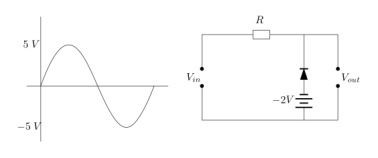 diode circuit with input voltage waveform
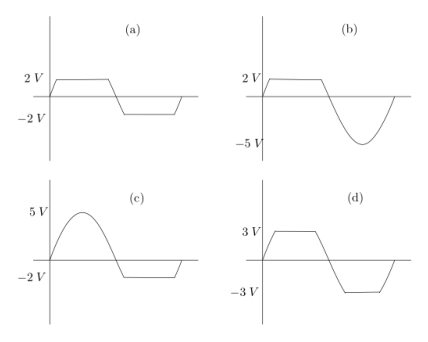 output voltage waveform options a, b, c, d
 sodium crystal unit cell structure
Topic: Circuits Metodi: Kirchhoff’s Laws, Equivalent Circuit Reduction Competenze: Physical Reasoning, Diagrammatic Reasoning Objects: Resistor, Battery Fonte: Testo (PDF) — p.5
Un diodo conduce corrente solo quando il potenziale del punto A è superiore al potenziale del punto B, altrimenti non permette al corrente di passare. Quando si conduce, la caduta di tensione attraverso una dioda ideale è zero.
Considerate un circuito con una dioda ideale come mostrato qui sotto. La tensione di ingresso è mostrata sulla sinistra.
Qual è la tensione di uscita ?
- A. a
- B. b
- C. c
- D. d
circuito di diodo con forma d’onda di tensione di ingresso
opzioni a, b, c, d
- struttura cellulare di unità di cristallo di sodio*
Topic: Circuits Metodi: Kirchhoff’s Laws, Equivalent Circuit Reduction Competenze: Physical Reasoning, Diagrammatic Reasoning Objects: Resistor, Battery Fonte: Testo (PDF) — p.5
One mole of an ideal gas () in a closed cylindrical piston is expanded from K, MPa to MPa by an adiabatic pathway. The energy supplied to the system , change in internal energy , and work done by the gas are:
- A. J, J, J
- B. J, J, J
- C. J, J, J
- D. J, J, J
- E. J, J, J
Topic: Thermodynamics Metodi: First Law of Thermodynamics, Ideal Gas Law, Thermodynamic Cycle Analysis Competenze: Physical Reasoning, Mathematical Modeling Objects: Gas, Cylinder, Piston Fonte: Testo (PDF) — p.5
Un mole di gas ideale () in un pistone cilindrico chiuso viene ampliato da K, MPa a MPa mediante un percorso adiabatico. L’energia fornita al sistema , la variazione dell’energia interna e il lavoro svolto dal gas sono:
- A. J, J, J
- B. J, J, J
- C. J, J, J
- D. J, J, J
- E. J, J, J
Topic: Thermodynamics Metodi: First Law of Thermodynamics, Ideal Gas Law, Thermodynamic Cycle Analysis Competenze: Physical Reasoning, Mathematical Modeling Objects: Gas, Cylinder, Piston Fonte: Testo (PDF) — p.5
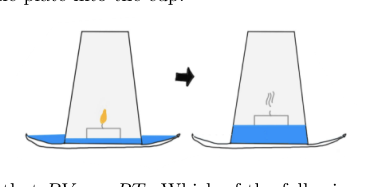
A plate is filled with a layer of water and a lit candle is placed in the centre. A cup is overturned and placed to fully cover the candle. The flame is extinguished, and the cup seems to ‘drink the liquid’ — the water is sucked from the plate into the cup.
Recall that . Which of the following explains why the cup sucks up the liquid?
- A. decreases so decreases
- B. decreases so decreases
- C. decreases so decreases
- D. decreases so decreases
- E. decreases so decreases
Topic: Thermodynamics Metodi: Ideal Gas Law, Physical Modeling Competenze: Physical Reasoning Objects: Gas, Container Fonte: Testo (PDF) — p.5
Si riempie di acqua un piatto e si pone una candela accesa al centro. Una tazza viene rovesciata e messa per coprire completamente la candela. La fiamma viene spenta e la tazza sembra ‘bevere il liquido’ l’acqua viene aspirata dal piatto nella tazza.
Ricordate che . Quale delle seguenti spiega perché la tazza assuma il liquido?
- A. diminuisce così diminuisce
- B. diminuisce così diminuisce
- C. diminuisce così diminuisce
- D. diminuisce così diminuisce
- E. diminuisce così diminuisce
Topic: Thermodynamics Metodi: Ideal Gas Law, Physical Modeling Competenze: Physical Reasoning Objects: Gas, Container Fonte: Testo (PDF) — p.5
An ideal gas goes through a process such that .
If the volume doubles during this process the temperature:
- A. remains constant.
- B. increases four-fold.
- C. decreases four-fold.
- D. increases eight-fold.
- E. decreases eight-fold.
Topic: Thermodynamics Metodi: Ideal Gas Law, Thermodynamic Cycle Analysis Competenze: Physical Reasoning, Mathematical Modeling Objects: Gas Fonte: Testo (PDF) — p.6
Un gas ideale passa attraverso un processo tale che .
Se il volume raddoppia durante questo processo, la temperatura:
- A. rimane costante.
- B. aumenta di quattro volte.
- C. diminuisce di quattro volte.
- D. aumenta otto volte.
- E. diminuisce otto volte.
Topic: Thermodynamics Metodi: Ideal Gas Law, Thermodynamic Cycle Analysis Competenze: Physical Reasoning, Mathematical Modeling Objects: Gas Fonte: Testo (PDF) — p.6
The temperature of a gas is increased by the same amount in two different processes.
Process A: The volume is kept constant. Process B: The pressure is kept constant.
Which of the following is correct?
- A. The heat required in process A is greater.
- B. The heat required in process B is greater.
- C. The same heat is required in both cases.
- D. The change in entropy is the same for both processes.
- E. The change in internal energy is the same for both processes. (F) C, D and E.
Topic: Thermodynamics Metodi: First Law of Thermodynamics, Ideal Gas Law Competenze: Physical Reasoning Objects: Gas Fonte: Testo (PDF) — p.6
La temperatura di un gas è aumentata della stessa quantità in due processi diversi.
Processo A: il volume è mantenuto costante. Processo B: la pressione è mantenuta costante.
Quale di queste parole è corretta?
- A. Il calore richiesto nel processo A è maggiore.
- B. Il calore richiesto nel processo B è maggiore.
- C. È necessario il medesimo calore in entrambi i casi.
- D. Il cambiamento di entropia è lo stesso per entrambi i processi.
- E. Il cambiamento di energia interna è lo stesso per entrambi i processi. (F) C, D ed E.
Topic: Thermodynamics Metodi: First Law of Thermodynamics, Ideal Gas Law Competenze: Physical Reasoning Objects: Gas Fonte: Testo (PDF) — p.6
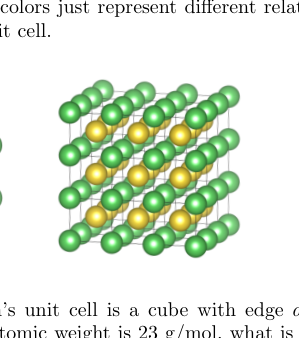
Sodium has a crystal structure which can be thought of as a repetition of a unit cell. Given that sodium’s unit cell is a cube with edge nm and its atomic weight is 23 g/mol, what is the density of sodium?
- A. 0.47 g/cm³
- B. 0.94 g/cm³
- C. 1.41 g/cm³
- D. 4.23 g/cm³
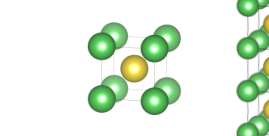 sodium crystal unit cell structure
Topic: Modern-Quantum Physics, Elasticity & Materials Metodi: Dimensional Analysis, Physical Modeling Competenze: Mathematical Modeling, Unit Conversion Objects: Atom Fonte: Testo (PDF) — p.6
Il sodio ha una struttura cristallina che può essere considerata come una ripetizione di una cellula unità. Dato che la cellula unità del sodio è un cubo con bordo nm e il suo peso atomico è di 23 g/mol, qual è la densità del sodio?
- A. 0,47 g/cm3
- B. 0,94 g/cm3
- C. 1,41 g/cm3
- D. 4,23 g/cm3
- struttura cellulare di unità di cristallo di sodio*
Topic: Modern-Quantum Physics, Elasticity & Materials Metodi: Dimensional Analysis, Physical Modeling Competenze: Mathematical Modeling, Unit Conversion Objects: Atom Fonte: Testo (PDF) — p.6
A light beam with two monochromatic components X and Y passes into a glass block and splits into two monochromatic beams when it comes out of the glass block. If the frequency of component X is smaller than that of Y, which of the following ray diagrams is correct?
- A. [diagram a: glass block with beams X and Y]
- B. [diagram b: glass block with beams X and Y]
- C. [diagram c: glass block with beams Y and X]
- D. [diagram d: glass block with beams X and Y]
 ray diagrams for glass dispersion options
Topic: Geometric Optics, Wave Optics Metodi: Snell’s Law, Ray Tracing Competenze: Physical Reasoning, Diagrammatic Reasoning Objects: Prism Fonte: Testo (PDF) — p.6
Un fascio di luce con due componenti monocromatici X e Y passa in un blocco di vetro e si divide in due fasci monocromatici quando esce dal blocco di vetro. Se la frequenza della componente X è inferiore a quella di Y, quale dei seguenti diagrammi di raggi è corretto?
- A. [diagrafo a: blocco di vetro con fasci X e Y]
- B. [diagrafo b: blocco di vetro con fasci X e Y]
- C. [diagrafo c: blocco di vetro con fasci Y e X]
- D. [diagrafo d: blocco di vetro con fasci X e Y]
diagrammi a raggi per le opzioni di dispersione del vetro
Topic: Geometric Optics, Wave Optics Metodi: Snell’s Law, Ray Tracing Competenze: Physical Reasoning, Diagrammatic Reasoning Objects: Prism Fonte: Testo (PDF) — p.6
A photocell emits electrons when it is illuminated with green light. We are uncertain whether it emits electrons when it is illuminated with:
- A. ultra-violet radiation
- B. X-rays
- C. red light
- D. blue light
Topic: Modern-Quantum Physics Metodi: Photon Energy Relation Competenze: Physical Reasoning Objects: Photon, Electron Fonte: Testo (PDF) — p.7
Una fotocellula emette elettroni quando viene illuminata con luce verde. Non è chiaro se emetta elettroni quando viene illuminato con:
- A. radiazioni ultraviolette
- B. raggi X
- C. luce rossa
- D. luce blu
Topic: Modern-Quantum Physics Metodi: Photon Energy Relation Competenze: Physical Reasoning Objects: Photon, Electron Fonte: Testo (PDF) — p.7
One of the two slits in a Young’s experiment is painted over so that it transmits only one-half the intensity of the other slit. As a result:
- A. The fringe system disappears
- B. The bright fringes get brighter and the dark ones get darker
- C. The bright fringes get dimmer
- D. The dark fringes get brighter
- E. The dark fringes get brighter and the bright ones get darker
Topic: Wave Optics Metodi: Interference & Diffraction Analysis, Superposition Principle Competenze: Physical Reasoning, Mathematical Modeling Objects: Slit, Screen Fonte: Testo (PDF) — p.7
Una delle due fessure dell’esperimento di Young viene dipinta in modo che trasmetta solo la metà dell’intensità dell’altra fessura. Di conseguenza:
- A. Il sistema marginale scompare
- B. I bordi luminosi diventano più brillanti e quelli scuri diventano più scuri
- C. I bordi luminosi diventano più sottili
- D. I bordi scuri diventano più luminosi
- E. I bordi scuri diventano più brillanti e quelli luminosi diventano più scuri
Topic: Wave Optics Metodi: Interference & Diffraction Analysis, Superposition Principle Competenze: Physical Reasoning, Mathematical Modeling Objects: Slit, Screen Fonte: Testo (PDF) — p.7
A double slit system is located in water (). What is the approximate spacing between two bright fringes? Assume that and that is the wavelength in vacuum.
(A)
(B)
(C)
(D)
Topic: Wave Optics Metodi: Interference & Diffraction Analysis, Snell’s Law Competenze: Physical Reasoning, Mathematical Modeling Objects: Slit, Screen Fonte: Testo (PDF) — p.7
Un sistema a doppia fessura è situato in acqua (). Qual è l’approssimativo spaziamento tra due margini luminosi? Supponiamo che e siano le lunghezze d’onda nel vuoto.
(A)
(B)
(C)
(D)
Topic: Wave Optics Metodi: Interference & Diffraction Analysis, Snell’s Law Competenze: Physical Reasoning, Mathematical Modeling Objects: Slit, Screen Fonte: Testo (PDF) — p.7
A turtle is pulling two stacked boxes as shown in the above figure. The string attached to the bottom box is parallel to the ground. The mass of the bottom box is and that of the top box is . The tension in the string is . The coefficient of static friction between the bottom box and the ground is and that between the two boxes is .
Find the range of with sufficient justification and mathematical reasoning when:
- A. two boxes are static
- B. the bottom box is moving relative to the ground with the box on top resting on it
- C. the bottom box is moving relative to the ground but there is also relative motion between the top and the bottom box
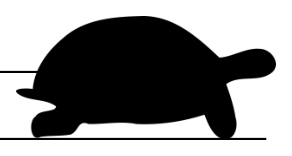 turtle pulling two stacked boxes on ground
Topic: Newtonian Mechanics, Rigid Body Statics Metodi: Free-Body Diagram, Conservation Laws, Kinematic Equations Competenze: Physical Reasoning, Mathematical Modeling Objects: Block, String Fonte: Testo (PDF) — p.8
Una tartaruga sta tirando due scatole impilate come mostrato nella figura sopra. La corda attaccata alla scatola inferiore è parallela al suolo. La massa della casella inferiore è e quella della casella superiore è . La tensione della corda è . Il coefficiente di attrito statico tra la scatola inferiore e il terreno è e quello tra le due scatole è .
Trova la gamma di con sufficiente giustificazione e ragionamento matematico quando:
- A. due caselle sono statiche
- B. la scatola inferiore si muove rispetto al suolo con la scatola in alto appoggiata su di essa
- C. la casella inferiore si muove rispetto al suolo ma c’è anche un movimento relativo tra la parte superiore e la casella inferiore
*turtle che tira due scatole impilate a terra *
Topic: Newtonian Mechanics, Rigid Body Statics Metodi: Free-Body Diagram, Conservation Laws, Kinematic Equations Competenze: Physical Reasoning, Mathematical Modeling Objects: Block, String Fonte: Testo (PDF) — p.8
A linear accelerator is a machine used to deliver radiation therapy to cancer patients. It shoots very precise beams of high energy photons into the patient’s body, and those photons interact with electrons and atoms in the cancer cells to kill it. In this question, we explore a Compton interaction between a photon and an electron.
The electron is originally at rest, has a mass and energy . An incoming photon with energy and momentum , where is the wavelength of the photon, collides with this electron and transfers some of its energy, which causes the electron and the photon to scatter in different directions. The ejected electron is now travelling at speed and has a mass and energy .
Derive an equation that relates the wavelength of the incoming photon with the wavelength of the outgoing scattered photon and its scattering angle .
Hint:
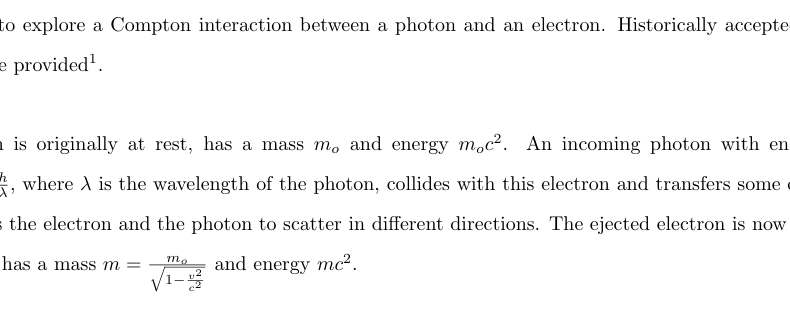 Compton scattering before and after collision diagram
Topic: Modern-Quantum Physics, Special Relativity Metodi: Conservation of Momentum, Conservation of Energy, Relativistic Energy-Momentum, Mass-Energy Equivalence Competenze: Mathematical Modeling, Physical Reasoning Objects: Photon, Electron Fonte: Testo (PDF) — p.9
Un acceleratore lineare è una macchina utilizzata per fornire radioterapia ai pazienti affetti da cancro. Spara raggi molto precisi di fotoni ad alta energia nel corpo del paziente, e questi fotoni interagiscono con elettroni e atomi nelle cellule tumorali per ucciderlo. In questa domanda, esploriamo un’interazione di Compton tra un fotone e un elettrone.
L’elettrone è originariamente a riposo, ha una massa ed energia . Un fotone in entrata con energia e impulso , dove è la lunghezza d’onda del fotone, collide con questo elettrone e trasferisce parte della sua energia, causando la dispersione dell’elettrone e del fotone in direzioni diverse. L’elettrone espulso è ora in movimento a velocità e ha una massa ed energia .
Derivare un’equazione che relaziona la lunghezza d’onda del fotone in entrata con la lunghezza d’onda del fotone sparso in uscita e il suo angolo di sparsione .
*Signore: *
Scatteraggio del compto prima e dopo il diagramma di collisione
Topic: Modern-Quantum Physics, Special Relativity Metodi: Conservation of Momentum, Conservation of Energy, Relativistic Energy-Momentum, Mass-Energy Equivalence Competenze: Mathematical Modeling, Physical Reasoning Objects: Photon, Electron Fonte: Testo (PDF) — p.9
One way of measuring distance using optics is to send a laser beam to the object and measure the angle the scattered light makes with the original beam.
The components inside the dashed line box form the optical distance sensor. The vertical rectangle represents a linear light sensor, which measures the point of impact of the returning beam. The three lines indicate light rays reflected from objects at different distances.
The linear sensor is 9 mm long and consists of one line of 600 pixels spaced 15 µm apart. The slit for the returning beam is 20 µm wide and is located 5 mm above the laser beam and 2 mm away from the linear sensor. The last pixel of the linear light sensor, the one closest to the laser beam is 15 µm above the slit.
What is the shortest and longest distance this sensor can measure in air?
If we want to measure the distance to an object underwater, two pixels of the linear sensor will be activated: one corresponding to the laser scattering off the water surface and one corresponding to the laser scattering off the object. Explain how one can use these two readings to get the proper distance to the object underwater.
Start with the case when the laser beam is perpendicular to the water surface.
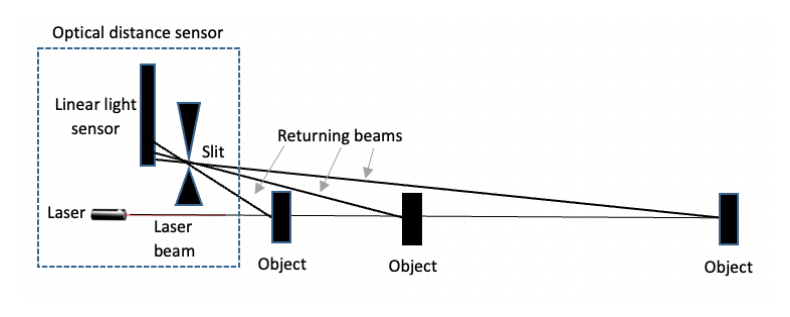 laser triangulation distance sensor schematic
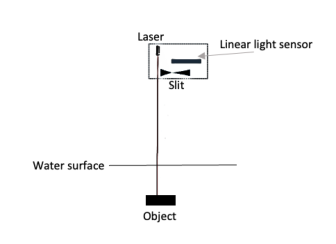 laser beam perpendicular to water surface
Topic: Geometric Optics, Wave Optics Metodi: Ray Tracing, Snell’s Law, Dimensional Analysis Competenze: Mathematical Modeling, Physical Reasoning Objects: Slit Fonte: Testo (PDF) — p.10
Un modo per misurare la distanza utilizzando l’ottica è quello di inviare un raggio laser all’oggetto e misurare l’angolo che la luce dispersa fa con il raggio originale.
I componenti all’interno della casella di linea a punti costituiscono il sensore di distanza ottica. Il rettangolo verticale rappresenta un sensore di luce lineare che misura il punto di impatto del fascio di ritorno. Le tre linee indicano i raggi luminosi riflessi da oggetti a diverse distanze.
Il sensore lineare è lungo 9 mm e consiste in una linea di 600 pixel spaziati tra loro a 15 μm. La fessura del fascio di ritorno è di 20 μm di larghezza e si trova a 5 mm sopra il fascio laser e a 2 mm dal sensore lineare. L’ultimo pixel del sensore di luce lineare, il più vicino al raggio laser, è a 15 μm sopra la fessura.
Qual è la distanza più breve e più lunga che questo sensore possa misurare nell’aria?
Se vogliamo misurare la distanza da un oggetto sott’acqua, vengono attivati due pixel del sensore lineare: uno corrispondente alla diffusione del laser dalla superficie dell’acqua e uno corrispondente alla diffusione del laser dall’oggetto. Spiegate come si possa usare queste due letture per ottenere la giusta distanza dall’oggetto sott’acqua.
Iniziate con il caso in cui il raggio laser sia perpendicolare alla superficie dell’acqua.
scenario del sensore di distanza di triangolazione laser
l’aspetto del fascio laser perpendicolare alla superficie dell’acqua
Topic: Geometric Optics, Wave Optics Metodi: Ray Tracing, Snell’s Law, Dimensional Analysis Competenze: Mathematical Modeling, Physical Reasoning Objects: Slit Fonte: Testo (PDF) — p.10