- A bead on a circular hoop with radius 2 m travels counterclockwise for 10 s and completes 2.25 rotations, at which point it reaches the position shown.
In the past 10 s, what were its average speed and the direction of its average velocity?
- A. , ↙
- B. , ↙
- C. , ↙
- D. , ↘
- E. , ↘
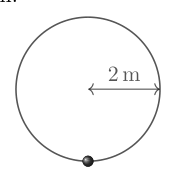 cerchio con perla e diametro 2m
Topic: Newtonian Mechanics Metodi: Kinematic Equations, Vector Decomposition Competenze: Physical Reasoning, Mathematical Modeling Objects: Ball Fonte: Testo (PDF) — p.2
- Un cerchio circolare con un raggio di 2 m si muove in senso contrario all’orologio per 10 secondi e completa 2,25 rotazioni. in cui raggiunge la posizione indicata.
Negli ultimi 10 secondi, qual era la sua velocità media e la direzione della sua velocità media?
- A. , ↙
- B. , ↙
- C. , ↙
- D. , ↘
- E. , ↘
- cerchio con perla e diametro 2 m *
Topic: Newtonian Mechanics Metodi: Kinematic Equations, Vector Decomposition Competenze: Physical Reasoning, Mathematical Modeling Objects: Ball Fonte: Testo (PDF) — p.2
- A mass on an ideal pendulum is released from rest at point I. When it reaches point II, which of the following shows the direction of its acceleration? (A) (B) (C) (D) (E)
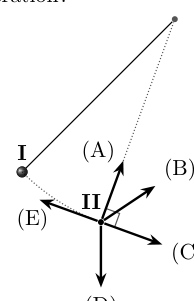 pendolo con direzioni di accelerazione
Topic: Newtonian Mechanics, Oscillations & Waves Metodi: Free-Body Diagram, Vector Decomposition, Simple Harmonic Motion Analysis Competenze: Diagrammatic Reasoning, Physical Reasoning Objects: Pendulum Fonte: Testo (PDF) — p.2
- Una massa su un pendolo ideale viene rilasciata dal riposo al punto I. Quando raggiunge il punto II, quale dei
- Il suo seguito indica la direzione dell’accelerazione? (A) (B) (C) (D) (E)
- pendolo con direzioni di accelerazione *
Topic: Newtonian Mechanics, Oscillations & Waves Metodi: Free-Body Diagram, Vector Decomposition, Simple Harmonic Motion Analysis Competenze: Diagrammatic Reasoning, Physical Reasoning Objects: Pendulum Fonte: Testo (PDF) — p.2
- A soccer ball is kicked up a hill with a flat top, as shown. The ball bounces twice on the hill, at the points shown, then lands on the top and begins rolling horizontally. Which of the following shows the vertical component of its velocity as a function of time?
- A. vs
- B. vs
- C. vs
- D. vs
- E. vs
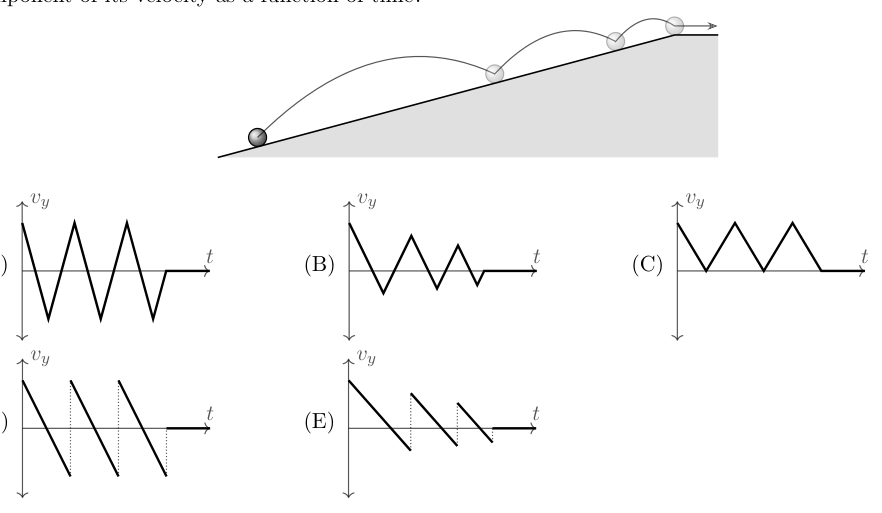 pallone su collina e grafici vy(t)
Topic: Newtonian Mechanics Metodi: Kinematic Equations, Physical Modeling Competenze: Physical Reasoning, Diagrammatic Reasoning Objects: Ball Fonte: Testo (PDF) — p.2
- Una palla da calcio viene calciata su una collina con una cima piatta, come mostrato. La palla rimbalza due volte sulla collina, nei punti mostrato, poi atterrà sulla parte superiore e inizierà a rotolare orizzontalmente. Qual è la seguente che mostra la verticale Componente della sua velocità come funzione del tempo?
- A. vs
- B. vs
- C. vs
- D. vs
- E. vs
- pallon su collina e grafici vy(t) *
Topic: Newtonian Mechanics Metodi: Kinematic Equations, Physical Modeling Competenze: Physical Reasoning, Diagrammatic Reasoning Objects: Ball Fonte: Testo (PDF) — p.2
- A box of mass is at the bottom of an inclined plane with angle to the horizontal, and height .
A person drags the box very slowly up the plane, by applying a force parallel to the plane. The coefficient of kinetic friction between the box and plane is . When the box reaches the top of the plane, how much work has the person done?
- A.
- B.
- C.
- D.
- E.
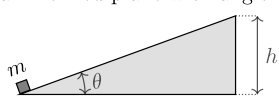 piano inclinato con scatola
Topic: Newtonian Mechanics, Conservation of Energy Metodi: Free-Body Diagram, Vector Decomposition, Energy Conservation Method Competenze: Diagrammatic Reasoning, Mathematical Modeling, Physical Reasoning Objects: Block, Inclined Plane Fonte: Testo (PDF) — p.3
- Una scatola di massa si trova in fondo a un piano inclinato con angolo orizzontale e altezza .
Una persona trascina la scatola molto lentamente verso l’alto, applicando una forza parallela all’aereo. Il coefficiente di attrito cinetico tra la scatola e il piano è . Quando la scatola raggiunge la cima dell’aereo, quanto il lavoro che la persona ha fatto?
- A.
- B.
- C.
- D.
- E.
- pianoforte inclinato con scatola *
Topic: Newtonian Mechanics, Conservation of Energy Metodi: Free-Body Diagram, Vector Decomposition, Energy Conservation Method Competenze: Diagrammatic Reasoning, Mathematical Modeling, Physical Reasoning Objects: Block, Inclined Plane Fonte: Testo (PDF) — p.3
- Two blocks of mass and a block of mass are attached to a system of massless fixed pulleys and massless string, as shown.
Assume all surfaces are frictionless. What is the acceleration of each mass ?
- A.
- B.
- C.
- D.
- E.
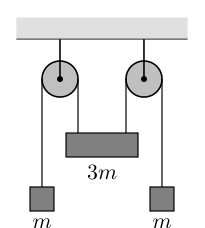 sistema di pulegge con masse m e 3m
Topic: Newtonian Mechanics Metodi: Free-Body Diagram, Vector Decomposition, Kinematic Equations Competenze: Diagrammatic Reasoning, Mathematical Modeling Objects: Block, Pulley, String Fonte: Testo (PDF) — p.3
- Due blocchi di massa e un blocco di massa sono attaccati a un sistema di polli fissi senza massa e stringhe senza massa, come mostrato.
Supponiamo che tutte le superfici siano senza attriti. Qual è l’accelerazione di ciascuna massa ?
- A.
- B.
- C.
- D.
- E.
- sistema di controllo con massa m e 3 m *
Topic: Newtonian Mechanics Metodi: Free-Body Diagram, Vector Decomposition, Kinematic Equations Competenze: Diagrammatic Reasoning, Mathematical Modeling Objects: Block, Pulley, String Fonte: Testo (PDF) — p.3
- A ball at the end of a rope of length 0.5 m is swung in a horizontal circle, with a speed of 15 m/s. The other end of the rope is fixed in place. What is the height difference between the ends of the rope?
- A. 1.1 cm
- B. 2.2 cm
- C. 3.8 cm
- D. 4.9 cm
- E. 7.5 cm
Topic: Newtonian Mechanics Metodi: Free-Body Diagram, Vector Decomposition, Kinematic Equations Competenze: Physical Reasoning, Mathematical Modeling Objects: Ball, String Fonte: Testo (PDF) — p.3
- Una palla alla fine di una corda di lunghezza 0,5 m viene oscillata in un cerchio orizzontale, con una velocità di 15 m/s. Il l’altra estremità della corda è fissata. Qual è la differenza di altezza tra le estremità della corda?
- A. 1.1 cm
- B. 2.2 cm
- C. 3.8 cm
- D. 4.9 cm
- E. 7.5 cm
Topic: Newtonian Mechanics Metodi: Free-Body Diagram, Vector Decomposition, Kinematic Equations Competenze: Physical Reasoning, Mathematical Modeling Objects: Ball, String Fonte: Testo (PDF) — p.3
- Two boxes are stacked side-by-side on top of a larger box as shown.
All three boxes have mass , the coefficient of static friction between the left box and the bottom box is , and all other surfaces are frictionless. A rightward force is applied to the bottom box. What is the minimum value of so that the upper boxes don’t slide?
- A.
- B.
- C.
- D.
- E.
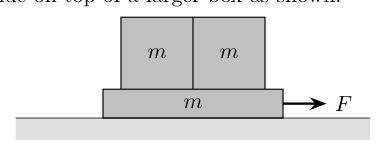 tre scatole impilate con forza F
Topic: Newtonian Mechanics, Rigid Body Statics Metodi: Free-Body Diagram, Vector Decomposition, Kinematic Equations Competenze: Diagrammatic Reasoning, Mathematical Modeling, Physical Reasoning Objects: Block Fonte: Testo (PDF) — p.3
- Due scatole sono impilate fianco a fianco sopra una scatola più grande come mostrato.
Tutte le tre caselle hanno massa , il coefficiente di attrito statico tra la casella sinistra e la casella inferiore è , e tutte le altre superfici sono senza attrito. Si applica una forza verso destra alla casella inferiore. Che cos’è valore minimo di in modo che le caselle superiori non scivolassero?
- A.
- B.
- C.
- D.
- E.
*tre scatole impilate con forza F *
Topic: Newtonian Mechanics, Rigid Body Statics Metodi: Free-Body Diagram, Vector Decomposition, Kinematic Equations Competenze: Diagrammatic Reasoning, Mathematical Modeling, Physical Reasoning Objects: Block Fonte: Testo (PDF) — p.3
- Two stars and , with masses satisfying , are in circular orbits around each other. In the rest frame of this system, find the ratio of the speeds .
- A.
- B.
- C.
- D. 9
- E. 10
Topic: Gravitation, Astrophysics Metodi: Newton’s Law of Gravitation, Conservation of Momentum Competenze: Mathematical Modeling, Physical Reasoning Objects: Star Fonte: Testo (PDF) — p.4
- Due stelle e , con masse soddisfacenti , sono in orbite circolari l’una intorno all’altra. Nel il sistema di sistema di riposo, trovare il rapporto delle velocità .
- A.
- B.
- C.
- D. 9
- E. 10
Topic: Gravitation, Astrophysics Metodi: Newton’s Law of Gravitation, Conservation of Momentum Competenze: Mathematical Modeling, Physical Reasoning Objects: Star Fonte: Testo (PDF) — p.4
- A helium balloon is released from the floor in a room at rest, then slowly rises and comes to rest touching the ceiling. During this process, the gravitational potential energy of the balloon has increased. Since energy is conserved, the energy of something else must have decreased during this process. Which of the following is the main contribution to this decrease?
- A. The kinetic energy of the balloon decreased.
- B. The elastic potential energy of the balloon decreased.
- C. The thermal energy of the air in the balloon decreased.
- D. The thermal energy of the air in the room decreased.
- E. The gravitational potential energy of the air in the room decreased.
Topic: Conservation of Energy, Fluid Mechanics Metodi: Energy Conservation Method, Hydrostatic Equilibrium, Conservation Laws Competenze: Physical Reasoning Objects: Bubble, Gas Fonte: Testo (PDF) — p.4
- Un pallone di elio viene rilasciato dal pavimento in una stanza a riposo, poi si alza lentamente e arriva a riposo toccando il soffitto. Durante questo processo, l’energia potenziale gravitazionale del palloncino è aumentata. Da quando Se si conserva energia, l’energia di qualcos’altro deve aver diminuito durante questo processo. Qual è il numero di La seguente è la principale contribuzione a questa diminuzione?
- A. L’energia cinetica del palloncino è diminuita.
- B. L’energia potenziale elastica del palloncino è diminuita.
- C. L’energia termica dell’aria nel palloncino è diminuita.
- D. L’energia termica dell’aria nella stanza è diminuita.
- E. L’energia potenziale gravitazionale dell’aria nella stanza è diminuita.
Topic: Conservation of Energy, Fluid Mechanics Metodi: Energy Conservation Method, Hydrostatic Equilibrium, Conservation Laws Competenze: Physical Reasoning Objects: Bubble, Gas Fonte: Testo (PDF) — p.4
- An archer takes aim at a target that is 100 m away. Assuming she holds the bow at the same height as the center of the target and shoots an arrow with velocity m/s, at what angle above the horizontal should she aim the bow so that the arrow hits the center of the target?
- A.
- B.
- C.
- D.
- E.
Topic: Newtonian Mechanics Metodi: Kinematic Equations, Vector Decomposition, Small-Angle Approximation Competenze: Mathematical Modeling, Physical Reasoning Objects: Projectile Fonte: Testo (PDF) — p.4
- Un arciere mira un bersaglio a 100 metri di distanza. Supponendo che tenga l’ arco alla stessa altezza che il centro dell’obiettivo e spara una freccia con velocità m/s, a quale angolo sopra l’orizzontale dovrebbe puntare l’arco in modo che la freccia colpisca il centro del bersaglio?
- A.
- B.
- C.
- D.
- E.
Topic: Newtonian Mechanics Metodi: Kinematic Equations, Vector Decomposition, Small-Angle Approximation Competenze: Mathematical Modeling, Physical Reasoning Objects: Projectile Fonte: Testo (PDF) — p.4
- A projectile is thrown from a horizontal surface, and reaches a maximum height and also lands a distance from the launch point. Neglecting air resistance, what is the maximum height for a projectile thrown directly upward with the same initial speed?
- A.
- B.
- C.
- D.
- E.
Topic: Newtonian Mechanics Metodi: Kinematic Equations, Vector Decomposition, Conservation Laws Competenze: Mathematical Modeling, Physical Reasoning Objects: Projectile Fonte: Testo (PDF) — p.4
- Un proiettile viene lanciato da una superficie orizzontale, raggiunge un’altezza massima e atterra anche a una distanza dal punto di lancio. Negliendo la resistenza dell’aria, qual è l’altezza massima per un proiettile lanciato Direttamente verso l’alto con la stessa velocità iniziale?
- A.
- B.
- C.
- D.
- E.
Topic: Newtonian Mechanics Metodi: Kinematic Equations, Vector Decomposition, Conservation Laws Competenze: Mathematical Modeling, Physical Reasoning Objects: Projectile Fonte: Testo (PDF) — p.4
- A block of mass is initially held in place by two massless strings, as shown.
The tension in the diagonal string is . Next, the horizontal string is cut, and immediately afterward the tension in the diagonal string is . Which of the following is true?
- A.
- B.
- C.
- D.
- E.
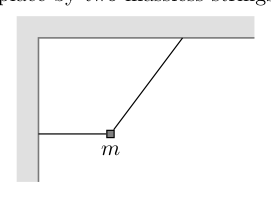 blocco appeso a due fili
Topic: Newtonian Mechanics Metodi: Free-Body Diagram, Vector Decomposition, Kinematic Equations Competenze: Physical Reasoning, Diagrammatic Reasoning Objects: Block, String Fonte: Testo (PDF) — p.4
- Un blocco di massa viene inizialmente mantenuto in posizione da due stringhe senza massa, come mostrato.
La tensione nella stringa diagonale è . Successivamente, la corda orizzontale viene tagliata, e immediatamente dopo la tensione nella corda diagonale è . Quale di queste parole è vero?
- A.
- B.
- C.
- D.
- E.
blocco appeso a fili dovuti
Topic: Newtonian Mechanics Metodi: Free-Body Diagram, Vector Decomposition, Kinematic Equations Competenze: Physical Reasoning, Diagrammatic Reasoning Objects: Block, String Fonte: Testo (PDF) — p.4
- A uniform box with mass is at rest on a horizontal surface, and the coefficient of static friction between them is . A force directed at an angle of above the horizontal is applied to the center of the box, with a linearly increasing magnitude .
The box will eventually slide or lift off the ground. Which of the following is correct?
- A. If , the box will lift off the ground first.
- B. If , the box will slide first.
- C. For any value of , the box will lift off the ground first.
- D. For any value of , the box will slide first.
- E. The answer depends on the values of , , and .
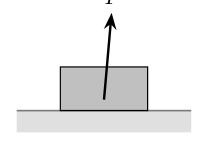 scatola su piano con forza inclinata F
Topic: Newtonian Mechanics, Rigid Body Statics Metodi: Free-Body Diagram, Vector Decomposition, Torque & Angular Momentum Analysis Competenze: Physical Reasoning, Mathematical Modeling, Diagrammatic Reasoning Objects: Block Fonte: Testo (PDF) — p.5
- Una scatola uniforme di massa è in riposo su una superficie orizzontale e il coefficiente di attrito statico tra sono . Un’intensità di forza diretta in un angolo sopra l’orizzontale è applicata al centro della scatola, con una magnitudine lineare in aumento .
La scatola alla fine scivola o si solleva dal terreno. Quale di queste parole è corretta?
- A. Se , la scatola si solleverà prima dal terreno.
- B. Se , la casella scorre prima.
- C. Per qualsiasi valore di , la scatola si solleva prima dal terreno.
- D. Per qualsiasi valore di , la casella scorre prima.
- E. La risposta dipende dai valori di , e .
Scatola su pianoforte con forza inclinata F
Topic: Newtonian Mechanics, Rigid Body Statics Metodi: Free-Body Diagram, Vector Decomposition, Torque & Angular Momentum Analysis Competenze: Physical Reasoning, Mathematical Modeling, Diagrammatic Reasoning Objects: Block Fonte: Testo (PDF) — p.5
- The object shown below is made of three rigidly connected, identical rods with uniform density. When it stands upright on a horizontal table, what fraction of its weight rests on the left leg?
- A.
- B.
- C.
- D.
- E.
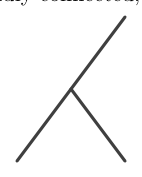 tre aste rigide connesse
Topic: Rigid Body Statics Metodi: Torque & Angular Momentum Analysis, Free-Body Diagram, Physical Modeling Competenze: Mathematical Modeling, Physical Reasoning Objects: Rod Fonte: Testo (PDF) — p.5
- L’oggetto mostrato di seguito è costituito da tre barre rigidamente collegate, identiche e di densità uniforme. Quando si trova eretta su un tavolo orizzontale, quale frazione del suo peso si trova sulla gamba sinistra?
- A.
- B.
- C.
- D.
- E.
*tre connessioni rigide *
Topic: Rigid Body Statics Metodi: Torque & Angular Momentum Analysis, Free-Body Diagram, Physical Modeling Competenze: Mathematical Modeling, Physical Reasoning Objects: Rod Fonte: Testo (PDF) — p.5
- The following plot shows the speed at which stars orbit about the center of a galaxy, as a function of their distance from the center.
Assuming the galaxy has a spherically symmetric mass distribution, which plot best shows the mass of the galaxy enclosed within radius ?
- A. vs
- B. vs
- C. vs
- D. vs
- E. vs
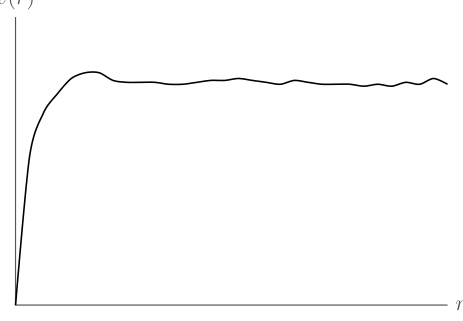 curva di rotazione galattica v(r)
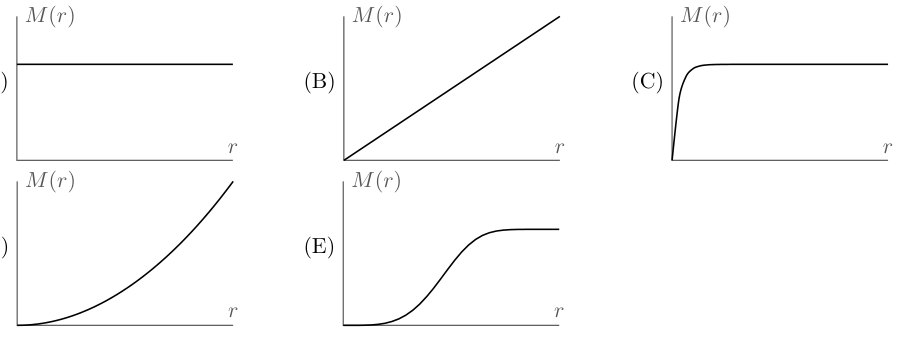 cinque grafici M(r) risposta
Topic: Gravitation, Astrophysics Metodi: Newton’s Law of Gravitation, Physical Modeling Competenze: Graph Linearization, Mathematical Modeling, Physical Reasoning Objects: Star Fonte: Testo (PDF) — p.5
- Il diagramma seguente mostra la velocità a cui le stelle orbitano intorno al centro di una galassia, come funzione di distanza dal centro.
Supponendo che la galassia abbia una distribuzione di massa sferica simmetrica, che mostra meglio la massa di la galassia chiusa all’interno del raggio ?
- A. vs
- B. vs
- C. vs
- D. vs
- E. vs
*curva di rotazione galattica v(r) *
*cinque grafici M(r) risposta *
Topic: Gravitation, Astrophysics Metodi: Newton’s Law of Gravitation, Physical Modeling Competenze: Graph Linearization, Mathematical Modeling, Physical Reasoning Objects: Star Fonte: Testo (PDF) — p.5
- A bead attached to a string of length m is released from a very small angle to the vertical. A wall is placed in the path of the bead such that the bead collides elastically with the wall when the string is at an angle to the vertical, as shown.
What is the time interval between the bead’s collisions with the wall?
- A. s
- B. s
- C. s
- D. s
- E. s
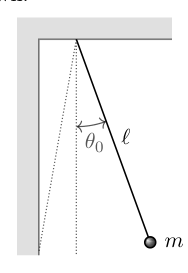 perla su filo con parete e angolo theta0
Topic: Oscillations & Waves, Newtonian Mechanics Metodi: Simple Harmonic Motion Analysis, Conservation of Energy, Small-Angle Approximation Competenze: Mathematical Modeling, Physical Reasoning Objects: Pendulum, String Fonte: Testo (PDF) — p.6
- Una perla attaccata a una corda di lunghezza m viene rilasciata da un angolo molto piccolo verso la verticale. A il muro è collocato nel percorso della perla in modo tale che la perla colpisca elasticamente con il muro quando la corda è all’angolo verso la verticale, come mostrato.
Qual è l’intervallo di tempo tra le collisioni delle perle con il muro?
- A. s
- B. s
- C. s
- D. s
- E. s
perla su filo con parete e angolo theta0
Topic: Oscillations & Waves, Newtonian Mechanics Metodi: Simple Harmonic Motion Analysis, Conservation of Energy, Small-Angle Approximation Competenze: Mathematical Modeling, Physical Reasoning Objects: Pendulum, String Fonte: Testo (PDF) — p.6
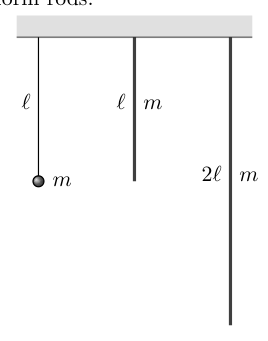
- Three physical pendulums are built as shown. The first is a typical pendulum with a massless rope, and the second and third are made of uniform rods.
What is the correct ranking of the moments of inertia , , and about the pivot points?
- A.
- B.
- C.
- D.
- E.
 tre pendoli fisici su aste
Topic: Rotational Dynamics, Oscillations & Waves Metodi: Torque & Angular Momentum Analysis, Simple Harmonic Motion Analysis Competenze: Mathematical Modeling, Physical Reasoning Objects: Pendulum, Rod, String Fonte: Testo (PDF) — p.6
- Sono costruiti tre penduli fisici come mostrato. Il primo è un tipico pendolo con una corda senza massa, e la seconda e la terza sono costituite da bastone uniformi.
Qual è la corretta classificazione dei momenti di inerzia , e nei punti di pivot?
- A.
- B.
- C.
- D.
- E.
tre pendoli fisici su aste
Topic: Rotational Dynamics, Oscillations & Waves Metodi: Torque & Angular Momentum Analysis, Simple Harmonic Motion Analysis Competenze: Mathematical Modeling, Physical Reasoning Objects: Pendulum, Rod, String Fonte: Testo (PDF) — p.6
- Alice, Bob, and Carol are each given identical airtight bags containing identical rocks, and a large tub of water with a scale sitting on the bottom. Each of them measures the weight of their bag and rock by putting the bag on the scale, using three slightly different procedures. • Alice closes the bag carefully, so that there is no air inside. • Bob fills the rest of the bag with water before closing it. • Carol closes the bag loosely, so that it contains some air. What is the correct ranking of their measured weights , , and ?
- A.
- B.
- C.
- D.
- E.
Topic: Fluid Mechanics, Newtonian Mechanics Metodi: Hydrostatic Equilibrium, Physical Modeling, Conservation Laws Competenze: Physical Reasoning Objects: Container Fonte: Testo (PDF) — p.7
- Alice, Bob e Carol ricevono ognuno delle stesse sacche a prova di aria contenenti le stesse rocce e una grande vasca di acqua con una scala sul fondo. Ognuno di loro misura il peso della sua borsa e della sua roccia mettendo la borsa sulla bilancia, utilizzando tre procedure leggermente diverse. • Alice chiude la borsa con attenzione, in modo che non ci sia aria all’interno. • Bob riempie l’acqua del sacchetto prima di chiuderlo. • Carol chiude il sacchetto liberamente, in modo che contenga un po’ di aria. Qual è la corretta classificazione dei loro pesi misurati , e ?
- A.
- B.
- C.
- D.
- E.
Topic: Fluid Mechanics, Newtonian Mechanics Metodi: Hydrostatic Equilibrium, Physical Modeling, Conservation Laws Competenze: Physical Reasoning Objects: Container Fonte: Testo (PDF) — p.7
- A student sets up a simple pendulum, measures its length to be m, and observes a period of oscillation of s. Using this data, the student computes . What is the uncertainty of this measurement?
- A.
- B.
- C.
- D.
- E.
Topic: Oscillations & Waves Metodi: Simple Harmonic Motion Analysis, Error Propagation Competenze: Error Propagation, Mathematical Modeling Objects: Pendulum Fonte: Testo (PDF) — p.7
- Uno studente imposta un semplice pendolo, ne misura la lunghezza a m, e osserva un periodo di oscillazione di s. Usando questi dati, lo studente calcola . Qual è l’incertezza di questa misura?
- A.
- B.
- C.
- D.
- E.
Topic: Oscillations & Waves Metodi: Simple Harmonic Motion Analysis, Error Propagation Competenze: Error Propagation, Mathematical Modeling Objects: Pendulum Fonte: Testo (PDF) — p.7
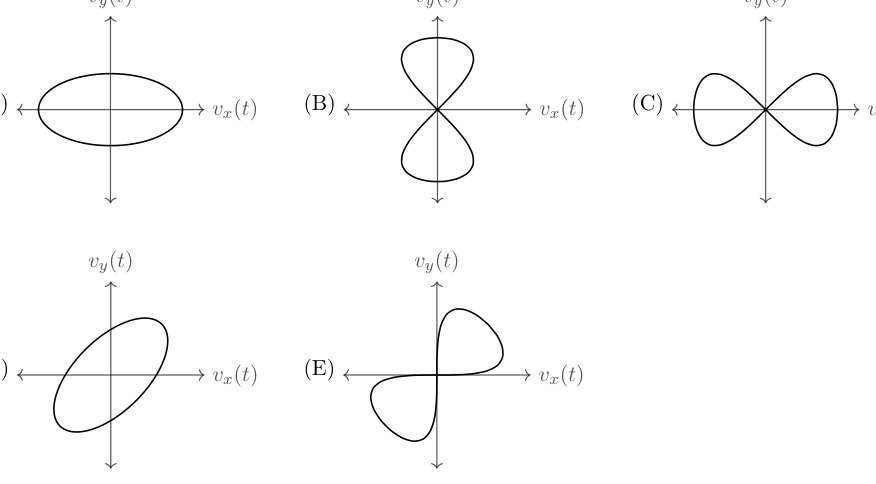
- A mass attached to the end of a string oscillates like a pendulum with small amplitude. The mass has horizontal velocity and vertical velocity . Which of the following could be a graph of the curve over a complete oscillation?
- A. vs
- B. vs
- C. vs
- D. vs
- E. vs
 cinque grafici di fase vx vs vy pendolo
Topic: Oscillations & Waves Metodi: Simple Harmonic Motion Analysis, Superposition Principle Competenze: Mathematical Modeling, Physical Reasoning, Diagrammatic Reasoning Objects: Pendulum, String Fonte: Testo (PDF) — p.7
- Una massa attaccata alla fine di una corda oscilla come un pendolo con piccola amplitudine. La massa ha velocità orizzontale e velocità verticale . Quale delle seguenti potrebbe essere un grafico della curva su un’oscillazione completa?
- A. vs
- B. vs
- C. vs
- D. vs
- E. vs
cinque grafici di fase vx vs vy pendolo
Topic: Oscillations & Waves Metodi: Simple Harmonic Motion Analysis, Superposition Principle Competenze: Mathematical Modeling, Physical Reasoning, Diagrammatic Reasoning Objects: Pendulum, String Fonte: Testo (PDF) — p.7
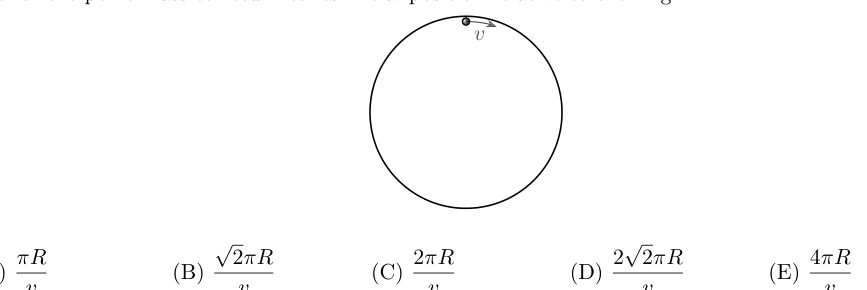
- A smooth ring of radius and mass lies on a frictionless surface. A point mass, also of mass , is placed just inside the ring and given a speed tangent to the inner surface of the ring. How long does it take for the point mass to return to its initial position relative to the ring?
- A.
- B.
- C.
- D.
- E.
 anello con massa puntiforme
Topic: Newtonian Mechanics, Conservation of Momentum Metodi: Conservation of Momentum, Free-Body Diagram, Kinematic Equations Competenze: Mathematical Modeling, Physical Reasoning Objects: Ball Fonte: Testo (PDF) — p.8
- Un anello liscio di raggio e massa si trova su una superficie senza attrito. Una massa puntologica, anche di massa , è si colloca proprio all’interno dell’anello e viene data una velocità tangente alla superficie interna dell’anello. Quanto tempo dura ? prendere per la massa puntaria di tornare alla sua posizione iniziale rispetto all’anello?
- A.
- B.
- C.
- D.
- E.
*anello con massa puntiforme *
Topic: Newtonian Mechanics, Conservation of Momentum Metodi: Conservation of Momentum, Free-Body Diagram, Kinematic Equations Competenze: Mathematical Modeling, Physical Reasoning Objects: Ball Fonte: Testo (PDF) — p.8
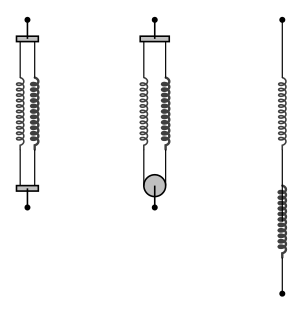
- Two springs with different spring constants are connected in three ways, as shown.
In the second case, the springs are connected to opposite ends of a string, which runs under a massless frictionless pulley. In each case, the two springs act like a single spring with an effective spring constant , , or . Which of the following is correct?
- A.
- B.
- C.
- D.
- E.
 tre configurazioni di molle kA kB kC
Topic: Newtonian Mechanics, Oscillations & Waves Metodi: Hooke’s Law, Free-Body Diagram, Superposition Principle Competenze: Physical Reasoning, Mathematical Modeling, Diagrammatic Reasoning Objects: Spring, Pulley, String Fonte: Testo (PDF) — p.8
- Due sorgenti con diverse costanti sorgenti sono collegate in tre modi, come mostrato.
Nel secondo caso, le sorgenti sono collegate alle estremità opposte di una corda, che corre sotto un polla senza attrito. In ogni caso, le due sorgenti agiscono come una singola sorgente con una costante di sorgente efficace , , or . Quale di queste parole è corretta?
- A.
- B.
- C.
- D.
- E.
*tre configurazioni di molle kA kB kC *
Topic: Newtonian Mechanics, Oscillations & Waves Metodi: Hooke’s Law, Free-Body Diagram, Superposition Principle Competenze: Physical Reasoning, Mathematical Modeling, Diagrammatic Reasoning Objects: Spring, Pulley, String Fonte: Testo (PDF) — p.8
- An astronomer on Earth, which is a distance from the Sun, observes a star and galaxy. The star is a distance away, and the galaxy is much further away than the star. Throughout the year, the angular distance between the star and galaxy appears to vary, reaching a minimum of 2 arcseconds on January 1st and a maximum of 2.5 arcseconds on July 1st. (One degree is equal to 3600 arcseconds.) Assume the Sun, star, and galaxy do not move relative to each other, and that the Earth’s orbit lies within their plane. What is the ratio ?
- A.
- B.
- C.
- D.
- E.
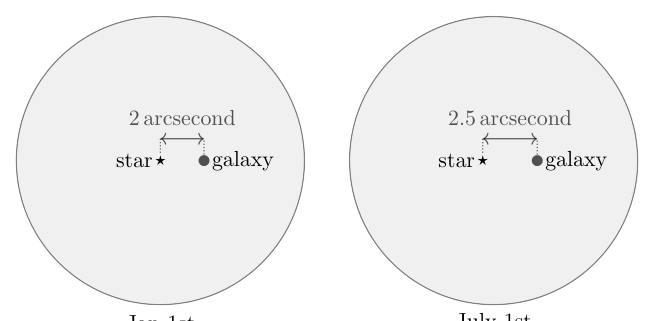 vista telescopio stella e galassia parallasse
Topic: Astrophysics, Gravitation Metodi: Newton’s Law of Gravitation, Small-Angle Approximation, Physical Modeling Competenze: Mathematical Modeling, Estimation & Approximation Objects: Star, Planet Fonte: Testo (PDF) — p.8
- Un astronomo sulla Terra, che è a una distanza dal Sole, osserva una stella e una galassia. La stella è una distanza , e la galassia è molto più lontana della stella. Durante tutto l’anno, La distanza angolare tra la stella e la galassia sembra variare, raggiungendo un minimo di 2 secondi d’arco Il 1° gennaio e il 1° luglio, un massimo di 2,5 secondi d’arco. (Un grado equivale a 3600 secondi d’arco.) Supponiamo che il Sole, la stella e la galassia non si muovano l’una rispetto all’altra e che l’orbita terrestre si trova all’interno del loro aereo. Qual è il rapporto ?
- A.
- B.
- C.
- D.
- E.
vista telescopio stella e galaxia parallasse
Topic: Astrophysics, Gravitation Metodi: Newton’s Law of Gravitation, Small-Angle Approximation, Physical Modeling Competenze: Mathematical Modeling, Estimation & Approximation Objects: Star, Planet Fonte: Testo (PDF) — p.8
- A very heavy plate continuously moves up and down with a small speed , switching directions after each time . At a random time, a ball is dropped from rest far above the plate, then bounces elastically off of it. How does the ball’s speed change during this collision?
- A. The ball always slows down.
- B. The ball is more likely to slow down than to speed up.
- C. The ball is equally likely to slow down or speed up.
- D. The ball is more likely to speed up than to slow down.
- E. The ball always speeds up.
Topic: Newtonian Mechanics, Conservation of Momentum Metodi: Conservation of Momentum, Impulse-Momentum Theorem, Physical Modeling Competenze: Physical Reasoning, Mathematical Modeling Objects: Ball Fonte: Testo (PDF) — p.9
- Una piastra molto pesante si muove continuamente su e giù a una piccola velocità , cambiando direzioni dopo ogni tempo . In un momento casuale, una palla viene scaricata dal riposo molto sopra la piastra, poi rimbalza elasticamente fuori di it. Come cambia la velocità della palla durante questa collisione?
- La palla rallenta sempre.
- B. La palla è più probabile rallentare che accelerare.
- C. La palla ha la stessa probabilità di rallentare o accelerare.
- D. La palla è più probabile che accelera che rallenti. La palla accelera sempre.
Topic: Newtonian Mechanics, Conservation of Momentum Metodi: Conservation of Momentum, Impulse-Momentum Theorem, Physical Modeling Competenze: Physical Reasoning, Mathematical Modeling Objects: Ball Fonte: Testo (PDF) — p.9
- A skier slides from rest along a frictionless slope with incline angle for 150 m, then smoothly transitions into a horizontal jumping ramp of height m. Neglecting air resistance, after the skier leaves the ramp, about how far will they travel horizontally before landing? (, 150 m, m)
- A. 164 m
- B. 173 m
- C. 181 m
- D. 200 m
- E. 210 m
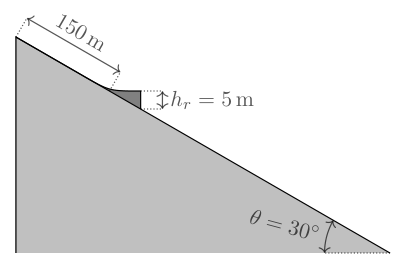 sciatore su pendio con rampa
Topic: Newtonian Mechanics, Conservation of Energy Metodi: Kinematic Equations, Energy Conservation Method, Vector Decomposition Competenze: Mathematical Modeling, Physical Reasoning Objects: Inclined Plane Fonte: Testo (PDF) — p.9
- Un sciatore sciva dal riposo lungo una pendice senza attrito con angolo di pendenza per 150 m, quindi senza problemi transito verso una rampa di salto orizzontale di altezza m. Trascurare la resistenza dell’aria, dopo lo sciatore Lascia la rampa, circa quanto lontano si muoveranno orizzontalmente prima di atterrare? (, 150 m, m)
- A. 164 m
- B. 173 m
- C. 181 m
- D. 200 m
- E. 210 m
sciatore su pendio con rampa
Topic: Newtonian Mechanics, Conservation of Energy Metodi: Kinematic Equations, Energy Conservation Method, Vector Decomposition Competenze: Mathematical Modeling, Physical Reasoning Objects: Inclined Plane Fonte: Testo (PDF) — p.9