You may use this sheet for both parts of the exam.
Part A
Question A1 — Circus Act
In this problem we consider a small ball bouncing back and forth between two points. In all parts below, the acceleration of gravity is , collisions are perfectly elastic, air resistance is negligible, and the impact points are at the same height. The diagrams are not drawn to scale.
a. Consider a ball bouncing between two inclined planes, which each make an angle to the horizontal. The ball has speed at the impact points, which are separated by a distance .
i. The ball can bounce back and forth along the same path, as shown.
For what values of is this motion possible? For these values, what is ?
ii. The ball can also take one trajectory while traveling to the right, and a separate trajectory when traveling back. Let be the angle between the paths at the impact points.
For what values of and is this motion possible? For these values, what is ?
b. Now suppose the ball bounces within a hemispherical well of radius of curvature . As in part a.ii, it alternates between two distinct paths, with flight times and .
Find all of the possible values of , in terms of and .
c. Finally, suppose the well has a sinusoidal shape, described by . The ball takes two distinct paths with flight times and , and the horizontal distance between the impact points is less than . Find all of the possible values of , in terms of and .
Question A2 — Time is a Flat Circle
A particle of mass and negative charge is constrained to move in a horizontal plane. In the situations described below, this particle can either oscillate back and forth in a straight line or move in a circle. (These two modes of motion are interesting because they generate linearly and circularly polarized radiation, respectively, but in this problem you may ignore any energy lost to radiation.)
a. A large positive charge is fixed in place a distance directly below the origin of the plane.
i. When the particle is a distance from the origin, find an approximate expression for its potential energy due to the charge to second order in , up to an arbitrary constant. You may use this result for the rest of the problem.
ii. If the particle oscillates linearly with amplitude , what is its angular frequency ?
iii. If the particle performs circular motion with radius , what is its angular frequency ?
b. Now an additional negative charge is fixed in place at the origin of the plane.
i. What is the equilibrium distance of the particle from the origin?
ii. If the particle oscillates linearly with amplitude , what is its angular frequency ? Is it higher or lower than ?
iii. Now suppose the particle performs circular motion with radius , where . What is its angular frequency , in terms of , , and ? Is it higher or lower than ?
Question A3 — The Motive Power of Ice
In the Carnot cycle, a gas is heated at constant temperature and cooled at constant temperature . Furthermore, no other heat transfer occurs, and all other steps of the cycle are reversible. The laws of thermodynamics state that any such cycle must have efficiency . Below we will explore two other heat engines, which recover this efficiency in certain limits.
a. Consider the following heat engine involving one mole of ideal monatomic gas. The gas begins at temperature , pressure , and volume , and undergoes four reversible steps.
- The gas is expanded at constant pressure until its temperature rises to .
- The gas is expanded at constant temperature until its pressure falls to .
- The gas is contracted at constant pressure until its temperature falls back to .
- The gas is contracted at constant temperature until its pressure rises back to .
i. Which steps require heat to be transferred to the gas? For each such step, give the total heat input in terms of , , , and .
ii. Under what conditions on and would we expect the efficiency of this heat engine to approach that of a Carnot cycle working between the same maximum and minimum temperatures?
iii. Find the efficiency of this heat engine for general and .
The second half of the problem is on the next page.
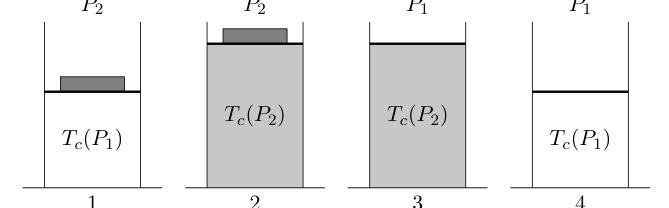
b. Now consider a heat engine built around the freezing and melting of water, which occurs at a pressure-dependent temperature . Initially, a volume of of water is squeezed underneath a piston, so that it experiences a total pressure , and the water is on the edge of freezing, with temperature . The engine then undergoes four reversible steps.
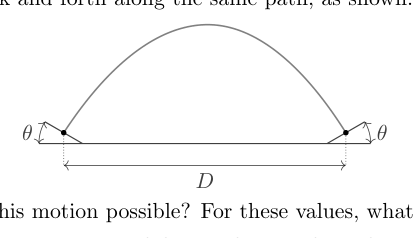 Palla rimbalzante tra piani inclinati
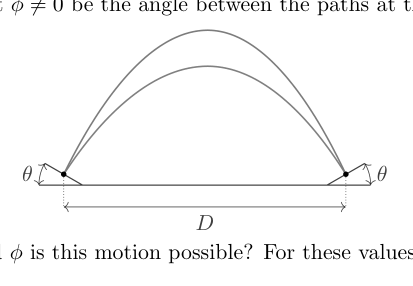 Due traiettorie palla piani inclinati
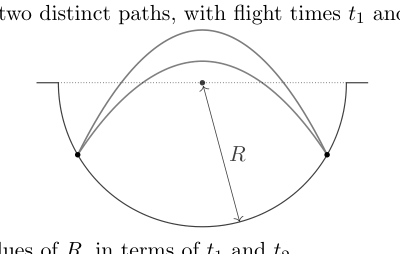 Palla in pozzo emisferico raggio R
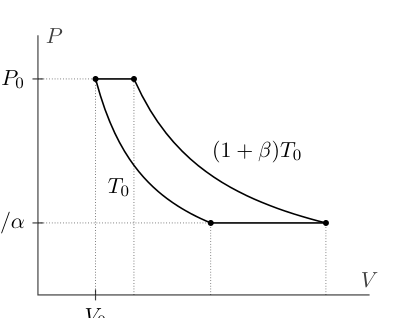 Diagramma P-V ciclo termodinamico
Topic: Newtonian Mechanics, Electrostatics, Thermodynamics Metodi: Kinematic Equations, Approximation & Series Expansion, Electric Potential Method, Thermodynamic Cycle Analysis Competenze: Mathematical Modeling, Physical Reasoning, Diagrammatic Reasoning Objects: Ball, Inclined Plane, Point Charge, Gas, Piston Fonte: Testo (PDF) — p.3
Puoi usare questo foglio per entrambe le parti dell’esame.
Parte A
La domanda A1 Legge sul circo
In questo problema consideriamo una piccola palla che rimbalza avanti e indietro tra due punti. In tutte le parti in seguito, l’accelerazione della gravità è , le collisioni sono perfettamente elastiche, la resistenza all’aria è trascurabile, e i punti di impatto sono alla stessa altezza. I diagrammi non sono disegnati su scala.
a. Considerate una palla che rimbalza tra due piani inclinati, che fanno ognuno un angolo alla
-
L’orizzontale. La palla ha velocità nei punti di impatto, separati da una distanza .
i. La palla può saltare avanti e indietro lungo lo stesso percorso, come mostrato.
Per quali valori di è possibile tale movimento? Per questi valori, quale è ?
ii. La palla può anche prendere una traiettoria mentre viaggia a destra, e una traiettoria separata quando si torna. L’angolo deve essere l’angolo tra i percorsi ai punti di impatto.
Per quali valori di e è possibile tale movimento? Per questi valori, quale è ?
b. Supponiamo che la palla rimbalzi all’interno di un pozzo emisfero di raggio di curvatura . Come in parte a.ii, si alternano due percorsi distinti, con tempi di volo e .
Trova tutti i valori possibili di , in termini di e .
c. Infine, supponiamo che il pozzo abbia una forma sinusoidale, descritta da . La palla prende due percorsi distinti con tempi di volo e e la distanza orizzontale tra i punti di impatto inferiori a . Trova tutti i valori possibili di , in termini di e .
Questione A2 Il tempo è un cerchio piatto
Una particella di massa e carica negativa è costretta a muoversi in piano orizzontale. Nel in situazioni descritte di seguito, questa particella può oscillare avanti e indietro in linea retta o muoversi in un cerchio. (Questi due modi di movimento sono interessanti perché generano in modo lineare e circolare la radiazione polarizzata, rispettivamente, ma in questo problema si può ignorare qualsiasi energia persa dalla radiazione.)
a. Una grande carica positiva è fissata a una distanza direttamente al di sotto dell’origine del piano.
i. Quando la particella è a una distanza dall’origine, trovare un’espressione approssimativa per la sua energia potenziale dovuta alla carica al secondo ordine in , fino a una costante arbitraria. Potete utilizzare questo risultato per il resto del problema.
ii. Se la particella oscilla linearmente con l’ampiezza , qual è la sua frequenza angolare ?
iii. Se la particella svolge un movimento circolare con raggio , qual è la sua frequenza angolare ?
b. Ora è fissata una carica negativa aggiuntiva all’origine del piano.
i. Qual è la distanza di equilibrio della particella dall’origine?
ii. Se la particella oscilla linearmente con l’ampiezza , qual è la sua frequenza angolare ? Is superiore o inferiore a ?
iii. Supponiamo che la particella esegua un movimento circolare con raggio , dove . Qual è la sua frequenza angolare , in termini di , e ? È superiore o inferiore a ?
Domanda A3 La forza motrice del ghiaccio
Nel ciclo Carnot, un gas viene riscaldato a temperatura costante e raffreddato a temperatura costante . Inoltre non si verifica nessun altro trasferimento di calore e tutte le altre fasi del ciclo sono reversibili. Il Le leggi della termodinamica affermano che un tale ciclo deve avere un’efficienza . Di seguito esploreremo altri due motori termosili che recuperano questa efficienza in certi limiti.
a. Considerate il seguente motore termico che prevede un mole di gas monatomo ideale. Il gas inizia a temperatura , pressione e volume , e subisce quattro fasi reversibili.
- Il gas viene ampliato a pressione costante fino a quando la sua temperatura aumenta a .
- Il gas viene ampliato a temperatura costante fino a quando la sua pressione scende a .
- Il gas viene contraccato a pressione costante fino a quando la sua temperatura scende a .
- Il gas viene contratto a temperatura costante fino a quando la sua pressione non sale di nuovo a .
i. Quali passaggi richiedono il trasferimento del calore al gas? Per ogni passo, indicare il calore totale input in termini di , , e .
ii. In quali condizioni, su e , si dovrebbe aspettarsi che l’efficienza di questo motore termico si avvicini che un ciclo Carnot che opera tra le stesse temperature massime e minime?
iii. Trova l’efficienza di questo motore termico per e in generale.
La seconda metà del problema è sulla pagina successiva.
b. Ora consideriamo un motore termico costruito attorno al congelamento e allo scioglimento dell’acqua, che si verifica in un temperatura pressurizzata . Inizialmente, viene compresso sotto un volume di acqua un pistone, in modo che essa subisca una pressione totale , e l’acqua sia sul bordo del congelamento, con temperatura . Il motore subisce quindi quattro passi reversibili.
Palla rimbalzante tra piani inclinati
Due traiettorie palla piani inclinati
*Palla in pozzo emisferico raggio R *
Diagramma P-V ciclo termodinamico
Topic: Newtonian Mechanics, Electrostatics, Thermodynamics Metodi: Kinematic Equations, Approximation & Series Expansion, Electric Potential Method, Thermodynamic Cycle Analysis Competenze: Mathematical Modeling, Physical Reasoning, Diagrammatic Reasoning Objects: Ball, Inclined Plane, Point Charge, Gas, Piston Fonte: Testo (PDF) — p.3
- A mass is slowly placed on the piston, raising the total pressure to .
- The water is cooled to temperature and frozen.
- The mass is slowly removed from the piston, lowering the pressure back to .
- The ice is heated back to temperature and melted.
Assume that water and ice are incompressible, with fixed densities and .
i. What is the net work done by this engine, in terms of , , , and the densities?
ii. Assume the latent heat per unit mass to melt ice is large, so that freezing and melting account for essentially all of the heat transfer in the cycle. What is the efficiency of the engine, in terms of , , , and the densities?
iii. Since we assumed all heat transfer occurs during melting or freezing, this cycle has the same efficiency as a Carnot cycle. In the limit where and are very close, use this fact to infer an expression for in terms of , , and the densities.
Part B
Question B1 — Electric Roulette
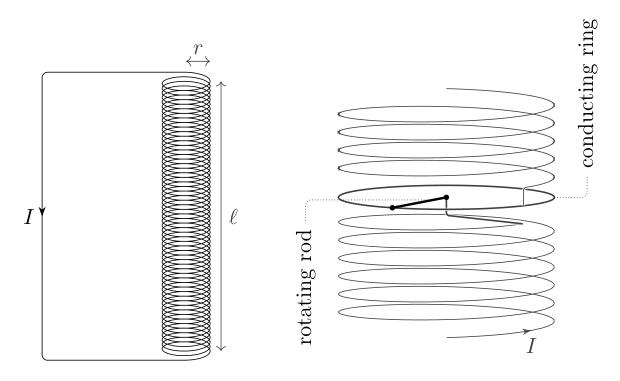
Consider a cylindrical solenoid with radius , length , and turns per unit length. It is made of one continuous wire, with the top connecting back to the bottom as shown at left.
In the middle of the solenoid, part of the wire is replaced with the assembly shown at right. A uniform conducting rod of mass and radius is connected to the bottom half of the solenoid, and is free to rotate about the solenoid’s axis of symmetry. The end of the rod slides on a fixed conducting ring, which is attached to the top half of the solenoid. This assembly and the solenoid form one continuous conductor, carrying total current .
a. What is the inductance of this system? Assume , so that the magnetic field produced by the current in the rod and ring is negligible.
b. When the rod is within a uniform vertical magnetic field , find the torque it experiences in terms of , , and .
c. If the rod rotates with angular velocity , the electrons inside have a tangential velocity. Find the electromotive force across the rod in terms of , , and .
Now we will consider the dynamics of this system in some simple situations. For all the parts below, neglect energy losses due to friction, resistance, and radiation.
d. First, suppose the system initially carries no current, and the entire system is inside a uniform external magnetic field parallel to the axis of the solenoid. If the rod is given a small initial angular velocity, its angular velocity will oscillate in time. Find the period of these oscillations.
e. Next, suppose there is no external magnetic field, , and at time , the system carries current and the rod has zero angular velocity.
i. The rod’s angular velocity approaches a value after a long time. What is ?
ii. Find in terms of , , , and . You may use the integrals on the reference sheet.
Question B2 — Fast and Furious
A space program wants to accelerate a spaceship of final mass to relativistic speeds to observe distant stars. They have two proposals to evaluate.
a. Their first proposal is to use traditional rocket propulsion. A rocket of initial mass and final mass that expels propellant with exhaust speed relative to the rocket will reach a speed
Suppose the desired final speed is . In the subparts below, neglect relativistic effects and give your answers in the form , where has at least two significant figures.
i. If the rocket has exhaust speed , what must its starting mass be in kilograms?
ii. If the propellant is exhausted at rate , how long does the acceleration take, in centuries?
iii. If the energy density of the fuel is , how much total energy is required, in Joules?
For the rest of this problem, you should account for special relativity.
b. Another option is to use a spaceship with constant mass , propelled by light produced by lasers on Earth, with total power . The light evenly impacts a sail on the spaceship, and reflects off the sail directly back towards the Earth. Neglect the orbital motion of the Earth, and give all your answers in the frame of the Earth.
i. What is the force on the spaceship when the spaceship has speed ?
ii. How long will it take to accelerate the spaceship to speed , in seconds? You may use the integrals on the reference sheet.
iii. At the moment the spaceship reaches this speed, how much total energy has been used to power the lasers, in Joules?
The following results from relativity may be helpful:
- The Lorentz factor is defined as .
- An object of mass and velocity has momentum and energy . The force is defined by .
- The momentum and energy of light are related by .
- In a frame with velocity relative to a frame , the energy and momentum are
Question B3 — Starry Messengers
In 1987, light from supernova SN1987A was detected by telescopes on Earth. The supernova occurred in the Large Magellanic Cloud, a distance away, making it the closest in centuries. Observations of this event tell us a remarkable amount about elementary particles.
a. Both light and neutrinos were produced in the core of the supernova. Neutrinos are elementary particles which interact extremely weakly with ordinary matter. Detectors on Earth saw a few dozen of these neutrinos, in a burst which occurred about hours before the light arrived.
i. One explanation of these observations is that the neutrinos’ speed was faster than the speed of light , violating special relativity. If this is the case, find in m/s.
ii. Another explanation is that the light was slowed down by the gas in the solar system, while the neutrinos always moved at speed . Suppose the solar system has a uniform index of refraction within a radius . What would have to be to explain the time delay?
Neither of these explanations seem plausible; the modern accepted explanation is that the light was trapped for some time inside the supernova, while the neutrinos were able to leave immediately. Therefore, for the rest of this problem you should assume special relativity holds. The results listed on the previous page may be helpful.
The neutrinos did not all arrive at once. The first arrived with an energy of about , and the last arrived about later with an energy of about .
b. One explanation of these observations is that neutrinos have a small mass , so that when they have energy , their speed is slightly slower than the speed of light.
i. Find an approximate expression for , to leading nontrivial order in .
ii. Using the information above, numerically estimate the neutrino mass , in units of .
c. Another explanation is that the neutrinos did not travel in straight lines, but rather were deflected by the intergalactic magnetic field. Suppose this field is uniform, , and directed perpendicular to the line joining Earth and the supernova, and that neutrinos have charge .
i. If a neutrino has momentum , then in the presence of the magnetic field, it travels in a circle of radius , and its path to the Earth has a total length . Find an approximate expression for , to leading nontrivial order in .
ii. Using the information above, and assuming the neutrinos are ultrarelativistic, numerically estimate the charge (in units of ) required to explain the spread in arrival times.
 Quattro stadi motore termico pistone
 Solenoide con asta rotante e anello conduttore
Topic: Thermodynamics, Electromagnetic Induction, Special Relativity Metodi: Thermodynamic Cycle Analysis, Faraday’s Law of Induction, Relativistic Energy-Momentum, Approximation & Series Expansion Competenze: Mathematical Modeling, Physical Reasoning, Estimation & Approximation Objects: Piston, Solenoid, Rod, Wire, Satellite, Photon Fonte: Testo (PDF) — p.7
- Una massa viene lentamente collocata sul pistone, aumentando la pressione totale a .
- L’acqua viene raffreddata a temperatura e congelata.
- La massa viene lentamente rimossa dal pistone, riducendo la pressione a .
- Il ghiaccio viene riscaldato a temperatura e sciolto.
Supponiamo che l’acqua e il ghiaccio siano incompressibili, con densità fisse e .
i. Qual è il lavoro netto svolto da questo motore, in termini di , , e densità?
ii. Supponiamo che il calore latente per unità di massa per sciogliere il ghiaccio sia grande, in modo che il congelamento e la fusione il calore è in sostanza il tutto del ciclo. Qual è l’efficienza del motore, in termini di , , e densità?
iii. Poiché abbiamo supposto che tutto il trasferimento di calore si verifica durante la fusione o il congelamento, questo ciclo ha la stessa efficienza come ciclo Carnot. Nel limite in cui e sono molto vicini, utilizzare questo fatto per dedurre un’espressione per in termini di , e densità.
Parte B
La domanda B1 Roulette elettrica
Considerate un solenoide cilindrico con raggio , lunghezza e giri per unità di lunghezza. È fatto di un filo continuo, con la parte superiore che si collega di nuovo alla parte inferiore, come mostrato a sinistra.
Nel mezzo del solenoide, una parte del filo viene sostituita con l’assemblaggio mostrato a destra. A la canna conduttrice uniforme di massa e di raggio è collegata alla metà inferiore del solenoide, e è libero di ruotare attorno all’asse di simmetria del solenoide. L’estremità della canna scivola su una fissa Anello conduttore, che è attaccato alla metà superiore del solenoide. Questo assemblaggio e il solenoide formano un conduttore continuo, con corrente totale .
a. Qual è l’inductanza di questo sistema? Supponiamo , in modo che il campo magnetico prodotto da la corrente nella canna e nell’anello è trascurabile.
b. Quando la canna è all’interno di un campo magnetico verticale uniforme , trova la coppia che essa sperimenta in i termini , e .
c. Se la canna ruota con velocità angolare , gli elettroni all’interno hanno una velocità tangenziale. Trova la forza elettromotrice attraverso la canna in termini di , e .
Ora consideriamo le dinamiche di questo sistema in alcune semplici situazioni. Per tutte le parti di seguito, trascurare le perdite energetiche dovute a attrito, resistenza e radiazioni.
d. In primo luogo, supponiamo che il sistema inizialmente non porti corrente, e l’intero sistema è all’interno di un uniforme campo magnetico esterno parallelo all’asse del solenoide. Se alla canna viene data una piccola iniziale velocità angolare, la sua velocità angolare oscillerà nel tempo. Trova il periodo di queste oscillazioni.
e. Quindi, supponiamo che non ci sia un campo magnetico esterno, , e al tempo , il sistema porta corrente e la canna ha velocità angolare zero.
i. La velocità angolare della canna si avvicina a un valore dopo un lungo periodo di tempo. Che cos’è ?
ii. Trova in termini di , , e . È possibile utilizzare gli integrali presenti nella scheda di riferimento.
D’altra parte, la domanda B2 è:
Un programma spaziale vuole accelerare una nave spaziale di massa finale a velocità relativistiche di osservare le stelle lontane. Hanno due proposte da valutare.
a. La loro prima proposta è quella di utilizzare la propulsione tradizionale dei razzi. Un razzo di massa iniziale e finale la massa che espelle il propellente con velocità di scarico rispetto al razzo raggiungerà una velocità
Supponiamo che la velocità finale desiderata sia . Nella sottoterra di seguito, si trascurano gli effetti relativistici e dare le risposte nella forma , dove ha almeno due cifre significative.
i. Se il razzo ha una velocità di scarico , quale deve essere la sua massa di partenza in chilogrammi?
ii. Se il propellente si esaurisce a velocità , quanto tempo ci vuole per accelerare, in secoli?
iii. Se la densità energetica del combustibile è , quanta energia totale è necessaria, in Joules?
Per il resto di questo problema, dovresti considerare la special relativity.
b. Un’altra opzione è quella di utilizzare una nave spaziale con massa costante , propulsa dalla luce prodotta dai laser sulla Terra, con potenza totale . La luce colpisce uniformemente una vela sulla nave spaziale, e riflette dalla vela direttamente verso la Terra. Non si deve attenersi al movimento orbitale della Terra. e date tutte le vostre risposte nel quadro della Terra.
i. Qual è la forza sulla nave spaziale quando la sua velocità è ?
ii. Quanto tempo ci vorrà per accelerare la nave spaziale a velocità , in secondi? Puoi farlo. utilizzare gli integrali della scheda di riferimento.
iii. Nel momento in cui la nave spaziale raggiunge questa velocità, quanta energia totale è stata utilizzata per Potenziare i laser, a Joules?
I seguenti risultati della relatività possono essere utili:
- Il fattore Lorentz è definito come .
- Un oggetto di massa e velocità ha impulso ed energia . Il la forza è definita da .
- L’impulso e l’energia della luce sono correlati da .
- In un telaio con velocità rispetto a un telaio , l’energia e l’impulso sono
La domanda B3 Messaggeri stellari
Nel 1987, la luce della supernova SN1987A fu rilevata dai telescopi sulla Terra. La supernova si è verificata nella Grande Nuvola di Magellano, a una distanza , rendendola la più vicina secoli. Le osservazioni di questo evento ci dicono una notevole quantità di particelle elementari.
a. Sia la luce che i neutrini sono stati prodotti nel nucleo della supernova. I neutrini sono elementari. particelle che interagiscono estremamente debolmente con la materia ordinaria. I rilevatori sulla Terra hanno visto alcuni una dozzina di questi neutrini, in una esplosione che si è verificata circa ore prima dell’ arrivo della luce.
i. Una spiegazione di queste osservazioni è che la velocità dei neutrini era più veloce della velocità di luce , violare la relatività speciale. Se è così, trovare in m/s.
ii. Un’altra spiegazione è che la luce è stata rallentata dal gas nel sistema solare, mentre i neutrini si muovevano sempre a velocità . Supponiamo che il sistema solare abbia un indice uniforme di rifrazione in un raggio . Qual è la definizione di per spiegare il ritardo di tempo?
Nessuna di queste spiegazioni sembra plausibile; l’esplicazione moderna accettata è che la la luce è stata intrappolata per un po’ all’interno della supernova, mentre i neutrini sono stati in grado di lasciare
- Non appena. Pertanto, per il resto di questo problema si dovrebbe assumere che la relatività speciale si applique. I risultati riportati nella pagina precedente possono essere utili.
I neutrini non sono arrivati tutti in una volta. Il primo è arrivato con un’energia di circa , L’ultima è arrivata circa più tardi con un’energia di circa .
b. Una delle spiegazioni di queste osservazioni è che i neutrini hanno una piccola massa , in modo che quando se hanno energia , la loro velocità è leggermente più lenta della velocità della luce.
i. Trova un’espressione approssimativa per , per l’ordine non triviale di riferimento in .
ii. Sfruttando le informazioni di cui sopra, si stima numericamente la massa dei neutrini , in unità di .
c. Un’altra spiegazione è che i neutrini non viaggiavano in linee rette, ma erano deviati dal campo magnetico intergalattico. Supponiamo che questo campo sia uniforme, , e diretto perpendicolare alla linea che unisce la Terra e la supernova, e che i neutrini hanno carica .
i. Se un neutrino ha un impulso , allora in presenza del campo magnetico, viaggia in un circolo di raggio e il suo percorso verso la Terra ha una lunghezza totale . Trova un espressione approssimativa per , all’ordine non triviale di riferimento in .
ii. Usando le informazioni di cui sopra, e assumendo che i neutrini siano ultrarrelativistici, numericamente stimare il carico (in unità di ) richiesto per spiegare lo spread nei tempi di arrivo.
Quattro stadi motore termico pistone
*Solenoide con astra rotante e anello conduttore *
Topic: Thermodynamics, Electromagnetic Induction, Special Relativity Metodi: Thermodynamic Cycle Analysis, Faraday’s Law of Induction, Relativistic Energy-Momentum, Approximation & Series Expansion Competenze: Mathematical Modeling, Physical Reasoning, Estimation & Approximation Objects: Piston, Solenoid, Rod, Wire, Satellite, Photon Fonte: Testo (PDF) — p.7