A skier of mass moves from rest down a slope of angle to the horizontal. The skier experiences a constant resistive force, . At time they have travelled a distance down the slope. Obtain an expression for in terms of the quantities given, and the acceleration due to gravity .
Topic: Newtonian Mechanics Metodi: Kinematic Equations, Free-Body Diagram Competenze: Mathematical Modeling Objects: Inclined Plane Fonte: Testo (PDF) — p.3
Un sciatore di massa si sposta dal riposo verso l’orizzontale in una pendice di angolo . Lo sciatore sperimenta una forza di resistenza costante, . Al tempo hanno percorso una distanza lungo la pendice. Ottenere un’espressione per in termini di quantità indicate e di accelerazione dovuta alla gravità .
Topic: Newtonian Mechanics Metodi: Kinematic Equations, Free-Body Diagram Competenze: Mathematical Modeling Objects: Inclined Plane Fonte: Testo (PDF) — p.3
A car of mass 1200 kg tows a caravan of mass 600 kg. The resistive forces acting on the car and caravan are proportional to their individual weights and their sum equals 900 N. The vehicle accelerates at 2.0 m s on a flat road.
(i) What force is exerted by the engine?
(ii) What is the tension in the tow bar?
(iii) What is the power being converted by the engine after 5 s?
Topic: Newtonian Mechanics Metodi: Free-Body Diagram, Kinematic Equations Competenze: Mathematical Modeling, Physical Reasoning Objects: Cart Fonte: Testo (PDF) — p.3
Una macchina di massa 1200 kg trascina una caravana di massa 600 kg. Le forze di resistenza che agiscono sulla vettura e sulla caravana sono proporzionali ai loro singoli pesi e la loro somma è pari a 900 N. Il veicolo accelera a 2,0 m s su una strada piatta.
(i) Quale forza viene esercitata dal motore?
(ii) Qual è la tensione nella barra di trazione?
(iii) Qual è la potenza che viene convertita dal motore dopo 5 secondi?
Topic: Newtonian Mechanics Metodi: Free-Body Diagram, Kinematic Equations Competenze: Mathematical Modeling, Physical Reasoning Objects: Cart Fonte: Testo (PDF) — p.3
The distance between village A and village B is 50 km. Helen and Robert decided to cycle from A to B.
Robert left A at 8.00 am, with a speed of 12 km h and had a break of 30 minutes.
Helen left at 8.30 am, did not have a break and reached B an hour before Robert. What was Helen’s speed?
Topic: Newtonian Mechanics Metodi: Kinematic Equations Competenze: Mathematical Modeling, Physical Reasoning Objects: — Fonte: Testo (PDF) — p.3
La distanza tra il villaggio A e il villaggio B è di 50 km. Helen e Robert hanno deciso di andare in bicicletta da A a B.
Robert ha lasciato A alle 8.00 del mattino, con una velocità di 12 km h e ha avuto una pausa di 30 minuti.
Helen se ne andò alle 8.30, non ha avuto una pausa e ha raggiunto B un’ora prima di Robert. Qual era la velocità di Helen?
Topic: Newtonian Mechanics Metodi: Kinematic Equations Competenze: Mathematical Modeling, Physical Reasoning Objects: — Fonte: Testo (PDF) — p.3
A uniform plank of mass stands on a smooth floor and leans against a smooth wall at an angle to the horizontal. It is held in place by a horizontal string attached to the bottom of the ladder and to the bottom of the wall, as shown in Fig. 1.
What is the tension, , in the string in terms of , and ?
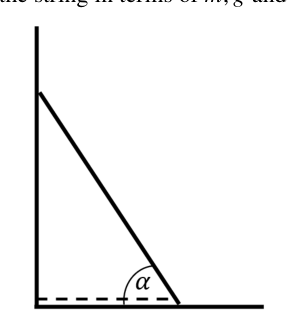 Plank leaning on wall held by string
Topic: Rigid Body Statics Metodi: Torque & Angular Momentum Analysis, Free-Body Diagram Competenze: Mathematical Modeling, Physical Reasoning Objects: Rod, String Fonte: Testo (PDF) — p.3
Una tavola uniforme di massa si trova su un pavimento liscio e si appoggia a una parete liscia in un angolo orizzontale. È tenuto in posizione da una corda orizzontale attaccata alla parte inferiore della scala e alla parte inferiore del muro, come mostrato alla figura. 1.
Qual è la tensione, , nella stringa in termini di , e ?
Planco appoggiato alla parete sostenuta da una corda
Topic: Rigid Body Statics Metodi: Torque & Angular Momentum Analysis, Free-Body Diagram Competenze: Mathematical Modeling, Physical Reasoning Objects: Rod, String Fonte: Testo (PDF) — p.3
An object falls under gravity. The ratio of the distance fallen by the object in the last second of its fall to the distance covered in the last but one second of its fall is 3 : 2.
(i) Find the height from which the object fell, and
(ii) The speed at which it hit the ground.
Topic: Newtonian Mechanics Metodi: Kinematic Equations Competenze: Mathematical Modeling, Physical Reasoning Objects: — Fonte: Testo (PDF) — p.4
Un oggetto cade sotto la gravità. Il rapporto tra la distanza percorruta dall’oggetto nell’ultimo secondo della sua caduta e la distanza percorsa nell’ultimo secondo della sua caduta è di 3 : 2.
(i) Indicare l’altezza da cui l’oggetto è caduto, e
- la velocità con cui ha colpito il terreno.
Topic: Newtonian Mechanics Metodi: Kinematic Equations Competenze: Mathematical Modeling, Physical Reasoning Objects: — Fonte: Testo (PDF) — p.4
A mass is suspended from a horizontal rod by two identical wires of negligible weight, each at angle to the vertical when attached to points A and B on the rod as shown in Fig. 2. The tension in each wire is .
(i) Obtain an expression for , the tension in each wire, in terms of and .
(ii) The wire BC is now cut. At the same instant the tension in wire AC, , will change as the system is now in motion. What is the ratio ?
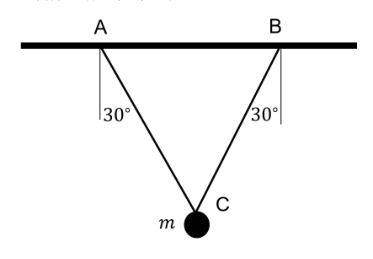 Mass suspended from two wires at 30°
Topic: Newtonian Mechanics, Rotational Dynamics Metodi: Free-Body Diagram, Torque & Angular Momentum Analysis Competenze: Mathematical Modeling, Physical Reasoning Objects: Rod, String, Block Fonte: Testo (PDF) — p.4
Una massa è sospesa da una canna orizzontale da due fili identici di peso trascurabile, ognuno all’angolo verso la verticale quando è attaccato ai punti A e B della canna come mostrato nella figura. 2. La tensione di ciascun filo è .
(i) Ottenere un’espressione per , la tensione in ciascun filo, in termini di e .
(ii) Il filo BC è ora tagliato. Allo stesso momento la tensione del filo AC, , cambierà mentre il sistema è in movimento. Qual è il rapporto ?
Massa sospesa da due fili a 30°
Topic: Newtonian Mechanics, Rotational Dynamics Metodi: Free-Body Diagram, Torque & Angular Momentum Analysis Competenze: Mathematical Modeling, Physical Reasoning Objects: Rod, String, Block Fonte: Testo (PDF) — p.4
The resistance of a copper wire 1 m long with a mass of 1 g is 0.15 Ω. Find the length of a wire of the same material with a mass of 1000 kg and a resistance of 6000 Ω.
Topic: Circuits Metodi: Dimensional Analysis, Physical Modeling Competenze: Mathematical Modeling, Physical Reasoning Objects: Wire Fonte: Testo (PDF) — p.4
La resistenza di un filo di rame lungo 1 m e di massa di 1 g è di 0,15 Ω. Trova la lunghezza di un filo dello stesso materiale con una massa di 1000 kg e una resistenza di 6000 Ω.
Topic: Circuits Metodi: Dimensional Analysis, Physical Modeling Competenze: Mathematical Modeling, Physical Reasoning Objects: Wire Fonte: Testo (PDF) — p.4
A glass block, with a reflecting lower surface, is shaped as a rectangular slab but whose left and right sides are curved in the shape of quarter circles of radius , as shown in Fig. 3. A ray of light enters horizontally from the left and passes out through the right side of the block at the same height above the base. The length of the top plane surface is .
If the depth of the block is 2.0 cm and the refractive index , what would be the minimum value of to satisfy this situation?
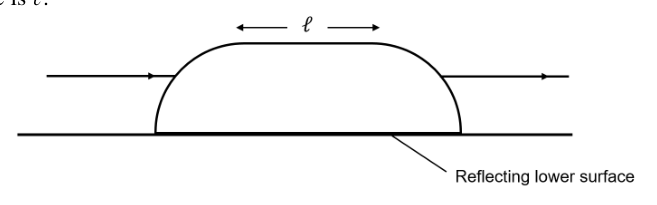 Light passing through curved glass block
Topic: Geometric Optics Metodi: Snell’s Law, Ray Tracing Competenze: Mathematical Modeling, Physical Reasoning Objects: — Fonte: Testo (PDF) — p.4
Un blocco di vetro, con una superficie inferiore riflettente, è formato come una lastra rettangolare, ma i cui lati sinistri e destri sono curvi a forma di quarti cerchi di raggio , come mostrato nella figura. 3. Un raggio di luce entra orizzontalmente da sinistra e passa attraverso il lato destro del blocco alla stessa altezza sopra la base. La lunghezza della superficie del piano superiore è .
Se la profondità del blocco è di 2,0 cm e l’indice di rifrazione , quale sarebbe il valore minimo di per soddisfare questa situazione?
Lumina che passa attraverso un blocco di vetro curvo
Topic: Geometric Optics Metodi: Snell’s Law, Ray Tracing Competenze: Mathematical Modeling, Physical Reasoning Objects: — Fonte: Testo (PDF) — p.4
An 8 W beam of light is shone on a surface at normal incidence. The surface reflects 50% of the incident light and absorbs the other 50%.
(i) What is the average force exerted on the surface by the radiation?
Hint: the momentum of a photon, , is given by its energy, , divided by the speed of light, : i.e.
(ii) The average wavelength of the light is 600 nm and the beam covers an area of 12 cm when it is incident on the surface. Calculate the volume density of photons in the beam.
Topic: Modern-Quantum Physics, Wave Optics Metodi: Photon Energy Relation, Physical Modeling Competenze: Mathematical Modeling, Physical Reasoning Objects: Photon Fonte: Testo (PDF) — p.5
Un raggio di luce di 8 W viene illuminato su una superficie con una frequenza normale. La superficie riflette il 50% della luce incidente e assorbe l’altro 50%.
(i) Qual è la forza media esercitata sulla superficie dalla radiazione?
**Insigna: ** il momento di un fotone, , è dato dalla sua energia, , divisa dalla velocità della luce, : cioè
(ii) The average wavelength of the light is 600 nm and the beam covers an area of 12 cm when it is incident on the surface. Calcolare la densità di volume dei fotoni nel raggio.
Topic: Modern-Quantum Physics, Wave Optics Metodi: Photon Energy Relation, Physical Modeling Competenze: Mathematical Modeling, Physical Reasoning Objects: Photon Fonte: Testo (PDF) — p.5
A short pulse of neutrons is fired through a vacuum at a target. If the bunch of neutrons is travelling at a speed m s and the half life of a neutron is 880 s, how many neutrons will decay whilst travelling a distance of 11 m towards the target?
Topic: Nuclear & Particle Physics Metodi: Radioactive Decay Law Competenze: Mathematical Modeling, Physical Reasoning Objects: Particle Beam Fonte: Testo (PDF) — p.5
Un breve impulso di neutroni viene sparato attraverso un vuoto verso un bersaglio. Se il gruppo di neutroni viaggia a una velocità m s e la durata di mezza vita di un neutrone è di 880 s, quanti neutroni decaderanno mentre viaggeranno a una distanza di 11 m verso l’obiettivo?
Topic: Nuclear & Particle Physics Metodi: Radioactive Decay Law Competenze: Mathematical Modeling, Physical Reasoning Objects: Particle Beam Fonte: Testo (PDF) — p.5
A smoothly hinged rod of mass rests, at angle to the vertical, on a smooth cylinder of radius which sits on the floor. The hinge is set on a vertical wall at a height of above the floor, and the lower end of the rod is at a height above the ground when the cylinder is in the corner of the wall and the floor, as shown in Fig. 4.
(i) Determine the value of .
It may help to know the identity: .
(ii) What is the length of the rod in terms of ? Give your answer as a fraction.
(iii) A light horizontal thread is attached to the rightmost point on the surface of the cylinder and it is pulled slowly to the right until the tension in the thread reduces to zero. What is the minimum amount of work that needs to be done by the thread?
(iv) As the cylinder is pulled away from the wall, the angle increases from its minimum value , which is illustrated in Fig. 4, to its maximum value , before decreasing again. What is the ratio ?
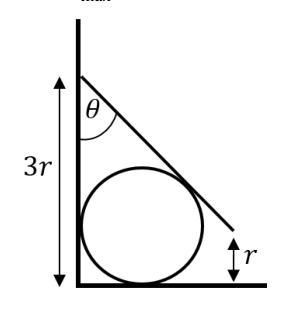 Hinged rod resting on cylinder near wall
Topic: Rigid Body Statics, Newtonian Mechanics Metodi: Torque & Angular Momentum Analysis, Free-Body Diagram, Conservation of Energy Competenze: Mathematical Modeling, Physical Reasoning Objects: Rod, Cylinder, String Fonte: Testo (PDF) — p.5
Una barra a bisaglio liscia di massa si posa, all’angolo verso la verticale, su un cilindro liscio di raggio che si trova sul pavimento. La cerniera è montata su un muro verticale ad un’altezza sopra il pavimento e l’estremità inferiore della canna è ad un’altezza sopra il terreno quando il cilindro è all’angolo del muro e del pavimento, come mostrato nella figura. 4.
- Determinare il valore di .
Potrebbe essere utile conoscere l’ identità: .
(ii) Qual è la lunghezza della canna in termini di ? Di’ la tua risposta in frazione.
(iii) Un filo orizzontale leggero è attaccato al punto più a destra della superficie del cilindro e viene tirato lentamente a destra fino a quando la tensione del filo si riduce a zero. Qual è la quantità minima di lavoro che deve essere fatto dal filo?
(iv) Quando il cilindro viene allontanato dal muro, l’angolo aumenta dal suo valore minimo , che è illustrato nella figura. 4, fino al suo valore massimo , prima di diminuire di nuovo. Qual è il rapporto ?
Stocca incrociata appoggiata su cilindro vicino al muro
Topic: Rigid Body Statics, Newtonian Mechanics Metodi: Torque & Angular Momentum Analysis, Free-Body Diagram, Conservation of Energy Competenze: Mathematical Modeling, Physical Reasoning Objects: Rod, Cylinder, String Fonte: Testo (PDF) — p.5
An object of mass slides down the smooth sloping surface of a wedge of mass , as shown in Fig. 5. The angle of the slope is to the horizontal. The wedge sits on a smooth horizontal surface.
(i) Mark on the forces on two free-body diagrams.
The block’s acceleration can be resolved into two components; one is down the slope, which would be the case if the wedge was fixed, and a second horizontal component so that it remains in contact with the accelerating wedge.
(ii) Resolve the forces on the sliding object normal to the slope.
(iii) Hence or otherwise, obtain an expression for the acceleration of the wedge in terms of , and .
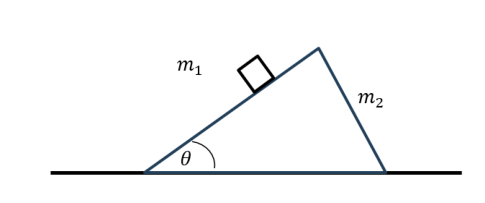 Block sliding on movable wedge
Topic: Newtonian Mechanics Metodi: Free-Body Diagram, Vector Decomposition, Conservation of Momentum Competenze: Mathematical Modeling, Diagrammatic Reasoning Objects: Block, Wedge Fonte: Testo (PDF) — p.6
Un oggetto di massa scivola giù sulla superficie liscia inclinata di un’anello di massa , come mostrato nella figura. 5. L’angolo della pendenza è verso l’orizzontale. La cunecca si trova su una superficie orizzontale liscia.
(i) Marcare le forze su due diagrammi di corpi liberi.
L’accelerazione del blocco può essere suddivisa in due componenti: una è in pendice, come sarebbe stato il caso se la ciglia fosse fissata, e una seconda componente orizzontale in modo che rimanga in contatto con la ciglia in accelerazione.
- risolvere le forze sull’oggetto scivolante normali alla pendenza.
(iii) In questo modo o in altro modo, ottenere un’espressione per l’accelerazione della cucina in termini di , e .
Slider di blocco su un’anello mobile
Topic: Newtonian Mechanics Metodi: Free-Body Diagram, Vector Decomposition, Conservation of Momentum Competenze: Mathematical Modeling, Diagrammatic Reasoning Objects: Block, Wedge Fonte: Testo (PDF) — p.6
Two ships, A and B spot each other at the moment ship B is due south of A with a range of 2.0 nautical miles. Ship A is travelling on a bearing 090° at 5.0 knots, and ship B on a bearing of 030° at 20 knots. What is their distance of closest approach?
1 knot = 1 nautical mile per hour.
A bearing is an angle measured clockwise from 0° as due north.
Topic: Newtonian Mechanics Metodi: Vector Decomposition, Kinematic Equations Competenze: Mathematical Modeling, Physical Reasoning Objects: — Fonte: Testo (PDF) — p.6
Due navi, A e B si trovano l’una l’altra nel momento in cui la nave B si dirige a sud di A con un raggio di 2,0 miglia nautiche. La nave A si sta muovendo su un cuscinetto 090° a 5,0 nodi e la nave B su un cuscinetto 030° a 20 nodi. Qual è la distanza di avvicinamento più vicina?
1 nodo = 1 miglio nautico all’ora.
Un cuscinetto è un angolo misurato in senso orario da 0° a nord.
Topic: Newtonian Mechanics Metodi: Vector Decomposition, Kinematic Equations Competenze: Mathematical Modeling, Physical Reasoning Objects: — Fonte: Testo (PDF) — p.6
A steel tube of 4.0 cm internal diameter and 30 cm long, with a wall 0.25 cm thick, is covered externally and lined internally with copper tubes 0.20 cm thick. The three concentric tubes are firmly connected. This compound tube is placed under tension by a load and the stress produced equals N m. Determine
(i) The extension of the tube
(ii) The stress in the copper tubes
(iii) The load carried by the compound tube
Young’s Moduli: Steel 200 GPa; Copper 110 GPa
Topic: Elasticity & Materials Metodi: Stress-Strain Analysis, Physical Modeling Competenze: Mathematical Modeling, Physical Reasoning Objects: Tube Fonte: Testo (PDF) — p.6
Un tubo di acciaio di diametro interno di 4,0 cm e lunghezza di 30 cm, con una parete di 0,25 cm di spessore, è coperto esternamente e rivestito internamente da tubi di rame di 0,20 cm di spessore. I tre tubi concentrici sono saldamente collegati. Questo tubo composto viene messo sotto tensione da un carico e la tensione prodotta è uguale a N m. Determinazione
-
L’estensione del tubo
-
La tensione nei tubi di rame
-
il carico trasportato dal tubo composto
Moduli di Young: acciaio 200 GPa; rame 110 GPa
Topic: Elasticity & Materials Metodi: Stress-Strain Analysis, Physical Modeling Competenze: Mathematical Modeling, Physical Reasoning Objects: Tube Fonte: Testo (PDF) — p.6
A thin wire of mass g and length m is stretched to a tension between two fixed supports. The wire is excited so that the third harmonic standing wave is formed of maximum amplitude . In such a wire, the total KE and elastic PE are equal. The tension is N and cm.
(i) Sketch a graph of the maximum kinetic energy of the particles in the wire against their position along the length of the wire in the range 0 to . Draw a line on your graph to show the total energy of the particles along the wire from 0 to .
(ii) Calculate the frequency of vibration of the wire.
(iii) Calculate the total energy due to the vibration of the wire.
Hint: The speed of a wave in a stretched wire is given by where is the mass per unit length of the wire.
Topic: Oscillations & Waves Metodi: Wave Equation, Simple Harmonic Motion Analysis Competenze: Mathematical Modeling, Physical Reasoning Objects: Wire Fonte: Testo (PDF) — p.7
Un filo sottile di massa g e lunghezza m è allungato fino a una tensione tra due supporti fissi. Il filo è eccitato in modo che la terza onda armonica in piedi si forma con l’ampiezza massima . In tale filo, il totale KE e l’Elastic PE sono uguali. La tensione è N e cm.
(i) Segnare un grafico dell’energia cinetica massima delle particelle del filo contro la loro posizione lungo la lunghezza del filo nell’intervallo da 0 a . Disegna una linea sul grafico per mostrare l’energia totale delle particelle lungo il filo da 0 a .
- Calcolare la frequenza di vibrazione del filo.
(iii) Calcolare l’energia totale dovuta alle vibrazioni del filo.
Signal: La velocità di un’onda in un filo allungato è data da dove è la massa per unità di lunghezza del filo.
Topic: Oscillations & Waves Metodi: Wave Equation, Simple Harmonic Motion Analysis Competenze: Mathematical Modeling, Physical Reasoning Objects: Wire Fonte: Testo (PDF) — p.7
A cell of emf with an internal resistance is connected across two resistors and in parallel, as in Fig. 6. Resistor is variable, whilst is fixed.
Obtain expressions for
(i) the current flowing through the cell in terms of , , , ,
(ii) the current flowing through in terms of , , ,
(iii) the power converted in in terms of , , , .
(iv) By considering the term or otherwise, determine an expression for in terms of and such that the power converted in is a maximum.
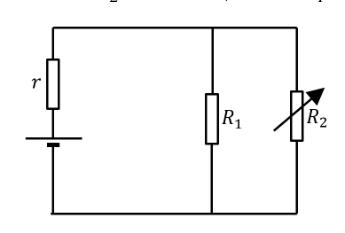 Parallel resistors with variable R2 and cell
Topic: Circuits Metodi: Kirchhoff’s Laws, Equivalent Circuit Reduction Competenze: Mathematical Modeling, Physical Reasoning Objects: Battery, Resistor Fonte: Testo (PDF) — p.7
Una cella di emf con resistenza interna è collegata in parallelo attraverso due resistori e , come in Figura. 6. Il resistore è variabile, mentre è fisso.
Ottenere espressioni per
(i) la corrente che scorre attraverso la cella in termini di , , , ,
(ii) la corrente che scorre attraverso in termini di , , ,
(iii) la potenza convertita in in termini di , , , .
(iv) Considerando il termine o altrimenti, determinare un’espressione per in termini di e tale che la potenza convertita in sia massima.
Resistenze parallele con variabile R2 e cellula
Topic: Circuits Metodi: Kirchhoff’s Laws, Equivalent Circuit Reduction Competenze: Mathematical Modeling, Physical Reasoning Objects: Battery, Resistor Fonte: Testo (PDF) — p.7
Three capacitors, , and are shown connected to a pair of cells of emfs and as shown in Fig. 7. Obtain an expression in terms of the capacitor values and the emfs for the potential across .
It is important that you write down your initial equations clearly.
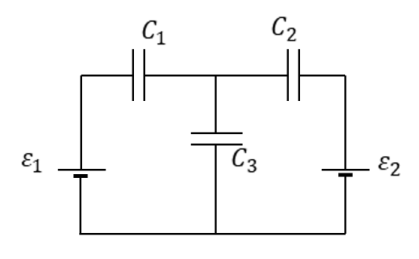 Three capacitors and two cells circuit
Topic: Circuits, Electrostatics Metodi: Kirchhoff’s Laws, Electric Potential Method Competenze: Mathematical Modeling, Physical Reasoning Objects: Capacitor, Battery Fonte: Testo (PDF) — p.8
Tre condensatori, , e , sono mostrati collegati a una coppia di celle di emfs e come mostrato nella figura. 7. Ottenere un’espressione in termini di valori del condensatore e emfs per il potenziale attraverso .
È importante che tu scriva chiaramente le tue equazioni iniziali.
Tre condensatori e due circuiti a celle
Topic: Circuits, Electrostatics Metodi: Kirchhoff’s Laws, Electric Potential Method Competenze: Mathematical Modeling, Physical Reasoning Objects: Capacitor, Battery Fonte: Testo (PDF) — p.8
A uniform rod, of length , floats partly immersed in a liquid, being supported by a string fastened to one of its ends, the other end of the string being attached to a fixed point A, as in Fig. 8. The density of the liquid is a factor 4/3 times that of the rod. Determine
(i) the fraction of the rod’s length that will be submerged, and
(ii) the tension, in the string.
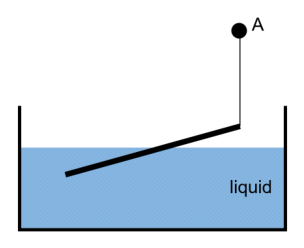 Uniform rod floating partly immersed in liquid
Topic: Fluid Mechanics, Rigid Body Statics Metodi: Hydrostatic Equilibrium, Torque & Angular Momentum Analysis, Free-Body Diagram Competenze: Mathematical Modeling, Physical Reasoning Objects: Rod, String Fonte: Testo (PDF) — p.8
Una canna uniforme, di lunghezza , galleggia in parte immersa in un liquido, sostenuta da una corda fissata ad una delle sue estremità, con l’altra estremità della corda fissata a un punto fisso A, come riportato in Figura. 8. La densità del liquido è di 4/3 volte quella della canna. Determinazione
-
la frazione della lunghezza della canna che verrà immersa;
-
la tensione, nella corda.
Rasta uniforme galleggiante parzialmente immersa in liquido
Topic: Fluid Mechanics, Rigid Body Statics Metodi: Hydrostatic Equilibrium, Torque & Angular Momentum Analysis, Free-Body Diagram Competenze: Mathematical Modeling, Physical Reasoning Objects: Rod, String Fonte: Testo (PDF) — p.8
Two balls A and B of masses and volumes , and , respectively are attached to the ends of a light thread. The thread is hung over a freely moving pulley above a beaker of water. The pulley is lowered so that B is fully submerged and ball A floats on the water.
cm, g, cm and g.
(i) Sketch a diagram showing the forces on each object in the system.
(ii) What fraction of the volume of A is submerged below the water surface?
Suppose that a short section of the thread is replaced by a spring of negligible mass of spring constant N m.
(iii) By how much is the spring extended?
Density of water g cm
Topic: Fluid Mechanics, Newtonian Mechanics Metodi: Hydrostatic Equilibrium, Free-Body Diagram, Hooke’s Law Competenze: Mathematical Modeling, Diagrammatic Reasoning Objects: Ball, String, Pulley, Spring, Container Fonte: Testo (PDF) — p.8
Due sfere A e B di massa e volume , e , , rispettivamente, sono attaccate alle estremità di un filo leggero. Il filo è appeso su una polla che si muove liberamente sopra un bicchiere d’acqua. La pollice viene abbassata in modo che B sia completamente sommersa e la palla A galleggi su acqua.
cm, g, cm e g.
(i) Segnare un diagramma che mostra le forze su ogni oggetto del sistema.
(ii) Quale frazione del volume di A è immersa sotto la superficie dell’acqua?
Supponiamo che una sezione corta del filo sia sostituita da una molla di massa trascurabile di costante molla N m.
(iii) Quanto è prolungata la primavera?
Densità dell’acqua g cm
Topic: Fluid Mechanics, Newtonian Mechanics Metodi: Hydrostatic Equilibrium, Free-Body Diagram, Hooke’s Law Competenze: Mathematical Modeling, Diagrammatic Reasoning Objects: Ball, String, Pulley, Spring, Container Fonte: Testo (PDF) — p.8
A vertical wooden pole with a circular cross section of diameter 30 cm has its footing embedded in a concrete block. A loose steel guy wire, A, is fixed to the ground a distance m from the base of the pole, and is attached to the pole at a height m above the ground. It is subject to a pull to the right by tension in a cable, attached at the same height, as shown in Fig. 9. This causes the wooden pole to bend a small amount to the right in the arc of a circle of radius with . The loose steel guy wire, A, then becomes tight and prevents the pole from bending any further. The bent pole stretches on one side and compresses on the other, with a neutral line down the centre of the pole. The pole has a maximum stress of 4000 N m at one side when bent.
(i) Calculate radius and the angle of the circular arc formed by the bent pole when the neutral line remains unstressed.
(ii) Draw a diagram to show how this angle can be used to calculate the length of the guy wire, A, when it is tight.
(iii) Calculate an approximate value for the length of slack in the guy wire when the pole is unloaded and straight and vertical.
You may assume that the bend is small enough so that the height of the pole when bent is not changed significantly. Young’s modulus for wood is 14 GPa.
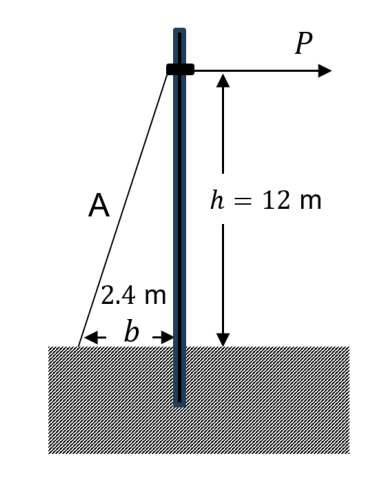 Wooden pole bending with guy wire A
Topic: Elasticity & Materials, Rigid Body Statics Metodi: Stress-Strain Analysis, Small-Angle Approximation, Physical Modeling Competenze: Mathematical Modeling, Physical Reasoning Objects: Rod, Wire Fonte: Testo (PDF) — p.9
Un palo di legno verticale con un tratto incrocio circolare di diametro 30 cm ha il suo fondamento incorporato in un blocco di cemento. Un filo di acciaio a pieghe, A, è fissato al suolo a una distanza m dalla base del polo e è attaccato al polo ad un’altezza m sopra il terreno. È soggetta a un’attrazione a destra da tensione in un cavo, collegato alla stessa altezza, come mostrato alla figura. 9. Questo fa sì che il palo di legno si piega un po’ a destra nell’arco di un cerchio di raggio con . Il filo di tipo di acciaio, A, diventa stretto e impedisce che il palo si piega ulteriormente. Il polo piegato si estende da un lato e si comprime dall’altro, con una linea neutrale nel centro del polo. Il polo ha una tensione massima di 4000 N m su un lato quando si piega.
(i) Calcolare il raggio e l’angolo dell’arco circolare formato dal polo piegato quando la linea neutrale rimane senza pressione.
(ii) Disegnare un diagramma che mostra come questo angolo può essere utilizzato per calcolare la lunghezza del filo di tipo A, quando è stretto.
(iii) Calcolare un valore approssimativo della lunghezza della mancia nel filo di mancia quando il polo è scaricato e retto e verticale.
Si può presumere che la curva sia abbastanza piccola da non cambiare significativamente l’altezza del polo quando si curva. Il modulo di Young per il legno è di 14 GPa.
*Polo di legno piegatura con filo di uomo A *
Topic: Elasticity & Materials, Rigid Body Statics Metodi: Stress-Strain Analysis, Small-Angle Approximation, Physical Modeling Competenze: Mathematical Modeling, Physical Reasoning Objects: Rod, Wire Fonte: Testo (PDF) — p.9