Question 2 — This question is about wind turbines.
a) Assuming a wind direction perpendicular to the plane of the turbine blades, determine the power if all of the kinetic energy of the wind is transferred to the blades, in terms of the density of the air , the length of the turbine blades , and the wind speed .
b) In reality, not all of the power of the wind is extracted. The wind speed is slower behind the turbine, and the wind can be imagined to disperse over a larger area as shown in Figure 2, where shows the area swept out by the turbine. This question will attempt a more realistic model of the energy transfers in a wind turbine. Assume the density of the air remains constant.
(i) Write down expressions for the rate of flow of air mass in region (i).
(ii) Write down expressions for the rate of flow of air mass in region (ii).
(iii) Write down expressions for the rate of flow of air mass in region (iii).
(iv) By considering the air before entry and after entry to the turbine, determine the power output of the turbine in terms of , , , and .
(v) If we now assume that equals the mean of and , write down an expression for the power output of the turbine in terms of , , and only.
(vi) Determine the value of which gives a maximum in the output of the turbine.
(vii) Determine the maximum power output of the turbine in terms of , and the prevailing wind speed .
(viii) The newest off-shore wind turbines in the North Sea have a blade length of 107 m, and the average wind speed is . Calculate the maximum possible power output from this turbine.
c) The electrical power from the wind farm is transferred to the shore using High Voltage Direct Current (HVDC) at 320 kV with respect to earth. The cable used to transfer the power will typically consist of a 2.2 cm radius copper core, surrounded by cross-linked polyethylene (XLPE) insulation of radius 4.0 cm which itself is surrounded by a protective metal screen. The greatest length in a North Sea project will be 265 km. The resistivity of copper is and of XLPE is .
(i) Calculate the resistance of the copper core and the power dissipated as heat, and percentage loss in the copper, if the cable transfers 800 MW of power.
(ii) Calculate the resistance of the XLPE insulation between the copper core and the metal screen, and hence calculate the leakage current, power and percentage loss due to the leakage current, when operating at 320 kV.
(iii) The thermal conductivity of XLPE . Assuming the temperature drop across all thermal barriers except the XLPE is negligible, calculate the operating temperature of the copper core at 800 MW given the ambient sea temperature is .
d) High current rectification (ac to dc conversion), and inversion (dc to ac conversion) was until relatively recently achieved using a device called a mercury arc valve. The principle of operation is that the mercury vapour at low pressure (7.0 mPa and ) becomes ionised and the ions collide with the mercury liquid which liberates electrons. These then become available to carry the current to the carbon anode, and also via collision with atoms of mercury vapour produce mercury ions to replace those reabsorbed into the liquid phase. There is no appreciable electron emission from the carbon anode and so the current flows in one direction only in the manner of a diode.
(i) Estimate the forward bias potential of this “diode”.
(ii) Inserting a grid between the anode and the mercury cathode allows the electron current to be modulated and thus an ac current produced from a dc supply. The anode current is given by , and , that is a constant bias and an oscillatory signal. The anode current contains a second harmonic component. Determine its amplitude.
(iii) The mean value of the anode current contains a term proportional to . Obtain the coefficient of this term.
(iv) If is the value of when and, when the signal is applied, oscillates between and , express the ratio of the amplitudes of the second harmonic and fundamental (1st harmonic) in terms of the quantity , which is defined as Hint: a useful identity is .
[25 marks]
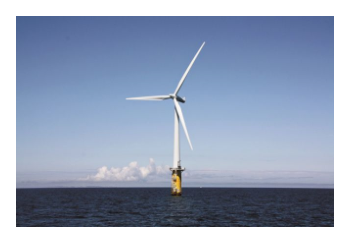 Offshore wind turbine photo
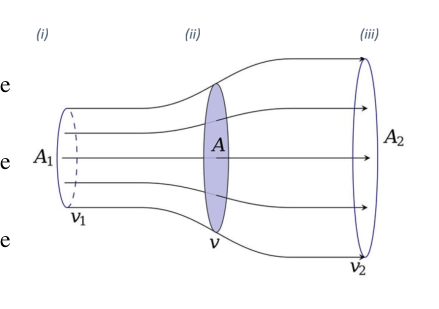 Air flow regions through turbine
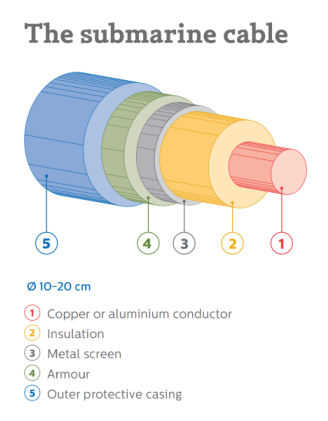 High voltage cable cross-section structure
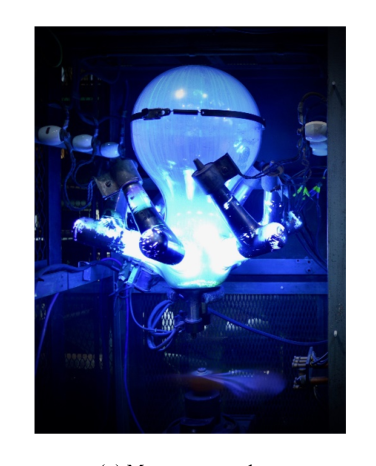 Mercury arc valve device photo
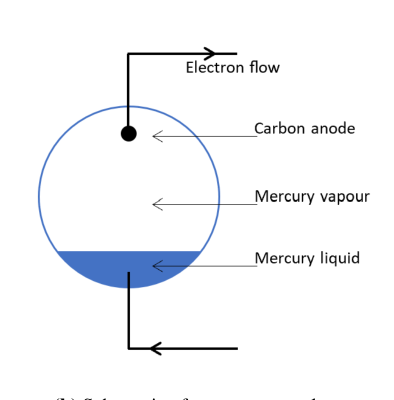 Schematic of mercury arc valve
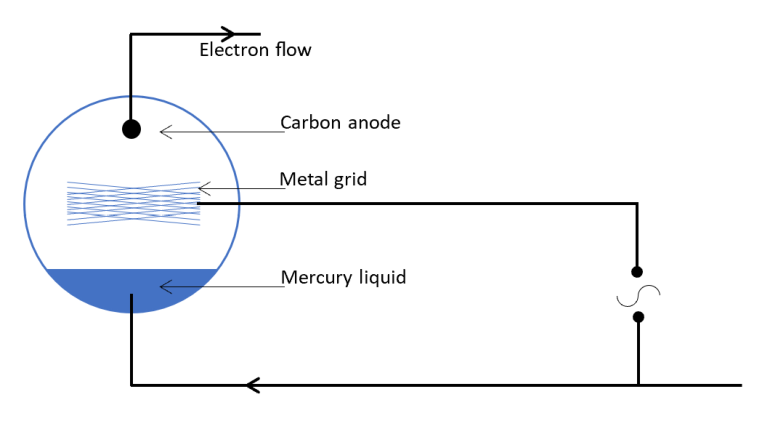 Mercury arc valve circuit diagram
Topic: Fluid Mechanics, Circuits, Thermodynamics Metodi: Continuity Equation, Conservation of Momentum, Kirchhoff’s Laws, Dimensional Analysis Competenze: Mathematical Modeling, Physical Reasoning Objects: Wheel, Wire, Tube, Gas Fonte: Testo (PDF) — p.3
La domanda 2 riguarda le turbine eoliche.
a) Sulla base di una direzione del vento perpendicolare al piano delle lame di turbina, determinare la potenza se tutta l’energia cinetica del vento viene trasferita alle lame, in termini di densità dell’aria , lunghezza delle lame di turbina e velocità del vento .
b) In realtà non si estrae tutta la potenza del vento. La velocità del vento è più lenta dietro la turbina e si può immaginare che il vento si disperda su una superficie più ampia come mostrato nella figura 2, dove mostra l’area spazzata via dalla turbina. Questa domanda tenterà di trovare un modello più realistico dei trasferimenti di energia in una turbina eolica. Supponiamo che la densità dell’aria rimanga costante.
(i) Scrivere espressioni per il tasso di flusso di massa dell’aria nella regione (i).
(ii) Scrivere espressioni per il tasso di flusso di massa dell’aria nella regione (ii).
(iii) Scrivere espressioni per il tasso di flusso di massa dell’aria nella regione (iii).
iv) Considerando l’aria prima e dopo l’ingresso nella turbina, determinare la potenza di uscita della turbina in termini di , , , e .
(v) Se supponiamo che sia uguale alla media di e , annotate un’espressione per la potenza di uscita della turbina in termini di , , e solo.
- Determinare il valore di che dà un massimo di potenza della turbina.
(vii) Determinare la potenza massima di uscita della turbina in termini di , e della velocità del vento prevalente .
(viii) Le più recenti turbine eoliche offshore del Mar del Nord hanno una lunghezza di lamina di 107 m e la velocità media del vento è . Calcolare la potenza massima possibile di uscita di questa turbina.
c) L’energia elettrica del parco eolico viene trasferita sulla riva utilizzando corrente diretta ad alta tensione (HVDC) a 320 kV rispetto alla terra. Il cavo utilizzato per il trasferimento di potenza sarà tipicamente costituito da un nucleo di rame di 2,2 cm di raggio, circondato da un isolamento di polietilene (XLPE) di raggio di 4,0 cm di raggio, che è circondato da uno schermo metallico protettivo. La lunghezza massima di un progetto sul Mar del Nord sarà di 265 km. La resistività del rame è e della XLPE è .
(i) Calcolare la resistenza del nucleo di rame e la potenza dissipata come calore e la perdita percentuale nel rame, se il cavo trasmette 800 MW di potenza.
-
Calcolare la resistenza dell’isolamento XLPE tra il nucleo di rame e la tela metallica e quindi calcolare la corrente di perdita, la potenza e la perdita percentuale dovuta alla corrente di perdita, quando si agisce a 320 kV.
-
La conducibilità termica di XLPE . Supponendo che la diminuzione della temperatura su tutte le barriere termiche, tranne la XLPE, sia trascurabile, calcolare la temperatura di funzionamento del nucleo di rame a 800 MW data la temperatura ambientale del mare .
d) La rettificazione ad alta corrente (conversione ac a dc) e l’inversione (conversione ac a dc) sono state raggiunte fino a tempi relativamente recenti con un dispositivo chiamato valvola a arco di mercurio. Il principio di funzionamento è che il vapore di mercurio a bassa pressione (7,0 mPa e ) si ionizza e gli ioni si schiantano con il liquido di mercurio che libera gli elettroni. Questi poi diventano disponibili per trasportare la corrente all’anodo di carbonio, e anche attraverso la collisione con atomi di vapore di mercurio producono ioni di mercurio per sostituire quelli riassorbiti nella fase liquida. Non vi è alcuna emissione di elettroni apprezzabile dall’anodo di carbonio e quindi la corrente scorre in una direzione solo come un diodo.
(i) Estimare il potenziale di bias in avanti di questo “diodo”.
- inserire una griglia tra l’anodo e il catodo di mercurio permette di modulare la corrente elettronica e quindi una corrente ac prodotta da un’alimentazione di corrente continua. La corrente anodica è data da e , cioè un bias costante e un segnale oscillatorio. La corrente anodica contiene una seconda componente armonica. Determina la sua amplitudine.
(iii) Il valore medio della corrente anodica contiene un termine proporzionale a . Ottieni il coefficiente di questo termine.
(iv) Se è il valore di quando e, quando viene applicato il segnale, oscilla tra e , esprimere il rapporto delle amplitudini della seconda armonica e della prima armonica fondamentale in termini di quantità , che è definito come Suggerimento: un’identità utile è .
[25 punti]
Foto di turbine eoliche offshore
Regioni di flusso d’aria attraverso la turbina
Struttura di sezione trasversale del cavo ad alta tensione
Foto del dispositivo di valvola a arco di mercurio
Schematic di valvola a arco di mercurio
*Diagramma di circuito di valvole a arco di mercurio *
Topic: Fluid Mechanics, Circuits, Thermodynamics Metodi: Continuity Equation, Conservation of Momentum, Kirchhoff’s Laws, Dimensional Analysis Competenze: Mathematical Modeling, Physical Reasoning Objects: Wheel, Wire, Tube, Gas Fonte: Testo (PDF) — p.3
Question 3 — This question is about hot air balloons.
a) A hot air balloon rises when the upthrust is greater than its total weight. Calculate the volume of hot air required to lift a balloon with a combined mass of 200 kg for the balloon and basket. You should include the mass of the hot air, which has a density of , in the total weight of the balloon. The density of the cold air surrounding the balloon is .
b) In 1783, the Montgolfier brothers’ hot air balloon freely ascended, but remained at a low height. The balloon had a volume of about , and a lifting capacity including its own weight of 830 kg. The air inside the balloon was heated by a fire in a basket below. Estimate the temperature of the air in the balloon. Air density at ground level is . Surface atmospheric pressure is . The molar mass of air .
c) Charles’ and the Robert brothers’ balloon flew not long after but was filled with hydrogen. The balloon had a capacity of and was filled on the ground at a sea level pressure of , and temperature of 288 K.
(i) Calculate the mass of hydrogen in the balloon.
(ii) The balloon was constructed of a single lamina of rubberised silk with a thickness 0.43 mm. The silk cloth has a mass per unit area of and a density of . Rubber has a density of . Assuming the balloon is spherical, calculate the mass of the balloon to three significant figures.
(iii) Taking the mass of the two passengers, gondola and rigging to be 270 kg, calculate the initial acceleration of the balloon at sea level. The density of air at sea level is .
d) In an unrelated example, a balloon of mass with a small amount of ballast descends with constant velocity due to a drag force acting on the balloon. The drag force is proportional to the speed of the balloon through the air. What is the mass of ballast , expressed in terms of , that must be jettisoned from the balloon so that it rises with the same velocity ?
e) (i) Atmospheric pressure is due to the weight of air above.
i. From the hydrostatic equation, , write down an expression for . This contains both and so you need another equation to eliminate .
ii. From the ideal gas equation, obtain a relation between and , , and , the molar mass.
iii. Now using the hydrostatic equation, obtain an expression for in terms of , , , and .
iv. The temperature decreases linearly with height, in the form . Use this with the previous result to produce an expression for atmospheric pressure as a function of altitude , in terms of sea level pressure , , the molar mass of air , the molar gas constant , the air temperature at sea level , the rate of decrease of temperature with altitude and altitude . Humidity should not be considered.
(ii) In a second flight, Charles ascended to 3000 m. Calculate the ambient temperature and pressure at this altitude. Take the molar mass of air to be , and the molar gas constant to be . The rate of decrease of temperature with height is , the reference sea level temperature and the reference sea level pressure .
(iii) The balloon expands in volume by 30% at a height of 3000 m.
i. Calculate the pressure inside the balloon, assuming no hydrogen has been lost.
ii. Determine the stress in the skin of the balloon.
iii. Estimate the Young’s Modulus of the composite skin material.
[25 marks]
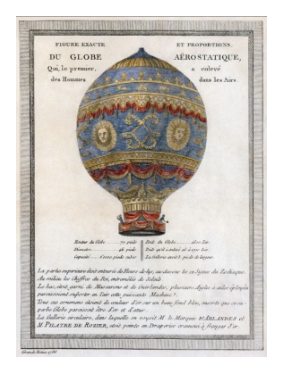 Montgolfier brothers balloon 1783
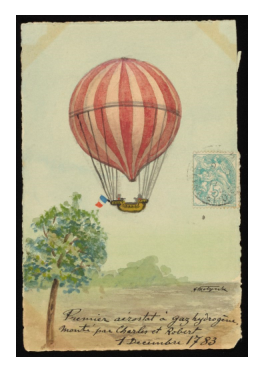 Charles and Robert hydrogen balloon
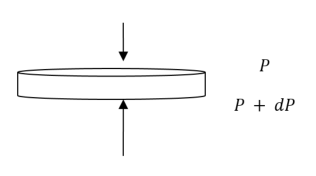 Thin disc of atmosphere pressure diagram
Topic: Fluid Mechanics, Thermodynamics, Elasticity & Materials Metodi: Hydrostatic Equilibrium, Ideal Gas Law, Bernoulli’s Equation, Differential Equations Competenze: Mathematical Modeling, Physical Reasoning Objects: Bubble, Gas Fonte: Testo (PDF) — p.6
La domanda 3 è relativa ai palloncini a caldo.
a) Un pallone a caldo si alza quando la spinta verso l’alto è superiore al suo peso totale. Calcolare il volume di aria calda necessario per sollevare un palloncino con una massa combinata di 200 kg per il palloncino e il cestino. È necessario includere la massa dell’aria calda, che ha una densità di , nel peso totale del palloncino. La densità dell’aria fredda che circonda il palloncino è .
b) Nel 1783, il pallone d’aria calda dei fratelli Montgolfier si alzò liberamente, ma rimase a bassa altezza. Il pallone aveva un volume di circa e una capacità di sollevamento che comprendeva il suo peso di 830 kg. L’aria all’interno del palloncino era riscaldata da un fuoco in un cestino sotto. Calcola la temperatura dell’aria nel palloncino. La densità dell’aria a livello del suolo è . La pressione atmosferica superficiale è . La massa molare dell’aria .
c) Il pallone di Charles e dei fratelli Robert volò poco dopo, ma era pieno di idrogeno. Il pallone aveva una capacità di e era riempito a terra a una pressione sul livello del mare di e una temperatura di 288 K.
- Calcolare la massa dell’idrogeno nel palloncino.
ii) Il pallone è stato costruito in una singola lamina di seta gommata con uno spessore di 0,43 mm. Il tessuto di seta ha una massa per unità di superficie di e una densità di . La gomma ha una densità di . Supponendo che il palloncino sia sferico, calcolare la massa del palloncino a tre cifre significative.
- Calcolare l’accelerazione iniziale del palloncino a livello del mare, tenendo conto della massa dei due passeggeri, della gondola e del rigging, a 270 kg. La densità dell’aria al livello del mare è .
d) In un esempio non correlato, un pallone di massa con una piccola quantità di ballast scende a velocità costante a causa di una forza di trazione che agisce sul pallone. La forza di trazione è proporzionale alla velocità del palloncino attraverso l’aria. Qual è la massa del ballast , espressa in , che deve essere gettato dal pallone in modo che si elevi con la stessa velocità ?
e) (i) La pressione atmosferica è dovuta al peso dell’aria sopra.
i. Dall’equazione idrostatica , scrivere un’espressione per . Questo contiene sia che quindi è necessaria un’altra equazione per eliminare .
ii. Dall’equazione ideale del gas, si ottiene una relazione tra e , , e , la massa molare.
iii. Ora, utilizzando l’equazione idrostatica, ottenere un’espressione per in termini di , , , e .
iv. La temperatura diminuisce linearmente con l’altezza, sotto forma di . Usare questo con il risultato precedente per produrre un’espressione della pressione atmosferica in funzione dell’altitudine , in termini di pressione sul livello del mare , , massa molare dell’aria , costante del gas molare , temperatura dell’aria al livello del mare , tasso di diminuzione della temperatura con altitudine e altitudine . L’umidità non deve essere presa in considerazione.
-
In un secondo volo, Carlo è salito a 3000 m. Calcolare la temperatura ambientale e la pressione a questa quota. Prendiamo la massa molare dell’aria a e la costante del gas molare a . Il tasso di diminuzione della temperatura con l’altezza è , la temperatura di riferimento del livello del mare e la pressione di riferimento del livello del mare .
-
il pallone si espandono di volume del 30% ad un’altezza di 3000 m.
i. Calcolare la pressione all’interno del palloncino, supponendo che non sia stato perso alcun idrogeno.
ii. Determina lo stress nella pelle del palloncino.
iii. Valutate il modulo del giovane del materiale composto della pelle.
[25 punti]
Balone dei fratelli Montgolfier 1783
Balone idrogeno Charles e Robert
Disco sottile di diagramma di pressione atmosferica
Topic: Fluid Mechanics, Thermodynamics, Elasticity & Materials Metodi: Hydrostatic Equilibrium, Ideal Gas Law, Bernoulli’s Equation, Differential Equations Competenze: Mathematical Modeling, Physical Reasoning Objects: Bubble, Gas Fonte: Testo (PDF) — p.6
Question 4 — This question is about orbits and satellites.
The Hope probe was launched on a journey to Mars on the 20th July 2020 with a mass of 1350 kg, including 800 kg of fuel onboard. In this problem the orbits of the planets will be assumed to be circular.
a) (i) At what distance from the centre of the Earth, with , does the gravitational field strength reduce to 1% of its value at the surface? Express this as a fraction of the radius of the Earth.
(ii) The Hope probe was launched from Tanegashima Space Centre in Japan, which lies on latitude above the equatorial plane. Calculate the tangential speed of the space centre.
(iii) Estimate the escape speed of a satellite that is launched from the surface of the Earth, with no kinetic energy contribution from Earth’s rotation, so that it completely escapes the Earth’s gravitational field.
(iv) What is the percentage reduction in energy for a satellite to escape the Earth’s gravitational field when
i. launched from Tanegashima Space Centre in Japan,
ii. it is already in a low Earth orbit (close to the surface of the Earth)?
(v) By considering the influence of the Sun only, use the idea of total energy to produce expressions for the velocity of the probe at point P (near Earth), , and at point A (near Mars), , in terms of the gravitational constant , the Solar mass , the radius of orbit of the Earth , and the radius of orbit of Mars . The trajectory of the space probe between Earth and Mars can be represented as part of an elliptical orbit about the Sun, with the Sun at one focus of the ellipse. For an elliptical orbit, , where is the displacement of the body from one focus, is the velocity vector, and is the angle between them.
(vi) Determine the difference between and the Earth’s orbital velocity , and the difference between and Mars’ orbital velocity . Thus calculate the total change in tangential velocity needed at point A to allow the probe to cruise to its meeting point with Mars; assume the probe already has sufficient kinetic energy to escape the gravitational potential well of the Earth.
(vii) Calculate the speed of the probe on close approach to Mars.
(viii) On the approach to Mars, the speed of the probe must be slowed to match the orbital speed of Mars to allow it to be captured in an orbit around the planet. This deceleration is achieved by using six thrusters expending half of the fuel over a 27 minute period. Assume the decelerating force and the rate of fuel consumption, , are constants. For the period of time in which the thrusters are in operation:
i. Sketch a graph of the variation of acceleration against time; append appropriate values to the axes.
ii. Produce an expression for the change in velocity with time in terms of the total decelerating force , the initial probe mass , the rate of fuel consumption , initial velocity and time .
iii. Calculate the force provided by each thruster.
b) The iridium satellite telephone system uses a constellation of 66 satellites orbiting at an altitude of 780 km above the surface of the Earth.
(i) Calculate the horizon radius of the area covered by any one satellite (this is the radius of a flat circle within the horizon, i.e. the radius of one of the small circles illustrated in Figure 11).
(ii) In practice, the effective radius is approximately 2350 km. The power distributed by the satellite transmitter to this area is about 200 W. Calculate the intensity of the signal at the Earth’s surface.
(iii) The movement of the satellites relative to the Earth’s surface introduces the Doppler Effect. If the wavelength of the signal from the satellite is , the speed of the satellite , and the speed of light , produce an expression for the shifted wavelength observed by the receiver as the satellite recedes.
(iv) Using a suitable approximation, provide an expression for the apparent shift in frequency, .
(v) Now consider the satellite moving above the receiver on the Earth’s surface. For the effective radius of coverage in (ii) calculate and as observed, given the transmission frequency of 1620 MHz, and thus state the bandwidth that must be set aside to manage Doppler shift.
Useful constants: , , , , , , .
[25 marks]
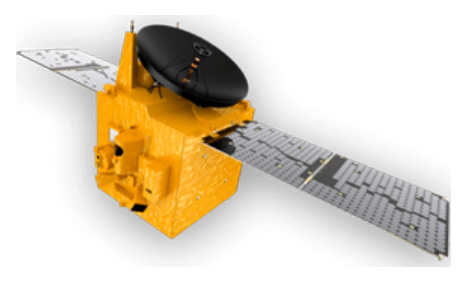 Hope probe spacecraft photo
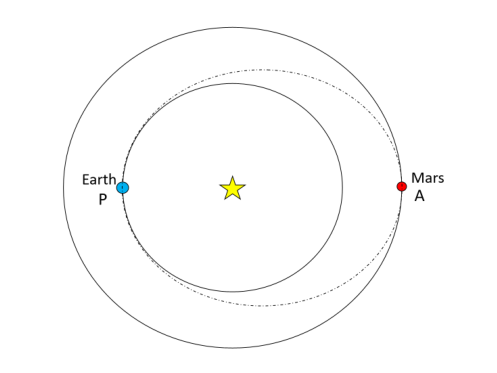 Elliptical trajectory Earth to Mars
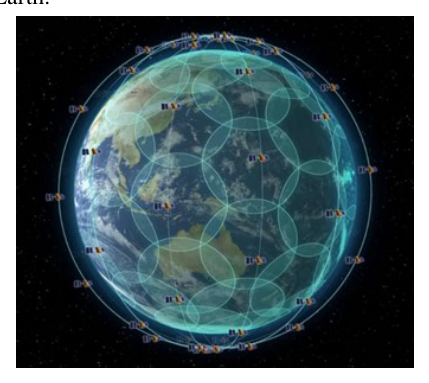 Satellite coverage circles on Earth
Topic: Gravitation, Newtonian Mechanics, Special Relativity Metodi: Newton’s Law of Gravitation, Kepler’s Laws, Conservation of Energy, Lorentz Transformation Competenze: Mathematical Modeling, Physical Reasoning Objects: Satellite, Planet, Star Fonte: Testo (PDF) — p.8
La domanda 4 riguarda orbite e satelliti.
La sonda Hope è stata lanciata in un viaggio su Marte il 20 luglio 2020 con una massa di 1350 kg, tra cui 800 kg di combustibile a bordo. In questo problema le orbite dei pianeti saranno presunte come circolari.
a) (i) A quale distanza dal centro della Terra, con , la forza del campo gravitazionale si riduce all’1% del suo valore sulla superficie? Esprimete questo come una frazione del raggio della Terra.
(ii) La sonda Hope è stata lanciata dal Tanegashima Space Center in Giappone, che si trova sulla latitudine sopra il piano equatoriale. Calcolare la velocità tangenziale del centro spaziale.
(iii) Estimare la velocità di fuga di un satellite lanciato dalla superficie della Terra, senza alcun contributo di energia cinetica della rotazione terrestre, in modo che sfugga completamente al campo gravitazionale terrestre.
(iv) Qual è la riduzione percentuale di energia per un satellite per sfuggire al campo gravitazionale terrestre quando
i. lanciato dal Centro Spaziale di Tanegashima, in Giappone,
ii. è già in una bassa orbita terrestre?
(v) Considerando solo l’influenza del Sole, utilizzare l’idea di energia totale per produrre espressioni per la velocità della sonda al punto P (vicino alla Terra), , e al punto A (vicino a Marte), , in termini di costante gravitazionale , massa solare , raggio di orbita della Terra , e raggio di orbita di Marte . La traiettoria della sonda spaziale tra la Terra e Marte può essere rappresentata come parte di un’orbita ellittica attorno al Sole, con il Sole ad un foco dell’ellisse. Per un’orbita ellittica, , dove è lo spostamento del corpo da un foco, è il vettore di velocità e è l’angolo tra di loro.
(vi) Determinare la differenza tra e la velocità orbitale della Terra , e la differenza tra e la velocità orbitale di Marte . Calcola quindi il cambiamento totale della velocità tangenziale necessario al punto A per consentire alla sonda di raggiungere il punto di incontro con Marte; supponiamo che la sonda abbia già energia cinetica sufficiente per sfuggire al pozzo di potenziale gravitazionale della Terra.
(vii) Calcolare la velocità della sonda in avvicinamento a Marte.
(viii) All’avvicinarsi a Marte, la velocità della sonda deve essere rallentata per corrispondere alla velocità orbitale di Marte per poter essere catturata in un’orbita attorno al pianeta. Questo rallentamento è raggiunto utilizzando sei propulsori che consumano metà del carburante per un periodo di 27 minuti. Supponiamo che la forza di rallentamento e il tasso di consumo di carburante, , siano costanti. Per il periodo di funzionamento dei propulsori:
i. Segnare un grafico della variazione dell’accelerazione rispetto al tempo; aggiungere i valori appropriati agli assi.
ii. Produrre un’espressione per il cambiamento di velocità con il tempo in termini di forza decelerante totale , massa iniziale della sonda , tasso di consumo di carburante , velocità iniziale e tempo .
iii. Calcolare la forza fornita da ciascun propulsore.
b) Il sistema telefonica satellitare iridio utilizza una costellazione di 66 satelliti che orbitano ad un’altitudine di 780 km sopra la superficie terrestre.
-
Calcolare il raggio di orizzonte dell’area coperta da un solo satellite (cioè il raggio di un cerchio piatto all’interno dell’orizzonte, cioè il raggio di uno dei piccoli cerchi illustrati alla figura 11).
-
in pratica, il raggio effettivo è di circa 2350 km. La potenza distribuita dal trasmettitore satellitare in questa zona è di circa 200 W. Calcolare l’intensità del segnale sulla superficie terrestre.
(iii) Il movimento dei satelliti rispetto alla superficie terrestre introduce l’effetto Doppler. Se la lunghezza d’onda del segnale proveniente dal satellite è , la velocità del satellite e la velocità della luce producono un’espressione della lunghezza d’onda spostata osservata dal ricevitore mentre il satellite si allontana.
(iv) Con un approccio appropriato, fornire un’espressione per il cambiamento apparente di frequenza, .
(v) Ora consideriamo il satellite che si muove sopra il ricevitore sulla superficie terrestre. Per il raggio effettivo di copertura di cui alla lettera ii), calcolare e come osservato, data la frequenza di trasmissione di 1620 MHz, e quindi indicare la larghezza di banda che deve essere riservata per gestire il cambio Doppler.
Costanti utili: , , , , , , .
[25 punti]
Foto della sonda spaziale di speranza
Trageggia ellittica Terra a Marte
Circoli di copertura satellitare sulla Terra
Topic: Gravitation, Newtonian Mechanics, Special Relativity Metodi: Newton’s Law of Gravitation, Kepler’s Laws, Conservation of Energy, Lorentz Transformation Competenze: Mathematical Modeling, Physical Reasoning Objects: Satellite, Planet, Star Fonte: Testo (PDF) — p.8
Question 5 — This question is about circuits.
a) A constant potential difference of 2.0 V is applied across the ends of a metal strip with the following dimensions: length 0.30 m, width 4.0 mm and thickness 10 µm. The metal has a resistivity of at and a temperature coefficient of resistance of . The strip loses heat to its surroundings at a rate proportional to the surface area, and to the excess temperature above the surroundings , which are at . The constant of proportionality is . Determine:
(i) The resistance of the strip at .
(ii) The electrical power transferred when the strip is at .
(iii) Write down expressions for the power converted as a function of excess temperature , and for the rate of heat loss as a function of excess temperature . Hence estimate the temperature reached after the current has been passing for a long period of time.
b) A tungsten filament lamp consists of a long, 25 cm filament supported at each end and in the middle. When operated using a 50 Hz supply there appeared to be four loops in the filament. Estimate the tension in the filament given the density of tungsten is .
c) In a conductor of volume , of uniform cross-section, made of a material of resistivity , the current density is (the current per unit area normal to the flow). Find an expression in terms of , and for the power dissipated as thermal energy.
d) The potential difference across a filament lamp, , is related to the current through it by the relationship The lamp is connected to a measurement arm of the bridge circuit shown. Resistors , and each have a resistance of . Determine the potential difference such that no current flows through the galvanometer G.
e) The circuit of Figure 13 includes an element known as a “T-section attenuator”. The attenuator is used to adjust the power delivered to the load. The attenuator is connected to a battery of emf and internal resistance , and to a load also of resistance . The values of and are adjusted until the battery delivers maximum power.
(i) For this maximum power condition, obtain a relation between and .
(ii) For the three currents , , shown in the circuit, obtain a general result for the ratio in terms of and .
(iii) is the power delivered at the battery terminals and is the power dissipated in the load. Show that where and are simple functions of .
Hint: in a circuit of emf and internal resistance connected to a load resistance , the condition for the battery to deliver maximum power to the load is when .
f) A metal hemisphere of radius 0.1 m is immersed near the centre of a large conducting tank containing a liquid of resistivity . The plane surface of the hemisphere is level with the surface of the liquid.
(i) Find an expression for the resistance between two hemispherical shells within the liquid, concentric with the centre of the metal hemisphere, having radii and respectively.
(ii) Hence calculate the resistance between the hemisphere and the tank.
(iii) If the hemisphere is replaced by a sphere in a very large closed container of the liquid, what is the resistance between the sphere and the tank now?
(iv) We now have two small conducting spheres each of radius separated by a distance where , embedded in a resistive material of infinite extent. What is the resistance between them? Hint: use the idea of superposition of currents in the material.
[25 marks]
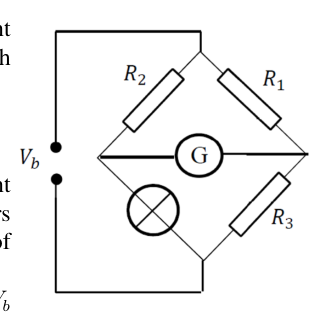 Wheatstone bridge circuit with non-linear lamp
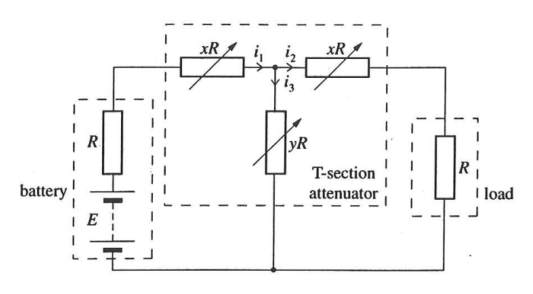 T-section attenuator circuit diagram
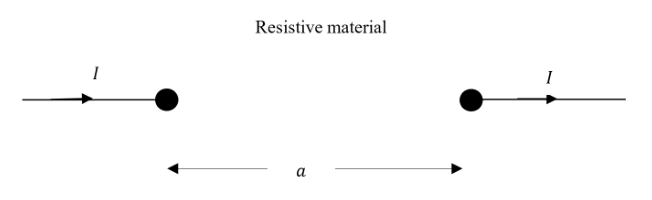 Two spherical conductors in resistive material
Topic: Circuits, Oscillations & Waves, Electrostatics Metodi: Kirchhoff’s Laws, Equivalent Circuit Reduction, Calculus-Integration, Simple Harmonic Motion Analysis Competenze: Mathematical Modeling, Physical Reasoning Objects: Wire, Resistor, Battery, Galvanometer Fonte: Testo (PDF) — p.11
Questione 5 Questa domanda riguarda i circuiti.
a) Si applica una differenza di potenziale costante di 2,0 V sulle estremità di una striscia metallica con le seguenti dimensioni: lunghezza 0,30 m, larghezza 4,0 mm e spessore 10 μm. Il metallo ha una resistività di a e un coefficiente di resistenza a temperatura di . La striscia perde il calore all’ambiente circostante a un ritmo proporzionale alla superficie e alla temperatura in eccesso sopra l’ambiente circostante , che si trova a . La costante di proporzionalità è . Determinazione:
(i) La resistenza della striscia a .
- la potenza elettrica trasferita quando la banda è .
(iii) Scrivere le espressioni della potenza convertita come funzione di temperatura in eccesso e della velocità di perdita di calore come funzione di temperatura in eccesso . Si stima quindi la temperatura raggiunta dopo che la corrente è passata per un lungo periodo di tempo.
b) Una lampada a filamenti di tungsteno è costituita da un filamento lungo di 25 cm sostenuto a ciascuna estremità e al centro. Quando era utilizzato con un’alimentazione a 50 Hz, il filamento sembrava avere quattro loop. Calcolare la tensione del filamento data la densità del tungsteno .
c) In un conduttore di volume , di sezione incrociata uniforme, fatto di materiale di resistività , la densità di corrente è (la corrente per unità di superficie normale al flusso). Trova un’espressione in termini di , e per la potenza dissipata come energia termica.
d) La differenza di potenziale tra una lampada a filamento, , è correlata alla corrente che la attraversa mediante la relazione La lampada è collegata a un braccio di misura del circuito del ponte mostrato. Le resistenze , e hanno ciascuna una resistenza di . Determinare la differenza di potenziale in modo tale che non si trascorra alcuna corrente attraverso il galvanometro G.
e) Il circuito della figura 13 comprende un elemento noto come “attenuatore di sezione T”. L’attenuatore è utilizzato per regolare la potenza fornita al carico. L’attenuatore è collegato a una batteria di emf e resistenza interna , nonché a un carico di resistenza . I valori di e vengono regolati fino a quando la batteria non fornisce la massima potenza.
(i) Per questa condizione di potenza massima, ottenere un rapporto tra e .
ii) Per i tre correnti , , mostrati nel circuito, ottenere un risultato generale per il rapporto in termini di e .
(iii) è la potenza fornita ai terminali della batteria e è la potenza dissipata nel carico. Indicare che dove e sono funzioni semplici di .
Suggerimento: in un circuito di emf e resistenza interna collegato a una resistenza a carico , la condizione per la batteria di fornire la massima potenza al carico è quando .
f) Un emisfero metallico di raggio di 0,1 m è immerso vicino al centro di un grande serbatoio conduttore contenente un liquido di resistività . La superficie piana dell’emisfero è a livello della superficie del liquido.
(i) Trovare un’espressione della resistenza tra due conchiglie emisferiche all’interno del liquido, concentrici con il centro dell’emisfero metallico, con radii e rispettivamente.
- calcolare quindi la resistenza tra l’emisfero e il serbatoio.
(iii) Se l’emisfero viene sostituito da una sfera in un vassoio chiuso molto grande del liquido, quale è la resistenza tra la sfera e il serbatoio ora?
(iv) Ora abbiamo due piccole sfere conduttrici di raggio separate da una distanza dove , incorporate in un materiale resistivo di portata infinita. Qual è la resistenza tra di loro? Suggerimento: utilizzare l’idea di sovrapposizione delle correnti nel materiale.
[25 punti]
Circuito di ponte di pietra di grano con lampada non lineare
Diagramma di circuito dell’attenuatore di sezione T
Due conduttori sferici in materiale resistivo
Topic: Circuits, Oscillations & Waves, Electrostatics Metodi: Kirchhoff’s Laws, Equivalent Circuit Reduction, Calculus-Integration, Simple Harmonic Motion Analysis Competenze: Mathematical Modeling, Physical Reasoning Objects: Wire, Resistor, Battery, Galvanometer Fonte: Testo (PDF) — p.11