Digging Disaster
You believe that you have a broken pipe in your backyard. The broken pipe is under the ground. In order to find the break you will have to dig a hole. Assume that the hole you dig will be a perfect square pyramid of depth . Assume that the side length of the square base is equal to the depth. Note that the apex of the pyramid is deep under the ground and the base is at the surface. The dirt that you have dug out will form a perfect square pyramid pile next to the hole. The height of this pyramid pile is also equal to the side length of its square base.
The centre of mass of a pyramid is located one quarter of the way between its base and its vertex. The volume of a square pyramid is given by where is the height of the pyramid and is the length of the side of the base.
When the dirt is in the ground, its density is given by . As you dig out the dirt it becomes less compact (some air gaps appear), causing the density of the dirt to decrease to .
1. Which of the following statements are true? (2 marks)
- A. The centre of mass of an upright pyramid is higher than half its height.
- B.
2. Find an algebraic expression for the height of the dirt pile (pyramid) that you have dug out. Show your working. (3 marks)
3. You must do work against gravity to lift dirt from the ground into the pile. How much work do you have to do against gravity to dig this hole? Give your answer as an algebraic expression in terms of , , and . Show your working. (5 marks)
4. Assuming that the depth of the hole is , the density of compacted dirt is and the density of uncompacted dirt is . How much work is done (in joules) against gravity to lift the dirt? Please assume that the acceleration due to gravity is for this question. (1 mark)
5. You are wondering how long it would take you to dig the hole from question 4. The average daily energy consumption for a human is . If a human uses a spade the digging process is about 20% efficient. Assume that a human uses their energy evenly throughout the day and uses 10% of their energy expenditure to dig the hole while digging. Explain the process that you would use to determine the amount of time that it would take them to dig the hole. Based on your process find an estimate for how long it would take for them to dig the hole (in hours). Show your working. (2 marks)
6. A tradie has a digging tool that is 10% efficient. Explain the process that you would use to determine the amount of time that it would take them to dig the hole from Question 4. Based on your process find an estimate for how long it would take for them to dig the hole (in seconds). Show your working. (2 marks)
7. Electricity prices are skyrocketing to 100 per hour)? (3 marks)
Topic: Newtonian Mechanics, Conservation of Energy, Order-of-Magnitude Estimation Metodi: Energy Conservation Method, Free-Body Diagram, Order-of-Magnitude Estimation Competenze: Mathematical Modeling, Estimation & Approximation, Physical Reasoning Objects: Tube Fonte: Testo (PDF) — p.3
Disastro di scavo
Ritieni di avere un tubo rotto nel tuo giardino. Il tubo rotto è sotto terra. Per trovare la rottura dovrai scavare una buca. Assumi che la buca che scavi sia una piramide a base quadrata perfetta di profondità . Assumi che la lunghezza del lato della base quadrata sia uguale alla profondità. Nota che l’apice della piramide è in profondità sotto terra e la base è in superficie. La terra che hai scavato formerà un mucchio a forma di piramide a base quadrata perfetta accanto alla buca. Anche l’altezza di questo mucchio piramidale è uguale alla lunghezza del lato della sua base quadrata.
Il centro di massa di una piramide si trova a un quarto del percorso tra la sua base e il suo vertice. Il volume di una piramide a base quadrata è dato da dove è l’altezza della piramide e è la lunghezza del lato della base.
Quando la terra è nel terreno, la sua densità è . Man mano che scavi la terra, essa diventa meno compatta (compaiono alcuni vuoti d’aria), facendo diminuire la densità della terra fino a .
1. Quali delle seguenti affermazioni sono vere? (2 punti)
- A. Il centro di massa di una piramide diritta è più in alto della metà della sua altezza.
- B.
2. Trova un’espressione algebrica per l’altezza del mucchio di terra (piramide) che hai scavato. Mostra i passaggi. (3 punti)
3. Devi compiere lavoro contro la gravità per sollevare la terra dal terreno al mucchio. Quanto lavoro devi compiere contro la gravità per scavare questa buca? Fornisci la risposta come espressione algebrica in termini di , , e . Mostra i passaggi. (5 punti)
4. Assumendo che la profondità della buca sia , la densità della terra compattata sia e la densità della terra non compattata sia . Quanto lavoro viene compiuto (in joule) contro la gravità per sollevare la terra? Per questa domanda assumi che l’accelerazione di gravità sia . (1 punto)
5. Ti stai chiedendo quanto tempo ti servirebbe per scavare la buca della domanda 4. Il consumo energetico medio giornaliero di un essere umano è . Se una persona usa una vanga, il processo di scavo è efficiente circa al 20%. Assumi che una persona usi la propria energia in modo uniforme durante la giornata e impieghi il 10% del proprio dispendio energetico per scavare la buca mentre scava. Spiega il procedimento che useresti per determinare il tempo che le servirebbe per scavare la buca. In base al tuo procedimento, trova una stima di quanto tempo le servirebbe per scavare la buca (in ore). Mostra i passaggi. (2 punti)
6. Un operaio ha uno strumento di scavo da efficiente al 10%. Spiega il procedimento che useresti per determinare il tempo che gli servirebbe per scavare la buca della Domanda 4. In base al tuo procedimento, trova una stima di quanto tempo gli servirebbe per scavare la buca (in secondi). Mostra i passaggi. (2 punti)
7. I prezzi dell’elettricità stanno salendo alle stelle a 100 all’ora)? (3 punti)
Topic: Newtonian Mechanics, Conservation of Energy, Order-of-Magnitude Estimation Metodi: Energy Conservation Method, Free-Body Diagram, Order-of-Magnitude Estimation Competenze: Mathematical Modeling, Estimation & Approximation, Physical Reasoning Objects: Tube Fonte: Testo (PDF) — p.3
Slithering Snake
A class is asked to investigate and model the motion of snakes.
Student A sees a video of a snake rising to stand on the tip of its tail. They decide to model the snake as a cylinder of mass and length with a uniform mass distribution.
1. If the vertical velocity of the snake’s head is , calculate an expression for the magnitude of the snake’s vertical momentum at a time after the snake has started rising. (4 marks)
2. For an object to change its momentum in a given direction, it must have a net force with a component in that direction. By considering the forces on the snake and the electronic scale, sketch a graph of the reading on the electronic scale over time. Include the reading on the scale before the snake starts rising. (4 marks)
3. Student A now wants to validate their model. However, they have a fear of snakes and instead use a rope with the same length and mass to mimic the snake. Holding the end of the rope, they lift the rope up such that the rope’s motion exactly matches the motion of the snake. Explain why the reading on the electronic scale would not match the answer in part 2. (4 marks)
Student B models the snake as two blocks of mass connected by a rod which can change its length from an initial length . The model snake is initially stationary.
During the closing phase, a constant force is exerted on both masses until the distance between the two masses is 0. During the opening phase, a constant force is exerted on both masses until the distance between the two masses is . A closing phase immediately followed by an opening phase will be referred to as a ‘closing-opening cycle’. For parts 4 and 5, assume there is no friction between the model snake and the ground.
4. Calculate the time it takes for the model snake to undergo one closing-opening cycle. (4 marks)
5. Explain why the centre of the model snake does not move forward after each cycle. (2 marks)
After doing some research, Student B finds that the kinetic friction coefficient between the snake and the ground is when the snake moves forwards, but when the snake moves backwards. This allows the model snake to move forward after each closing-opening cycle.
6. Draw force diagrams which show the forces acting on each mass during the closing and opening phases. (4 marks)
7. Calculate the distance which the centre of the model snake moves forward by after one closing-opening cycle. (7 marks)
8. Describe the movement of the model snake if the static and kinetic friction coefficients are large when the model snake moves backward and are 0 when it moves forward. (2 marks)
Topic: Newtonian Mechanics, Conservation of Momentum, Rotational Dynamics Metodi: Free-Body Diagram, Conservation of Momentum, Kinematic Equations Competenze: Physical Reasoning, Diagrammatic Reasoning, Mathematical Modeling Objects: Block, Rod, String Fonte: Testo (PDF) — p.4
Slittering Snake
Una classe viene invitata a studiare e modellare il movimento dei serpenti.
Lo studente A. vede un video di un serpente che si alza per stare sulla punta della coda. Decidono di modellare il serpente come un cilindro di massa e lunghezza con una distribuzione di massa uniforme.
Se la velocità verticale della testa del serpente è , calcolare un’espressione per la grandezza del momento verticale del serpente in un momento dopo che il serpente ha iniziato a salire. (4 punti)
2. Per un oggetto cambiare la sua dinamica in una determinata direzione, deve avere una forza netta con una componente in quella direzione. Considerando le forze della serpente e la scala elettronica, disegna un grafico della lettura sulla scala elettronica nel tempo. Includere la lettura sulla scala prima che il serpente cominciasse a salire. (4 punti)
Lo studente A vuole ora convalidare il suo modello. Tuttavia, hanno paura dei serpenti e invece usano una corda della stessa lunghezza e massa per imitare il serpente. Tenendo la punta della corda, sollevano la corda in modo tale che il movimento della corda corrisponda esattamente al movimento del serpente. Spiegate perché la lettura della scala elettronica non corrisponde alla risposta della parte 2. (4 punti)
Studente B modella il serpente come due blocchi di massa collegati da una canna che può cambiare la sua lunghezza da una lunghezza iniziale . Il serpente modello è inizialmente fermo.
Durante la fase di chiusura, una forza costante viene esercitata su entrambe le masse fino a quando la distanza tra le due masse è di 0. Durante la fase di apertura, una forza costante viene esercitata su entrambe le masse fino a quando la distanza tra le due masse è . Una fase di chiusura immediatamente seguita da una fase di apertura si denominerà “ciclo di chiusura-apertura”. Per le parti 4 e 5, supponiamo che non ci sia attrito tra il serpente modello e il terreno.
**4. ** Calcolare il tempo necessario per il serpente modello per sottoporsi a un ciclo di chiusura-apertura. (4 punti)
5. Spiegare perché il centro del serpente modello non si muove in avanti dopo ogni ciclo. 2 punti)
Dopo aver fatto alcune ricerche, lo studente B scopre che il coefficiente di attrito cinetico tra il serpente e il terreno è quando il serpente si muove in avanti, ma quando il serpente si muove in indietro. Questo consente al serpente modello di muoversi avanti dopo ogni ciclo di chiusura-apertura.
6. Disegnare diagrammi di forza che mostrano le forze che agiscono su ogni massa durante le fasi di chiusura e apertura. (4 punti)
7. Calcolare la distanza che il centro del serpente modello si muove in avanti dopo un ciclo di chiusura-apertura. (7 punti)
8. Descrivere il movimento del serpente modello se i coefficienti di attrito statico e cinetico sono grandi quando il serpente modello si muove verso l’indietro e sono 0 quando si muove verso l’avanguardia. 2 punti)
Topic: Newtonian Mechanics, Conservation of Momentum, Rotational Dynamics Metodi: Free-Body Diagram, Conservation of Momentum, Kinematic Equations Competenze: Physical Reasoning, Diagrammatic Reasoning, Mathematical Modeling Objects: Block, Rod, String Fonte: Testo (PDF) — p.4
Violin Vibrations
This question uses concepts from waves and motion.
A violin consists of four strings fixed at both ends (the bridge and the nut). In this question, model the violin as a single string fixed at both ends. Only the lowest frequency wave occurs. The period (in seconds) and frequency (in Hertz) are related by:
A bowed violin string oscillates between ‘sticking’ and ‘slipping’ phases. A graph of the velocity of the string at the point of contact with the bow over time is provided.
1. Using the graph, determine the frequency of the sound produced by this bowed violin string. (1 mark)
2. Sketch a graph of the displacement of the string at the point of contact with the bow over time. Label the amplitude of the motion. (The displacement must return to 0 after each period.) (7 marks)
3. Using your answer to part 2, or otherwise, sketch a graph of the displacement of the string over its length at . Assume that the note played is the lowest note that the violin can play for this string length. (6 marks)
4. The speed of a wave in a string depends on the tension force and the linear mass density (mass per unit length) of the string. It is given by where and are constants. Using dimensional analysis, determine the exponents and . (3 marks)
One technique violinists use is known as ‘harmonics’. The violinist places their finger lightly on the string at certain points, forcing that point to be a node (zero displacement), while still allowing the entire string to oscillate.
5. Draw a scale diagram of the violin string and label the nut and bridge. Indicate clearly on the diagram exactly three points where a violinist could place their finger lightly to achieve ‘harmonics’. (2 marks)
6. The wavelength of a wave is the distance between consecutive peaks. A wave moving at a constant speed travels one wavelength in one period. For each of the positions in part 5, determine the frequency that would be heard, as a multiple of (the frequency of the open string). Show your working and justify your answer. (3 marks)
A more advanced technique is known as ‘artificial harmonics’. The violinist places one finger on the string to shorten the effective length, and another finger lightly in front (closer to the bridge) to force a node. Suppose the violinist places their first finger on the A-string () and plays the note B (). Then, they lightly place their pinky. An artificial harmonic is heard two octaves above the note B.
7. What frequency should sound if the first finger is lifted and the pinky is placed firmly down? (5 marks)
Our violinist wants to create a new musical system called the ‘decimal scale’. It splits the octave into only 10 tones instead of 12. The notes in the octave are numbered 0 to 9, with each successive octave encoded by the ten’s digit. The lowest note 0 in the new system corresponds to a low C in the Western system (). For example, the note 10 would be exactly one octave above the note 0 (); the note 43 would be two octaves above the note 23.
8. Find a relationship between the note number and the frequency in Hz in terms of . What frequency in Hz would the note 27 correspond to? (5 marks)
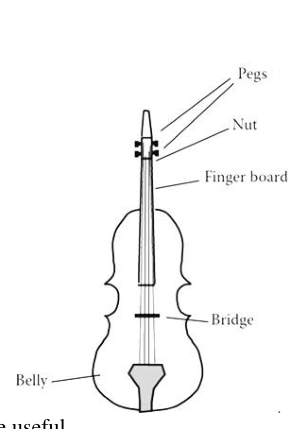 Schema violino: piroli, capotasto, ponte, cassa
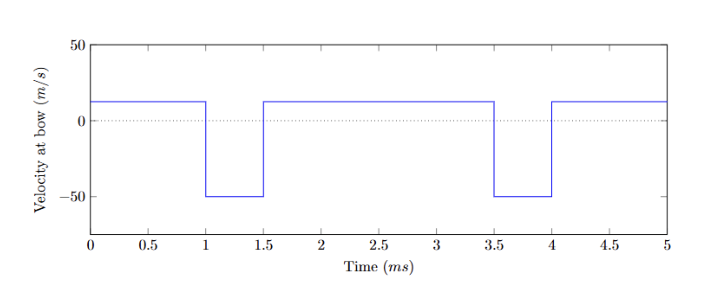 Grafico velocità arco su corda violino vs tempo
Topic: Oscillations & Waves, Newtonian Mechanics, Wave Optics Metodi: Wave Equation, Dimensional Analysis, Simple Harmonic Motion Analysis Competenze: Diagrammatic Reasoning, Mathematical Modeling, Physical Reasoning Objects: String Fonte: Testo (PDF) — p.6
Vibrazioni del violino
Questa domanda utilizza concetti provenienti da onde e movimento.
Un violino è composto da quattro corde fissate alle due estremità (il ponte e la noce). In questa domanda, modella il violino come una singola corda fissata alle entrambe le estremità. Si verifica solo l’onda a bassa frequenza. Il periodo (in secondi) e la frequenza (in Hertz) sono correlati da:
Una corda di violino inclinata oscilla tra le fasi di “collegamento” e di “slipping”. Si fornisce un grafico della velocità della corda al punto di contatto con l’arco nel tempo.
1. Con il grafico, determinare la frequenza del suono prodotto da questa corda di violino inclinata. 1 punto
2. Segnare un grafico del spostamento della corda al punto di contatto con l’arco nel tempo. Etichettare l’ampiezza del movimento. (Il spostamento deve tornare a 0 dopo ogni periodo.) (7 punti)
3. Usando la tua risposta alla parte 2, o altrimenti, disegna un grafico del spostamento della stringa lungo la sua lunghezza a . Supponiamo che la nota suonata sia la nota più bassa che il violino possa suonare per questa lunghezza di corda. (6 punti)
4. La velocità di un’onda in una corda dipende dalla forza di tensione e dalla densità di massa lineare (massa per lunghezza unità) della corda. È data da dove e sono costanti. Usando l’analisi dimensionale, determinare gli esponenti e . (3 punti)
Una tecnica che i violinisti usano è conosciuta come ‘harmonics’. Il violinista pone leggermente il dito sulla corda in certi punti, costringendo quel punto ad essere un nodo (smutazione zero), mentre permette ancora all’intera corda di oscillare.
5. Disegnare un diagramma di scala della corda del violino e etichettare il nodo e il ponte. Indicare chiaramente sul diagramma esattamente tre punti in cui un violinista potrebbe mettere il dito leggermente per ottenere l‘“armonia”. 2 punti)
6. La lunghezza d’onda di un’onda è la distanza tra picchi consecutivi. Un’onda che si muove a velocità costante percorre una lunghezza d’onda in un periodo. Per ciascuna delle posizioni della parte 5, determinare la frequenza che si sentirebbe, come multiplo di (la frequenza della stringa aperta). Mostrate il vostro lavoro e giustificate la vostra risposta. (3 punti)
Una tecnica più avanzata è conosciuta come “armonici artificiali”. Il violinista pone un dito sulla corda per accorciare la lunghezza effettiva, e un altro dito leggermente davanti (più vicino al ponte) per forzare un nodo. Supponiamo che il violinista metta il suo primo dito sulla corda A () e suoni la nota B (). Poi, mettono leggermente il loro piccolo. Un armonico artificiale si sente due ottave sopra la nota B.
Qual è la frequenza con cui deve suonare se il primo dito viene sollevato e il dito è posto saldamente in basso? 5 punti)
Il nostro violinista vuole creare un nuovo sistema musicale chiamato “scala decimale” (MSK1). Divide l’ottava in soli 10 toni invece di 12. Le note dell’ottava sono numerate da 0 a 9, con ogni successiva ottava codificata con la cifra del dieci. La nota 0 più bassa del nuovo sistema corrisponde a una C bassa del sistema occidentale (). Ad esempio, la nota 10 sarebbe esattamente un’ottava sopra la nota 0 (); la nota 43 sarebbe due ottave sopra la nota 23.
8. Trova una relazione tra il numero di nota e la frequenza in Hz in termini di . A quale frequenza in Hz corrisponde la nota 27? 5 punti)
Schema violino: piroli, capotasto, ponte, cassa
Grafico velocità arco su corda violino vs tempo
Topic: Oscillations & Waves, Newtonian Mechanics, Wave Optics Metodi: Wave Equation, Dimensional Analysis, Simple Harmonic Motion Analysis Competenze: Diagrammatic Reasoning, Mathematical Modeling, Physical Reasoning Objects: String Fonte: Testo (PDF) — p.6
Reflection Replicas
Jane was looking in the mirror one day when she noticed that her reflection had two very faint copies. In total there are three reflections.
Her mirror is made up of a layer of glass backed by a reflective metal layer. The glass reflects about 4% of the light that hits its surface, and transmits the rest into/out of the mirror.
1. Explain using a drawing of light ray paths how these three reflections may have been formed. You may wish to use a diagram. (5 marks)
 Foto specchio con tre riflessioni smiley
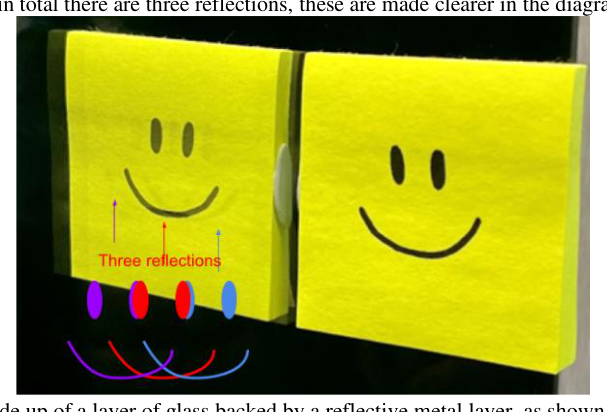 Foto specchio con frecce tre riflessioni evidenziate
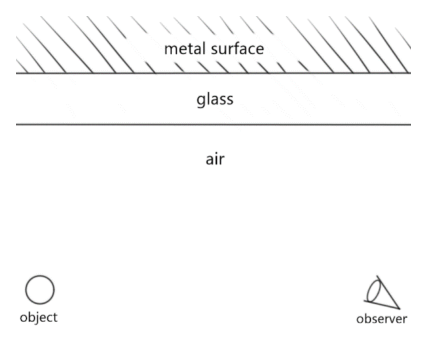 Sezione specchio: metallo, vetro, aria; oggetto-osservatore
Topic: Geometric Optics, Wave Optics Metodi: Ray Tracing, Superposition Principle Competenze: Diagrammatic Reasoning, Physical Reasoning Objects: Mirror Fonte: Testo (PDF) — p.9
Riplicazioni riflessive
Un giorno Jane si guardava allo specchio quando notò che il suo riflesso aveva due copie molto deboli. In totale ci sono tre riflessioni.
Il suo specchio è costituito da uno strato di vetro sostenuto da uno strato metallico riflettente. Il vetro riflette circa il 4% della luce che colpisce la sua superficie e trasmette il resto nello specchio.
1. Spiegare con un disegno di percorsi dei raggi luminosi come queste tre riflessioni possono essere state formate. Potrebbe essere opportuno utilizzare un diagramma. 5 punti)
Foto specchio con tre riflessioni smiley
Foto specchio con frecce tre riflessioni
Sezione specchio: metallo, vetro, aria; oggetto-osservatore
Topic: Geometric Optics, Wave Optics Metodi: Ray Tracing, Superposition Principle Competenze: Diagrammatic Reasoning, Physical Reasoning Objects: Mirror Fonte: Testo (PDF) — p.9
Twisting Torques and Leaning Lego
When studying Newton’s laws, for an object to remain at rest, the forces on it must be balanced. However it is possible for an object with balanced forces on it to twist. The rotational equivalent of force is called torque.
For this question, define a clockwise torque as a torque which makes the unicycle-human system rotate clockwise. Torques are calculated around the centre of the unicycle-human system.
The torque caused by a force is given by: where is the magnitude of the torque, is the distance between the pivot point and the force’s location on the object, is the magnitude of the force, and is the angle between the force and a line joining the force’s position to the pivot point.
1. For each of three diagrams showing a unicyclist with a single force depicted, indicate whether the force corresponds to a clockwise torque, an anti-clockwise torque, or no torque. (3 marks)
2. Draw a free body diagram of the unicycle/unicyclist system in each of the following circumstances. State whether the forces are balanced and whether the torques are balanced. (6 marks)
- A. The unicycle and rider are stationary.
- B. The unicycle and rider while moving at constant velocity.
- C. The unicycle and rider while accelerating forwards.
Leaning Lego Logic
You tape a Lego baseplate to your fridge and start stacking bricks outwards horizontally. The cylindrical bumps on top of the Lego bricks are called studs.
Each brick has weight and dimensions as given in the provided diagram. Assume that the acceleration due to gravity is .
3. Draw a free body diagram of your experiment showing the relevant forces. (4 marks)
4. Imagine you kept making the horizontal tower longer and longer until it collapsed under its own weight. Where in the tower do you expect it to fail (break)? Justify your answer. (3 marks)
You find that the horizontal tower was able to hold 44 Lego bricks before collapsing.
5. For this question assume that only friction from the top of each stud prevents each piece of Lego from sliding off the previous piece. Assume that the weight is distributed evenly between the studs. Assume that the normal force is caused only by the weight of the blocks hanging from the studs. Using the formula , where is the friction force, is the normal force and is the static coefficient of friction, find . Show your working. (4 marks)
You find that the coefficient of friction is unrealistically high. You realise there must be extra forces: compressive forces from the tightly fitting Lego bricks! The coefficient of friction of ABS (Lego) is .
6. Using your experimental results, determine the compressive force acting between stacked Lego bricks. Show your working. (4 marks)
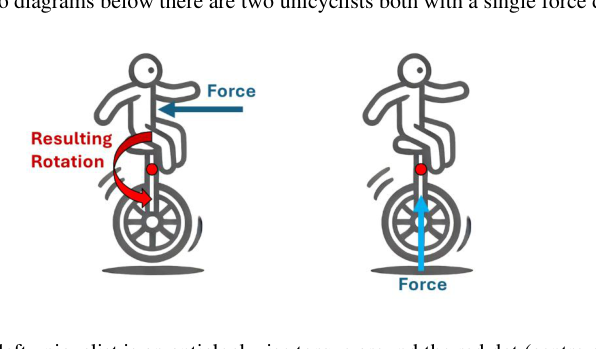 Due uniciklisti con forza e rotazione risultante
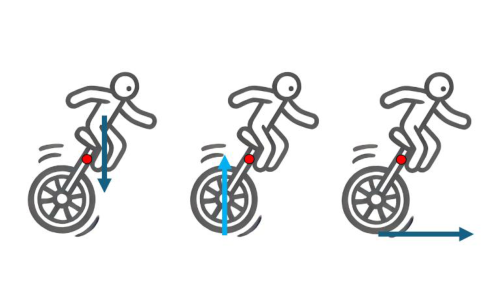 Tre uniciklisti con forza singola per identificare coppia
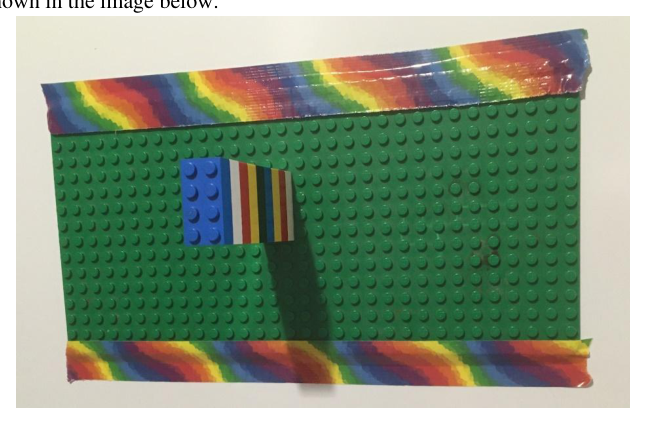 Foto mattoncini Lego impilati orizzontalmente su frigo
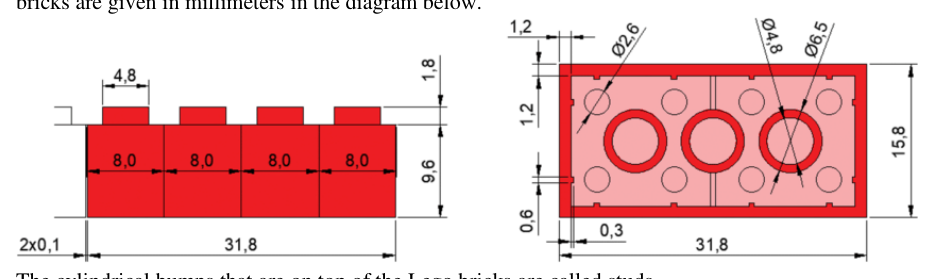 Quote mattoncino Lego 2x4 vista laterale e superiore
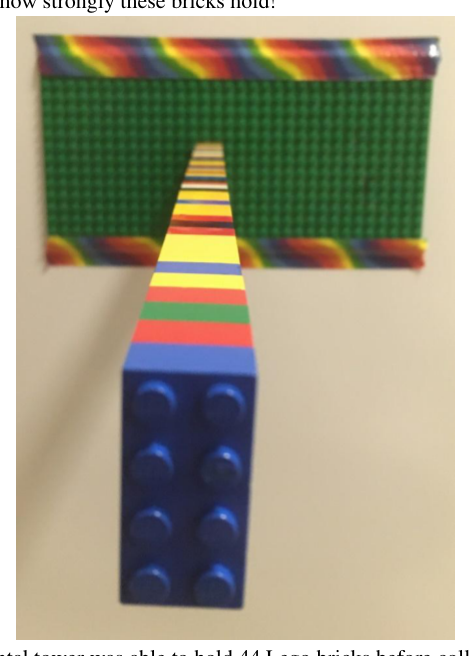 Foto torre Lego orizzontale da 44 mattoncini
Topic: Rigid Body Statics, Newtonian Mechanics, Rotational Dynamics Metodi: Torque & Angular Momentum Analysis, Free-Body Diagram, Conservation Laws Competenze: Diagrammatic Reasoning, Physical Reasoning, Mathematical Modeling Objects: Block Fonte: Testo (PDF) — p.10
Twisting Torques and Leaning Lego
Quando si studiano le leggi di Newton, per un oggetto rimanere in riposo, le forze su di esso devono essere equilibrate. Tuttavia è possibile che un oggetto con forze equilibrate si torcia. L’equivalente rotazionale di forza è denominato torque.
Per questa domanda, definire una coppia in senso orario come una coppia che fa girare il sistema unicello-umano in senso orario. Le coppie sono calcolate intorno al centro del sistema unicello-umano.
La coppia causata da una forza è data da: se è la magnitudine della coppia, è la distanza tra il punto di rotazione e la posizione della forza sull’oggetto, è la magnitudine della forza e è l’angolo tra la forza e una linea che collega la posizione della forza al punto di rotazione.
1. Per ciascun dei tre diagrammi che mostrano un monovolume con una sola forza rappresentata, indicare se la forza corrisponde a una coppia in senso orario, a una coppia antiorario o a nessuna coppia. (3 punti)
2. Disegnare un diagramma della carrozzeria libera del sistema unicello/unicello in ciascuna delle seguenti circostanze. Indicare se le forze sono equilibrate e se le coppie sono equilibrate. (6 punti)
- A. L’unicello e il pilota sono fermi.
- B. Il monovolume e il pilota mentre si muove a velocità costante.
- C. Il monovolume e il pilota mentre accelerano in avanti.
Leaning Lego Logic
You tape a Lego baseplate to your fridge and start stacking bricks outwards horizontally. Le spoglie cilindriche sopra i mattoni Lego sono chiamate stelle.
Ogni mattone ha peso e dimensioni come indicato nel diagramma fornito. Supponiamo che l’accelerazione dovuta alla gravità sia .
3. Disegna un diagramma del corpo libero del tuo esperimento che mostra le forze pertinenti. (4 punti)
4. Imagine you kept making the horizontal tower longer and longer until it collapsed under its own weight. Dove nella torre ti aspetti che falli? giustifica la tua risposta. (3 punti)
Scopri che la torre orizzontale era in grado di contenere 44 mattoni Lego prima di crollare.
5. For this question assume that only friction from the top of each stud prevents each piece of Lego from sliding off the previous piece. Supponiamo che il peso sia distribuito uniformemente tra i strisci. Supponiamo che la forza normale sia causata solo dal peso dei blocchi appesi ai striscioni. Usando la formula , dove è la forza di attrito, è la forza normale e è il coefficiente statico di attrito, trovi . Mostrate il vostro lavoro. (4 punti)
Si scopre che il coefficiente di attrito è irrealmente alto. Ti rendi conto che ci devono essere forze extra: forze compressive dalle mattone Lego strettamente fissate! Il coefficiente di attrito di ABS (Lego) è .
6. Using your experimental results, determine the compressive force acting between stacked Lego bricks. Mostrate il vostro lavoro. (4 punti)
Due uniciklisti con forza e rotazione risultante
Tre uniciklisti con forza singola per identificare coppia
Foto mattoncini Lego impilati orizzontalmente su frigo
Quote mattoncino Lego 2x4 vista laterale e superiore
Foto torre Lego orizzontale da 44 mattoncini
Topic: Rigid Body Statics, Newtonian Mechanics, Rotational Dynamics Metodi: Torque & Angular Momentum Analysis, Free-Body Diagram, Conservation Laws Competenze: Diagrammatic Reasoning, Physical Reasoning, Mathematical Modeling Objects: Block Fonte: Testo (PDF) — p.10