- An archer fires an arrow from the ground so that it passes through two hoops, which are both a height above the ground. The arrow passes through the first hoop one second after the arrow is launched, and through the second hoop another second later. What is the value of ?
- A. 5 m
- B. 10 m
- C. 12 m
- D. 15 m
- E. There is not enough information to decide.
Topic: Newtonian Mechanics Metodi: Kinematic Equations, Free-Body Diagram Competenze: Physical Reasoning, Mathematical Modeling Objects: Projectile Fonte: Testo (PDF) — p.2
- Un arciere spara una freccia dal terreno in modo che passi attraverso due cerchi, entrambi di altezza
- Sopra il terreno. La freccia passa attraverso il primo cerchio un secondo dopo il lancio della freccia, e attraverso il secondo cerchio un secondo dopo. Qual è il valore di ?
- A. 5 m
- B. 10 m
- C. 12 m
- D. 15 m
- E. Non ci sono informazioni sufficienti per decidere.
Topic: Newtonian Mechanics Metodi: Kinematic Equations, Free-Body Diagram Competenze: Physical Reasoning, Mathematical Modeling Objects: Projectile Fonte: Testo (PDF) — p.2
- An amusement park ride consists of a circular, horizontal room. A rider leans against its frictionless outer walls, which are angled back at with respect to the vertical, so that the rider’s center of mass is 5.0 m from the center of the room. When the room begins to spin about its center, at what angular velocity will the rider’s feet first lift off the floor?
- A. 1.9 rad/s
- B. 2.3 rad/s
- C. 3.5 rad/s
- D. 4.0 rad/s
- E. 5.6 rad/s
Topic: Newtonian Mechanics, Rotational Dynamics Metodi: Free-Body Diagram, Vector Decomposition, Torque & Angular Momentum Analysis Competenze: Diagrammatic Reasoning, Mathematical Modeling Objects: — Fonte: Testo (PDF) — p.2
- Un giro in un parco di divertimenti consiste in una stanza circolare e orizzontale. Un cavaliere si appoggia alla sua parte esterna senza attrito pareti, che sono angolate in retro alla verticale a , in modo che il centro di massa del pilota sia di 5,0 m dal centro della stanza. Quando la stanza inizia a girare intorno al suo centro, a che velocità angolare Il cavaliere si alzerà per primo dal pavimento?
- A. 1,9 rad/s
- B. 2,3 rad/s
- C. 3,5 rad/s
- D. 4,0 rad/s
- E. 5,6 rad/s
Topic: Newtonian Mechanics, Rotational Dynamics Metodi: Free-Body Diagram, Vector Decomposition, Torque & Angular Momentum Analysis Competenze: Diagrammatic Reasoning, Mathematical Modeling Objects: — Fonte: Testo (PDF) — p.2
- A simple bridge is made of five thin rods rigidly connected at four vertices. A B D C F The ground is frictionless, so that it can only exert vertical normal forces at and . The weight of the bridge is negligible, but a person stands at its middle, exerting a downward force at vertex . In static equilibrium, each rod can be experiencing either tension or compression. Which of the following is true?
- A. Only the vertical rod is in tension.
- B. Only the horizontal rods are in tension.
- C. Both the vertical rod and the diagonal rods are in tension.
- D. Both the vertical rod and the horizontal rods are in tension.
- E. All of the rods are in tension.
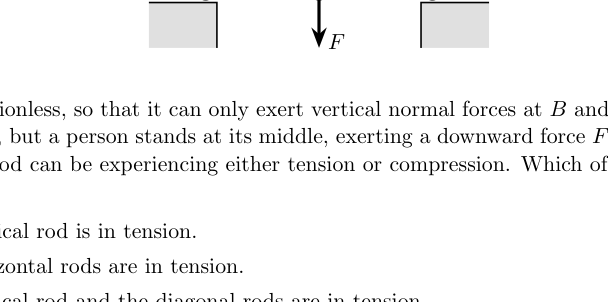 Ponte a cinque aste vertici A B C D F
Topic: Rigid Body Statics, Newtonian Mechanics Metodi: Free-Body Diagram, Vector Decomposition, Symmetry Argument Competenze: Diagrammatic Reasoning, Physical Reasoning Objects: Rod Fonte: Testo (PDF) — p.2
- Un semplice ponte è costituito da cinque sottili bastone rigidamente collegati a quattro vertici. A B D C F Il terreno è senza attrito, in modo che possa esercitare solo forze verticali normali a e . Il peso del il ponte è trascurabile, ma una persona si trova al suo centro, esercitando una forza verso il basso alla vertica . In static In equilibrio, ogni canna può essere sottoposta a tensione o compressione. Quale di queste parole è vero?
- A. Solo la barra verticale è tensa.
- B. Solo le barre orizzontali sono in tensione.
- C. Sia la canna verticale che la canna diagonale sono in tensione.
- D. Sia la canna verticale che la canna orizzontale sono in tensione.
- E. Tutte le barre sono in tensione.
*Ponte a cinque aste vertici A B C D F *
Topic: Rigid Body Statics, Newtonian Mechanics Metodi: Free-Body Diagram, Vector Decomposition, Symmetry Argument Competenze: Diagrammatic Reasoning, Physical Reasoning Objects: Rod Fonte: Testo (PDF) — p.2
- A bouncy ball is thrown vertically upward from the ground. Air resistance is negligible, and the ball’s collisions with the ground are perfectly elastic. Which of the following shows the kinetic energy of the ball as a function of time? Assume the collisions are too quick for their duration to be seen in the plot. (A) K t (B) K t (C) K t (D) K t (E) K t
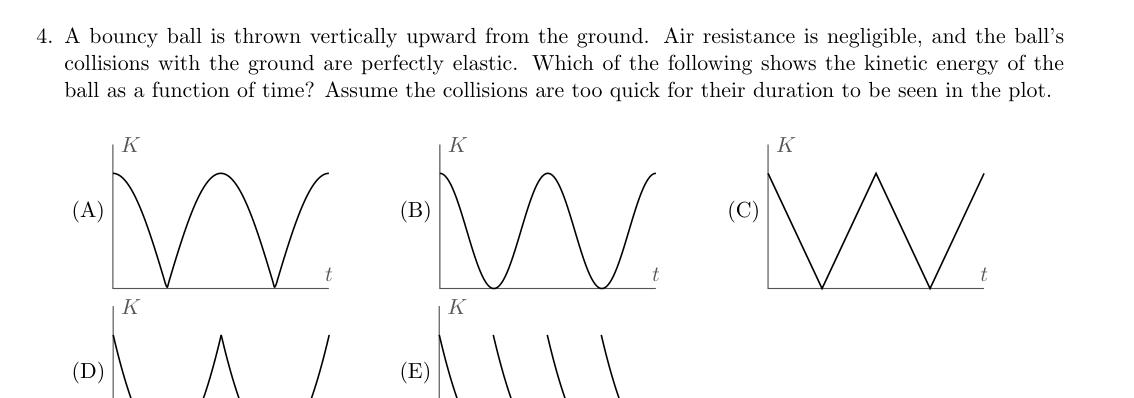 Cinque grafici energia cinetica K vs tempo
Topic: Conservation of Energy, Newtonian Mechanics Metodi: Energy Conservation Method, Kinematic Equations Competenze: Physical Reasoning, Mathematical Modeling Objects: Ball Fonte: Testo (PDF) — p.3
- Una palla rimbalzata viene lanciata verticalmente verso l’alto dal terreno. La resistenza dell’aria è trascurabile, e le palle Le collisioni con il terreno sono perfettamente elastica. Qual è la seguente che mostra l’energia cinetica del
- La palla come funzione del tempo? Supponiamo che le collisioni siano troppo rapide per la loro durata da vedere nella trama. (A) K t (B) K t (C) K t (D) K t (E) K t
Cinque grafici energia cinetica K vs tempo
Topic: Conservation of Energy, Newtonian Mechanics Metodi: Energy Conservation Method, Kinematic Equations Competenze: Physical Reasoning, Mathematical Modeling Objects: Ball Fonte: Testo (PDF) — p.3
- A massless inclined plane with angle to the horizontal is fixed to a scale. A block of mass is released from the top of the plane, which is frictionless. m As the block slides down the plane, what is the reading on the scale?
- A.
- B.
- C.
- D.
- E.
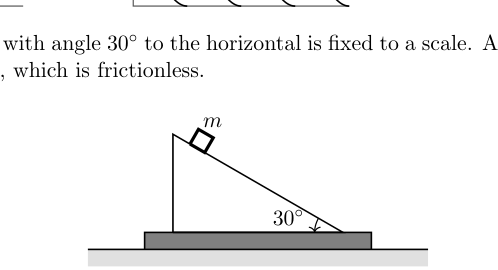 Piano inclinato 30 gradi con blocco m
Topic: Newtonian Mechanics Metodi: Free-Body Diagram, Vector Decomposition, Kinematic Equations Competenze: Diagrammatic Reasoning, Mathematical Modeling Objects: Block, Inclined Plane Fonte: Testo (PDF) — p.3
- Un piano inclinato senza massa con angolo orizzontale è fissato a una scala. Si rilascia un blocco di massa dalla parte superiore dell’aereo, che è senza attrito. m Mentre il blocco scivola giù per il piano, qual è la lettura sulla scala?
- A.
- B.
- C.
- D.
- E.
Piano inclinato a 30 gradi con blocco m
Topic: Newtonian Mechanics Metodi: Free-Body Diagram, Vector Decomposition, Kinematic Equations Competenze: Diagrammatic Reasoning, Mathematical Modeling Objects: Block, Inclined Plane Fonte: Testo (PDF) — p.3
- A pendulum is made with a string and a bucket full of water. When the string is vertical, the bottom of the bucket is near the ground. Then, the pendulum is set swinging with a small amplitude, and a very small hole is opened at the bottom of the bucket, which leaks water at a constant rate. After a few full swings, which of the following best shows the amount of water that has landed on the ground as a function of position? (A) (B) (C) (D) (E)
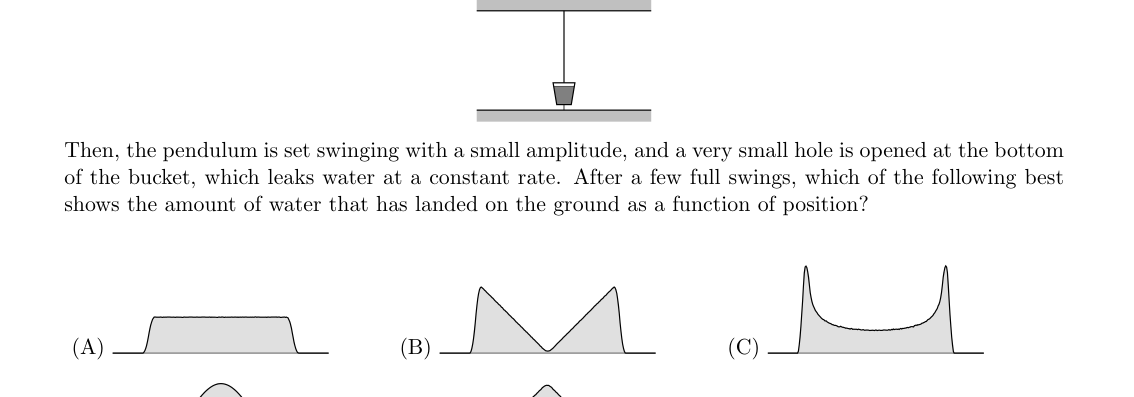 Cinque grafici acqua al suolo vs posizione
Topic: Oscillations & Waves, Newtonian Mechanics Metodi: Simple Harmonic Motion Analysis, Physical Modeling Competenze: Physical Reasoning, Mathematical Modeling Objects: Pendulum, Container Fonte: Testo (PDF) — p.3
- Un pendolo è fatto di una corda e di un secchio pieno di acqua. Quando la stringa è verticale, il fondo di Il secchio è vicino al terreno. Poi, il pendolo viene impostato a oscillare con una piccola amplitudine, e un piccolo buco viene aperto in fondo di un secchio che scorre acqua a velocità costante. Dopo qualche svolta completa, quale dei seguenti è il migliore indica la quantità di acqua che è atterrata sul suolo in funzione della posizione? (A) (B) (C) (D) (E)
5 grafici conosciuti al suolo vs posizione
Topic: Oscillations & Waves, Newtonian Mechanics Metodi: Simple Harmonic Motion Analysis, Physical Modeling Competenze: Physical Reasoning, Mathematical Modeling Objects: Pendulum, Container Fonte: Testo (PDF) — p.3
- A particle travels in a straight line. Its velocity as a function of time is shown below. t Which of the following shows the velocity as a function of distance from its initial position? (A) x (B) x (C) x (D) x (E) x
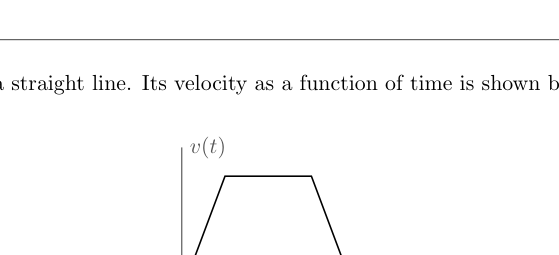 Grafico velocita v in funzione del tempo t
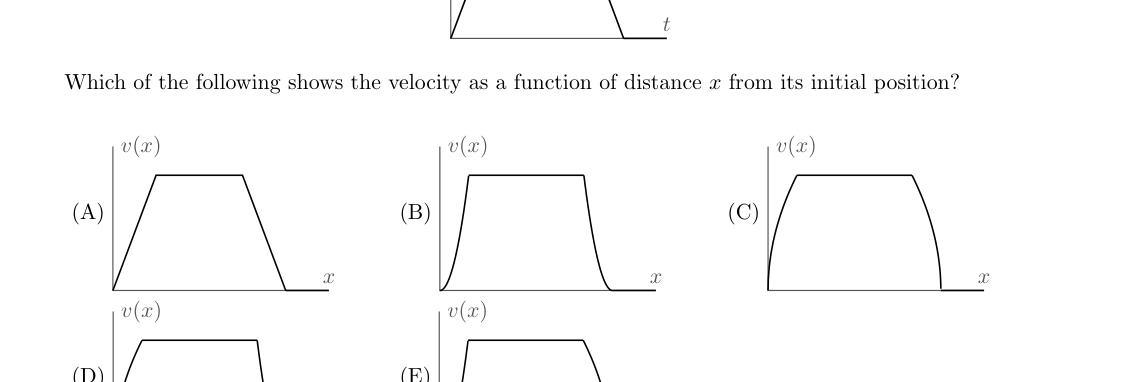 Cinque grafici v(x) risposta A-E
Topic: Newtonian Mechanics Metodi: Kinematic Equations, Physical Modeling Competenze: Physical Reasoning, Graph Linearization Objects: Particle Beam Fonte: Testo (PDF) — p.4
- Una particella viaggia in linea retta. La sua velocità come funzione del tempo è mostrata qui sotto. t Qual è il risultato della velocità come funzione della distanza dalla sua posizione iniziale? (A) x (B) x (C) x (D) x (E) x
*Grafico velocita v in funzione del tempo t *
5 grafici v) risposta A-E
Topic: Newtonian Mechanics Metodi: Kinematic Equations, Physical Modeling Competenze: Physical Reasoning, Graph Linearization Objects: Particle Beam Fonte: Testo (PDF) — p.4
- A rod of length is sliding down a frictionless wall. L v When the rod makes an angle of to the horizontal, the bottom of the rod has speed . At this moment, what is the speed of the middle of the rod?
- A.
- B.
- C.
- D.
- E.
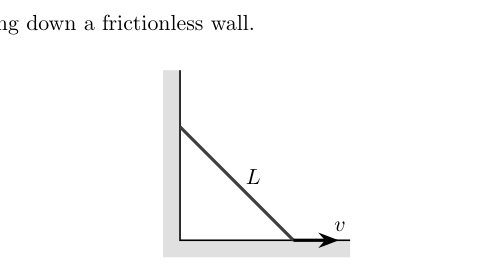 Asta di lunghezza L su parete liscia
Topic: Newtonian Mechanics, Rotational Dynamics Metodi: Vector Decomposition, Kinematic Equations Competenze: Diagrammatic Reasoning, Mathematical Modeling Objects: Rod Fonte: Testo (PDF) — p.4
- Una barra di lunghezza scorre in un muro senza attrito. L v Quando la canna fa un angolo di verso l’orizzontale, la parte inferiore della canna ha una velocità . In questo momento, Qual è la velocità della metà della canna?
- A.
- B.
- C.
- D.
- E.
Asta di lunghezza L su parete liscia
Topic: Newtonian Mechanics, Rotational Dynamics Metodi: Vector Decomposition, Kinematic Equations Competenze: Diagrammatic Reasoning, Mathematical Modeling Objects: Rod Fonte: Testo (PDF) — p.4
- When a car’s brakes are fully engaged, it takes 100 m to stop on a dry road, which has coefficient of kinetic friction with the tires. Now suppose only the first 50 m of the road is dry, and the rest is covered with ice, with . What total distance does the car need to stop?
- A. 150 m
- B. 200 m
- C. 250 m
- D. 400 m
- E. 850 m
Topic: Newtonian Mechanics Metodi: Kinematic Equations, Free-Body Diagram Competenze: Physical Reasoning, Mathematical Modeling Objects: — Fonte: Testo (PDF) — p.4
- Quando i freni sono completamente attivi, occorrono 100 m per fermarsi su una strada secca, che ha un coefficiente di frattura con i pneumatici. Ora supponiamo che solo i primi 50 metri della strada siano secchi, e il resto sia coperto. con ghiaccio, con . Quanta distanza ha bisogno l’auto per fermarsi?
- A. 150 m
- B. 200 m
- C. 250 m
- D. 400 m
- E. 850 m
Topic: Newtonian Mechanics Metodi: Kinematic Equations, Free-Body Diagram Competenze: Physical Reasoning, Mathematical Modeling Objects: — Fonte: Testo (PDF) — p.4
- A block of mass is connected to the walls of a frictionless box by two massless springs with relaxed lengths and , and spring constants and respectively. The length of the box is . The system rotates with a constant angular velocity about one of its walls. m Suppose the block stays at a constant distance from the axis of rotation, without touching either of the walls. What is the value of ?
- A.
- B.
- C.
- D.
- E.
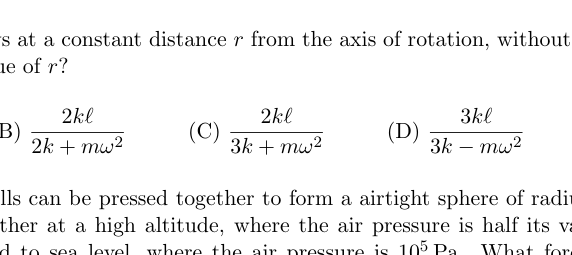 Blocco m su molle in scatola rotante omega
Topic: Newtonian Mechanics, Rotational Dynamics Metodi: Free-Body Diagram, Hooke’s Law, Vector Decomposition Competenze: Diagrammatic Reasoning, Mathematical Modeling Objects: Block, Spring Fonte: Testo (PDF) — p.5
- Un blocco di massa è collegato alle pareti di una scatola senza attrito da due sorgenti senza massa con rilassate Le lunghezze e e le costanti di primavera e rispettivamente. La lunghezza della scatola è . Il sistema ruota con una velocità angolare costante circa una delle sue pareti. m Supponiamo che il blocco rimanga a una distanza costante dall’asse di rotazione, senza toccare nessuna delle due
- Le pareti. Qual è il valore di ?
- A.
- B.
- C.
- D.
- E.
Blocco m su molle in scatola rotante omega
Topic: Newtonian Mechanics, Rotational Dynamics Metodi: Free-Body Diagram, Hooke’s Law, Vector Decomposition Competenze: Diagrammatic Reasoning, Mathematical Modeling Objects: Block, Spring Fonte: Testo (PDF) — p.5
- Two hemispherical shells can be pressed together to form a airtight sphere of radius 40 cm. Suppose the shells are pressed together at a high altitude, where the air pressure is half its value at sea level. The sphere is then returned to sea level, where the air pressure is Pa. What force , applied directly outward to each hemisphere, is required to pull them apart?
- A. 25,000 N
- B. 50,000 N
- C. 100,000 N
- D. 200,000 N
- E. 400,000 N
Topic: Fluid Mechanics, Newtonian Mechanics Metodi: Hydrostatic Equilibrium, Free-Body Diagram Competenze: Physical Reasoning, Mathematical Modeling Objects: Sphere Fonte: Testo (PDF) — p.5
- Due conchiglie emisferiche possono essere premute insieme per formare una sfera aerea di raggio di 40 cm. Supponiamo che il le conchiglie sono premute a un’alta quota, dove la pressione dell’aria è la metà del suo valore al livello del mare. Il la sfera viene poi riportata al livello del mare, dove la pressione dell’aria è Pa. Qual è la forza applicata direttamente verso l’esterno di ogni emisfero, è necessario separarli?
- A. 25,000 N
- B. 50,000 N
- C. 100,000 N
- D. 200,000 N
- E. 400,000 N
Topic: Fluid Mechanics, Newtonian Mechanics Metodi: Hydrostatic Equilibrium, Free-Body Diagram Competenze: Physical Reasoning, Mathematical Modeling Objects: Sphere Fonte: Testo (PDF) — p.5
- A space probe with mass at point traverses through a cluster of three asteroids, at points , , and . The masses and locations of the asteroids are shown below. P m C 3M A M B 2M d d d d What is the torque on the probe about point ?
- A.
- B.
- C.
- D.
- E.
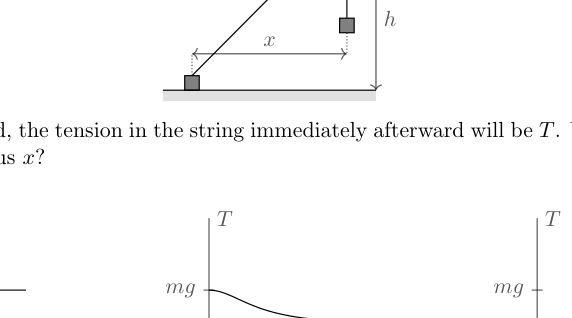 Asteroidi A B C e sonda P con masse e distanze
Topic: Gravitation, Newtonian Mechanics Metodi: Newton’s Law of Gravitation, Torque & Angular Momentum Analysis, Vector Decomposition Competenze: Diagrammatic Reasoning, Mathematical Modeling Objects: Satellite Fonte: Testo (PDF) — p.5
- Una sonda spaziale con massa al punto attraversa un ammasso di tre asteroidi, ai punti , e . Le masse e le posizioni degli asteroidi sono mostrate di seguito. P m C 3M A M B 2M d d d d Qual è la coppia della sonda circa il punto ?
- A.
- B.
- C.
- D.
- E.
Asteroidi A B C e sonda P con massa e distanza
Topic: Gravitation, Newtonian Mechanics Metodi: Newton’s Law of Gravitation, Torque & Angular Momentum Analysis, Vector Decomposition Competenze: Diagrammatic Reasoning, Mathematical Modeling Objects: Satellite Fonte: Testo (PDF) — p.5
- Two frictionless blocks of mass are connected by a massless string which passes through a fixed massless pulley, which is a height above the ground. Suppose the blocks are initially held with horizontal separation , and the length of the string is chosen so that the right block hangs in the air as shown. x h If the blocks are relased, the tension in the string immediately afterward will be . Which of the following shows a plot of versus ? (A) T x mg (B) T x mg (C) T x mg (D) T x mg (E) T x mg
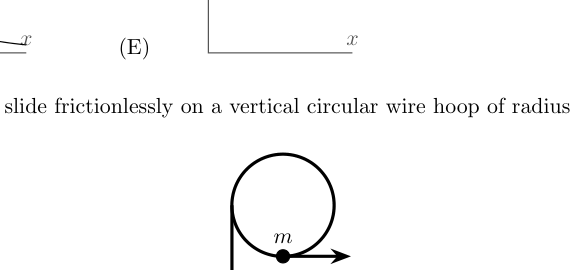 Due blocchi con corda e carrucola fissa
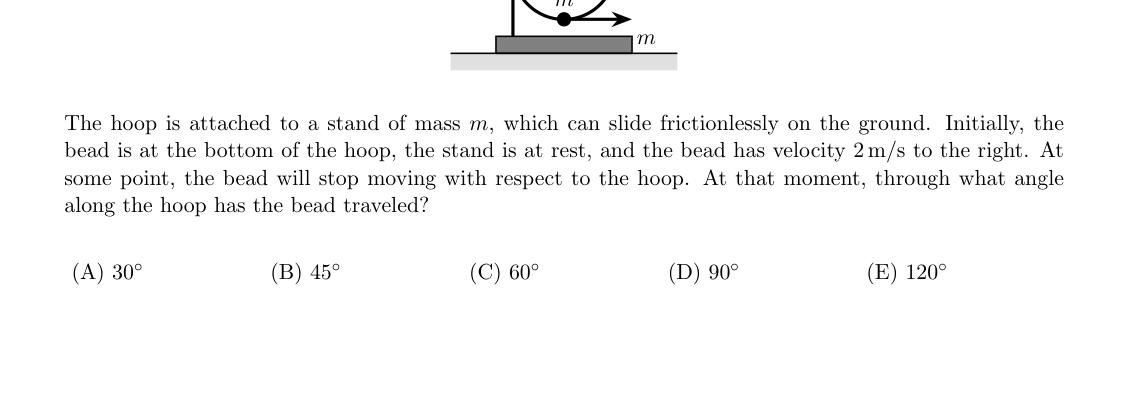 Cinque grafici tensione T vs separazione x
Topic: Newtonian Mechanics Metodi: Free-Body Diagram, Vector Decomposition, Kinematic Equations Competenze: Diagrammatic Reasoning, Mathematical Modeling Objects: Block, String, Pulley Fonte: Testo (PDF) — p.6
- Due blocchi senza attrito di massa sono collegati da una corda senza massa che passa attraverso un blocco fisso senza massa Pulley, che è un’altezza sopra il suolo. Supponiamo che i blocchi siano inizialmente tenuti con l’orizzontale Sezione , e la lunghezza della corda viene scelta in modo che il blocco destro sia appeso nell’aria come mostrato. x h Se i blocchi sono rilassati, la tensione della corda immediatamente successiva sarà . Qual è di seguito indicato: mostra un diagramma di rispetto a ? (A) T x mg (B) T x mg (C) T x mg (D) T x mg (E) T x mg
Due blocchi con corda e carcola fissa
*Cinque grafici tensione T vs separazione x *
Topic: Newtonian Mechanics Metodi: Free-Body Diagram, Vector Decomposition, Kinematic Equations Competenze: Diagrammatic Reasoning, Mathematical Modeling Objects: Block, String, Pulley Fonte: Testo (PDF) — p.6
- A bead of mass can slide frictionlessly on a vertical circular wire hoop of radius 20 cm. m m The hoop is attached to a stand of mass , which can slide frictionlessly on the ground. Initially, the bead is at the bottom of the hoop, the stand is at rest, and the bead has velocity 2 m/s to the right. At some point, the bead will stop moving with respect to the hoop. At that moment, through what angle along the hoop has the bead traveled?
- A.
- B.
- C.
- D.
- E.
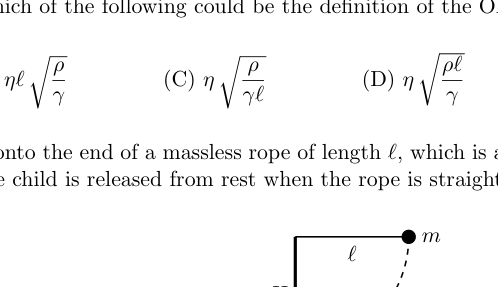 Perla su cerchio verticale con base scorrevole
Topic: Newtonian Mechanics, Conservation of Energy, Conservation of Momentum Metodi: Conservation of Energy, Conservation of Momentum, Free-Body Diagram Competenze: Physical Reasoning, Mathematical Modeling Objects: Ball, Wheel Fonte: Testo (PDF) — p.6
- Una manciata di massa può scivolare senza attrito su un cerchio di filo circolare verticale di raggio di 20 cm. m m Il cerchio è fissato ad un supporto di massa , che può scivolare senza attrito sul terreno. Inizialmente, il la perla è in fondo al cerchio, il supporto è in riposo e la perla ha velocità di 2 m/s a destra. At A un certo punto, la perla smetterà di muoversi rispetto al cerchio. In quel momento, da quale angolo Lungo l’orlo ha viaggiato la perla?
- A.
- B.
- C.
- D.
- E.
*Perla su cerchio verticale con base scorrevole *
Topic: Newtonian Mechanics, Conservation of Energy, Conservation of Momentum Metodi: Conservation of Energy, Conservation of Momentum, Free-Body Diagram Competenze: Physical Reasoning, Mathematical Modeling Objects: Ball, Wheel Fonte: Testo (PDF) — p.6
- The viscous force between two plates of area , with relative speed and separation , is , where is the viscosity. In fluid mechanics, the Ohnesorge number is a dimensionless number proportional to which characterizes the importance of viscous forces, in a drop of fluid of density , surface tension , and length scale . Which of the following could be the definition of the Ohnesorge number?
- A.
- B.
- C.
- D.
- E.
Topic: Fluid Mechanics Metodi: Dimensional Analysis Competenze: Mathematical Modeling, Physical Reasoning Objects: Droplet Fonte: Testo (PDF) — p.7
- La forza viscosa tra due lastre di superficie , con velocità relativa e separazione , è , dove è la viscosità. Nella meccanica dei fluidi, il numero di Ohnesorge è un numero senza dimensioni proporzionale a che caratterizza l’importanza delle forze viscose, in una goccia di fluido di densità , tensione superficiale e scala di lunghezza . Quale delle seguenti potrebbe essere la definizione del numero Ohnesorge?
- A.
- B.
- C.
- D.
- E.
Topic: Fluid Mechanics Metodi: Dimensional Analysis Competenze: Mathematical Modeling, Physical Reasoning Objects: Droplet Fonte: Testo (PDF) — p.7
- A child of mass holds onto the end of a massless rope of length , which is attached to a pivot a height above the ground. The child is released from rest when the rope is straight and horizontal. m H d At some point, the child lets go of the rope, flies through the air, and lands on the ground a horizontal distance from the pivot. On Earth, the maximum possible value of is . If the setup is moved to the Moon, which has 1/6 the gravitational acceleration, what is the new maximum possible value of ?
- A.
- B.
- C.
- D.
- E.
 Bambino su fune da perno altezza H
Topic: Newtonian Mechanics, Conservation of Energy Metodi: Energy Conservation Method, Kinematic Equations, Physical Modeling Competenze: Mathematical Modeling, Physical Reasoning, Estimation & Approximation Objects: Pendulum, String Fonte: Testo (PDF) — p.7
- Un bambino di massa si aggrappa alla fine di una corda senza massa di lunghezza , che è attaccata a un pivot ad un’altezza sopra il suolo. Il bambino viene liberato dal riposo quando la corda è dritta e orizzontale. m H d A un certo punto il bambino lascia andare la corda, vola in aria e atterra a terra in un’orizzontale Distanza dal pivot. Su Terra, il valore massimo possibile di è . Se l’impostazione viene spostata al Luna, che ha 1/6 dell’accelerazione gravitazionale, qual è il nuovo valore massimo possibile di ?
- A.
- B.
- C.
- D.
- E.
Bambino su fune da perno altezza H
Topic: Newtonian Mechanics, Conservation of Energy Metodi: Energy Conservation Method, Kinematic Equations, Physical Modeling Competenze: Mathematical Modeling, Physical Reasoning, Estimation & Approximation Objects: Pendulum, String Fonte: Testo (PDF) — p.7
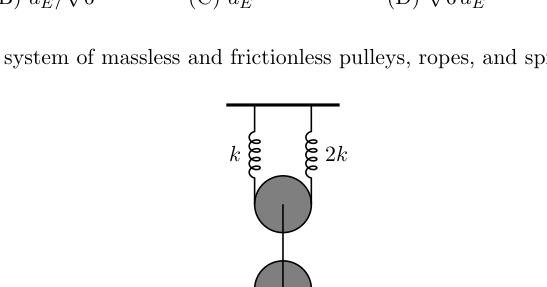
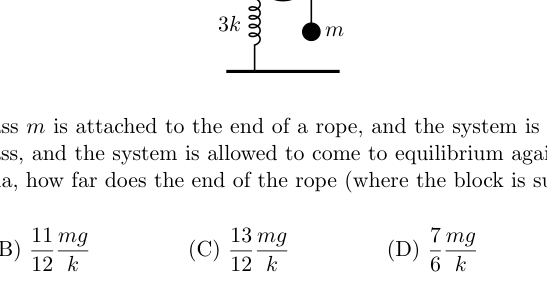
- Consider the following system of massless and frictionless pulleys, ropes, and springs. 2k k 3k m Initially, a block of mass is attached to the end of a rope, and the system is in equilibrium. Next the block is doubled in mass, and the system is allowed to come to equilibrium again. During the transition between these equilibria, how far does the end of the rope (where the block is suspended) move?
- A.
- B.
- C.
- D.
- E.
 Sistema pulegge molle 2k k 3k con massa
Topic: Newtonian Mechanics Metodi: Free-Body Diagram, Hooke’s Law, Physical Modeling Competenze: Diagrammatic Reasoning, Mathematical Modeling Objects: Pulley, String, Spring, Block Fonte: Testo (PDF) — p.7
- Considerate il seguente sistema di polle, corde e molle senza massa e senza attrito. 2k k 3k m Inizialmente, un blocco di massa è attaccato alla fine di una corda e il sistema è in equilibrio. - E poi Il blocco è raddoppiato in massa e il sistema è permesso di tornare in equilibrio. Durante la transizione tra questi equilibri, quanto si muove la fine della corda (dove il blocco è sospeso)?
- A.
- B.
- C.
- D.
- E.
Sistema pulegge molle 2k k 3k con massa
Topic: Newtonian Mechanics Metodi: Free-Body Diagram, Hooke’s Law, Physical Modeling Competenze: Diagrammatic Reasoning, Mathematical Modeling Objects: Pulley, String, Spring, Block Fonte: Testo (PDF) — p.7
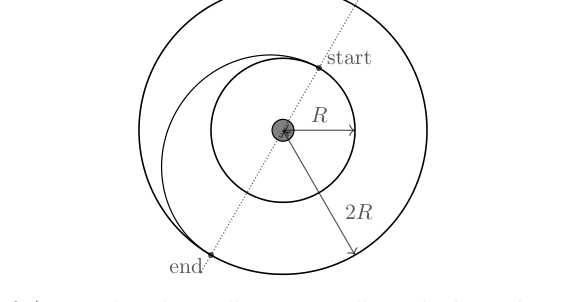
- A satellite is initially in a circular orbit of radius around a planet of mass . It fires its rockets to instantaneously increase its speed by , keeping the direction of its velocity the same, so that it enters an elliptical orbit whose maximum distance from the planet is . start end R 2R What is the value of ? (Hint: when the satellite is in an elliptical orbit with semimajor axis , its total energy per unit mass is .)
- A.
- B.
- C.
- D.
- E.
 Orbita circolare e ellittica satellite R e 2R
Topic: Gravitation, Conservation of Energy Metodi: Energy Conservation Method, Conservation of Momentum, Newton’s Law of Gravitation, Kepler’s Laws Competenze: Mathematical Modeling, Physical Reasoning Objects: Satellite, Planet Fonte: Testo (PDF) — p.8
- Un satellite è inizialmente in orbita circolare di raggio attorno a un pianeta di massa . Scapa i suoi razzi aumentare istantaneamente la sua velocità di , mantenendo la direzione della sua velocità uguale, in modo che entri un’orbita ellittica la cui distanza massima dal pianeta è . Iniziare fine R 2R Qual è il valore di ? (Signore: quando il satellite è in orbita ellittica con asse semimajor , il suo totale è di energia per unità di massa è .)
- A.
- B.
- C.
- D.
- E.
*Orbita circolare e satellite ellittica R e 2R *
Topic: Gravitation, Conservation of Energy Metodi: Energy Conservation Method, Conservation of Momentum, Newton’s Law of Gravitation, Kepler’s Laws Competenze: Mathematical Modeling, Physical Reasoning Objects: Satellite, Planet Fonte: Testo (PDF) — p.8
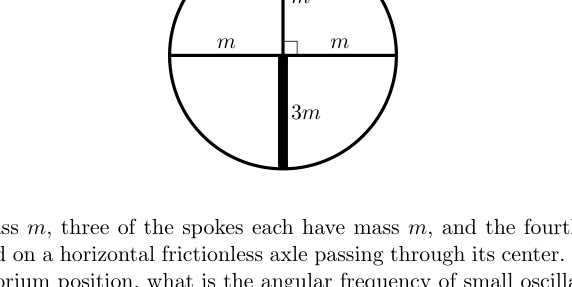
- A wheel of radius has a thin rim and four spokes, each of which have uniform density. m m m 3m m The entire rim has mass , three of the spokes each have mass , and the fourth spoke has mass . The wheel is suspended on a horizontal frictionless axle passing through its center. If the wheel is slightly rotated from its equilibrium position, what is the angular frequency of small oscillations?
- A.
- B.
- C.
- D.
- E.
 Ruota con quattro razze masse m e 3m
Topic: Rotational Dynamics, Oscillations & Waves Metodi: Torque & Angular Momentum Analysis, Simple Harmonic Motion Analysis, Physical Modeling Competenze: Mathematical Modeling, Physical Reasoning Objects: Wheel Fonte: Testo (PDF) — p.8
- Una ruota di raggio ha un bordo sottile e quattro spine, ognuna delle quali ha una densità uniforme. m m m 3m m L’intero bordo ha massa , tre delle spine hanno massa e la quarta spina ha massa . La ruota è sospesa su un asse orizzontale senza attrito che attraversa il suo centro. Se la ruota è leggermente se si ruota dalla sua posizione di equilibrio, qual è la frequenza angolare delle piccole oscillazioni?
- A.
- B.
- C.
- D.
- E.
*Rota con quattro razze mass m e 3 m *
Topic: Rotational Dynamics, Oscillations & Waves Metodi: Torque & Angular Momentum Analysis, Simple Harmonic Motion Analysis, Physical Modeling Competenze: Mathematical Modeling, Physical Reasoning Objects: Wheel Fonte: Testo (PDF) — p.8
- Four massless rigid rods are connected into a quadrilateral by four hinges. The hinges have mass , and allow the rods to freely rotate. A spring of spring constant is connected across each of the diagonals, so that the springs are at their relaxed length when the rods form a square. m m m m k k Assume the springs do not interfere with each other. If the square is slightly compressed along one of its diagonals, its shape will oscillate over time. What is the period of these oscillations?
- A.
- B.
- C.
- D.
- E.
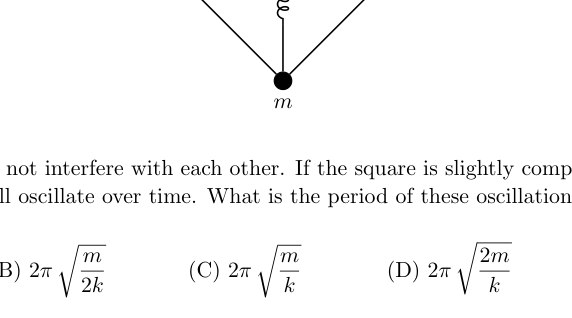 Quadrilatero con molle sulle diagonali
Topic: Oscillations & Waves, Newtonian Mechanics Metodi: Simple Harmonic Motion Analysis, Hooke’s Law, Symmetry Argument Competenze: Mathematical Modeling, Physical Reasoning Objects: Rod, Spring Fonte: Testo (PDF) — p.9
- Quattro barre rigide senza massa sono collegate in un quadrilaterale da quattro cerniere. Le cerniere hanno una massa e consentire alle barre di girare liberamente. Un molle di costante di molle è collegato su ciascuna diagonale, quindi che le sorgenti sono a lungo e rilassate quando le barre formano un quadrato. m m m m k k Supponiamo che le sorgenti non si interferiscano tra loro. Se il quadrato è leggermente compresso lungo uno dei suoi diagonali, la sua forma oscillerà nel tempo. Qual è il periodo di queste oscillazioni?
- A.
- B.
- C.
- D.
- E.
Quadrilatore con molle sulle diagonali
Topic: Oscillations & Waves, Newtonian Mechanics Metodi: Simple Harmonic Motion Analysis, Hooke’s Law, Symmetry Argument Competenze: Mathematical Modeling, Physical Reasoning Objects: Rod, Spring Fonte: Testo (PDF) — p.9
- A syringe is filled with water of density and negligible viscosity. Its body is a cylinder of cross-sectional area , which gradually tapers into a needle with cross-sectional area . The syringe is held in place and its end is slowly pushed inward by a force , so that it moves with constant speed . Water shoots straight out of the needle’s tip. What is the approximate value of ?
- A.
- B.
- C.
- D.
- E.
Topic: Fluid Mechanics Metodi: Bernoulli’s Equation, Continuity Equation, Approximation & Series Expansion Competenze: Mathematical Modeling, Physical Reasoning Objects: Tube, Piston Fonte: Testo (PDF) — p.9
- Una siringa è riempita di acqua di densità e di viscosità trascurabile. Il suo corpo è un cilindro di sezione trasversale area , che si abbatte gradualmente in un ago con area trasversale . La siringa è tenuta dentro il punto e la sua estremità sono spinti lentamente verso l’interno da una forza , in modo che si muova a velocità costante . Acqua spara direttamente dalla punta dell’ ago. Qual è il valore approssimativo di ?
- A.
- B.
- C.
- D.
- E.
Topic: Fluid Mechanics Metodi: Bernoulli’s Equation, Continuity Equation, Approximation & Series Expansion Competenze: Mathematical Modeling, Physical Reasoning Objects: Tube, Piston Fonte: Testo (PDF) — p.9
- A spherical shell is made from a thin sheet of material with a mass per area of . Consider two points, and , which are close to each other, but just inside and outside the sphere, respectively. If the accelerations due to gravity at these points are and , respectively, what is the value of ?
- A.
- B.
- C.
- D.
- E.
Topic: Gravitation Metodi: Newton’s Law of Gravitation, Gauss’s Law, Symmetry Argument Competenze: Mathematical Modeling, Physical Reasoning Objects: Sphere Fonte: Testo (PDF) — p.9
- Un guscio sferico è realizzato da un sottile foglio di materiale con una massa per superficie di . Considerate due punti: e , che sono vicini l’uno all’altro, ma solo all’interno e all’esterno della sfera, rispettivamente. Se il le accelerazioni dovute alla gravità in questi punti sono e , rispettivamente, qual è il valore di ?
- A.
- B.
- C.
- D.
- E.
Topic: Gravitation Metodi: Newton’s Law of Gravitation, Gauss’s Law, Symmetry Argument Competenze: Mathematical Modeling, Physical Reasoning Objects: Sphere Fonte: Testo (PDF) — p.9
- Collisions between ping pong balls and paddles are not perfectly elastic. Suppose that if a player holds a paddle still and drops a ball on top of it from any height , it will bounce back up to height . To keep the ball bouncing steadily, the player moves the paddle up and down, so that it is moving upward with speed 1.0 m/s whenever the ball hits it. What is the height to which the ball is bouncing?
- A. 0.21 m
- B. 0.45 m
- C. 1.0 m
- D. 1.7 m
- E. There is not enough information to determine the height.
Topic: Newtonian Mechanics, Conservation of Energy Metodi: Conservation of Momentum, Energy Conservation Method, Impulse-Momentum Theorem Competenze: Physical Reasoning, Mathematical Modeling Objects: Ball Fonte: Testo (PDF) — p.9
- Le collisioni tra palle di ping-pong e paddle non sono perfettamente elastic. Supponiamo che se un giocatore se una paga ferma e si lascia cadere una palla sopra da qualsiasi altezza , rimbalzerà fino a . To mantenere la palla in salto costante, il giocatore muove la pagaia su e giù, in modo che si muova verso l’alto con velocità di 1,0 m/s ogni volta che la palla lo colpisce. A che altezza sta saltando la palla?
- A. 0.21 m
- B. 0.45 m
- C. 1.0 m
- D. 1.7 m
- E. Non ci sono informazioni sufficienti per determinare l’altezza.
Topic: Newtonian Mechanics, Conservation of Energy Metodi: Conservation of Momentum, Energy Conservation Method, Impulse-Momentum Theorem Competenze: Physical Reasoning, Mathematical Modeling Objects: Ball Fonte: Testo (PDF) — p.9
- When a projectile falls through a fluid, it experiences a drag force proportional to the product of its cross-sectional area, the fluid density , and the square of its speed. Suppose a sphere of density of radius is dropped in the fluid from rest. When the projectile has reached half of its terminal velocity, which of the following is its displacement proportional to?
- A.
- B.
- C.
- D.
- E.
Topic: Fluid Mechanics, Newtonian Mechanics Metodi: Differential Equations, Dimensional Analysis, Physical Modeling Competenze: Mathematical Modeling, Physical Reasoning, Estimation & Approximation Objects: Sphere, Projectile Fonte: Testo (PDF) — p.10
- Quando un proiettile cade attraverso un fluido, subisce una forza di trazione proporzionale al prodotto del suo area di sezione trasversale, densità del fluido e quadrato della sua velocità. Supponiamo una sfera di densità di raggio viene rilasciato nel liquido dal riposo. Quando il proiettile raggiunge la metà della sua velocità terminale, quale dei seguenti è proporzionale al suo spostamento?
- A.
- B.
- C.
- D.
- E.
Topic: Fluid Mechanics, Newtonian Mechanics Metodi: Differential Equations, Dimensional Analysis, Physical Modeling Competenze: Mathematical Modeling, Physical Reasoning, Estimation & Approximation Objects: Sphere, Projectile Fonte: Testo (PDF) — p.10
- A yo-yo consists of two massive uniform disks of radius connected by a thin axle. A thick string is wrapped many times around the axle, so that the end of the string is initially a distance from the axle. Then, the end of the string is held in place and the yo-yo is dropped from rest. Assume that energy losses are negligible, and that the string has negligible mass and always remains vertical. Below, we show a cross-section of the yo-yo partway through its descent. Between the moment the yo-yo is released and the moment the string completely unwinds, which of the following is true regarding the yo-yo’s acceleration?
- A. It is always zero.
- B. It points downward, but decreases in magnitude over time.
- C. It points downward and has constant magnitude.
- D. It points downward, but increases in magnitude over time.
- E. None of the above.
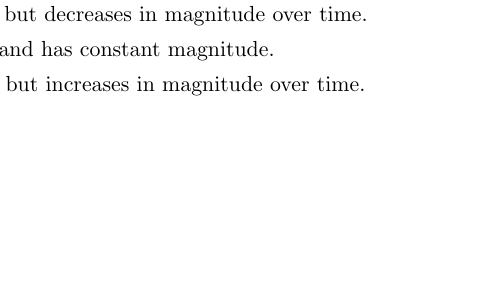 Sezione trasversale yo-yo in discesa
Topic: Rotational Dynamics, Conservation of Energy Metodi: Torque & Angular Momentum Analysis, Energy Conservation Method, Physical Modeling Competenze: Physical Reasoning, Mathematical Modeling Objects: Disk, String Fonte: Testo (PDF) — p.10
- Un yo-yo è costituito da due dischi massicci uniformi di raggio collegati da un asse sottile. Una corda spessa è avvolto molte volte intorno all’asse, in modo che la fine della corda sia inizialmente distante dall’asse. Poi, la fine della corda viene tenuta in posizione e il yo-yo viene lasciato cadere dal riposo. Supponiamo che le perdite energetiche Le stringa non sono più di una massa trascurabile e rimane sempre verticale. Qui sotto, mostreremo un sezione trasversale della mezza via yo-yo attraverso la sua discesa. Tra il momento in cui il yo-yo viene rilasciato e il momento in cui la corda si allontana completamente, quale dei due la seguente è vera per quanto riguarda l’accelerazione yo-yo?
- A. È sempre zero.
- B. Indica verso il basso, ma diminuisce di magnitudo nel tempo.
- C. Indica verso il basso e ha una grandezza costante.
- D. Indica verso il basso, ma aumenta di magnitudo nel tempo.
- E. Nessuna delle seguenti.
Sezione trasversale yo-yo in discesa
Topic: Rotational Dynamics, Conservation of Energy Metodi: Torque & Angular Momentum Analysis, Energy Conservation Method, Physical Modeling Competenze: Physical Reasoning, Mathematical Modeling Objects: Disk, String Fonte: Testo (PDF) — p.10