A stone is dropped from rest from a height of 5.0 m above the water surface of a pool. After hitting the water, it sinks to the bottom, 4.0 m below the surface. If it sinks with the same speed as it struck the water, for how long is the stone in motion?
Topic: Newtonian Mechanics Metodi: Kinematic Equations Competenze: Mathematical Modeling, Physical Reasoning Objects: — Fonte: Testo (PDF) — p.3
Una pietra viene abbassata dal riposo da un’altezza di 5,0 m sopra la superficie dell’acqua di una piscina. Dopo aver colpito l’acqua, affonda al fondo, a 4,0 metri sotto la superficie. Se affonda con la stessa velocità con cui colpisce l’acqua, per quanto tempo la pietra è in movimento?
Topic: Newtonian Mechanics Metodi: Kinematic Equations Competenze: Mathematical Modeling, Physical Reasoning Objects: — Fonte: Testo (PDF) — p.3
The Earth orbits the Sun at a distance of 8.0 light minutes away. The Sun lies at a position in the Milky Way galaxy at about 8.3 kpc from the centre. The galaxy rotates about the galactic centre with an orbital period of 240 million years. What is the value of the orbital speed of the Solar System in the galaxy divided by the orbital speed of the Earth about the Sun?
1.00 pc (parsec) = 3.26 light years
Topic: Astrophysics, Newtonian Mechanics Metodi: Kinematic Equations, Order-of-Magnitude Estimation Competenze: Mathematical Modeling, Physical Reasoning Objects: Planet, Star Fonte: Testo (PDF) — p.3
La Terra orbita intorno al Sole a una distanza di 8,0 minuti luce. Il Sole si trova in una posizione nella Via Lattea a circa 8,3 kpc dal centro. La galassia ruota intorno al centro galattico con un periodo orbitale di 240 milioni di anni. Qual è il valore della velocità orbitale del Sistema Solare nella galassia divisa dalla velocità orbitale della Terra attorno al Sole?
1,00 pc (parsec) = 3,26 anni luce
Topic: Astrophysics, Newtonian Mechanics Metodi: Kinematic Equations, Order-of-Magnitude Estimation Competenze: Mathematical Modeling, Physical Reasoning Objects: Planet, Star Fonte: Testo (PDF) — p.3
A spring with spring constant sits on the floor of an elevator with a mass resting on top. The elevator then accelerates upwards and uniformly from zero to 18 m s in 6 s.
What is the ratio , where is the initial contraction in length of the spring when the lift is stationary, and is the contraction measured when the lift is accelerating?
Topic: Newtonian Mechanics Metodi: Free-Body Diagram, Kinematic Equations Competenze: Mathematical Modeling, Physical Reasoning Objects: Spring, Block Fonte: Testo (PDF) — p.3
Una molla con costante molla si trova sul pavimento di un ascensore con una massa appoggiata in cima. L’ascensore si accelera quindi in modo uniforme verso l’alto da zero a 18 m s in 6 s.
Qual è il rapporto , dove è la contrazione iniziale nella lunghezza della molla quando l’ascensore è fermo e è la contrazione misurata quando l’ascensore si accelera?
Topic: Newtonian Mechanics Metodi: Free-Body Diagram, Kinematic Equations Competenze: Mathematical Modeling, Physical Reasoning Objects: Spring, Block Fonte: Testo (PDF) — p.3
A mass hangs from the end of a light string of length , which is attached to a point on the ceiling. It is set in motion so that the mass moves in a horizontal circle of radius with the string at angle to the vertical as it traces out the curved surface of a cone.
(i) By resolving the forces on the mass, obtain an expression for the period of orbit, , of the mass, in terms of , and .
(ii) Substitute for to express the period of orbit in terms of , and .
Topic: Newtonian Mechanics, Oscillations & Waves Metodi: Free-Body Diagram, Kinematic Equations Competenze: Mathematical Modeling, Physical Reasoning Objects: Pendulum, String Fonte: Testo (PDF) — p.3
Una massa è appesa alla fine di una stringa di luce di lunghezza , che è fissata a un punto del soffitto. È impostato in movimento in modo che la massa si muova in un cerchio orizzontale di raggio con la corda ad angolo verso la verticale mentre traccia la superficie curva di un cono.
(i) Risolvendo le forze sulla massa, si ottiene un’espressione per il periodo di orbita, , della massa, in termini di , e .
(ii) Sostituire per esprimere il periodo di orbita in termini di , e .
Topic: Newtonian Mechanics, Oscillations & Waves Metodi: Free-Body Diagram, Kinematic Equations Competenze: Mathematical Modeling, Physical Reasoning Objects: Pendulum, String Fonte: Testo (PDF) — p.3
A light lever in the form of a letter L, with arms AB, BC of lengths , , is smoothly pivoted at B so that it can turn in a vertical plane. Masses and are attached at A and C respectively. In an equilibrium position, the inclination of AB to the vertical is given by angle . Obtain an expression for in terms of , , and .
Topic: Rigid Body Statics Metodi: Torque & Angular Momentum Analysis, Free-Body Diagram Competenze: Mathematical Modeling, Physical Reasoning Objects: Lever, Rod Fonte: Testo (PDF) — p.3
Una leva leggera a forma di lettera L, con braccia AB, BC di lunghezza , , è rotata in modo liscio a B in modo da poter girare in piano verticale. Le masse e sono fissate rispettivamente a A e C. In posizione di equilibrio, l’inclinazione di AB verso la verticale è data da un angolo . Ottenere un’espressione per in termini di , , e .
Topic: Rigid Body Statics Metodi: Torque & Angular Momentum Analysis, Free-Body Diagram Competenze: Mathematical Modeling, Physical Reasoning Objects: Lever, Rod Fonte: Testo (PDF) — p.3
A heavy uniform plank of length and mass , is fixed to the ground at its lower end by a smooth hinge. Initially, it stands upright next to a stationary trolley of mass and height , as shown in Fig. 1. The plank is disturbed and it tips over, pushing the trolley along horizontally with the smooth flat surface of the plank pushing the top rear corner of the trolley.
When the plank is falling over, the top end swings in a circle at speed , such that the plank’s rotational kinetic energy about the pivot at the lower fixed end is given by .
At the moment the top of the plank reaches the top corner of the trolley, obtain an expression for the speed of the trolley, , in terms of and , given and .
Neglect friction in this question.
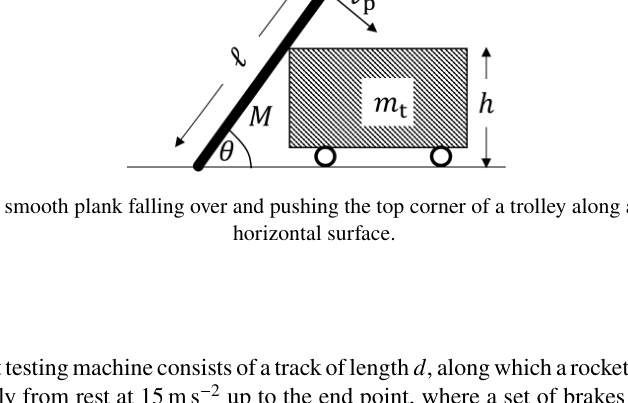 Plank falling over pushing trolley corner
Topic: Rotational Dynamics, Newtonian Mechanics Metodi: Conservation of Energy, Torque & Angular Momentum Analysis, Conservation of Momentum Competenze: Mathematical Modeling, Physical Reasoning Objects: Beam, Cart Fonte: Testo (PDF) — p.4
Una piastra pesante uniforme di lunghezza e massa , è fissata al suolo alla sua estremità inferiore da una cerniera liscia. Inizialmente, si trova verticalmente accanto a un carrello stazionario di massa e altezza , come mostrato nella figura. 1. La tavola è disturbata e si inclina, spingendo il carrello orizzontalmente con la superficie liscia e piatta della tavola spingendo l’angolo posteriore superiore del carrello.
Quando la tavola cade, l’estremità superiore oscilla in un cerchio a velocità , in modo tale che l’energia cinetica di rotazione della tavola intorno al pivot alla fine fissa inferiore è data da .
Nel momento in cui la parte superiore della tavola raggiunge l’angolo superiore del carrello, si ottiene un’espressione per la velocità del carrello, , in termini di e , data e .
Non si tratta di attrito.
*Planco che cade sopra angolo del carrello *
Topic: Rotational Dynamics, Newtonian Mechanics Metodi: Conservation of Energy, Torque & Angular Momentum Analysis, Conservation of Momentum Competenze: Mathematical Modeling, Physical Reasoning Objects: Beam, Cart Fonte: Testo (PDF) — p.4
A rocket testing machine consists of a track of length , along which a rocket can accelerate uniformly from rest at 15 m s up to the end point, where a set of brakes rapidly brings it to rest in a negligible time. It is then drawn back to the start at a constant speed of m s. If the time taken from firing the rocket to its return to the starting point is 48 s, what is the length of the track, ?
Topic: Newtonian Mechanics Metodi: Kinematic Equations Competenze: Mathematical Modeling, Physical Reasoning Objects: — Fonte: Testo (PDF) — p.4
Una macchina di prova dei razzi è costituita da una pista di lunghezza , lungo la quale un razzo può accelerare uniformemente dal riposo a 15 m s fino al punto finale, dove un insieme di freni lo porta rapidamente a riposo in un tempo trascurabile. Il sistema di controllo è quindi riportato all’inizio a una velocità costante di m s. Se il tempo necessario per il lancio del razzo fino al suo ritorno al punto di partenza è di 48 s, quale è la lunghezza della pista, ?
Topic: Newtonian Mechanics Metodi: Kinematic Equations Competenze: Mathematical Modeling, Physical Reasoning Objects: — Fonte: Testo (PDF) — p.4
The displacement of a point in an elastic medium when a wave passes through depends on the time and the location of the point, relative to the starting time and the origin. The displacement is obtained from the phase of the wave at that point, which is the sum of the phases due to the time increment and the relative distance from the origin. The displacement of a point at and , is given by
(Units are given in brackets)
(i) Determine the amplitude, frequency, wavelength, and speed of the wave.
(ii) What is the maximum speed of motion of the point in the medium?
Topic: Oscillations & Waves Metodi: Wave Equation, Simple Harmonic Motion Analysis Competenze: Mathematical Modeling, Physical Reasoning Objects: — Fonte: Testo (PDF) — p.4
Il spostamento di un punto in un mezzo elastico quando una onda passa dipende dal tempo e dalla posizione del punto, rispetto al tempo di partenza e all’origine. Il spostamento è ottenuto dalla fase dell’onda in quel punto, che è la somma delle fasi dovute all’incremento temporale e alla distanza relativa dall’origine. Il spostamento di un punto a e è dato da:
(Le unità sono indicate in parentesi)
(i) Determinare l’ampiezza, la frequenza, la lunghezza d’onda e la velocità dell’onda.
(ii) Qual è la velocità massima di movimento del punto nel mezzo?
Topic: Oscillations & Waves Metodi: Wave Equation, Simple Harmonic Motion Analysis Competenze: Mathematical Modeling, Physical Reasoning Objects: — Fonte: Testo (PDF) — p.4
Beats are produced when two waves of similar frequencies interfere, causing slowly varying constructive and destructive interference. If the frequencies differ by 1 Hz then the constructive to destructive to constructive interference will occur once each second, giving a beat frequency of 1 Hz.
A siren producing a note of 256 Hz and an organ pipe of slightly lower frequency full of air at 17°C, when played together give a beat frequency of 4 Hz. On slowly changing the temperature of the air in the pipe, the beat frequency first reduces to zero and then increases again to 4 Hz. What is the change in temperature of the air in the pipe?
The speed of a wave in air is given by where is a numerical constant, is the pressure and is the density of the air.
Topic: Oscillations & Waves, Thermodynamics Metodi: Wave Equation, Ideal Gas Law Competenze: Mathematical Modeling, Physical Reasoning Objects: Tube Fonte: Testo (PDF) — p.5
I battiti sono prodotti quando due onde di frequenze simili interferiscono, causando interferenze costruttive e distruttive che variano lentamente. Se le frequenze differiscono di 1 Hz, allora l’interferenza costruttiva a distruttiva a costruttiva si verificherà una volta ogni secondo, dando una frequenza di battito di 1 Hz.
Una sirena che produce una nota di 256 Hz e un tubo di organo di frequenza leggermente inferiore pieno di aria a 17°C, quando suonata insieme, danno una frequenza di battito di 4 Hz. Al cambiare lentamente la temperatura dell’aria nel tubo, la frequenza di battuta si riduce prima a zero e poi aumenta di nuovo a 4 Hz. Qual è il cambiamento di temperatura dell’aria nella tubazione?
La velocità di un’onda nell’aria è data da , dove è una costante numerica, è la pressione e è la densità dell’aria.
Topic: Oscillations & Waves, Thermodynamics Metodi: Wave Equation, Ideal Gas Law Competenze: Mathematical Modeling, Physical Reasoning Objects: Tube Fonte: Testo (PDF) — p.5
Pure water can be cooled down to C without freezing. If a small piece of ice is dropped into this supercooled water held in a thermally insulated container, some of the water immediately freezes. What fraction will freeze?
J kg
J kg °C
Topic: Thermodynamics Metodi: First Law of Thermodynamics, Conservation of Energy Competenze: Mathematical Modeling, Physical Reasoning Objects: Container Fonte: Testo (PDF) — p.5
L’acqua pura può essere raffreddata a C senza congelamento. Se un piccolo pezzo di ghiaccio viene gettato in questa acqua super raffreddata contenuta in un contenitore termicamente isolato, parte dell’acqua congela immediatamente. Quale frazione si congela?
J kg
J kg °C
Topic: Thermodynamics Metodi: First Law of Thermodynamics, Conservation of Energy Competenze: Mathematical Modeling, Physical Reasoning Objects: Container Fonte: Testo (PDF) — p.5
A circuit with an ideal diode in series with a resistor is shown in Fig. 2. Two supply voltages each with amplitude and frequency are also shown: in (a) as a square wave, and (b) a sinusoidal variation with time. Obtain expressions for the average power dissipated in the resistor for
(i) the square wave signal shown in (a), and
(ii) for the sinusoidal variation shown in (b).
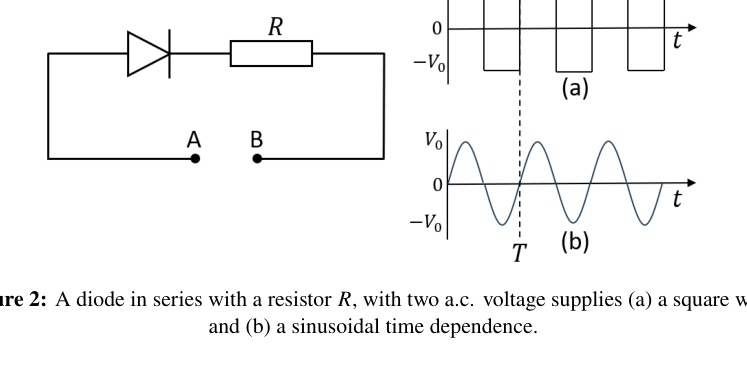 Diode-resistor circuit with square and sine wave supply
Topic: Circuits Metodi: Kirchhoff’s Laws, Physical Modeling Competenze: Mathematical Modeling, Physical Reasoning Objects: Resistor Fonte: Testo (PDF) — p.5
Il quadro mostra un circuito con una diodo ideale in serie con una resistenza . 2. Sono inoltre mostrate due tensioni di alimentazione, ciascuna con amplitudine e frequenza : a) come onda quadrata e b) una variazione sinusoidale nel tempo. Ottenere espressioni per la potenza media dissipata nella resistenza per
-
il segnale di onda quadrata indicato alla lettera a), e
-
per la variazione sinusoidale indicata alla lettera b).
Circuito di resistenza a diodi con alimentazione a onde quadrate e sinusoide
Topic: Circuits Metodi: Kirchhoff’s Laws, Physical Modeling Competenze: Mathematical Modeling, Physical Reasoning Objects: Resistor Fonte: Testo (PDF) — p.5
A uniform wire of resistance per unit length is formed into a square of side , with diagonals that are connected at the centre. This is shown in Fig. 3. Obtain an expression for the resistance between points A and B at the corners of the square, in terms of and . Give your answer in surds.
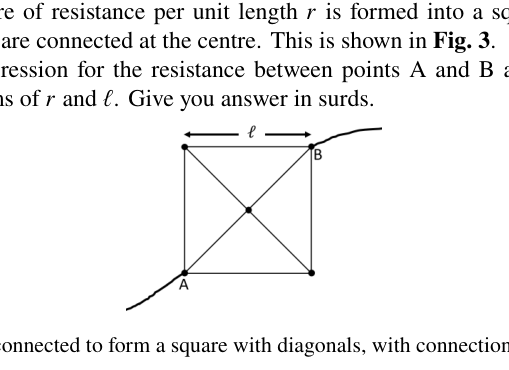 Wire square with diagonals, contacts at A and B
Topic: Circuits Metodi: Equivalent Circuit Reduction, Kirchhoff’s Laws Competenze: Mathematical Modeling, Physical Reasoning Objects: Wire Fonte: Testo (PDF) — p.6
Un filo uniforme di resistenza per lunghezza è formato in un quadrato laterale , con diagonali collegati al centro. Questo è mostrato nella figura. 3. Ottenere un’espressione della resistenza tra i punti A e B negli angoli del quadrato, in termini di e . Rispondi in sordo.
Cabrato di fili con diagonali, contatti a A e B
Topic: Circuits Metodi: Equivalent Circuit Reduction, Kirchhoff’s Laws Competenze: Mathematical Modeling, Physical Reasoning Objects: Wire Fonte: Testo (PDF) — p.6
A length of resistance wire of diameter 1.4 mm and resistivity Ω m is bent to form a circle, as shown in Fig. 4. The radius of the circle is 10 cm. Two conducting wires are connected at points A and B, such that the contact B can slide around the circle.
(i) Calculate the maximum resistance that can exist between A and B.
(ii) Sketch a graph of the resistance between A and B against the arc length measured from A as contact B is slid from A around the circle and back to A on the other side.
(iii) What is the shortest length of the arc between A and B such that the resistance between A and B is 22.0 Ω?
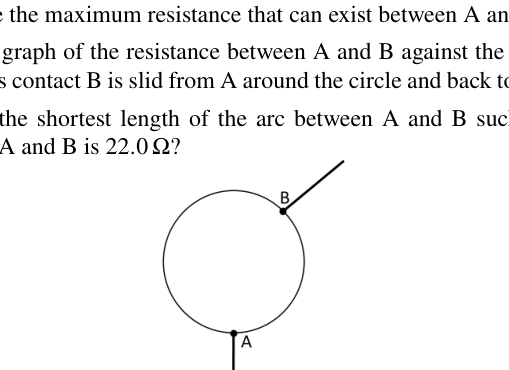 Circular resistance wire with sliding contact B
Topic: Circuits Metodi: Equivalent Circuit Reduction, Physical Modeling Competenze: Mathematical Modeling, Physical Reasoning Objects: Wire Fonte: Testo (PDF) — p.6
Una lunghezza di filo resistente di diametro 1,4 mm e resistenza Ω m è piegata per formare un cerchio, come mostrato nella figura. 4. Il raggio del cerchio è di 10 cm. Due fili conduttori sono collegati ai punti A e B, in modo che il contatto B possa scivolare intorno al cerchio.
(i) Calcolare la resistenza massima che può esistere tra A e B.
(ii) Segnare un grafico della resistenza tra A e B rispetto alla lunghezza d’arco misurata da A mentre il contatto B viene scivolato da A intorno al cerchio e di nuovo a A dall’altro lato.
(iii) Qual è la lunghezza più breve dell’arco tra A e B tale che la resistenza tra A e B sia di 22,0 Ω?
*Circolo di resistenza con contatto scorrevole B *
Topic: Circuits Metodi: Equivalent Circuit Reduction, Physical Modeling Competenze: Mathematical Modeling, Physical Reasoning Objects: Wire Fonte: Testo (PDF) — p.6
Before a device is fully charged, the current flowing into it at a time is given by where is the initial current.
(i) How long does it take to charge it, and
(ii) how much charge is accumulated?
Topic: Circuits Metodi: Calculus-Integration, Differential Equations Competenze: Mathematical Modeling, Physical Reasoning Objects: — Fonte: Testo (PDF) — p.6
Prima che un dispositivo sia completamente carico, la corrente che ne scorre a un momento è data da dove è la corrente iniziale.
(i) Quanto tempo ci vuole per caricarlo; e
- quanto carico viene accumulato?
Topic: Circuits Metodi: Calculus-Integration, Differential Equations Competenze: Mathematical Modeling, Physical Reasoning Objects: — Fonte: Testo (PDF) — p.6
A cone of circular cross section sits in a liquid of density with apex pointing down and its base level with the surface of the liquid. The density of the cone varies linearly along its length. The base of the cone has a density half that of the liquid. What is the ratio of the density of the apex, , to the density of the liquid?
Topic: Fluid Mechanics Metodi: Hydrostatic Equilibrium, Calculus-Integration Competenze: Mathematical Modeling, Physical Reasoning Objects: — Fonte: Testo (PDF) — p.7
Un cono di sezione incrociata circolare si trova in un liquido di densità con l’apice puntato verso il basso e il suo livello base con la superficie del liquido. La densità del cono varia linearmente lungo la sua lunghezza. La base del cono ha una densità della metà del liquido. Qual è il rapporto tra la densità dell’apice, , e la densità del liquido?
Topic: Fluid Mechanics Metodi: Hydrostatic Equilibrium, Calculus-Integration Competenze: Mathematical Modeling, Physical Reasoning Objects: — Fonte: Testo (PDF) — p.7
An elastic material called neoprene is used within sections of motorway roads in hot countries to maintain a flat road with no discontinuities under different temperatures. If we have a road built with 2.0 cm of neoprene placed between every 20 m lengths of concrete, and the concrete has a thermal expansion coefficient of K, what is the highest temperature it can go up to before the road cracks? Assume that the elastic material is initially under no deformation at a temperature of 20°C. Thermal expansion coefficient is specified by in which is the expanded length, the initial length, and the temperature rise.
Young’s Modulus of neoprene MPa
Breaking stress of concrete MPa
Topic: Elasticity & Materials, Thermodynamics Metodi: Stress-Strain Analysis, Physical Modeling Competenze: Mathematical Modeling, Physical Reasoning Objects: — Fonte: Testo (PDF) — p.7
Un materiale elastico chiamato neoprene viene utilizzato in sezioni di autostrade nei paesi caldi per mantenere una strada piatta senza discontinuità a diverse temperature. Se abbiamo una strada costruita con 2,0 cm di neoprene, posta tra ogni 20 m di lunghezza di calcestruzzo, e il calcestruzzo ha un coefficiente di espansione termica di K, quale è la temperatura più alta che può raggiungere prima che la strada si spaccino? Supponiamo che il materiale elastico non sia inizialmente deformato a una temperatura di 20°C. Il coefficiente di espansione termico è specificato da in cui è la lunghezza ampliata, la lunghezza iniziale e l’aumento della temperatura.
Modulo di neoprene di Young MPa
Tensione di rottura del calcestruzzo MPa
Topic: Elasticity & Materials, Thermodynamics Metodi: Stress-Strain Analysis, Physical Modeling Competenze: Mathematical Modeling, Physical Reasoning Objects: — Fonte: Testo (PDF) — p.7
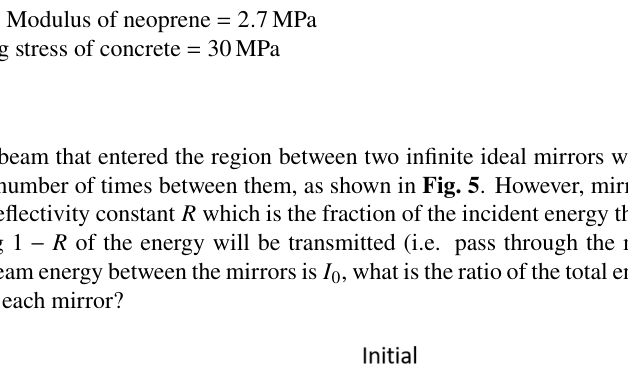
A laser beam that entered the region between two infinite ideal mirrors would reflect an infinite number of times between them, as shown in Fig. 5. However, mirrors in real life have a reflectivity constant which is the fraction of the incident energy that is reflected, meaning of the energy will be transmitted (i.e. pass through the mirror). If the initial beam energy between the mirrors is , what is the ratio of the total energy escaping through each mirror?
 Parallel mirrors with beam reflecting between them
Topic: Wave Optics, Geometric Optics Metodi: Superposition Principle, Physical Modeling Competenze: Mathematical Modeling, Physical Reasoning Objects: Mirror Fonte: Testo (PDF) — p.7
Un raggio laser che entrasse nella regione tra due specchi ideali infiniti rifletterebbe un numero infinito di volte tra di loro, come mostrato nella figura. 5. Tuttavia, gli specchi nella vita reale hanno una costante di riflettività che è la frazione dell’energia incidente che viene riflessa, il che significa dell’energia che verrà trasmessa (cioè: passano attraverso lo specchio). Se l’energia iniziale del fascio tra i specchi è , qual è il rapporto tra l’energia totale che scorre attraverso ogni specchio?
Rispecchi paralleli con raggio riflessivo tra di loro
Topic: Wave Optics, Geometric Optics Metodi: Superposition Principle, Physical Modeling Competenze: Mathematical Modeling, Physical Reasoning Objects: Mirror Fonte: Testo (PDF) — p.7
In a closed tube of length and cross-section area there is a volume of high pressure gas and an equal volume of low pressure gas separated by a diaphragm in the centre of the tube. The tube is uniformly heated from until the diaphragm bursts, which occurs when a maximum force is applied. After a moment the pressure equalises in the tube, which is now insulated from the surroundings so that no thermal energy is lost. What is the final pressure inside the tube?
Topic: Thermodynamics, Kinetic Theory Metodi: Ideal Gas Law, First Law of Thermodynamics Competenze: Mathematical Modeling, Physical Reasoning Objects: Gas, Tube, Membrane Fonte: Testo (PDF) — p.7
In un tubo chiuso di lunghezza e di superficie di sezione trasversale si trova un volume di gas ad alta pressione e un volume uguale di gas a bassa pressione separato da un diaframma nel centro del tubo. Il tubo viene riscaldato uniformemente da fino a quando il diaframma si scoppe, che si verifica quando viene applicata una forza massima . Dopo un momento la pressione si eguaglia nel tubo, che è isolato dall’ambiente circostante in modo che non si perda alcuna energia termica. Qual è la pressione finale all’interno del tubo?
Topic: Thermodynamics, Kinetic Theory Metodi: Ideal Gas Law, First Law of Thermodynamics Competenze: Mathematical Modeling, Physical Reasoning Objects: Gas, Tube, Membrane Fonte: Testo (PDF) — p.7