- A particle is moving on a plane at a constant speed of 1 m/s, but not necessarily in a straight line. Which of the following plot pairs could describe the particle’s position over time, in rectilinear coordinates?
I. — II. — III. (coppie di grafici e , assi da a , (s))
- A. I only
- B. II only
- C. III only
- D. II and III only
- E. All three plots could describe the particle’s position over time
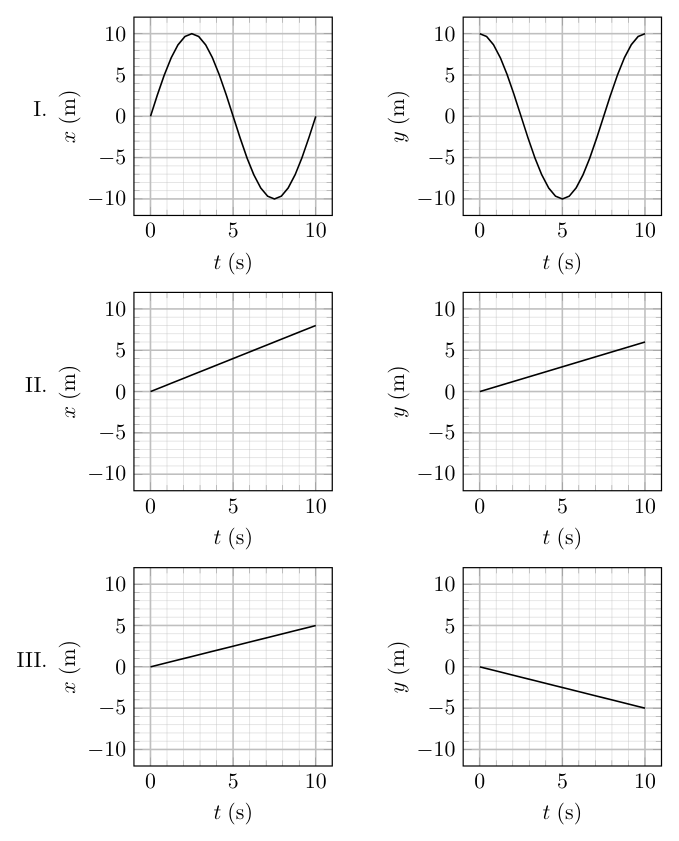 coppie di grafici x(t) e y(t) I-II-III
Topic: Newtonian Mechanics Metodi: Kinematic Equations, Vector Decomposition Competenze: Diagrammatic Reasoning, Physical Reasoning, Mathematical Modeling Objects: — Fonte: Testo (PDF) — p.2
- Una particella si muove su un piano a una velocità costante di 1 m/s, ma non necessariamente in linea retta. Che di queste coppie di grafici potrebbero descrivere la posizione della particella nel tempo, in coordinate rettolinee?
I. — II. III. (coppie di grafici e , assi da a , (s))
- A. I solo
- solo B. II
- solo C. III
- solo D. II e III
- E. Tutti e tre i grafici potrebbero descrivere la posizione delle particelle nel tempo
coppie di grafica x) e y) I-II-III
Topic: Newtonian Mechanics Metodi: Kinematic Equations, Vector Decomposition Competenze: Diagrammatic Reasoning, Physical Reasoning, Mathematical Modeling Objects: — Fonte: Testo (PDF) — p.2
The following information applies to problems 2 and 3.
Three identical disks are placed on a frictionless table. Initially, two of the disks are at rest and in contact with each other. The third disk is launched with speed directly toward the midpoint of the two stationary disks along a path perpendicular to the line connecting their centers, as shown in the diagram. Analyze the motion of the disks after the collision, assuming all interactions are perfectly elastic and that when the disks collide, there is no friction or inelastic energy loss.
- Assume that all three disks collide simultaneously. What is the final velocity of the third disk?
- A. in the opposite direction to the initial velocity
- B. in the same direction as the initial velocity
- C.
- D. in the opposite direction to the initial velocity
- E. in the same direction as the initial velocity
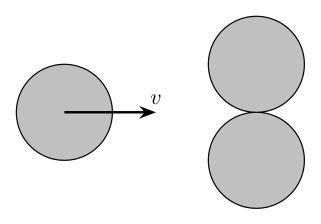 tre dischi in collisione su piano
Topic: Conservation of Momentum, Conservation of Energy, Newtonian Mechanics Metodi: Conservation of Momentum, Conservation of Energy, Vector Decomposition Competenze: Physical Reasoning, Mathematical Modeling Objects: Disk Fonte: Testo (PDF) — p.3
Le seguenti informazioni si applicano ai problemi 2 e 3.
Tre dischi identici sono posizionati su un tavolo senza attrito. Inizialmente, due dei dischi sono a riposo e in contatto tra loro. Il terzo disco viene lanciato con velocità direttamente verso il punto medio dei due dischi stazionari lungo un percorso perpendicolare alla linea che collega i loro centri, come mostrato nel diagramma. Analizzare il movimento dei dischi dopo la collisione, presumendo che tutte le interazioni siano perfettamente elastiche e che quando i dischi si schiantano, non si verifica attrito o perdita di energia inelastica.
- Supponiamo che tutti e tre i dischi si incollino contemporaneamente. Qual è la velocità finale del terzo disco?
- A. nella direzione opposta alla velocità iniziale
- B. nella stessa direzione della velocità iniziale
- C.
- D. nella direzione opposta alla velocità iniziale
- E. nella stessa direzione della velocità iniziale
*tre dischi in collisione su pianoforte *
Topic: Conservation of Momentum, Conservation of Energy, Newtonian Mechanics Metodi: Conservation of Momentum, Conservation of Energy, Vector Decomposition Competenze: Physical Reasoning, Mathematical Modeling Objects: Disk Fonte: Testo (PDF) — p.3
- Assume that there is a little imperfection in disks’ initial alignment so when the disks collide two collisions happen one at a time, rather than all three disks colliding simultaneously. What is the final speed of the third disk?
- A.
- B.
- C.
- D.
- E. 0
Topic: Conservation of Momentum, Conservation of Energy, Newtonian Mechanics Metodi: Conservation of Momentum, Conservation of Energy, Physical Modeling Competenze: Physical Reasoning, Mathematical Modeling Objects: Disk Fonte: Testo (PDF) — p.3
- Supponiamo che ci sia una piccola imperfezione nell’allineamento iniziale dei dischi, quindi quando i dischi si scontrano due collisioni accadono uno alla volta, piuttosto che tutti e tre i dischi si scontrino contemporaneamente. Qual è la velocità finale della Terzo disco?
- A.
- B.
- C.
- D.
- E. 0
Topic: Conservation of Momentum, Conservation of Energy, Newtonian Mechanics Metodi: Conservation of Momentum, Conservation of Energy, Physical Modeling Competenze: Physical Reasoning, Mathematical Modeling Objects: Disk Fonte: Testo (PDF) — p.3
- A mouse M is running from A to with constant speed . A cat C is chasing the mouse with constant speed and direction always toward the mouse. At a certain time and the length of . What is the magnitude of the acceleration of the cat C?
- A. 0
- B.
- C.
- D.
- E. none of the above
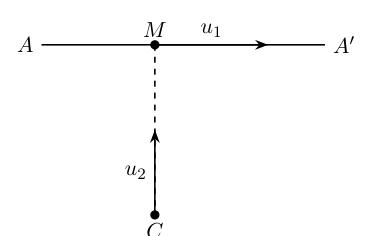 percorso topo A-A’ e gatto C
Topic: Newtonian Mechanics Metodi: Kinematic Equations, Vector Decomposition, Physical Modeling Competenze: Physical Reasoning, Mathematical Modeling Objects: — Fonte: Testo (PDF) — p.3
- Un mouse M corre da A a con velocità costante . Un gatto C sta inseguendo il topo con costante velocità e direzione sempre verso il mouse. In un certo momento e la lunghezza di . Qual è la magnitudine dell’accelerazione del gatto C?
- A. 0
- B.
- C.
- D.
- E. nessuna delle seguenti:
percorso topo A-A’ e gatto C
Topic: Newtonian Mechanics Metodi: Kinematic Equations, Vector Decomposition, Physical Modeling Competenze: Physical Reasoning, Mathematical Modeling Objects: — Fonte: Testo (PDF) — p.3
- Three identical cylinders are used in this setup. Two of them are placed side by side on a horizontal surface, with a negligible distance between their surfaces so they do not touch. The third identical cylinder is placed on top of the first two, such that their centers form an equilateral triangle, as shown in the figure below. The coefficients of friction are:
- : the coefficient of friction between the cylinders, and
- : the coefficient of friction between the cylinders and the ground.
For which of the following pairs will the system remain in equilibrium? Pair 1: . Pair 2: . Pair 3: .
- A. Pair 1 only
- B. Pair 2 only
- C. Pair 3 only
- D. Pairs 1 and 2 only
- E. Pairs 1, Pair 2, and Pair 3
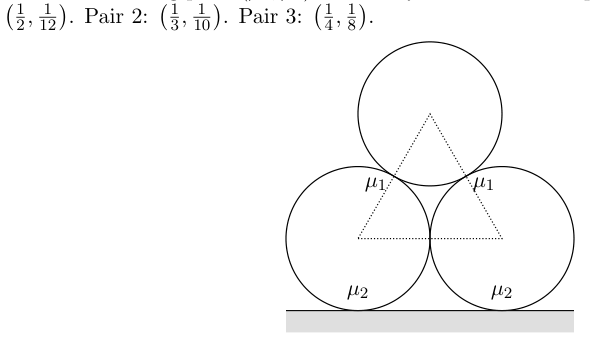 tre cilindri impilati con attrito mu1 mu2
Topic: Rigid Body Statics, Newtonian Mechanics Metodi: Free-Body Diagram, Vector Decomposition, Torque & Angular Momentum Analysis Competenze: Diagrammatic Reasoning, Mathematical Modeling, Physical Reasoning Objects: Cylinder Fonte: Testo (PDF) — p.4
- In questa configurazione vengono utilizzati tre cilindri identici. Due di esse sono posizionate fianco a fianco su una superficie orizzontale, con una distanza non molto elevata tra le loro superfici, e non si toccano. Il terzo cilindro identico è posizionati sopra le prime due, in modo che i loro centri formino un triangolo equilaterale, come mostrato nella figura
- Qui sotto. I coefficienti di attrito sono:
- : il coefficiente di attrito tra i cilindri, e
- : il coefficiente di attrito tra i cilindri e il terreno.
Per quale delle seguenti coppie il sistema rimarrà in equilibrio? Parete 1: . Parete 2: . Parete 3: .
- A. Solo coppia 1
- B. Solo coppia 2
- C. Solo coppia 3
- D. Solo coppie 1 e 2
- E. coppie 1, coppie 2 e coppie 3
3 cilindri impilati con attrito mu1 mu2
Topic: Rigid Body Statics, Newtonian Mechanics Metodi: Free-Body Diagram, Vector Decomposition, Torque & Angular Momentum Analysis Competenze: Diagrammatic Reasoning, Mathematical Modeling, Physical Reasoning Objects: Cylinder Fonte: Testo (PDF) — p.4
- A ball rolls without slipping down a ramp, which turns horizontal at the bottom; at the bottom of the ramp, the ball falls through the air, as in the diagram. If the ball starts from the position marked O, it lands 10 cm away from the bottom of the ramp. Which starting position will get the ball to land closest to 25 cm away?
- A. Position A
- B. Position B
- C. Position C
- D. Position D
- E. Position E
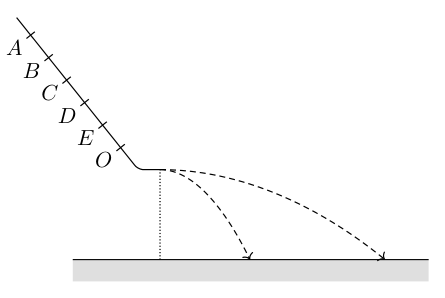 rampa con palla e traiettorie A-O
Topic: Newtonian Mechanics, Rotational Dynamics Metodi: Kinematic Equations, Energy Conservation Method, Physical Modeling Competenze: Physical Reasoning, Mathematical Modeling, Estimation & Approximation Objects: Ball, Inclined Plane Fonte: Testo (PDF) — p.4
- Una palla ruota senza scivolare in una rampa, che si gira orizzontale in basso; in basso della rampa Ramp, la palla cade nell’aria, come nel diagramma. Se la palla parte dalla posizione contrassegnata O, Atterraggiano a 10 cm dal fondo della rampa. Quale posizione di partenza farà atterrare la palla più vicino
- A 25 cm di distanza?
- A. Pozizione A
- B. Posizione B
- C. Pozizione C
- D. Posizione D
- E. Posizione E
*rampa con palla e traiettoria A-O *
Topic: Newtonian Mechanics, Rotational Dynamics Metodi: Kinematic Equations, Energy Conservation Method, Physical Modeling Competenze: Physical Reasoning, Mathematical Modeling, Estimation & Approximation Objects: Ball, Inclined Plane Fonte: Testo (PDF) — p.4
- A mechanism consists of three point masses, each of mass , connected by two massless rods of length and a torsion spring acting as a hinge. The potential energy of the torsion spring is given by . This system is designed to “walk” down a set of stairs, as shown in the figure. The angles and (see figure) represent the orientation of the rods, and their rates of change, and , are the corresponding angular velocities. Assume that the mass on the surface is instantaneously at rest. Which equation correctly describes the total energy of the system?
- A.
- B.
- C.
- D.
- E.
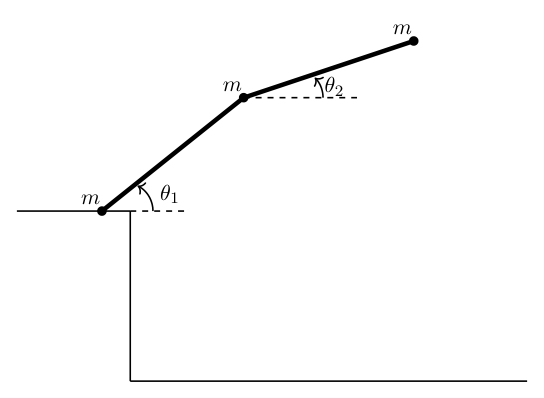 meccanismo tre masse su aste e molla torsionale
Topic: Rotational Dynamics, Conservation of Energy, Newtonian Mechanics Metodi: Energy Conservation Method, Torque & Angular Momentum Analysis, Vector Decomposition Competenze: Mathematical Modeling, Physical Reasoning, Diagrammatic Reasoning Objects: Rod, Spring Fonte: Testo (PDF) — p.5
- Un meccanismo è costituito da tre masse puntate, ciascuna di massa , collegate da due barre senza massa di lunghezza e una molla a torsione che agisce come cerniera. L’energia potenziale della molla di torsione è data da . Questo Il sistema è progettato per scendere in una serie di scale, come mostrato nella figura. Gli angoli e (vedere figura) rappresentano l’orientamento delle barre e i loro tassi di variazione, e , sono i corrispondenti angolari velocità. Supponiamo che la massa sulla superficie sia istantaneamente a riposo. Quale equazione descrive correttamente l’energia totale del sistema?
- A.
- B.
- C.
- D.
- E.
- meccanismo di massa su ast e molla torsionale *
Topic: Rotational Dynamics, Conservation of Energy, Newtonian Mechanics Metodi: Energy Conservation Method, Torque & Angular Momentum Analysis, Vector Decomposition Competenze: Mathematical Modeling, Physical Reasoning, Diagrammatic Reasoning Objects: Rod, Spring Fonte: Testo (PDF) — p.5
- A symmetric spinning top, rotating clockwise at an angular frequency , is placed upright in the center of a frictionless circular plate. The plate then begins to rotate counterclockwise at a constant angular velocity . Assume the top’s axis remains perfectly vertical and stable without any precession. From the perspective of an observer rotating with the plate, how does the top appear to rotate?
- A. The top appears stationary without any rotation.
- B. The top appears to rotate in the clockwise direction at an angular frequency .
- C. The top appears to rotate in the clockwise direction at an angular frequency .
- D. The top appears to rotate in the counterclockwise direction at an angular frequency .
- E. The top appears to rotate in the counterclockwise direction at an angular frequency .
Topic: Rotational Dynamics, Newtonian Mechanics Metodi: Torque & Angular Momentum Analysis, Physical Modeling, Symmetry Argument Competenze: Physical Reasoning, Diagrammatic Reasoning Objects: Spinning Top, Disk Fonte: Testo (PDF) — p.5
- Una parte superiore simmetrica di rotazione, che ruota nel senso orario a una frequenza angolare , è collocata verticalmente al centro di una piastra circolare senza attrito. La piastra inizia quindi a ruotare in senso contrario all’orologio ad un angolo costante velocità . Supponiamo che l’asse superiore rimanga perfettamente verticale e stabile senza alcuna precessione. Dal la prospettiva di un osservatore che ruota con la piastra, come sembra ruotare la parte superiore?
- A. La parte superiore appare ferma senza rotazione.
- B. La parte superiore sembra ruotare in senso orario a una frequenza angolare .
- C. La parte superiore sembra ruotare in senso orario a una frequenza angolare .
- D. La parte superiore sembra ruotare in direzione contraria al senso orario ad una frequenza angolare .
- E. La parte superiore sembra ruotare in direzione contraria al senso orario ad una frequenza angolare .
Topic: Rotational Dynamics, Newtonian Mechanics Metodi: Torque & Angular Momentum Analysis, Physical Modeling, Symmetry Argument Competenze: Physical Reasoning, Diagrammatic Reasoning Objects: Spinning Top, Disk Fonte: Testo (PDF) — p.5
- circles in a plane, , each rotate with frequency relative to an inertial frame. The center of is fixed in the inertial frame, and the center of is fixed on (for ), as shown in the figure. Each circle has radius , where . A mass is fixed on . The position of the mass relative to the center of is . For the case shown, which of the following statements is true?
During the time interval from 0 to , the magnitude of acceleration of mass on
- A. reached its maximum and minimum more than once.
- B. reached its maximum and minimum exactly once.
- C. reached its maximum only once but the minimum more than once.
- D. reached its minimum only once but the maximum more than once.
- E. was constant.
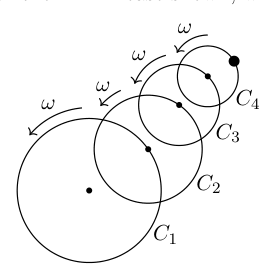 cerchi annidati C1-C4 con omega
Topic: Newtonian Mechanics, Rotational Dynamics Metodi: Kinematic Equations, Vector Decomposition, Physical Modeling Competenze: Mathematical Modeling, Physical Reasoning Objects: Disk Fonte: Testo (PDF) — p.6
- Circoli in un piano, , ognuno di essi ruota con frequenza rispetto a un quadro inerziale. Il centro di è fissato nel quadro inerziale e il centro di fissato su (per ), come mostrato nella figura. Ogni cerchio ha un raggio , dove . Una massa è fissata a . La posizione della massa relativa al centro di è . Per il caso mostrato, quale delle seguenti affermazioni è vera?
Durante l’intervallo temporale da 0 a , la magnitudine di accelerazione della massa su
- A. ha raggiunto il suo massimo e il suo minimo più di una volta.
- B. ha raggiunto il suo massimo e il suo minimo esattamente una volta.
- C. ha raggiunto il suo massimo solo una volta ma il minimo più di una volta.
- D. ha raggiunto il suo minimo solo una volta ma il massimo più di una volta.
- E. è stata costante.
cerchi annidati C1-C4 con omega
Topic: Newtonian Mechanics, Rotational Dynamics Metodi: Kinematic Equations, Vector Decomposition, Physical Modeling Competenze: Mathematical Modeling, Physical Reasoning Objects: Disk Fonte: Testo (PDF) — p.6
The following information applies to problems 10 and 11.
When two objects of very different masses collide, it is difficult to transfer a substantial fraction of the energy of one to the other. Consider two objects, of mass and .
- If the lighter object is initially at rest, and the heavier object collides elastically with it, what is the approximate maximum fraction of the heavier object’s kinetic energy that could be transferred to the lighter object?
- A.
- B.
- C.
- D.
- E.
Topic: Conservation of Momentum, Conservation of Energy, Newtonian Mechanics Metodi: Conservation of Momentum, Conservation of Energy, Approximation & Series Expansion Competenze: Physical Reasoning, Mathematical Modeling Objects: Block Fonte: Testo (PDF) — p.6
*Le seguenti informazioni si applicano ai problemi 10 e 11. *
Quando due oggetti di masse molto diverse si scontrano, è difficile trasferire una frazione sostanziale della massa di energia di uno all’altro. Considerate due oggetti, di massa e .
- Se l’oggetto più leggero è inizialmente a riposo e l’oggetto più pesante si schianta con esso in modo elastico, quale è il la frazione massima approssimativa dell’energia cinetica dell’oggetto più pesante che potrebbe essere trasferita al
- Un oggetto più leggero?
- A.
- B.
- C.
- D.
- E.
Topic: Conservation of Momentum, Conservation of Energy, Newtonian Mechanics Metodi: Conservation of Momentum, Conservation of Energy, Approximation & Series Expansion Competenze: Physical Reasoning, Mathematical Modeling Objects: Block Fonte: Testo (PDF) — p.6
- Now suppose that instead, the heavier object is initially at rest, and the lighter object collides elastically with it. What is the approximate maximum fraction of the lighter object’s kinetic energy that could be transferred to the heavier object?
- A.
- B.
- C.
- D.
- E.
Topic: Conservation of Momentum, Conservation of Energy, Newtonian Mechanics Metodi: Conservation of Momentum, Conservation of Energy, Approximation & Series Expansion Competenze: Physical Reasoning, Mathematical Modeling Objects: Block Fonte: Testo (PDF) — p.6
- Supponiamo che invece l’oggetto più pesante sia inizialmente a riposo e l’oggetto più leggero si schianti elasticamente
- Con questo. Qual è la frazione massima approssimativa dell’energia cinetica dell’oggetto più leggero che potrebbe essere trasferito all’oggetto più pesante?
- A.
- B.
- C.
- D.
- E.
Topic: Conservation of Momentum, Conservation of Energy, Newtonian Mechanics Metodi: Conservation of Momentum, Conservation of Energy, Approximation & Series Expansion Competenze: Physical Reasoning, Mathematical Modeling Objects: Block Fonte: Testo (PDF) — p.6
- A 50 g piece of clay is thrown horizontally with a velocity of 20 m/s striking the bob of a stationary pendulum with length m and a bob mass of 200 g. Upon impact, the clay sticks to the pendulum weight and the pendulum starts to swing. What is the maximum change in angle of the pendulum?
- A.
- B.
- C.
- D.
- E.
Topic: Conservation of Momentum, Conservation of Energy, Oscillations & Waves Metodi: Conservation of Momentum, Energy Conservation Method, Impulse-Momentum Theorem Competenze: Mathematical Modeling, Physical Reasoning Objects: Pendulum Fonte: Testo (PDF) — p.6
- Un pezzo di argilla di 50 g viene gettato orizzontalmente con una velocità di 20 m/s colpendo il bob di un’artiglieria pendolo di lunghezza m e massa di 200 g. Quando si colpisce, l’argilla si attacca al pendolo peso e il pendolo inizia a oscillare. Qual è il massimo cambiamento di angolo del pendolo?
- A.
- B.
- C.
- D.
- E.
Topic: Conservation of Momentum, Conservation of Energy, Oscillations & Waves Metodi: Conservation of Momentum, Energy Conservation Method, Impulse-Momentum Theorem Competenze: Mathematical Modeling, Physical Reasoning Objects: Pendulum Fonte: Testo (PDF) — p.6
The following information applies to problems 13 and 14.
Angela the puppy loves chasing tennis balls, so her owners built a tennis ball launcher. It fires balls along the floor at some initial speed, applying no rotation to them. The balls initially slip along the floor, then start rolling without slipping. Ignore the potential deformation of the ball and floor during this process, as well as air resistance.
- Which of the following plot pairs could show the linear speed and rotational speed of one of the balls over time? Assume the floor has a constant roughness.
(A), (B), (C), (D), (E): coppie di grafici e .
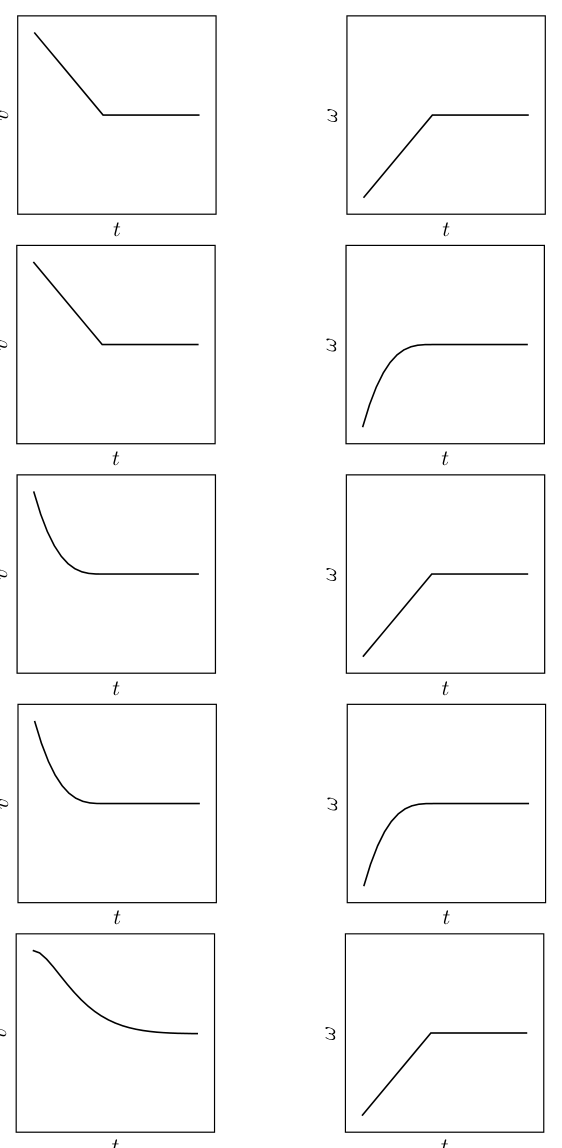 coppie grafici v(t) e omega(t) opzioni A-E
Topic: Rotational Dynamics, Newtonian Mechanics Metodi: Torque & Angular Momentum Analysis, Free-Body Diagram, Kinematic Equations Competenze: Diagrammatic Reasoning, Physical Reasoning, Mathematical Modeling Objects: Ball Fonte: Testo (PDF) — p.7
*Le seguenti informazioni si applicano ai problemi 13 e 14. *
Angela il cucciolo ama inseguire palline da tennis, quindi i suoi proprietari hanno costruito un lanciatore da palline da tennis. - Fa fuoco a palle . il pavimento a una velocità iniziale, senza applicare loro rotazione. Le palle inizialmente scivolavano lungo il pavimento, poi iniziare a rotolare senza scivolare. Ignorare la potenziale deformazione della palla e del pavimento durante questo processo, come anche la resistenza all’aria.
- Qual delle seguenti coppie di plot potrebbe mostrare la velocità lineare e la velocità di rotazione di una delle palle nel tempo? Supponiamo che il pavimento abbia una costante rugosità.
(A), (B), (C), (D), (E): coppie di grafici e .
Coppia grafica e opzioni A-E
Topic: Rotational Dynamics, Newtonian Mechanics Metodi: Torque & Angular Momentum Analysis, Free-Body Diagram, Kinematic Equations Competenze: Diagrammatic Reasoning, Physical Reasoning, Mathematical Modeling Objects: Ball Fonte: Testo (PDF) — p.7
- There are three kinds of balls that can be launched in this set-up, all having the same radius : I. a regular tennis ball (a thin spherical shell of rubber) of mass II. a solid wooden ball of mass III. a solid rubber ball of mass where . All three types of ball emerge from the launcher with the same velocity. For which ball will the final velocity be highest?
- A. Ball I
- B. Ball II
- C. Ball III
- D. Balls II and III
- E. The final velocity will be the same for all three balls
Topic: Rotational Dynamics, Newtonian Mechanics, Conservation of Momentum Metodi: Torque & Angular Momentum Analysis, Conservation of Momentum, Energy Conservation Method Competenze: Physical Reasoning, Mathematical Modeling Objects: Ball, Sphere Fonte: Testo (PDF) — p.8
- Ci sono tre tipi di palle che possono essere lanciate in questa configurazione, tutte con lo stesso raggio : I. una palla da tennis regolare (un tenue guscio sferico di gomma) di massa II. di massa III. Il di massa dove . Tutti e tre i tipi di palla emergono dal lanciatore con la stessa velocità. Per il quale la velocità finale della palla sarà più alta?
- A. Ball I
- B. Ball II
- C. Ball III
- D. Pelle II e III
- E. La velocità finale sarà la stessa per tutte e tre le palle
Topic: Rotational Dynamics, Newtonian Mechanics, Conservation of Momentum Metodi: Torque & Angular Momentum Analysis, Conservation of Momentum, Energy Conservation Method Competenze: Physical Reasoning, Mathematical Modeling Objects: Ball, Sphere Fonte: Testo (PDF) — p.8
- A uniform rigid rod of mass and length is attached to a massless rod of length , which is fixed at one end to the ceiling and free to rotate in a vertical plane. The massive rod is connected to the free end of the massless rod. Suppose an impulse is applied horizontally to the bottom of the massive rod. Determine the relationship between the magnitudes of the angular velocity of the massless rod and of the massive rod immediately after the impulse is applied. The moment of inertia of a uniform rod of length and mass about its center of mass is given by .
- A.
- B.
- C.
- D.
- E.
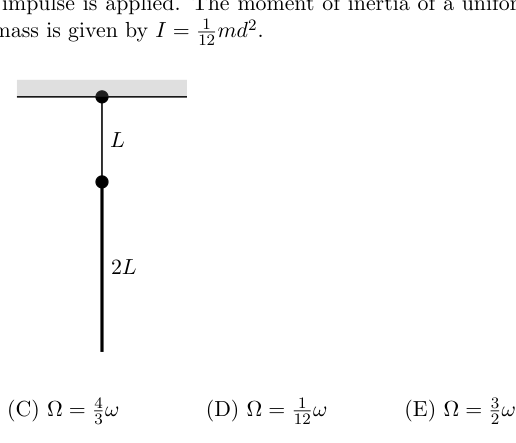 asta massless L e sbarra 2L al soffitto
Topic: Rotational Dynamics, Newtonian Mechanics Metodi: Torque & Angular Momentum Analysis, Impulse-Momentum Theorem, Free-Body Diagram Competenze: Mathematical Modeling, Diagrammatic Reasoning, Physical Reasoning Objects: Rod Fonte: Testo (PDF) — p.8
- Una barra rigida uniforme di massa e lunghezza è attaccata a una barra senza massa di lunghezza , che è fissata al una estremità del soffitto e libera di rotazione in piano verticale. La canna massiccia è collegata alla fine libera della canna senza massa. Supponiamo che un impulso sia applicato orizzontalmente alla parte inferiore della canna massiccia. Determinare la relazione tra le magnitudini della velocità angolare della canna senza massa e di una barra massiccia immediatamente dopo l’impulso. Il momento di inerzia di una barra uniforme di La lunghezza e la massa circa il suo centro di massa sono dati da .
- A.
- B.
- C.
- D.
- E.
asta massless L e sbarra 2L al soffitto
Topic: Rotational Dynamics, Newtonian Mechanics Metodi: Torque & Angular Momentum Analysis, Impulse-Momentum Theorem, Free-Body Diagram Competenze: Mathematical Modeling, Diagrammatic Reasoning, Physical Reasoning Objects: Rod Fonte: Testo (PDF) — p.8
- Two soap bubbles of radii cm and cm conjoin together in the air, such that a narrow bridge forms between them. Assuming the system starts in equilibrium, the bubbles are extremely thin, and that air can flow freely between the bubbles through the bridge, describe the evolution and final state of the bubbles.
- A. The smaller bubble will shrink and the larger bubble will grow.
- B. The larger bubble will shrink and the smaller bubble will grow.
- C. The bubbles will maintain their sizes.
- D. Air will oscillate between the two bubbles.
- E. Both bubbles will simultaneously shrink.
Topic: Fluid Mechanics Metodi: Hydrostatic Equilibrium, Physical Modeling, Bernoulli’s Equation Competenze: Physical Reasoning, Mathematical Modeling Objects: Bubble Fonte: Testo (PDF) — p.8
- Due bolle di sapone di raggio cm e cm si uniscono nell’aria, in modo che un ponte stretto
- le forme tra loro. Supponendo che il sistema inizia in equilibrio, le bolle sono estremamente sottili, e che L’aria può fluire liberamente tra le bolle attraverso il ponte, descrivere l’evoluzione e lo stato finale della
- Le bolle.
- A. La bolla più piccola si restringe e la bolla più grande si sviluppa.
- B. La bolla più grande si contrairà e la bolla più piccola crescerà.
- C. Le bolle manterranno le loro dimensioni.
- D. L’aria oscillerà tra le due bolle.
- E. Entrambe le bolle si ridurranno contemporaneamente.
Topic: Fluid Mechanics Metodi: Hydrostatic Equilibrium, Physical Modeling, Bernoulli’s Equation Competenze: Physical Reasoning, Mathematical Modeling Objects: Bubble Fonte: Testo (PDF) — p.8
- A particle of mass moves in the plane with potential energy The closest point to the origin (, ) during its motion was at a distance , and the particle’s speed at that point was . Which of the following statements is true regarding the path of the particle after a long time ()?
- A. The particle’s trajectory will be circular.
- B. The particle’s trajectory will be asymptotic to a straight line pointing away from the origin.
- C. The particle will spiral outwards away from the origin.
- D. The particle will travel on a parabolic trajectory.
- E. The particle will spiral inwards towards the origin.
Topic: Newtonian Mechanics, Conservation of Energy Metodi: Energy Conservation Method, Physical Modeling, Differential Equations Competenze: Mathematical Modeling, Physical Reasoning Objects: — Fonte: Testo (PDF) — p.9
- Una particella di massa si muove nel piano con energia potenziale Il punto più vicino all’origine (, ) durante il suo movimento era a una distanza , e le particelles velocità a quel punto era . Qual è la verità delle seguenti affermazioni riguardo al percorso della particella dopo un lungo periodo di tempo ()?
- A. La traiettoria delle particelle sarà circolare.
- B. La traiettoria delle particelle sarà assinttica a una linea retta che punta lontano dall’origine.
- C. La particella si spira verso l’esterno all’infuori dell’origine.
- D. La particella viaggierà su una traiettoria parabolica.
- E. La particella si spira verso l’interno verso l’origine.
Topic: Newtonian Mechanics, Conservation of Energy Metodi: Energy Conservation Method, Physical Modeling, Differential Equations Competenze: Mathematical Modeling, Physical Reasoning Objects: — Fonte: Testo (PDF) — p.9
- A particle of mass moves in the plane with potential energy If the particle begins at the origin, then it is possible to displace it slightly in some direction, so that the particle subsequently oscillates periodically. What is the period of this motion?
- A.
- B.
- C.
- D.
- E.
Topic: Oscillations & Waves, Newtonian Mechanics Metodi: Simple Harmonic Motion Analysis, Energy Conservation Method, Differential Equations Competenze: Mathematical Modeling, Physical Reasoning Objects: — Fonte: Testo (PDF) — p.9
- Una particella di massa si muove nel piano con energia potenziale Se la particella inizia all’origine, allora è possibile spostarla leggermente in una certa direzione, in modo che la particella la particella oscilla successivamente periodicamente. Quanto è il periodo di questa mozione?
- A.
- B.
- C.
- D.
- E.
Topic: Oscillations & Waves, Newtonian Mechanics Metodi: Simple Harmonic Motion Analysis, Energy Conservation Method, Differential Equations Competenze: Mathematical Modeling, Physical Reasoning Objects: — Fonte: Testo (PDF) — p.9
- Near the ground, wind speed can be modeled as proportional to height above the ground. (This is a reasonable assumption for small heights.) A wind turbine converts a constant fraction of the available kinetic energy into electricity. The conditions are such that when operating at 10 m above the ground, the turbine delivers 15 kW of power. How much power would the same windmill deliver if it were operating at 20 m above the ground?
- A. 15 kW
- B. 21 kW
- C. 30 kW
- D. 60 kW
- E. 120 kW
Topic: Fluid Mechanics, Newtonian Mechanics Metodi: Dimensional Analysis, Physical Modeling, Energy Conservation Method Competenze: Physical Reasoning, Mathematical Modeling, Estimation & Approximation Objects: — Fonte: Testo (PDF) — p.9
- Vicino al suolo, la velocità del vento può essere modellata in proporzione all’altezza al di sopra del suolo. (Questo è un La capacità di un’energia a vento è di circa un milione di unità. energia cinetica in elettricità. Le condizioni sono tali che, quando si opera a 10 m di altitudine, il la turbina fornisce 15 kW di potenza. Quanto energia produrrebbe lo stesso mulino se funzionasse a 20 metri di altezza?
- A. 15 kW
- B. 21 kW
- C. 30 kW
- D. 60 kW
- E. 120 kW
Topic: Fluid Mechanics, Newtonian Mechanics Metodi: Dimensional Analysis, Physical Modeling, Energy Conservation Method Competenze: Physical Reasoning, Mathematical Modeling, Estimation & Approximation Objects: — Fonte: Testo (PDF) — p.9
- The International Space Station orbits the Earth in a circular orbit 400 km above the surface, and a full revolution takes 93 minutes. An astronaut on a space walk neglects safety precautions and tosses away a spanner at a speed of 1 m/s directly towards the Earth. You may assume that the Earth is a sphere of uniform density. At which of the following five times will the spanner be closest to the astronaut?
- A. After 139.5 minutes.
- B. After 131.5 minutes.
- C. After 93 minutes.
- D. After 46.5 minutes.
- E. After 1 minute.
Topic: Gravitation, Newtonian Mechanics Metodi: Kepler’s Laws, Newton’s Law of Gravitation, Physical Modeling Competenze: Physical Reasoning, Mathematical Modeling Objects: Satellite, Planet Fonte: Testo (PDF) — p.9
- La Stazione Spaziale Internazionale orbita la Terra in un’orbita circolare a 400 km sopra la superficie, e un La rivoluzione dura 93 minuti. Un astronauta in una passeggiata spaziale trascura le precauzioni di sicurezza e butta via un spanner a una velocità di 1 m/s direttamente verso la Terra. Potreste presumere che la Terra sia una sfera di densità uniforme. In quale delle cinque seguenti volte il spanner sarà più vicino all’astronauta?
- A. Dopo 139,5 minuti.
- B. Dopo 131,5 minuti.
- C. Dopo 93 minuti.
- D. Dopo 46, 5 minuti.
- E. Dopo 1 minuto.
Topic: Gravitation, Newtonian Mechanics Metodi: Kepler’s Laws, Newton’s Law of Gravitation, Physical Modeling Competenze: Physical Reasoning, Mathematical Modeling Objects: Satellite, Planet Fonte: Testo (PDF) — p.9
The following information applies to problems 21 and 22.
Water flows through a pipe with a radius of 5 cm at a velocity of 10 cm/s before entering a narrower section of pipe with a radius of 2.5 cm.
- What is the difference in the speed of water between the two pipes?
- A. 20 cm/s
- B. 30 cm/s
- C. 40 cm/s
- D. 50 cm/s
- E. 60 cm/s
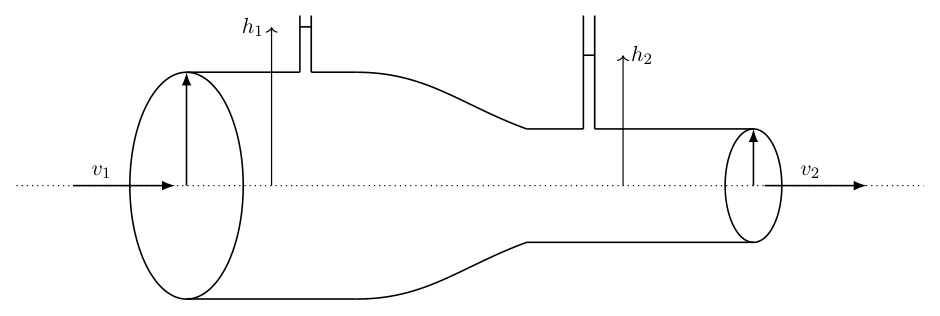 tubo largo e stretto con h1 h2 v1 v2
Topic: Fluid Mechanics Metodi: Continuity Equation, Bernoulli’s Equation Competenze: Physical Reasoning, Mathematical Modeling Objects: Tube Fonte: Testo (PDF) — p.10
*Le seguenti informazioni si applicano ai problemi 21 e 22. *
Acqua scorre attraverso un tubo con un raggio di 5 cm a una velocità di 10 cm/s prima di entrare in un tubo più stretto sezione di tubo con un raggio di 2,5 cm.
- Qual è la differenza nella velocità dell’acqua tra i due tubi?
- A. 20 cm/s
- B. 30 cm/s
- C. 40 cm/s
- D. 50 cm/s
- E. 60 cm/s
Tuti lunghi e estensioni con h1 h2 v1 v2
Topic: Fluid Mechanics Metodi: Continuity Equation, Bernoulli’s Equation Competenze: Physical Reasoning, Mathematical Modeling Objects: Tube Fonte: Testo (PDF) — p.10
- To measure this difference, two graduated cylinders are connected to the top of the pipe (one in the broad section and the other in the narrowed section). Water then flows up each pipe and the height the water reaches is measured. Estimate the difference in height between the two cylinders.
- A. 6.3 mm
- B. 7.5 mm
- C. 8.2 mm
- D. 12.2 mm
- E. 12.7 mm
Topic: Fluid Mechanics Metodi: Bernoulli’s Equation, Hydrostatic Equilibrium, Continuity Equation Competenze: Physical Reasoning, Mathematical Modeling, Estimation & Approximation Objects: Tube Fonte: Testo (PDF) — p.10
- Per misurare questa differenza, due cilindri graduati sono collegati alla parte superiore del tubo (uno nella parte larga del tubo) Sezione e l’altra nella sezione ristretta). L’acqua scorre poi su ogni tubo e l’altezza l’acqua si misura il raggiungimento. Calcolare la differenza di altezza tra i due cilindri.
- A. 6.3 mm
- B. 7.5 mm
- C. 8.2 mm
- D. 12.2 mm
- E. 12.7 mm
Topic: Fluid Mechanics Metodi: Bernoulli’s Equation, Hydrostatic Equilibrium, Continuity Equation Competenze: Physical Reasoning, Mathematical Modeling, Estimation & Approximation Objects: Tube Fonte: Testo (PDF) — p.10
- A student conducted an experiment to determine the spring constant of a spring using a ruler and two different weighing scales. The measured elongation of the spring was 1.5 cm, and the smallest division on the ruler was 1 mm. The mass of the attached weight was measured using two different scales in the school laboratory, yielding values of 198 g and 210 g. The student also found that the local acceleration due to gravity in her city is given as . Calculate the percent error in measuring the spring constant.
- A. 2 %
- B. 4 %
- C. 8 %
- D. 11 %
- E. 14 %
Topic: Newtonian Mechanics Metodi: Error Propagation, Hooke’s Law, Experimental Data Analysis Competenze: Error Propagation, Experimental Data Analysis, Measurement & Instrumentation Objects: Spring Fonte: Testo (PDF) — p.10
- Uno studente ha condotto un esperimento per determinare la costante di primavera di una primavera utilizzando una regola e due diverse pesanti. L’allungamento misurato della sorgente era di 1,5 cm e la più piccola divisione sulla gomma era di 1 mm. La massa del peso attaccato è stata misurata utilizzando due diverse scale nella laboratorio scolastico, con valori di produzione di 198 g e 210 g. Lo studente ha anche scoperto che l’accelerazione locale a causa della gravità nella sua città è indicato come . Calcolare l’ errore percentuale nella misurazione del costante di primavera.
- A. 2 %
- B. 4 %
- C. 8 %
- D. 11 %
- E. 14 %
Topic: Newtonian Mechanics Metodi: Error Propagation, Hooke’s Law, Experimental Data Analysis Competenze: Error Propagation, Experimental Data Analysis, Measurement & Instrumentation Objects: Spring Fonte: Testo (PDF) — p.10
- A massive bead is attached to the end of a massless rigid rod of length . The other end of the rod is attached to an ideal pivot, which allows it to rotate frictionlessly in any direction. The rod is initially at angle to the horizontal, and there is no gravitational force. Next, the bead receives an impulse directly into the page, giving it a speed . How long does it take for the bead to return to its original position?
- A.
- B.
- C.
- D.
- E.
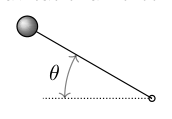 asta rigida con perla e angolo theta
Topic: Rotational Dynamics, Newtonian Mechanics Metodi: Torque & Angular Momentum Analysis, Kinematic Equations, Vector Decomposition Competenze: Mathematical Modeling, Diagrammatic Reasoning, Physical Reasoning Objects: Rod Fonte: Testo (PDF) — p.11
- Un’ampia perla è attaccata alla fine di una barra rigida senza massa di lunghezza . L’altra estremità della canna è collegato ad un pivot ideale, che consente di ruotare senza attrito in qualsiasi direzione. La canna è inizialmente a angolo verso l’orizzontale e non vi è forza gravitazionale. Successivamente, la perla riceve un impulso direttamente nella pagina, dandole una velocità . Quanto tempo ci vuole per la perla per tornare alla sua posizione originale?
- A.
- B.
- C.
- D.
- E.
*asta rigida con perla e angolo theta *
Topic: Rotational Dynamics, Newtonian Mechanics Metodi: Torque & Angular Momentum Analysis, Kinematic Equations, Vector Decomposition Competenze: Mathematical Modeling, Diagrammatic Reasoning, Physical Reasoning Objects: Rod Fonte: Testo (PDF) — p.11
- A puck of mass can slide on a frictionless inclined plane (prism). The prism has a much greater mass compared to the puck and is itself sliding without friction on a horizontal surface. The velocity of the prism is , where is the acceleration due to gravity and is the height from which the puck starts sliding on the prism. The transition from the prism to the horizontal surface is smooth. The puck starts from rest relative to the prism. Find the final velocity of the puck once it begins sliding on the horizontal surface.
- A.
- B.
- C.
- D.
- E.
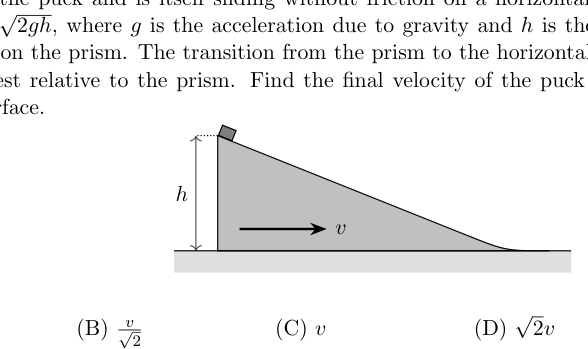 prisma inclinato con puck e quota h
Topic: Newtonian Mechanics, Conservation of Energy, Conservation of Momentum Metodi: Conservation of Energy, Conservation of Momentum, Free-Body Diagram Competenze: Mathematical Modeling, Physical Reasoning, Diagrammatic Reasoning Objects: Inclined Plane, Wedge Fonte: Testo (PDF) — p.11
- Una chiave di massa può scivolare su un piano inclinato senza attrito (prismo). Il prisma ha una massa molto maggiore comparato con il puck e che scivola senza attrito su una superficie orizzontale. La velocità del il prisma è , dove è l’accelerazione dovuta alla gravità e è l’altezza da cui il puck inizia a scivolare sul prisma. Il passaggio dal prisma alla superficie orizzontale è liscio. Il puck inizia dal riposo relativo al prisma. Trova la velocità finale del puck una volta che inizia a scivolare sul superficie orizzontale.
- A.
- B.
- C.
- D.
- E.
- prisma inclinato con puck e quota h *
Topic: Newtonian Mechanics, Conservation of Energy, Conservation of Momentum Metodi: Conservation of Energy, Conservation of Momentum, Free-Body Diagram Competenze: Mathematical Modeling, Physical Reasoning, Diagrammatic Reasoning Objects: Inclined Plane, Wedge Fonte: Testo (PDF) — p.11