Problem A1: Shake It
Most hairy mammals shake after getting wet; shaking the water off is energetically advantageous to waiting for it to dry on its own. In this problem, we investigate the mechanics of shaking off water. For simplicity, we will model animals as solid cylinders with the sides covered in fur. You may ignore gravity throughout the problem.
a. We can model the shaking by assuming that the angular position of the cylinder undergoes a sinusoidal oscillation: . (The rotation is about the axis of rotational symmetry.) Letting the radius of the cylindrical animal be , derive an expression for the magnitude of the acceleration of a point on the surface of the animal under such a motion.
b. For the rest of this problem, rather than modeling sinusoidal motion, we will assume that the cylindrical animal is simply spinning at constant angular speed . Wet fur tends to separate into cylindrical clumps of radius . A droplet of water on the end of a clump of fur will be separated from it if the centripetal force overcomes the forces due to surface tension. Derive an approximate relationship (valid up to scalar numerical constants) between the surface tension , the radius of the fur clump, the radius of the animal, the angular speed , and the density of water. The diagram below shows the cross-section of the animal, showing four clumps of fur with droplets on their end.
c. Experimentally, it is observed that all mammalian fur forms clumps of similar radius. Under the assumption that different animals all have the same density and are simply scaled copies of each other (i.e. larger animals are both longer and fatter), the relationship between an animal’s mass and its angular velocity of shaking is of the form : find the value of .
d. Shaking requires energy, which we can crudely model as the rotational energy of the corresponding cylinder. An alternative strategy for the animal is to simply air-dry their fur, which requires energy to evaporate the water. Assume a wet animal has approximately 5% of their body weight in water, and has to supply all the energy for evaporating the water. Our model predicts that for some animal sizes, it will be energetically advantageous to air dry themselves: estimate the range of animal masses for which this is true. You may use the following facts: a mouse weighs 20 g, has a radius of 1 cm, and shakes itself with angular velocity rad/s. The latent heat of vaporization of water at room temperature is J/g.
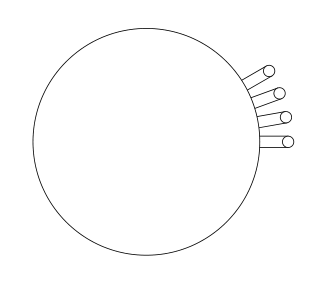 Cross-section of animal showing four fur clumps with droplets
Topic: Rotational Dynamics, Fluid Mechanics, Oscillations & Waves Metodi: Simple Harmonic Motion Analysis, Dimensional Analysis, Energy Conservation Method, Physical Modeling Competenze: Physical Reasoning, Estimation & Approximation Objects: Cylinder, Droplet Fonte: Testo (PDF) — p.4
Il problema A1: agita
La maggior parte dei mammiferi pelosi tremano dopo essere bagnati; agitare l’acqua è energeticamente vantaggioso per aspettare che si secchi da sola. In questo problema, si studia la meccanica dello scosso dell’acqua. Per semplificazione, modelleremo gli animali come cilindri solidi con i lati coperti di pelliccia. Potresti ignorare la gravità durante tutto il problema.
a. Possiamo modellare lo scosso assumendo che la posizione angolare del cilindro subisca un’oscillazione sinusoidale: . (La rotazione si riferisce all’asse della simmetria di rotazione.) Se il raggio del veicolo cilindrico è , si deriva un’espressione per la magnitudine dell’accelerazione di un punto sulla superficie dell’animale sotto tale movimento.
b. Per il resto di questo problema, piuttosto che modellare il movimento sinusoidale, presumere che l’animale cilindrico sta semplicemente girando a velocità angolare costante . La pelliccia bagnata tende a separarsi in gruppi cilindrici di raggio . Una goccia d’acqua sul capo di un gruppo di pelliccia si separerà se la forza centripeta supera le forze dovute alla tensione superficiale. Derivare una relazione approssimativa (valeva fino a costanti numeriche scalari) tra la tensione superficiale , il raggio del grumo di pelliccia, il raggio dell’animale, la velocità angolare e la densità dell’acqua. Il diagramma di seguito mostra la sezione trasversale dell’animale, mostrando quattro gruppi di pelliccia con goccioline alla fine.
c. Sperimentalmente si osserva che tutti i pelli di mammiferi formano gruppi di raggio simile. Sotto l’ipotesi che gli animali diversi abbiano tutti la stessa densità e siano semplicemente copie scalate l’una dell’altra (cioè: animali più grandi sono più lunghi e più grassi), la relazione tra la massa di un animale e la sua velocità angolare di scosse è della forma : trova il valore di .
d. Lo scosso richiede energia, che possiamo modellare in modo crudo come l’energia di rotazione del cilindro corrispondente. Una strategia alternativa per l’animale è semplicemente asciugare l’aria con la pelliccia, che richiede energia per evaporare l’acqua. Supponiamo che un animale umido abbia circa il 5% del suo peso corporeo in acqua e debba fornire tutta l’energia per evaporare l’acqua. Il nostro modello prevede che per alcune dimensioni animali sarà energeticamente vantaggioso asciugare l’aria: stima l’intervallo di massa animale per cui questo è vero. Si possono usare i seguenti dati: un topo pesa 20 g, ha un raggio di 1 cm e si scossa con velocità angolare rad/s. Il calore latente della vaporizzazione dell’acqua a temperatura ambiente è J/g.
Trassezione di animali con quattro gruppi di pelliccia con goccioline
Topic: Rotational Dynamics, Fluid Mechanics, Oscillations & Waves Metodi: Simple Harmonic Motion Analysis, Dimensional Analysis, Energy Conservation Method, Physical Modeling Competenze: Physical Reasoning, Estimation & Approximation Objects: Cylinder, Droplet Fonte: Testo (PDF) — p.4
Problem A2: Black Tides
Consider a spherically symmetric, nonrotating star of mass and radius . If it gets too close to the supermassive black hole of mass at the center of a galaxy, it will be ripped apart by tidal forces. Throughout this problem, neglect relativistic effects and give answers in terms of , , , and . When asked for numbers, assume the star is Sun-like, so that kg, m, and , and give all numeric answers to one significant figure.
a. Suppose the star orbits the black hole in a circle of radius . What is the radius of curvature of the trajectory of each point on the star’s surface? Note that the star does not rotate as it orbits.
b. Gas on the star’s surface facing the black hole is attracted to the star by the star’s gravity, and pulled away from the star by the black hole’s tidal force. Write an expression for the tidal acceleration at the point closest to the black hole.
c. At a radius where the gravitational and tidal forces are in equilibrium, the star will start being tidally ripped apart. This effect can only be observed when is outside the black hole’s Schwarzschild radius . Find an expression for and numerically evaluate the ratio .
For the rest of the problem, we consider a star on a parabolic orbit whose periapsis (distance of closest approach) is equal to the radius found in part c. Near periapsis, the star will be torn apart in a “tidal disruption event”. As a very rough model of this phenomenon, assume the star is initially a single rigid body. The moment it reaches periapsis, it fragments into many rigid pieces which do not interact with each other, and feel only the black hole’s gravity.
d. Afterward, some of the fragments will escape from the black hole, while the rest remain bound. Numerically evaluate the fraction of the mass which escapes.
e. An escaping fragment has speed when it is far from the black hole. Find the maximum possible value of , among all fragments, and evaluate it numerically.
f. A bound fragment orbits with period . Find the minimum possible value of , among all fragments, and evaluate it numerically.
As bound fragments return to the location of the initial disruption, they collide with other debris, causing them to be absorbed into the black hole’s accretion disk. This process produces an enormous amount of light, with the luminosity (or energy emitted over time) proportional to the mass absorption rate. If at the moment the star fragments apart, then light begins to be emitted at the time you found in part f, and afterward the luminosity scales as for a constant .
g. Find the value of . Assume for simplicity that the total energies of the bound fragments are uniformly distributed between their minimum and maximum values.
Topic: Gravitation, Astrophysics, Newtonian Mechanics Metodi: Newton’s Law of Gravitation, Conservation Laws, Kepler’s Laws, Conservation of Energy Competenze: Physical Reasoning, Mathematical Modeling Objects: Star, Black Hole Fonte: Testo (PDF) — p.5
problema A2: Marde nere
Considera una stella sferica simmetrica non rotante di massa e raggio . Se si avvicina troppo al buco nero supermassiccio di massa al centro di una galassia, sarà strappato a pezzi dalle forze delle maree. In tutto questo problema, trascurare gli effetti relativistici e dare risposte in termini di , , , e . Quando viene chiesto dei numeri, supponiamo che la stella sia simile al Sole, in modo che kg, m e , e di dare tutte le risposte numeriche a una cifra significativa.
a. Supponiamo che la stella orbita intorno al buco nero in un cerchio di raggio . Qual è il raggio di curvatura della traiettoria di ogni punto sulla superficie della stella? Si noti che la stella non ruota mentre orbita.
b. Il gas sulla superficie della stella rivolto verso il buco nero è attratto dalla gravità della stella e allontanato dalla stella dalla forza delle maree del buco nero. Scrivi un’espressione per l’accelerazione delle maree nel punto più vicino al buco nero.
c. A un raggio in cui le forze gravitazionali e le maremotte sono in equilibrio, la stella inizierà a essere strappata a maremotte. Questo effetto può essere osservato solo quando è al di fuori del raggio Schwarzschild del buco nero. Trova un’espressione per e valuta numericamente il rapporto .
Per il resto del problema, consideriamo una stella in orbita parabolica la cui periapsis (distanza di avvicinamento più vicino) è uguale al raggio trovato nella parte c. Vicino alla periapsis, la stella si spezzerà in un “evento di interruzione delle maree”. Come modello molto grosso di questo fenomeno, supponiamo che la stella sia inizialmente un solo corpo rigido. Quando raggiunge la periapsis, si fragmenta in molti pezzi rigidi che non interagiscono tra loro e sentono solo la gravità del buco nero.
d. Dopo, alcuni frammenti sfuggiranno dal buco nero, mentre il resto rimane legato. Valutare numericamente la frazione di massa che scappa.
e. Un frammento in fuga ha una velocità quando è lontano dal buco nero. Trova il valore massimo possibile di , tra tutti i frammenti, e valuta numericamente.
f. Un frammento legato orbita con periodo . Trova il minimo possibile di , tra tutti i frammenti, e valuta numericamente.
Quando i frammenti legati tornano al luogo della perturbazione iniziale, si scontrano con altri detriti, causando loro di essere assorbiti nel disco di accrescimento del buco nero. Questo processo produce una quantità enorme di luce, con la luminosità (o energia emessa nel tempo) proporzionale al tasso di assorbimento di massa. Se al momento la stella si fragmenta, allora la luce inizia ad essere emessa al momento che si trova nella parte f, e successivamente la luminosità si scala come per una costante .
g. Trova il valore di . Per semplicità, supponiamo che le energie totali dei frammenti legati siano distribuite uniformemente tra i loro valori minimi e massimi.
Topic: Gravitation, Astrophysics, Newtonian Mechanics Metodi: Newton’s Law of Gravitation, Conservation Laws, Kepler’s Laws, Conservation of Energy Competenze: Physical Reasoning, Mathematical Modeling Objects: Star, Black Hole Fonte: Testo (PDF) — p.5
Problem A3: Bitter and Magnetic
In this problem, we explore some of the design considerations for an electromagnet.
a. Consider an electromagnet consisting of a long solenoid, i.e. a spiral of thin wire wrapped in a single layer around a cylindrical nonmagnetic core. The wire is wrapped in such a way that the adjacent coils almost touch. When a current is sent through the wire, a magnetic field is generated inside the solenoid; this magnetic field exerts an outward force on the wire. Find the pressure on the solenoid in terms of the magnetic field inside the solenoid.
b. The pressure on the “walls” of the solenoid is counteracted by tension inside the wire. Derive an expression for the maximal achievable magnetic field in terms of coil radius , wire diameter (thickness) , and wire tensile strength . (The tensile strength of a material is the force per unit cross-sectional area that needs to be applied in order to pull the material apart.) Assume the wire is circular in cross-section.
c. Let m, m. The tensile strength of copper is MPa, and the permeability of free space is H/m. What is the maximum magnetic field that can be achieved in a single-layer solenoid made out of such a wire without the wire snapping?
d. In theory, we could generate a stronger field by increasing the wire thickness, but the nonuniform distribution of current inside the wire makes this difficult to analyze. Instead, consider wrapping the solenoid in many layers of wire. We will place adjacent layers a distance apart so that they just barely don’t touch, and will adjust the current through each wire to equalize the tensile stress. The wire coils span the space from an inner core radius of to an outer radius of . Estimate the maximum achievable field strength inside this electromagnet. You may assume that the wire is thin (, ).
e. Estimate the numeric value of the maximum magnetic field that can be achieved in a multi-layer solenoid described above with m and m.
Topic: Electromagnetism, Magnetism, Elasticity & Materials Metodi: Free-Body Diagram, Stress-Strain Analysis, Physical Modeling Competenze: Physical Reasoning, Mathematical Modeling Objects: Solenoid, Wire, Coil Fonte: Testo (PDF) — p.6
Problema A3: Amaro e magneto
In questo problema, esploriamo alcune delle considerazioni progettuali per un elettromagneto.
a. Considerate un elettromagneto costituito da un lungo solenoide, ovvero una spirale di filo sottile avvolta in un unico strato intorno a un nucleo non magnetico cilindrico. Il filo è avvolto in modo tale che le bobine adiacenti si toccano quasi. Quando una corrente viene inviata attraverso il filo, un campo magnetico viene generato all’interno del solenoide; questo campo magnetico esercita una forza esterna sul filo. Trova la pressione sul solenoide in termini di campo magnetico all’interno del solenoide.
b. La pressione sulle “pareti” del solenoide viene contrastabile dalla tensione all’interno del filo. Derivare un’espressione per il campo magnetico massimo raggiungibile in termini di raggio della bobina , diametro del filo (spessore) e resistenza alla trazione del filo . (La resistenza alla trazione di un materiale è la forza per unità di area di sezione trasversale che deve essere applicata per separare il materiale.)
c. Lasciate m, m. La resistenza alla trazione del rame è MPa e la permeabilità dello spazio libero è H/m. Qual è il massimo campo magnetico che può essere raggiunto in un solenoide a un solo strato fatto di tale filo senza che il filo si spacchi?
d. In teoria, potremmo generare un campo più forte aumentando lo spessore del filo, ma la distribuzione non uniforme della corrente all’interno del filo rende difficile l’analisi. Invece, considerate avvolgere il solenoide in molti strati di filo. Posteremo strati adiacenti a una distanza da loro in modo che non si toccino a malapena, e regolare la corrente attraverso ogni filo per eguagliare la tensione di trazione. Le bobine del filo spaziano lo spazio da un raggio interno del nucleo di a un raggio esterno di . Estima la forza massima raggiungibile del campo all’interno di questo elettromagneto. Si può presumere che il filo sia sottile (, ).
e. Estimare il valore numerico del campo magnetico massimo che può essere raggiunto in un solenoide a più strati descritto sopra con m e m.
Topic: Electromagnetism, Magnetism, Elasticity & Materials Metodi: Free-Body Diagram, Stress-Strain Analysis, Physical Modeling Competenze: Physical Reasoning, Mathematical Modeling Objects: Solenoid, Wire, Coil Fonte: Testo (PDF) — p.6
Problem B1: Scroll ‘n’ Roll
Consider a disk with mass and radius placed on a large and frictionless table. An ant with mass is placed on top of the disk. The ant can move freely without sliding on the disk.
a. Initially, the ant starts on the edge of the disk, and both the ant and the disk are at rest (relative to the table). Then, the ant starts walking across the disk’s diameter, such that in the frame of the disk, the ant has (constant) velocity . What is ant’s velocity in the frame of the table?
b. Suppose instead that the ant walks counterclockwise along the edge of the disk at constant speed in the frame of the disk. What is the ant’s speed in the frame of the table?
c. Now there are two ants on the disk! The second ant (also of mass ) starts at distance from the center of the disk, with an angle offset by from the first ant. The second ant walks counterclockwise around this circle with radius at speed (relative to the disk). Find all such that the second ant is stationary in the frame of the table.
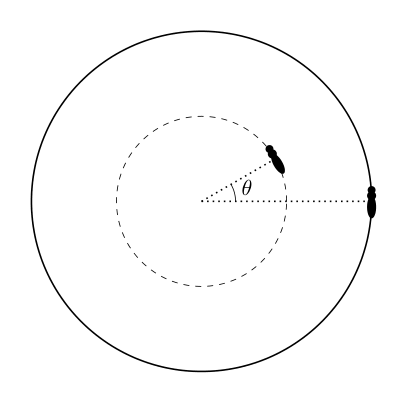 Disk with two ants showing angle theta offset
Topic: Rotational Dynamics, Newtonian Mechanics, Conservation of Momentum Metodi: Conservation of Momentum, Torque & Angular Momentum Analysis, Kinematic Equations Competenze: Physical Reasoning, Mathematical Modeling Objects: Disk Fonte: Testo (PDF) — p.7
Il problema B1: Scroll ‘n’ Roll
Considera un disco con massa e raggio posizionato su un tavolo grande e senza attrito. Una formica di massa viene collocata sulla parte superiore del disco. La formica può muoversi liberamente senza scivolare sul disco.
a. Inizialmente, la formica inizia sul bordo del disco, e sia la formica che il disco sono a riposo (relativamente alla tavola). Poi, la formica inizia a camminare attraverso il diametro del disco, in modo tale che nella cornice del disco, la formica ha una velocità (constante) . Qual è la velocità della formica nel quadro della tavola?
b. Supponiamo invece che la formica cammini in senso contrario all’orologio lungo il bordo del disco a velocità costante nel quadro del disco. Qual è la velocità della formica nel quadro del tavolo?
c. Ora ci sono due formiche sul disco! La seconda formica (anche di massa ) inizia a distanza dal centro del disco, con un angolo compensato da dalla prima formica. La seconda formica cammina in senso contrario all’orologio intorno a questo cerchio con raggio a velocità (relativamente al disco). Trova tutti in modo tale che la seconda formica sia stazionaria nel quadro della tabella.
*Disco con due formiche che mostrano l’angolo di compensazione *
Topic: Rotational Dynamics, Newtonian Mechanics, Conservation of Momentum Metodi: Conservation of Momentum, Torque & Angular Momentum Analysis, Kinematic Equations Competenze: Physical Reasoning, Mathematical Modeling Objects: Disk Fonte: Testo (PDF) — p.7
Problem B2: Where’s the Kaboom?
A plane is flying horizontally at constant velocity and altitude . The speed of sound at altitude is given by where is a constant. Suppose , and define the Mach number as If is constant for all , then the envelope is a cone with half angle where and propagates with the speed of sound .
a. Sketch the envelope.
b. Now, the speed of sound depends on the altitude because the temperature is not uniform. For the altitudes we are interested in, the following linear model works well: where is a constant. Sketch the envelope of the boom.
c. If the Mach number is large enough then the sonic boom hits the ground. Assume it is large enough. On the ground, there are two sensors at and , one directly above the other. Assume and . At time , the top sensor receives the sonic boom signal and at a later time, the bottom sensor also receives the signal. Express the Mach number of the airplane in terms of , , , , , , where .
d. If the plane travels slower without changing direction, its sonic boom could become no longer audible from the ground for the Mach number . What is the upper limit for the Mach number for which this can occur? Express your answer in terms of , , , . You do not necessarily need all of these parameters.
Topic: Oscillations & Waves, Thermodynamics, Geometric Optics Metodi: Wave Equation, Approximation & Series Expansion, Ray Tracing, Snell’s Law Competenze: Physical Reasoning, Mathematical Modeling Objects: — Fonte: Testo (PDF) — p.8
Il problema B2: dov’è il Kaboom?
Un aereo vola orizzontalmente a velocità costante e altitudine . La velocità del suono ad altitudine è data da in cui è una costante. Supponiamo , e definire il numero di Mach come Se è costante per tutti , allora l’envelope è un cono con mezzo angolo dove e si propaga con la velocità del suono .
a. Segna la busta.
b. Ora, la velocità del suono dipende dall’altitudine perché la temperatura non è uniforme. Per le altitudini che ci interessano, il seguente modello lineare funziona bene: in cui è una costante. Segna la busta del boom.
c. Se il numero di Mach è abbastanza grande, il boom sonore colpisce il terreno. Supponiamo che sia abbastanza grande. Sul terreno, ci sono due sensori a e , uno direttamente sopra l’altro. Supponiamo e . Al momento , il sensore superiore riceve il segnale sonoro e in un momento successivo, il sensore inferiore riceve anche il segnale. Esprimere il numero di Mach dell’aereo in termini di , , , , , , dove .
d. Se l’aereo viaggia più lentamente senza cambiare direzione, il suo boom sonore potrebbe non più essere udito dal suolo per il numero di Mach . Qual è il limite superiore per il numero di Mach per il quale può verificarsi questo? Esprimere la risposta in termini di , , , . Non è necessaria necessariamente la necessità di tutti questi parametri.
Topic: Oscillations & Waves, Thermodynamics, Geometric Optics Metodi: Wave Equation, Approximation & Series Expansion, Ray Tracing, Snell’s Law Competenze: Physical Reasoning, Mathematical Modeling Objects: — Fonte: Testo (PDF) — p.8
Problem B3: Locked and Moded
a. Consider two mirrors facing each other separated by a distance (a Fabry–Pérot resonator). The cavity (the space between the two mirrors) is in vacuum (index of refraction , no dispersion), and the mirrors have high reflectivities so that the main resonance condition is that an integer multiple of half-wavelengths fit into the cavity. A light pulse containing multiple different frequencies travels between the mirrors and interferes with itself.
i. State the condition for resonance in terms of and wavelength .
ii. Write down an expression for the resonant angular frequencies , with counting each of the possible resonances.
iii. What is the angular frequency spacing between adjacent angular frequencies?
b. The electric field at the antinodes of the standing waves in the resonator is a superposition of oscillations at the resonant angular frequencies and is given by: Now suppose we introduce a gain medium (such as a doped crystal) into the laser cavity. The gain medium completely absorbs incoming light and re-emits it over a finite range of angular frequencies centered around some angular frequency , which coincides with one of the values determined above. Within this bandwidth, the gain medium amplifies and supports oscillations at all that fall within the range. (Assume is an odd number.)
Assume that each of these angular frequencies—also referred to as modes—has the same amplitude , and that their phases are locked such that there is zero relative phase between them at . This condition is known as mode locking. Set their common phase so that all electric fields are expressed as cosine functions, consistent with the form of .
i. Write an expression for the total electric field as the sum of these equally spaced angular frequencies (with zero relative phase).
ii. Show that in the limit of many angular frequencies (, ), the time-dependent electric field approximately takes the following form: and determine the function .
c. To answer the next part of the problem, assume is odd and find the following limit when , where is an integer:
d. Mode locking can dramatically increase the peak intensity of the laser output. Use the expression , where is a known constant, to answer the following questions.
i. Determine the total instantaneous intensity of the electric field.
ii. What is the maximum possible intensity of the total field, and at what time(s) is this achieved?
e. The uncertainty principle states . In optics, we are more commonly interested in the duration of the pulse rather than its spatial extent; the two are related via . Consider the problem of setting up a very short laser pulse. Use the uncertainty principle to estimate the required bandwidth (range of frequencies). Compare that to the relationship between pulse duration and gain bandwidth that we’re achieving in this problem.
Topic: Wave Optics, Oscillations & Waves, Modern-Quantum Physics Metodi: Superposition Principle, Wave Equation, Interference & Diffraction Analysis, Approximation & Series Expansion Competenze: Mathematical Modeling, Physical Reasoning Objects: Mirror Fonte: Testo (PDF) — p.9
Problema B3: bloccato e modificato
a. Considerate due specchi rivolti l’uno all’altro separati da una distanza (un risonatore FabryPérot). La cavità (lo spazio tra i due specchi) è in vuoto (indice di rifrazione , nessuna dispersione), e i specchi hanno elevate riflettività, in modo che la condizione principale di risonanza è che un numero intero multiplo di mezza lunghezza d’onda si inserisca nella cavità. Un impulso luminoso contenente molteplici frequenze diverse viaggia tra i specchi e interferisce con se stesso.
i. Indicare la condizione di risonanza in termini di e lunghezza d’onda .
ii. Scrivere un’espressione per le frequenze angolari risonanti , con che conti ogni possibile risonanza.
iii. Qual è l’intervallo di frequenza angolare tra le frequenze angolari adiacenti?
b. Il campo elettrico degli antinodi delle onde in piedi nel risonatore è una sovrapposizione di oscillazioni alle frequenze angolari risonanti ed è dato da: Ora supponiamo di introdurre un mezzo di guadagno (come un cristallo dopato) nella cavità laser. Il mezzo di guadagno assorbe completamente la luce in arrivo e la emette nuovamente su un intervallo finito di frequenze angolari incentrate intorno a una frequenza angolare , che coincide con uno dei valori definiti sopra. All’interno di questa larghezza di banda, il mezzo di guadagno amplifica e supporta le oscillazioni di tutti che rientrano nell’intervallo. (Supponiamo che sia un numero impar.)
Supponiamo che ciascuna di queste frequenze angolari , anche denominate modi, abbia la stessa amplitudine , e che le loro fasi siano bloccate in modo tale che vi sia una fase relativa zero tra di loro a . Questa condizione è nota come locking mode. Impostare la loro fase comune in modo che tutti i campi elettrici siano espressi come funzioni cosini, coerenti con la forma di .
i. Scrivere un’espressione per il campo elettrico totale come la somma di queste frequenze angolari spaziate ugualmente (con fase relativa zero).
ii. Mostra che nel limite di molte frequenze angolari (, ), il campo elettrico a seconda del tempo assume circa la seguente forma: e determinare la funzione .
c. Per rispondere alla parte successiva del problema, supponiamo che sia impar e troviamo il seguente limite quando , dove è un intero:
d. Il blocco in modalità può aumentare notevolmente l’intensità massima della uscita laser. Per rispondere alle seguenti domande, utilizzare l’espressione , dove è una costante nota.
i. Determinare l’intensità istantanea totale del campo elettrico.
ii. Qual è l’intensità massima possibile del campo totale e a che ora viene raggiunto?
e. Il principio di incertezza indica . In ottica, ci interessa più la durata del pulso che la sua estensione spaziale; i due sono correlati via . Considerate il problema di impostare un impulso laser molto breve. Utilizzare il principio di incertezza per stimare la larghezza di banda richiesta (intervallo di frequenze). Confrontate questo con la relazione tra durata del pulso e larghezza di banda che stiamo ottenendo in questo problema.
Topic: Wave Optics, Oscillations & Waves, Modern-Quantum Physics Metodi: Superposition Principle, Wave Equation, Interference & Diffraction Analysis, Approximation & Series Expansion Competenze: Mathematical Modeling, Physical Reasoning Objects: Mirror Fonte: Testo (PDF) — p.9