Question 1 — General Questions
(a) Half the length of a 1.0 m rope is stretched out in a straight line on a frictionless table. The other half of the rope hangs vertically from the edge of the table. The rope is released from rest. Calculate the speed of the rope as it leaves the table.
(b) Stoodley Pike Monument in West Yorkshire stands 37 m tall at high elevation above exposed moorland (Fig. 1). As such, in winter, it is subject to ferocious wind speeds .
Roughly speaking, the tower is cylindrical in shape and solid throughout with an average diameter of 7.5 m. The local sandstone, which is used as construction material, has a density of .
A horizontal wind exerts an inertial force , where is the projected area of the tower and is the density of air.
Assuming that it has negligible foundations (below-ground construction), determine the wind speed that would topple the monument. Suggest the significance of the actual shape of the monument.
(c) The angular momentum of a particle about a specified axis is defined as where is the perpendicular distance from to the line of motion of the particle and is the linear momentum of the particle.
(i) Calculate the angular momentum of a 25 g rubber bung on a 50 cm light string being whirled in a circle 4.0 times per second. Give your answer in the standard (S.I.) unit for angular momentum.
(ii) A cyclist is travelling at . Her front wheel has a mass of 1.3 kg and a diameter of 62 cm. If the wheel does not slip with respect to the ground, find its angular momentum.
(iii) We can crudely model a uniform rod of mass and length as a system of equally spaced particles, each of mass . If the rod is pivoted at one end and rotates with angular velocity , determine an expression for its angular momentum in terms of .
Hint: the sum of the first square numbers is given by
(iv) By taking an appropriate limit, find an exact expression for the angular momentum of the rotating rod from part (iii) in terms of , and only.
(v) Determine the kinetic energy of the rotating rod from part (iii) in terms of , and only.
 Stoodley Pike Monument, West Yorkshire
Topic: Newtonian Mechanics, Rotational Dynamics Metodi: Conservation of Energy, Torque & Angular Momentum Analysis, Kinematic Equations Competenze: Mathematical Modeling, Physical Reasoning Objects: String, Cylinder, Wheel, Rod Fonte: Testo (PDF) — p.2
Domanda 1 Domande generali
**(a) ** La metà della lunghezza di una corda di 1,0 m è estesa in linea retta su un tavolo senza attrito. L’altra metà della corda è appesa verticalmente dal bordo del tavolo. La corda è rilasciata dal riposo. Calcola la velocità della corda mentre lascia il tavolo.
Il monumento di Stoodley Pike nel West Yorkshire è alto 37 m ad alta quota sopra le paludi esposte (Fig. 1). In tal modo, in inverno è soggetta a velocità di vento feroci .
A dirla grosso modo, la torre è cilindrica e solida con un diametro medio di 7,5 m. La pietra di sabbia locale, utilizzata come materiale di costruzione, ha una densità di .
Un vento orizzontale esercita una forza di inerzia , dove è la superficie progettata della torre e è la densità dell’aria.
Supponendo che abbia fondamenta trascurabili (construzione sotterranea), determinare la velocità del vento che rovinerebbe il monumento. Suggerire l’importanza della forma effettiva del monumento.
**(c) ** Il momento angolare di una particella intorno ad un asse specificato è definito come dove è la distanza perpendicolare da alla linea di movimento della particella e è il momento lineare della particella.
Calcolare il momento angolare di un fascio di gomma di 25 g su una corda di luce da 50 cm che gira in cerchio 4,0 volte al secondo. Rispondi nella unità standard (SI) per il momento angolare.
**(ii) ** Un ciclista sta viaggiando a . La sua ruota anteriore ha una massa di 1,3 kg e un diametro di 62 cm. Se la ruota non scivola rispetto al terreno, trova il suo impulso angolare.
**(iii) ** Possiamo modellare in modo grezzo una barra uniforme di massa e lunghezza come un sistema di particelle spaziate ugualmente, ognuna di massa . Se la canna è rotata ad una estremità e ruota con velocità angolare , determinare un’espressione del suo impulso angolare in termini di .
*Signore: * la somma dei primi numeri quadrati è data da
**(iv) ** Prendendo un limite appropriato, trovare una espressione esatta per la velocità angolare della canna rotante dalla parte (iii) in termini di , e solo.
**(v) ** Determina l’energia cinetica della canna rotante dalla parte (iii) in termini di , e solo.
Monumento a Stoodley Pike, West Yorkshire
Topic: Newtonian Mechanics, Rotational Dynamics Metodi: Conservation of Energy, Torque & Angular Momentum Analysis, Kinematic Equations Competenze: Mathematical Modeling, Physical Reasoning Objects: String, Cylinder, Wheel, Rod Fonte: Testo (PDF) — p.2
Question 2 — Random Walks
This question explores the motion of individual particles within a gas. This is an example of a random walk.
(a) Calculate the typical (root mean-square) speed of nitrogen molecules () at room temperature. Assume that acts as an ideal gas. The molar mass of is .
(b) Show that the density of any substance composed of particles occupying a total volume is given by where is the molar mass and is Avogadro’s constant. Hence, find an expression (in terms of density) for the average volume occupied by each particle.
(c) Under standard conditions, liquid nitrogen () has a density of . Estimate (crudely) the diameter of a molecule of , stating any assumptions you make.
For an ideal gas of particles occupying a total volume , the typical distance moved between collisions by molecules of diameter is known as the mean free path . This is given by: We can also define the collision time as the typical time from one collision to the next.
(d) Determine for nitrogen molecules () at room temperature and pressure .
(e) Suppose a given molecule undergoes collisions in a total time . After collision , its velocity vector points at an angle measured anticlockwise from the positive axis, as shown in Fig. 3. Write down an expression for in terms of , the molecular speed and the conventional unit vectors , , which are aligned with the positive horizontal and vertical axes, respectively.
(f) Briefly explain why, after time and collisions, the vector displacement of the molecule is given by
(g) With reference to your answer to (e), argue why on average the vector displacement is zero.
(h) By considering the average value of , determine an expression for the expected magnitude of the molecular displacement after collisions.
(i) Assuming the expression you have just derived also applies in three dimensions (3D), estimate the time taken for a nitrogen molecule to diffuse a distance of 5.00 m from its starting point. Assume room temperature and pressure , and leave your answer in a sensible unit.
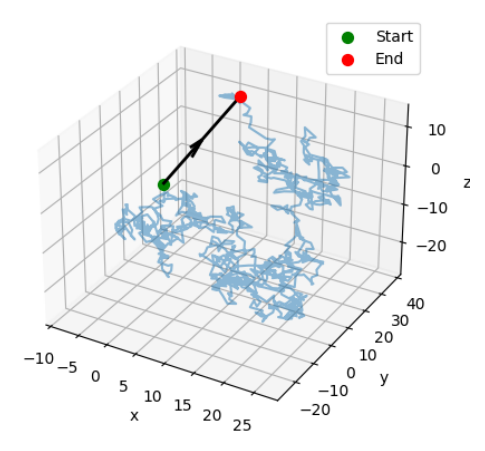 Random walk of a gas molecule, 1000 collisions
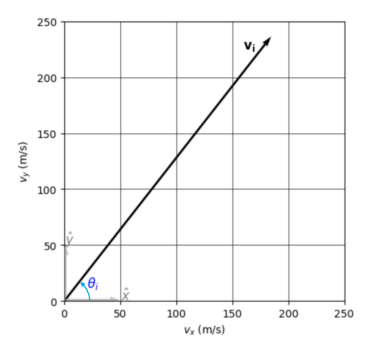 Velocity vector of gas molecule in 2D
Topic: Kinetic Theory, Thermodynamics Metodi: Kinetic Theory of Gases, Ideal Gas Law, Statistical Averaging Competenze: Mathematical Modeling, Estimation & Approximation Objects: Gas Fonte: Testo (PDF) — p.4
Domanda 2 Passeggiate casuali
Questa domanda esplora il movimento delle singole particelle all’interno di un gas. Questo è un esempio di una passeggiata casuale.
**(a) ** Calcolare la velocità tipica (media quadrata della radice) delle molecole di azoto () a temperatura ambiente. Supponiamo che agisca come gas ideale. La massa molare di è .
**(b) ** Indicare che la densità di qualsiasi sostanza composta da particelle che occupano un volume totale è data da dove è la massa molare e è la costante di Avogadro. Quindi, troverete un’espressione (in termini di densità) per il volume medio occupato da ciascuna particella.
**(c) ** In condizioni standard, l’azoto liquido () ha una densità di . Estima (grossamente) il diametro di una molecola di , indicando eventuali ipotesi che fai.
Per un gas ideale di particelle che occupano un volume totale , la distanza tipica spostata tra collisioni da molecole di diametro è nota come il percorso libero medio . Questo è dato da: Possiamo anche definire il tempo di collisione **** come il tempo tipico da una collisione alla successiva.
**(d) ** Determina per le molecole di azoto () a temperatura ambiente e pressione .
**(e) ** Supponiamo che una determinata molecola subisca collisioni in un tempo totale . Dopo la collisione , il suo vettore di velocità punta ad un angolo misurato in senso anticlockwise dall’asse positivo , come mostrato nella figura. 3. Scrivere un’espressione per in termini di , velocità molecolare e vettori unitari convenzionali , , che sono allineati rispettivamente con gli assi positivi orizzontali e verticali.
**(f) ** Spiegate brevemente perché, dopo le collisioni di tempo e , il spostamento vettoriale della molecola è dato da
**(g) ** In riferimento alla tua risposta a (e), argomenta perché in media il spostamento vettoriale è zero.
**(h) ** Considerando il valore medio di , determinare un’espressione per la magnitudine attesa del spostamento molecolare dopo le collisioni .
**i) ** Supponendo che l’espressione che avete appena ottenuto si applique anche in tre dimensioni (3D), calcoli il tempo necessario per una molecola di azoto per diffondersi a una distanza di 5,00 m dal suo punto di partenza. Supponiamo la temperatura e la pressione della stanza , e lasciate la risposta in un’unità ragionevole.
*Mode di cammino casuale di una molecola di gas, 1000 collisioni *
Vettore di velocità di molecola di gas in 2D
Topic: Kinetic Theory, Thermodynamics Metodi: Kinetic Theory of Gases, Ideal Gas Law, Statistical Averaging Competenze: Mathematical Modeling, Estimation & Approximation Objects: Gas Fonte: Testo (PDF) — p.4
Question 3 — The Blast Radius of The Gadget
This question is about the world’s first atomic bomb test, which took place in New Mexico, USA, in 1945. The operation — part of the Manhattan Project — was code-named Trinity and the bomb itself was nicknamed The Gadget.
The radius of the shockwave from an atomic bomb depends upon the density of the atmosphere , the time after the explosion and the energy released in the explosion.
(a) Using arguments of dimensional homogeneity (i.e., consistency of units), determine the values of the dimensionless unknowns , and if
It is reasonable to assume the dimensionless constant of proportionality implied in Eq. 5 is of order unity. Its precise value depends upon the circumstances of the explosion. Assume for the remainder of the question, and for simplicity, that .
(b) Prove that the atmospheric density is given by where is the (representative) molar mass of an air molecule. Show that, under typical sea-level conditions, .
(c) The speed of sound is related to the ambient pressure and density by a simple formula: where is the adiabatic index for air. Calculate the speed of sound under typical sea-level conditions.
(d) Use information in Fig. 4 to show that the energy released by The Gadget was approximately 100 TJ.
(e) Calculate the radius of the shockwave generated by The Gadget after (i) 1 ms, (ii) 10 ms, and (iii) 0.1 s.
(f) Calculate the speed of the shockwave after (i) 1 ms, (ii) 10 ms, and (iii) 0.1 s.
(g) Eventually, the shockwave stalled due to dissipation of the shockwave energy to the surroundings. Briefly explain why energy dissipation increases dramatically when the shockwave speed drops below the speed of sound in the external atmosphere.
(h) Estimate the radius at which The Gadget’s shockwave stalled and the corresponding time, after detonation, that this occurred.
(i) Following the test, scientists recorded structural damage to buildings at a distance of 3 km from the detonation site. Broken glass damage was observed as far as 30 km away. Reconcile these figures with your answer to part (h).
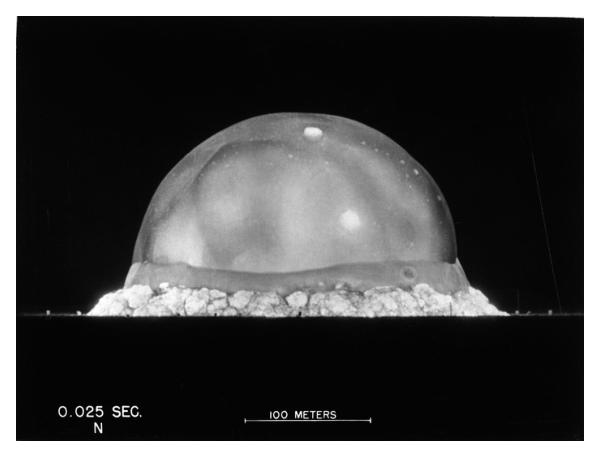 Hemispherical shockwave 25 ms after detonation
Topic: Thermodynamics, Order-of-Magnitude Estimation Metodi: Dimensional Analysis, Ideal Gas Law, Order-of-Magnitude Estimation Competenze: Physical Reasoning, Estimation & Approximation Objects: Gas Fonte: Testo (PDF) — p.6
Question 3 — The Blast Radius of The Gadget
Questa domanda riguarda il primo test di bomba atomica del mondo, che ebbe luogo nel New Mexico, negli Stati Uniti, nel 1945. L’operazione parte del progetto Manhattan era denominata in codice Trinity e la bomba stessa era soprannominata The Gadget.
Il raggio dell’onda d’urto di una bomba atomica dipende dalla densità dell’atmosfera , dal tempo successivo all’esplosione e dall’energia rilasciata nell’esplosione.
**(a) ** Utilizzando gli argomenti di omogeneità dimensionale (cioè coerenza delle unità), determinare i valori degli sconosciuti senza dimensioni , e se
È ragionevole supporre la costante dimensionistica di proporzionalità implicita in Eq. 5 è di unità di ordine. Il suo valore preciso dipende dalle circostanze dell’esplosione. Supponiamo, per il resto della domanda, e per semplicità, che .
**(b) ** Prove che la densità atmosferica è data da dove è la massa molare (representativa) di una molecola di aria. Indicare che, in condizioni tipiche del livello del mare, .
**(c) ** La velocità del suono è correlata alla pressione ambientale e alla densità con una semplice formula: dove è l’indice adiabatico per l’aria. Calcolare la velocità del suono in condizioni tipiche del livello del mare.
**(d) ** Utilizza le informazioni riportate nella figura. 4 per dimostrare che l’energia rilasciata dal Gadget era di circa 100 TJ.
**(e) ** Calcolare il raggio dell’onda d’urto generata dal Gadget dopo (i) 1 ms, (ii) 10 ms e (iii) 0,1 s.
**(f) ** Calcolare la velocità dell’onda d’urto dopo (i) 1 ms, (ii) 10 ms e (iii) 0,1 s.
(g) Eventually, the shockwave stalled due to dissipation of the shockwave energy to the surroundings. Spiegate brevemente perché la dissipazione dell’energia aumenta drasticamente quando la velocità delle onde d’urto scende al di sotto della velocità del suono nell’atmosfera esterna.
** h) ** Calcolare il raggio di onde d’urto del gadget e il tempo corrispondente, dopo la detonazione, che si è verificato.
**i) ** Dopo la prova, gli scienziati hanno registrato danni strutturali agli edifici a una distanza di 3 km dal sito di detonazione. I danni del vetro rotto sono stati osservati fino a 30 km di distanza. Conciliare queste cifre con la risposta alla parte (h).
onda di shock emisferica 25 ms dopo la detonazione
Topic: Thermodynamics, Order-of-Magnitude Estimation Metodi: Dimensional Analysis, Ideal Gas Law, Order-of-Magnitude Estimation Competenze: Physical Reasoning, Estimation & Approximation Objects: Gas Fonte: Testo (PDF) — p.6
Question 4 — The Pendulum
A mass is suspended from a frictionless pivot by a light string of length . It is released from rest at an angle from the vertical.
(a) Prove, given certain assumptions that you should clearly state, that the time period of the subsequent oscillations is
(b) By considering the principle of conservation of energy, prove that the angular velocity at angular displacement satisfies
(c) Hence argue that the time period of the subsequent oscillations can be written in integral form as
(d) By introducing an auxiliary angle such that prove that and express the constant in terms of . Hint: .
(e) By inserting a relevant value for into the integral expression above, show clearly how the result from part (a) can be recovered.
(f) For a general value of (and therefore ) there is no closed-form solution for the integral above. However, the result can be expressed in terms of the arithmetic-geometric mean function, : where is the result derived in part (a). The arithmetic-geometric mean function is recursively defined as the large limit of two simple sequences , : to find , set , and then: for . If and the mass is released from the same level as the pivot, with the string taut, determine the oscillatory time period to 3 significant figures.
(g) A more complex pendulum is composed of two masses, each , respectively at distances and from the pivot, where . The masses are connected with the pivot and to one another by co-linear, light rods. Draw the arrangement and explain, for a given value of , whether the oscillatory time period is shorter than, equal to, or longer than the simple pendulum of mass and length .
Topic: Oscillations & Waves, Newtonian Mechanics Metodi: Simple Harmonic Motion Analysis, Conservation of Energy, Calculus-Integration Competenze: Mathematical Modeling, Physical Reasoning Objects: Pendulum, Rod Fonte: Testo (PDF) — p.8
Quesito 4 — Il Pendolo
Una massa è sospesa a un perno privo di attrito mediante un filo leggero di lunghezza . Viene lasciata partire da ferma a un angolo dalla verticale.
(a) Dimostra, sotto certe assunzioni che dovresti enunciare chiaramente, che il periodo delle oscillazioni successive è
(b) Considerando il principio di conservazione dell’energia, dimostra che la velocità angolare allo spostamento angolare soddisfa
(c) Deduci quindi che il periodo delle oscillazioni successive può essere scritto in forma integrale come
(d) Introducendo un angolo ausiliario tale che dimostra che ed esprimi la costante in termini di . Suggerimento: .
(e) Inserendo un valore opportuno di nell’espressione integrale precedente, mostra chiaramente come si possa recuperare il risultato del punto (a).
(f) Per un valore generale di (e quindi di ) non esiste una soluzione in forma chiusa per l’integrale precedente. Tuttavia, il risultato può essere espresso in termini della funzione media aritmetico-geometrica, : dove è il risultato ricavato nel punto (a). La funzione media aritmetico-geometrica è definita ricorsivamente come il limite per grande di due semplici successioni , : per trovare , poni , e poi: per . Se e la massa viene lasciata partire dallo stesso livello del perno, con il filo teso, determina il periodo di oscillazione con 3 cifre significative.
(g) Un pendolo più complesso è composto da due masse, ciascuna , poste rispettivamente a distanze e dal perno, dove . Le masse sono collegate al perno e tra loro da aste leggere e collineari. Disegna la configurazione e spiega, per un dato valore di , se il periodo di oscillazione è minore, uguale o maggiore rispetto a quello del pendolo semplice di massa e lunghezza .
Topic: Oscillations & Waves, Newtonian Mechanics Metodi: Simple Harmonic Motion Analysis, Conservation of Energy, Calculus-Integration Competenze: Mathematical Modeling, Physical Reasoning Objects: Pendulum, Rod Fonte: Testo (PDF) — p.8