Galileo e il cannocchiale. [20 punti]
Nell’Agosto 1609 Galileo presentò al Doge e al Senato della Repubblica di Venezia il suo cannocchiale, costituito da due lenti allineate su uno stesso asse: la prima convergente (detta obiettivo), l’altra divergente (oculare). Il sistema può essere facilmente ricostruito disponendo due lenti di focale ed con alle due estremità di un tubo di cartone di lunghezza ; il sistema viene detto afocale perché un fascio di raggi che entrano paralleli (quando la sorgente è puntiforme, come una stella o un particolare della superficie lunare) emergono dallo strumento ancora paralleli.
NOTA BENE: Le due lenti possono essere trattate come “sottili” e gli angoli di inclinazione dei raggi rispetto all’asse ottico sono sempre “angoli piccoli”, cosicché si possono usare le consuete approssimazioni: , ecc.
-
Si consideri un raggio proveniente da una stella fuori asse, ovvero un raggio che si propaga obliquamente, con un angolo rispetto all’asse ottico; si supponga che, dopo aver attraversato l’obiettivo in un punto a distanza dall’asse ottico, vada a passare per il centro dell’oculare. Determinare il valore dell’angolo in funzione di e delle focali delle due lenti.
-
Disegnare un diagramma che mostri il percorso corretto di un fascio di raggi che entrano paralleli nella lente-obiettivo, inclinati di un angolo rispetto all’asse ottico, ed escono paralleli dalla lente-oculare, inclinati di un angolo .
-
Mostrare che l’ingrandimento angolare, definito come il rapporto , dipende solo dal valore delle focali delle due lenti. Osservata al cannocchiale, la Luna appare più grande di quanto sia vista ad occhio nudo e dunque sembra più vicina ed è possibile osservarne dei particolari non puntiformi — come un certo cratere — non visibili ad occhio nudo.
-
Sapendo che Galileo aveva usato due lenti di focale ed , e che la Luna si trova a circa dalla Terra, a che distanza sembra essere quel cratere lunare quando lo si osserva attraverso questo cannocchiale?
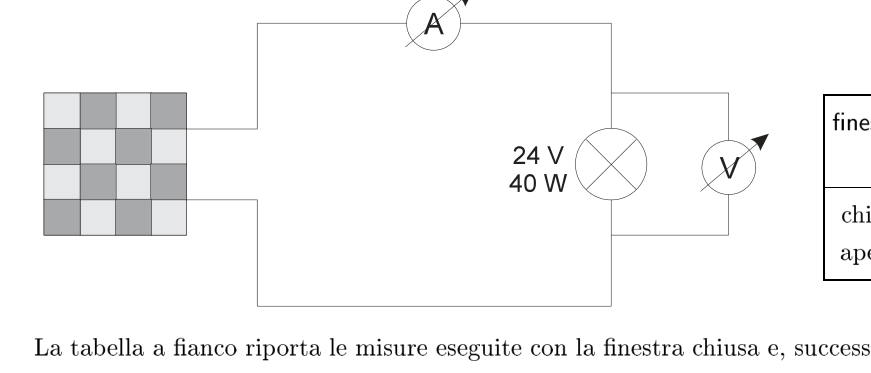
p.4 — Pannello fotovoltaico con lampadina e voltmetro
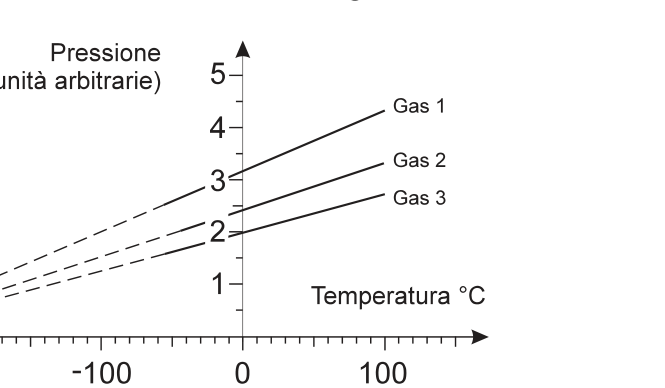
p.4 — Pressione contro temperatura per tre gas
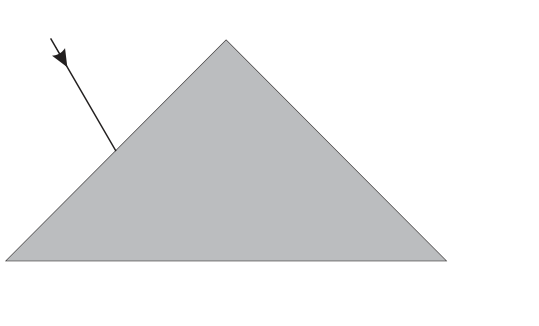
p.6 — Prisma triangolare con raggio incidente
Topic: Geometric Optics Metodi: Snell’s Law, Ray Tracing, Thin Lens & Mirror Equation Competenze: Diagrammatic Reasoning, Mathematical Modeling, Physical Reasoning Objects: Lens Fonte: Testo (PDF) — p.1 Soluzione: Soluzioni (PDF)
Galileo and the cannochial. [20 points]
In August 1609, Galileo presented to the Doge and Senate of the Republic of Venice his cannochial, consisting of two lenses aligned on the same axis: the first convergent (called objective), the other divergent (ocular). The system can be easily reconstructed by having two focal lenses and with at the two ends of a cardboard tube of length; the system is called afocal because a beam of parallel entering rays (when the source is pointed, such as a star or a particular feature of the lunar surface) emerge from the instrument still parallel.
**BEN NOTE: ** The two lenses can be treated as “thin” and the angles of inclination of the beams relative to the optical axis are always “small angles”, so the usual approximations can be used: , etc.
-
Consider a beam from a star off axis, or a beam that propagates obliquely, at an angle to the optical axis; assume that, after crossing the lens at a point away from the optical axis, it passes through the centre of the eye. Determine the angle as a function of and the focal lengths of the two lenses.
-
Draw a diagram showing the correct path of a beam of rays entering parallel to the lens-lens, inclined at an angle with respect to the optical axis, and exiting parallel to the lens-eye, inclined at an angle .
-
Show that the angular magnification, defined as the ratio, depends only on the value of the focal lengths of the two lenses. Observed at the cannochial, the Moon appears larger than it is seen with the naked eye and therefore appears closer and it is possible to observe non-pointy details of it such as a certain crater that is not visible to the naked eye.
-
Sapendo che Galileo aveva usato due lenti di focale ed , e che la Luna si trova a circa dalla Terra, a che distanza sembra essere quel cratere lunare quando lo si osserva attraverso questo cannocchiale?
**p.4 ** Photovoltaic panel with lamp and voltmeter
p.4 — Pressione contro temperatura per tre gas
p.6 — Prisma triangolare con raggio incidente
Topic: Geometric Optics Metodi: Snell’s Law, Ray Tracing, Thin Lens & Mirror Equation Competenze: Diagrammatic Reasoning, Mathematical Modeling, Physical Reasoning Objects: Lens Fonte: Testo (PDF) — p.1 Soluzione: Soluzioni (PDF)
Un carrello con piano inclinato. [20 punti]
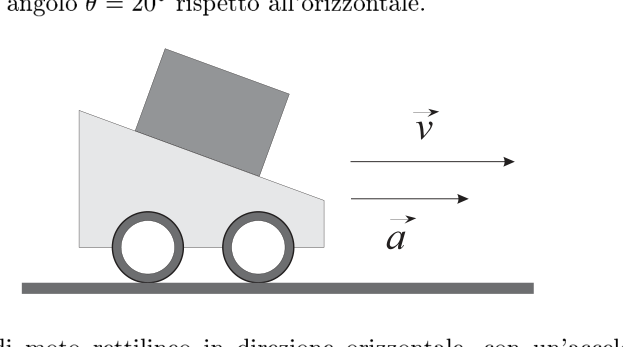
Un blocco a forma di parallelepipedo rettangolo di massa è appoggiato sul pianale di un carrellino. Il pianale è inclinato di un angolo rispetto all’orizzontale. Il carrellino si muove di moto rettilineo in direzione orizzontale, con un’accelerazione costante di , concorde con la velocità. Il coefficiente di attrito statico tra blocco e pianale è , quello dinamico è .
-
Determinare il modulo della forza di attrito statico necessario ad impedire al blocco di scivolare.
-
Determinare il massimo valore che la forza di attrito statico può assumere, in modulo, in queste condizioni.
-
Stabilire se il blocco scivola o no e dire qual è il valore effettivo del modulo dell’attrito.
p.8 — Blocco su carrello con pianale inclinato
Topic: Geometric Optics Metodi: Ray Tracing, Physical Modeling Competenze: Diagrammatic Reasoning, Physical Reasoning Objects: Block, Cart, Inclined Plane Fonte: Testo (PDF) — p.2 Soluzione: Soluzioni (PDF)
A cart with a sloping plane. [20 points]
A rectangular parallel-piped block of mass shall be rested on the plane of a trailer. The plane shall be tilted at an angle from the horizontal. The trailer shall be moved in a straight line motion in a horizontal direction with a constant acceleration of , in accordance with the speed. The static friction coefficient between block and plane is , the dynamic coefficient is .
-
Determine the modulus of static friction required to prevent the block from slipping.
-
Determine the maximum value that the static friction force can assume in the form under these conditions.
-
Establish whether the block slips or not and tell the actual value of the friction modulus.
p.8 Block on cart with sloping plan
Topic: Geometric Optics Metodi: Ray Tracing, Physical Modeling Competenze: Diagrammatic Reasoning, Physical Reasoning Objects: Block, Cart, Inclined Plane Fonte: Testo (PDF) — p.2 Soluzione: Soluzioni (PDF)
Ruotando un tubo ad U… [20 punti]
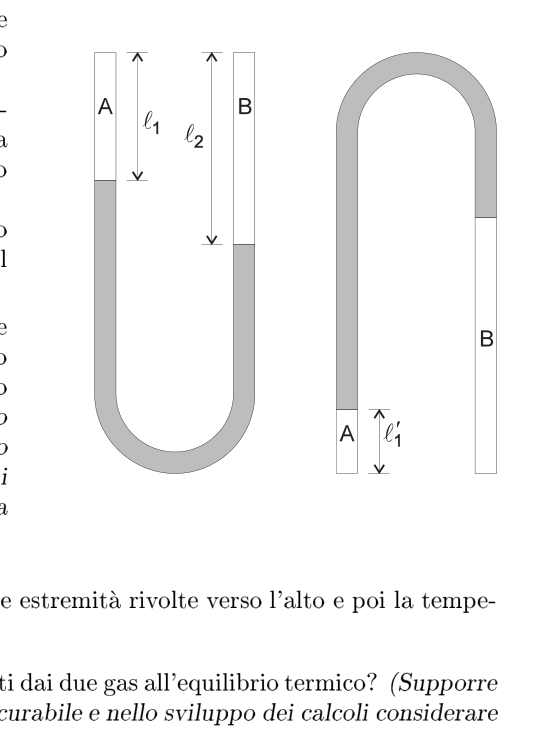
Un tubo di vetro, a forma di U e di sezione uniforme, contiene del mercurio. Le due estremità del tubo sono sigillate e un ramo del tubo contiene un gas A, mentre l’altro ramo contiene un gas B, entrambi considerati come gas perfetti. Quando il tubo viene mantenuto verticale con le estremità rivolte verso l’alto, come mostrato nella parte sinistra della figura, le parti del tubo occupate dai gas A e B hanno una lunghezza rispettivamente e . Quando invece il tubo viene capovolto, come mostrato nella parte destra della figura, la lunghezza della parte del tubo occupata dal gas A è .
-
Quanto valgono le lunghezze delle parti del tubo occupate dai due gas, quando il tubo è adagiato sopra un piano orizzontale in modo tale che entrambi i rami si trovino alla stessa altezza? (Supporre che i due rami del tubo abbiano la stessa lunghezza, che la colonna di mercurio non si spezzi, che nel corso del ribaltamento del tubo i due gas non si mescolino e che la temperatura rimanga costante a .)
Il tubo viene posto nuovamente in posizione verticale con le estremità rivolte verso l’alto e poi la temperatura viene aumentata fino a .
-
Quanto vale la variazione di lunghezza degli spazi occupati dai due gas all’equilibrio termico? (Supporre che l’espansione termica del mercurio e del vetro sia trascurabile e nello sviluppo dei calcoli considerare che i termini di secondo ordine siano trascurabili.)
Dato numerico: La densità del mercurio vale .
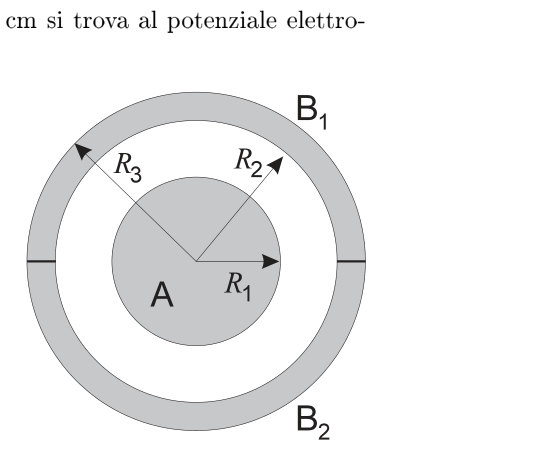
p.3 — Sfere conduttrici concentriche A, B1, B2
p.9 — Tubo a U con mercurio, posizioni verticali
Topic: Geometric Optics Metodi: Thin Lens & Mirror Equation, Physical Modeling, Small-Angle Approximation Competenze: Mathematical Modeling, Physical Reasoning Objects: Tube, Gas Fonte: Testo (PDF) — p.3 Soluzione: Soluzioni (PDF)
The value of the underlying load shall be the sum of the values of the load load.
A glass tube, U-shaped and uniformly divided, contains mercury. The two ends of the tube are sealed and one branch of the tube contains a gas A, while the other branch contains a gas B, both of which are considered perfect gases. When the pipe is kept vertical with the ends facing upwards, as shown in the left side of the figure, the parts of the pipe occupied by the gases A and B have a length of and respectively. When the tube is turned upside down, as shown in the right side of the figure, the length of the part of the tube occupied by gas A is .
- What is the value of the lengths of the parts of the pipe occupied by the two gases when the pipe is laid above a horizontal plane so that both branches are at the same height? (Assuming that the two tube branches are of the same length, that the mercury column does not break, that during the turning of the tube the two gases do not mix and that the temperature remains constant at .)
The tube is placed vertically again with the ends facing upwards and the temperature is then raised to .
- What is the difference in length of the spaces occupied by the two gases at the thermal equilibrium? (Assuming that the thermal expansion of mercury and glass is negligible and in the development of the calculations considering second order terms to be negligible.)
The mercury density is .
The following table shows the results of the calculation of the total number of samples:
U-tube with mercury, vertical positions
Topic: Geometric Optics Metodi: Thin Lens & Mirror Equation, Physical Modeling, Small-Angle Approximation Competenze: Mathematical Modeling, Physical Reasoning Objects: Tube, Gas Fonte: Testo (PDF) — p.3 Soluzione: Soluzioni (PDF)