Due ciclisti fanno una gara ad inseguimento partendo da punti opposti di una pista circolare. Trascurando i brevi intervalli di tempo delle accelerazioni, il moto dei due ciclisti può essere trattato come uniforme.
- Se uno dei due mantiene una velocità superiore all’altro del 10 %, dopo quanti giri il più veloce raggiunge l’altro?
Topic: Newtonian Mechanics Metodi: Kinematic Equations, Physical Modeling Competenze: Mathematical Modeling, Physical Reasoning Objects: — Fonte: Testo (PDF) — p.3 Soluzione: Soluzioni (PDF)
Two cyclists are pursuing a race starting from opposite points of a circular track. If the short intervals of acceleration are not taken into account, the motion of the two cyclists can be treated as uniform.
- If one of them keeps a speed of 10% faster than the other, how many laps later does the fastest one get to the other?
Topic: Newtonian Mechanics Metodi: Kinematic Equations, Physical Modeling Competenze: Mathematical Modeling, Physical Reasoning Objects: — Fonte: Testo (PDF) — p.3 Soluzione: Soluzioni (PDF)
Un cavo d’acciaio (), del diametro di , è teso verticalmente tra soffitto e pavimento di un locale alto . La tensione del cavo, nell’estremità attaccata al pavimento, è .
- Qual è la tensione interna in un punto A del cavo situato sotto il soffitto?
NOTA: La tensione interna può essere definita come la forza che occorrerebbe applicare al cavo, se si rompesse in quel punto, per mantenerlo nello stesso stato.
Topic: Newtonian Mechanics, Elasticity & Materials Metodi: Free-Body Diagram, Physical Modeling Competenze: Mathematical Modeling, Physical Reasoning Objects: String Fonte: Testo (PDF) — p.3 Soluzione: Soluzioni (PDF)
A steel cable () of diameter is tense vertically between the ceiling and floor of a high room . The voltage of the cable at the end attached to the floor is .
- Qual è la tensione interna in un punto A del cavo situato sotto il soffitto?
NOTE: Internal voltage can be defined as the force that would be applied to the cable if it broke at that point to keep it in the same state.
Topic: Newtonian Mechanics, Elasticity & Materials Metodi: Free-Body Diagram, Physical Modeling Competenze: Mathematical Modeling, Physical Reasoning Objects: String Fonte: Testo (PDF) — p.3 Soluzione: Soluzioni (PDF)
Un campione di isotopo radioattivo contiene inizialmente atomi.
- Sapendo che il tempo di dimezzamento (o emivita) dell’isotopo è di 4 ore e che dopo 12 ore l’energia emessa dal campione è pari a , calcolare l’energia emessa da ciascun atomo in un decadimento.
Topic: Nuclear & Particle Physics Metodi: Radioactive Decay Law, Physical Modeling Competenze: Mathematical Modeling, Physical Reasoning Objects: Nucleus, Atom Fonte: Testo (PDF) — p.3 Soluzione: Soluzioni (PDF)
A radioactive isotope sample initially contains atoms.
- Knowing that the half-life of the isotope is 4 hours and that after 12 hours the energy emitted by the sample is , calculate the energy emitted by each atom in a decay.
Topic: Nuclear & Particle Physics Metodi: Radioactive Decay Law, Physical Modeling Competenze: Mathematical Modeling, Physical Reasoning Objects: Nucleus, Atom Fonte: Testo (PDF) — p.3 Soluzione: Soluzioni (PDF)
Il sistema in figura rappresenta due dischi di raggi ed che, per attrito, possono ruotare a contatto uno dell’altro senza slittare. Su ciascun disco è fissato un rocchetto di raggio su cui è avvolta una fune. Alla prima è applicata una forza verticale mentre alla seconda è appesa una massa .
- Se sui perni non c’è attrito e tutto il sistema è in equilibrio, quanto vale il modulo della forza ?
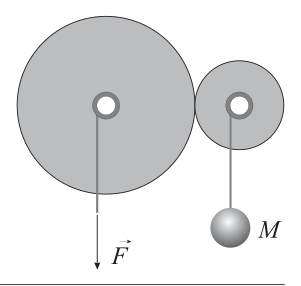 Two disks with spools in equilibrium
Topic: Rigid Body Statics, Rotational Dynamics Metodi: Torque & Angular Momentum Analysis, Free-Body Diagram Competenze: Diagrammatic Reasoning, Mathematical Modeling Objects: Disk, String, Block Fonte: Testo (PDF) — p.3 Soluzione: Soluzioni (PDF)
The system in the figure represents two discs of and rays which, by friction, can rotate in contact with each other without slipping. A beam rocket is fixed on each disc and a rope is wrapped around it. The first is to be applied a vertical force while the second is to be suspended a mass .
- If there is no friction on the pins and the whole system is in balance, how much is the force modulus worth?
Two disks with spools in equilibrium
Topic: Rigid Body Statics, Rotational Dynamics Metodi: Torque & Angular Momentum Analysis, Free-Body Diagram Competenze: Diagrammatic Reasoning, Mathematical Modeling Objects: Disk, String, Block Fonte: Testo (PDF) — p.3 Soluzione: Soluzioni (PDF)
La relazione caratteristica tensione–corrente di una batteria di celle solari è rappresentata nella figura a lato. Si collega ai morsetti della batteria di celle un resistore di resistenza in modo da poter utilizzare una potenza .
- Che valori di soddisfano questo requisito?
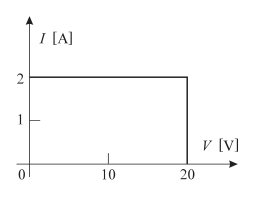 Solar cell voltage-current characteristic curve
Topic: Circuits, Electrostatics Metodi: Equivalent Circuit Reduction, Experimental Data Analysis Competenze: Graph Linearization, Physical Reasoning Objects: Battery, Resistor Fonte: Testo (PDF) — p.4 Soluzione: Soluzioni (PDF)
The characteristic current voltage ratio of a solar cell battery is shown in the figure below. A resistor is connected to the cell battery wrenches so that a power can be used.
- What values of meet this requirement?
The energy efficiency of the solar cell shall be determined by the following:
Topic: Circuits, Electrostatics Metodi: Equivalent Circuit Reduction, Experimental Data Analysis Competenze: Graph Linearization, Physical Reasoning Objects: Battery, Resistor Fonte: Testo (PDF) — p.4 Soluzione: Soluzioni (PDF)
Una piccola lampadina, che possiamo trattare come una sorgente puntiforme, è collocata sull’asse ottico principale di uno specchio circolare concavo avente un raggio di curvatura . Le dimensioni trasversali dello specchio sono piccole rispetto ad e dunque il sistema si può studiare in approssimazione parassiale. Su uno schermo, perpendicolare all’asse ottico dello specchio, la luce riflessa forma una macchia luminosa circolare. Spostando la lampadina lungo l’asse ottico, si osserva che ci sono due posizioni della lampadina in corrispondenza delle quali la macchia luminosa sullo schermo ha le stesse dimensioni dello specchio. La distanza tra queste due posizioni è .
- Si trovi la distanza tra lo schermo e il vertice dello specchio.
Topic: Geometric Optics Metodi: Thin Lens & Mirror Equation, Ray Tracing Competenze: Mathematical Modeling, Physical Reasoning Objects: Mirror, Screen Fonte: Testo (PDF) — p.4 Soluzione: Soluzioni (PDF)
A small bulb, which we can treat as a pointed source, is placed on the main optical axis of a concave circular mirror with a radius of curvature . The cross-sectional dimensions of the mirror are small compared to and therefore the system can be studied in a parasitic approximation. On a screen perpendicular to the mirror’s optical axis, reflected light forms a circular bright spot. Moving the lamp along the optical axis, you notice that there are two positions of the lamp corresponding to which the bright spot on the screen is the same size as the mirror. The distance between these two positions is .
- Find the distance between the screen and the top of the mirror.
Topic: Geometric Optics Metodi: Thin Lens & Mirror Equation, Ray Tracing Competenze: Mathematical Modeling, Physical Reasoning Objects: Mirror, Screen Fonte: Testo (PDF) — p.4 Soluzione: Soluzioni (PDF)
Una goccia di pioggia di massa sta scendendo verticalmente a velocità costante a causa dell’azione di una forza di frenamento , dove è una costante.
- Calcolare l’energia cinetica della goccia di pioggia, in funzione della massa , della costante e dell’accelerazione di gravità .
Topic: Newtonian Mechanics, Fluid Mechanics Metodi: Free-Body Diagram, Physical Modeling Competenze: Mathematical Modeling, Physical Reasoning Objects: Droplet Fonte: Testo (PDF) — p.4 Soluzione: Soluzioni (PDF)
A drop of rain mass is descending vertically at a constant speed due to the action of a braking force , where is a constant.
- Calculate the kinetic energy of the rain drop, in terms of mass , constant and gravity acceleration .
Topic: Newtonian Mechanics, Fluid Mechanics Metodi: Free-Body Diagram, Physical Modeling Competenze: Mathematical Modeling, Physical Reasoning Objects: Droplet Fonte: Testo (PDF) — p.4 Soluzione: Soluzioni (PDF)
Nella regione di spazio indicata in figura è presente un campo elettrico uniforme e parallelo al piano del foglio dove giacciono i punti A, B, C, D e P. I punti A, B, C e D sono posti ai vertici di un quadrato di lato e il punto P si trova al centro del quadrato stesso. Nel punto A il potenziale elettrico vale , nei punti B e D vale , nel punto C vale , mentre nel punto P vale .
- Qual è il campo elettrico nel punto P?
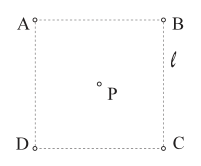 Square ABCD with uniform electric field
Topic: Electrostatics Metodi: Electric Potential Method, Symmetry Argument Competenze: Mathematical Modeling, Diagrammatic Reasoning Objects: — Fonte: Testo (PDF) — p.4 Soluzione: Soluzioni (PDF)
The area region shown in the figure shall have a uniform electric field parallel to the plane of the sheet where points A, B, C, D and P lie. The points A, B, C and D are placed at the vertices of a side square and the point P is located at the centre of the square itself. In point A the electric potential is , in points B and D it is , in point C it is , while in point P it is .
What’s the electric field at P?
Square ABCD with uniform electric field
Topic: Electrostatics Metodi: Electric Potential Method, Symmetry Argument Competenze: Mathematical Modeling, Diagrammatic Reasoning Objects: — Fonte: Testo (PDF) — p.4 Soluzione: Soluzioni (PDF)
Un motorino elettrico ha capacità termica . Esso viene isolato termicamente e adoperato per sollevare da terra una massa attaccata all’asse del motore mediante un filo. Il motore viene arrestato quando la massa ha raggiunto un’altezza . Quando si apre il circuito, la massa ritorna a terra lentamente, a velocità costante, srotolando il filo. Il motorino funziona per e, in questo tempo, fluisce una corrente mentre la tensione applicata è .
- Di quanto aumenta la temperatura del motorino elettrico in seguito a tale processo?
NOTA: Si supponga che l’unico effetto del processo sia quello di riscaldare il motorino e che si possano trascurare le dispersioni di calore.
Topic: Thermodynamics, Circuits Metodi: Conservation of Energy, First Law of Thermodynamics Competenze: Mathematical Modeling, Physical Reasoning Objects: String, Block Fonte: Testo (PDF) — p.4 Soluzione: Soluzioni (PDF)
An electric motor has a thermal capacity . It is heat-insulated and used to lift a mass attached to the engine axle from the ground by a wire. The engine is stopped when the mass has reached a height . When the circuit opens, the mass returns to the ground slowly, at a constant speed, twisting the wire. The engine is running for and, at this time, a current is flowing while the applied voltage is .
How much does the temperature of the electric motor increase as a result of this process?
**NOTE: ** Suppose that the only effect of the process is to heat the engine and that heat dissipation can be neglected.
Topic: Thermodynamics, Circuits Metodi: Conservation of Energy, First Law of Thermodynamics Competenze: Mathematical Modeling, Physical Reasoning Objects: String, Block Fonte: Testo (PDF) — p.4 Soluzione: Soluzioni (PDF)
Il sistema ottico in figura è costituito da una lente sottile per la quale si suppone che i raggi incidenti siano vicini all’asse ottico e formino con questo angoli piccoli, in modo da rendere trascurabili gli effetti di ogni tipo di aberrazione ottica; in questa approssimazione (detta di Gauss) si può dimostrare che le immagini dei punti di una retta sono allineate su un’altra retta. La lente è rappresentata dalla doppia freccia verticale e i punti F’ e F” sono i suoi fuochi.
- Copiare la figura sul foglio protocollo delle soluzioni, accostandola al bordo sinistro e tracciare l’immagine reale della freccia prodotta dalla lente, giustificando opportunamente, mediante il disegno o calcoli algebrici, il risultato ottenuto.
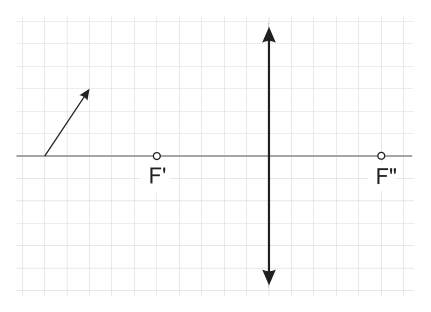 Thin lens with object arrow and foci F’, F”
Topic: Geometric Optics Metodi: Ray Tracing, Thin Lens & Mirror Equation Competenze: Diagrammatic Reasoning, Mathematical Modeling Objects: Lens Fonte: Testo (PDF) — p.4 Soluzione: Soluzioni (PDF)
The optical system in the figure consists of a thin lens for which it is assumed that the incident rays are close to the optical axis and form at this small angle, so as to make negligible the effects of any type of optical aberration; in this approximation (Gauss’s view) it can be shown that the images of the points of one line are aligned on another line. The lens is represented by the double vertical arrow and the F and F points are its fires.
- Copy the figure on the solution protocol sheet, attach it to the left edge and draw the actual image of the arrow produced by the lens, justifying the result by drawing or algebraic calculations.
Thin lens with object arrow and foci F’, F’
Topic: Geometric Optics Metodi: Ray Tracing, Thin Lens & Mirror Equation Competenze: Diagrammatic Reasoning, Mathematical Modeling Objects: Lens Fonte: Testo (PDF) — p.4 Soluzione: Soluzioni (PDF)
Un satellite cosiddetto “geostazionario” gira intorno alla Terra in (circa) 24 ore, stando ad un’altezza di circa sulla superficie terrestre.
- In quanto tempo una sonda spaziale percorre un’orbita circolare se la sua altezza dal suolo è di circa ?
Per un esperimento si vuole lanciare, dalla sonda spaziale verso la Terra, un oggetto che cada giù verticalmente, con una velocità iniziale rispetto alla Terra (l’oggetto ha una massa trascurabile rispetto a quella della sonda).
- Rispetto alla direzione di moto della sonda, a che angolo sarà lanciato l’oggetto?
- Che velocità viene data all’oggetto, rispetto alla sonda?
- Supponendo di poter trascurare la presenza dell’atmosfera fino ad una quota di circa dal suolo, che velocità ha l’oggetto quando incontra l’atmosfera?
NOTA: Nella soluzione del problema utilizzare, oltre ai valori numerici dei dati, solo quelli dell’accelerazione di gravità al suolo e del raggio della Terra .
Topic: Gravitation, Newtonian Mechanics Metodi: Kepler’s Laws, Conservation of Energy, Kinematic Equations Competenze: Mathematical Modeling, Physical Reasoning Objects: Satellite, Planet Fonte: Testo (PDF) — p.5 Soluzione: Soluzioni (PDF)
A so-called “geostationary” satellite orbits the Earth in (about) 24 hours, standing at a height of about on the Earth’s surface.
- How long does a spacecraft travel in a circular orbit if its altitude from the ground is about ?
For an experiment, you want to launch from the space probe to Earth an object that drops vertically, with an initial speed relative to the Earth (the object has a negligible mass relative to that of the probe).
- Compared to the direction of motion of the probe, what angle will the object be launched at?
- What speed is given to the object, relative to the probe?
- Assuming you can ignore the presence of the atmosphere up to about from the ground, what speed does the object have when it meets the atmosphere?
NOTE: In the solution of the problem, in addition to the numerical values of the data, only those of the ground gravity acceleration and the radius of the Earth are used.
Topic: Gravitation, Newtonian Mechanics Metodi: Kepler’s Laws, Conservation of Energy, Kinematic Equations Competenze: Mathematical Modeling, Physical Reasoning Objects: Satellite, Planet Fonte: Testo (PDF) — p.5 Soluzione: Soluzioni (PDF)
Si consideri un recipiente con le pareti termicamente isolanti e diviso in due ambienti da una parete, anch’essa termicamente isolante, che può scorrere senza attrito. In ciascun ambiente ci sono inizialmente moli di una miscela di gas perfetti che si trova a pressione , temperatura e volume . Un riscaldatore elettrico fornisce molto lentamente del calore all’ambiente posto a sinistra. Il gas si espande fino a quando nell’ambiente di destra la pressione raggiunge il valore . Il rapporto tra il calore specifico molare a pressione costante e quello molare a volume costante vale .
Determinare in funzione di , e :
- la temperatura finale del gas nell’ambiente di destra.
- il lavoro eseguito sul gas nell’ambiente di destra.
- la temperatura finale del gas nell’ambiente di sinistra.
- quanto calore è stato assorbito dal gas nell’ambiente di sinistra.
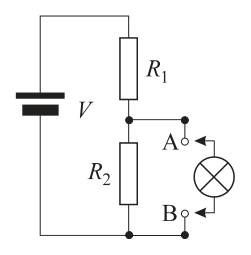 Resistor voltage divider circuit with lamp
Topic: Thermodynamics, Kinetic Theory Metodi: Ideal Gas Law, First Law of Thermodynamics, Thermodynamic Cycle Analysis Competenze: Mathematical Modeling, Physical Reasoning Objects: Container, Gas, Piston Fonte: Testo (PDF) — p.6 Soluzione: Soluzioni (PDF)
Consider a container with thermal insulating walls and divided into two rooms by a wall, also thermal insulating, which can flow without friction. In each environment there are initially moles of a perfect gas mixture at pressure, temperature and volume. An electric heater provides very slow heat to the left-handed environment. The gas expands until the pressure in the right environment reaches . The ratio of the molar specific heat at constant pressure to the molar specific heat at constant volume is .
Determine as a function of , and :
- the final temperature of the gas in the environment on the right.
- The work done on gas in the right environment.
- the final temperature of the gas in the left environment.
- How much heat has been absorbed by the gas in the left environment.
Resistor voltage divider circuit with lamp
Topic: Thermodynamics, Kinetic Theory Metodi: Ideal Gas Law, First Law of Thermodynamics, Thermodynamic Cycle Analysis Competenze: Mathematical Modeling, Physical Reasoning Objects: Container, Gas, Piston Fonte: Testo (PDF) — p.6 Soluzione: Soluzioni (PDF)
Una lampadina da di potenza nominale deve essere alimentata a , ma si dispone solamente di un alimentatore (generatore di f.e.m.) con ; la si vuole accendere utilizzando il circuito rappresentato in figura.
- Si dispone di un resistore da da utilizzare come . Che valore deve avere la resistenza perché, prima di inserire la lampadina nel circuito, fra i punti A e B vi sia una d.d.p. di ?
- Se, utilizzando i valori di e di cui al punto precedente, si inserisce la lampadina ai punti A e B, quanto vale la potenza assorbita dalla lampadina?
- Che valore di occorre affinché la lampadina assorba effettivamente la potenza nominale di ?
- Potendo variare anche il valore di , quali valori conviene dare a e affinché la potenza erogata dal generatore sia minima, pur continuando la lampadina ad assorbire ?
NOTA: Trascurare la dipendenza delle resistenze dalla temperatura.
Topic: Circuits Metodi: Kirchhoff’s Laws, Equivalent Circuit Reduction Competenze: Mathematical Modeling, Physical Reasoning Objects: Resistor, Battery Fonte: Testo (PDF) — p.6 Soluzione: Soluzioni (PDF)
A nominal power lamp shall be powered to , but only a power supply (f.e.m. generator) with is available; it shall be lit using the circuit shown in the figure.
- A resistor of is available to be used as . What value must the resistance have because, before the lamp is inserted into the circuit, there is a d.d.p. between points A and B. di ?
- If, using the values of and in the previous point, the lamp is placed in points A and B, what is the power absorbed by the lamp?
- What value of is required for the bulb to actually absorb the rated power of ?
- Since the value of can also be varied, what values should be given to and so that the power delivered by the generator is minimal, while the lamp continues to absorb ?
NOTE: Ignore the dependence of resistance to temperature.
Topic: Circuits Metodi: Kirchhoff’s Laws, Equivalent Circuit Reduction Competenze: Mathematical Modeling, Physical Reasoning Objects: Resistor, Battery Fonte: Testo (PDF) — p.6 Soluzione: Soluzioni (PDF)