Un’asta di lunghezza , costruita di materiale omogeneo di densità lineare , è imperniata su un asse orizzontale fissato a una parete verticale e coincidente con la sua estremità in alto. È tenuta in equilibrio esercitando una forza orizzontale nell’estremo più in basso.
Siano: , , .
- Quanto vale l’intensità della reazione che il muro esercita sull’estremo più in alto dell’asta?
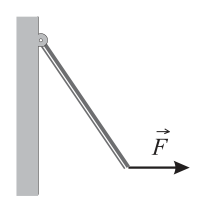 Asta imperniata a parete con forza
Topic: Rigid Body Statics, Newtonian Mechanics Metodi: Torque & Angular Momentum Analysis, Free-Body Diagram Competenze: Physical Reasoning, Mathematical Modeling Objects: Rod Fonte: Testo (PDF) — p.3 Soluzione: Soluzioni (PDF)
A length axis , constructed of homogeneous linear density material, is impregnated on a horizontal axis fixed to a vertical wall and coinciding with its upper end. It is balanced by applying a horizontal force at the lower end.
Siano: , , .
- What’s the intensity of the reaction the wall exerted on the upper end of the arrow?
*It is tightly wall-mounted *
Topic: Rigid Body Statics, Newtonian Mechanics Metodi: Torque & Angular Momentum Analysis, Free-Body Diagram Competenze: Physical Reasoning, Mathematical Modeling Objects: Rod Fonte: Testo (PDF) — p.3 Soluzione: Soluzioni (PDF)
Un cilindro con pistone a tenuta contiene 2 mol di elio alla temperatura di . Il sistema subisce una trasformazione nella quale assorbe di calore. Al termine la temperatura del gas è di . In questo intervallo di temperatura, l’elio può essere considerato, con ottima approssimazione, un gas ideale.
- Determinare l’eventuale scambio di energia con l’ambiente, avvenuto sotto forma di lavoro meccanico.
Topic: Thermodynamics Metodi: First Law of Thermodynamics, Ideal Gas Law Competenze: Physical Reasoning, Mathematical Modeling Objects: Cylinder, Piston, Gas Fonte: Testo (PDF) — p.3 Soluzione: Soluzioni (PDF)
A cylinder with a piston hold contains 2 mol of helium at . The system undergoes a transformation in which it absorbs heat. The gas temperature at the end is . At this temperature range, helium can be considered, with excellent approximation, an ideal gas.
- Determine the possible energy exchange with the environment in the form of mechanical work.
Topic: Thermodynamics Metodi: First Law of Thermodynamics, Ideal Gas Law Competenze: Physical Reasoning, Mathematical Modeling Objects: Cylinder, Piston, Gas Fonte: Testo (PDF) — p.3 Soluzione: Soluzioni (PDF)
Due ciclisti in fuga corrono lungo una strada, ciascuno a velocità costante. Il primo ha una velocità e, ad un certo istante, si trova oltre un incrocio, che può essere preso come punto di riferimento; il secondo invece procede a velocità e, nello stesso istante, si trova prima dello stesso incrocio.
- Dopo quanto tempo il secondo ciclista raggiungerà il primo?
Topic: Newtonian Mechanics Metodi: Kinematic Equations Competenze: Mathematical Modeling, Physical Reasoning Objects: — Fonte: Testo (PDF) — p.3 Soluzione: Soluzioni (PDF)
Two on the run cyclists run along a road, each at a constant speed. The first has a speed and at a certain moment lies above a cross, which can be taken as a reference point; the second instead proceeds at a speed and at the same moment lies before the same cross.
How long before the second rider gets to the first?
Topic: Newtonian Mechanics Metodi: Kinematic Equations Competenze: Mathematical Modeling, Physical Reasoning Objects: — Fonte: Testo (PDF) — p.3 Soluzione: Soluzioni (PDF)
Ponendo un piccolo oggetto sull’asse ottico di una lente sottile convergente, a dalla lente stessa, si forma un’immagine virtuale a dalla lente.
- Se lo stesso oggetto viene posto a dalla lente, dove si forma l’immagine?
Topic: Geometric Optics Metodi: Thin Lens & Mirror Equation Competenze: Mathematical Modeling, Physical Reasoning Objects: Lens Fonte: Testo (PDF) — p.3 Soluzione: Soluzioni (PDF)
By placing a small object on the optical axis of a thin converging lens, at from the lens itself, a virtual image at from the lens is formed.
- If the same object is placed at by the lens, where does the image form?
Topic: Geometric Optics Metodi: Thin Lens & Mirror Equation Competenze: Mathematical Modeling, Physical Reasoning Objects: Lens Fonte: Testo (PDF) — p.3 Soluzione: Soluzioni (PDF)
Nel circuito in figura un condensatore, che al tempo è scarico, viene caricato mediante un generatore che fornisce una corrente costante nel tempo, con intensità . In la d.d.p. ai capi del condensatore aumenta da a .
- Determinare la capacità del condensatore.
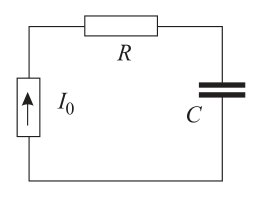 Circuito con generatore e condensatore
Topic: Circuits Metodi: Equivalent Circuit Reduction Competenze: Mathematical Modeling, Physical Reasoning Objects: Capacitor, Battery Fonte: Testo (PDF) — p.4 Soluzione: Soluzioni (PDF)
In the circuit shown a capacitor, which is discharged at time, is charged by a generator providing a constant current over time, with an intensity . In la d.d.p. The capacitor heads shall be increased from to .
Determine the capacitance of the capacitor.
Circuit with generator and capacitor
Topic: Circuits Metodi: Equivalent Circuit Reduction Competenze: Mathematical Modeling, Physical Reasoning Objects: Capacitor, Battery Fonte: Testo (PDF) — p.4 Soluzione: Soluzioni (PDF)
In un termostato sono inseriti due recipienti rigidi che contengono due gas perfetti alla stessa temperatura. Il primo ha un volume di e in esso il gas ha una pressione di . Il secondo ha un volume di e in esso il gas ha una pressione di . I due recipienti vengono posti in comunicazione, cosicché i due gas si mescolano.
- Calcolare la pressione finale.
Topic: Thermodynamics, Kinetic Theory Metodi: Ideal Gas Law Competenze: Mathematical Modeling, Physical Reasoning Objects: Container, Gas Fonte: Testo (PDF) — p.4 Soluzione: Soluzioni (PDF)
Two rigid containers are inserted into a thermostat containing two perfect gases at the same temperature. The first has a volume of and the gas has a pressure of in it. The second volume is and the gas in it has a pressure of . The two vessels are placed in communication, so that the two gases mix.
- Calculate the final pressure.
Topic: Thermodynamics, Kinetic Theory Metodi: Ideal Gas Law Competenze: Mathematical Modeling, Physical Reasoning Objects: Container, Gas Fonte: Testo (PDF) — p.4 Soluzione: Soluzioni (PDF)
Una cassa di massa viene trainata su un piazzale in piano, partendo da ferma, con accelerazione costante . La forza di trazione è applicata mediante una fune orizzontale. Il coefficiente d’attrito tra la cassa e il piano stradale è .
- Si vuol sapere la potenza che occorre applicare alla fune dopo un tempo dall’inizio dello spostamento.
Valori numerici: ; ; ; .
Topic: Newtonian Mechanics Metodi: Free-Body Diagram, Kinematic Equations Competenze: Mathematical Modeling, Physical Reasoning Objects: Block, String Fonte: Testo (PDF) — p.4 Soluzione: Soluzioni (PDF)
A mass box is drawn onto a flat square, starting from a stationary position, with constant acceleration . The traction force shall be applied by means of a horizontal rope. The friction coefficient between the casing and the road surface is .
- You want to know the power that needs to be applied to the rope after a certain time from the start of the shift.
Valori numerici: ; ; ; .
Topic: Newtonian Mechanics Metodi: Free-Body Diagram, Kinematic Equations Competenze: Mathematical Modeling, Physical Reasoning Objects: Block, String Fonte: Testo (PDF) — p.4 Soluzione: Soluzioni (PDF)
Lungo un’autostrada dritta c’è un’industria chimica nella quale un ventilatore difettoso emette un forte ronzio a . Un automobilista, che si trova a grande distanza rispetto alla distanza fra fabbrica e strada, vede l’impianto davanti a sé e sente un fischio a .
- A che velocità si sta muovendo la macchina?
Nota: La velocità di propagazione del suono sia .
Topic: Oscillations & Waves Metodi: Wave Equation Competenze: Physical Reasoning, Mathematical Modeling Objects: — Fonte: Testo (PDF) — p.4 Soluzione: Soluzioni (PDF)
Along a straight highway is a chemical industry where a faulty fan makes a loud buzz at . A driver, who is far away from the factory and road, sees the plant in front of him and hears a whistle at .
- How fast is the car moving?
Note: The speed of propagation of sound is .
Topic: Oscillations & Waves Metodi: Wave Equation Competenze: Physical Reasoning, Mathematical Modeling Objects: — Fonte: Testo (PDF) — p.4 Soluzione: Soluzioni (PDF)
Una goccia d’acqua ha un diametro di ed è carica negativamente. Alla sua superficie il campo elettrico ha intensità uniforme .
- Determinare l’intensità di un campo elettrico uniforme capace di mantenere la goccia sospesa in equilibrio in aria, ferma.
Topic: Electrostatics, Newtonian Mechanics Metodi: Gauss’s Law, Free-Body Diagram Competenze: Physical Reasoning, Mathematical Modeling Objects: Droplet Fonte: Testo (PDF) — p.4 Soluzione: Soluzioni (PDF)
A drop of water has a diameter of and is negatively charged. The electric field on its surface has a uniform intensity .
- Determine the intensity of a uniform electric field capable of keeping the drop suspended in balance in the air, still.
Topic: Electrostatics, Newtonian Mechanics Metodi: Gauss’s Law, Free-Body Diagram Competenze: Physical Reasoning, Mathematical Modeling Objects: Droplet Fonte: Testo (PDF) — p.4 Soluzione: Soluzioni (PDF)
Un corpo di massa è in equilibrio, appeso ad una molla di costante elastica , che lo sostiene. Il corpo viene sollevato, molto lentamente, di un tratto .
- Calcolare il lavoro compiuto dalla forza che solleva il corpo.
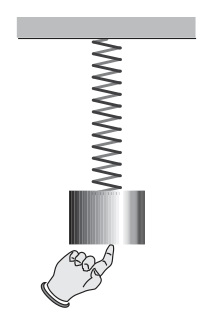 Corpo appeso a molla
Topic: Conservation of Energy, Newtonian Mechanics Metodi: Energy Conservation Method, Hooke’s Law Competenze: Physical Reasoning, Mathematical Modeling Objects: Spring, Block Fonte: Testo (PDF) — p.4 Soluzione: Soluzioni (PDF)
A mass body is in equilibrium, suspended from a spring of constant elasticity , which supports it. The body is raised very slowly, at a sudden rate of .
- Calculate the work done by the force lifting the body.
Body suspended from the spring
Topic: Conservation of Energy, Newtonian Mechanics Metodi: Energy Conservation Method, Hooke’s Law Competenze: Physical Reasoning, Mathematical Modeling Objects: Spring, Block Fonte: Testo (PDF) — p.4 Soluzione: Soluzioni (PDF)
Problema 1 – Motore termico [Punti 20]
Un motore termico effettua il ciclo termodinamico mostrato nel piano cartesiano – in figura, costituito da trasformazioni quasi-stazionarie. Il fluido del motore è costituito da moli di un gas perfetto monoatomico.
- Giustificando le risposte, dire: a. In quali trasformazioni il gas compie lavoro e in quali lo riceve. b. In quali trasformazioni il gas si riscalda e in quali si raffredda. c. In quali trasformazioni l’energia interna del gas aumenta e in quali diminuisce. d. In quali trasformazioni il gas assorbe calore e in quali lo cede.
- Calcolare il rendimento del motore.
Si ponga adesso e , .
- Calcolare la temperatura più bassa e quella più alta raggiunte dal fluido durante il ciclo e individuare in quali stati il sistema raggiunge questi valori.
- Determinare il rendimento di un motore che esegue un ciclo di Carnot tra le due temperature trovate nella domanda precedente.
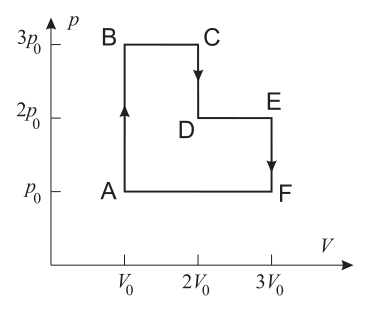 Ciclo termodinamico nel piano V-p
Topic: Thermodynamics Metodi: Thermodynamic Cycle Analysis, First Law of Thermodynamics, Ideal Gas Law Competenze: Physical Reasoning, Mathematical Modeling Objects: Heat Engine, Gas Fonte: Testo (PDF) — p.5 Soluzione: Soluzioni (PDF)
The following is the list of the types of electricity generated by the electricity generated by the electricity generated by the electricity generated by the electricity generated by the electricity generated by the electricity generated by the electricity generated by the electricity generated by the electricity generated by the electricity generated by the electricity generated by the electricity generated by the electricity generated by the electricity generated by the electricity generated by the electricity generated by the electricity generated by the electricity generated by the electricity generated by the electricity generated by the electricity generated by the electricity generated by the electricity generated by the electricity generated electricity generated by the electricity generated electricity generated by the electricity generated electricity generated electricity generated by the electricity generated electricity generated electricity generated by the electricity generated electricity generated electricity generated electricity generated electricity.
A thermal engine performs the thermodynamic cycle shown in the Cartesian plane V$$p in the figure, consisting of quasi-stationary transformations. The engine fluid is molles of a perfect monoatomic gas.
- Justifying the answers, say: a. In which processes the gas performs work and in which it receives it. b. In which processes the gas is heated and cooled. c. In which transformations the internal energy of the gas increases and decreases. d. In which processes the gas absorbs heat and in which it releases it.
- Calculate the engine performance.
Now put and , .
- Calculate the lowest and highest fluid temperature during the cycle and identify the states in which the system reaches these values.
- Determine the performance of an engine running a Carnot cycle between the two temperatures found in the previous question.
The thermodynamic cycle in the V-p plane
Topic: Thermodynamics Metodi: Thermodynamic Cycle Analysis, First Law of Thermodynamics, Ideal Gas Law Competenze: Physical Reasoning, Mathematical Modeling Objects: Heat Engine, Gas Fonte: Testo (PDF) — p.5 Soluzione: Soluzioni (PDF)
Problema 2 – Asta che ruota con molla [Punti 20]
La figura a sinistra mostra un corpo puntiforme, di massa , attaccato ad un’estremità di un’asta rigida che può ruotare liberamente in un piano verticale attorno alla sua altra estremità, fissata nel punto . L’asta ha massa trascurabile e lunghezza . Il corpo è attaccato anche ad una molla di costante elastica e lunghezza a riposo , la cui altra estremità è fissata ad un punto che si trova sulla verticale passante per , ad una distanza sotto di esso.
Valori numerici: , , , , .
Il punto in cui si trova il corpo può assumere tutte le posizioni sulla circonferenza di raggio , fra il punto più in alto e quello più in basso . La lunghezza della molla può variare fra il valore massimo, , nel punto e quello minimo, , nel punto . Dati i valori di e riportati sopra, è sempre maggiore della lunghezza minima , per cui la molla è sempre in trazione.
- Mostrare che l’equilibrio è instabile nel punto , è stabile nel punto e che non esistono altri punti di equilibrio stabile (basta mostrarlo in un punto qualunque).
- Ricavare l’espressione dell’energia del corpo in condizioni statiche in un punto generico e calcolarne il valore nei punti e .
- Supponendo che l’asta venga messa in moto quando si trova nel punto facendole acquistare una velocità angolare , qual è il minimo valore di che permette al corpo di raggiungere il punto ?
Si consideri adesso la situazione illustrata nella figura a destra, in cui la molla è attaccata al punto . Le posizioni che il corpo può occupare sono ancora sulla stessa circonferenza. Ci si limiti a considerare quelle per cui la molla è allungata (cioè quelle per cui ). In questa situazione esistono due altre posizioni di equilibrio (oltre a ), con diverso da zero, simmetriche rispetto all’asse .
- Calcolare il valore dell’angolo che la molla forma con la verticale in una di queste due posizioni.
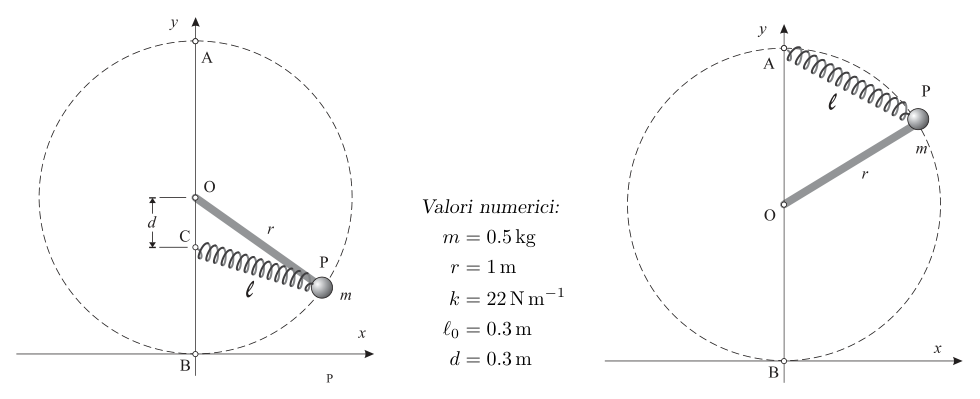 Asta rotante con molla (due configurazioni)
Topic: Oscillations & Waves, Conservation of Energy, Newtonian Mechanics Metodi: Energy Conservation Method, Torque & Angular Momentum Analysis, Simple Harmonic Motion Analysis Competenze: Physical Reasoning, Mathematical Modeling Objects: Rod, Spring, Block Fonte: Testo (PDF) — p.6 Soluzione: Soluzioni (PDF)
Problema 2 – Asta che ruota con molla [Punti 20]
The figure on the left shows a pointed body, in mass, attached to one end of a rigid shaft that can rotate freely vertically around its other end, fixed at . The auction has a negligible mass and length . The body is also attached to a spring of constant elasticity and rest length , the other end of which is fixed to a point located on the vertical passing by , at a distance below it.
Valori numerici: , , , , .
The point where the body is located may take all positions on the radius circumference between the highest and the lowest point. The length of the spring may vary between the maximum value, , in and the minimum value, , in . Given the values of and above, is always greater than the minimum length , so the spring is always in traction.
- Show that the equilibrium is unstable at , is stable at and that there are no other stable equilibrium points (showing it at any point).
- Find the expression of body energy under static conditions at a generic point and calculate its value in and points.
- Assuming that the axle is set in motion when it is at , and thus acquires an angular velocity , what is the minimum value of that allows the body to reach ?
Consider now the situation illustrated in the figure to the right, where the spring is attached to the . The positions the body can occupy are still on the same circumference. The only consideration is those for which the spring is elongated (i.e. those for which ). In this situation there are two other equilibrium positions (in addition to ), with different from zero, symmetrical to the axis.
- Calculate the value of the angle that the spring forms with the vertical in one of these two positions.
*This rotary spring (two configurations) *
Topic: Oscillations & Waves, Conservation of Energy, Newtonian Mechanics Metodi: Energy Conservation Method, Torque & Angular Momentum Analysis, Simple Harmonic Motion Analysis Competenze: Physical Reasoning, Mathematical Modeling Objects: Rod, Spring, Block Fonte: Testo (PDF) — p.6 Soluzione: Soluzioni (PDF)
Problema 3 – Due elettrici in uno [Punti 20]
Parte A
Tre piccole sfere cariche , , sono disposte come in figura, ai vertici di un triangolo rettangolo i cui cateti stanno fra loro in rapporto . In queste condizioni, sulla sfera agisce una forza di intensità , orientata a rispetto alle rette dei due cateti.
- Determinare il rapporto delle cariche presenti sulle sferette ed .
Le posizioni delle sfere ed vengono scambiate lasciando ferma .
- Determinare il rapporto tra l’intensità della forza agente adesso sulla sfera e quella della forza .
Parte B
Il circuito in figura è alimentato da un generatore di corrente costante ; le resistenze valgono rispettivamente , , , mentre lo strumento di misura (un milliamperometro) presenta una resistenza trascurabile.
Si vuole determinare la corrente misurata dal milliamperometro in queste condizioni.
- Perché si può affermare che le due resistenze ed si comportano come se fossero in parallelo? (e analogamente per con )
- Calcolare, in funzione di , i valori delle correnti che scorrono nei quattro resistori.
- Quanto vale allora la corrente misurata dal milliamperometro, se ?
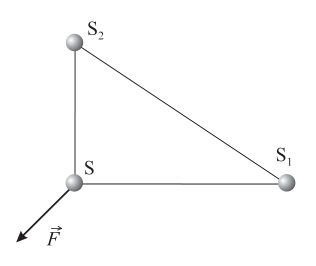 Triangolo rettangolo con sfere cariche
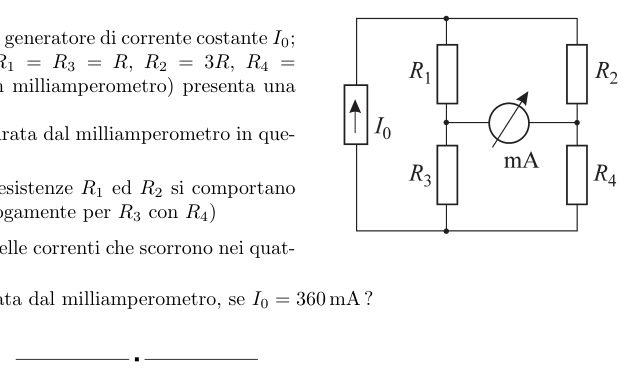 Circuito con quattro resistori e milliamperometro
Topic: Electrostatics, Circuits Metodi: Coulomb’s Law, Kirchhoff’s Laws, Superposition Principle Competenze: Physical Reasoning, Mathematical Modeling Objects: Point Charge, Resistor, Galvanometer Fonte: Testo (PDF) — p.7 Soluzione: Soluzioni (PDF)
The following is the list of the types of electrical equipment used in the manufacture of electrical equipment:
The following information shall be provided:
Three small charge spheres , , are arranged as shown in the figure, at the vertices of a rectangular triangle whose cathetes are in the ratio. Under these conditions, a force of intensity , oriented to , acts on the sphere with respect to the lines of the two cathetes.
- Determine the ratio of loads present on the and spheres.
The positions of the spheres and are exchanged leaving still.
- Determine the ratio of the force intensity agent now on the sphere to that of the force .
The following information shall be provided:
The circuit in the figure is powered by a constant current generator ; the resistance values are , , respectively, while the measuring instrument (a milliampereometer) has negligible resistance.
You want to determine the current measured by the millimeter under these conditions.
- Why can it be said that the two resistances and behave as if they were in parallel? (and similarly for with )
- Calculate, according to , the values of the currents flowing through the four resistors.
- What is the value of the current measured by the milliampereometer, if ?
*Rectangle with loaded spheres *
Circuit with four resistors and a milliampeter
Topic: Electrostatics, Circuits Metodi: Coulomb’s Law, Kirchhoff’s Laws, Superposition Principle Competenze: Physical Reasoning, Mathematical Modeling Objects: Point Charge, Resistor, Galvanometer Fonte: Testo (PDF) — p.7 Soluzione: Soluzioni (PDF)