Prima parte — Quesito 1. In questi giorni, 450 anni fa, nasceva a Pisa Galileo Galilei (15.02.1564 – 08.01.1642) universalmente riconosciuto come padre della scienza moderna. Nel Sidereus Nuncius egli racconta così la storia del cannocchiale astronomico:
“Circa dieci mesi fa ci giunse notizia che era stato costruito da un certo Fiammingo un occhiale, per mezzo del quale gli oggetti visibili, pur distanti assai dall’occhio di chi guarda, si vedevan distintamente come fossero vicini; (…) Preparai dapprima un tubo di piombo alle cui estremità applicai due lenti, entrambe piane da una parte, e dall’altra una convessa e una concava; posto l’occhio alla parte concava vidi gli oggetti abbastanza grandi e vicini, tre volte più vicini e nove volte più grandi di quanto non si vedano a occhio nudo…”
Un cannocchiale galileiano per osservazioni astronomiche è dunque realizzato con due semplici lenti sottili, una convergente (detta obiettivo) e l’altra divergente (oculare). Si supponga che la distanza focale dell’obiettivo sia e quella dell’oculare (ricordiamo che per convenzione la distanza focale di una lente divergente viene assunta negativa). Per un occhio normale, una corretta visione si ha quando l’immagine del sistema ottico si forma all’infinito.
- Quale deve essere – in questo caso – la distanza fra le due lenti? Topic: Geometric Optics Metodi: Thin Lens & Mirror Equation, Ray Tracing Competenze: Physical Reasoning Objects: Lens Fonte: Testo (PDF) Soluzione: Soluzioni
**First Part Question 1. ** In these days, 450 years ago, Galileo Galilei (15.02.1564 08.01.1642) was born in Pisa, universally recognized as the father of modern science. In Sidereus Nuncius he tells the story of the astronomical cannochial:
“About ten months ago we received news that a certain Flemish man had built a spectacle, by means of which visible objects, though far from the eye of the beholder, could be seen distinctly as if they were nearby; (…) I first prepared a lead tube to whose ends two lenses were applied, both flat on one side, and one convex and one concave on the other; and with my eye on the concave side I saw objects quite large and close, three times closer and nine times larger than is not seen with the naked eye”…
A Galilean cannochial for astronomical observations is therefore made with two simple thin lenses, one convergent (called a lens) and the other divergent (ocular). Assume that the focal length of the lens is and that of the eyepiece (remember that conventionally the focal length of a divergent lens is assumed to be negative). For a normal eye, a correct vision is obtained when the image of the optical system is formed infinitely.
- What should be the distance between the two lenses? Topic: Geometric Optics Metodi: Thin Lens & Mirror Equation, Ray Tracing Competenze: Physical Reasoning Objects: Lens Fonte: Testo (PDF) Soluzione: Soluzioni
Prima parte — Quesito 2. Una lastra è composta da uno strato di vetro (conducibilità termica ) di spessore sovrapposto ad uno strato di polistirene espanso (). Le facce opposte della lastra sono mantenute rispettivamente alle temperature (dalla parte del vetro) e (dalla parte del polistirene). La temperatura all’interfaccia tra vetro e polistirene è .
- Qual è lo spessore dello strato di polistirene? Topic: Thermodynamics Metodi: Physical Modeling Competenze: Mathematical Modeling Objects: — Fonte: Testo (PDF) Soluzione: Soluzioni
Part One Question 2. A sheet is composed of a layer of glass (thermal conductivity ) of thickness overlaid with an expanded layer of polystyrene (). The opposite sides of the plate shall be maintained at (on the glass side) and (on the polystyrene side) respectively. The interface temperature between glass and polystyrene is .
What’s the thickness of the polystyrene layer? Topic: Thermodynamics Metodi: Physical Modeling Competenze: Mathematical Modeling Objects: — Fonte: Testo (PDF) Soluzione: Soluzioni
Prima parte — Quesito 3. Nel circuito in figura la resistenza vale e i condensatori hanno capacità e , con ; la carica iniziale di entrambi i condensatori è .
- Quanto vale e in quale verso scorre la corrente nel circuito, subito dopo la chiusura dell’interruttore?
p.3 — Circuito con resistenza R e due condensatori
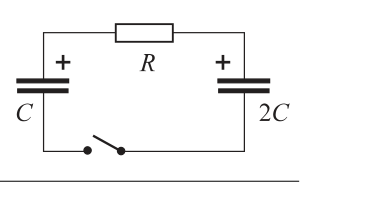
Topic: Circuits, Electrostatics Metodi: Kirchhoff’s Laws, Equivalent Circuit Reduction Competenze: Physical Reasoning Objects: Resistor, Capacitor, Switch Fonte: Testo (PDF) Soluzione: Soluzioni
Part One Question 3. In the circuit shown the resistance is and the capacitors have capacities and , with ; the initial charge of both capacitors is .
- What’s the value and which way is the current flowing in the circuit as soon as the switch is closed?
**p.3 ** R-resistance circuit and two capacitors
Topic: Circuits, Electrostatics Metodi: Kirchhoff’s Laws, Equivalent Circuit Reduction Competenze: Physical Reasoning Objects: Resistor, Capacitor, Switch Fonte: Testo (PDF) Soluzione: Soluzioni
Prima parte — Quesito 4. Su una rotaia orizzontale con attrito trascurabile, un carrellino di massa si muove ad una velocità e ne raggiunge un secondo che si sta muovendo a nello stesso verso. Dopo l’urto, che si può considerare elastico, quest’ultimo si muove a .
- Qual è la massa del secondo carrellino? Topic: Conservation of Momentum, Conservation of Energy Metodi: Conservation of Momentum, Conservation of Energy Competenze: Mathematical Modeling Objects: Cart Fonte: Testo (PDF) Soluzione: Soluzioni
Part One Question 4. On a horizontal railway with negligible friction, a mass trailer moves at a speed and reaches a second of it moving at in the same direction. After the impact, which can be considered elastic, the latter moves to .
- What’s the mass of the second trailer? Topic: Conservation of Momentum, Conservation of Energy Metodi: Conservation of Momentum, Conservation of Energy Competenze: Mathematical Modeling Objects: Cart Fonte: Testo (PDF) Soluzione: Soluzioni
Prima parte — Quesito 5. Un motore termico reale che opera fra una sorgente termica alla temperatura di e un refrigerante a sviluppa una potenza meccanica di e ha un rendimento pari al di quello di una macchina termica reversibile che scambi calore con gli stessi termostati.
- Qual è la potenza termica che esso assorbe alla temperatura di ? Topic: Thermodynamics Metodi: Thermodynamic Cycle Analysis, First Law of Thermodynamics Competenze: Physical Reasoning Objects: Heat Engine Fonte: Testo (PDF) Soluzione: Soluzioni
Part One Question 5. A real heat engine operating between a heat source at and a refrigerant at develops a mechanical power of and has an output equal to that of a reversible heat engine exchanging heat with the same thermostats.
- What is the thermal power it absorbs at ? Topic: Thermodynamics Metodi: Thermodynamic Cycle Analysis, First Law of Thermodynamics Competenze: Physical Reasoning Objects: Heat Engine Fonte: Testo (PDF) Soluzione: Soluzioni
Prima parte — Quesito 6. Il disegno a fianco mostra una studentessa alta che lancia una palla da tennis da un terrapieno, con una velocità iniziale di modulo , inclinata di verso l’alto. Al momento del lancio la palla sta poco sopra la testa della ragazza e al momento dell’impatto col terreno, la velocità della palla ha un modulo di .
- Se la resistenza dell’aria può essere trascurata, qual è l’altezza del terrapieno?
NOTA: il disegno non intende fornire una riproduzione in scala della situazione.
p.4 — Studentessa lancia palla da un terrapieno
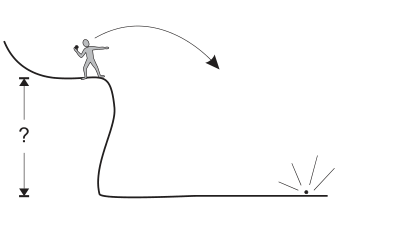
Topic: Newtonian Mechanics, Conservation of Energy Metodi: Kinematic Equations, Energy Conservation Method Competenze: Mathematical Modeling Objects: Ball, Projectile Fonte: Testo (PDF) Soluzione: Soluzioni
Part One Question 6. The side drawing shows a tall female student throwing a tennis ball from a terrain, with an initial speed of , tilted upwards by . At the time of the throw the ball is just above the girl’s head and at the time of impact with the ground, the ball’s speed is .
If the air resistance can be neglected, what is the height of the landfill?
NOTE: the not design is intended to provide a full-scale reproduction of the situation.
Student throws a ball from a dirt road
Topic: Newtonian Mechanics, Conservation of Energy Metodi: Kinematic Equations, Energy Conservation Method Competenze: Mathematical Modeling Objects: Ball, Projectile Fonte: Testo (PDF) Soluzione: Soluzioni
Prima parte — Quesito 7. Il signor Archimede decide di usare una bilancia a bracci uguali per pesare alcune pepite d’oro, ma lo fa ponendo tutto (bilancia, pepite e pesi di riferimento) sott’acqua. Trova che la bilancia è in perfetto equilibrio quando su un piatto ci sono le pepite e sull’altro c’è un blocco di rame che egli sa avere una massa . Egli sa anche che la densità del rame è e quella dell’oro è .
- Qual è la massa delle pepite? Topic: Fluid Mechanics, Newtonian Mechanics Metodi: Hydrostatic Equilibrium, Free-Body Diagram Competenze: Physical Reasoning Objects: Lever, Block Fonte: Testo (PDF) Soluzione: Soluzioni
**Part One Question 7. ** Mr Archimedes decides to use a scale with equal arms to weigh some gold nuggets, but he does so by putting everything (balance, nuggets and reference weights) underwater. He finds that the balance is in perfect balance when one plate has peptides and the other one has a copper block that he knows has a mass . He also knows that the density of copper is and that of gold is .
- What’s the mass of the peppers? Topic: Fluid Mechanics, Newtonian Mechanics Metodi: Hydrostatic Equilibrium, Free-Body Diagram Competenze: Physical Reasoning Objects: Lever, Block Fonte: Testo (PDF) Soluzione: Soluzioni
Prima parte — Quesito 8. Un lampione di diametro viene appeso ad una staffa rigida a forma di L, di massa trascurabile e di lunghezza ; la staffa è fissata al muro con un bullone posto ad altezza rispetto alla sua parte orizzontale, come mostrato in figura. Per strappare il bullone dal muro occorre applicare una forza orizzontale di intensità .
- Qual è il valore massimo del peso del lampione che può essere appeso alla staffa? Esprimerlo in termini delle grandezze date.
p.4 — Lampione appeso a staffa a L
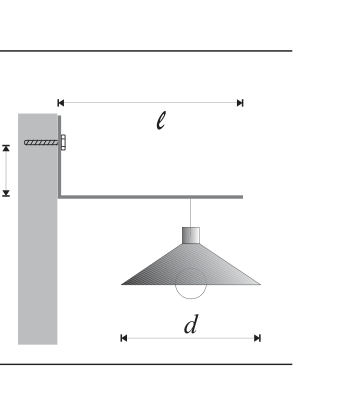
Topic: Rigid Body Statics Metodi: Torque & Angular Momentum Analysis, Free-Body Diagram Competenze: Mathematical Modeling Objects: Beam Fonte: Testo (PDF) Soluzione: Soluzioni
Part One Question 8. A lamp of diameter is hung on an L-shaped rigid rod of negligible mass and length ; the rod is fixed to the wall with a bolt placed at a height relative to its horizontal part, as shown in Figure 1. To tear the bolt from the wall a horizontal force of shall be applied.
What is the maximum value of the weight of the lamp that can be hung on the pole? Express it in terms of the given quantities.
The following table shows the number of lamps and the number of lamps and lamps.
Topic: Rigid Body Statics Metodi: Torque & Angular Momentum Analysis, Free-Body Diagram Competenze: Mathematical Modeling Objects: Beam Fonte: Testo (PDF) Soluzione: Soluzioni
Prima parte — Quesito 9. Tre fili elettrici, e , di lunghezza , e di lunghezza sono collegati come mostrato in figura. Il punto può trovarsi in una qualsiasi posizione, lungo il terzo filo, tra e . I fili hanno la stessa sezione e sono fatti dello stesso materiale.
- Quale deve essere la lunghezza del tratto del filo per ottenere la resistenza massima tra e ?
p.4 — Fili AB, AC e ABC con punto B
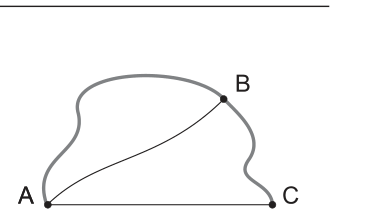
Topic: Circuits Metodi: Equivalent Circuit Reduction Competenze: Mathematical Modeling, Physical Reasoning Objects: Wire Fonte: Testo (PDF) Soluzione: Soluzioni
Part One Question 9. Three electrical wires, and , of length , and of length are connected as shown in Figure. The point may be located in any position along the third line between and . The wires have the same section and are made of the same material.
- Quale deve essere la lunghezza del tratto del filo per ottenere la resistenza massima tra e ?
**p.4 ** AB, AC and ABC wires with B
Topic: Circuits Metodi: Equivalent Circuit Reduction Competenze: Mathematical Modeling, Physical Reasoning Objects: Wire Fonte: Testo (PDF) Soluzione: Soluzioni
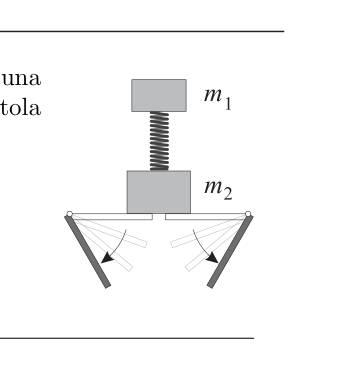
Prima parte — Quesito 10. Due corpi di massa e sono collegati fra loro da una molla di massa trascurabile. Il corpo di massa appoggia su una botola chiusa, mentre la molla è posta verticalmente e sostiene il corpo di massa . Improvvisamente la botola si spalanca e i due corpi precipitano.
- Qual è l’accelerazione di ciascun corpo immediatamente dopo l’apertura?
p.4 — Masse collegate da molla sopra botola
Topic: Newtonian Mechanics Metodi: Free-Body Diagram, Kinematic Equations Competenze: Physical Reasoning Objects: Spring, Block Fonte: Testo (PDF) Soluzione: Soluzioni
Part One Question 10. Two bodies of mass and are connected by a negligible mass spring. The mass body rests on a closed bolt, while the spring is positioned vertically and supports the mass body . Suddenly the bottle opens and the two bodies fall.
What is the acceleration of each body immediately after opening?
**p.4 ** Masses connected by spring over the bolt
Topic: Newtonian Mechanics Metodi: Free-Body Diagram, Kinematic Equations Competenze: Physical Reasoning Objects: Spring, Block Fonte: Testo (PDF) Soluzione: Soluzioni
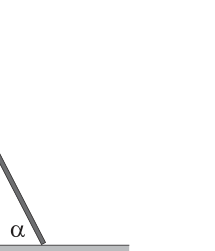
Seconda parte — Problema 1 — Asta in equilibrio. [Punti 24]
Un’asta rigida e sottile, di peso e lunghezza , è appoggiata allo spigolo di un gradino, di altezza . Sia il coefficiente d’attrito statico tra l’asta e il pavimento. Si supponga invece che l’attrito nel punto di contatto tra l’asta e il gradino sia trascurabile.
- Si trovi l’intervallo di valori entro cui può variare l’angolo che l’asta forma con l’orizzontale (restando appoggiata al gradino), indipendentemente dalle condizioni di equilibrio.
- Si trovino, in funzione di e di , le intensità delle forze vincolari necessarie per tenere in equilibrio l’asta.
- Si trovi per quali valori di l’asta risulta in equilibrio rispetto alla rotazione attorno allo spigolo del gradino. La disequazione che si ottiene può essere studiata analiticamente o anche numericamente.
- Si trovi per quali valori di l’asta risulta in equilibrio rispetto allo scivolamento sul pavimento. È richiesta la precisione di .
Suggerimento: si consiglia uno studio numerico della disequazione che si ottiene.
p.6 — Asta appoggiata allo spigolo di un gradino
Topic: Rigid Body Statics, Newtonian Mechanics Metodi: Free-Body Diagram, Torque & Angular Momentum Analysis, Physical Modeling Competenze: Mathematical Modeling, Physical Reasoning Objects: Rod Fonte: Testo (PDF) — p.6 Soluzione: Soluzioni
The following table shows the results of the tests:
A rigid and thin shaft, in weight and in length, shall be supported on the top of a ladder, in height. The static friction coefficient between the axle and the floor shall be . Suppose, instead, that the friction at the point of contact between the axle and the step is negligible.
- The range of values within which the angle of the axle can vary with the horizontal (stage-backed) angle, regardless of the equilibrium conditions.
- The strengths of the binding forces necessary to keep the auction in balance are given, according to and .
- Find out for which values of the axle is in equilibrium with respect to the rotation around the stepper’s axis. The resulting dissection can be analytically or even numerically studied.
- Find out for which values of the axle is in balance with the floor slide. The precision of is required.
Suggest: a numerical study of the resulting dissection is recommended.
**p.6 ** A pole supported on the top of a step
Topic: Rigid Body Statics, Newtonian Mechanics Metodi: Free-Body Diagram, Torque & Angular Momentum Analysis, Physical Modeling Competenze: Mathematical Modeling, Physical Reasoning Objects: Rod Fonte: Testo (PDF) — p.6 Soluzione: Soluzioni
Seconda parte — Problema 2 — Interferenza. [Punti 20]
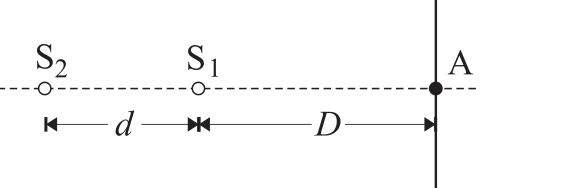
Due sorgenti puntiformi, ed , emettono onde sonore di lunghezza d’onda , in fase tra loro. La distanza tra le due sorgenti è , con intero. Su un piano perpendicolare alla retta passante per le due sorgenti, distante dalla sorgente più vicina (v. figura a lato), si hanno dei massimi e dei minimi di oscillazione che formano delle frange d’interferenza analoghe a quelle che si possono osservare in ottica.
- Dire se nel punto si ha un massimo, un minimo o nessuno dei due.
- Dire qual è la forma delle frange d’interferenza, motivando la risposta.
- Si indichi con la distanza tra e la frangia di minimi più vicina. Sia , e . Si calcoli l’espressione di in funzione di , e .
- Si calcoli il valore numerico di .
Suggerimenti: Può essere utile tenere presente che, con i valori indicati, si può dimostrare che risulta . (Si ricordi che se allora ). In alternativa, si può osservare che , ed è quindi molto minore di .
p.6 — Sorgenti S1 e S2 con piano distante D
Topic: Oscillations & Waves, Wave Optics Metodi: Superposition Principle, Approximation & Series Expansion, Wave Equation Competenze: Mathematical Modeling, Physical Reasoning Objects: Screen Fonte: Testo (PDF) — p.6 Soluzione: Soluzioni
Seconda parte — Problema 2 — Interferenza. [Punti 20]
Two point-form sources, and , emit sound wavelengths of in phase with each other. The distance between the two sources is , with whole. On a plane perpendicular to the straight line passing through the two sources, away from the nearest source (see paragraphs 1 and 2). The maximum and minimum oscillations are in the same range as those seen in the optical system.
- To say whether in there is a maximum, a minimum or neither.
- Tell what the shape of the interference fringes is, motivating the response.
- Indicate with the distance between and the nearest minimum fringe. Sia , e . The expression is calculated as a function of , and .
- The numerical value of shall be calculated.
Suggerimenti: Può essere utile tenere presente che, con i valori indicati, si può dimostrare che risulta . (Remember that if then ). Alternatively, you can see that , and is therefore much smaller than .
**p.6 ** S1 and S2 sources with distance plane D
Topic: Oscillations & Waves, Wave Optics Metodi: Superposition Principle, Approximation & Series Expansion, Wave Equation Competenze: Mathematical Modeling, Physical Reasoning Objects: Screen Fonte: Testo (PDF) — p.6 Soluzione: Soluzioni
Seconda parte — Problema 3 — Forza elettrica e forza magnetica. [Punti 16]
Parte A
Infinite cariche elettriche, tutte uguali in modulo a , ma di segno alterno () sono fissate su una retta a distanza una dall’altra.
- Stimare, con l’aiuto della calcolatrice, la forza elettrica che agisce su di un’ulteriore carica (di valore , uguale alle altre) posta nel punto medio tra due cariche consecutive.
- Se si volesse verificare sperimentalmente la stima fatta entro lo , quante cariche elettriche sarebbe sufficiente considerare?
Parte B
In un ideale esperimento un disco di massa e carica striscia su un piano orizzontale in presenza di un campo magnetico uniforme verticale ; sia il coefficiente d’attrito dinamico tra disco e piano.
- Si calcoli la variazione del raggio di curvatura della traiettoria seguita dal disco in un intervallo di tempo .
Topic: Electrostatics, Magnetism, Newtonian Mechanics Metodi: Coulomb’s Law, Superposition Principle, Lorentz Force Analysis, Free-Body Diagram, Kinematic Equations Competenze: Mathematical Modeling, Physical Reasoning, Estimation & Approximation Objects: Point Charge, Disk Fonte: Testo (PDF) — p.7 Soluzione: Soluzioni
Part Two Problem 3 Electrical and magnetic forces. [Points 16]
The following information shall be provided:
Infinite electrical charges, all of the same in the form but of alternating sign () are fixed on a straight line at a distance from each other.
- Estimate, with the help of the calculator, the electrical force acting on an additional charge (value , equal to the others) placed in the middle between two consecutive charges.
- If the estimate made within were to be tested experimentally, how many electrical charges would be sufficient to consider?
The following information shall be provided:
In an ideal experiment a disk of mass and load is drawn onto a horizontal plane in the presence of a uniform vertical magnetic field ; the dynamic friction coefficient between disk and plane is .
- Calculate the change in the curvature radius of the trajectory followed by the disc over a time interval .
Topic: Electrostatics, Magnetism, Newtonian Mechanics Metodi: Coulomb’s Law, Superposition Principle, Lorentz Force Analysis, Free-Body Diagram, Kinematic Equations Competenze: Mathematical Modeling, Physical Reasoning, Estimation & Approximation Objects: Point Charge, Disk Fonte: Testo (PDF) — p.7 Soluzione: Soluzioni