Q1 Nel sistema in figura, che è in condizioni di equilibrio, l’angolo è di , la massa appesa è e il coefficiente di attrito statico tra la massa M e il piano è ; la massa del filo si può trascurare. • Quanto vale – in modulo – la forza d’attrito che il piano esercita sulla massa M ?
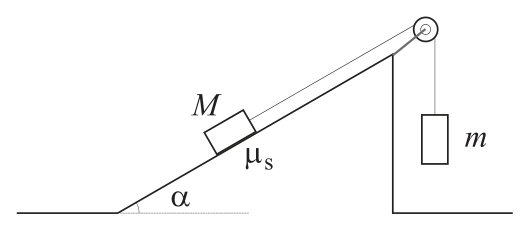 piano inclinato con carrucola e massa
Topic: Newtonian Mechanics, Rigid Body Statics Metodi: Free-Body Diagram, Vector Decomposition, Conservation Laws Competenze: Diagrammatic Reasoning, Mathematical Modeling, Physical Reasoning Objects: Inclined Plane, Pulley, Block, String Fonte: Testo (PDF) — p.3 Soluzione: Soluzioni (PDF)
Q1 In the system shown in the figure, which is in equilibrium, the angle is , the angle is . The mass of the suspension is and the friction coefficient The mass of the plane is ; the mass of the plane is . The wire can be neglected. • What is the value of the force of friction in the form What plan does the M-mass have ?
sloping plane with carriage and mass
Topic: Newtonian Mechanics, Rigid Body Statics Metodi: Free-Body Diagram, Vector Decomposition, Conservation Laws Competenze: Diagrammatic Reasoning, Mathematical Modeling, Physical Reasoning Objects: Inclined Plane, Pulley, Block, String Fonte: Testo (PDF) — p.3 Soluzione: Soluzioni (PDF)
Q2 Un corpo, appeso ad una molla ideale di massa trascurabile, oscilla con un periodo di 3 s quando è fissato all’ultima spira della molla, la trentaseiesima, come mostrato nella parte a sinistra della figura. • Se il corpo fosse appeso alla dodicesima spira (parte a destra della figura), con che periodo oscillerebbe?
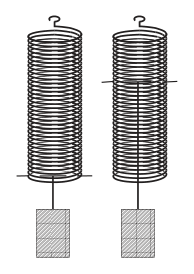 due molle con masse appese
Topic: Oscillations & Waves Metodi: Simple Harmonic Motion Analysis, Physical Modeling Competenze: Physical Reasoning, Mathematical Modeling Objects: Spring, Block Fonte: Testo (PDF) — p.3 Soluzione: Soluzioni (PDF)
Q2 A body, suspended from an ideal spring of negligible mass, oscillates with a 3 s period when fixed to the last spring spire, the 36th, As shown in the left side of the figure. • If the body was hung on the twelfth spire (right side of the figure), which Would the time oscillate?
two springs with suspended masses
Topic: Oscillations & Waves Metodi: Simple Harmonic Motion Analysis, Physical Modeling Competenze: Physical Reasoning, Mathematical Modeling Objects: Spring, Block Fonte: Testo (PDF) — p.3 Soluzione: Soluzioni (PDF)
Q3 Viene condotto un esperimento di interferenza alla Young. Luce proveniente da una lampada al sodio (lunghezza d’onda = 589 nm) incide normalmente su una coppia di fenditure parallele. Su uno schermo parallelo al piano delle fenditure si formano delle frange di interferenza. Nella zona centrale della figura d’interferenza, la distanza tra due frange successive è pari a 3 mm e quella tra lo schermo e le fenditure è pari a 2 m. • Qual è la distanza fra le due fenditure?
Topic: Wave Optics Metodi: Interference & Diffraction Analysis, Superposition Principle Competenze: Mathematical Modeling, Physical Reasoning Objects: Slit, Screen Fonte: Testo (PDF) — p.4 Soluzione: Soluzioni (PDF)
Q3 A interference experiment is being conducted on Young. Light from a lamp at Sodium (wavelength = 589 nm) normally affects a pair of parallel cracks. Su a parallel screen to the plane of the cracks forming interference fringes. In the centre of the interference figure, the distance between two successive fringes is 3 mm and that of the It’s about 2 meters between the screen and the cracks. • What is the distance between the two fissures?
Topic: Wave Optics Metodi: Interference & Diffraction Analysis, Superposition Principle Competenze: Mathematical Modeling, Physical Reasoning Objects: Slit, Screen Fonte: Testo (PDF) — p.4 Soluzione: Soluzioni (PDF)
Q4 In ognuno di due vertici consecutivi, A e B, di un quadrato di lato L c’è una carica elettrica positiva q. • Determinare il modulo del campo elettrico in uno degli altri due vertici del quadrato.
Topic: Electrostatics Metodi: Coulomb’s Law, Vector Decomposition, Superposition Principle Competenze: Diagrammatic Reasoning, Mathematical Modeling Objects: Point Charge Fonte: Testo (PDF) — p.4 Soluzione: Soluzioni (PDF)
Q4 In each of the two consecutive vertices, A and B, of a square side L there is an electric charge The positive q. • Determine the electric field modulus at one of the other two vertices of the square.
Topic: Electrostatics Metodi: Coulomb’s Law, Vector Decomposition, Superposition Principle Competenze: Diagrammatic Reasoning, Mathematical Modeling Objects: Point Charge Fonte: Testo (PDF) — p.4 Soluzione: Soluzioni (PDF)
Q5 Un oggetto di peso 90 N viene parzialmente immerso in un liquido sconosciuto per 1/3 del proprio volume. In queste condizioni per mantenerlo in equilibrio, è necessario applicargli una forza verticale di 57 N rivolta verso l’alto. • Quale forza occorre applicargli per mantenerlo in equilibrio quando è completamente immerso?
Topic: Fluid Mechanics Metodi: Hydrostatic Equilibrium, Free-Body Diagram Competenze: Mathematical Modeling, Physical Reasoning Objects: — Fonte: Testo (PDF) — p.4 Soluzione: Soluzioni (PDF)
Q5 An object weighing 90 N is partially immersed in an unknown liquid for 1/3 of its own The volume. In these conditions, to keep it in balance, it is necessary to apply vertical force to it. 57 N facing up. • What force is needed to keep it in balance when fully immersed?
Topic: Fluid Mechanics Metodi: Hydrostatic Equilibrium, Free-Body Diagram Competenze: Mathematical Modeling, Physical Reasoning Objects: — Fonte: Testo (PDF) — p.4 Soluzione: Soluzioni (PDF)
Q6 In un calorimetro termicamente isolato, dell’acqua è in equilibrio termico con il recipiente ad una temperatura . Vi si introducono un lingotto di rame alla temperatura e del ghiaccio alla temperatura . Il sistema si porta all’equilibrio alla temperatura . Sono date: , , e . Si conoscono inoltre la capacità termica del calorimetro , la massa di ghiaccio g e quella del rame g. • Si calcoli la massa d’acqua inizialmente presente nel calorimetro.
Topic: Thermodynamics Metodi: First Law of Thermodynamics, Physical Modeling Competenze: Mathematical Modeling, Physical Reasoning Objects: Calorimeter Fonte: Testo (PDF) — p.4 Soluzione: Soluzioni (PDF)
Q6 In a heat-insulated calorimeter, water is in thermal equilibrium with the container at a temperature of temperatura . A copper bulk at and ice at is introduced into the temperatura . The system is brought to equilibrium at . The following dates are given: , , and . The heat capacity of the calorimeter , the ice mass g are also known and the copper g. • Calculate the initial water mass in the calorimeter.
Topic: Thermodynamics Metodi: First Law of Thermodynamics, Physical Modeling Competenze: Mathematical Modeling, Physical Reasoning Objects: Calorimeter Fonte: Testo (PDF) — p.4 Soluzione: Soluzioni (PDF)
Q7 Un’automobile che sta viaggiando a 90 km/h decelera in modo uniforme per 5 s. • Se alla fine la sua velocità è pari a 50 km/h, quanto spazio ha percorso durante la frenata?
Topic: Newtonian Mechanics Metodi: Kinematic Equations Competenze: Mathematical Modeling, Unit Conversion Objects: — Fonte: Testo (PDF) — p.4 Soluzione: Soluzioni (PDF)
Q7 A car travelling at 90 km/h slows down evenly for 5 seconds. • If its speed is 50 km/h, how much space has it travelled during braking?
Topic: Newtonian Mechanics Metodi: Kinematic Equations Competenze: Mathematical Modeling, Unit Conversion Objects: — Fonte: Testo (PDF) — p.4 Soluzione: Soluzioni (PDF)
Q8 Un condensatore di capacità 1 mF è caricato con una carica di . • Calcolare la massima corrente che si ha quando viene connesso ad un resistore di 25 .
Topic: Circuits Metodi: Kirchhoff’s Laws, Differential Equations Competenze: Mathematical Modeling, Physical Reasoning Objects: Capacitor, Resistor Fonte: Testo (PDF) — p.4 Soluzione: Soluzioni (PDF)
Q8 A capacitor of 1 mF shall be loaded with a load of . • Calculate the maximum current when connected to a resistor of 25 .
Topic: Circuits Metodi: Kirchhoff’s Laws, Differential Equations Competenze: Mathematical Modeling, Physical Reasoning Objects: Capacitor, Resistor Fonte: Testo (PDF) — p.4 Soluzione: Soluzioni (PDF)
Q9 Una macchina termica opera tra una sorgente ed una più fredda con rendimento . Una seconda macchina tra la stessa sorgente ed una ancora più fredda con rendimento . Le due macchine vengono collegate in serie nel senso che il calore espulso dalla prima viene integralmente assorbito dalla seconda. • Si calcoli, in funzione di ed , il rendimento del sistema formato dalle due macchine.
Topic: Thermodynamics Metodi: Thermodynamic Cycle Analysis, First Law of Thermodynamics Competenze: Mathematical Modeling, Physical Reasoning Objects: Heat Engine Fonte: Testo (PDF) — p.4 Soluzione: Soluzioni (PDF)
Q9 A heat machine operates between a source and a cooler source with a yield . One of them. A second machine from the same source and an even cooler with output . The two The machines are connected in series in the sense that the heat expelled from the first is absorbed completely From the second. • The performance of the system formed by the two machines is calculated on the basis of and .
Topic: Thermodynamics Metodi: Thermodynamic Cycle Analysis, First Law of Thermodynamics Competenze: Mathematical Modeling, Physical Reasoning Objects: Heat Engine Fonte: Testo (PDF) — p.4 Soluzione: Soluzioni (PDF)
Q10 Un laser a He-Ne irraggia una potenza di 1 mW alla lunghezza d’onda di 632.8 nm. • Quanti fotoni emette in 2 s?
Topic: Modern-Quantum Physics Metodi: Photon Energy Relation Competenze: Mathematical Modeling, Estimation & Approximation Objects: Photon Fonte: Testo (PDF) — p.4 Soluzione: Soluzioni (PDF)
Q10 A laser with He-Ne irradiates a power of 1 mW at a wavelength of 632.8 nm. • How many photons does it emit in 2 seconds?
Topic: Modern-Quantum Physics Metodi: Photon Energy Relation Competenze: Mathematical Modeling, Estimation & Approximation Objects: Photon Fonte: Testo (PDF) — p.4 Soluzione: Soluzioni (PDF)
P1 Una lente allo specchio Punti 20 Su un banco ottico ci sono una lente sottile convergente di lunghezza focale 20 cm e un oggetto di altezza h, collocato a 32.9 cm dalla lente. Si fissi un sistema di riferimento lungo l’asse ottico della lente con origine nella posizione della sorgente, orientato in modo che la lente si trovi sul semiasse x > 0.
- Qual è, nel sistema di riferimento scelto, la posizione dell’immagine dell’oggetto? È reale o virtuale? Diritta o capovolta? Qual è l’ingrandimento? Sullo stesso banco ottico, ad una distanza cm dalla lente e dalla parte opposta rispetto all’oggetto, viene posto uno specchio piano, rivolto verso la lente. Lo specchio è perpendicolare all’asse ottico della lente. Il sistema lente+specchio forma ora due immagini dell’oggetto. Una prima è quella formata dai raggi riflessi dallo specchio piano.
- Qual è, nel sistema di riferimento scelto, la coordinata di questa prima immagine? È reale o virtuale? Diritta o capovolta? Questa prima immagine costituisce a sua volta una sorgente per la lente, che ne fornisce una seconda.
- Qual è la coordinata della seconda immagine? È reale o virtuale? È diritta o capovolta (rispetto all’oggetto)? Qual è il suo ingrandimento (sempre rispetto all’oggetto)?
- Si vuole ottenere la prima di queste due immagini, nella stessa posizione e con le stesse caratteristiche, con un unico specchio sferico. Dev’essere concavo o convesso? Quale dev’essere il suo raggio di curvatura?
Topic: Geometric Optics Metodi: Thin Lens & Mirror Equation, Ray Tracing Competenze: Diagrammatic Reasoning, Mathematical Modeling Objects: Lens, Mirror Fonte: Testo (PDF) — p.6 Soluzione: Soluzioni (PDF)
P1 A mirrored lens The Commission shall adopt implementing acts in accordance with Article 21 of this Regulation. On an optical bench there is a thin convergent lens of 20 cm focal length and an object of Height h, positioned 32.9 cm from the lens. A reference system shall be fixed along the optical axis of the lens originating in the source position. oriented so that the lens is on the x > 0 semi-axis.
- What is the position of the image of the object in the chosen reference system? Is it real or virtual? The right Or the other way around? What is enlargement? On the same optical bench, at a distance cm from the lens and the side opposite the object, Place a flat mirror, facing the lens. The mirror is perpendicular to the optical axis of the lens. The lens+mirror system now forms two images of the object. One is the one formed by the reflected rays. From the flat mirror.
- What is the coordinate of this first image in the selected reference system? Is it real or virtual? Right or wrong? This first image is a source for the lens, which provides a second.
- What is the coordinate of the second image? Is it real or virtual? It is straight or upside down (respective of the subject)? What is its magnification (always relative to the object)?
- You want to get the first of these two images, in the same position and with the same characteristics, with A single spherical mirror. Must it be concave or convex? What should be its radius of curvature?
Topic: Geometric Optics Metodi: Thin Lens & Mirror Equation, Ray Tracing Competenze: Diagrammatic Reasoning, Mathematical Modeling Objects: Lens, Mirror Fonte: Testo (PDF) — p.6 Soluzione: Soluzioni (PDF)
P2 Sull’Ottovolante Punti 20 Un carrello di massa m viene appoggiato su una rotaia che presenta attrito trascurabile e lanciato con velocità dal punto più basso, come mostrato in figura. La rotaia è formata da due archi di cerchio uguali, di raggio R su un piano verticale, raccordati nel punto P. Sia l’angolo che la normale comune ai due archi di circonferenza nel punto di raccordo forma con la verticale (v. figura). Si vuole che il carrello arrivi nel punto più alto senza distaccarsi mai dalla rotaia.
- Supponendo che il carrello possa arrivare nel punto più alto senza staccarsi dalla rotaia, qual è – in funzione dei dati forniti – la minima velocità iniziale che deve avere?
- Si dimostri che, se il carrello si stacca dalla rotaia, questo avviene appena superato il punto P.
- Che condizione deve soddisfare la velocità iniziale perché il carrello non si stacchi?
- Per quali valori dell’angolo non è possibile che il carrello arrivi nel punto più alto mantenendo il contatto con la rotaia?
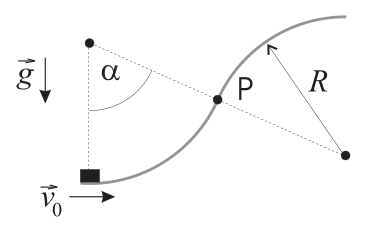 carrello su rotaia curva con punto P
Topic: Newtonian Mechanics, Conservation of Energy Metodi: Free-Body Diagram, Conservation of Energy, Kinematic Equations Competenze: Diagrammatic Reasoning, Mathematical Modeling, Physical Reasoning Objects: Cart Fonte: Testo (PDF) — p.6 Soluzione: Soluzioni (PDF)
P2 On the eight-volt The Commission shall adopt implementing acts in accordance with Article 21 of this Regulation. A mass cart m is resting on a rail that has negligible friction and is launched at from the point of maximum low, as shown in the figure. The railway consists of two arches of a circle of equal radius R on a vertical plane, connected at the point P. Sia l’angolo che la normale comune ai due archi di circonferenza the point of contact form with the vertical (v. The Commission has not yet adopted a proposal. You want the cart to get to the top without detachment. Never from the railroad.
- Assuming the cart can reach the highest point without The railway is not a railway, but a railway is a railway. minimum initial speed to be achieved?
- It is shown that if the cart is detached from the rail, this happens just after the point P.
- What condition must the initial speed satisfy so that the cart does not detach?
- For which values of the angle it is not possible for the cart to reach the highest point while maintaining contact With the railroad?
carriage on curved rail with point P
Topic: Newtonian Mechanics, Conservation of Energy Metodi: Free-Body Diagram, Conservation of Energy, Kinematic Equations Competenze: Diagrammatic Reasoning, Mathematical Modeling, Physical Reasoning Objects: Cart Fonte: Testo (PDF) — p.6 Soluzione: Soluzioni (PDF)
P3 Anello elettrico Punti 10 Una carica nC è distribuita su un sottile anello conduttore di raggio cm. Una particella di carica C viene lanciata verso il centro dell’anello da un punto P, posto sull’asse di questo, a distanza m. Si osserva che la particella riesce a passare attraverso il centro O dell’anello solo se ha velocità di modulo superiore a .
- Indicando con x la distanza di un punto dell’asse dal centro dell’anello, calcolare il potenziale dovuto alla carica sull’anello.
- Calcolare la massa della particella.
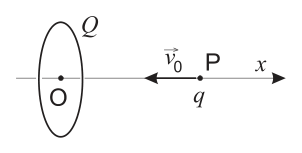 anello carico con particella sull’asse
Topic: Electrostatics, Conservation of Energy Metodi: Electric Potential Method, Energy Conservation Method, Coulomb’s Law Competenze: Mathematical Modeling, Physical Reasoning Objects: Point Charge Fonte: Testo (PDF) — p.6 Soluzione: Soluzioni (PDF)
P3 Electrical ring The Commission shall adopt implementing acts in accordance with Article 10 of this Regulation. A charge nC is distributed over a thin conductive ring of radius cm. A charge particle C is thrown towards the centre of the ring from a point P, placed on the axis of This, at a distance m. It is observed that the particle can pass through the centre of the ring only if it has a speed of more than .
- Indicating by x the distance of a point of the axis from the centre of the ring, calculate the potential due The charge on the ring.
- Calculate the mass of the particle.
particle-laden ring on the axis
Topic: Electrostatics, Conservation of Energy Metodi: Electric Potential Method, Energy Conservation Method, Coulomb’s Law Competenze: Mathematical Modeling, Physical Reasoning Objects: Point Charge Fonte: Testo (PDF) — p.6 Soluzione: Soluzioni (PDF)
P4 Luce sul Potassio Punti 10 Viene condotto un esperimento con una fotocellula avente un fotocatodo di potassio. Il fotocatodo viene illuminato con radiazione monocromatica. Per certe lunghezze d’onda della radiazione incidente si osserva che dal fotocatodo vengono emessi elettroni. Alcuni di essi riescono a raggiungere l’anodo anche se questo viene portato ad un potenziale minore di quello del catodo. Tuttavia, questo accade purché la d.d.p. tra catodo e anodo rimanga inferiore ad un valore detto differenza di potenziale d’arresto. Per alcuni valori della lunghezza d’onda della luce incidente viene misurata la d.d.p. di arresto. I risultati sono elencati nella seguente tabella: Lunghezza d’onda [nm] 579 562 546 491 436 423 405 D.d.p. di arresto [V] 0.14 0.20 0.27 0.53 0.84 0.91 1.06
- Individuate due grandezze x e y, legate ai dati sperimentali e tra le quali la teoria indica che esiste una relazione lineare, le si riportino in un grafico.
- Si ricavi dal grafico l’energia minima necessaria per estrarre un elettrone dal potassio (chiamato lavoro di estrazione.)
- Si determini la lunghezza d’onda massima della radiazione incidente al di sopra della quale non viene estratto nessun elettrone (soglia fotoelettrica per il potassio).
Topic: Modern-Quantum Physics Metodi: Photon Energy Relation, Graph Linearization, Experimental Data Analysis Competenze: Graph Linearization, Experimental Data Analysis, Mathematical Modeling Objects: Photon, Electron Fonte: Testo (PDF) — p.7 Soluzione: Soluzioni (PDF)
P4 Light on Potassium The Commission shall adopt implementing acts in accordance with Article 10 of this Regulation. An experiment is being conducted with a photocell with a potassium photocatode. The photocatode It is illuminated by monochrome radiation. For certain wavelengths of incident radiation, observed The photocathode emits electrons. Some of them can reach the anode even though this comes It’s a smaller potential than the cathode. However, this is only possible if the D.D.P. between cathode and The anode remains below a value called the stop potential difference. For some wavelength values of incident light the d.d.p. is measured. I’m going to arrest you. The results are listed in the following table: Wavelength [nm] 579 562 546 491 436 423 405 D.d.p. of arrest [V] 0.14 0.20 0.27 0.53 0.84 0.91 1.06
- Identify two dimensions x and y, linked to the experimental data, and between which the theory indicates that there is a linear relationship, they’re shown on a graph.
- The minimum energy required to extract an electron from potassium (called the work of (Extraction)
- Determine the maximum wavelength of incident radiation above which no radiation is received. The electron is not extracted (photoelectric threshold for potassium).
Topic: Modern-Quantum Physics Metodi: Photon Energy Relation, Graph Linearization, Experimental Data Analysis Competenze: Graph Linearization, Experimental Data Analysis, Mathematical Modeling Objects: Photon, Electron Fonte: Testo (PDF) — p.7 Soluzione: Soluzioni (PDF)