Una boa a forma di guscio sferico, di raggio esterno e spessore uniforme, galleggia sulla superficie di un lago essendo immersa per metà del suo volume.
Sapendo che la boa è fatta di una lega di ferro con densità , qual è il suo spessore?
Topic: Fluid Mechanics Metodi: Hydrostatic Equilibrium, Physical Modeling Competenze: Physical Reasoning, Mathematical Modeling Objects: Sphere Fonte: Testo (PDF) — p.3 Soluzione: Soluzioni (PDF)
A spherical shell-shaped boa, of a uniform thickness and external radius , floats on the surface of a lake being submerged by half its volume.
Since the boa is made of a metal alloy with a density of , what is its thickness?
Topic: Fluid Mechanics Metodi: Hydrostatic Equilibrium, Physical Modeling Competenze: Physical Reasoning, Mathematical Modeling Objects: Sphere Fonte: Testo (PDF) — p.3 Soluzione: Soluzioni (PDF)
Due lenti, una prima convergente, , di focale e una seconda divergente, , di focale , hanno l’asse ottico in comune. Un fascio di raggi paralleli a quest’asse incide su . All’uscita da i raggi risultano ancora paralleli all’asse ottico.
Quanto vale la distanza tra le lenti?
Topic: Geometric Optics Metodi: Thin Lens & Mirror Equation, Ray Tracing Competenze: Physical Reasoning, Mathematical Modeling Objects: Lens Fonte: Testo (PDF) — p.3 Soluzione: Soluzioni (PDF)
Two lenses, a first convergent, , of focal and a second divergent, , of focal , have the optical axis in common. A beam of rays parallel to this axis affects . At the output from the beams are still parallel to the optical axis.
What is the distance between the lenses?
Topic: Geometric Optics Metodi: Thin Lens & Mirror Equation, Ray Tracing Competenze: Physical Reasoning, Mathematical Modeling Objects: Lens Fonte: Testo (PDF) — p.3 Soluzione: Soluzioni (PDF)
Un sistema fisico in uno stato di non equilibrio può raggiungere uno stato stabile dissipando energia. Si consideri un recipiente cilindrico di raggio che contiene acqua fino a un’altezza . Il recipiente viene collegato, per mezzo di un tubicino molto corto (tale che il suo volume possa essere trascurato) ad un secondo cilindro appoggiato sullo stesso piano, inizialmente vuoto, di raggio doppio del primo; il tubicino è collegato sul fondo dei contenitori.
Quanta energia meccanica si dissipa per raggiungere l’equilibrio?
Topic: Fluid Mechanics, Conservation of Energy Metodi: Hydrostatic Equilibrium, Energy Conservation Method Competenze: Physical Reasoning, Mathematical Modeling Objects: Container, Cylinder Fonte: Testo (PDF) — p.3 Soluzione: Soluzioni (PDF)
A physical system in an unbalanced state can achieve a stable state by dissipating energy. A cylindrical container of radius containing water up to a height of shall be considered. The container is connected, by means of a very short tube (so that its volume can be neglected) to a second cylinder resting on the same plane, initially empty, of radius twice that of the first; the tube is connected to the bottom of the containers.
How much mechanical energy is dissipated to achieve balance?
Topic: Fluid Mechanics, Conservation of Energy Metodi: Hydrostatic Equilibrium, Energy Conservation Method Competenze: Physical Reasoning, Mathematical Modeling Objects: Container, Cylinder Fonte: Testo (PDF) — p.3 Soluzione: Soluzioni (PDF)
Determinare la velocità di una particella relativistica la cui energia è pari al doppio della sua energia a riposo.
Topic: Special Relativity Metodi: Relativistic Energy-Momentum, Mass-Energy Equivalence Competenze: Physical Reasoning, Mathematical Modeling Objects: — Fonte: Testo (PDF) — p.3 Soluzione: Soluzioni (PDF)
Determine the velocity of a relativistic particle whose energy is twice its resting energy.
Topic: Special Relativity Metodi: Relativistic Energy-Momentum, Mass-Energy Equivalence Competenze: Physical Reasoning, Mathematical Modeling Objects: — Fonte: Testo (PDF) — p.3 Soluzione: Soluzioni (PDF)
Una molla ideale, di costante elastica , ha lunghezza ; ad essa è attaccata una massa ; il sistema si muove su un piano orizzontale e ruota, con velocità angolare uniforme , attorno ad un asse verticale (vedi figura).
Trovare la lunghezza della molla quando è in rotazione.
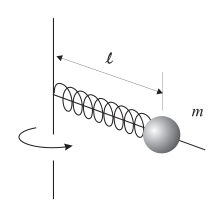 Molla con massa in rotazione piano orizzontale
Topic: Newtonian Mechanics, Oscillations & Waves Metodi: Hooke’s Law, Free-Body Diagram, Kinematic Equations Competenze: Physical Reasoning, Mathematical Modeling Objects: Spring, Block Fonte: Testo (PDF) — p.4 Soluzione: Soluzioni (PDF)
An ideal spring, of constant elasticity , has a length ; a mass is attached to it; the system moves on a horizontal plane and wheel, with uniform angular velocity , around a vertical axis (see figure).
Find the length of the spring when it is rotating.
Mull with horizontal rotating mass in the plane
Topic: Newtonian Mechanics, Oscillations & Waves Metodi: Hooke’s Law, Free-Body Diagram, Kinematic Equations Competenze: Physical Reasoning, Mathematical Modeling Objects: Spring, Block Fonte: Testo (PDF) — p.4 Soluzione: Soluzioni (PDF)
Nella parte di circuito mostrata in figura il filo conduttore , di sezione uniforme, ha resistenza ; su di esso un contatto mobile si trova nel punto tale che .
Quanto vale la resistenza se la resistenza misurata tra i punti e è uguale a quella del filo ?
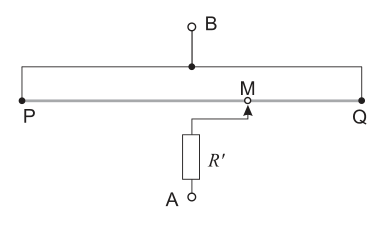 Circuito con filo PQ e contatto mobile M
Topic: Circuits Metodi: Kirchhoff’s Laws, Equivalent Circuit Reduction Competenze: Physical Reasoning, Mathematical Modeling Objects: Wire, Resistor Fonte: Testo (PDF) — p.4 Soluzione: Soluzioni (PDF)
In the part of the circuit shown in the figure, the uniform section of the conductive wire has a resistance ; on it a mobile contact is located at such that .
What is the resistance if the resistance measured between the and points is equal to that of the wire?
PQ wire circuit and mobile contact M
Topic: Circuits Metodi: Kirchhoff’s Laws, Equivalent Circuit Reduction Competenze: Physical Reasoning, Mathematical Modeling Objects: Wire, Resistor Fonte: Testo (PDF) — p.4 Soluzione: Soluzioni (PDF)
La velocità delle onde di superficie in acqua può essere approssimata con l’espressione quando la profondità dell’acqua è dell’ordine della lunghezza d’onda o maggiore. Quando invece la profondità è molto minore della lunghezza d’onda vale con buona approssimazione l’espressione ; tutto questo vale fintantoché l’ampiezza dell’onda è molto minore della profondità .
Un ragazzo si trova al mare sulla spiaggia, e osserva le onde che arrivano. Egli conta 18 onde in un minuto.
Calcolare la lunghezza d’onda delle onde al largo.
Topic: Oscillations & Waves, Fluid Mechanics Metodi: Wave Equation, Physical Modeling, Approximation & Series Expansion Competenze: Physical Reasoning, Estimation & Approximation Objects: — Fonte: Testo (PDF) — p.4 Soluzione: Soluzioni (PDF)
The surface wave velocity in water can be approximated by when the water depth is on the order of wavelength or greater. When the depth is much less than the wavelength, the expression is used with good approximation; this is true as long as the wavelength is much less than the depth .
A boy is at sea on the beach, watching the waves coming. He counts 18 waves in a minute.
Calculate the wavelength of the waves off shore.
Topic: Oscillations & Waves, Fluid Mechanics Metodi: Wave Equation, Physical Modeling, Approximation & Series Expansion Competenze: Physical Reasoning, Estimation & Approximation Objects: — Fonte: Testo (PDF) — p.4 Soluzione: Soluzioni (PDF)
In uno spettrometro di massa entra un fascio di ioni aventi carica , velocità e massa per alcuni e per altri (con unità di massa atomica). Il fascio viene deviato di da un campo magnetico uniforme, perpendicolare al fascio, (vedi figura).
Qual è la distanza tra i punti e ?
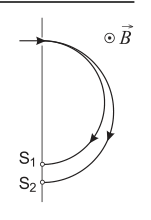 Spettrometro di massa, punti S1 S2
Topic: Magnetism, Modern-Quantum Physics Metodi: Lorentz Force Analysis, Kinematic Equations Competenze: Physical Reasoning, Mathematical Modeling Objects: Particle Beam, Magnet Fonte: Testo (PDF) — p.4 Soluzione: Soluzioni (PDF)
A mass spectrometer includes a beam of ions with a charge , velocity and mass for some and for others (with atomic mass units). The beam is deflected by by a uniform magnetic field perpendicular to the beam, (see figure).
What is the distance between and ?
The following information is provided for the purpose of this Regulation:
Topic: Magnetism, Modern-Quantum Physics Metodi: Lorentz Force Analysis, Kinematic Equations Competenze: Physical Reasoning, Mathematical Modeling Objects: Particle Beam, Magnet Fonte: Testo (PDF) — p.4 Soluzione: Soluzioni (PDF)
Un gas perfetto è soggetto al ciclo termodinamico ---- rappresentato in figura nel piano -, dove è la temperatura assoluta.
Disegnare il grafico di questo ciclo nel piano -, indicando le posizioni degli stati , , , .
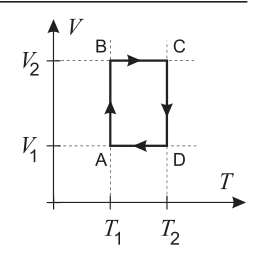 Ciclo termodinamico piano V-T
Topic: Thermodynamics Metodi: Ideal Gas Law, Thermodynamic Cycle Analysis Competenze: Physical Reasoning, Diagrammatic Reasoning Objects: Gas Fonte: Testo (PDF) — p.4 Soluzione: Soluzioni (PDF)
A perfect gas is subject to the thermodynamic cycle ---- as shown in Figure 5 in the plane -, where is the absolute temperature.
Draw the graph of this cycle in the plane -, indicating the positions of the states , , , .
The following is the list of the types of energy sources used:
Topic: Thermodynamics Metodi: Ideal Gas Law, Thermodynamic Cycle Analysis Competenze: Physical Reasoning, Diagrammatic Reasoning Objects: Gas Fonte: Testo (PDF) — p.4 Soluzione: Soluzioni (PDF)
La costante solare, ovvero la quantità di energia radiante che arriva sulla Terra dal Sole per unità di tempo e di superficie, misurata perpendicolarmente ai raggi, ha un valore medio . L’orbita terrestre ha un raggio , mentre il Sole ha un raggio .
Assumendo che il Sole emetta come un corpo nero, trova la temperatura della fotosfera, cioè del sottile strato da cui proviene la radiazione solare.
Topic: Astrophysics, Thermodynamics Metodi: Physical Modeling, Conservation of Energy Competenze: Physical Reasoning, Mathematical Modeling Objects: Star, Planet Fonte: Testo (PDF) — p.4 Soluzione: Soluzioni (PDF)
The solar constant, or the amount of radiant energy coming to Earth from the Sun per unit time and surface, measured perpendicular to the rays, has an average value of . Earth’s orbit has a radius , while the Sun has a radius .
Assuming that the Sun emits as a black body, it finds the temperature of the photosphere, that is, the thin layer from which the solar radiation comes.
Topic: Astrophysics, Thermodynamics Metodi: Physical Modeling, Conservation of Energy Competenze: Physical Reasoning, Mathematical Modeling Objects: Star, Planet Fonte: Testo (PDF) — p.4 Soluzione: Soluzioni (PDF)
Problema 1 — Camminando, con attrito, sui cilindri… (Punti 20)
Parte A [Punti 6]
Due amici e si trovano spesso a camminare svelti, a una velocità di circa , su di un viale alberato in cui il percorso è segnato con una targhetta ogni .
Ad un certo punto chiede: «A che velocità stiamo andando, secondo te?» «Usa il tuo cronometro e dimmi in quanto tempo facciamo » replica . Percorso quel tratto, dice: « secondi»; in un attimo gli risponde: «Andiamo a ».
All’amico stupito della rapidità della risposta, spiega come ha fatto: «Ho fatto la differenza tra secondi e il tempo che mi hai dato: che è un piccolo intervallo; poi ho diviso questo piccolo intervallo per e l’ho sommato a , cioè che è, appunto, la velocità che ti ho detto in km/h. Se non camminiamo troppo velocemente, questo modo di fare il conto dà un risultato quasi giusto, conoscendo quel piccolo intervallo.»
- Per quali valori di quel piccolo intervallo, questo metodo fornisce un risultato corretto entro l’?
- Qual è la massima velocità corrispondente?
Topic: Newtonian Mechanics, Order-of-Magnitude Estimation Metodi: Approximation & Series Expansion, Kinematic Equations Competenze: Estimation & Approximation, Mathematical Modeling Objects: — Fonte: Testo (PDF) — p.6 Soluzione: Soluzioni (PDF)
**Problem 1 Walking with friction on the cylinders… (Points 20) **
Parte A [Punti 6]
Two friends and often find themselves walking fast, at a speed of about , on a tree-lined avenue where the path is marked with a tag each .
Ad un certo punto chiede: «A che velocità stiamo andando, secondo te?» Use your timer and tell me how long we’re going to do replica . In that passage, says: seconds; in a moment answers: Let’s go to .
All’amico stupito della rapidità della risposta, spiega come ha fatto: «Ho fatto la differenza tra secondi e il tempo che mi hai dato: che è un piccolo intervallo; poi ho diviso questo piccolo intervallo per e l’ho sommato a , cioè che è, appunto, la velocità che ti ho detto in km/h. If we don’t walk too fast, this way of counting gives an almost right result, knowing that little interval.
- For what values of that small range does this method provide a correct result within ?
- What is the corresponding maximum speed?
Topic: Newtonian Mechanics, Order-of-Magnitude Estimation Metodi: Approximation & Series Expansion, Kinematic Equations Competenze: Estimation & Approximation, Mathematical Modeling Objects: — Fonte: Testo (PDF) — p.6 Soluzione: Soluzioni (PDF)
Problema 1 — Parte B [Punti 7]
Una piccola pedina di massa , appoggiata su di un disco che sta ruotando attorno al suo asse, con accelerazione angolare costante . La pedina si trova in un punto a distanza dall’asse di rotazione.
Nell’istante a cui fa riferimento la figura, la velocità angolare del disco è , e la pedina è ferma rispetto al disco, grazie all’attrito statico di coefficiente .
Nella parte destra della figura, in cui il disco è visto dall’alto, il vettore rappresenta la forza centripeta agente sulla pedina, disegnata in unità arbitrarie, nello stesso istante.
Dopo aver riportato sul foglio a quadretti la figura a destra, con il vettore di lunghezza pari ad almeno 6 quadretti, disegnare — nella stessa scala — la forza d’attrito che agisce in quello stesso istante sulla pedina, motivando adeguatamente la soluzione trovata.
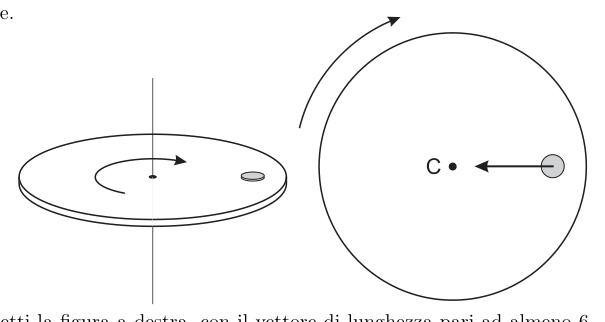 Pedina su disco rotante, vettore forza centripeta
Topic: Rotational Dynamics, Newtonian Mechanics Metodi: Free-Body Diagram, Torque & Angular Momentum Analysis, Vector Decomposition Competenze: Diagrammatic Reasoning, Physical Reasoning Objects: Disk Fonte: Testo (PDF) — p.6 Soluzione: Soluzioni (PDF)
The following is the list of the types of products which are subject to the approval of the competent authority:
A small mass pedal, resting on a disc rotating around its axis, with a constant angular acceleration . The pedal shall be located at a point from the axis of rotation.
At the moment referred to in the figure, the angular velocity of the disk is , and the pedal is fixed relative to the disk, thanks to the static friction coefficient .
In the right side of the figure, where the disk is seen from above, the vector represents the centrifugal force on the pedal, drawn in arbitrary units, at the same instant.
After returning the figure to the right on the square sheet, with the length vector equal to at least 6 squares, draw in the same scale the friction force acting at the same moment on the pedal, adequately justifying the solution found.
The vehicle shall be equipped with a single rotary disc, centrifugal force vector.
Topic: Rotational Dynamics, Newtonian Mechanics Metodi: Free-Body Diagram, Torque & Angular Momentum Analysis, Vector Decomposition Competenze: Diagrammatic Reasoning, Physical Reasoning Objects: Disk Fonte: Testo (PDF) — p.6 Soluzione: Soluzioni (PDF)
Problema 1 — Parte C [Punti 7]
Tre cilindri, tutti di massa , rotolano senza scivolare lungo un piano inclinato di altezza . I cilindri hanno le seguenti caratteristiche: il primo è vuoto ed ha raggio ; il secondo è pieno ed ha raggio ; il terzo è pieno ed ha raggio .
Se i tre cilindri sono stati lasciati liberi simultaneamente dalla stessa altezza, quale cilindro impiegherà più tempo a raggiungere la base del piano inclinato?
Topic: Rotational Dynamics, Newtonian Mechanics Metodi: Torque & Angular Momentum Analysis, Conservation of Energy, Free-Body Diagram Competenze: Physical Reasoning, Mathematical Modeling Objects: Cylinder, Inclined Plane Fonte: Testo (PDF) — p.6 Soluzione: Soluzioni (PDF)
The following information is provided by the Commission to the Member States:
Three cylinders, all in mass, rolling without slipping along an inclined plane of height. The cylinders have the following characteristics: the first is empty and has a radius ; the second is full and has a radius ; the third is full and has a radius .
If the three cylinders were released simultaneously from the same height, which cylinder will take longer to reach the base of the sloping plane?
Topic: Rotational Dynamics, Newtonian Mechanics Metodi: Torque & Angular Momentum Analysis, Conservation of Energy, Free-Body Diagram Competenze: Physical Reasoning, Mathematical Modeling Objects: Cylinder, Inclined Plane Fonte: Testo (PDF) — p.6 Soluzione: Soluzioni (PDF)
Problema 2 — Laser e fenditura (Punti 20)
Si pone una fenditura di larghezza davanti a un laser a He-Ne che emette un fascio, sottile e collimato, di luce monocromatica di lunghezza d’onda . Su di uno schermo ortogonale al fascio del laser e posto ad una distanza dalla fenditura si osserva una figura di diffrazione come quella qui riprodotta, per comodità, a colori invertiti. Si tenga presente che la scala del disegno è tale che la quadrettatura minore è di , quella maggiore di .
- Lo schema seguente illustra parzialmente il montaggio sperimentale con cui si è ottenuta la figura di diffrazione, riportata sopra, orizzontalmente. Dopo aver copiato sul foglio lo schema, completarlo con gli elementi essenziali che mancano.
- Fissato un sistema di riferimento sulla figura di diffrazione data, determinare le posizioni dei minimi e riportarle in un grafico in funzione del numero d’ordine. In base a tale grafico, fornire la migliore stima per il valore della distanza tra due minimi adiacenti.
- Utilizzando il risultato del quesito precedente, determinare la larghezza della fenditura.
- Dimostrare che, nei punti di minimo della figura di diffrazione, la differenza di fase tra i raggi che provengono dai bordi opposti della fenditura è pari a un multiplo intero di .
- Calcolare il valore della differenza di fase tra i raggi che arrivano nel punto equidistante dal primo e secondo minimo, provenendo dai bordi opposti della fenditura.
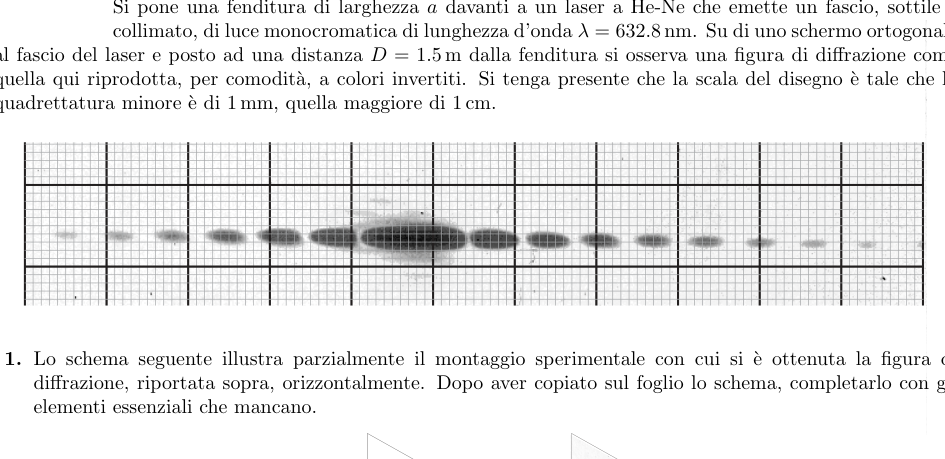 Figura di diffrazione da fenditura (colori invertiti)
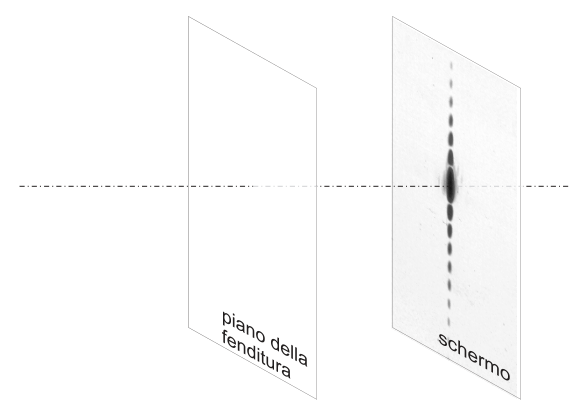 Schema montaggio laser, fenditura, schermo
Topic: Wave Optics Metodi: Interference & Diffraction Analysis, Superposition Principle, Graph Linearization Competenze: Experimental Data Analysis, Diagrammatic Reasoning, Graph Linearization Objects: Slit, Screen Fonte: Testo (PDF) — p.7 Soluzione: Soluzioni (PDF)
The following information is provided by the Commission in the field of safety and health:
A width crack is placed in front of a He-Ne laser that emits a thin, collimated monochrome light beam of wavelength. On a screen orthogonal to the laser beam and placed at a distance from the crack, a diffraction figure such as that reproduced here is observed, for convenience, in reverse colour. Note that the scale of the drawing is such that the smaller square is , the larger one is .
- The following diagram partially illustrates the experimental assembly with which the diffraction figure shown above was obtained horizontally. After copying the pattern onto the sheet, complete it with the missing essential elements.
- Set a reference system for the given diffraction figure, determine the positions of the minima and return them to a chart according to the order number. Based on this chart, provide the best estimate for the distance between two adjacent lows.
- Using the result of the previous question, determine the width of the crack.
- Demonstrate that, at the lowest points of the diffraction figure, the phase difference between the rays coming from the opposite edges of the cleft is equal to an integer multiple of .
- Calculate the value of the phase difference between the rays reaching the point equidistant from the first and second minimum, coming from the opposite edges of the cleft.
*Fragment diffraction by crack (inverted colours) *
The following information is provided for in the Annex to this Regulation:
Topic: Wave Optics Metodi: Interference & Diffraction Analysis, Superposition Principle, Graph Linearization Competenze: Experimental Data Analysis, Diagrammatic Reasoning, Graph Linearization Objects: Slit, Screen Fonte: Testo (PDF) — p.7 Soluzione: Soluzioni (PDF)
Problema 3 — Moto di cariche (Punti 20)
In fondo ad un lungo filo ben teso, disposto verticalmente ed isolante, è collocata una sferetta di massa , dotata di una carica elettrica . Più in alto, ad una distanza dalla prima, si trova, libera di scorrere lungo il filo ed in situazione di equilibrio, una seconda sferetta di massa uguale e carica . Le sferette possono essere trattate sempre come puntiformi e l’attrito tra di esse e il filo può essere trascurato.
- Scrivere l’espressione di in funzione dei dati e di eventuali costanti e calcolarne il valore.
Successivamente, si blocca la sferetta superiore e si lancia l’altra verso l’alto con una velocità iniziale .
- Qual è la minima distanza alla quale la sferetta inferiore riesce ad avvicinarsi all’altra?
(Suggerimento: utilizzare l’espressione di trovata precedentemente.)
L’esperimento viene ora ripetuto lasciando la sferetta superiore libera di muoversi lungo il filo.
- Qual è la minima distanza alla quale la sferetta inferiore riesce ora ad avvicinarsi all’altra?
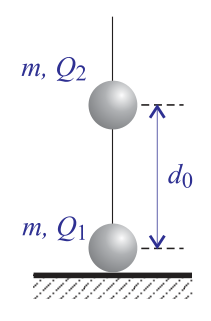 Due sferette cariche su filo verticale isolante
Topic: Electrostatics, Newtonian Mechanics Metodi: Coulomb’s Law, Conservation of Energy, Conservation of Momentum, Free-Body Diagram Competenze: Physical Reasoning, Mathematical Modeling Objects: Point Charge, Wire Fonte: Testo (PDF) — p.8 Soluzione: Soluzioni (PDF)
The following is the list of the types of vehicles that are included in the list:
At the end of a long well-tanned wire, arranged vertically and insulating, a sphere of mass , with an electric charge , is placed. Further up, at a distance from the first, a second sphere of equal mass and charge is found, free to flow along the wire and in equilibrium. The spheres can always be treated as point shapes and the friction between them and the wire can be neglected.
- Write the expression in terms of data and any constants and calculate its value.
Next, lock the upper sphere and launch the other upwards at an initial speed .
- What is the minimum distance that the lower sphere can approach the other?
(Suggest: use the expression previously found.)
The experiment is now repeated by leaving the upper sphere free to move along the wire.
- What is the minimum distance that the lower sphere can now approach the other?
*Two loading spheres on the insulating vertical wire *
Topic: Electrostatics, Newtonian Mechanics Metodi: Coulomb’s Law, Conservation of Energy, Conservation of Momentum, Free-Body Diagram Competenze: Physical Reasoning, Mathematical Modeling Objects: Point Charge, Wire Fonte: Testo (PDF) — p.8 Soluzione: Soluzioni (PDF)