Q1 Un’onda acustica piana giunge sulla superficie di separazione fra due mezzi con un angolo di incidenza di . • Sapendo che la velocità di propagazione nel primo mezzo è di e nel secondo mezzo è di , si trovi l’angolo di rifrazione.
Topic: Oscillations & Waves Metodi: Snell’s Law, Wave Equation, Ray Tracing Competenze: Physical Reasoning, Mathematical Modeling Objects: — Fonte: Testo (PDF) — p.3 Soluzione: Soluzioni (PDF)
Q1 A flat acoustic wave reaches the separation surface between two means with an angle of incidence di . • Knowing that the rate of propagation in the first half is and in the second half is , The angle of refraction is the angle of refraction.
Topic: Oscillations & Waves Metodi: Snell’s Law, Wave Equation, Ray Tracing Competenze: Physical Reasoning, Mathematical Modeling Objects: — Fonte: Testo (PDF) — p.3 Soluzione: Soluzioni (PDF)
Q2 Un blocco di marmo di massa , con una base tale da non potersi ribaltare, è appoggiato sul pianale di un camion; l’elevato attrito statico tra piano e carico assicura la stabilità del sistema anche quando il camion deve effettuare una brusca frenata con accelerazione di modulo su una strada rettilinea piana. • Quanto vale il modulo della forza d’attrito agente sul blocco di marmo durante la frenata?
Topic: Newtonian Mechanics Metodi: Free-Body Diagram, Vector Decomposition, Kinematic Equations Competenze: Diagrammatic Reasoning, Physical Reasoning Objects: Block Fonte: Testo (PDF) — p.3 Soluzione: Soluzioni (PDF)
Q2 A block of marble with a base such that it cannot be turned over is supported on the floor of a truck; the high static friction between the floor and the load ensures stability of the system even when the truck is to brake abruptly with a mode acceleration on a straight path. • What is the form of the force of friction on the marble block during braking?
Topic: Newtonian Mechanics Metodi: Free-Body Diagram, Vector Decomposition, Kinematic Equations Competenze: Diagrammatic Reasoning, Physical Reasoning Objects: Block Fonte: Testo (PDF) — p.3 Soluzione: Soluzioni (PDF)
Q3 Un cilindro di volume 2 L (∗) e lunghezza 40 cm contiene un gas perfetto alla pressione di 100 kPa ed è diviso in due parti uguali da un pistone di spessore trascurabile. Il sistema è a temperatura uniforme e in equilibrio. • Se il pistone viene lentamente spostato verso destra di 5 cm, mantenendo la temperatura del gas costante, qual è, in modulo, la forza di richiamo che agisce sul pistone? (∗) Si ricorda che dal 1979 (in deroga alla convenzione secondo cui i simboli che iniziano con lettera maiuscola sono solo quelli che derivano da nomi propri) si è deciso di adottare, come simbolo SI del litro, anche la L maiuscola, per evitare una possibile confusione tra la lettera l (elle) e la cifra 1 (uno).
Topic: Thermodynamics, Newtonian Mechanics Metodi: Ideal Gas Law, Free-Body Diagram, Physical Modeling Competenze: Mathematical Modeling, Physical Reasoning Objects: Gas, Cylinder, Piston Fonte: Testo (PDF) — p.3 Soluzione: Soluzioni (PDF)
Q3 A cylinder of 2 L () volume and length of 40 cm contains a Perfect gas at a pressure of 100 kPa and divided into two parts equal to a piston of negligible thickness. The system is at a temperature. uniform and balanced. • If the piston is slowly moved to the right by 5 cm, keeping the temperature of the gas constant, which is, in the form, the The force of call acting on the piston? (∗) It should be recalled that since 1979 (by way of derogation from the Convention, which states that symbols beginning with a capital letter are only those which are The Commission has decided to adopt the capital letter L as the SI symbol for the litre to avoid any confusion. between the letter (s) and the number 1 (one).
Topic: Thermodynamics, Newtonian Mechanics Metodi: Ideal Gas Law, Free-Body Diagram, Physical Modeling Competenze: Mathematical Modeling, Physical Reasoning Objects: Gas, Cylinder, Piston Fonte: Testo (PDF) — p.3 Soluzione: Soluzioni (PDF)
Q4 Un corridore amatoriale fa una sessione di allenamento, alternando dei tratti di corsa alla velocità di 12.6 km/h con una marcia alla velocità di 5.7 km/h. • Se al termine dell’allenamento la sua velocità media è stata di 11.2 km/h, quale percentuale della durata della sessione ha trascorso correndo?
Topic: Newtonian Mechanics Metodi: Kinematic Equations, Physical Modeling Competenze: Physical Reasoning, Mathematical Modeling Objects: — Fonte: Testo (PDF) — p.4 Soluzione: Soluzioni (PDF)
Q4 An amateur runner takes a training session, alternating tracks at speed of 12,6 km/h with a speed of 5,7 km/h. • If at the end of training the average speed was 11.2 km/h, as a percentage of the duration of the training Did you run through the session?
Topic: Newtonian Mechanics Metodi: Kinematic Equations, Physical Modeling Competenze: Physical Reasoning, Mathematical Modeling Objects: — Fonte: Testo (PDF) — p.4 Soluzione: Soluzioni (PDF)
Q5 Un’asta rigida di massa trascurabile può ruotare attorno ad un perno. Due masse, una di g e l’altra di g, sono poste alle estremità dell’asta rispettivamente a distanza cm e cm dall’asse di rotazione. Il sistema, inizialmente fermo in posizione verticale con la massa in alto, viene spostato leggermente, nel verso indicato in figura. L’attrito è trascurabile. • Qual è la velocità angolare quando il sistema passa per la posizione di equilibrio stabile?
Topic: Rotational Dynamics, Conservation of Energy Metodi: Energy Conservation Method, Torque & Angular Momentum Analysis, Conservation Laws Competenze: Diagrammatic Reasoning, Mathematical Modeling Objects: Rod, Lever Fonte: Testo (PDF) — p.4 Soluzione: Soluzioni (PDF)
Q5 A rigid shaft of negligible mass can rotate around a spindle. Two Masses, one g and the other g, shall be placed at the ends dell’asta rispettivamente a distanza cm e cm dall’asse di rotazione. Il The system, initially stationary in a vertical position with the mass at the top, is moved lightly, in the text shown in the figure. The friction is negligible. • What is the angular velocity when the system passes through the equilibrium position stable?
Topic: Rotational Dynamics, Conservation of Energy Metodi: Energy Conservation Method, Torque & Angular Momentum Analysis, Conservation Laws Competenze: Diagrammatic Reasoning, Mathematical Modeling Objects: Rod, Lever Fonte: Testo (PDF) — p.4 Soluzione: Soluzioni (PDF)
Q6 La resistenza di un filo conduttore è 1.78 ; il filo viene tirato finché la sua lunghezza aumenta dello 0.9%, in un ambiente mantenuto a temperatura costante. • Quanto vale la resistenza del filo allungato?
Topic: Circuits, Elasticity & Materials Metodi: Physical Modeling, Stress-Strain Analysis Competenze: Mathematical Modeling, Physical Reasoning Objects: Wire, Resistor Fonte: Testo (PDF) — p.4 Soluzione: Soluzioni (PDF)
Q6 La resistenza di un filo conduttore è 1.78 ; il filo viene tirato finché la sua lunghezza aumenta dello 0.9%, in an environment maintained at a constant temperature. • How much is the strength of the wire?
Topic: Circuits, Elasticity & Materials Metodi: Physical Modeling, Stress-Strain Analysis Competenze: Mathematical Modeling, Physical Reasoning Objects: Wire, Resistor Fonte: Testo (PDF) — p.4 Soluzione: Soluzioni (PDF)
Q7 Un recipiente cilindrico ha sezione uguale a ed è disposto con asse verticale; contiene solo una massa compatta di ghiaccio a fino a un certo livello. Dopo un po’ di tempo tutto il ghiaccio si è trasformato in acqua a e il livello si è abbassato di 2 cm. • Calcolare la quantità di calore assorbita.
Topic: Thermodynamics Metodi: First Law of Thermodynamics, Physical Modeling Competenze: Mathematical Modeling, Physical Reasoning Objects: Container Fonte: Testo (PDF) — p.4 Soluzione: Soluzioni (PDF)
Q7 A cylindrical container has a section equal to and is arranged vertically; it contains only one compact ice mass at to a certain level. After a while all the ice will It has been transformed into water at and the level has dropped by 2 cm. • Calculate the amount of heat absorbed.
Topic: Thermodynamics Metodi: First Law of Thermodynamics, Physical Modeling Competenze: Mathematical Modeling, Physical Reasoning Objects: Container Fonte: Testo (PDF) — p.4 Soluzione: Soluzioni (PDF)
Q8 Tre resistori, rispettivamente da 1 , 2 e 5 , sono collegati in parallelo e attraversati complessivamente da una corrente di 10 A. • Quanto vale la corrente che attraversa il resistore da 2 ?
Topic: Circuits Metodi: Kirchhoff’s Laws, Equivalent Circuit Reduction Competenze: Diagrammatic Reasoning, Mathematical Modeling Objects: Resistor Fonte: Testo (PDF) — p.4 Soluzione: Soluzioni (PDF)
Q8 Three resistors, 1 , 2 and 5 respectively, are connected in parallel and are crossed together by a current of 10 A. • What is the current passing through the resistor of 2 ?
Topic: Circuits Metodi: Kirchhoff’s Laws, Equivalent Circuit Reduction Competenze: Diagrammatic Reasoning, Mathematical Modeling Objects: Resistor Fonte: Testo (PDF) — p.4 Soluzione: Soluzioni (PDF)
Q9 In una certa regione dello spazio, giungono due onde sonore della stessa frequenza aventi intensità e . • Si calcoli l’intensità sonora nei punti in cui le due onde arrivano in fase.
Topic: Oscillations & Waves Metodi: Superposition Principle, Wave Equation Competenze: Mathematical Modeling, Physical Reasoning Objects: — Fonte: Testo (PDF) — p.4 Soluzione: Soluzioni (PDF)
Q9 In a certain region of space, two sound waves of the same frequency reach e . • The sound intensity is calculated at the points where the two waves come together.
Topic: Oscillations & Waves Metodi: Superposition Principle, Wave Equation Competenze: Mathematical Modeling, Physical Reasoning Objects: — Fonte: Testo (PDF) — p.4 Soluzione: Soluzioni (PDF)
Q10 Quando il catodo di un apparecchio per lo studio dell’effetto fotoelettrico viene irradiato con un fascio di lunghezza d’onda nm si misura un potenziale di arresto . Se, invece, viene irradiato con un fascio di lunghezza d’onda nm si misura un potenziale di arresto . Il rapporto tra i potenziali di arresto è . • Si calcoli il lavoro di estrazione .
Topic: Modern-Quantum Physics Metodi: Photon Energy Relation, Physical Modeling Competenze: Mathematical Modeling, Physical Reasoning Objects: Photon, Electron Fonte: Testo (PDF) — p.4 Soluzione: Soluzioni (PDF)
Q10 When the cathode of a photoelectric effect study is irradiated with a The measurement of the wavelength of the wavelength nm shall be made by measuring the stop potential . If, on the other hand, it comes radiated with a wavelength beam nm a stop potential is measured. The relationship between the arrest potential is . • Mining work is calculated.
Topic: Modern-Quantum Physics Metodi: Photon Energy Relation, Physical Modeling Competenze: Mathematical Modeling, Physical Reasoning Objects: Photon, Electron Fonte: Testo (PDF) — p.4 Soluzione: Soluzioni (PDF)
P1 Un granello di polvere su un satellite Punti 22 Un satellite di raggio a e massa m descrive un’orbita circolare di raggio r attorno a un pianeta di massa M; si trattino pianeta e satellite come sferici e omogenei. Il centro di massa del sistema si può considerare coincidente con il centro del pianeta. I periodi di rotazione e rivoluzione del satellite sono identici, cosicché il satellite rivolge al pianeta sempre la stessa faccia (come la Luna fa con la Terra). In tutto il problema si trascuri la gravità della stella attorno a cui orbita il pianeta.
- Si calcoli, in funzione di M ed r, la velocità angolare del moto di rivoluzione del satellite attorno al pianeta. Si consideri un piccolo corpo di massa appoggiato sulla superficie del satellite, nel punto più vicino al pianeta.
- Si calcoli il modulo N della forza normale esercitata dalla superficie del satellite sul corpo. Si esprima il risultato in funzione di , M, m, r e a.
- Qual è la condizione che deve essere verificata affinché il corpuscolo non si stacchi dalla superficie del satellite? Se il satellite fosse troppo vicino al pianeta, il piccolo corpo non riuscirebbe a rimanere appoggiato sulla superficie del satellite.
- Nell’ipotesi si calcoli il minimo raggio orbitale per cui il corpuscolo non si stacca dalla superficie del satellite. Si esprima il risultato in funzione di M, m e a. Suggerimento: si ricordi che, per si può usare l’approssimazione per qualunque (anche negativo). Di conseguenza i binomi con si possono approssimare ponendo
- Qual è il minimo raggio a cui potrebbe orbitare intorno alla Terra un piccolo satellite sferico di densità pari a senza che un corpo appoggiato sulla sua superficie, nel punto più vicino al pianeta, si stacchi? ———————————
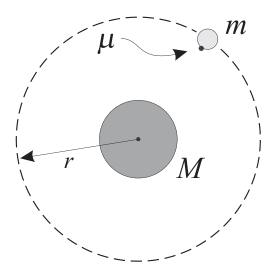 Satellite che orbita attorno a pianeta
Topic: Gravitation, Newtonian Mechanics, Rotational Dynamics Metodi: Newton’s Law of Gravitation, Free-Body Diagram, Approximation & Series Expansion Competenze: Mathematical Modeling, Physical Reasoning, Estimation & Approximation Objects: Satellite, Planet Fonte: Testo (PDF) — p.6 Soluzione: Soluzioni (PDF)
P1 A grain of dust on a satellite The Commission shall adopt implementing acts in accordance with Article 22 of this Regulation. A satellite of radius a and mass m describes a circular orbit of radius r around a planet of M mass; planets and satellites are treated as spherical and homogeneous. The center of mass of the system can be considered to coincide with the center of the planet. The rotation periods The satellite revolution is identical, so the satellite always faces the planet the same way (as the satellite does). The moon is with the earth. The whole problem is neglecting the gravity of the star around which the planet orbits.
- The angular velocity of the satellite’s revolutionary motion around the planet is calculated as a function of M and r. Consider a small mass body resting on the surface of the satellite, The closest point to the planet.
- The formula N of the normal force exerted by the surface of the Satellites on the body. The result is expressed as a function of , M, m, r and a.
- What is the condition that the body must be verified in order to ensure that the body does not You’re detached from the satellite’s surface? If the satellite were too close to the planet, the tiny body would not be able to remain resting on the surface of the satellite.
- In the hypothesis, the minimum orbital radius is calculated for which the The body does not detach from the satellite surface. The result is expressed In the function of M, m and a. Note: Please note that for the approximation can be used for any (also negative). The binomials and can therefore be approximated by
- What is the minimum radius at which a small spherical satellite of density could orbit the Earth? equal to without a body resting on its surface at the nearest point The planet, are you breaking up? ———————————
Satellite orbiting a planet
Topic: Gravitation, Newtonian Mechanics, Rotational Dynamics Metodi: Newton’s Law of Gravitation, Free-Body Diagram, Approximation & Series Expansion Competenze: Mathematical Modeling, Physical Reasoning, Estimation & Approximation Objects: Satellite, Planet Fonte: Testo (PDF) — p.6 Soluzione: Soluzioni (PDF)
P2 Onde su corda verticale Punti 16 La velocità delle onde trasversali su una corda tesa dipende dalla tensione F, dalla densità del materiale e dall’area A della sezione trasversale, in questo modo
- Ricavare tale espressione della velocità da sole considerazioni dimensionali, sapendo che il fattore numerico adimensionale è uguale a 1. NOTA BENE: non si chiede di fare semplicemente una verifica dimensionale dell’espressione data, ma di mostrare come tale relazione può essere trovata. Una corda di massa non trascurabile e sezione uniforme è tesa verticalmente tra due punti fissi al soffitto e al pavimento; sia il modulo della tensione all’estremità inferiore.
- Si trovi l’espressione della tensione della corda in funzione dell’altezza h, misurata a partire dall’estremità inferiore.
- Si trovi l’espressione della velocità con cui si propaga un impulso trasversale su questa corda, in funzione dell’altezza h e della velocità alla base della corda.
- Si calcoli l’accelerazione dell’impulso, indicandone anche il verso. ———————————
Topic: Oscillations & Waves, Newtonian Mechanics Metodi: Dimensional Analysis, Free-Body Diagram, Wave Equation Competenze: Mathematical Modeling, Physical Reasoning, Diagrammatic Reasoning Objects: String Fonte: Testo (PDF) — p.6 Soluzione: Soluzioni (PDF)
P2 Waves on vertical rope The Commission shall adopt implementing acts in accordance with Article 16 (1) of this Regulation. The speed of the transverse waves on a stretched string depends on the F voltage, the density of the material and from the cross section area A, thus
- To obtain this expression of speed from dimensional considerations alone, knowing that the numerical factor dimensional is equal to 1. The first is that the data is not only a dimensional check of the given expression, but also a How can such a relationship be found? A non-negligible mass rope and uniform section is stretched vertically between two fixed points at the ceiling and the floor; either the voltage module at the lower end.
- The expression of the tension of the rope in relation to the height h, measured from the end lower.
- The expression of the speed at which a transverse pulse propagates over this rope, as a function of the the h height and the speed at the base of the rope.
- The acceleration of the pulse is calculated by indicating the direction. ———————————
Topic: Oscillations & Waves, Newtonian Mechanics Metodi: Dimensional Analysis, Free-Body Diagram, Wave Equation Competenze: Mathematical Modeling, Physical Reasoning, Diagrammatic Reasoning Objects: String Fonte: Testo (PDF) — p.6 Soluzione: Soluzioni (PDF)
P3 Condensatore semicircolare Punti 22 Si consideri un condensatore piano a facce parallele le cui armature hanno la forma di semicerchi di raggio R, ad una distanza con : le due armature sono in aria . Una delle due armature è fissa ed è disposta con il diametro orizzontale, mentre l’altra, di massa m, può ruotare di un angolo attorno ad un asse perpendicolare alla faccia e passante per il centro del cerchio C. Poiché la distanza d tra le armature è molto minore del raggio R di queste, si può ritenere – con sufficiente approssimazione – che, quando il condensatore è carico, il campo elettrico tra le armature sia non nullo solo nella parte in cui le due superfici sono affacciate, che sia perpendicolare alle armature e uniforme.
- Determinare la capacità del condensatore in funzione dell’angolo , di R e di .
- Se il condensatore viene caricato con un generatore di f.e.m. nella posizione , e successivamente isolato, qual è l’energia elettrostatica immagazzinata nel condensatore in funzione dell’angolo nell’intervallo ? Rappresentare schematicamente in un grafico la funzione .
- Utilizzando la risposta precedente, spiegare perché l’armatura mobile del condensatore rimane in equilibrio solo per sia che il condensatore sia carico sia che sia scarico. All’armatura mobile viene ora fissato un filo sottile al quale viene appeso un corpo di massa m pari a quella dell’armatura, come mostrato in figura.
- Determinare l’angolo di equilibrio del sistema quando il condensatore è scarico, sapendo che il centro di massa di un semicerchio si trova a distanza dal centro del cerchio.
- Spiegare perché, se il condensatore è carico, la posizione di equilibrio si ha per un angolo minore di trovato al punto precedente.
- Nel caso particolare di un condensatore descritto dai valori dati qui di seguito, e calcolando l’energia totale del sistema a partire dalla posizione con passo pari a , stimare il valore di . cm; ; V; g.
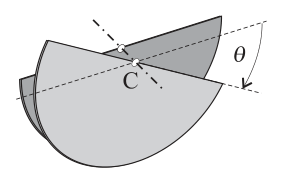 Condensatore piano a facce semicircolari
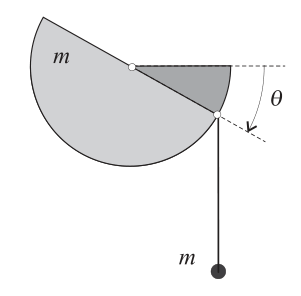 Condensatore con filo e massa appesa
Topic: Electrostatics, Conservation of Energy, Rotational Dynamics Metodi: Electric Potential Method, Energy Conservation Method, Calculus-Integration Competenze: Mathematical Modeling, Physical Reasoning, Diagrammatic Reasoning Objects: Capacitor, String Fonte: Testo (PDF) — p.7 Soluzione: Soluzioni (PDF)
P3 Other, of a kind used for the manufacture of goods of heading 8106 The Commission shall adopt implementing acts in accordance with Article 22 of this Regulation. Consider a flat-sided condenser whose frames are in the form of R-ray semicircles, at a distance with : the two frames are in the air . One of the two frames is fixed and is arranged with the horizontal diameter, whereas the other, m in mass, can rotate at an angle around an axis perpendicular to the face and passing through the centre of circle C. Since the distance d between the armour is much less than the radius R of these, can be considered with sufficient approximation that, when the capacitor is The electric field between the frames is not zero only in the having two surfaces facing each other, perpendicular to the armour, and uniforms.
- Determine the capacitance of the capacitor according to the , R and angles.
- If the capacitor is charged with an F.E.M. generator, at the position , and subsequently isolated, which is the electrostatic energy stored in the capacitor at the angle in the range ? Schematically represent the function in a graph.
- Using the previous answer, explain why the moving capacitor armor remains in balance only for whether the capacitor is loaded or discharged. The mobile armor is now fixed with a thin wire to which a body mass m equal to that of the armor, as shown in Figure 1.
- Determine the equilibrium angle of the system when the capacitor is It is discharged, knowing that the center of mass of a semicircle is at distance from the centre of the circle.
- Explain why, if the capacitor is loaded, the equilibrium position is has for an angle less than found in the previous point.
- In the particular case of a capacitor described by the values given here The total energy of the system from the position is calculated. with step equal to , estimate the value of . cm; ; V; g.
*Semi-circular flat surface capacitor *
Wire and suspended mass capacitor
Topic: Electrostatics, Conservation of Energy, Rotational Dynamics Metodi: Electric Potential Method, Energy Conservation Method, Calculus-Integration Competenze: Mathematical Modeling, Physical Reasoning, Diagrammatic Reasoning Objects: Capacitor, String Fonte: Testo (PDF) — p.7 Soluzione: Soluzioni (PDF)