Problema 3 – Trasferimento di calore [Punti 22]
Un riscaldatore elettrico eroga una potenza . All’istante esso viene inserito in un recipiente contenente una miscela di acqua liquida e ghiaccio, a e alla pressione standard; sia la massa iniziale di ghiaccio ed la massa totale della miscela. La miscela viene mescolata in modo tale che la sua temperatura sia sempre uniforme in tutta la sua massa.
ATTENZIONE: in questo problema le temperature sono tutte espresse in °C; esse sono scritte con la maiuscola per distinguerle dai tempi ( minuscola).
Inizialmente si supponga che il sistema costituito dalla miscela con immerso il riscaldatore non scambi calore con l’ambiente esterno, considerando trascurabili sia la capacità termica del recipiente che la quantità d’acqua evaporata prima dell’ebollizione.
- Determinare, in funzione di , , e delle costanti necessarie, l’istante in cui il ghiaccio si è fuso completamente e la successiva variazione di temperatura della miscela nel tempo . Tracciare un grafico qualitativo dell’andamento della temperatura della miscela nel tempo , a partire dall’istante fino all’ebollizione, indicando su di esso le grandezze trovate sopra: , e .
Se invece il sistema scambia calore con l’ambiente esterno, l’andamento della temperatura della miscela, in funzione del tempo , è quello rappresentato nel grafico allegato.
Si faccia l’ipotesi che il calore disperso all’esterno per unità di tempo sia proporzionale alla differenza di temperatura tra la miscela e l’ambiente esterno: dove è ancora la temperatura della miscela, è la temperatura dell’ambiente e è un parametro indipendente dalla temperatura. Si assuma che la temperatura dell’ambiente sia costante e valga , in modo che risulti più semplicemente: con sempre espresso in °C.
Considerando ancora trascurabili sia la capacità termica del recipiente che la quantità d’acqua che evapora prima dell’ebollizione, si risponda alle seguenti domande, ricavando i dati necessari dal grafico .
- Determinare la massa iniziale del ghiaccio nella miscela.
- Determinare la massa totale della miscela.
- Determinare il parametro .
- Determinare la potenza massima del riscaldatore, in modo tale che l’acqua non arrivi all’ebollizione.
- Mantenendo gli stessi valori per le masse e per il coefficiente , determinare il tempo in cui inizierebbe l’ebollizione dell’acqua se la potenza emessa dal riscaldatore elettrico valesse .
NOTA BENE: È possibile utilizzare il grafico allegato per tracciare delle costruzioni geometriche utili a ricavare le risposte; va quindi riconsegnato insieme ai fogli della soluzione.
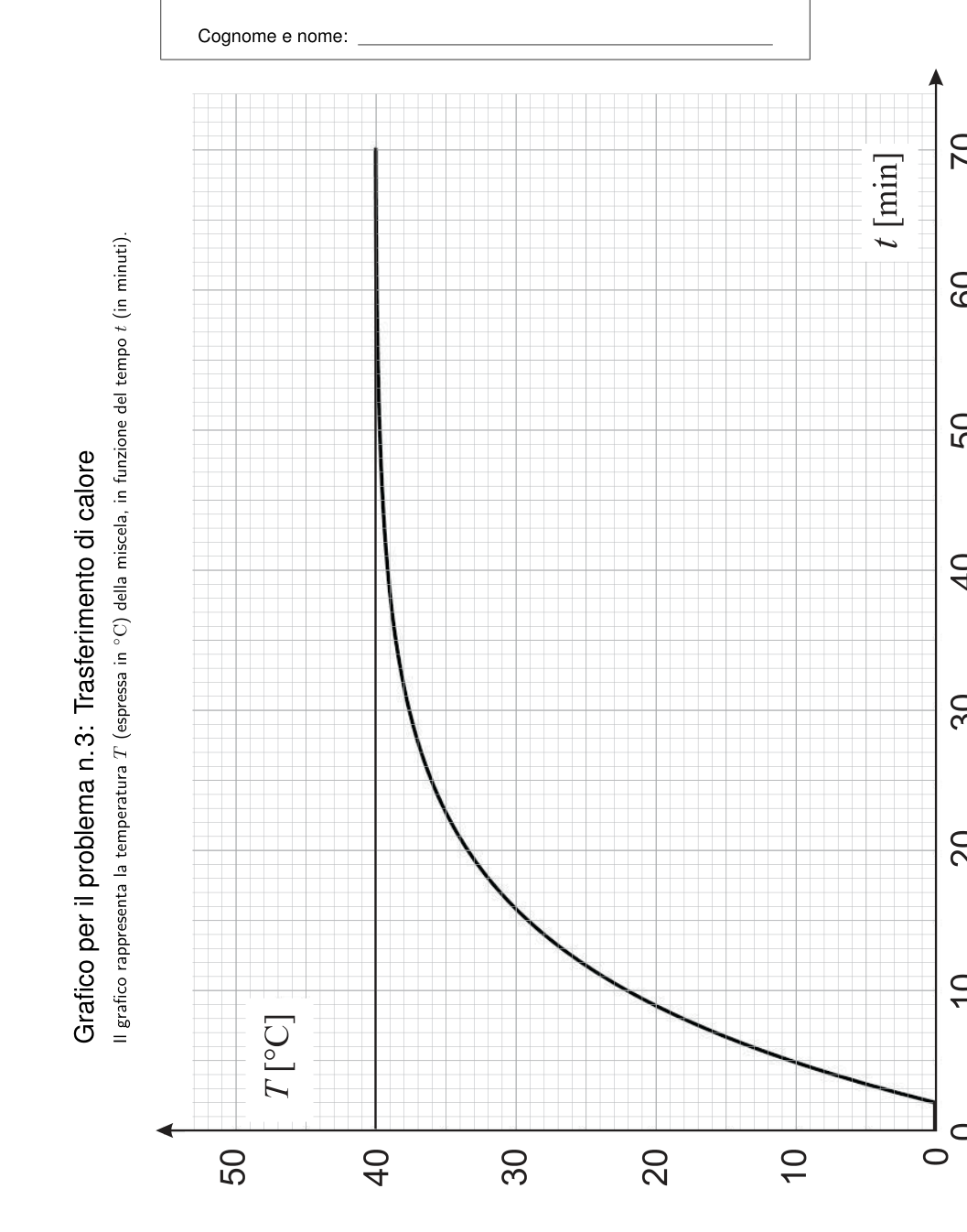 Grafico T(t) con dispersione di calore
Topic: Thermodynamics, Kinetic Theory Metodi: First Law of Thermodynamics, Differential Equations, Experimental Data Analysis Competenze: Graph Linearization, Mathematical Modeling Objects: Container Fonte: Testo (PDF) — p.1 Soluzione: Soluzioni (PDF)
The following is the list of the main types of heat transfer:
An electric heater shall deliver a power of . It is immediately inserted into a container containing a mixture of liquid water and ice, at and standard pressure; both the initial ice mass and the total mass of the mixture. The mixture is mixed so that its temperature is always uniform throughout its mass.
ADJ: in this problem the temperatures are all expressed in °C; they are written with the capital to distinguish them from the time ( minuscule).
The system consisting of the mixture with the heater immersed in the mixture is initially assumed to not exchange heat with the external environment, since both the heat capacity of the container and the amount of water evaporated before boiling are negligible.
- Determine, according to , , and the necessary constants, the instant at which the ice completely melted and the subsequent temperature change of the mixture over time . Draw a qualitative chart of the temperature of the mixture over time , starting at until boiling, indicating on it the above values: , and .
If the system exchanges heat with the external environment, the temperature trend of the mixture , in terms of time , is as shown in the graph.
Assume that the heat dispersed outside per unit time is proportional to the temperature difference between the mixture and the external environment: where is still the temperature of the mixture, is the ambient temperature and is a temperature independent parameter. Assume that the ambient temperature is constant and , so that it is more simply: with always expressed in °C.
Considering that both the heat capacity of the container and the amount of water evaporated before boiling are still negligible, the following questions are answered by drawing the necessary data from the chart.
- Determine the initial mass of the ice in the mixture.
- Determine the total mass of the mixture.
- Determine the parameter .
- Determine the maximum heat output so that the water does not boil.
- By maintaining the same values for masses and the coefficient , determine the time at which the boiling of water would start if the power emitted by the electric heater was .
BEN NOTE: The attached graph can be used to trace geometric constructions useful for obtaining the answers; it must then be returned together with the solution sheets.
Graph T(t) with heat dispersion
Topic: Thermodynamics, Kinetic Theory Metodi: First Law of Thermodynamics, Differential Equations, Experimental Data Analysis Competenze: Graph Linearization, Mathematical Modeling Objects: Container Fonte: Testo (PDF) — p.1 Soluzione: Soluzioni (PDF)