P1 Pendolo trascinato Punti 20 È stato ritrovato un foglio con pochi appunti relativi ad un esperimento da provare in laboratorio. Si tratta di una sfera di massa appesa a un supporto in movimento con un filo di lunghezza . Si dice che durante il moto il filo è in tensione e forma un angolo costante con la verticale e che anche l’orientazione del piano verticale, mostrato in figura, su cui giace il filo, rimane fissa durante l’esperimento. Si considerano trascurabili gli attriti. Inizialmente si consideri rettilineo il moto del sistema, in direzione orizzontale, nel piano verticale della figura.
- Spiegare perche ́ il moto deve essere accelerato, trovarne l’accelerazione e determinare la tensione del filo. Più in generale, togliendo la condizione che il moto debba essere orizzontale, ma che si svolga sempre nello stesso piano verticale della figura, l’accelerazione del sistema può essere diretta in modo da formare un angolo con l’asse orizzontale orientato a destra.
- Trovare la tensione del filo in funzione dell’angolo . Determinare inoltre i limiti di questo angolo. D’ora in poi si vuole scoprire se sono possibili moti in ogni direzione, nello spazio, con il filo ancora nel piano verticale della figura e con le condizioni date sopra.
- Nel caso particolare con , spiegare se, dalle sole informazioni scritte negli appunti, è possibile o meno dedurre la direzione e il verso della velocità.
- Dimostrare che, in generale, la traiettoria del sistema è una curva piana con un asse di simmetria; indicare come si può individuare tale piano, quali curve sono possibili e come sono orientati la curva e l’asse di simmetria.
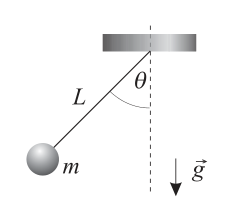 Pendolo su supporto mobile, angolo θ
Topic: Newtonian Mechanics, Rotational Dynamics Metodi: Free-Body Diagram, Vector Decomposition, Kinematic Equations, Symmetry Argument Competenze: Diagrammatic Reasoning, Mathematical Modeling, Physical Reasoning Objects: Pendulum Fonte: Testo (PDF) — p.2 Soluzione: Soluzioni (PDF)
P1 The pendulum dragged The Commission shall adopt implementing acts in accordance with Article 21 of this Regulation. A paper was found with a few notes relating to an experiment to be tested in The lab. It is a mass sphere suspended from a moving support a length of wire. It is said that while the wire is moving, it is tense and forms a the angle with the vertical and that also the orientation of the vertical plane, The wire, shown in the figure, on which the wire lies, remains fixed during the experiment. They consider friction negligible. Initially, the motion of the system in horizontal direction in the plane shall be considered straight. The vertical of the figure.
- Explain why the motorcycle must be accelerated, find its acceleration and determine the speed of the motorcycle. the voltage of the wire. More generally, the condition that the motorcycle must be horizontal, but always running in the The system acceleration can be directed to form an angle with the horizontal axis facing right.
- Find the wire voltage as a function of the angle . Determine the limits of this angle. From now on, we want to find out if there are any possible movements in any direction, in space, with the wire still in the plane. The figures are vertical and the conditions above.
- In the particular case with , explain whether, from the information in the notes alone, it is possible or not To deduce the direction and direction of the velocity.
- Demonstrate that the trajectory of the system is generally a flat curve with an axis of symmetry; indicate How to identify this plane, what curves are possible and how the curve and axis of the The symmetry.
The following is the list of the types of equipment used in the manufacture of the product:
Topic: Newtonian Mechanics, Rotational Dynamics Metodi: Free-Body Diagram, Vector Decomposition, Kinematic Equations, Symmetry Argument Competenze: Diagrammatic Reasoning, Mathematical Modeling, Physical Reasoning Objects: Pendulum Fonte: Testo (PDF) — p.2 Soluzione: Soluzioni (PDF)
P2 Sferetta appesa in un campo elettrico Punti 18 Una superficie piana, disposta verticalmente, di materiale isolante, è caricata con densità superficiale uniforme . Una sferetta dello stesso materiale ha massa e carica ; essa è sospesa a un filo isolante che forma un angolo con la verticale, come in figura, e si trova nel punto P a distanza dalla lastra. La lastra ha dimensioni molto maggiori di e la sferetta è molto lontana dai bordi della lastra. Il tutto è in condizioni di equilibrio.
- Determinare il campo elettrostatico generato dalla lastra piana nel punto P.
- Calcolare la densità . All’istante il filo si rompe.
- Detta H la proiezione ortogonale di P sulla lastra, determinare a che distanza da H la sferetta colpisce la lastra.
- Con quale velocità la sferetta urta la lastra? Pag. 2 di 3 AIF – Olimpiadi di Fisica 2019 Gara di livello – 21 Febbraio 2019
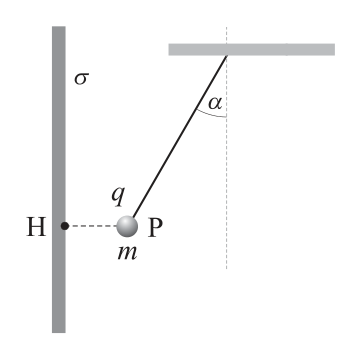 Sferetta appesa vicino a lastra carica
Topic: Electrostatics, Newtonian Mechanics Metodi: Gauss’s Law, Free-Body Diagram, Kinematic Equations Competenze: Diagrammatic Reasoning, Mathematical Modeling, Physical Reasoning Objects: Sphere, String, Point Charge Fonte: Testo (PDF) — p.2 Soluzione: Soluzioni (PDF)
P2 Sphere suspended in an electric field The Commission shall adopt implementing acts in accordance with Article 18 (1) of this Regulation. A flat surface, arranged vertically, of insulating material, is loaded with uniform surface density . A sphere of the same The material has a mass and a load ; it is suspended at a wire insulating angle with the vertical, as in Figure, and located at point P from the plate. La lastra ha dimensioni molto maggiori di e la sferetta è molto lontana From the edges of the plate. Everything is in equilibrium.
- Determine the electrostatic field generated by the flat plate in the point P.
- Calculate the density . The wire breaks as soon as .
- This H is the orthogonal projection of P on the plate, determining a The distance from H the sphere hits the plate.
- How fast does the sphere hit the plate? Pay it. 2 di 3 AIF 2019 Olympics in Physics Gara di livello – 21 Febbraio 2019
Sphere hanging near load plate
Topic: Electrostatics, Newtonian Mechanics Metodi: Gauss’s Law, Free-Body Diagram, Kinematic Equations Competenze: Diagrammatic Reasoning, Mathematical Modeling, Physical Reasoning Objects: Sphere, String, Point Charge Fonte: Testo (PDF) — p.2 Soluzione: Soluzioni (PDF)
P3 Trasferimento di calore Punti 22 Un riscaldatore elettrico eroga una potenza . All’istante esso viene inserito in un recipiente contenente una miscela di acqua liquida e ghiaccio, a e alla pressione standard; sia la massa iniziale di ghiaccio ed la massa totale della miscela. La miscela viene mescolata in modo tale che la sua temperatura sia sempre uniforme in tutta la sua massa. ATTENZIONE: in questo problema le temperature sono tutte espresse in ; esse sono scritte con la maiuscola per distinguerle dai tempi ( minuscola). Si raccomanda di prestare attenzione a questo fatto nella scrittura della soluzione. Inizialmente si supponga che il sistema costituito dalla miscela con immerso il riscaldatore non scambi calore con l’ambiente esterno, considerando trascurabili sia la capacità termica del recipiente che la quantità d’acqua evaporata prima dell’ebollizione.
- Determinare, in funzione di , , e delle costanti necessarie, l’istante in cui il ghiaccio si è fuso completamente e la successiva variazione di temperatura della miscela nel tempo (∗). Tracciare un grafico qualitativo dell’andamento della temperatura della miscela nel tempo , a partire dall’istante fino all’ebollizione, indicando su di esso le grandezze trovate sopra: , e . Se invece il sistema scambia calore con l’ambiente esterno, l’andamento della temperatura della miscela, in funzione del tempo , è quello rappresentato nel grafico allegato. Si faccia l’ipotesi che il calore disperso all’esterno per unità di tempo sia proporzionale alla differenza di temperatura tra la miscela e l’ambiente esterno, , dove è ancora la temperatura della miscela, è la temperatura dell’ambiente e è un parametro indipendente dalla temperatura. Si assuma che la temperatura dell’ambiente sia costante e valga , in modo che risulti più semplicemente con sempre espresso in . Considerando ancora trascurabili sia la capacità termica del recipiente che la quantità d’acqua che evapora prima dell’ebollizione, si risponda alle seguenti domande, ricavando i dati necessari dal grafico .
- Determinare la massa iniziale del ghiaccio nella miscela.
- Determinare la massa totale della miscela.
- Determinare il parametro .
- Determinare la potenza massima del riscaldatore, in modo tale che l’acqua non arrivi all’ebollizione.
- Mantenendo gli stessi valori per le masse e per il coefficiente , determinare il tempo in cui inizierebbe l’ebollizione dell’acqua se la potenza emessa dal riscaldatore elettrico valesse . NOTA BENE: È possibile utilizzare il grafico allegato per tracciare delle costruzioni geometriche utili a ricavare le risposte; va quindi riconsegnato insieme ai fogli della soluzione. (∗) Poiche ́ il rapporto in generale non è costante, il valore istantaneo si ottiene considerando intervalli sempre più piccoli, indicati con e . Analogamente più avanti si userà la notazione
Topic: Thermodynamics Metodi: First Law of Thermodynamics, Differential Equations, Experimental Data Analysis Competenze: Experimental Data Analysis, Graph Linearization, Mathematical Modeling Objects: Container Fonte: Testo (PDF) — p.3 Soluzione: Soluzioni (PDF)
P3 Heat transfer The Commission shall adopt implementing acts in accordance with Article 22 of this Regulation. An electric heater shall deliver a power of . All’istante esso viene inserito in a container containing a mixture of liquid water and ice, at and at standard pressure; The total mass of the mixture is and the initial ice mass . The mixture is mixed so that its temperature is always uniform throughout its mass. ATTENTION: in this problem the temperatures are all expressed in ; they are written with the capital to distinguish them from the tempi ( minuscola). It is recommended that you pay attention to this The problem is that the solution is written. The system consisting of the mixture with the heater immersed shall initially be assumed to be heat-exchange-free. with the external environment, considering that both the thermal capacity of the container and the quantity of water are negligible Evaporated before boiling.
- Determine, according to , , and the necessary constants, the instant in which the ice has melted completamente e la successiva variazione di temperatura della miscela nel tempo (∗). Tracing a Qualitative graph of the temperature trend of the mixture over time , starting from the current until boiling, indicating on it the values above: , and . If the system exchanges heat with the external environment, the temperature change of the mixture, in The time function is the one shown in the graph attached. The heat dispersed outside per unit time is assumed to be proportional to the difference in The temperature between the mixture and the external environment, , where is still the temperature of the mixture. Mix, is the temperature of the environment and is a temperature independent parameter. It is assumed that the ambient temperature is constant and , so that it is more easily with always expressed in . Considering that both the thermal capacity of the vessel and the amount of water evaporated are still negligible Before boiling, answer the following questions by drawing the necessary data from the graph .
- Determine the initial mass of the ice in the mixture.
- Determine the total mass of the mixture.
- Determine the parameter .
- Determine the maximum heat output so that the water does not boil.
- By maintaining the same values for masses and the coefficient , determine the time at which it would start The boiling point of water if the power output from the electric heater is . The following table shows the results of the study: The Commission will also draw up a proposal for a directive on the approximation of the laws of the Member States relating to the use of the geometric construction. The following information is provided by the Commission to the Member States: The solution. (∗) Poiche ́ il rapporto in generale non è costante, il valore istantaneo si ottiene considerando intervalli sempre più piccoli, indicated by and . Similarly, later the notation will be used.
Topic: Thermodynamics Metodi: First Law of Thermodynamics, Differential Equations, Experimental Data Analysis Competenze: Experimental Data Analysis, Graph Linearization, Mathematical Modeling Objects: Container Fonte: Testo (PDF) — p.3 Soluzione: Soluzioni (PDF)