Q1 In una corsa sui 10 000 m, che si svolge su una pista di 400 m, il concorrente più debole corre ad una velocità pari al 95 % di quella del più forte. • Supponendo che le velocità dei corridori siano praticamente costanti, quale distanza ha percorso il primo quando raggiunge l’ultimo?
Topic: Newtonian Mechanics Metodi: Kinematic Equations Competenze: Mathematical Modeling, Physical Reasoning Objects: — Fonte: Testo (PDF) — p.3 Soluzione: Soluzioni (PDF)
Q1 In a race over 10 000 m, which takes place on a 400 m track, the weakest competitor runs a speed equal to 95 percent of the strongest. • Assuming that the speed of the runners is practically constant, what distance was covered by the first runner When does it reach the last one?
Topic: Newtonian Mechanics Metodi: Kinematic Equations Competenze: Mathematical Modeling, Physical Reasoning Objects: — Fonte: Testo (PDF) — p.3 Soluzione: Soluzioni (PDF)
Q2 Una certa quantità di gas perfetto compie il ciclo di trasformazioni mostrato in figura, dove e . • Disegnare lo stesso ciclo nel piano , indicando anche il verso di percorrenza.
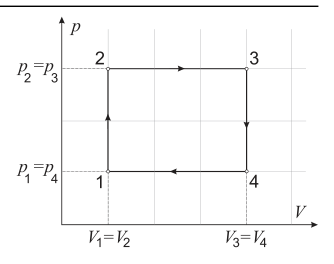 Ciclo termodinamico piano p-V
Topic: Thermodynamics Metodi: Ideal Gas Law, Thermodynamic Cycle Analysis, First Law of Thermodynamics Competenze: Mathematical Modeling, Diagrammatic Reasoning Objects: Gas Fonte: Testo (PDF) — p.3 Soluzione: Soluzioni (PDF)
Q2 A certain amount of perfect gas completes the transformation cycle shown in the figure, where e . • Draw the same cycle in the plane, including the line of The path.
The following is the list of the types of energy sources used:
Topic: Thermodynamics Metodi: Ideal Gas Law, Thermodynamic Cycle Analysis, First Law of Thermodynamics Competenze: Mathematical Modeling, Diagrammatic Reasoning Objects: Gas Fonte: Testo (PDF) — p.3 Soluzione: Soluzioni (PDF)
Q3 Una bobina formata da 120 spire, ognuna di area pari a , viene posizionata con il suo asse parallelo ad un campo magnetico uniforme. L’intensità del campo magnetico viene fatta variare in maniera uniforme da 80 mT a 20 mT in 4 s . • Determinare il modulo della forza elettromotrice indotta sulla bobina in questo intervallo di tempo.
Topic: Electromagnetic Induction Metodi: Faraday’s Law of Induction Competenze: Mathematical Modeling Objects: Coil Fonte: Testo (PDF) — p.3 Soluzione: Soluzioni (PDF)
Q3 A coil of 120 spires, each of area, is positioned with its axis parallel to a uniform magnetic field. The intensity of the magnetic field is varied in uniformly from 80 mT to 20 mT in 4 seconds . • Determine the modulus of induced electromotive force on the coil during this time interval.
Topic: Electromagnetic Induction Metodi: Faraday’s Law of Induction Competenze: Mathematical Modeling Objects: Coil Fonte: Testo (PDF) — p.3 Soluzione: Soluzioni (PDF)
Q4 Due lastre conduttrici di grande dimensione (con superfici di area S) vengono affacciate parallelamente una all’altra a piccola distanza cosicche ́ gli effetti di bordo possano essere trascurati. Sulle due lastre vengono poste rispettivamente le cariche e con . • Quanto vale il modulo del campo elettrostatico tra le due lastre, lontano dai bordi?
Topic: Electrostatics Metodi: Gauss’s Law, Superposition Principle Competenze: Mathematical Modeling, Physical Reasoning Objects: Capacitor Fonte: Testo (PDF) — p.3 Soluzione: Soluzioni (PDF)
Q4 Two large conductive plates (with S-area surfaces) are placed parallel to each other at a short distance so that the effects on the board can be neglected. The two plates shall be loaded with and with respectively. • How much is the electrostatic field between the two plates, far from the edges, worth?
Topic: Electrostatics Metodi: Gauss’s Law, Superposition Principle Competenze: Mathematical Modeling, Physical Reasoning Objects: Capacitor Fonte: Testo (PDF) — p.3 Soluzione: Soluzioni (PDF)
Q5 Si ipotizza che un campione radioattivo abbia un tempo di dimezzamento (emivita) di 16 giorni. Si effettua una misura con un contatore Geiger-Müller rilevando 810 conteggi in 6 minuti di funzionamento; in assenza del campione il contatore segna una media di 15 conteggi al minuto. Dopo 4 giorni si ripetono entrambe le misure, effettuando un conteggio per 10 minuti con il campione e misurando ancora 15 conteggi al minuto in assenza di esso. • Quanto ci si aspetta che indichi il contatore se l’ipotesi è corretta, trascurando il fatto che questi conteggi sono in ogni caso affetti da incertezze statistiche?
 Vaschetta onde stazionarie distanza d
Topic: Nuclear & Particle Physics Metodi: Radioactive Decay Law Competenze: Mathematical Modeling, Physical Reasoning Objects: — Fonte: Testo (PDF) — p.4 Soluzione: Soluzioni (PDF)
Q5 A radioactive sample is assumed to have a half-life of 16 days. Si The measurement is performed with a Geiger-Müller counter detecting 810 counts in 6 minutes of operation; in the absence of the sample the counter scores an average of 15 counts per minute. After 4 days, they repeat. The sample is measured in two dimensions, with a 10-minute counting of the sample and another 15 counts at the minute in its absence. • How long is the counter expected to tell whether the hypothesis is correct, neglecting the fact that these counts are Are they at all affected by statistical uncertainties?
The following is the list of the main types of air conditioning systems:
Topic: Nuclear & Particle Physics Metodi: Radioactive Decay Law Competenze: Mathematical Modeling, Physical Reasoning Objects: — Fonte: Testo (PDF) — p.4 Soluzione: Soluzioni (PDF)
Q6 Una scatola cubica di acciaio, con le sei facce di lato e spessore , entra esattamente in un contenitore cilindrico di vetro. • Che altezza H deve avere, al minimo, il cilindro di vetro perche ́, versandovi dell’acqua, la scatola cubica possa galleggiarvi? Suggerimento: lo spessore delle facce della scatola si può considerare trascurabile rispetto al lato. Densità dell’acciaio: .
Topic: Fluid Mechanics Metodi: Hydrostatic Equilibrium, Physical Modeling Competenze: Physical Reasoning, Mathematical Modeling Objects: Container, Cylinder Fonte: Testo (PDF) — p.4 Soluzione: Soluzioni (PDF)
Q6 A cubic steel box, with six sides and thickness , fits exactly into a cylindrical glass container. • What height H must the glass cylinder have at least because, pouring water into it, the cube box Can I float you? Tip: The thickness of the sides of the box may be considered negligible relative to the side. Density of the steel: .
Topic: Fluid Mechanics Metodi: Hydrostatic Equilibrium, Physical Modeling Competenze: Physical Reasoning, Mathematical Modeling Objects: Container, Cylinder Fonte: Testo (PDF) — p.4 Soluzione: Soluzioni (PDF)
Q7 Nell’interferometro di Michelson [v. figura] lo specchio semitrasparente al centro separa in due il raggio di luce proveniente da una sorgente laser. I raggi separati vengono riflessi dai due specchi ed e ritornano allo specchio semitrasparente che di nuovo li separa: una parte di questi va verso la sorgente (non sono stati disegnati nella figura), un’altra viene raccolta su uno schermo dove si forma l’immagine della sorgente. Una vite micrometrica consente di far muovere perpendicolarmente a se stesso lo specchio . In un esperimento lo specchio mobile viene spostato di ; durante lo spostamento sullo schermo si vedono alternarsi 50 frange d’interferenza. • Calcolare la lunghezza d’onda del laser.
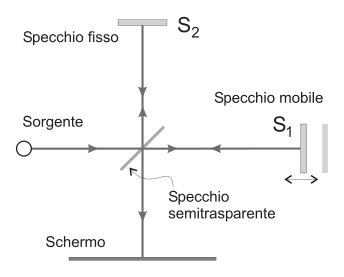 Interferometro di Michelson con specchi
Topic: Wave Optics Metodi: Interference & Diffraction Analysis, Superposition Principle Competenze: Mathematical Modeling Objects: Mirror, Screen Fonte: Testo (PDF) — p.4 Soluzione: Soluzioni (PDF)
Q7 In the Michelson interferometer [v. Figure] the semi-transparent mirror at the centre separates the light ray from a laser source in two. The separate rays are reflected by the two and mirrors and return to the semitravelling mirror which The new part separates them: some of these go to the source (they are not The data is collected on a screen. where the image of the source is formed. A micrometer screw allows you to move perpendicularly The mirror itself . In an experiment, the moving mirror comes moved by ; when moving on screen they are seen The Commission has decided to adopt a proposal for a regulation on the approximation of the laws of the Member States relating to the use of the electricity sector. • Calculate the laser wavelength.
Michelson interferometer with mirrors
Topic: Wave Optics Metodi: Interference & Diffraction Analysis, Superposition Principle Competenze: Mathematical Modeling Objects: Mirror, Screen Fonte: Testo (PDF) — p.4 Soluzione: Soluzioni (PDF)
Q8 Un automobilista che viaggia su un tratto dritto di strada sul piano orizzontale a velocità frena bruscamente, tanto da bloccare in modo praticamente istantaneo le ruote, fino a fermare completamente l’automobile che ha una massa, carico compreso, di 1200 kg. Sull’asfalto rimane una traccia lunga 16 m provocata dagli pneumatici. Si assuma che il coefficiente d’attrito dinamico tra la gomma e l’asfalto valga . • Determinare la velocità .
Topic: Newtonian Mechanics, Conservation of Energy Metodi: Energy Conservation Method, Kinematic Equations, Free-Body Diagram Competenze: Mathematical Modeling, Physical Reasoning Objects: — Fonte: Testo (PDF) — p.4 Soluzione: Soluzioni (PDF)
Q8 A driver travelling on a straight stretch of road on the horizontal plane at brake speed The vehicle is capable of operating at a speed of up to and including 1200 kg. There’s a long trail on the asphalt. 16 m caused by the tyres. The dynamic friction coefficient between the tyre and the asphalt is assumed to be . • Determine the speed .
Topic: Newtonian Mechanics, Conservation of Energy Metodi: Energy Conservation Method, Kinematic Equations, Free-Body Diagram Competenze: Mathematical Modeling, Physical Reasoning Objects: — Fonte: Testo (PDF) — p.4 Soluzione: Soluzioni (PDF)
Q9 Una molla fissata a soffitto sostiene una massa . Una seconda massa è sospesa alla prima mediante un sottile filo, di massa trascurabile. Il sistema è in equilibrio statico. • Determinare l’accelerazione della massa nell’istante in cui il filo viene bruciato.
Topic: Newtonian Mechanics, Oscillations & Waves Metodi: Free-Body Diagram, Hooke’s Law, Simple Harmonic Motion Analysis Competenze: Physical Reasoning, Mathematical Modeling Objects: Spring, String, Block Fonte: Testo (PDF) — p.4 Soluzione: Soluzioni (PDF)
Q9 A ceiling-mounted spring shall support a mass . A second mass is suspended The first one is by a thin thread of negligible mass. The system is in static equilibrium. • Determine the mass acceleration at the moment the wire is burned.
Topic: Newtonian Mechanics, Oscillations & Waves Metodi: Free-Body Diagram, Hooke’s Law, Simple Harmonic Motion Analysis Competenze: Physical Reasoning, Mathematical Modeling Objects: Spring, String, Block Fonte: Testo (PDF) — p.4 Soluzione: Soluzioni (PDF)
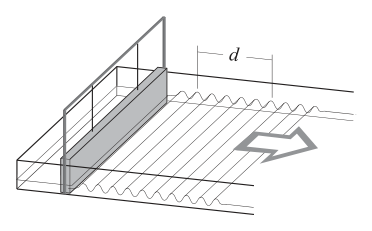
Q10 Si usa una vaschetta per mostrare la formazione delle onde stazionarie; un dispositivo (generatore di onde) viene fatto vibrare con una frequenza . La figura mostra la parte della vaschetta dove sono generate le onde e i punti di massimo delle onde che si stanno formando e si propagano verso la parete di fondo della vaschetta; la distanza d è di 60 cm. Per osservare le onde stazionarie in tutta la vaschetta occorre attendere di tempo dalla messa in moto del generatore. • Qual è la distanza tra il generatore di onde e la parete di fondo della vaschetta?
Topic: Oscillations & Waves Metodi: Wave Equation, Simple Harmonic Motion Analysis Competenze: Mathematical Modeling, Physical Reasoning Objects: Container Fonte: Testo (PDF) — p.4 Soluzione: Soluzioni (PDF)
Q10 A tray is used to show the formation of stationary waves; a device (wave generator) is vibrated at a frequency . The figure It shows the part of the vessel where the waves are generated and the high points of the waves that are forming and propagating. towards the bottom wall of the tank; the distance d is 60 cm. To observe the stationary waves throughout the tank, wait of time from the start of the generator. • What is the distance between the wave generator and the bottom wall The tub?
Topic: Oscillations & Waves Metodi: Wave Equation, Simple Harmonic Motion Analysis Competenze: Mathematical Modeling, Physical Reasoning Objects: Container Fonte: Testo (PDF) — p.4 Soluzione: Soluzioni (PDF)