Q1 Un oggetto parte da fermo e viene accelerato come mostrato nel grafico, percorrendo una traiettoria rettilinea. Si supponga che la variazione di accelerazione avvenga in un intervallo di tempo trascurabile. • Determinare la massima distanza dal punto di partenza raggiunta dall’oggetto.
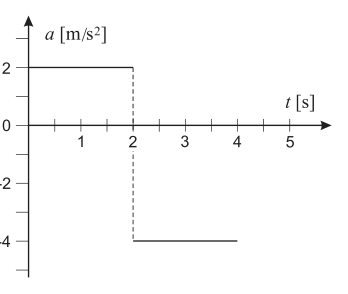 grafico accelerazione vs tempo traiettoria
Topic: Newtonian Mechanics Metodi: Kinematic Equations, Graph Linearization Competenze: Diagrammatic Reasoning, Mathematical Modeling, Graph Linearization Objects: — Fonte: Testo (PDF) — p.2 Soluzione: Soluzioni (PDF)
Q1 An object starts at a steady pace and accelerates as shown in the graph, following a straight path. Suppose the change in acceleration occurs over a negligible time interval. • Determine the maximum distance from the starting point reached from the object.
The following table shows the acceleration rate of the vehicle:
Topic: Newtonian Mechanics Metodi: Kinematic Equations, Graph Linearization Competenze: Diagrammatic Reasoning, Mathematical Modeling, Graph Linearization Objects: — Fonte: Testo (PDF) — p.2 Soluzione: Soluzioni (PDF)
Q2 Un condensatore inizialmente scarico è collegato in serie ad un potenziometro, un amperometro e una batteria, come mostrato in figura. Dopo che l’interruttore viene chiuso il potenziometro viene continuamente variato in modo da mantenere costante per 30 secondi la corrente di carica del condensatore al valore di . Durante questo tempo la d.d.p. ai capi del condensatore sale da 0 a 12 V. • Determinare la capacità del condensatore.
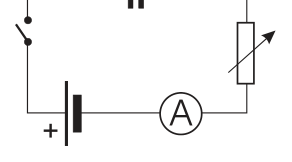 circuito condensatore potenziometro amperometro
Topic: Circuits, Electrostatics Metodi: Kirchhoff’s Laws, Electric Potential Method Competenze: Mathematical Modeling, Physical Reasoning Objects: Capacitor, Battery, Resistor, Switch, Galvanometer Fonte: Testo (PDF) — p.2 Soluzione: Soluzioni (PDF)
Q2 A condenser initially discharged is connected in series to a potentiometer, ampereometer and battery, as shown in It’s a figure. After the switch is closed, the power meter is continuously changed to maintain the current constant for 30 seconds. the capacitor load at . During this time the d.d.p. the capacitor heads are rated 0 to 12 V. • Determine the capacitance of the capacitor.
The following table shows the results of the calculations:
Topic: Circuits, Electrostatics Metodi: Kirchhoff’s Laws, Electric Potential Method Competenze: Mathematical Modeling, Physical Reasoning Objects: Capacitor, Battery, Resistor, Switch, Galvanometer Fonte: Testo (PDF) — p.2 Soluzione: Soluzioni (PDF)
Q3 La frequenza di una particolare luce verde è Hz. Un raggio di questa luce passa attraverso uno strato di materiale vetroso che ha indice di rifrazione 1.5. • Determinare la lunghezza d’onda del raggio nel vetro.
Topic: Oscillations & Waves, Geometric Optics Metodi: Wave Equation, Snell’s Law Competenze: Mathematical Modeling, Unit Conversion Objects: Prism Fonte: Testo (PDF) — p.2 Soluzione: Soluzioni (PDF)
Q3 The frequency of a particular green light is Hz. A ray of light passes through a layer of glass material with a refractive index of 1.5. • Determine the wavelength of the beam in the glass.
Topic: Oscillations & Waves, Geometric Optics Metodi: Wave Equation, Snell’s Law Competenze: Mathematical Modeling, Unit Conversion Objects: Prism Fonte: Testo (PDF) — p.2 Soluzione: Soluzioni (PDF)
Q4 Una barra sottile viene piegata a formare un quarto di circonferenza di raggio cm come mostrato in figura. Sulla barra viene distribuita uniformemente una carica elettrica con densità lineare . • Determinare, motivando la risposta, il potenziale elettrostatico nel centro dell’arco di circonferenza, avendo posto a distanza molto grande (infinita).
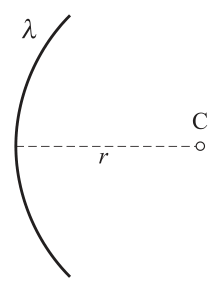 quarto di circonferenza carica elettrica
Topic: Electrostatics Metodi: Electric Potential Method, Calculus-Integration, Symmetry Argument Competenze: Mathematical Modeling, Physical Reasoning Objects: Rod Fonte: Testo (PDF) — p.3 Soluzione: Soluzioni (PDF)
Q4 A thin bar is bent to form a quarter of the circumference of the radius cm as shown in Figure 1. The bar is evenly distributed with a linear density electric charge. . • Determine, by reasoning the response, the electrostatic potential in the center of the arc of circumference, having placed at a very large (infinite) distance.
fourth electric charge circumference
Topic: Electrostatics Metodi: Electric Potential Method, Calculus-Integration, Symmetry Argument Competenze: Mathematical Modeling, Physical Reasoning Objects: Rod Fonte: Testo (PDF) — p.3 Soluzione: Soluzioni (PDF)
Q5 Per costruire le fondazioni di un ponte, una gru cala in un fiume un blocco di cemento di densità ; un contrappeso mobile fa in modo che il baricentro del sistema sia esattamente sull’asse della gru (come sarebbe senza carico e contrappeso). • Quando il blocco è completamente immerso, di quanto deve essere variata – percentualmente – la distanza del contrappeso dall’asse della gru in modo che il bilanciamento resti invariato (ovvero, che la risultante di tutte forze agenti sul sistema resti applicata sulla stessa verticale) ? Si trascurino gli effetti dovuti alla velocità dell’acqua del fiume.
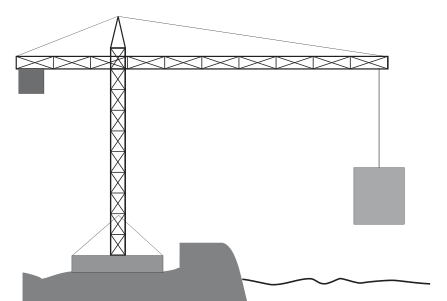 gru con blocco immerso in fiume
Topic: Fluid Mechanics, Rigid Body Statics Metodi: Hydrostatic Equilibrium, Torque & Angular Momentum Analysis, Free-Body Diagram Competenze: Physical Reasoning, Mathematical Modeling Objects: Block Fonte: Testo (PDF) — p.3 Soluzione: Soluzioni (PDF)
Q5 To build the foundations of a bridge, a A crane falls into a river a block of concrete density ; a moving counterweight makes so that the hub of the system is exactly on the crankshaft (as would be without load and counterweight). • When the block is completely submerged, how much should be varied percent distance The weight of the crane axle is so that the balance remains unchanged (i.e. the resulting of all the remaining force on the system applied on the The same vertical ? The effects of the water speed of the The river.
gru with river block
Topic: Fluid Mechanics, Rigid Body Statics Metodi: Hydrostatic Equilibrium, Torque & Angular Momentum Analysis, Free-Body Diagram Competenze: Physical Reasoning, Mathematical Modeling Objects: Block Fonte: Testo (PDF) — p.3 Soluzione: Soluzioni (PDF)
Q6 Una cabina di una ruota panoramica (evidenziata in nero in figura), in un parco divertimenti, ha una massa di 400 kg e descrive una circonferenza verticale di raggio 5.3 m. Durante il collaudo della ruota, questa viene fatta ruotare uniformemente ad una velocità di , molto maggiore di quella di esercizio. • Trovare il modulo della forza che la struttura della ruota esercita sulla cabina quando il punto in cui è agganciata è all’altezza del centro di rotazione, trattando la cabina stessa come un punto materiale.
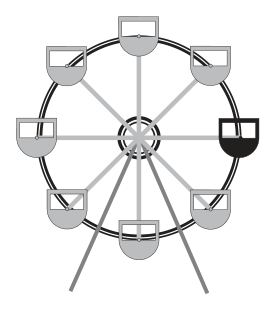 ruota panoramica cabina in rotazione
Topic: Newtonian Mechanics Metodi: Free-Body Diagram, Kinematic Equations, Vector Decomposition Competenze: Diagrammatic Reasoning, Mathematical Modeling Objects: — Fonte: Testo (PDF) — p.3 Soluzione: Soluzioni (PDF)
Q6 A cab with a panoramic wheel (highlighted in black in figure), In an amusement park, it weighs 400 kg and describes a a vertical circumference of 5,3 m radius. During the wheel test, this It is rotated evenly at a speed of , much higher I’m not going to say anything about the exercise. • Find the force pattern that the wheel structure exert on the cabin where the point at which it is attached is at the height of the centre of rotation, Treating the cabin itself as a material spot.
The vehicle shall be equipped with a ‘R’ or ‘R’ system.
Topic: Newtonian Mechanics Metodi: Free-Body Diagram, Kinematic Equations, Vector Decomposition Competenze: Diagrammatic Reasoning, Mathematical Modeling Objects: — Fonte: Testo (PDF) — p.3 Soluzione: Soluzioni (PDF)
Q7 In un cavo coassiale rettilineo molto lungo di raggio esterno cm scorre una corrente di 0.11 A verso l’alto lungo il filo interno e verso il basso lungo la guaina esterna. • Calcolare l’intensità del campo magnetico a 0.25 cm e a 0.75 cm dall’asse del cavo coassiale.
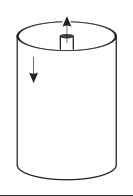 sezione trasversale cavo coassiale
Topic: Magnetism Metodi: Ampère’s Law, Symmetry Argument Competenze: Mathematical Modeling, Physical Reasoning Objects: Wire Fonte: Testo (PDF) — p.3 Soluzione: Soluzioni (PDF)
Q7 In a very long straight coastal cable of outer radius cm flow a current of 0.11 A upward along the inner wire and downward along the The outside of the house. • Calculate the magnetic field intensity at 0.25 cm and 0.75 cm from the cable axis The coastal.
The following is the list of the components of the ‘Multi-level’ module:
Topic: Magnetism Metodi: Ampère’s Law, Symmetry Argument Competenze: Mathematical Modeling, Physical Reasoning Objects: Wire Fonte: Testo (PDF) — p.3 Soluzione: Soluzioni (PDF)
Q8 In un’esperienza sull’effetto fotoelettrico una piastrina di metallo viene colpita da una luce laser di lunghezza d’onda nm, assorbendo una potenza e producendo una corrente elettrica massima . • Si calcoli il rapporto tra il numero di elettroni estratti e il numero di fotoni incidenti sulla piastrina.
Topic: Modern-Quantum Physics Metodi: Photon Energy Relation Competenze: Mathematical Modeling, Physical Reasoning Objects: Photon, Electron Fonte: Testo (PDF) — p.4 Soluzione: Soluzioni (PDF)
Q8 In an experiment on the photoelectric effect a metal plate is hit by a laser light a wavelength of nm, absorbing a power of and producing a current The maximum electrical power output is . • The ratio between the number of electrons extracted and the number of incident photons on the plate is calculated.
Topic: Modern-Quantum Physics Metodi: Photon Energy Relation Competenze: Mathematical Modeling, Physical Reasoning Objects: Photon, Electron Fonte: Testo (PDF) — p.4 Soluzione: Soluzioni (PDF)
Q9 Una pentola contiene 2 L di acqua a ed è posta su un fornello di potenza . • Supponendo che non ci siano dispersioni di calore, e trascurando la quantità di acqua che evapora tra e , dopo 20 minuti quanta acqua sarà passata allo stato di vapore?
Topic: Thermodynamics Metodi: First Law of Thermodynamics, Energy Conservation Method Competenze: Mathematical Modeling, Physical Reasoning Objects: Container Fonte: Testo (PDF) — p.4 Soluzione: Soluzioni (PDF)
Q9 A pot contains 2 L of water at and is placed on a power stove . • Assuming there is no heat dissipation, and neglecting the amount of water evaporating between e , dopo 20 minuti quanta acqua sarà passata allo stato di vapore?
Topic: Thermodynamics Metodi: First Law of Thermodynamics, Energy Conservation Method Competenze: Mathematical Modeling, Physical Reasoning Objects: Container Fonte: Testo (PDF) — p.4 Soluzione: Soluzioni (PDF)
Q10 Uno specchio flessibile, disposto verticalmente, viene sagomato seguendo un arco di ellisse; in figura lo specchio è mostrato a destra, visto dall’alto. Una sorgente puntiforme isotropa viene fissata nel punto S, in corrispondenza di uno dei fuochi dell’ellisse, mentre un osservatore si posiziona nel punto O, in corrispondenza dell’altro fuoco, alla stessa altezza della sorgente e guarda verso lo specchio. • Come viene vista dall’osservatore la sorgente nello specchio?
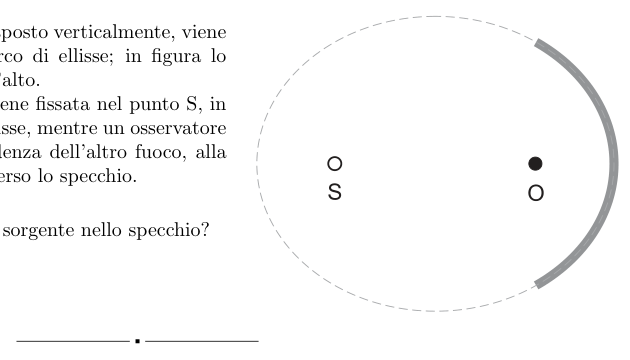 specchio ellittico visto di lato
 specchio ellittico vista dall alto OS
Topic: Geometric Optics Metodi: Ray Tracing, Physical Modeling Competenze: Physical Reasoning, Diagrammatic Reasoning Objects: Mirror Fonte: Testo (PDF) — p.4 Soluzione: Soluzioni (PDF)
Q10 A flexible mirror, arranged vertically, is shaped by an elliptical arc; mirror is shown on the right, seen from above. A point source isotropic is fixed at point S, in The following is a list of the fires in the hill station. is placed at the O point, in relation to the other fire, at the The same height as the fountain and look at the mirror. • How does the observer see the source in the mirror?
- elliptical mirror as seen from the side*
elliptical mirror as seen from the top of the OS
Topic: Geometric Optics Metodi: Ray Tracing, Physical Modeling Competenze: Physical Reasoning, Diagrammatic Reasoning Objects: Mirror Fonte: Testo (PDF) — p.4 Soluzione: Soluzioni (PDF)
P1 Ovale di Monza Punti 20 L’Autodromo di Monza era formato, fino agli anni ‘60 del secolo scorso, da due piste: il circuito stradale, tuttora utilizzato per i gran premi, e una pista ovale, ora in disuso, con due curve sopraelevate aventi pendenza che raggiunge un valore massimo pari all’80 % nella parte più esterna (si ricorda che la pendenza è il valore della tangente dell’angolo di inclinazione rispetto all’orizzontale: ). In tutto il problema si consideri una macchina che percorre la curva sopraelevata a velocità costante, mantenendosi alla stessa altezza nella parte più esterna dove il raggio di curvatura è m . Si seguano poi due ulteriori indicazioni fortemente semplificative: si trascuri ogni forza aerodinamica perpendicolare al piano stradale, dovuta ad alettoni o simili strutture, e si tralasci ogni considerazione relativa ai momenti applicati e alla eventualità di ribaltamento della macchina. Quando un’automobile affronta una curva, la necessaria accelerazione centripeta è data, di solito, dalla sola spinta laterale che l’attrito tra le gomme e l’asfalto esercita sul mezzo; le curve sopraelevate consentono di ridurre o eliminare del tutto questa necessità.
- A quale velocità costante una macchina dovrebbe percorrere la curva sopraelevata in modo che l’attrito tra gomme e asfalto non abbia componente laterale, cioè perpendicolare alla direzione del moto? A velocità diverse da questa, poiché la reazione normale al terreno determina il modulo della forza d’attrito massima, le due componenti dell’attrito – nella direzione della velocità e normale a questa – non sono indipendenti; tuttavia nelle condizioni di questo problema una buona stima della grandezza richiesta al punto successivo si ottiene anche trascurando del tutto la componente di attrito parallela alla velocità.
- Così facendo, si determini, in funzione del coefficiente di attrito statico tra le ruote e l’asfalto e degli altri dati, un’espressione per la velocità massima di percorrenza della curva senza che le ruote slittino lateralmente, e se ne calcoli il valore con un coefficiente d’attrito statico pari a 0.9.
- Si determini, in funzione del coefficiente di attrito statico tra le ruote e l’asfalto e degli altri dati, la velocità minima di percorrenza della curva senza che le ruote slittino lateralmente, e se ne calcoli il valore con un coefficiente d’attrito statico pari a 0.9. Si consideri adesso che le gomme delle auto da corsa hanno spesso valori del coefficiente di attrito con l’asfalto maggiori di 1.
- Oltre quale valore del coefficiente di attrito non ci sarebbero limiti alla velocità massima sulle sopraelevate di Monza?
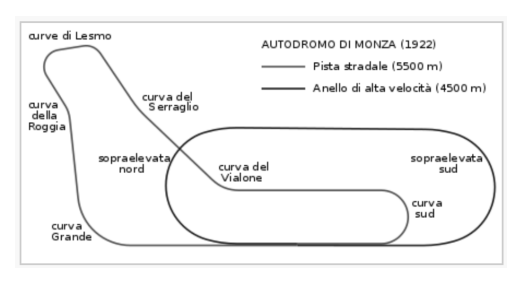 ovale di Monza circuito sopraelevato
Topic: Newtonian Mechanics Metodi: Free-Body Diagram, Vector Decomposition, Conservation Laws Competenze: Mathematical Modeling, Physical Reasoning, Diagrammatic Reasoning Objects: — Fonte: Testo (PDF) — p.7 Soluzione: Soluzioni (PDF)
P1 Oval of Monza The Commission shall adopt implementing acts in accordance with Article 21 of this Regulation. The Monza Motor Speedway was formed, until the years 60 of the last century, from two lanes: the road circuit, still used for the grand prix, and an oval track, now disused, with two curves raised with a slope of not more than 50 mm equal to 80% in the outermost part (remember that slope is the tangent value of the angle of The slope of the line shall be: . You think of yourself as a machine in the whole problem. The following is the list of the following: external where the radius of curvature is m . Two further highly simplifying indications follow: any aerodynamic force perpendicular to the road surface due to axles or similar structures is ignored and any consideration of the road surface is ignored. the time applied and the possibility of turning the machine over. When a car is facing a curve, the required centrifugal acceleration is usually given by the single The lateral thrust exerted by the friction between the tyres and the asphalt on the centre; the raised curves allow for The Commission will also be able to take the necessary measures to reduce or eliminate this need.
- At what constant speed a machine should travel the curve above it so that the friction between the Does the tyre and asphalt have a side component, i.e. perpendicular to the direction of the motorcycle? At speeds other than this, since the normal ground reaction determines the maximum force of friction, the two components of the friction in the direction of the velocity and normal to this are not independent; However, under the conditions of this problem a good estimate of the required size in the next point is The speed of the friction component is also neglected.
- In doing so, it determines, based on the static friction coefficient between the wheels and the asphalt and other data, aexpression for the maximum speed of the curve without the wheels slipping laterally, and The value of the product shall be calculated with a static friction coefficient of 0.9.
- The speed shall be determined by the static friction coefficient between the wheels and the asphalt and other data. The minimum curve path without the wheels sliding laterally, and the value is calculated with a The coefficient of static friction is 0.9. Consider now that race car tyres often have asphalt friction coefficient values greater than 1.
- In addition to what the friction coefficient value would be there would be no speed limits on the above-mentioned
- What about Monza?
Oval of Monza elevated circuit
Topic: Newtonian Mechanics Metodi: Free-Body Diagram, Vector Decomposition, Conservation Laws Competenze: Mathematical Modeling, Physical Reasoning, Diagrammatic Reasoning Objects: — Fonte: Testo (PDF) — p.7 Soluzione: Soluzioni (PDF)
P2 Reticolo Punti 20 Un reticolo viene illuminato perpendicolarmente con la luce proveniente da una sorgente gassosa. Si osservano una riga rossa ( nm) ad un angolo rispetto all’asse del reticolo ed una riga verde ( nm) ad un angolo .
- Si calcoli il rapporto tra gli ordini degli spettri a cui appartengono la riga rossa e quella verde.
- Tenendo conto del fatto che fra i due angoli indicati non si osserva alcuna radiazione, si determinino i valori di e .
- Qual è il passo del reticolo?
- Qual è il massimo ordine a cui si può osservare una riga rossa con quel reticolo?
Topic: Wave Optics Metodi: Interference & Diffraction Analysis, Superposition Principle Competenze: Mathematical Modeling, Physical Reasoning Objects: Diffraction Grating Fonte: Testo (PDF) — p.7 Soluzione: Soluzioni (PDF)
P2 Other, of a kind used for the manufacture of goods The Commission shall adopt implementing acts in accordance with Article 21 of this Regulation. A lattice is illuminated perpendicular to the light from a gaseous source. They’re watching themselves. a red line ( nm) at an angle to the lattice axis and a green line ( nm) at an angle .
- The ratio is calculated between the orders of the spectra to which the red line belongs and the green line.
- Taking into account that no radiation is observed between the two angles indicated, the values are determined di e .
- What’s the grid’s pace?
- What’s the highest order you can see a red line with that grid?
Topic: Wave Optics Metodi: Interference & Diffraction Analysis, Superposition Principle Competenze: Mathematical Modeling, Physical Reasoning Objects: Diffraction Grating Fonte: Testo (PDF) — p.7 Soluzione: Soluzioni (PDF)
P3 Un campo teorico Punti 10 Fissato un sistema di coordinate cartesiane ortogonali di origine O e versori , in una regione attorno ad O si consideri il campo elettrostatico non uniforme, le cui tre componenti dipendono dalle coordinate del punto P in questo modo: con , , m ; in altri termini, le componenti del campo e.s. sono ; ; .
- Posto e sapendo che la d.d.p. , determinare il valore del parametro .
- Si calcoli il modulo di nel punto . Si consideri un volume cubico di centro O, con le facce perpendicolari agli assi cartesiani e tale che A sia un punto della sua superficie.
- Determinare la quantità di carica elettrica presente entro tale cubo.
- Qual è la densità di carica nel punto O?
 circuito batterie condensatori C1 C2
Topic: Electrostatics Metodi: Electric Potential Method, Calculus-Integration, Gauss’s Law Competenze: Mathematical Modeling, Physical Reasoning Objects: — Fonte: Testo (PDF) — p.8 Soluzione: Soluzioni (PDF)
P3 A theoretical field The Commission shall adopt implementing acts in accordance with Article 10 of this Regulation. Fixed a system of orthogonal Cartesian coordinates of origin O and lines , in a region around Or consider the non-uniform electrostatic field , the three components of which depend on the coordinates of point P as follows: with , , m ; In other words, the components of the field e.s. sono ; ; .
- Posto e sapendo che la d.d.p. , determine the value of the parameter .
- The form is calculated in . Consider a cubic volume of center O, with faces perpendicular to the Cartesian axis and such that A is a point on its surface.
- Determine the amount of electrical charge present within that cube.
- What is the charge density at point O?
circuito batterie condensatori C1 C2
Topic: Electrostatics Metodi: Electric Potential Method, Calculus-Integration, Gauss’s Law Competenze: Mathematical Modeling, Physical Reasoning Objects: — Fonte: Testo (PDF) — p.8 Soluzione: Soluzioni (PDF)
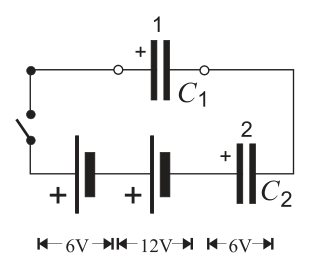
P4 Se la batteria è piccola Punti 10 Pierino ha un condensatore di capacità (1 in figura) che deve essere caricato alla d.d.p. , ma ha a disposizione solo 2 batterie, una con f.e.m. , l’altra con f.e.m. , insieme a numerosi altri condensatori di varie capacità, fino ad un massimo di 10 volte . Le batterie possono essere considerate come generatori ideali di f.e.m. Dopo averci pensato un po’, decide di prendere un altro condensatore di capacità qualunque , (2 in figura) caricarlo con la prima batteria alla d.d.p. , e con la serie costituita dalle due batterie e dal condensatore 2 appena caricato, caricare il primo condensatore, come mostrato in figura, dato che . Purtroppo Pierino si accorge subito che il suo metodo non funziona.
- Dimostrare, infatti, che con questo circuito, ad equilibrio raggiunto, la d.d.p. ai capi del condensatore 1 è minore di 24 V . Pierino pensa allora di utilizzare entrambe le batterie per caricare inizialmente il condensatore 2.
- Quale deve essere la capacità del condensatore 2 per ottenere lo scopo?
- Supposto di aver caricato il condensatore 2 in questo modo, qual è l’energia dissipata per effetto Joule durante la carica del condensatore 1?
Topic: Circuits, Conservation of Energy Metodi: Kirchhoff’s Laws, Energy Conservation Method, Conservation Laws Competenze: Mathematical Modeling, Physical Reasoning, Diagrammatic Reasoning Objects: Capacitor, Battery Fonte: Testo (PDF) — p.8 Soluzione: Soluzioni (PDF)
P4 If the battery is small The Commission shall adopt implementing acts in accordance with Article 10 of this Regulation. Pierino has a capacitor (1 in Figure) which must be be loaded to the D.D.P. , ma ha a disposizione solo 2 batterie, One with f.e.m. , the other with f.e.m. , together with numerous Other capacitors of various capacities, up to a maximum of 10 times . Le batteries can be considered as ideal f.e.m. generators. After thinking about it for a while, he decided to get another capacitor. of any capacity (2 in figure) to charge it with the first battery at the d.d.p. , and with the series consisting of two batteries and the capacitor 2 just loaded, load the first capacitor, as shown in Figure 2, dato che . Unfortunately, Pierino soon realizes that his method is not working.
- The resulting effect is that the current of the electrical circuit is not enough to produce the electrical energy. the capacitor heads 1 are less than 24 V . Pierino then thinks he’s going to use both batteries to charge capacitor 2 initially.
- What must be the capacity of capacitor 2 to achieve the purpose?
- Suppose you charge capacitor 2 this way, what is the energy dissipated by Joule effect During the charge of capacitor 1?
Topic: Circuits, Conservation of Energy Metodi: Kirchhoff’s Laws, Energy Conservation Method, Conservation Laws Competenze: Mathematical Modeling, Physical Reasoning, Diagrammatic Reasoning Objects: Capacitor, Battery Fonte: Testo (PDF) — p.8 Soluzione: Soluzioni (PDF)