Q1 Un corpo celeste sferico ha densità uniforme e ruota attorno ad un suo asse in modo uniforme. Un sassolino è posto in un punto dell’equatore. • Si esprima, in funzione di , il periodo minimo di rotazione che il corpo può avere affinche ́ il sassolino possa rimanere appoggiato.
Topic: Gravitation, Rotational Dynamics Metodi: Newton’s Law of Gravitation, Free-Body Diagram, Vector Decomposition Competenze: Mathematical Modeling, Physical Reasoning Objects: Planet Fonte: Testo (PDF) — p.2 Soluzione: Soluzioni (PDF)
Q1 A spherical celestial body has a uniform density and rotates around its axis uniformly. Un The rock is placed at a point on the equator. • Si esprima, in funzione di , il periodo minimo di rotazione che il corpo può avere affinche ́ il sassolino possa Staying on your back.
Topic: Gravitation, Rotational Dynamics Metodi: Newton’s Law of Gravitation, Free-Body Diagram, Vector Decomposition Competenze: Mathematical Modeling, Physical Reasoning Objects: Planet Fonte: Testo (PDF) — p.2 Soluzione: Soluzioni (PDF)
Q2 Un gas perfetto è sottoposto a un ciclo reversibile di Carnot () tra le temperature superiore e inferiore e () nel piano , come mostrato in figura. • Rappresentare lo stesso ciclo in un piano , dove è l’entropia e dimostrare che l’area racchiusa nel grafico che si ottiene è ancora il lavoro netto fatto nel ciclo.
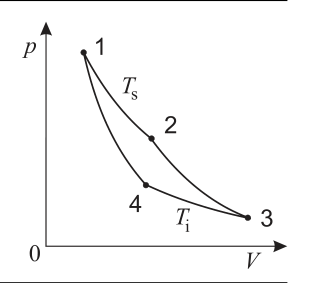 ciclo di Carnot piano p-V
Topic: Thermodynamics Metodi: Thermodynamic Cycle Analysis, First Law of Thermodynamics, Calculus-Integration Competenze: Mathematical Modeling, Physical Reasoning Objects: Gas Fonte: Testo (PDF) — p.2 Soluzione: Soluzioni (PDF)
Q2 A perfect gas is subject to a reversible Carnot cycle () tra le temperature superiore e inferiore e () in the plane, as shown in Figure 1. • Representing the same cycle in a plane , where is entropy and To demonstrate that the area enclosed in the graph that you get is still work The net made in the cycle.
The following table shows the results of the calculation of the calculation of the total cost of the vehicle:
Topic: Thermodynamics Metodi: Thermodynamic Cycle Analysis, First Law of Thermodynamics, Calculus-Integration Competenze: Mathematical Modeling, Physical Reasoning Objects: Gas Fonte: Testo (PDF) — p.2 Soluzione: Soluzioni (PDF)
Q3 Si supponga di voler misurare la distanza focale di una lente convergente. Per fare questo si fissano su un banco ottico la lente, una sorgente luminosa e uno schermo in modo che su questo l’immagine della sorgente sia a fuoco; si misura la distanza tra sorgente e schermo. Detta la posizione della lente, si osserva che, spostando solo la lente in una diversa posizione l’immagine della sorgente è ancora a fuoco sullo schermo; sia la distanza misurata tra le posizioni e . • Si esprima la distanza focale della lente in termini di e .
Topic: Geometric Optics Metodi: Thin Lens & Mirror Equation, Ray Tracing Competenze: Mathematical Modeling, Diagrammatic Reasoning Objects: Lens, Screen Fonte: Testo (PDF) — p.3 Soluzione: Soluzioni (PDF)
Q3 Suppose you want to measure the focal length of a convergent lens. To do this, they fix the lens on an optical bench, a light source and a screen in the so that the image of the source is on fire; the distance between the source and the screen is measured. Detta la posizione della lente, si osserva che, spostando solo la lente in una diversa posizione l’immagine The source is still on the screen; either the distance measured between the positions and . • The focal length of the lens is expressed in terms of and .
Topic: Geometric Optics Metodi: Thin Lens & Mirror Equation, Ray Tracing Competenze: Mathematical Modeling, Diagrammatic Reasoning Objects: Lens, Screen Fonte: Testo (PDF) — p.3 Soluzione: Soluzioni (PDF)
Q4 L’insegna dell’Osteria della Luna piena è realizzata con un tondino di ferro che forma un triangolo rettangolo di lati pari a 60, 80 e 100 cm e, all’interno, una circonferenza che rappresenta la Luna, tangente ai tre lati. Il diametro del tondino di ferro è trascurabile rispetto alle dimensioni dell’insegna. • In quale punto dell’ipotenusa deve essere sospesa l’insegna se si vuole che il cateto maggiore risulti orizzontale? Suggerimenti: Il raggio del cerchio inscritto in un triangolo è dato dal rapporto tra il doppio dell’area del triangolo e il suo perimetro. È utile fissare un sistema di assi cartesiani in modo che i cateti stiano su di essi e l’origine nel vertice comune.
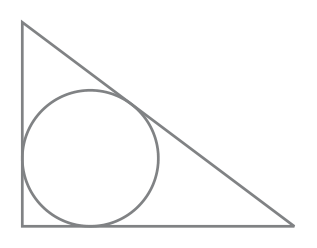 triangolo rettangolo con cerchio inscritto
Topic: Rigid Body Statics Metodi: Free-Body Diagram, Torque & Angular Momentum Analysis, Physical Modeling Competenze: Diagrammatic Reasoning, Mathematical Modeling Objects: Rod Fonte: Testo (PDF) — p.3 Soluzione: Soluzioni (PDF)
Q4 The sign of the Full Moon sign is made with an iron scissor which forms a rectangular triangle with sides equal to 60, 80 and 100 cm and inside a circumference that represents the Moon, tangent on three sides. The diameter of the iron scissor is negligible The size of the sign. • Where on the hypotenuse the sign must be suspended if desired That the major catheter is horizontal? Suggestions for the following: The radius of the circle inscribed in a triangle is given by the ratio between the the area of the triangle and its perimeter. It is useful to fix a system of Cartesian axes so that the catheters are The Commission has already adopted a number of proposals for the implementation of the Community’s common agricultural policy.
triangle rectangle with inscribed circle
Topic: Rigid Body Statics Metodi: Free-Body Diagram, Torque & Angular Momentum Analysis, Physical Modeling Competenze: Diagrammatic Reasoning, Mathematical Modeling Objects: Rod Fonte: Testo (PDF) — p.3 Soluzione: Soluzioni (PDF)
Q5 Una massa può scorrere senza attrito su una guida rettilinea in un piano orizzontale; la massa viene agganciata ad una molla avente costante elastica e lunghezza a riposo trascurabile. La molla è fissata a un punto del piano a distanza dalla guida, come in figura, vista dall’alto. • Determinare il periodo delle oscillazioni della massa attorno alla sua posizione di equilibrio.
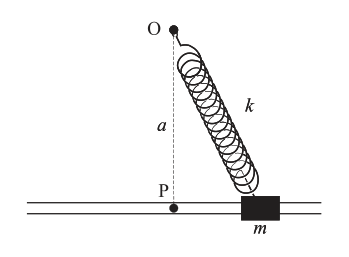 massa su guida con molla fissata
Topic: Oscillations & Waves, Newtonian Mechanics Metodi: Hooke’s Law, Simple Harmonic Motion Analysis, Vector Decomposition Competenze: Mathematical Modeling, Diagrammatic Reasoning Objects: Block, Spring Fonte: Testo (PDF) — p.3 Soluzione: Soluzioni (PDF)
Q5 A mass can flow smoothly on a straight guide In a horizontal plane, the mass is attached to a spring with a constant elasticity and a negligible resting length. La The spring shall be fixed at a point on the plane from the driver, as in Figure, seen from above. • Determine the period of oscillations of mass around its The position of balance.
mass on a fixed spring drive
Topic: Oscillations & Waves, Newtonian Mechanics Metodi: Hooke’s Law, Simple Harmonic Motion Analysis, Vector Decomposition Competenze: Mathematical Modeling, Diagrammatic Reasoning Objects: Block, Spring Fonte: Testo (PDF) — p.3 Soluzione: Soluzioni (PDF)
Q6 Le osservazioni delle macchie solari mostrano che il Sole ruota attorno a un asse perpendicolare alla linea di vista. La rotazione non è uniforme: il periodo aumenta spostandosi verso i poli. Per una misura accurata del periodo minimo, si osserva la riga dell’idrogeno nello spettro della luce emessa ai due estremi del diametro equatoriale. A causa della rotazione, le misure di lunghezza d’onda della stessa riga , nei due spettri, differiscono di nm con l’incertezza dell’1 %. • Trovare il periodo di rotazione della fascia equatoriale del Sole attorno al proprio asse. Si considerino trascurabili gli effetti dovuti al moto dell’osservatore. I dati necessari si possono trovare nella tabella delle costanti.
Topic: Rotational Dynamics, Astrophysics Metodi: Wave Equation, Approximation & Series Expansion, Kinematic Equations Competenze: Mathematical Modeling, Physical Reasoning, Estimation & Approximation Objects: Star Fonte: Testo (PDF) — p.3 Soluzione: Soluzioni (PDF)
Q6 Observations of sunspots show that the Sun rotates around an axis perpendicular to the Sun’s axis. The line of sight. The rotation is not uniform: the period increases as it moves towards the poles. For one . The minimum period is measured accurately, the line of hydrogen is observed in the light spectrum emitted by the two extremes of the equatorial diameter. Because of rotation, the wavelength measurements of the same line in the two spectra differ from nm with an uncertainty of 1%. • Find the period of rotation of the equatorial band of the Sun around its axis. The effects of the motion of the observer shall be considered negligible. The necessary data can be found in the following table: the table of constants.
Topic: Rotational Dynamics, Astrophysics Metodi: Wave Equation, Approximation & Series Expansion, Kinematic Equations Competenze: Mathematical Modeling, Physical Reasoning, Estimation & Approximation Objects: Star Fonte: Testo (PDF) — p.3 Soluzione: Soluzioni (PDF)
Q7 Un solenoide formato da 240 spire, affiancate una all’altra, è lungo 20 cm ed è percorso da una corrente di 2.2 A; in un caso reale come questo anche la superficie laterale su cui è avvolto il solenoide è attraversata da linee di campo. La circuitazione del campo magnetico lungo una particolare linea di campo vale T m. • A che distanza dalle estremità la linea di campo considerata interseca la superficie laterale del solenoide?
Topic: Magnetism Metodi: Ampère’s Law, Physical Modeling Competenze: Mathematical Modeling, Physical Reasoning Objects: Solenoid Fonte: Testo (PDF) — p.3 Soluzione: Soluzioni (PDF)
Q7 A solenoid formed by 240 spires, side by side, is 20 cm long and is traversed by a 2.2 A current; in a real case like this the lateral surface on which the solenoid is wrapped It’s crossed by field lines. The magnetic field circuit along a particular field line is T m. • At what distance from the ends does the field line considered intersect the lateral surface of the solenoid?
Topic: Magnetism Metodi: Ampère’s Law, Physical Modeling Competenze: Mathematical Modeling, Physical Reasoning Objects: Solenoid Fonte: Testo (PDF) — p.3 Soluzione: Soluzioni (PDF)
Q8 Nel circuito in figura, alimentato da una batteria di f.e.m. e resistenza interna , viene dissipata una potenza quando l’interruttore è chiuso. • Calcolare la variazione relativa della potenza dissipata nel circuito quando l’interruttore è aperto, in funzione del rapporto .
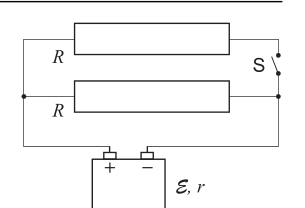 circuito con batteria R r interruttore S
Topic: Circuits Metodi: Kirchhoff’s Laws, Equivalent Circuit Reduction Competenze: Mathematical Modeling, Physical Reasoning Objects: Battery, Resistor, Switch Fonte: Testo (PDF) — p.4 Soluzione: Soluzioni (PDF)
Q8 In the circuit shown, powered by an f.e.m. battery and internal resistance , a power of is dissipated when The switch is closed. • Calculate the relative change in the power dissipated in the circuit when The switch is open, according to the ratio.
- battery circuit R r switch S*
Topic: Circuits Metodi: Kirchhoff’s Laws, Equivalent Circuit Reduction Competenze: Mathematical Modeling, Physical Reasoning Objects: Battery, Resistor, Switch Fonte: Testo (PDF) — p.4 Soluzione: Soluzioni (PDF)
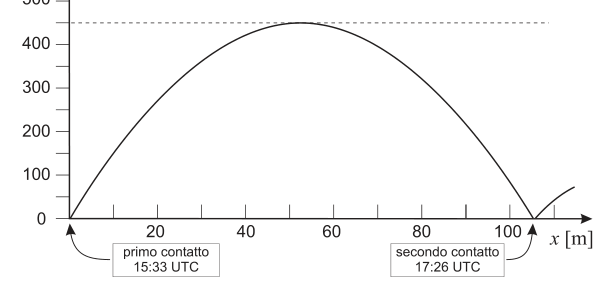
Q9 Il 12 novembre 2014 il lander Philae, trasportato dalla sonda spaziale Rosetta, atterrò sulla cometa 67P/Churyumov-Gerasimenko. Il lander rimbalzò due volte stabilizzandosi solo al terzo contatto con la superficie. In figura è mostrata la traiettoria del primo rimbalzo e sono indicati i tempi dei primi due contatti con la cometa. • Stimare l’intensità media dell’accelerazione di gravità della cometa 67P/Churyumov-Gerasimenko, con un modello (estremamente semplificato) di gravità uniforme.
 traiettoria rimbalzo Philae x-y con contatti
Topic: Gravitation, Newtonian Mechanics Metodi: Kinematic Equations, Physical Modeling, Approximation & Series Expansion Competenze: Estimation & Approximation, Mathematical Modeling, Physical Reasoning Objects: Satellite, Planet Fonte: Testo (PDF) — p.4 Soluzione: Soluzioni (PDF)
Q9 On 12 November 2014 the lander was Philae, carried by the Rosetta spacecraft, will land on the comet. The Commission has not yet decided whether to proceed with the investigation. The lander bounced twice, only stabilizing at third contact with the surface. The trajectory is shown in Figure The first bounce and the times are indicated The first two contacts with the comet. • Estimate the average gravitational acceleration intensity of comet 67P/Churyumov-Gerasimenko by a model (extremely simplified) of gravity uniforms.
*bounce trajectory Philae x-y with contacts *
Topic: Gravitation, Newtonian Mechanics Metodi: Kinematic Equations, Physical Modeling, Approximation & Series Expansion Competenze: Estimation & Approximation, Mathematical Modeling, Physical Reasoning Objects: Satellite, Planet Fonte: Testo (PDF) — p.4 Soluzione: Soluzioni (PDF)
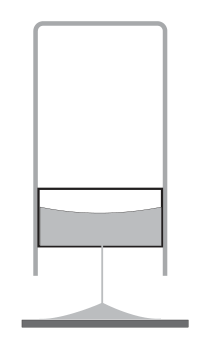
Q10 Una mole di gas perfetto monoatomico è contenuta in un cilindro isolante di volume chiuso nella parte inferiore da un pistone. Il pistone è di materiale isolante, cavo e riempito di sabbia con una massa complessiva . Siano e la temperatura e la pressione del gas dove è la pressione atmosferica esterna al cilindro. Inizialmente il sistema è all’equilibrio. A un certo istante, e per un certo tempo, la sabbia contenuta nel pistone comincia a cadere molto lentamente (v. figura), da un forellino presente nel pistone, finche ́ la massa complessiva del pistone si è ridotta ad un terzo di quella iniziale. Il pistone si muove con attrito trascurabile e si può quindi ritenere che il gas subisca una trasformazione reversibile. • Calcolare la pressione e il volume finali del gas in funzione di e . Materiale elaborato dal Gruppo NOTA BENE: È possibile utilizzare, riprodurre, distribuire, comunicare al pubblico questo materiale alle due seguenti condizioni: citare la fonte; non usare il materiale, nemmeno parzialmente, per fini commerciali.
Tavola di Costanti Fisiche Costanti Fisiche Primarie [ Valori esatti per definizione – (26.CGPM/16.11.2018) ] COSTANTE SIMB. VALORE UNITÀ Velocità della luce nel vuoto Carica elementare C Costante di Planck J s Costante di Boltzmann Costante di Avogadro Altre Costanti Fisiche † Massa dell’elettrone kg Massa del protone kg Massa del neutrone kg Permeabilità magnetica del vuoto Costante dielettrica del vuoto: Costante elettrostatica: Costante universale dei gas: 8.3145 Costante di Faraday: Costante di Stefan–Boltzmann Costante di gravitazione universale Pressione atmosferica standard Pa Temperatura standard () 273.15 K Volume molare di un gas perfetto in condizioni standard () Unità di massa atomica kg Tavola di dati che possono essere necessari † Accelerazione di gravità (val. convenzionale) 9.80665 Densità dell’acqua (a )⋆ Calore specifico dell’acqua (a )⋆ Densità del ghiaccio (a )⋆ Calore di fusione del ghiaccio Calore di vaporizzazione dell’acqua (a )⋆ Raggio equatoriale del Sole m Lunghezza d’onda della riga 486.133 nm † Valori arrotondati, da considerare esatti nella soluzione delle prove delle Olimpiadi di Fisica. ⋆ Salvo diversa indicazione esplicita, questi dati si potranno utilizzare anche ad altre temperature senza errori importanti. TEMPO: 1 ora e 40 minuti. • Esponi con chiarezza il procedimento risolutivo e tieni conto che nella valutazione si prenderanno in considerazione anche le soluzioni parziali. • Riporta il tuo nome su TUTTI i fogli che consegnerai, nell’angolo in alto a SINISTRA. • Utilizza un foglio diverso per ogni problema che hai risolto, numerandone le pagine, nell’angolo in alto a DESTRA. • Indica il numero del problema in testa alla relativa soluzione, secondo questo esempio: Problema 2 Soluzione: … • Indica chiaramente la domanda (1., 2., … ) cui si riferisce la parte di soluzione che stai scrivendo. NOTA importante sui DATI NUMERICI: I dati numerici forniti nei singoli problemi, qualunque sia il numero di cifre con cui vengono scritti, si devono considerare noti con un’incertezza dello 0.1 %, salvo esplicita indicazione contraria. Le costanti fornite nella tabella generale si possono invece considerare note con incertezza trascurabile. Di conseguenza si scrivano i risultati numerici, quando richiesti, con un numero di cifre appropriato all’incertezza del risultato stesso. APPROSSIMAZIONI UTILI: Per si possono utilizzare queste approssimazioni: ; sen ; tg ; ; ; . Attenzione: se si tratta di un angolo è espresso in radianti.
 cilindro pistone con sabbia che cade
Topic: Thermodynamics Metodi: Ideal Gas Law, First Law of Thermodynamics, Hydrostatic Equilibrium Competenze: Mathematical Modeling, Physical Reasoning Objects: Gas, Cylinder, Piston Fonte: Testo (PDF) — p.4 Soluzione: Soluzioni (PDF)
Q10 A perfect mole of monoatomic gas is contained in an insulating cylinder a volume closed at the bottom by a piston. The piston is of insulating material, cable and sand filler with an overall mass . They are and the temperature and pressure of the gas where is the external atmospheric pressure The cylinder. Initially the system is in equilibrium. At a certain moment, and for a certain time, The sand contained in the piston begins to fall very slowly (v. Figure 1), by a the piston bore is present until the piston’s total mass has been reduced to one third of the initial. The piston moves with negligible friction and can therefore be considered The gas is reversible. • Calculate the final gas pressure and volume according to and . Material prepared by the Group BENEFIT: You can use, reproduce, distribute, communicate this material to the public under the following two conditions: cite the source; do not use the material, even partially; for commercial purposes.
Table of physical constants Primary physical constants The following table shows the total value of the assets of the Union industry as defined in Article 107 (1) of the Treaty: The following is a list of the I’m going to be a little late. The value Unity Speed of light in vacuum Basic load C Planck constant J s The Boltzmann constant is the constant The Avogadro constant is the Other physical constants † Mass of the electron kg Mass of proton kg Mass of the neutron kg The magnetic permeability of the vacuum Costante dielettrica del vuoto: Costante elettrostatica: The gas constant is the universal gas constant: 8.3145 Costante di Faraday: The following is the list of the values of the values of the values of the values of the values of the values of the values of the values of the values of the values of the values of the values of the values of the values of the values of the values of the values of the values of the values of the values of the values of the values of the values of the values of the values of the values of the values of the values of the values of the values of the values of the values of the values of the values of the values of the values of the values of the values of the values of the values of the values of the values of the values of the values of the values of the values of the values of the values of the values of the values of the values of the values of the values of the values of the values of the values of the values of the values of the values of the values of the values of the values of the values of the values of the values of the values of the values of the values of the values of the values of the values of the values of the values of the values of the values of the values of the values of the values of the values of the values of the values of the values of the values of the values of the values of the values of the values of the values of the values of the values of the values of the values of the values of the values of the values of the values of the values of the values of the values of the values of the values of the values of the values of the values of the values of the values of the values of the values of the values of the values of the values of the values of the values of the values of the values of the values of the values of the values of the values of the values of the values of the values of the values of the values of the first The universal gravitational constant is the Standard atmospheric pressure Pa Standard temperature () 273.15 K Molar volume of a perfect gas in standard conditions () Unit of atomic mass kg Table of data that may be needed † The acceleration of gravity (value) is the acceleration of the acceleration of gravity. (Conventional) 9.80665 Density of water (in ) The specific temperature of the water (at ) The ice density (in ) Heat of melting ice Heat of evaporation of water (at ) Equatorial rays of the Sun m Line wavelength 486.133 nm † Round values, to be considered accurate in the solution of the Physics Olympics tests. ⋆ Unless otherwise explicitly stated, these data can be used at other temperatures without significant errors. Time: 1 hour and 40 minutes. • Clearly explain the resolution procedure and note that partial solutions will also be taken into account in the evaluation. • Put your name on ALL the sheets you deliver in the top corner of SINISTRA. • Use a different sheet for each problem you have solved, numbering the pages in the top-to-bottom corner Right. • Indicate the number of problems before the solution, using this example: Problem two Solution: . . • Clearly indicate the question (1., 2., … ) which refers to the part of the solution you are writing. Important note on the numerical data: The numerical data provided in the individual problems, whatever the number of digits they are written with, must be considered known with uncertainty. of 0,1% unless otherwise explicitly stated. The constants in the general table can be considered as notations with negligible uncertainty. The results are therefore written down. The number of digits is the number of digits that is appropriate to the uncertainty of the result. Useful estimates: For the following approximations may be used: ; sen ; tg ; ; ; . Note: if it is an angle it is expressed in radiants.
*piston cylinder with sand falling *
Topic: Thermodynamics Metodi: Ideal Gas Law, First Law of Thermodynamics, Hydrostatic Equilibrium Competenze: Mathematical Modeling, Physical Reasoning Objects: Gas, Cylinder, Piston Fonte: Testo (PDF) — p.4 Soluzione: Soluzioni (PDF)
P1 Due piani carichi Punti 20 Su due piani paralleli molto estesi, A e B, posti a distanza , è distribuita, in modo uniforme, una carica negativa con densità superficiale e , rispettivamente. Si fissa un sistema di riferimento con origine nel piano A e asse perpendicolare ad esso e diretto verso il piano B, come in figura. Nel seguito si consideri la regione di spazio in un intorno dell’origine O, lontana dai bordi dei piani.
- Assumendo che il potenziale elettrostatico sia nullo nel punto , determinarne l’espressione; tracciare il grafico della funzione , indicando sugli assi i valori principali. Suggerimento: ricordare che il potenziale è una funzione continua della posizione. Una particella di massa e carica viene posta nel punto e lasciata andare da ferma; si supponga che i piani possano essere attraversati dalla particella senza che le distribuzioni di cariche siano modificate.
- Indicare in quale punto la particella si ferma nuovamente.
- Dire in quale punto la particella raggiunge la massima velocità e quanto vale tale velocità. Si supponga ora che i due piani siano di materiale conduttore e che vengano collegati con un filo di resistenza .
- Quanto vale la corrente che scorre inizialmente nel filo?
- Quanto vale la densità di carica nei due piani ad equilibrio raggiunto? ———————————
Topic: Electrostatics, Conservation of Energy Metodi: Gauss’s Law, Electric Potential Method, Energy Conservation Method Competenze: Mathematical Modeling, Physical Reasoning, Diagrammatic Reasoning Objects: Point Charge, Wire Fonte: Testo (PDF) — p.7 Soluzione: Soluzioni (PDF)
P1 Two floors loaded The Commission shall adopt implementing acts in accordance with Article 21 of this Regulation. On two very long parallel planes, A and B, placed at a distance , it is distributed, so that uniform, a negative charge with a surface density of and , respectively. Si establishes a reference system originating in plane A and the axis perpendicular to It’s going to be directed to Plan B, as shown in Figure 1. The following is a list of regions of space in a circle of origin O, away from the edges of the planes.
- Assuming that the electrostatic potential is zero in , determine the expression of the function; plot the graph of the function , indicating The main values on the axes. Tip: Remember that potential is a continuous function of position. A particle of mass and charge is placed in the and left The first step is to go from the ground up. Suppose the planes can be crossed by the particle. without any change in the distribution of loads.
- Indicate the point at which the particle stops again.
- To say at what point the particle reaches its maximum velocity and what that velocity is worth. Assume that the two layers are of conductive material and are connected by a resistance wire .
- What is the current that initially flows in the wire?
- What is the load density in the two planes of equilibrium reached? ———————————
Topic: Electrostatics, Conservation of Energy Metodi: Gauss’s Law, Electric Potential Method, Energy Conservation Method Competenze: Mathematical Modeling, Physical Reasoning, Diagrammatic Reasoning Objects: Point Charge, Wire Fonte: Testo (PDF) — p.7 Soluzione: Soluzioni (PDF)
P2 Piano inclinato scabro Punti 20 Un corpo di massa viene lanciato in salita su di un piano inclinato scabro, con velocità iniziale ; dopo aver percorso un tratto di lunghezza il corpo si ferma, inizia a scendere e passa per il punto di partenza a velocità . Con questi dati si vogliono determinare il coefficiente di attrito dinamico , l’inclinazione del piano rispetto all’orizzontale e fornire una stima del coefficiente di attrito statico . Esprimere, in funzione dei dati del problema:
- Il lavoro fatto dalla forza d’attrito dinamico tra l’istante iniziale e quello finale.
- L’altezza raggiunta dal corpo rispetto al punto di partenza.
- L’angolo e il coefficiente di attrito dinamico .
- Gli estremi dell’intervallo in cui è compreso il coefficiente di attrito statico . ———————————
Topic: Newtonian Mechanics, Conservation of Energy Metodi: Free-Body Diagram, Energy Conservation Method, Kinematic Equations Competenze: Mathematical Modeling, Physical Reasoning, Diagrammatic Reasoning Objects: Block, Inclined Plane Fonte: Testo (PDF) — p.7 Soluzione: Soluzioni (PDF)
P2 The following is the list of the following: The Commission shall adopt implementing acts in accordance with Article 21 of this Regulation. A mass body is launched upwards on a sloping plane, with initial speed ; after After a length of the body stops, starts to descend and passes through the starting point to The speed . The data are used to determine the dynamic friction coefficient , the slope of the plane of respect the horizontal and provide an estimate of the static friction coefficient . Explain, depending on the data of the problem:
- The work done by the dynamic friction force between the initial and final instant.
- The body height from the starting point.
- The angle and the dynamic friction coefficient .
- The extremes of the range in which the static friction coefficient is included. ———————————
Topic: Newtonian Mechanics, Conservation of Energy Metodi: Free-Body Diagram, Energy Conservation Method, Kinematic Equations Competenze: Mathematical Modeling, Physical Reasoning, Diagrammatic Reasoning Objects: Block, Inclined Plane Fonte: Testo (PDF) — p.7 Soluzione: Soluzioni (PDF)
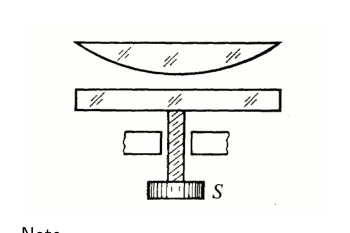
P3 Anelli di Newton Punti 20 Una lente piano convessa di vetro di indice di rifrazione è fissata con l’asse verticale e la convessità verso il basso. Al di sotto di essa c’è un piano di vetro orizzontale che può essere spostato verticalmente mediante una vite micrometrica di passo 0.100 mm (vedi figura). Il tutto è illuminato dall’alto, in direzione verticale, con una lampada spettrale al sodio (lunghezza d’onda di emissione: 589 nm), e si formano anelli di Newton a causa dell’interferenza tra la luce riflessa dalla superficie curva della lente e quella riflessa dal piano di vetro. Note.
- Per questione di chiarezza, il raggio di curvatura della lente mostrata in figura è molto minore di quello reale per cui l’intercapedine tra lente e vetrino piano risulta molto esagerata.
- I raggi di luce da considerare sono quelli parassiali ossia prossimi e circa paralleli all’asse della lente. Suggerimento: tenere presente le approssimazioni riportate nel riquadro della pagina 1 di 3. Inizialmente la lente e il piano di vetro sono a contatto, e si osserva che la 5ª frangia chiara ha il raggio mm.
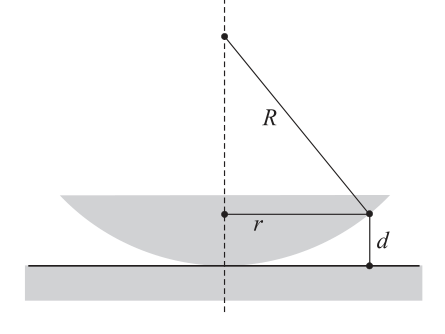
- Dopo aver dimostrato che tra le grandezze indicate in figura vale la relazione , si determini il raggio di curvatura della lente.
- Si determini la distanza focale della lente piano–convessa utilizzata, trattandola come una lente sottile.
- Si calcoli il raggio della 3ª frangia chiara. Successivamente, mediante la vite micrometrica, si allontana il piano di vetro dalla lente.
- Si dica come cambia il sistema di anelli specificando se il raggio di una data frangia aumenta o diminuisce.
- Scelto un punto a una distanza dal centro pari al raggio della terza frangia chiara, quante frange chiare lo attraversano mentre la vite fa un giro completo? Materiale elaborato dal Gruppo NOTA BENE: È possibile utilizzare, riprodurre, distribuire, comunicare al pubblico questo materiale alle due seguenti condizioni: citare la fonte; non usare il materiale, nemmeno parzialmente, per fini commerciali.
 apparato anelli di Newton lente-piatto
 schema geometrico anelli di Newton R r d
Topic: Wave Optics, Geometric Optics Metodi: Interference & Diffraction Analysis, Thin Lens & Mirror Equation, Small-Angle Approximation Competenze: Mathematical Modeling, Physical Reasoning, Diagrammatic Reasoning Objects: Lens Fonte: Testo (PDF) — p.8 Soluzione: Soluzioni (PDF)
P3 The Newton rings The Commission shall adopt implementing acts in accordance with Article 21 of this Regulation. A flat convex lens of glass with a refractive index is fixed with vertical axis and downward convexity. Under it There is a horizontal glass plane that can be moved vertically by means of a micrometer screw of 0,100 mm (see figure). The whole thing It is illuminated from above, in a vertical direction, by a spectral lamp Sodium (emission wavelength: 589 nm), and rings are formed Newton’s because of interference between the light reflected from the surface The curve of the lens and the one reflected from the glass plane. Notes from the book.
- For clarity’s sake, the lens’s curvature radius shown in the figure is much smaller than the actual The inter-head gap between the lens and the flat glass is therefore very much exaggerated.
- The light rays to be considered are those that are near or parallel to the lens axis. Suggestion: keep in mind the approximations in the box on page 1 of 3. Initially the lens and the glass plane are in contact, and you notice that the fifth clear border has the radius mm.
- After proving that the ratio is the value of the quantities shown in the figure, the radius of curvatura della lente.
- Determine the focal length of the plane lens It’s used, treated like a thin lens.
- Calculate the radius of the third clear fringe. Then, by micrometer screw, it moves away The glass plane from the lens.
- Tell us how you change the ring system by specifying whether the The radius of a given fringe increases or decreases.
- Pick a point at a distance from the center equal to the radius Of the third clear fringe, how many clear fringes cross it as the vines make a full spin? Material prepared by the Group BENEFIT: You can use, reproduce, distribute, communicate this material to the public under the following two conditions: cite the source; do not use the material, even partially; for commercial purposes.
- slow-flat Newton ring device*
schema geometrico anelli di Newton R r d
Topic: Wave Optics, Geometric Optics Metodi: Interference & Diffraction Analysis, Thin Lens & Mirror Equation, Small-Angle Approximation Competenze: Mathematical Modeling, Physical Reasoning, Diagrammatic Reasoning Objects: Lens Fonte: Testo (PDF) — p.8 Soluzione: Soluzioni (PDF)