P1 Scorrere, scorrere… Punti 20 Un blocco di massa e dimensioni trascurabili è appoggiato sul bordo destro di un altro blocco di massa , che può scorrere su un piano orizzontale con attrito trascurabile. Il coefficiente di attrito statico tra i due blocchi è = 0.30, mentre quello di attrito dinamico è = 0.21. Inizialmente entrambi i blocchi sono fermi. A partire dall’istante , sul blocco inferiore è applicata una forza diretta parallelamente al piano, come in figura, di intensità pari a 15 N .
- Mostrare che in queste condizioni il blocco superiore scorre su quello inferiore. Il blocco inferiore ha lunghezza .
- Determinare le accelerazioni dei due blocchi (nel sistema di riferimento del laboratorio) e il tempo che il blocco superiore impiega a raggiungere il bordo sinistro del blocco inferiore.
- Determinare verso e modulo delle velocità dei due blocchi all’istante .
- Determinare lo spostamento del centro di massa del sistema formato dai due blocchi tra l’istante e l’istante . ———————————
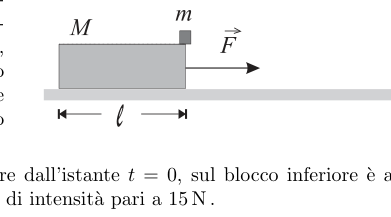 due blocchi M e m con forza F
Topic: Newtonian Mechanics Metodi: Free-Body Diagram, Kinematic Equations, Conservation of Momentum Competenze: Diagrammatic Reasoning, Mathematical Modeling, Physical Reasoning Objects: Block Fonte: Testo (PDF) — p.2 Soluzione: Soluzioni (PDF)
P1 Run, run, run, run, run, run, run, run, run, run, run… The Commission shall adopt implementing acts in accordance with Article 21 of this Regulation. A block of mass and negligible dimensions shall be rested on the right edge of another block of mass , which can flow on a horizontal plane with friction It’s negligible. The static friction coefficient between the two The block is = 0.30, while the dynamic friction è = 0.21. Initially, both blocks are still. From the moment, a a force directed parallel to the plane, as shown in Figure, of intensity equal to 15 N.
- Show that under these conditions the upper block flows over the lower block. The lower block length is .
- Determine the accelerations of the two blocks (in the laboratory reference system) and the time that the The upper block takes the left edge of the lower block.
- Determine the direction and mode of the velocities of the two blocks next to .
- Determine the displacement of the centre of mass of the system consisting of the two blocks between the distance and l’istante . ———————————
two M and m blocks with force F
Topic: Newtonian Mechanics Metodi: Free-Body Diagram, Kinematic Equations, Conservation of Momentum Competenze: Diagrammatic Reasoning, Mathematical Modeling, Physical Reasoning Objects: Block Fonte: Testo (PDF) — p.2 Soluzione: Soluzioni (PDF)
P2 Due in uno Punti 20 Parte A [Punti 12] Un gas perfetto monoatomico () esegue il ciclo reversibile rappresentato in figura, dove la trasformazione (1) è una isocora che porta il gas dallo stato iniziale allo stato B in cui la pressione è doppia; la trasformazione (2) è una espansione adiabatica e la trasformazione (3) è una compressione isoterma che riporta il sistema allo stato iniziale. Calcolare le seguenti grandezze:
- La pressione in funzione di e il volume in funzione di .
- Il rendimento del ciclo.
- La potenza sviluppata da un ipotetico motore, che esegue questo ciclo partendo da uno stato A caratterizzato da , e che lavora a una frequenza cicli . ——————————— Parte B [Punti 8] Il valore medio dell’intensità della radiazione del Sole incidente sulla Terra (fuori dell’atmosfera) vale , quello della distanza Terra-Sole è .
- Qual è la potenza media emessa dal Sole? Nel diciannovesimo secolo furono proposti diversi modelli per spiegare l’emissione di energia da parte del Sole. Uno tra questi ipotizzava che il Sole fosse un blocco di carbone infuocato, che emette energia per irraggiamento. Il potere calorifico del carbone è , la massa del Sole vale . Poiché oltre al carbone è necessaria anche la presenza di almeno un comburente (ad esempio ossigeno), il modello prevede che solo il 40 % della massa del Sole sia composta da carbone che può essere completamente combusto.
- Calcolare in quanto tempo verrebbe esaurito il carbone disponibile all’interno del Sole e discutere se questo modello può essere ritenuto valido. ———————————
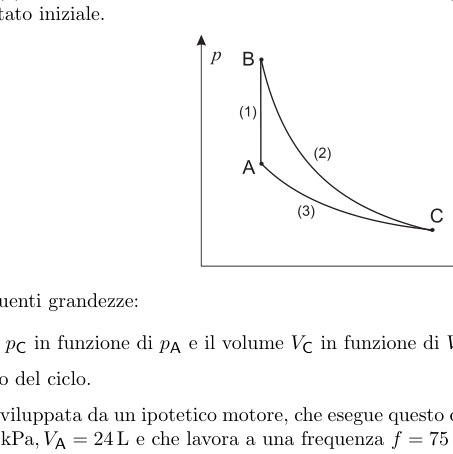 ciclo termodinamico piano p-V punti A B C
Topic: Thermodynamics, Astrophysics, Kinetic Theory Metodi: Thermodynamic Cycle Analysis, Ideal Gas Law, First Law of Thermodynamics Competenze: Physical Reasoning, Mathematical Modeling, Estimation & Approximation Objects: Gas, Star Fonte: Testo (PDF) — p.2 Soluzione: Soluzioni (PDF)
P2 Two in one The Commission shall adopt implementing acts in accordance with Article 21 of this Regulation. Part A The Commission shall adopt implementing acts in accordance with Article 21 of this Regulation. A perfect monoatomic gas () performs the reversible cycle shown in Figure 1, where the transformation (1) is an isocore that carries the gas from the initial state to the state B where the pressure is doubled; The conversion (2) is an adiabatic expansion and the conversion (3) is an isothermal compression which results in the system at its initial state. Calculate the following quantities:
- The pressure for and the volume for .
- The performance of the cycle.
- The power developed by a hypothetical motor, which performs this cycle starting from a characteristic state A da , e che lavora a una frequenza cicli . ——————————— Part B The Commission shall adopt implementing acts in accordance with Article 21 of this Regulation. The mean value of the intensity of the sun’s radiation incident on Earth (outside the atmosphere) is , that of the distance Earth-Sun is .
- What is the average power emitted by the Sun? In the 19th century, several models were proposed to explain the solar energy emission. One of these hypothesized that the Sun was a block of burning coal, which emits energy through radiation. The heat power of coal is , the mass of the Sun is . Since in addition to coal, at least one fuel (e.g. oxygen) is also required, the The model predicts that only 40 percent of the mass of the Sun is made up of coal that can be completely I’m burned.
- Calculate how long the available coal within the Sun would be exhausted and discuss whether this the model can be considered valid. ———————————
ciclo termodinamico piano p-V punti A B C
Topic: Thermodynamics, Astrophysics, Kinetic Theory Metodi: Thermodynamic Cycle Analysis, Ideal Gas Law, First Law of Thermodynamics Competenze: Physical Reasoning, Mathematical Modeling, Estimation & Approximation Objects: Gas, Star Fonte: Testo (PDF) — p.2 Soluzione: Soluzioni (PDF)
P3 Circuiti RC Punti 20 Si vuole caricare un condensatore da 10 mF alla d.d.p. , ma si dispone solamente di un generatore di f.e.m. stabilizzata ; in più si hanno a disposizione 3 resistenze da 1 k, altre 3 da 2 k e un interruttore. Tutto il materiale è mostrato in figura. Si può procedere in due modi diversi. Nel primo modo si pensa di montare un semplice circuito RC con l’alimentatore da 12 V, il condensatore inizialmente scarico, un’opportuna resistenza e l’interruttore. La d.d.p. voluta ai capi del condensatore si otterrà aprendo l’interruttore dopo un certo tempo.
- Quanto deve valere la resistenza del circuito se la durata della carica viene fissata ad un minuto?
- Calcolare la frazione dell’energia erogata dal generatore che viene immagazzinata nel condensatore.
- Mostrare come si può ottenere la resistenza necessaria determinata al punto 1, collegando opportunamente alcune delle resistenze disponibili. Suggerimenti: a) si ricorda che una primitiva di è ; b) approssimare la parte decimale del valore della resistenza, espresso in k, con una frazione semplice; Nel secondo modo si monta invece il circuito in figura (detto “partitore di tensione”) scegliendo opportunamente le resistenze e in modo che, una volta raggiunta una situazione stazionaria, la d.d.p. ai capi del condensatore sia quella voluta.
- Quale deve essere il rapporto per ottenere lo scopo ?
- Mostrare un modo di scegliere, tra le resistenze disponibili, quelle utili per realizzare il partitore di tensione. ———————————
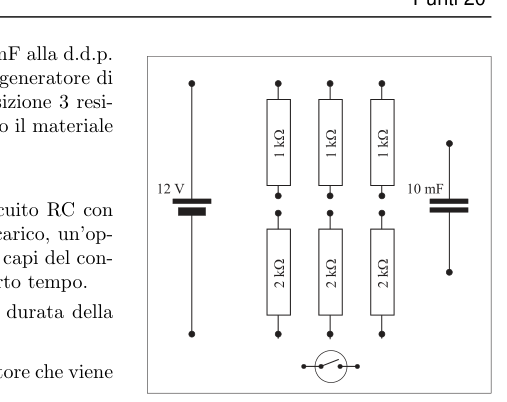 componenti circuito resistori condensatore interruttore
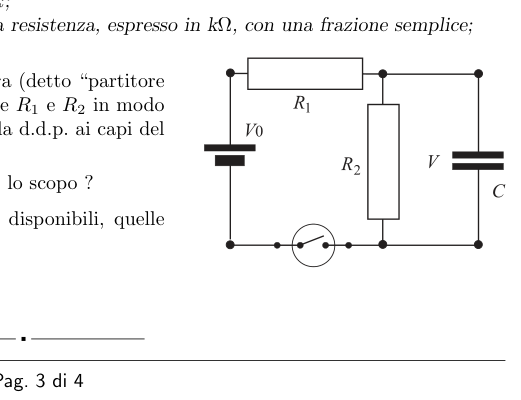 partitore di tensione R1 R2 condensatore C
Topic: Circuits, Electrostatics Metodi: Kirchhoff’s Laws, Equivalent Circuit Reduction, Energy Conservation Method Competenze: Physical Reasoning, Mathematical Modeling, Diagrammatic Reasoning Objects: Capacitor, Resistor, Switch, Battery Fonte: Testo (PDF) — p.3 Soluzione: Soluzioni (PDF)
P3 Other, of a kind used for the manufacture of goods The Commission shall adopt implementing acts in accordance with Article 21 of this Regulation. You want to charge a 10 mF capacitor at the D.D.P. , ma si dispone solamente di un generatore di f.e.m. stabilizzata ; in più si hanno a disposizione 3 resistenze da 1 k, altre 3 da 2 k e un interruttore. All the material It’s shown in the figure. There are two different ways to do this. In the first way, you think you’re going to put together a simple RC circuit with The 12V power supply, the initial discharge capacitor, a suitable resistance and the switch. La d.d.p. The capacitor headers are designed to be used by opening the switch after a certain period of time.
- What is the value of the resistance of the circuit if the duration of the The charge is fixed to a minute?
- Calculate the fraction of energy delivered by the generator coming from the stored in the condenser.
- Show how to obtain the required resistance as determined in point 1, by connecting appropriately some of the resistance available. Suggestions for the following: (a) it is recalled that a prime of is ; (b) approximate the decimal part of the resistance value, expressed in k, by a simple fraction; In the second way, the circuit in figure (called partitor) is mounted instead. di tensione”) scegliendo opportunamente le resistenze e in modo The Commission has therefore decided to adopt a decision on the basis of the information provided by the Member States. The Commission shall adopt the following measures: I’m not going to let you get away with this.
- Quale deve essere il rapporto per ottenere lo scopo ?
- Show a way to choose, from the resistance available, those The voltage ratio is the voltage ratio of the voltage ratio. ———————————
componenti circuito resistori condensatore interruttore
partitore di tensione R1 R2 condensatore C
Topic: Circuits, Electrostatics Metodi: Kirchhoff’s Laws, Equivalent Circuit Reduction, Energy Conservation Method Competenze: Physical Reasoning, Mathematical Modeling, Diagrammatic Reasoning Objects: Capacitor, Resistor, Switch, Battery Fonte: Testo (PDF) — p.3 Soluzione: Soluzioni (PDF)