Q1 Un corpo di massa urta elasticamente un altro corpo fermo. Dopo l’urto i due corpi si muovono nella direzione iniziale del primo corpo, in versi opposti, con velocità di uguale modulo. • Qual è la massa del corpo inizialmente fermo?
Topic: Conservation of Momentum, Conservation of Energy Metodi: Conservation of Momentum, Conservation of Energy, Conservation Laws Competenze: Mathematical Modeling, Physical Reasoning Objects: Block Fonte: Testo (PDF) — p.2 Soluzione: Soluzioni (PDF)
Q1 A mass body elastically hits another solid body. After the impact the two bodies were They move in the initial direction of the first body, in opposite directions, with the same speed of the module. • What is the of the initially stationary body?
Topic: Conservation of Momentum, Conservation of Energy Metodi: Conservation of Momentum, Conservation of Energy, Conservation Laws Competenze: Mathematical Modeling, Physical Reasoning Objects: Block Fonte: Testo (PDF) — p.2 Soluzione: Soluzioni (PDF)
Q2 Una guida di materiale non conduttore e di lunghezza ruota uniformemente in un piano orizzontale con velocità angolare (antioraria in figura) attorno a un estremo. Nella regione è presente un campo magnetico uniforme verticale di intensità , di verso uscente. Una particella di massa e carica è libera di muoversi lungo la guida. Si vuole che la particella resti a distanza costante dall’asse di rotazione. • Si determini il valore di necessario per ottenere la situazione descritta.
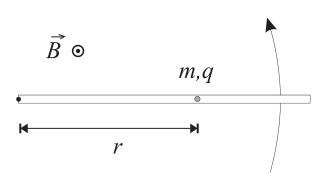 guida rotante in campo magnetico
Topic: Rotational Dynamics, Magnetism, Newtonian Mechanics Metodi: Lorentz Force Analysis, Free-Body Diagram, Vector Decomposition Competenze: Diagrammatic Reasoning, Mathematical Modeling Objects: Rod, Point Charge Fonte: Testo (PDF) — p.2 Soluzione: Soluzioni (PDF)
Q2 A guide of non-conductive material and length rotates uniformly in a horizontal plane with speed angular (antiormal in figure) around one end. The region has a uniform vertical magnetic field of , coming out. A particle of mass and charge is free to move along the
- He’s driving. The particle is to remain at a constant distance from the axis of The rotation. • Determine the required to achieve the described situation.
guida rotante in campo magnetico
Topic: Rotational Dynamics, Magnetism, Newtonian Mechanics Metodi: Lorentz Force Analysis, Free-Body Diagram, Vector Decomposition Competenze: Diagrammatic Reasoning, Mathematical Modeling Objects: Rod, Point Charge Fonte: Testo (PDF) — p.2 Soluzione: Soluzioni (PDF)
Q3 La figura rappresenta – schematicamente, ma in scala – una giostra in movimento, con i seggiolini vuoti. L’altezza in figura è pari a circa . • Stimare il tempo che la giostra impiega a fare un giro.
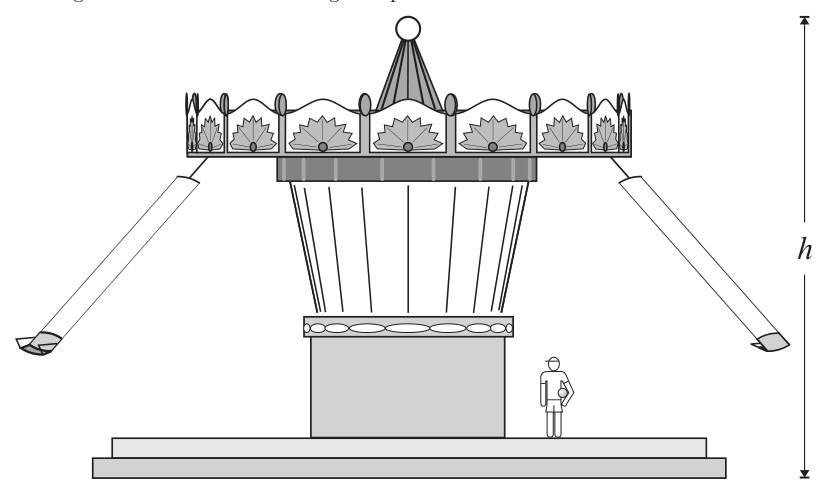 giostra in sezione con altezza
Topic: Order-of-Magnitude Estimation, Newtonian Mechanics Metodi: Order-of-Magnitude Estimation, Physical Modeling, Small-Angle Approximation Competenze: Estimation & Approximation, Physical Reasoning Objects: — Fonte: Testo (PDF) — p.3 Soluzione: Soluzioni (PDF)
Q3 The figure represents schematically, but on a scale a moving gait, with the seats empty. The height in the figure is approximately . • Estimate the time the ride takes to walk.
sectional gauge with height
Topic: Order-of-Magnitude Estimation, Newtonian Mechanics Metodi: Order-of-Magnitude Estimation, Physical Modeling, Small-Angle Approximation Competenze: Estimation & Approximation, Physical Reasoning Objects: — Fonte: Testo (PDF) — p.3 Soluzione: Soluzioni (PDF)
Q4 Un elettrone si trova in una regione di spazio in cui è presente un campo elettrico diretto lungo l’asse . Il potenziale elettrico ad esso associato, espresso in volt, è con espresso in millimetri, il cui grafico è riportato in figura. Un elettrone è mantenuto fermo nel punto di coordinata . • Se, ad un certo istante, l’elettrone viene lasciato libero di muoversi, a che distanza dall’origine la sua velocità sarà di nuovo nulla?
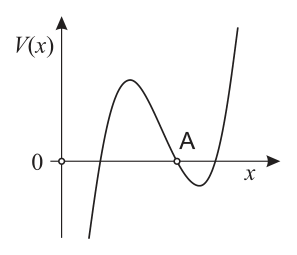 grafico potenziale vs
Topic: Electrostatics, Conservation of Energy Metodi: Electric Potential Method, Energy Conservation Method, Conservation Laws Competenze: Mathematical Modeling, Diagrammatic Reasoning Objects: Electron Fonte: Testo (PDF) — p.3 Soluzione: Soluzioni (PDF)
Q4 An electron is located in a region of space where a direct electric field is present along the axis. The electric potential associated with it, expressed in volts, is with in millimetres, shown in the following table In the figure. An electron is held stationary at the coordinate point . • If, at a certain moment, the electron is left free to move, what distance from the origin its speed will again be nothing?
grafico potenziale vs
Topic: Electrostatics, Conservation of Energy Metodi: Electric Potential Method, Energy Conservation Method, Conservation Laws Competenze: Mathematical Modeling, Diagrammatic Reasoning Objects: Electron Fonte: Testo (PDF) — p.3 Soluzione: Soluzioni (PDF)
Q5 In un condensatore a facce quadrate, piane e parallele, le armature sono separate da una sottile lastra di mica avente costante dielettrica relativa e rigidità dielettrica . La rigidità dielettrica è il massimo campo elettrostatico che il dielettrico può sopportare rimanendo isolante. • Quanto vale, al massimo, l’energia che si può immagazzinare nel condensatore, se le armature hanno un’area e la lamina ha spessore ?
Topic: Electrostatics Metodi: Electric Potential Method, Gauss’s Law Competenze: Mathematical Modeling, Physical Reasoning Objects: Capacitor Fonte: Testo (PDF) — p.3 Soluzione: Soluzioni (PDF)
Q5 In a square, flat and parallel-faced capacitor, the frames are separated by a a thin mica plate with a relative dielectric constant and a dielectric stiffness . The dielectric rigidity is the maximum electrostatic field that the dielectric can withstand while remaining insulating. • What is the maximum energy that can be stored in the capacitor if the armor has an area and the sheet has a thickness ?
Topic: Electrostatics Metodi: Electric Potential Method, Gauss’s Law Competenze: Mathematical Modeling, Physical Reasoning Objects: Capacitor Fonte: Testo (PDF) — p.3 Soluzione: Soluzioni (PDF)
Q6 In figura è mostrato un ciclo termodinamico, ABCDA, compiuto da moli di gas perfetto. È nota la temperatura e valgono le relazioni: , e . • Qual è il lavoro svolto in questo ciclo in funzione di e ?
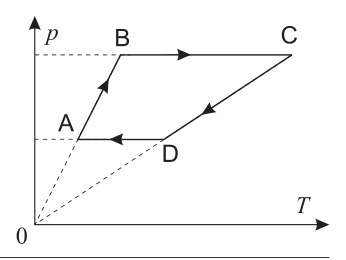 ciclo termodinamico ABCDA in piano p-T
Topic: Thermodynamics Metodi: Thermodynamic Cycle Analysis, First Law of Thermodynamics, Ideal Gas Law Competenze: Mathematical Modeling, Physical Reasoning Objects: Gas Fonte: Testo (PDF) — p.3 Soluzione: Soluzioni (PDF)
Q6 The figure shows a thermodynamic cycle, ABCDA, compiuto da moli di gas perfetto. The temperature is known and the following ratios are valid: , e . • What is the work done in this cycle according to and ?
ciclo termodinamico ABCDA in piano p-T
Topic: Thermodynamics Metodi: Thermodynamic Cycle Analysis, First Law of Thermodynamics, Ideal Gas Law Competenze: Mathematical Modeling, Physical Reasoning Objects: Gas Fonte: Testo (PDF) — p.3 Soluzione: Soluzioni (PDF)
Q7 Un blocchetto è tenuto fermo su un piano inclinato. Viene lasciato libero e quando raggiunge la base del piano inclinato la sua velocità è di . Successivamente il blocchetto viene riportato fermo nella stessa posizione iniziale e poi lanciato verso l’alto lungo il piano inclinato alla velocità iniziale di ; raggiunta la massima altezza, il blocchetto scende fino alla base. • Nel secondo lancio qual è la velocità del blocchetto quando raggiunge la base del piano inclinato? Trascurare tutti gli attriti.
Topic: Newtonian Mechanics, Conservation of Energy Metodi: Energy Conservation Method, Kinematic Equations Competenze: Physical Reasoning, Mathematical Modeling Objects: Block, Inclined Plane Fonte: Testo (PDF) — p.4 Soluzione: Soluzioni (PDF)
Q7 A lock is held firm on a sloping floor. He is released and when he reaches the base of the inclined plane, its speed . Then the block comes returned stationary in the same initial position and then thrown upwards along the inclined plane At the initial speed of ; at the maximum height, the block is lowered to the base. • In the second launch, how fast does the paddle reach the base of the tilted plane? Ignore all the friction.
Topic: Newtonian Mechanics, Conservation of Energy Metodi: Energy Conservation Method, Kinematic Equations Competenze: Physical Reasoning, Mathematical Modeling Objects: Block, Inclined Plane Fonte: Testo (PDF) — p.4 Soluzione: Soluzioni (PDF)
Q8 Un modulo lunare di massa sta scendendo verticalmente sulla superficie della Luna. Quando si trova a di altezza e ha una velocità di , accende i motori per frenare. • Quale dev’essere la spinta dei motori, supposta costante, se si vuole che il modulo si posi sulla superficie lunare con velocità nulla? Trattare come uniforme il campo di gravità.
Topic: Newtonian Mechanics, Gravitation Metodi: Kinematic Equations, Energy Conservation Method, Free-Body Diagram Competenze: Mathematical Modeling, Physical Reasoning Objects: — Fonte: Testo (PDF) — p.4 Soluzione: Soluzioni (PDF)
Q8 A lunar module of mass is descending vertically on the surface of the Moon. When it is at height and has a speed of , it turns on the engines to brake. • What must be the engine thrust, assumed to be constant, if the module is to be placed on the surface A moon with no speed? Treat the gravitational field as uniform.
Topic: Newtonian Mechanics, Gravitation Metodi: Kinematic Equations, Energy Conservation Method, Free-Body Diagram Competenze: Mathematical Modeling, Physical Reasoning Objects: — Fonte: Testo (PDF) — p.4 Soluzione: Soluzioni (PDF)
Q9 Una molla di lunghezza a riposo e costante elastica , è agganciata a una seconda molla di lunghezza a riposo e costante elastica . Le due molle hanno massa trascurabile e sono fissate a due punti distanti . Il sistema si trova in equilibrio. • Qual è, in questa situazione, l’allungamento della prima molla?
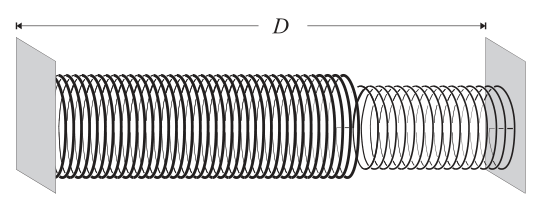 due molle in serie tra pareti
Topic: Newtonian Mechanics Metodi: Hooke’s Law, Free-Body Diagram Competenze: Mathematical Modeling, Physical Reasoning Objects: Spring Fonte: Testo (PDF) — p.4 Soluzione: Soluzioni (PDF)
Q9 A spring of rest length and elastic constant is attached to a second spring a spring of rest length and an elastic constant . The two springs have mass The measurement of the distance between the two points is not insignificant and is fixed at two points . The system is in balance. • What is the extension in this situation? The first spring?
two springs in series between walls
Topic: Newtonian Mechanics Metodi: Hooke’s Law, Free-Body Diagram Competenze: Mathematical Modeling, Physical Reasoning Objects: Spring Fonte: Testo (PDF) — p.4 Soluzione: Soluzioni (PDF)
Q10 Un cilindro di volume (lunghezza , sezione ), disposto orizzontalmente, è separato in due parti uguali da una parete scorrevole, a tenuta, di spessore trascurabile. In ognuna delle due parti è presente del gas a pressione , e il sistema è in equilibrio. Il cilindro è contenuto entro un termostato che garantisce sempre una temperatura costante del gas . La parete viene spostata di un tratto pari a e tenuta ferma. • Determinare la forza necessaria per mantenere la parete in questa posizione.
Topic: Thermodynamics Metodi: Ideal Gas Law, First Law of Thermodynamics Competenze: Mathematical Modeling, Physical Reasoning Objects: Gas, Cylinder, Piston Fonte: Testo (PDF) — p.4 Soluzione: Soluzioni (PDF)
Q10 A cylinder of volume (length , section ) arranged horizontally shall be separated in two equal parts of a wall of slightly thick, slippery, retaining material. In each of the two parts of the gas at pressure are present, and the system is in balance. The cylinder is contained within a thermostat which always ensures a constant gas temperature . The wall is moved by a stroke equal to and held firm. • Determine the force required to keep the wall in this position.
Topic: Thermodynamics Metodi: Ideal Gas Law, First Law of Thermodynamics Competenze: Mathematical Modeling, Physical Reasoning Objects: Gas, Cylinder, Piston Fonte: Testo (PDF) — p.4 Soluzione: Soluzioni (PDF)
P1 I problemi di Paolo Punti 25 Parte A: Groviglio di molle. [Punti 8] Sul piano sono dati due punti e collegati con una molla di costante elastica e lunghezza di riposo nulla.
- Scrivere l’espressione della forza applicata al punto in funzione dei vettori posizione e dei due punti rispetto all’origine delle coordinate, in forma vettoriale o in termini di componenti dei vettori. Quattro punti, , , e , sono fissati ciascuno sulla verticale di uno dei quattro vertici consecutivi di un quadrato di lato , a quote rispettivamente , , , . Un punto materiale è collegato ai precedenti quattro con quattro molle identiche aventi massa e lunghezza a riposo trascurabili.
- Fissato un riferimento cartesiano ortogonale avente per origine il centro del quadrato e con gli assi e allineati con le diagonali del quadrato, scrivere i vettori posizione , , , ed dei punti , , , e .
- Determinare la quota alla quale il punto materiale è in equilibrio sotto l’azione delle forze elastiche. ——————————— Parte B: Corsa con il vento. [Punti 8] Giovanni sta correndo verso Est a e sente venire il vento da Sud-Est. Se rallenta e corre a sente venire il vento da Sud. • Determinare l’intensità del vento rispetto al terreno e l’angolo tra la direzione del vento e la direzione Est. ——————————— Parte C: Macchina termica. [Punti 9] Una macchina termica funziona con una sorgente di calore alla temperatura e ha come refrigerante un blocco di ghiaccio, di , alla temperatura .
- Quanto calore è necessario fornire al blocco di ghiaccio per fonderlo completamente? La macchina sviluppa una potenza meccanica con un rendimento pari al di quello di una macchina di Carnot che operi fra le stesse temperature.
- Per quanto tempo può funzionare la macchina prima che il ghiaccio sia completamente fuso? ———————————
Topic: Newtonian Mechanics, Thermodynamics Metodi: Free-Body Diagram, Vector Decomposition, Thermodynamic Cycle Analysis, First Law of Thermodynamics Competenze: Mathematical Modeling, Physical Reasoning, Diagrammatic Reasoning Objects: Spring, Heat Engine Fonte: Testo (PDF) — p.7 Soluzione: Soluzioni (PDF)
P1 The Problems of Paul The Commission shall adopt implementing acts in accordance with Article 21 of this Regulation. Part A: Sprinkler cork. The Commission shall adopt implementing acts in accordance with Article 21 of this Regulation. On the plane two points and connected by an elastic constant spring are given; and the length of rest is zero.
- Write the expression of the force applied to the point in terms of the position vectors and of the two points the origin of the coordinates, in vector form or in terms of vector components. Four points, , , and , are fixed each on the vertical of one of the four consecutive vertices of a quadrato di lato , a quote rispettivamente , , , . A material point is connected to the previous four with four identical springs of negligible mass and length at rest.
- Fixed an orthogonal Cartesian reference originating in the centre of the square and with the axes and Aligned with the diagonal of the square, write the position vectors , , , and of the points , , , e .
- Determine the at which the material point is in equilibrium under the action of elastic forces. ——————————— Part B: Run with the wind. The Commission shall adopt implementing acts in accordance with Article 21 of this Regulation. Giovanni sta correndo verso Est a e sente venire il vento da Sud-Est. If you slow down and run at you hear The wind is coming from the south. • Determine the wind intensity relative to the ground and the angle between the wind direction and the east direction. ——————————— Part C: Heat engine. The Commission shall adopt implementing acts in accordance with Article 21 of this Regulation. A heat engine operates with a heat source at and has as coolant a block of ice, , at a temperature of .
- How much heat does it take to provide the ice block to melt it completely? The machine develops a mechanical power with a yield equal to of that of a Carnot’s machine that operates at the same temperature.
- How long can the machine run before the ice is completely melted? ———————————
Topic: Newtonian Mechanics, Thermodynamics Metodi: Free-Body Diagram, Vector Decomposition, Thermodynamic Cycle Analysis, First Law of Thermodynamics Competenze: Mathematical Modeling, Physical Reasoning, Diagrammatic Reasoning Objects: Spring, Heat Engine Fonte: Testo (PDF) — p.7 Soluzione: Soluzioni (PDF)
P2 Energia immagazzinata in un condensatore Punti 15 Le armature di un condensatore piano, a facce quadrate di area , sono mantenute a una differenza di potenziale costante . Tra le due armature non c’è un dielettrico. La distanza tra le armature può variare, restando comunque molto minore di . Scrivere le risposte in termini delle grandezze date e delle costanti necessarie.
- Si calcoli la forza con cui un’armatura attira l’altra. Tenendo ferma la prima armatura, la seconda viene portata lentamente da distanza a distanza , mantenendo sempre costante.
- Si calcoli la variazione di energia interna nel condensatore.
- Si calcoli il lavoro compiuto durante il processo dalla forza esterna che agisce sulla seconda armatura. ———————————
Topic: Electrostatics, Conservation of Energy Metodi: Electric Potential Method, Energy Conservation Method, Gauss’s Law Competenze: Mathematical Modeling, Physical Reasoning Objects: Capacitor Fonte: Testo (PDF) — p.8 Soluzione: Soluzioni (PDF)
P2 Energy stored in a capacitor The Commission shall adopt implementing acts in accordance with Article 15 of this Regulation. The frames of a flat capacitor, square-faced area, are maintained at a difference of di potenziale costante . There’s no dielectric between the two frames. The distance between the frames può variare, restando comunque molto minore di . Write the answers in terms of the given quantities and the necessary constants.
- The force with which one armor attracts the other is calculated. Holding the first armor firm, the second is slowly moved from to , while sempre costante.
- Calculate the change in internal energy in the capacitor.
- The work performed during the process is calculated by the external force acting on the second armor. ———————————
Topic: Electrostatics, Conservation of Energy Metodi: Electric Potential Method, Energy Conservation Method, Gauss’s Law Competenze: Mathematical Modeling, Physical Reasoning Objects: Capacitor Fonte: Testo (PDF) — p.8 Soluzione: Soluzioni (PDF)
P3 Misura di spessore Punti 20 Si vuole determinare lo spessore di una sottile lamina di un materiale trasparente di indice di rifrazione . Per far questo si pone la lamina davanti ad una delle due fenditure parallele di un apparato per l’esperienza di Young. Le due fenditure sono a distanza una dall’altra, e su di esse incide una radiazione del medio infrarosso di lunghezza d’onda .
- Determinare l’espressione dello sfasamento temporale con cui le onde emesse dalle fenditure raggiungono perpendicolarmente uno schermo posto a grande distanza, .
- Determinare lo spostamento del massimo centrale della figura di interferenza, rispetto alla posizione che avrebbe in assenza della lamina, indicando anche il verso dello spostamento a seconda di quale fenditura viene coperta dalla lamina.
- Se tra le due posizioni del massimo centrale (con e senza la lamina) si contano massimi di interferenza, determinare lo spessore della lamina.
Topic: Wave Optics, Oscillations & Waves Metodi: Interference & Diffraction Analysis, Superposition Principle, Wave Equation Competenze: Mathematical Modeling, Diagrammatic Reasoning Objects: Slit, Screen Fonte: Testo (PDF) — p.8 Soluzione: Soluzioni (PDF)
P3 Measurement of thickness The Commission shall adopt implementing acts in accordance with Article 21 of this Regulation. The thickness of a thin sheet of a transparent material of an index of rifrazione . To do this, the sheet is placed in front of one of the two parallel slits of an appliance for the I’m not sure. The two fissures are apart, and radiation from the medium is applied to them. Infrared wavelength .
- Determine the expression of the time lag with which the waves emitted by the cracks reach perpendicularly a screen placed at a great distance, .
- Determine the displacement of the central maximum of the interference figure, relative to the position that In the absence of the sheet, the direction of displacement shall also be indicated, depending on the cracking It’s covered in a sheet of paper.
- If the two positions of the central maximum (with or without the sheet) have interference maximum, determine the thickness of the sheet.
Topic: Wave Optics, Oscillations & Waves Metodi: Interference & Diffraction Analysis, Superposition Principle, Wave Equation Competenze: Mathematical Modeling, Diagrammatic Reasoning Objects: Slit, Screen Fonte: Testo (PDF) — p.8 Soluzione: Soluzioni (PDF)