q1 Un pendolo è costituito da un filo di lunghezza e da una sferetta di massa . La sferetta viene lasciata partire da ferma da una posizione A tale che il filo teso formi un angolo con la verticale, come mostrato in figura. • Trascurando la resistenza dell’aria, quanto vale la velocità della sferetta quando raggiunge il punto B?
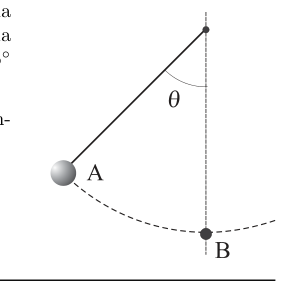 pendolo con angolo e punti A B
Topic: Newtonian Mechanics, Conservation of Energy Metodi: Energy Conservation Method, Free-Body Diagram, Vector Decomposition Competenze: Mathematical Modeling, Physical Reasoning Objects: Pendulum Fonte: Testo (PDF) — p.2 Soluzione: Soluzioni (PDF)
q1 A pendulum consists of a length wire and a The mass sphere . The sphere is left to start from ferma da una posizione A tale che il filo teso formi un angolo with the vertical, as shown in the figure. • Given the resistance of the air, what is the speed of the sphere when it reaches point B?
pendulum with angle and points A B
Topic: Newtonian Mechanics, Conservation of Energy Metodi: Energy Conservation Method, Free-Body Diagram, Vector Decomposition Competenze: Mathematical Modeling, Physical Reasoning Objects: Pendulum Fonte: Testo (PDF) — p.2 Soluzione: Soluzioni (PDF)
q2 Una carica puntiforme viene posta al centro di un guscio sferico conduttore scarico di raggio interno e spessore . Sulle superfici interna ed esterna del guscio si forma una carica indotta. • A equilibrio raggiunto, determinare il rapporto tra la densità superficiale di carica presente sulla superficie interna e quella presente sulla superficie esterna del guscio.
Topic: Electrostatics Metodi: Gauss’s Law, Symmetry Argument, Electric Potential Method Competenze: Mathematical Modeling, Diagrammatic Reasoning Objects: Point Charge, Conducting Sphere Fonte: Testo (PDF) — p.2 Soluzione: Soluzioni (PDF)
q2 A pointed charge is placed at the centre of a spherical shell conducting internal radius discharge e spessore . On the inner and outer surfaces of the shell an induced charge is formed. • At equilibrium, determine the ratio of the surface load density present on the surface the inner and outer surface of the shell.
Topic: Electrostatics Metodi: Gauss’s Law, Symmetry Argument, Electric Potential Method Competenze: Mathematical Modeling, Diagrammatic Reasoning Objects: Point Charge, Conducting Sphere Fonte: Testo (PDF) — p.2 Soluzione: Soluzioni (PDF)
q3 La sovrapposizione di una radiazione di colore rosso e una verde viene percepita dall’occhio umano di colore giallo. Due radiazioni monocromatiche, di lunghezza d’onda (nel rosso) e (nel verde), vengono fatte incidere perpendicolarmente su un reticolo di diffrazione avente passo . La figura di diffrazione che si forma su uno schermo perpendicolare al fascio incidente, a distanza dal reticolo, è simmetrica rispetto al centro e presenta righe molto sottili e ben definite. Nel centro della figura di diffrazione si osserva una riga gialla. • A che distanza dal centro si osserva la successiva riga gialla?
Topic: Wave Optics Metodi: Interference & Diffraction Analysis, Superposition Principle, Small-Angle Approximation Competenze: Mathematical Modeling, Physical Reasoning Objects: Diffraction Grating, Screen Fonte: Testo (PDF) — p.2 Soluzione: Soluzioni (PDF)
q3 The superposition of red and green radiation is perceived by the human eye. yellow. Two monochrome radiations, of wavelength (red) and (green), The measurement shall be made perpendicular to a diffraction lattice with a step . The figure of diffraction forming on a screen perpendicular to the incident beam, at a distance from the lattice, is It’s symmetrical to the center and has very thin, well-defined lines. In the centre of the diffraction figure You see a yellow line. • How far from the center is the next yellow line?
Topic: Wave Optics Metodi: Interference & Diffraction Analysis, Superposition Principle, Small-Angle Approximation Competenze: Mathematical Modeling, Physical Reasoning Objects: Diffraction Grating, Screen Fonte: Testo (PDF) — p.2 Soluzione: Soluzioni (PDF)
q4 L’aria di una stanza di volume si trova alla temperatura di , uguale a quella esterna. A seguito dell’accensione di un termosifone, la temperatura si innalza a . L’aria può essere considerata come un gas perfetto con una percentuale di molecole di ossigeno pari al 21 %. • Che percentuale di ossigeno è uscita dallo spiraglio di una finestra?
Topic: Thermodynamics, Kinetic Theory Metodi: Ideal Gas Law, Physical Modeling Competenze: Mathematical Modeling, Physical Reasoning Objects: Gas Fonte: Testo (PDF) — p.2 Soluzione: Soluzioni (PDF)
q4 The air in a room of volume is at , the temperature of the outside. The temperature rises to after the thermosphere is turned on. The air may be It is considered a perfect gas with a percentage of oxygen molecules of 21%. • What percentage of oxygen has come out of a window sill?
Topic: Thermodynamics, Kinetic Theory Metodi: Ideal Gas Law, Physical Modeling Competenze: Mathematical Modeling, Physical Reasoning Objects: Gas Fonte: Testo (PDF) — p.2 Soluzione: Soluzioni (PDF)
q5 Un filo è avvolto su una carrucola e passa attraverso una fenditura come in figura. Ai suoi estremi sono appesi due blocchetti di massa ed con . Carrucola e filo possono essere trattati come ideali. Il sistema è inizialmente in quiete e, lasciato libero, si mette in movimento spontaneamente. Il filo, strisciando nella fenditura, subisce da parte di questa una forza d’attrito costante, . • Si determini il modulo dell’accelerazione della massa .
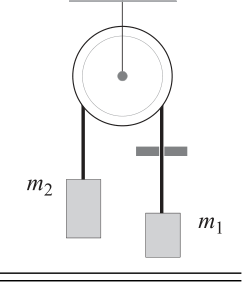 carrucola con filo e due masse
Topic: Newtonian Mechanics Metodi: Free-Body Diagram, Kinematic Equations, Conservation Laws Competenze: Diagrammatic Reasoning, Mathematical Modeling Objects: Pulley, String, Block Fonte: Testo (PDF) — p.3 Soluzione: Soluzioni (PDF)
q5 A wire is wrapped in a carriage and goes through a crack like In the figure. Two mass blocks and are hung at its ends. with . Carriage and wire can be treated as ideal. The system is initially still and, when left free, it starts moving. spontaneously. The wire, crawling in the crack, is subjected by this one The force of friction shall be constant, . • Determine the mass acceleration formula .
*wire-coated and two-wheeled coach *
Topic: Newtonian Mechanics Metodi: Free-Body Diagram, Kinematic Equations, Conservation Laws Competenze: Diagrammatic Reasoning, Mathematical Modeling Objects: Pulley, String, Block Fonte: Testo (PDF) — p.3 Soluzione: Soluzioni (PDF)
q6 Tre resistori valgono rispettivamente , e . La serie formata dai resistori e è collegata in parallelo a e a un generatore di f.e.m. che ha resistenza interna trascurabile. • Determinare il rapporto tra le potenze dissipate nei resistori e .
Topic: Circuits Metodi: Kirchhoff’s Laws, Equivalent Circuit Reduction Competenze: Diagrammatic Reasoning, Mathematical Modeling Objects: Resistor, Battery Fonte: Testo (PDF) — p.3 Soluzione: Soluzioni (PDF)
q6 Three resistors are , and respectively. The series of resistors and is connected in parallel to and to an f.e.m. generator. che ha resistenza interna trascurabile. • Determine the ratio of the dissipation power in the and resistors.
Topic: Circuits Metodi: Kirchhoff’s Laws, Equivalent Circuit Reduction Competenze: Diagrammatic Reasoning, Mathematical Modeling Objects: Resistor, Battery Fonte: Testo (PDF) — p.3 Soluzione: Soluzioni (PDF)
q7 Un sonar invia da una nave ferma un segnale sonoro di frequenza verso il fondale marino alla profondità e il segnale riflesso viene ricevuto dopo un tempo . • Determinare la lunghezza d’onda del segnale sonoro nell’acqua.
Topic: Oscillations & Waves Metodi: Wave Equation, Kinematic Equations Competenze: Mathematical Modeling, Physical Reasoning Objects: — Fonte: Testo (PDF) — p.3 Soluzione: Soluzioni (PDF)
q7 A sonar sends a sound signal of frequency from a stationary ship to the seabed alla profondità e il segnale riflesso viene ricevuto dopo un tempo . • Determine the wavelength of the sound signal in the water.
Topic: Oscillations & Waves Metodi: Wave Equation, Kinematic Equations Competenze: Mathematical Modeling, Physical Reasoning Objects: — Fonte: Testo (PDF) — p.3 Soluzione: Soluzioni (PDF)
q8 Una macchina termica compie 4 cicli al secondo utilizzando di gas perfetto biatomico. Il ciclo, in cui la trasformazione AB è adiabatica, è rappresentato in figura. Il calore ceduto dal sistema viene usato per portare a ebollizione 13 L d’acqua. • Se la temperatura iniziale dell’acqua è , dopo quanto tempo inizia l’ebollizione?
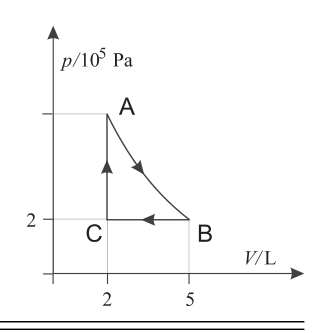 ciclo termodinamico p-V adiabatico
Topic: Thermodynamics Metodi: Thermodynamic Cycle Analysis, First Law of Thermodynamics, Ideal Gas Law Competenze: Mathematical Modeling, Physical Reasoning Objects: Heat Engine, Gas Fonte: Testo (PDF) — p.3 Soluzione: Soluzioni (PDF)
q8 A thermal machine completes four cycles per second using di gas perfetto biatomico. The cycle in which the transformation AB is adiabatic is shown in Figure 1. The heat from the system is used to boil 13 L of water. • If the initial water temperature is , after how long does it start The boiling?
ciclo termodinamico p-V adiabatico
Topic: Thermodynamics Metodi: Thermodynamic Cycle Analysis, First Law of Thermodynamics, Ideal Gas Law Competenze: Mathematical Modeling, Physical Reasoning Objects: Heat Engine, Gas Fonte: Testo (PDF) — p.3 Soluzione: Soluzioni (PDF)
q9 Una ragazza è ferma sul suo skateboard, su un piano orizzontale. La ragazza lancia in avanti il proprio zainetto di massa a una velocità , rispetto al terreno, inclinata di un angolo sopra l’orizzontale. La massa della ragazza e dello skateboard è . Lo zainetto impiega un tempo per toccare terra. Gli attriti sono trascurabili. • A che distanza dallo skateboard cade lo zainetto?
Topic: Newtonian Mechanics, Conservation of Momentum Metodi: Conservation of Momentum, Kinematic Equations, Vector Decomposition Competenze: Mathematical Modeling, Physical Reasoning Objects: Projectile Fonte: Testo (PDF) — p.3 Soluzione: Soluzioni (PDF)
q9 A girl is standing on her skateboard, on a horizontal plane. The girl throws her own A mass line at a speed , with respect to the ground, tilted at an angle sopra l’orizzontale. The mass of the girl and the skateboard is . The little one It takes to touch the ground. The friction is negligible. • How far from the skateboard does the spider fall?
Topic: Newtonian Mechanics, Conservation of Momentum Metodi: Conservation of Momentum, Kinematic Equations, Vector Decomposition Competenze: Mathematical Modeling, Physical Reasoning Objects: Projectile Fonte: Testo (PDF) — p.3 Soluzione: Soluzioni (PDF)
q10 Un serbatoio cilindrico per la raccolta d’acqua è appoggiato a terra. Sulla parete laterale, ad altezza da terra, si forma un forellino, di diametro molto minore di quello del serbatoio, da cui fuoriesce uno zampillo. • Determinare il livello dell’acqua nel serbatoio, sapendo che lo zampillo tocca terra a distanza dalla base del serbatoio. Si trascurino la viscosità dell’acqua e l’attrito con l’aria.
Topic: Fluid Mechanics, Newtonian Mechanics Metodi: Bernoulli’s Equation, Kinematic Equations, Continuity Equation Competenze: Mathematical Modeling, Physical Reasoning Objects: Container Fonte: Testo (PDF) — p.3 Soluzione: Soluzioni (PDF)
q10 A cylindrical water collection tank is leaning against the ground. On the side wall, at height from the ground, forming a furnace, of a diameter much smaller than that of the tank, from which a fountain of fire springs. • Determine the water level in the tank, knowing that the footstep touches the ground at a distance from the water the base of the tank. The viscosity of water and air friction are neglected.
Topic: Fluid Mechanics, Newtonian Mechanics Metodi: Bernoulli’s Equation, Kinematic Equations, Continuity Equation Competenze: Mathematical Modeling, Physical Reasoning Objects: Container Fonte: Testo (PDF) — p.3 Soluzione: Soluzioni (PDF)
p1 Auto elettriche e frenate rigenerative Punti 20 Una tipica batteria di auto a motore termico ha le seguenti specifiche: tensione 12 V, “capacità” 70 A h . (1)
- Determinare, in kWh, l’energia di una batteria con queste caratteristiche, quando è completamente carica. Nelle specifiche tecniche di un’auto elettrica si legge che ha una massa di 1765 kg, una potenza massima di 208 kW, un’autonomia di 513 km e in media consuma 13.2 kWh di energia ogni 100 km percorsi.
- Determinare, in kWh, l’energia della batteria che alimenta il motore elettrico quando è completamente carica. Calcolare il numero minimo di batterie tradizionali che si dovrebbero utilizzare per avere a disposizione la stessa energia. [Dare la risposta come numero intero.] Nelle automobili a motore termico la frenata è sempre e solo totalmente dissipativa perché tutta l’energia cinetica finisce trasformata in calore e dispersa nell’ambiente. Invece in un’auto elettrica quando si alza il piede dall’acceleratore si interrompe l’erogazione di corrente diretta verso il motore e il motore si trasforma immediatamente in un generatore elettrico il quale sottrae energia cinetica al veicolo, che quindi rallenta. Grazie all’efficienza molto alta del generatore si riesce a recuperare circa l’85 % dell’energia meccanica sottratta e questa energia recuperata può essere utilizzata in seguito. Si esaminino tre tipologie di frenata: in città, in emergenza, in discesa. In tutti i casi si trascurino gli attriti meccanici e aerodinamici. Si supponga che in nessun caso la batteria si ricarichi completamente. Frenata in città. Si consideri una frenata con arresto del veicolo, in città, partendo da una velocità iniziale di 30 km/h.
- Se questo capita 10 volte, determinare, in kWh, quanta energia viene recuperata complessivamente. Frenata in emergenza. Si immagini di percorrere un’autostrada alla velocità e di doversi improvvisamente fermare di fronte a un ostacolo. Si supponga che, grazie all’intervento del sistema ABS – che impedisce il bloccaggio delle ruote – l’auto riesca a mantenere per tutta la frenata un’accelerazione di modulo .
- Determinare la potenza frenante all’inizio della frenata. Nessuna auto elettrica è in grado di assorbire tale potenza frenante iniziale e dunque è necessario l’intervento immediato dei freni meccanici per dissipare la maggior parte di questa potenza.
- Supponendo che, in frenata, il generatore sia in grado di assorbire al massimo una potenza pari a 208 kW, determinare il valore massimo e la percentuale dell’energia recuperabile in una frenata di emergenza da 130 km/h fino a fermarsi. Frenata in discesa. Si sta percorrendo ora una strada montana scendendo a velocità costante per un dislivello . Si supponga anche in questo caso di recuperare l’85 % dell’energia.
- Determinare, in kWh, quanta energia si recupera e calcolare a quanti chilometri aggiuntivi di percorrenza equivale. ——————————— (1) Purtroppo nel gergo tecnico si usa questo termine che non va confuso con la grandezza elettrica “capacità” caratteristica ad esempio dei condensatori.
Topic: Newtonian Mechanics, Conservation of Energy, Circuits Metodi: Energy Conservation Method, Kinematic Equations, Physical Modeling Competenze: Mathematical Modeling, Physical Reasoning, Estimation & Approximation Objects: Battery Fonte: Testo (PDF) — p.8 Soluzione: Soluzioni (PDF)
p1 Electric vehicles and regenerative brakes The Commission shall adopt implementing acts in accordance with Article 21 of this Regulation. A typical thermal motor car battery has the following specifications: The power supply is provided by the electricity supply system. (1)
- Determine, in kWh, the energy of a battery with these characteristics when fully charged. The technical specifications of an electric car state that it has a mass of 1765 kg, a maximum power of The average energy consumption is 13.2 kWh for every 100 km of routes.
- Determine, in kWh, the battery energy that powers the electric motor when fully charged. Calculate the minimum number of traditional batteries that should be used to make the The same energy. [Give the answer as an integer.] In thermal motor vehicles braking is always and only totally dissipative because all kinetic energy is It is then converted to heat and dispersed into the environment. In an electric car, however, when you lift your foot from the accelerator, the power supply is interrupted. It is directed towards the engine and the engine immediately turns into an electrical generator which subtracts energy kinetic energy to the vehicle, which then slows down. The very high efficiency of the generator allows recovery of approximately The 85 per cent of the mechanical energy extracted and this energy recovered can be used later. Three types of braking should be considered: in the city, in emergency, and in descent. In all cases, the friction is neglected. The following is the list of the types of aircraft and their aircraft: Assume that under no circumstances will the battery be fully charged. Brake in the city. Consider a braking with vehicle stop in the city, starting from an initial speed of 30 km/h.
- If this happens 10 times, you determine, in kWh, how much energy is recovered overall. Brake in an emergency. Imagine that you are driving on a motorway at a speed of and suddenly have to stop at a I’m facing an obstacle. It is assumed that, thanks to the intervention of the ABS system, the The vehicle is capable of maintaining a mode of acceleration throughout the braking period.
- Determine the braking power at the start of the braking. No electric car can absorb this initial braking power and therefore the intervention is necessary. The first thing that I want to do is to use the mechanical brakes to dissipate most of this power.
- Assuming that the brake generator is capable of absorbing a maximum power of 208 kW, determine the maximum value and percentage of recoverable energy in an emergency brake from 130 miles an hour until it stops. Brake down. We are now taking a mountain road descending at a steady rate for a . Si The Commission’s proposal for a directive on the protection of workers from the risks of pollution and pollution is therefore not a sufficient step forward.
- Determine how much energy is recovered in kWh and calculate how many additional kilometres of travel That’s the equivalent. ——————————— (1) Unfortunately, in technical jargon this term is not to be confused with the electrical magnitude characteristic of The first is the condensers.
Topic: Newtonian Mechanics, Conservation of Energy, Circuits Metodi: Energy Conservation Method, Kinematic Equations, Physical Modeling Competenze: Mathematical Modeling, Physical Reasoning, Estimation & Approximation Objects: Battery Fonte: Testo (PDF) — p.8 Soluzione: Soluzioni (PDF)
p2 Radiazione infrarossa Punti 10 La schiena scoperta di una persona avente un’area di circa emette radiazione infrarossa.
- Facendo l’ipotesi che la pelle si comporti approssimativamente come un corpo nero alla temperatura di , si determini a quale lunghezza d’onda la radiazione emessa presenta il massimo e la potenza complessiva irradiata dalla schiena. Assumendo per la potenza irradiata dalla schiena un valore arrotondato , si consideri una superficie S posta di fronte alla schiena della persona, parallela a essa alla distanza di 5 cm.
- Determinare l’irradianza (la potenza incidente per unità di superficie) sulla superficie S.
- Determinare l’irradianza nel caso in cui la stessa superficie S sia portata a una distanza dalla persona, considerando ancora la sola radiazione emessa dalla schiena.
Topic: Thermodynamics, Oscillations & Waves Metodi: Physical Modeling, Dimensional Analysis Competenze: Mathematical Modeling, Physical Reasoning, Estimation & Approximation Objects: — Fonte: Testo (PDF) — p.9 Soluzione: Soluzioni (PDF)
p2 Infrared radiation The Commission shall adopt implementing acts in accordance with Article 10 of this Regulation. The exposed back of a person with an area of about emits infrared radiation.
- Assuming that the skin behaves approximately like a black body at , The maximum radiation emission and overall power shall be determined at what wavelength Radiated from the back. Assuming a rounded value for the power radiated from the back, a surface is considered It is placed in front of the person’s back, parallel to it at a distance of 5 cm.
- Determine the irradiance (incident power per unit area) on surface S.
- Determine irradiance in the event that the same surface S is carried to a distance from the The only radiation emitted from the back is the radiation emitted from the back.
Topic: Thermodynamics, Oscillations & Waves Metodi: Physical Modeling, Dimensional Analysis Competenze: Mathematical Modeling, Physical Reasoning, Estimation & Approximation Objects: — Fonte: Testo (PDF) — p.9 Soluzione: Soluzioni (PDF)
p3 Particella carica verso un filo Punti 10 Una particella per la quale , viene lanciata con velocità verso un filo di rame rettilineo indefinito percorso da corrente continua, nel verso indicato, e descrive la traiettoria mostrata in figura in un piano contenente il filo; si consideri trascurabile l’effetto della gravità. Nel punto più vicino al filo, a distanza da questo, la traiettoria ha raggio di curvatura .
- Qual è il segno della carica sulla particella?
- Qual è il modulo della velocità nel punto più vicino al filo?
- Quanto vale la corrente che scorre nel filo?
- Sapendo che la potenza dissipata dal filo per unità di lunghezza è , determinare il raggio del filo.
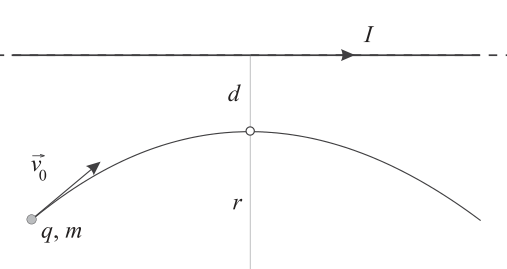 traiettoria particella carica verso filo
Topic: Magnetism, Circuits Metodi: Biot-Savart Law, Lorentz Force Analysis, Conservation of Energy Competenze: Diagrammatic Reasoning, Mathematical Modeling, Physical Reasoning Objects: Point Charge, Wire Fonte: Testo (PDF) — p.9 Soluzione: Soluzioni (PDF)
p3 Particle loaded to a wire The Commission shall adopt implementing acts in accordance with Article 10 of this Regulation. A particle for which is launched at speed towards the a straight, continuous copper wire running in the direction indicated, and describes the The trajectory shown in the figure in a plane containing the wire is considered negligible. In the punto più vicino al filo, a distanza da questo, la traiettoria ha raggio di curvatura .
- What’s the sign of the charge on the particle?
- What is the speed modulation in The closest point to the wire?
- What is the current flowing In the thread?
- Knowing that the power dissipated by the wire per unit length is , determine the radius of the wire.
*trajectory of the particle loaded towards the wire *
Topic: Magnetism, Circuits Metodi: Biot-Savart Law, Lorentz Force Analysis, Conservation of Energy Competenze: Diagrammatic Reasoning, Mathematical Modeling, Physical Reasoning Objects: Point Charge, Wire Fonte: Testo (PDF) — p.9 Soluzione: Soluzioni (PDF)
p4 Massa e molla al soffitto Punti 20 Un corpo di massa è appeso al soffitto tramite una molla ideale di costante elastica . Il sistema è in quiete, nella sua configurazione di equilibrio.
- Esprimere l’allungamento della molla in questa configurazione iniziale in funzione di , e dell’accelerazione di gravità . Il corpo viene urtato elasticamente da un corpo di uguale massa lanciato verticalmente dal basso. Sia la velocità di questo corpo al momento dell’urto. Si trascurino tutti gli attriti e si supponga che non avvengano altri urti tra i due corpi.
- Esprimere in termini di , , e l’allungamento massimo della molla nel moto del corpo che è stato urtato.
- Calcolare i valori numerici di e se , , . Si supponga ora che il corpo di massa sia costituito da due parti di massa e . Il sistema è tornato nella sua configurazione di equilibrio ed è in quiete. In un certo istante la parte di massa si stacca, e la parte rimanente inizia perciò ad oscillare.
- Per quali valori del rapporto la molla risulterà compressa, rispetto alla sua lunghezza di riposo, in alcune fasi della sua oscillazione?
Topic: Oscillations & Waves, Conservation of Momentum, Newtonian Mechanics Metodi: Simple Harmonic Motion Analysis, Conservation of Momentum, Hooke’s Law Competenze: Mathematical Modeling, Physical Reasoning, Diagrammatic Reasoning Objects: Spring, Block Fonte: Testo (PDF) — p.9 Soluzione: Soluzioni (PDF)
p4 Mass and spray on the ceiling The Commission shall adopt implementing acts in accordance with Article 21 of this Regulation. A mass body is suspended from the ceiling by an ideal spring of constant elasticity . The system It’s quiet, in its equilibrium configuration.
- Express the extension of the spring in this initial configuration as a function of , and the gravity acceleration. The body is elastically impacted by a body of equal mass thrown vertically from below. Sia la The velocity of this body at the time of impact. Let all the friction be ignored and let it not happen Another collision between the two bodies.
- Express in terms of , , and the maximum length of the spring in body motion which is I was hit.
- Calculate the numerical values of and if , , . Assume now that the mass body consists of two parts of mass and . The system is back. It’s in its equilibrium configuration and it’s still. At a certain moment the mass part is disconnected, and the The remaining part starts to oscillate.
- For which values of the ratio the spring will be compressed, relative to its resting length, in Some of the phases of its oscillation?
Topic: Oscillations & Waves, Conservation of Momentum, Newtonian Mechanics Metodi: Simple Harmonic Motion Analysis, Conservation of Momentum, Hooke’s Law Competenze: Mathematical Modeling, Physical Reasoning, Diagrammatic Reasoning Objects: Spring, Block Fonte: Testo (PDF) — p.9 Soluzione: Soluzioni (PDF)