p1 Rimbalzi di due palline Punti 15 Una sbarretta sottile di lunghezza è fissata a un motore che la fa ruotare a velocità costante in un piano verticale attorno al suo centro, posto a un’altezza appena superiore a rispetto al pavimento. Due palline identiche, di massa molto minore della massa della sbarretta e raggio trascurabile, poste a un’altezza sul pavimento, vengono lasciate cadere insieme da ferme all’istante mentre la sbarretta, ruotando, si trova disposta verticalmente come mostrato nella parte sinistra della figura. Fissando opportunamente la velocità del motore, si vuole fare in modo che le due palline urtino elasticamente due punti della sbarretta a distanza trascurabile dalle due estremità, mentre questa è orizzontale, avendo compiuto un quarto di giro, come nella parte destra della figura. Dopo l’urto con la sbarretta, questa viene fermata dopo un altro quarto di giro e le due palline cadono sul pavimento in tempi successivi, in modo completamente anelastico. In tutto il problema si trascuri l’effetto dell’attrito con l’aria.
- Detto l’intervallo di tempo dal rilascio delle palline all’urto con la sbarretta, si determini in funzione di .
- Dato che, subito prima dell’urto, la pallina A e l’estremo sinistro della sbarretta si muovono nella stessa direzione e verso, affinché l’urto avvenga è necessario che la velocità della pallina sia maggiore di quella dell’estremo della sbarretta. Si dimostri che questa condizione è verificata.
- Determinare, in termini di , le velocità delle palline subito dopo l’urto con la sbarretta.
- Calcolare gli istanti di tempo e in cui le palline toccano il pavimento, in funzione di .
- Si mostri, calcolandone il valore, che nel sistema di riferimento della pallina A la velocità dell’altra pallina è costante fino alla prima collisione e, successivamente, è ancora costante fino all’urto di A con il pavimento. Assumendo come unità di misura sui due assi le quantità e , si tracci il grafico, in funzione del tempo, della posizione della pallina B, nel riferimento della pallina A, fino all’istante in cui questa cade sul pavimento.
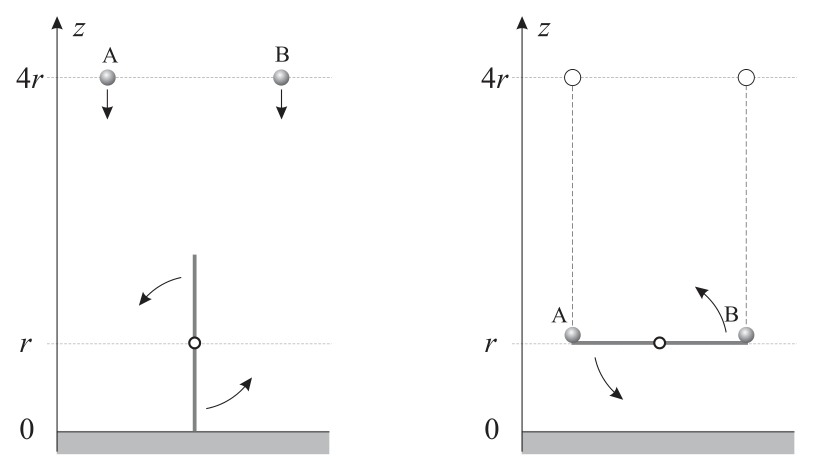 due palline rimbalzanti su sbarretta rotante
Topic: Newtonian Mechanics, Conservation of Momentum, Rotational Dynamics Metodi: Kinematic Equations, Conservation of Momentum, Impulse-Momentum Theorem, Free-Body Diagram Competenze: Mathematical Modeling, Physical Reasoning, Diagrammatic Reasoning Objects: Rod, Ball Fonte: Testo (PDF) — p.2 Soluzione: Soluzioni (PDF)
p1 Rebound of two balls The Commission shall adopt implementing acts in accordance with Article 15 of this Regulation. A thin rod of length is attached to an engine that makes it rotate at constant speed in the A vertical plane around its centre, at a height of slightly above the floor. Two identical balls, of a mass much less than the mass of the bar and a negligible beam, placed at a height on the floor, are dropped together by adjacent stands while the bar, rotating, it is positioned vertically as shown in the left side of the figure. By setting the engine speed appropriately, you want to make sure that the two balls hit elastically The barrel shall be made of two points at a negligible distance from each end, while the barrel is horizontal, having I’ve done a quarter of a turn, like the right side of the figure. After the barrel hit, this one comes The balls are dropped on the floor at a later time, so that the balls are dropped on the ground. It’s completely ring-shaped. The whole problem is neglected by the effect of air friction.
- Detto l’intervallo di tempo dal rilascio delle palline all’urto con la sbarretta, si determini in funzione di .
- Since, just before the impact, ball A and the far left of the barrel move in the same direction and direction, for the impact to occur the speed of the ball must be greater than that of the ball The end of the bar. It is shown that this condition has occurred.
- Determine, in terms of , the ball speeds immediately after the impact with the bar.
- Calculate the times and in which the balls touch the floor, according to .
- It is shown by calculating its value that in the ball reference system A the velocity of the other ball is It is constant until the first collision and then it is still constant until A hits the floor. Assuming the quantities and as the two axes, the time-scale graph of the the position of ball B in the reference of ball A, up to the point at which it falls to the floor.
two bouncing balls on the rotating bar
Topic: Newtonian Mechanics, Conservation of Momentum, Rotational Dynamics Metodi: Kinematic Equations, Conservation of Momentum, Impulse-Momentum Theorem, Free-Body Diagram Competenze: Mathematical Modeling, Physical Reasoning, Diagrammatic Reasoning Objects: Rod, Ball Fonte: Testo (PDF) — p.2 Soluzione: Soluzioni (PDF)
p2 Circuito capacitivo Punti 15 Il circuito schematizzato in figura è in condizioni stazionarie, dopo che la rete di condensatori – tutti inizialmente scarichi – è stata collegata al generatore di f.e.m. , chiudendo l’interruttore A, mentre l’interruttore B è mantenuto aperto. Calcolare:
- la capacità equivalente del circuito tra i terminali del generatore e l’energia totale immagazzinata nei condensatori;
- la carica accumulata in ogni condensatore;
- la differenza di potenziale tra le armature di ogni condensatore. Dati del problema: , , , , . Mantenendo chiuso l’interruttore A, l’interruttore B viene ora chiuso, cortocircuitando così il condensatore .
- Calcolare la variazione di energia immagazzinata nei condensatori, indicando se questa è diminuita o aumentata rispetto a prima e giustificando la risposta.
- Quanta carica viene erogata dal generatore dopo la chiusura dell’interruttore B?
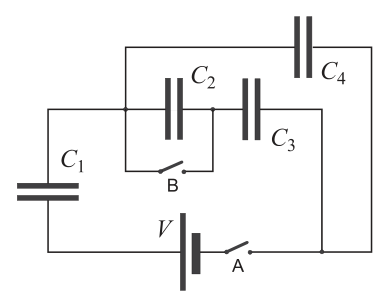 circuito con quattro condensatori e interruttori
Topic: Electrostatics, Circuits, Conservation of Energy Metodi: Equivalent Circuit Reduction, Electric Potential Method, Conservation Laws Competenze: Mathematical Modeling, Physical Reasoning, Diagrammatic Reasoning Objects: Capacitor, Switch, Battery Fonte: Testo (PDF) — p.3 Soluzione: Soluzioni (PDF)
p2 Capacitive circuit The Commission shall adopt implementing acts in accordance with Article 15 of this Regulation. The circuit shown in the figure is in stationary condition, after the network of capacitors all initially discharged has been connected to the f.e.m. generator. , by closing The switch A, while the switch B is kept open. Calculate:
- the equivalent capacity of the circuit between the generator terminals and the total energy stored in the capacitors;
- the accumulated charge in each capacitor;
- the difference in the potential between the frames of each capacitor. Dati del problema: , , , , . By keeping the A switch closed, the B switch is now closed, thus shorting the capacitor.
- Calculate the change in energy stored in capacitors, indicating whether it has decreased or increased compared to before and justifying the response.
- How much charge is delivered by the generator after the switch B is closed?
circuit with four capacitors and switches
Topic: Electrostatics, Circuits, Conservation of Energy Metodi: Equivalent Circuit Reduction, Electric Potential Method, Conservation Laws Competenze: Mathematical Modeling, Physical Reasoning, Diagrammatic Reasoning Objects: Capacitor, Switch, Battery Fonte: Testo (PDF) — p.3 Soluzione: Soluzioni (PDF)
p3 Un cono di vetro illuminato Punti 15 Un cono di vetro perfettamente trasparente, di indice di rifrazione e raggio di base , ha la sezione assiale a forma di triangolo equilatero. Il cono è tenuto su un piano orizzontale come mostrato in figura, con l’asse verticale e il vertice V a contatto del piano. Una sorgente monocromatica luminosa, posta sopra il cono a grande distanza, illumina il cono e il piano con un fascio uniforme di raggi verticali paralleli; di conseguenza l’irradianza (potenza incidente per unità di superficie) su ogni piano che interseca ortogonalmente il fascio è uniforme e vale .
- Dimostrare che un raggio che incide sulla base del cono a distanza dal suo asse arriva sul piano a distanza dal vertice V del cono.
- Si dimostri che l’irradianza dovuta ai soli raggi che incidono sulla base del cono è uniforme sul cerchio del piano di centro V e raggio .
- Considerando i punti P e Q del piano prossimi alla circonferenza di raggio centrata sul vertice del cono, determinare il rapporto tra l’irradianza nei due punti: .
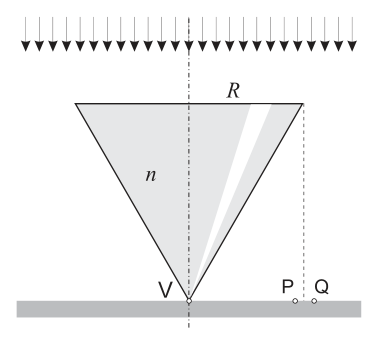 cono di vetro con raggi luminosi incidenti
Topic: Geometric Optics Metodi: Ray Tracing, Snell’s Law, Symmetry Argument Competenze: Diagrammatic Reasoning, Mathematical Modeling, Physical Reasoning Objects: — Fonte: Testo (PDF) — p.3 Soluzione: Soluzioni (PDF)
p3 A glass cone illuminated The Commission shall adopt implementing acts in accordance with Article 15 of this Regulation. A perfectly transparent glass cone, of an index of rifrazione e raggio di base , ha la sezione assiale in the shape of an equilateral triangle. The cone is held on a horizontal plane as shown in the figure. with the vertical axis and the V-vertical contact plane. A fountain a light monochrome, placed over the cone at a great distance, illuminates the cone and plane with a uniform beam of vertical rays paralleli; di conseguenza l’irradianza (potenza incidente per unità The beam is at the same level as the beam on the surface. uniform and is .
- Demonstrate that a beam impacting the base of the cone from its axis reaches the plane from the top V of the cone.
- The radiance due to the rays alone that affect the base of the cone is shown to be uniform on the circle of the cone. The centre plane V and radius .
- Whereas the P and Q points of the plane are close to the radius circumference centred on the top of the cone, determine the ratio of the irradiance in the two points: .
glass cone with incident light rays
Topic: Geometric Optics Metodi: Ray Tracing, Snell’s Law, Symmetry Argument Competenze: Diagrammatic Reasoning, Mathematical Modeling, Physical Reasoning Objects: — Fonte: Testo (PDF) — p.3 Soluzione: Soluzioni (PDF)
p4 Segnali dal cielo Punti 15 Un paracadutista usa un dispositivo per determinare la sua velocità di discesa e la quota dal suolo a cui si trova, per poter determinare il momento in cui aprire il paracadute. Il dispositivo emette due segnali acustici – a distanza di tempo l’uno dall’altro pari a – che vengono riflessi dal suolo; i segnali riflessi vengono captati da un ricevitore inserito nel dispositivo stesso. Durante una prova, il paracadutista si lancia e, non appena raggiunge una velocità costante, accende il dispositivo e, per ciascun segnale, registra rispettivamente i seguenti intervalli di tempo tra emissione e ricezione: e . Si suggerisce di denominare con i quattro istanti consecutivi di emissione e ricezione dei segnali.
- Esprimere, in termini delle grandezze date, l’intervallo tra i segnali ricevuti e calcolarne il valore.
- Supponendo che la velocità del suono sia , a quale velocità si sta muovendo il paracadutista?
- Quale sarebbe l’intervallo di tempo tra emissione e ricezione di un terzo segnale emesso dopo un tempo dal secondo?
- A che altezza dal suolo si trovava il paracadutista nell’istante in cui è stato inviato il primo segnale? Materiale elaborato dal Gruppo NOTA BENE: È possibile utilizzare, riprodurre, distribuire, comunicare al pubblico questo materiale alle due seguenti condizioni: citare la fonte; non usare il materiale, nemmeno parzialmente, per fini commerciali.
Topic: Oscillations & Waves, Newtonian Mechanics Metodi: Kinematic Equations, Physical Modeling, Wave Equation Competenze: Physical Reasoning, Mathematical Modeling Objects: — Fonte: Testo (PDF) — p.4 Soluzione: Soluzioni (PDF)
p4 Signals from the sky The Commission shall adopt implementing acts in accordance with Article 15 of this Regulation. A parachute uses a device to determine its descent speed and altitude from the ground to the So we can determine when to open the parachute. The device emits two Sound signals at a time distance from each other equal to reflected from the ground; signals The reflections are captured by a receiver embedded in the device itself. During a test, the parachutist launches and, as soon as he reaches a constant speed, turns on the the device and, for each signal, record the following time intervals between emission and reception respectively: e . It is suggested to name the four consecutive instances of signal emission and reception.
- Express, in terms of given quantities, the range between the received signals and calculate their value.
- Assuming the speed of sound is , at what speed is the parachute moving?
- What would be the time interval between the issuance and receipt of a third signal issued after a time From the second?
- How high from the ground was the parachutist the moment the first signal was sent? Material prepared by the Group Good note: You can use, reproduce, distribute, communicate this material to the public under the following two conditions: the source is given; not to use the material, even partially, for commercial purposes.
Topic: Oscillations & Waves, Newtonian Mechanics Metodi: Kinematic Equations, Physical Modeling, Wave Equation Competenze: Physical Reasoning, Mathematical Modeling Objects: — Fonte: Testo (PDF) — p.4 Soluzione: Soluzioni (PDF)