q1 La luce irradiata dal Sole impiega un intervallo di tempo = 8.32 minuti per percorrere 1 au (Unità Astronomica, che rappresenta approssimativamente la distanza media tra la Terra e il Sole). • In quanti minuti la luce emessa dal Sole raggiunge l’orbita di Giove? Si consideri che il periodo di rivoluzione di Giove è = 11.9 anni e si trattino come circolari sia l’orbita di Giove che l’orbita della Terra.
Topic: Astrophysics, Gravitation Metodi: Kepler’s Laws, Kinematic Equations Competenze: Mathematical Modeling, Physical Reasoning Objects: Star, Planet Fonte: Testo (PDF) — p.2 Soluzione: Soluzioni (PDF)
q1 The light radiated by the Sun takes a time interval = 8.32 minutes to travel 1 AU (Unit) Astronomy, which roughly represents the average distance between Earth and the Sun). • In how many minutes does the sun’s light reach Jupiter’s orbit? Consider that the period of revolution of Jupiter is = 11.9 years and treat it as circular and the orbit of Jupiter is Jupiter is orbiting the Earth.
Topic: Astrophysics, Gravitation Metodi: Kepler’s Laws, Kinematic Equations Competenze: Mathematical Modeling, Physical Reasoning Objects: Star, Planet Fonte: Testo (PDF) — p.2 Soluzione: Soluzioni (PDF)
q2 Dal fondale di uno stagno profondo 1.8 m viene emessa una bolla di un gas, il cui volume è . La temperatura superficiale dello stagno è di , e decresce linearmente con la profondità, con un gradiente termico . • Determinare il volume della bolla una volta giunta in superficie, assumendo che la bolla sia sempre in equilibrio termico con l’acqua, trascurando la variazione di densità dell’acqua con la temperatura e considerando il gas come perfetto.
Topic: Thermodynamics, Fluid Mechanics Metodi: Ideal Gas Law, Hydrostatic Equilibrium Competenze: Mathematical Modeling, Physical Reasoning Objects: Bubble, Gas Fonte: Testo (PDF) — p.2 Soluzione: Soluzioni (PDF)
q2 From the bottom of a pond 1.8 m deep, a gas bubble is emitted, the volume of which is . The surface temperature of the pond is , and decreases linearly with depth, with a heat gradient . • Determine the volume of the bubble once it reaches the surface, assuming that the bubble is always in thermal equilibrium with water, ignoring the change in water density with temperature and considering the The gas is perfect.
Topic: Thermodynamics, Fluid Mechanics Metodi: Ideal Gas Law, Hydrostatic Equilibrium Competenze: Mathematical Modeling, Physical Reasoning Objects: Bubble, Gas Fonte: Testo (PDF) — p.2 Soluzione: Soluzioni (PDF)
q3 Due solenoidi coassiali, di raggio rispettivamente e , con = 4 cm, e uguale lunghezza molto maggiore del raggio, sono inseriti uno completamente nell’altro; sono realizzati con filo uguale e hanno lo stesso numero di spire per unità di lunghezza ; sono collegati in parallelo e alimentati da una corrente totale = 3 A. • Se le correnti scorrono nei solenoidi in verso discorde, quanto vale il modulo del campo magnetico nel punto centrale del sistema dei due solenoidi?
Topic: Magnetism, Circuits Metodi: Ampère’s Law, Kirchhoff’s Laws Competenze: Mathematical Modeling, Diagrammatic Reasoning Objects: Solenoid, Wire Fonte: Testo (PDF) — p.2 Soluzione: Soluzioni (PDF)
q3 Two coaxial solenoids, of a radius and respectively, with = 4 cm, and very equal length The two are made of the same thread and have a the same number of spires per unit length ; they are connected in parallel and powered a total current of = 3 A. • If the currents are flowing in the solenoids in opposite directions, what is the magnetic field modulus at the point The central system of the two solenoids?
Topic: Magnetism, Circuits Metodi: Ampère’s Law, Kirchhoff’s Laws Competenze: Mathematical Modeling, Diagrammatic Reasoning Objects: Solenoid, Wire Fonte: Testo (PDF) — p.2 Soluzione: Soluzioni (PDF)
q4 Un sistema ottico è formato da due lenti sottili convergenti disposte come in figura. La prima lente ha una focale di 20 cm e la seconda di 10 cm. Le lenti sono distanti 30 cm una dall’altra. Un oggetto è posto a 40 cm dalla prima lente. • Dove si forma l’immagine dell’oggetto prodotta dal sistema di lenti?
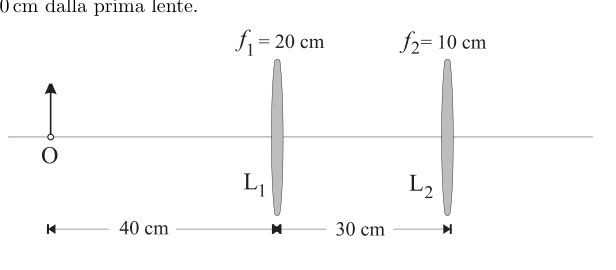 sistema ottico due lenti convergenti
Topic: Geometric Optics Metodi: Thin Lens & Mirror Equation, Ray Tracing Competenze: Mathematical Modeling, Diagrammatic Reasoning Objects: Lens Fonte: Testo (PDF) — p.3 Soluzione: Soluzioni (PDF)
q4 An optical system consists of two thin, convergent lenses arranged as shown in the figure. The first lens It has a focal length of 20 cm and a second focal length of 10 cm. The lenses are 30 cm apart. An object It’s placed 40 centimeters from the first lens. • Where is the image of the object produced by the lens system formed?
optical system two converging lenses
Topic: Geometric Optics Metodi: Thin Lens & Mirror Equation, Ray Tracing Competenze: Mathematical Modeling, Diagrammatic Reasoning Objects: Lens Fonte: Testo (PDF) — p.3 Soluzione: Soluzioni (PDF)
q5 Un’auto della polizia si sta muovendo a 90 km/h su una strada rettilinea; la sirena posta sul tetto emette un suono bitonale alternato a 622 e 466 Hz. Il suono giunge a due ricevitori, P e Q, posti sul bordo della strada, come mostrato in figura. • Assumendo che la velocità del suono in aria sia , qual è la distanza minima fra P e Q affinché il suono più basso giunga in fase ai ricevitori?
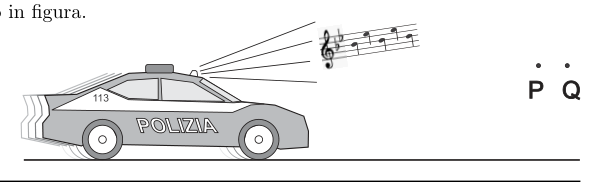 auto polizia con sirena e ricevitori P Q
Topic: Oscillations & Waves Metodi: Wave Equation, Superposition Principle, Physical Modeling Competenze: Physical Reasoning, Mathematical Modeling Objects: — Fonte: Testo (PDF) — p.3 Soluzione: Soluzioni (PDF)
q5 A police car is moving at 90 km/h on a straight road; the siren on the roof It emits an alternate bitonal sound at 622 and 466 Hz. The sound reaches two receivers, P and Q, placed on the the side of the road, as shown in the figure. • Assuming that the speed of sound in the air is , which is the minimum distance between P and Q so that the Does the lower sound reach the receiver?
Police car with siren and P Q*
Topic: Oscillations & Waves Metodi: Wave Equation, Superposition Principle, Physical Modeling Competenze: Physical Reasoning, Mathematical Modeling Objects: — Fonte: Testo (PDF) — p.3 Soluzione: Soluzioni (PDF)
q6 Una pallina di dimensioni trascurabili e di massa = 100 g è attaccata a un filo ideale e sta ruotando con attrito trascurabile su un piano orizzontale con velocità angolare . Il filo passa attraverso un piccolo foro praticato nel piano e viene tirato fino a che il raggio della traiettoria della pallina non viene dimezzato. • Quanto vale la velocità angolare in questa nuova configurazione?
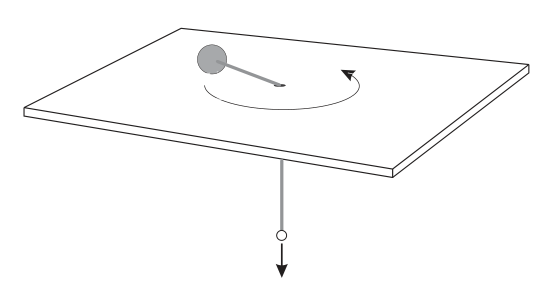 pallina su filo che ruota su piano
Topic: Newtonian Mechanics, Rotational Dynamics Metodi: Torque & Angular Momentum Analysis, Conservation Laws Competenze: Mathematical Modeling, Physical Reasoning Objects: Ball, String Fonte: Testo (PDF) — p.3 Soluzione: Soluzioni (PDF)
q6 A ball of negligible size and of a mass = 100 g is attached to a Ideal wire and it ‘s spinning with friction It’s not visible on a horizontal plane with speed. angolare . The wire goes through a small The hole is drilled into the plane and is pulled until The ball’s trajectory radius does not come halfway. • What is the angular velocity in this new configuration?
wire ball that rotates flat
Topic: Newtonian Mechanics, Rotational Dynamics Metodi: Torque & Angular Momentum Analysis, Conservation Laws Competenze: Mathematical Modeling, Physical Reasoning Objects: Ball, String Fonte: Testo (PDF) — p.3 Soluzione: Soluzioni (PDF)
q7 Un sistema costituito da 0.5 mol di gas perfetto si trova inizialmente in uno stato caratterizzato da una pressione e un volume . Il sistema subisce un’espansione quasistatica in cui la pressione diminuisce linearmente all’aumentare del volume fino a ridursi a un terzo del valore iniziale quando il volume è raddoppiato. • Calcolare la temperatura massima toccata dal gas in questa trasformazione.
Topic: Thermodynamics Metodi: Ideal Gas Law, Calculus-Integration Competenze: Mathematical Modeling, Physical Reasoning Objects: Gas Fonte: Testo (PDF) — p.3 Soluzione: Soluzioni (PDF)
q7 A system consisting of 0.5 mol of perfect gas is initially in a state characterized by a pressure and a volume . The system is experiencing a quasi-static expansion in where the pressure decreases linearly as the volume increases until it falls to one third of the value The initial value is doubled. • Calculate the maximum temperature affected by the gas in this transformation.
Topic: Thermodynamics Metodi: Ideal Gas Law, Calculus-Integration Competenze: Mathematical Modeling, Physical Reasoning Objects: Gas Fonte: Testo (PDF) — p.3 Soluzione: Soluzioni (PDF)
q8 Un foglio rigido di cartone, di spessore trascurabile, largo = 50 cm e alto = 80 cm è appoggiato sul lato più corto a una parete liscia. Si osserva che il foglio sta in equilibrio senza scivolare sul pavimento solo se l’angolo tra il piano del foglio e il pavimento è maggiore di (v. figura). La densità superficiale del cartone è . • Determinare il coefficiente d’attrito statico tra il cartone e il pavimento.
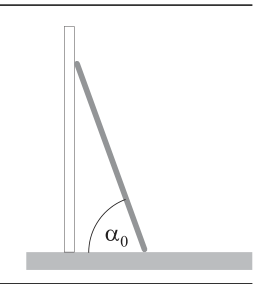 cartone appoggiato al muro angolo alpha0
Topic: Rigid Body Statics Metodi: Free-Body Diagram, Torque & Angular Momentum Analysis, Vector Decomposition Competenze: Diagrammatic Reasoning, Mathematical Modeling Objects: — Fonte: Testo (PDF) — p.3 Soluzione: Soluzioni (PDF)
q8 Un foglio rigido di cartone, di spessore trascurabile, largo = 50 cm e alto = 80 cm è appoggiato sul lato più corto a una parete liscia. Si Observe that the sheet is in balance without slipping on the floor alone If the angle between the sheet plane and the floor is greater than (see paragraphs 1 and 2) The Commission has not yet adopted a proposal. The surface density of the cardboard is . • Determine the coefficient of static friction between the cardboard and the floor.
board supported to the wall at the alpha0 angle
Topic: Rigid Body Statics Metodi: Free-Body Diagram, Torque & Angular Momentum Analysis, Vector Decomposition Competenze: Diagrammatic Reasoning, Mathematical Modeling Objects: — Fonte: Testo (PDF) — p.3 Soluzione: Soluzioni (PDF)
q9 Un disco di plastica di diametro e spessore ha strisce di metallo posizionate uniformemente sul suo bordo. Ciascuna striscia porta una carica elettrica e il disco viene fatto ruotare intorno al suo asse compiendo rivoluzioni al secondo. • Calcolare l’intensità di corrente attraverso un semipiano che ha per origine l’asse del disco.
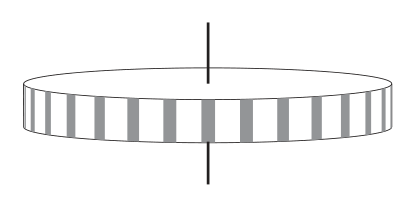 disco plastica con strisce metalliche
Topic: Electrostatics, Electromagnetism Metodi: Physical Modeling, Coulomb’s Law Competenze: Mathematical Modeling, Physical Reasoning Objects: Disk Fonte: Testo (PDF) — p.4 Soluzione: Soluzioni (PDF)
q9 A plastic disc of diameter and thickness has Metal strips uniformly placed on its surface I’m on the edge. Each strip carries an electrical charge and the disk is rotated around its axis by revolutions at the second. • Calculate the current intensity through a semiplane that The origin of the disk axis.
plastic disc with metal strips
Topic: Electrostatics, Electromagnetism Metodi: Physical Modeling, Coulomb’s Law Competenze: Mathematical Modeling, Physical Reasoning Objects: Disk Fonte: Testo (PDF) — p.4 Soluzione: Soluzioni (PDF)
q10 Un canale ha una larghezza di 8.5 m. In una giornata invernale, la pioggia scende uniformemente con un’intensità costante di 9.1 mm/h. Si ricorda che, detto il volume d’acqua che cade su un’area in un intervallo di tempo , l’intensità è . Si supponga che la situazione sia di regime stazionario. • Se attraverso una sezione del canale la portata è , qual è la portata 3.2 km più a valle?
Topic: Fluid Mechanics Metodi: Continuity Equation, Physical Modeling Competenze: Mathematical Modeling, Physical Reasoning Objects: — Fonte: Testo (PDF) — p.4 Soluzione: Soluzioni (PDF)
q10 A channel is 8 and a half meters wide. On a winter day, the rain falls evenly with a constant intensity of 9.1 mm/h. It is recalled that, say the volume of water falling on the a area over a time interval , the intensity is . Suppose the situation is stationary. • If the range across a section of the channel is , what is the range 3.2 km downstream?
Topic: Fluid Mechanics Metodi: Continuity Equation, Physical Modeling Competenze: Mathematical Modeling, Physical Reasoning Objects: — Fonte: Testo (PDF) — p.4 Soluzione: Soluzioni (PDF)